
Jonathan Chait's Blog, page 49
June 7, 2011
Republicans Adapt To the Ryan Blunder
How are Republicans responding to the unpopularity of the Medicare plan in their budget? Phase one is for anybody not already committed to the plan to slowly, slowly edge toward the door:
Pawlenty congratulated himself on Tuesday for speaking bold truths. “I promised to level with the American people,” he said. “To look them in the eye. And tell them the truth.” Here’s a truth: The biggest fiscal threat to the country is the exploding growth of health care costs, especially through Medicare. Pawlenty’s speech did not mention the word “Medicare” a single time.
It will be interesting to see if Republicans let this stand. Pawlenty's plan involves staggeringly high tax cuts -- will that be enough to get him off the hook for leaving health care untouched?
Phase two is for everybody already committed to vouchercare to try to get to the left of the Democrats:
Here is the most amazing example of this yet — a remarkable new ad from the NRCC that accuses Dem Rep. Jerry Costello of Illinois of supporting a “Democrat plan” that would “decimate” Medicare, “shred the social safety net,” and “leave seniors at risk”:
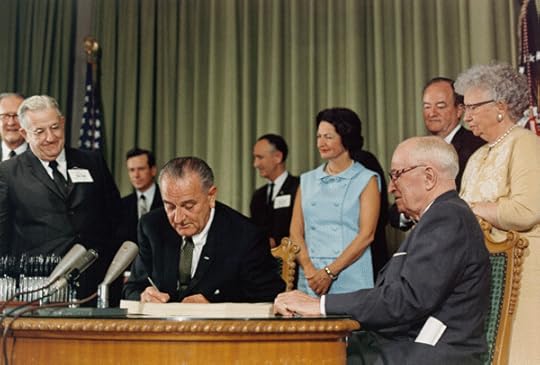
The final stage, I suspect, involves Paul Ryan speaking to the nation from Lyndon Johnson's ranch.


Pawlenty's Boring Radicalism
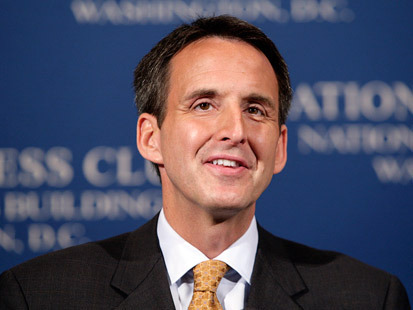
One consequence of the ongoing crazification of the Republican Party is that the standards have now adjusted such that a figure like Tim Pawlenty can propose an economic plan that's utterly bonkers and still be considered boring and mainstream. (Ezra Klein goes through the nutty assumptions, which revolve around the classic supply-side tropes of proposing massive tax cuts, assuming unprecedented long-term growth, and waving away any fiscal ramifications.)
I'll add that Pawlenty's tax plan is more radical than even his critics think. Pawlenty proposes to collapse the tax code into two brackets, 10% and 25%. How little revenue is that?
The 1986 Tax Reform Act created two tax brackets, 15% and 28%. That tax system raised not nearly enough revenue to fund the government, and the next two presidents had to raise taxes in order to get the spiraling deficit under control. Pawlenty would have even lower rates. What's more, Reagan's tax reform eliminated preferential treatment for capital gains and dividends, taxing them at the same rate as other kinds of income. Pawlenty would eliminate taxes on that form of income altogether, opening up massive loopholes and providing a huge windfall to the affluent.
Ramesh Ponnuru shrugs at this part of the plan:
I like that Pawlenty would radically reduce the overtaxation of savings and investment. The capital-gains tax, the estate tax, the interest-income tax, and the dividend tax would all be gone. We’d basically have a consumption tax.
Actually, this isn't a consumption tax. A consumption tax makes you pay on any income you consume. So, under a consumption tax, Paris Hilton wouldn't pay anything when she sells her family stock, but she would pay some kind of tax when she starts buying cars and tiny, precious dogs.
Pawlenty's plan has no mechanism for taxing consumption. All it does is take the income tax and eliminate all the taxes on income from capital. That makes it a wage tax. The difference is crucial, because many economists believe a consumption tax could be more efficient than an income tax, they believe the opposite of a wage tax:
A consumption tax that exempts old assets is just a tax on future wages. And the same studies that show that a consumption tax (which taxes all old capital assets) is more efficient than an income tax also show that a wage tax is less efficient than an income tax-because not taxing capital requires higher tax rates on wages to raise the same revenue and hence distorts people’s work decisions more.
So this is just your basic supply-side pixie dust plan, sprinkling massive windfall gains on the rich, not bothering to make the numbers add up and assuming implausibly high economic benefits will result. The interesting thing is that Pawlenty's version of voodoo economics is more radical than George Bush's 2000 version of voodoo economics, which was in turn more radical than Bob Dole's 1996 version of voodoo economics, which was itself totally nuts.
David Brooks Needs To Read Burke, Or Kenneth Arrow
David Brooks channels the argument Paul Ryan has been making -- that the health care debate comes down to limiting cost inflation through either bureaucratic rationing (boo!) or markets (yay!). Brooks says that Ryan's method of privatizing health insurance works:
They also note that the Medicare prescription drug benefit also uses a competition model. Consumers have been adept at negotiating a complex marketplace, and costs are 41 percent below expectations.
This is another one of the things that Ryan says that is totally misleading. Edwin Park explains:
This claim does not withstand scrutiny. The two primary factors driving the reduction in Medicare Part D spending were:
The sharp decline in growth in spending for prescription drugs throughout the U.S. health care system. In the late 1990s and early 2000s, prescription drug spending grew rapidly, reflecting the availability of new “blockbuster” drugs, rising prices for existing drugs, and greater utilization by beneficiaries. Drug spending growth began to moderate unexpectedly and then slowed more significantly around the time the Medicare prescription drug benefit took effect in 2006. But this was not caused by enactment of the drug legislation, as is evidenced by the fact that growth in spending on pharmaceuticals slowed throughout the health care system. This slowing of expenditure growth was the result of other developments, including some major drugs going off-patent, fewer new blockbuster drugs coming to market, and much greater usage of lower-cost generic drugs. Indeed, overall U.S. prescription drug spending was about 35 percent lower in 2010 than had been projected back in 2003. As the Medicare Trustees noted in their recent annual reports, these system-wide drug cost trends have been key factors in reducing Medicare Part D spending below the levels projected when the Medicare drug benefit was enacted.
Lower-than-expected enrollment in Medicare Part D. On average, about 93 percent of Medicare Part B beneficiaries were expected to enroll in the Medicare drug benefit (or receive employer-sponsored retiree drug coverage subsidized by Medicare) during its first eight years. CBO now estimates, however, that only about 77 percent of Part B beneficiaries enrolled in Part D or subsidized retiree coverage in 2010. That means roughly 6.5 million fewer beneficiaries were enrolled in Medicare Part D last year than originally projected, causing costs to be substantially lower than CBO originally assumed.
Moreover, there is evidence that, far from reducing costs, the use of private plans to deliver the Medicare drug benefit has increased costs. Prior to the creation of Medicare Part D, Medicaid provided prescription drug coverage to “dual eligibles” — the low-income beneficiaries enrolled in both Medicare and Medicaid. Then, starting in 2006, Medicaretook over drug coverage for the dual eligibles. When Congress enacted the Medicare drug benefit, it assumed that the private insurance companies that would participate in Medicare Part D would be able to negotiate larger discounts from drug manufacturers than those required under Medicaid. In fact, however, research shows that the private insurers offering Part D coverage are getting significantly smaller discounts for drugs than the rebates that manufacturers are required to provide state Medicaid programs. One estimate found that drug prices, net of discounts, under Part D to be at least 20 percent higher than the estimated net prices that Medicaid pays.
Right, again -- Medicare Part D costs 20% more than regular Medicare. Which is not surprising at all. Health insurance is inherently rife with market failure. The largest factor for any insurer is always going to be avoiding sick customers. Introducing private insurers layers just layers on a private bureaucracy engaged in cost-shifting. The experience of Medicare Part D does not vindicate Ryan's theory, it undercuts it.
Brooks argues that neither Obama's bureaucratic approach nor Ryan's free market approach has been tried, and therefore we can't know which one will work, except -- hint, hint -- top-down bureaucracy always fails. And it's true that nothing exactly like either what Obama has proposed nor what Ryan has proposed has ever existed. But, as Jonathan Cohn notes in his excellent response to Brooks, we did have something pretty close to what Ryan envisions before Medicare existed:
As Princeton economist Uwe Reinhardt wrote in his Times some week ago, the Republican plan would likely "shift an ever-larger share of the total health spending on Medicare beneficiaries from the books of government to the household budgets of these beneficiaries."
Perhaps it goes without saying, but this would almost surely put decent health insurance beyond the reach of many seniors. If you want to game this out, the most likely outcome of the Republican proposal is that private insurers would start offering radically scaled back benefit plans in order to cater to the market of moderately low-income seniors. They'd end up with the equivalent of junk insurance, or something close to it, and facing huge medical bills that forced them either to skip care or undergo severe financial hardship. This is basically the situation that existed in the 1950s and 1960s, before Medicare came along.
That was a really free market solution. It didn't work at all! So we created Medicare.
Meanwhile, we do use some form of what Brooks would describe as heavy-handed government bureaucracy in every other advanced country. And every other advanced country spends far less on health care than we do, and they're so happy with their systems that even conservatives support them wholeheartedly.
Again, Obama's plan isn't exactly like any particular foreign country's system. But it does move us in the direction of more government influence, and given that every other advanced country has both more government control and more cost-effective health care, this does seem like a reason to believe it might work.
Indeed, for a Burkean like Brooks, you would think that the international comparison might put some weight on the value of government involvement, wouldn't it? When every other advanced country has government-directed universal health care and it works better than ours, is putting all our chips on a radical market-based plan really the Burkean way to approach the problem?
Romney Death Watch
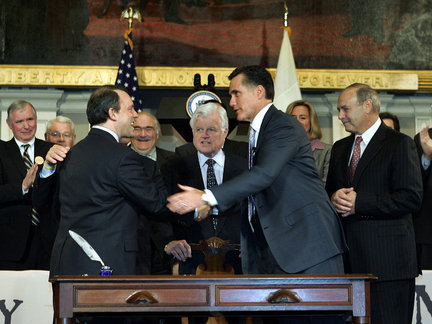
Yet another conservative group out to defeat him:
Anti-tax organization Club for Growth – declared foe of government spenders and ‘establishment’ Republicans -- has released its policy white paper on former Massachusetts Gov. Mitt Romney, offering a bleak assessment of the perceived GOP frontrunner’s record on taxes and regulation.
The group’s report takes Romney to task for his “unshakeable reputation as a flip-flopper,” with Club for Growth president Chris Chocola concluding that the organization has “serious concerns over his governing philosophy.”
“To this day, Romney supports big government solutions to health care and opposes pro-growth tax code reform – positions that are simply opposite to those supported by true economic conservatives,” the report reads.
Also, Republicans hate his health care plan:
The Massachusetts health-care plan enacted under Romney remains a potentially serious problem in the former governor’s bid. By nearly 2 to 1, Republicans oppose the plan, with strong detractors far outnumbering solid supporters. But there is some potential for him to frame the matter: Almost four in 10 Republicans expressed no opinion about the state’s program.
The Post presents the fact that 40% of Republicans have no opinion of Romney's plan as positive evidence for him. Still time to spin them! I believe it suggests the opposite. Romney still clings to decent support because a lot of Republicans don't know that he's the father of national health care reform. Given that the plan violates party dogma, is being attacked relentlessly by conservatives (Sarah Palin and Rudy Giuliani are the latest to go after it), and Romney doesn't want to defend it anymore (as evidenced by his failure to mention it in his announcement), what do you think is going to happen when those Republicans learn about Romneycare from Fox News, talk radio or another trusted news source? Is it going to make them more friendly toward Romney, or is it going to make them hate him? Another way to ask this is, do you think the Republicans who haven't yet heard about Romneycare are somehow more disposed to favor it than the Republicans who have? To me, the question answers itself.
Obama Lied, Paul Ryan Cried, The Economy Died
The new line on the right is that the economy is now swooning because President Obama criticized Paul Ryan. Here's Michael Barone:
On April 13 Obama delivered a ballyhooed speech at George Washington University. ...
The man depicted as pragmatic and free of ideological cant indulged in cheap political rhetoric, accusing Republicans, including House Budget Committee Chairman Paul Ryan who was in the audience, of pushing old ladies in wheelchairs down the hill and starving autistic children.
The signal was clear. Obama had already ignored his own deficit reduction commission in preparing his annual budget, which was later rejected 97-0 in the Senate. Now he was signaling that the time for governing was over and that he was entering campaign mode 19 months before the November 2012 election. People took notice, especially those people who decide whether to hire or not. Goldman Sachs's Current Activity Indicator stood at 4.2 percent in March. In April -- in the middle of which came Obama's GW speech -- it was 1.6 percent. For May it is 1 percent.
And here, via Nexis, is Bill Kristol on Fox News Sunday:
Two months ago, the economy's prospects looked better and President Obama's political prospects looked better. Then he gave that speech on April 13th. It was at Georgetown, where he demagogically attacked the Paul Ryan budget and basically started employing the "Mediscare" tactics.
I don't think it's an accident that the people have lost confidence in the last two months. I actually think it's hurt him politically.
Remember earlier this year he was going to compromise with Republicans, he was getting serious about the debt, he was pivoting to the center? I think that April 13 speech could be a moment where people look back and say, he went for a short-term political benefit, but hurt his prospects next year and hurt the economy.
David Frum rebuts:
I would myself lay much more emphasis on economic factors like: (i) the continuing destruction of American consumer wealth as housing prices deflate; (ii) the burden of rising oil prices; (iii) the collective decision of American consumers to increase their saving by 6 points of personal income – a laudable decision, but one that subtracts a lot of demand from the economy.
But if I were a believer in the business confidence theory, here’s the counter-question I’d put to Michael Barone:
Which is more likely to subtract from business confidence: a lame speech by the president – or a highly credible and sustained threat by the majority party in the House of Representatives to force a default on the debts, contracts, and other obligations of the United States?
Stan Collender thinks the economic consequences of the debt ceiling hostage fight are already occurring.
JONATHAN CHAIT >>
June 6, 2011
Is Paul Ryan Running?
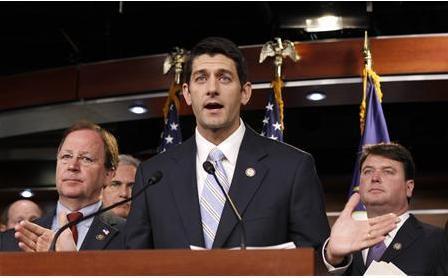
In the face of what seems like obvious steps by Paul Ryan to at least generate interest in a presidential campaign, I've been utterly baffled by the lack of general media interest in the possibility that he might run. Can somebody tell me why I'm wrong? Okay -- you there, Jay Newton-Small from Time, with your post entitled "Why Paul Ryan Isn't Running For President." Here we go:
Generally, Ryan replies that he’s flattered but happy where he is. He talks about his young children and how his father and grandfather both died young of heart disease. Ryan, as a teen, was the one who discovered his father’s body. And while the Wisconsin congressman is doing everything in his power to avoid that fate – including leading daily morning exercise classes on Capitol Hill – he can’t be sure. There’s a reason, he says, that he’s not in leadership: He prefers spending weekends with his kids rather than crisscrossing the country fundraising and stumping for candidates, as leaders are expected to do.
He doesn't want to run because he wants to keep his exercise regimen? He does know that the current president is an exercise fanatic, as was the president before him, right?
Let's continue:
And, finally, Ryan says he’s “a policy guy who has to be a politician for the policy,” as he told me last year. He’s happy being Budget Committee chairman – and just look at the waves he’s managed to make there – burying himself with wonky spreadsheets and think tank white papers, dreaming of one day becoming chairman of the powerful tax writing Ways & Means Committee. To a deficit hawk like Ryan, that seat is the pinnacle of power, perhaps even more so than the Oval Office. After all, constitutionally, the House is the branch of government responsible for taxing and spending — not the White House.
Okay, unrelated point first: Stop calling Ryan a "deficit hawk." He voted for all of Bush's tax cuts. He voted for all the wars. He voted for Bush's Medicare prescription drug bill. He voted against the deficit-reducing Affordable Care Act. He voted against the Bowles-Simpson plan. He opposes any deficit reduction plan that increases revenue. Ryan is anti-government but he is clearly not a deficit hawk.
Anyway, back to the main point. We're supposed to believe that Ryan doesn't want to be president because he's a humble spreadsheet wonk? The degree to which Ryan has gotten reporters to swallow his crafted public image is just shocking. And I agree that Ryan would love to head the Ways & Means Committee -- so he could hand out tax cuts for the rich, because he's not a deficit hawk -- but the notion that he believes that job has more power over the budget than president of the United States is just daft.
What's more, this notion that Ryan just cares too much about the federal budget to run for president has a bit of trouble explaining what he was doing delivering a foreign policy address. Budget Committee chairmen don't do that very often.
Newton-Small provides one more reason:
Almost everyone I know in Ryan’s circle laughs this off, repeating to me all the reasons above why Ryan’s not going to run. I can think of at least one more: the Democrats’ demagoguery of Ryan’s plans for Medicare. They would love Ryan to run for President if only so they could keep spreading their message that Ryan, along with all Republicans who don’t disavow his plan, want to kill Medicare as we know it. (In fact, Ryan does want to fundamentally change Medicare, though those over 55 would be grandfathered in.) That’s probably why it’s mostly Democrats who are seriously pushing the notion that Ryan is running.
Mostly Democrats? I don't know anyone left of center other than me who's argued that Ryan seems to be considering a run. But conservative magazines and blogs are on fire with the notion. Here's conservative pundit/"political analyst" Michael Barone describing his attempts to personally beg Ryan to run:
One question hung over the meeting, and was briefly mentioned by National Review editor Rich Lowry in his 20-minute colloquy with Ryan after the speech: Will Paul Ryan run for president? Before the talk began I asked Ryan if he had read Paul Rahe’s ricochet.com blogpost entitled “Paul Ryan: A Duty to Serve.” Ryan has said that one reason he is not interested in running for president is that he would have to spend time away from his family, including three young children. Rahe, referencing Jennifer Rubin’s reflections in her Washington Post Right Turn blog on how Navy sailors and officers spend months away from their families, argues that Ryan has a duty to serve. His final paragraph is pretty strong stuff...
After the speech and colloquy I handed Ryan a paper copy of Rahe’s post and urged him to read it. He said he would. My guess is that Paul Ryan is giving serious consideration to running for president, and that something like Paul Rahe’s call to duty rather than any crass political calculation is likely to persuade him to do so. I note that over at the Huffington Post Jon Ward seems to be drawing a similar conclusion.
For the record, neither Barone nor any of the other people described in his post are Democrats.
I don't dismiss the fact that Ryan's allies laugh off the presidential run talk. But there's a way this game is played. Denying interest is the norm. Hinting that you might run isn't. Statements and actions suggesting interest in a run therefore carry more weight than disavowals of interest. And Newton-Small's reasons why he absolutely, positively won't run seem very weak.
&c
-- Dean Baker: We could be on the verge of another Great Depression.
-- Kevin Drum also wants to know more about the Homosexual Activist-Dunkin Donuts Election Stealing caper alleged by Florida Republicans.
-- Jeff Goldberg has discovered Longfellow's original draft of "Paul Revere's Ride"
Paul Ryan's Exceptionalism

I thought the most obviously fraudulent part of Paul Ryan's foreign policy speech on Friday, was its attempt to sneakily invoke the myth that President Obama does not accept American exceptionalism (a myth based on truncating an Obama quote.) Daniel Drezner disagrees, pointing out this passage of Ryan's speech that I missed:
We cannot face these challenges alone. To the contrary, we need our allies and friends to increase their capacity and willingness to act in defense of our common interests.
The first step in that process is robust and frank engagement with our closest allies. We all share an interest in the maintenance of the international order with its liberal trading system, general tranquility, and abundant opportunity – and we should all share the burden of maintaining it.
The Obama administration has taken our allies for granted and accepted too willingly the decline of their capacity for international action. Our alliances were vital to our victory in the Cold War and they need to be revitalized to see us through the 21stcentury.
Note that in the boldest sentence, Ryan assails Obama both for being to hard on our allies and too soft on them. He takes their contributions for granted -- but he must demand they shoulder more of the military burden! As Drezner notes, the notion that Obama has "accepted too willingly" our allies refusal to shoulder military burdens obviously flies in the face of reality. (Hello -- Libya?)
Drezner amusingly imagines the Ryan Doctrine in action:
Basically, Ryan's definition of U.S. leadership amounts to "exerting pressure on our allies to take on greater defense expenditures." OK, but how will this conversation take place? Let's imagine this:
PRESIDENT RYAN: Hey, NATO allies -- to be robust and frank about it, you need to goose up your defense expenditures and assist us more vigorously.
NATO ALLIES: What's that? I'm sorry, I couldn't hear you over the protestors in the streets furious about the latest round of bailouts to Greece and Ireland, combined with the cuts in social services we need to make in a nod towards austerity. Hey, you're a big fan of that policy, right? What's that you want us to do again with our increasingly scarce capital in a politically hostile environment?
PRESIDENT RYAN: Uh, never mind, let me try our Japanese allies. Hey, Japan, we've been protecting you for decades, it's time to pony up and contribute your fair share.
JAPAN: I'm sorry, what was that? I couldn't hear you because we're selecting which old people will volunteer to help clean up the Fukushima reactor mess. Gee, this is not going to be cheap, and our debt-to-GDP ratio is already at 200%. You really harped on the debt problem during your campaign, so you know what we're talking about here. Now, what did you want us to do with our dwindling and rapidly agining population again?
PRESIDENT RYAN: Er... (to foreign policy advisors) are there any rich allies left?
Ryan's "robust and frank engagement" is really just one step removed from Donald Trump's claims that the right negotiator could get Saudia Arabia to lower oil prices or China to revalue the yuan. It's the foreign policy of Campaign Fantasyland.
Does Racism Hurt The GOP?
David Frum points out the obvious racial incitement on the Drudge report:
I've heard Republicans in private deplore the racial incitement that too often substitutes for conservative talk. But in public, who has a word to say when the popular home page of the DrudgeReport strings together local news headlines of college-student rowdiness over Memorial Day to create a (false, obviously) image of the Obama administration licensing a nationwide eruption of African-American anti-white violence?
UPDATE: MIAMI 'WAR ZONE' DURING URBAN WEEKEND ...
'I was scared for my life' ...
Poet 'Da Real One' Gunned Down In Front Of Miami Poetry Cafe ...
Violent crime explodes in Myrtle during Black Bike Week; 8-hour hell ...
Rib Fest At Rochester beach turns rowdy ...
Riot On Long Island ...
Urban Melee In Charlotte ...
Chaos causes DNC concern for convention ...
Unruly urban crowd shuts down Nashville water park ...
Emanuel shuts down packed Chicago beach; 'heat-related illnesses' ...
REPORT: 'Dozens of gang bangers' ...
TEEN GANGS UNLEASHED ON BOSTON BEACH
Obama cracks down on civil rights abuses by big-city police departments ...
Mainstream conservatives confine their criticism of racism in American life almost exclusively to anti-white racism or anti-black racism by people who are not members in good standing of the conservative movement. It's admirable to see Frum take this on, though I don't really consider him a member of the conservative movement in good standing himself.
But the odd thing is that Frum includes this important point within a tactical argument for why Republicans must not blow their chance to win the 2012 election. ("Obama could lose if -- and here's the big if -- Republicans do not blow the opportunity by presenting themselves as Medicare-annihilating racist maniacs.") Does Frum really think the incitement of white racial paranoia by conservatives who aren't on the Republican ticket actually hurts the party? Or is he couching his case in tactical terms because he doubts Republicans will buy it as a moral proposition?
A Medicare By Any Other Name
Paul Krugman wades into the debate over whether Republicans did indeed vote to end Medicare:
I’ll just quote the blogger Duncan Black, who summarizes this as saying that “when we replace the Marines with a pizza, we’ll call the pizza the Marines.” The point is that you can name the new program Medicare, but it’s an entirely different program — call it Vouchercare — that would offer nothing like the coverage that the elderly now receive. (Republicans get huffy when you call their plan a voucher scheme, but that’s exactly what it is.)
Medicare is a government-run insurance system that directly pays health-care providers. Vouchercare would cut checks to insurance companies instead. Specifically, the program would pay a fixed amount toward private health insurance — higher for the poor, lower for the rich, but not varying at all with the actual level of premiums. If you couldn’t afford a policy adequate for your needs, even with the voucher, that would be your problem.
I mostly, but not entirely, agree. There's a continuum here among potential changes to the program. At one end, you could argue that even small reforms constitute "ending Medicare." The Affordable Care Act tries to rationalize the incentives and payment structure of the system. I wouldn't call that "ending Medicare," but it certainly changes the program from one thing into something different. A more powerful version of the ACA reforms could more properly be called "ending Medicare" -- or, at least, bring us closer to the point where that label would be fair.
At the other end of the continuum, if you replaced Medicare with a program to give every retiree a bottle of aspirin and $10 off their next doctors' visit, that would be "ending Medicare," even if some right-wing think-tank shoved out a paper claiming that this would somehow lead to old people leading healthier lives.
In between, you have a gray area where you can legitimately debate whether a change constitutes ending Medicare. Now, I think the charge as applied to the GOP budget happens to be fair. But it's a matter of interpretation, not fact. Republicans have tried to get the news media to treat this claim as a falsehood, like death panels. It clearly is not that. But the Republican defense is also not a total absurdity along the lines of calling a pizza "the Marines." The Republicans have a plausible argument that their proposal does not mean ending Medicare. I don't buy the argument, but this is a proper matter of dispute, not a question where fact-checkers can provide us with a clear-cut answer.
Jonathan Chait's Blog
- Jonathan Chait's profile
- 35 followers

