
Jonathan Chait's Blog, page 123
January 28, 2011
Dick Morris's Latest Racket
 The greasy little charlatan is now trying to whip his marks into a frenzy over Rahm Emanuel:
Dear Friend,
Have we learned our lesson? Do we now know to nip aspiring, radical, charismatic Chicago politicians in the bud? We missed our chance once. Now a second chance is coming around again.
Rahm Emanuel – the most ruthless, aggressive, ambitious, radical, take-no-prisoners politician in America – is running for Mayor of Chicago. The bottom rung of his ladder. From there, it’s the Senate and then the White House. This time as the boss.
Let’s knock him off the bottom rung before he rises further. Stop him before his political career metastases.
If we don't stop Rahm now, he'll become president! So send money to Dick Morris today.
(If you haven't read Brad Plumer's great explication of how the Morris con works, you should so so right away.)


Watch The Change Not Happen
One of the things that happens when power shifts in Washington is that people expect far more change than actually occurs. New officeholders may talk loosely about change, but the underlying forces driving the status quo haven't changed, and neither will the policies.
Two New York Times stories published today illustrate this quite nicely. The first is about corporate tax reform. President Obama and some members of Congress have discussed reforming the corporate tax code, which has high nominal rates but enormous loopholes. The trouble is, people who benefit from the loopholes don't want to reform the system:
But recent efforts to rationalize the code all have failed, and some members of both parties express skepticism that this time will be different. The problem, in a nutshell, is that the popular step of lowering taxes for industries like trucking requires the unpopular step of raising taxes for industries like biotech.
The very idea is already drawing howls from the corporate sector.
Moreover, many of the individual exceptions that allow corporations to shield profits from taxation actually enjoy broad popularity, like tax breaks to support domestic manufacturing, low-income housing and green energy.
Guess what? The interest of the companies benefiting from loopholes outweighs the interest of the companies that would like lower rates. If nothing else, loss aversion will drive the loophole beneficiaries to lobby harder than non-beneficiaries. My prediction: nothing happens.
Meanwhile, you know how Tea Party candidates were talking about trimming wasteful defense spending? That isn't going to happen either:
To hear the Republican leadership tell it, the once-sacred Pentagon budget, protected by the party for generations, is suddenly on the table. But a closer look shows that even as Speaker John A. Boehner and Representative Eric Cantor, the House majority leader, insist on the need for military cuts, divisions have opened among Republicans about whether, and how much, to chop Pentagon spending that comes to more than a half trillion dollars a year. ...
So far, few Tea Party-backed members on the House Armed Services Committee have said specifically where they would cut. In public remarks at the hearing on Wednesday, several spoke up in favor of favorite military programs or of protecting military installations at home, illustrating the difficulty of balancing their overarching philosophy and goals with the immediate concerns of their districts.
Guess what? Wasteful defense spending exists because it creates jobs in somebody's congressional district. That hasn't changed. My prediction: very little happens.
January 26, 2011
Bachmann Or Ryan?
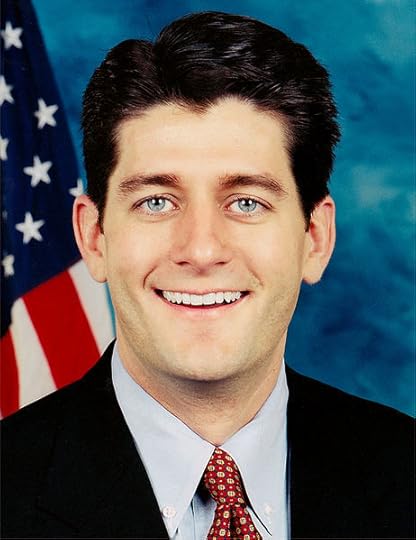
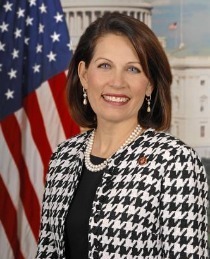
Paul Ryan and Michelle Bachmann each delivered responses to President Obama last night. They were eerily similar recitations of conservatives doggerel. Can you guess who said what? Answers in the comment section.
1. Debt
"Two years ago, when Barack Obama became our president, unemployment was 7.8 percent and our national debt stood at what seemed like a staggering $10.6 trillion dollars. We wondered whether the president would cut spending, reduce the deficit and implement real job-creating policies. Unfortunately, the president's strategy for recovery was to spend a trillion dollars on a failed stimulus program, fueled by borrowed money…Deficits were unacceptably high under President Bush, but they exploded under President Obama's direction, growing the national debt by an astounding $3.1 trillion.
"A few years ago, reducing spending was important. Today, it's imperative. Here's why: We face a crushing burden of debt. The debt will soon eclipse our entire economy and grow to catastrophic levels in the years ahead…Unfortunately, instead of restoring the fundamentals of economic growth, he engaged in a stimulus spending spree that not only failed to deliver on its promise to create jobs but also plunged us even deeper into debt.The facts are clear: Since taking office, President Obama has signed into law spending increases of nearly 25 percent for domestic government agencies – an 84 percent increase when you include the failed stimulus."
2. Unemployment
"There is no doubt the president came into office facing a severe fiscal and economic situation. Unfortunately, instead of restoring the fundamentals of economic growth, he engaged in a stimulus spending spree that not only failed to deliver on its promise to create jobs but also plunged us even deeper into debt…All of this new government spending was sold as "investment." Yet after two years, the unemployment rate remains above 9 percent and government has added over $3 trillion to our debt."
"The White House promised us that all the spending would keep unemployment under 8 percent. Well not only did that plan fail to deliver, but within three months the national jobless rate spiked to 9.4 percent. It hasn't been lower for 20 straight months. While the government grew, we lost more than 2 million jobs."
3. Size of government:
“The president and the Democratic leadership have shown, by their actions, that they believe government needs to increase its size and its reach, its price tag and its power.
Whether sold as "stimulus" or repackaged as "investment," their actions show they want a federal government that controls too much, taxes too much and spends too much in order to do too much.
And during the last two years, that is exactly what we have gotten – along with record deficits and debt – to the point where the president is now urging Congress to increase the debt limit.”
“Deficits were unacceptably high under President Bush, but they exploded under President Obama's direction, growing the national debt by an astounding $3.1 trillion. Well, what did we buy? Instead of a leaner, smarter government, we bought a bureaucracy that now tells us which light bulbs to buy, and which will put 16,500 IRS agents in charge of policing President Obama's health care bill."
4. Health Care
"Obamacare mandates and penalties may even force many job creators to just stop offering health insurance altogether, unless of course yours is one of the more-than-222 privileged companies or unions that has already received a government waiver under Obamacare. In the end, unless we fully repeal Obamacare, a nation that currently enjoys the world's finest health care might be forced to rely on government-run coverage. That could have a devastating impact on our national debt for even generations to come…[T]he president should repeal Obamacare and support free-market solutions, like medical malpractice reform and allowing all Americans to buy any healthcare policy they like anywhere in the United States."
"Then the president and his party made matters even worse, by creating a new open-ended health care entitlement.What we already know about the president's health care law is this: Costs are going up, premiums are rising and millions of people will lose the coverage they currently have. Job creation is being stifled by all of its taxes, penalties, mandates and fees.
Businesses and unions from around the country are asking the Obama administration for waivers from the mandates. Washington should not be in the business of picking winners and losers. The president mentioned the need for regulatory reform to ease the burden on American businesses. We agree – and we think his health care law would be a great place to start.
Last week, House Republicans voted for a full repeal of this law, as we pledged to do, and we will work to replace it with fiscally responsible, patient-centered reforms that actually reduce costs and expand coverage."
5. Rhetorical devices
"[European countries’] day of reckoning has arrived. Ours is around the corner. That is why we must act now.
Some people will back away from this challenge. But I see this challenge as an opportunity to rebuild what Lincoln called the "central ideas" of the republic."
"I believe that we are in the early days of a history-making turn in America…Our current debt crisis we face today is different, but we still need all of us to pull together. But we can do this. That's our hope. We will push forward. We will proclaim liberty throughout the land."
6. And summaries of their principles:
“We believe a renewed commitment to limited government will unshackle our economy and create millions of new jobs and opportunities for all people, of every background, to succeed and prosper. Under this approach, the spirit of initiative – not political clout – determines who succeeds…We need to reclaim our American system of limited government, low taxes, reasonable regulations and sound money, which has blessed us with unprecedented prosperity. And it has done more to help the poor than any other economic system ever designed. That's the real secret to job creation – not borrowing and spending more money in Washington. Limited government and free enterprise have helped make America the greatest nation on earth. These are not easy times, but America is an exceptional nation.”
“We need to start making things again in this country, and we can do that by reducing the tax and regulatory burdens on job creators…Because of you, Congress is responding and we are just starting to undo the damage that's been done the last few years. Because we believe in lower taxes. We believe in a limited view of government, and exceptionalism in America. And I believe that America is the indispensable nation of the world."
Career Advice Corner
Conor Friedersdorf probably does not have a future as a pulp romance novelist.
Harmonic Convergence
President Obama holds up the jersey of former University of Michigan Heisman Trophy winner Charles Woodson:
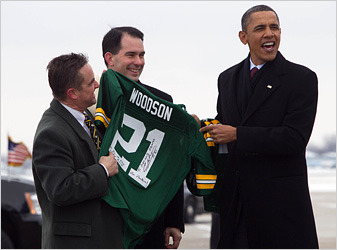
The man is obviously working very hard for my vote:

Mindlessness On Public Investment
I suspect that President Obama's emphasis on public investment reflects less a desire to increase spending on infrastructure, R&D and the like than a platform from which to oppose anticipated Republican cuts. He's attempting to distinguish federal spending that subsidizes consumption (like Medicaid or farm subsidies) from that which actually increases productivity and raises future living standards (such as air traffic controllers.) Thus far, as Steven Pearlstein points out, the GOP refuses to recognize any such distinction:
Asked about investment on the television talk shows Sunday, House Republican leader Eric Cantor (R-Va.) and Senate Republican leader Mitch McConnell (R-Ky.) each declared it was just another Democratic ploy to spend more money. Instead of Obama's "invest-and-grow," Republicans now offer "cut-and-grow," which will take its place beside "government ownership of the means of production" and "tax cuts that pay for themselves" in the Pantheon of Economic Nonsense.
Republicans, it turns out, have no public investment strategy, just as they have no health-care strategy and no agreed-upon blueprint for reducing federal spending. What they have are poll-tested talking points, economic delusions and an overwhelming partisan instinct to say "no" to anything Barack Obama proposes. In their response to the president's State of the Union message, they remind us once again that they are not serious about economic policy and not ready to govern.
For another good example of what he's talking about, take a look at today's Wall Street Journal editorial:
Government "investments"—Mr. Obama's favorite word last night—are by definition made for political purposes, rather than for their highest potential return. They are allocated by politics rather than by prices. In our view, that 4% of GDP a year could have contributed far more to economic recovery had it stayed in private hands.
But even if you believe that such spending prevented a depression, it makes no economic sense to keep those resources under political sway now that the recovery is underway. Would you rather have Congress allocating that 4% of GDP, or millions of individuals deciding among Apple, Gilead Sciences, or the next great idea?
The path back to faster growth, more jobs and a more competitive U.S. economy does not travel through more political mediation. Nor does it lie in endlessly easy Fed policy in a misguided attempt to refloat the housing bubble or revive the financial boom. A better economy requires policies that reward work and innovation, while letting capital flow to the companies and individuals with the best ideas.
Even the most committed libertarian will admit that there's such a thing as public goods. The free market is not going to provide roads and bridges. Almost any libertarian will soon concede that things like scientific research and education create positive externalities that will not be priced into the free market.
Now, the devil is in the details. Exactly how much public investment we need, and just how to provide it in a way that minimizes political interference, are important technocratic questions about which we can disagree intelligently. But if you assert that public investment is "by definition" inferior to private investment, then you're committed to ultra-ideological mindlessness that can't survive even the slightest scrutiny.
I Am Being Baited
Jennifer Rubin has an interview with Arthur Brooks and Pete Wehner about their new book. It's a combination that seems to have been created for the express purpose of spurring me to write a blog item -- indeed, so much so that when I first saw it I wondered if it was some kind of trap to bait me -- and they don't disappoint. Here's one highly entertaining exchange:
Public schools (if we are lucky) teach about democracy but students rarely get any instruction in economics, let alone a defense of free market capitalism. Why is the former is considered essential and instruction in capitalism is not, or worse, is considered inappropriately partisan?
That's a great question, and we're not sure we know the answer to it.
Yeah, why don't schools indoctrinate students in our point of view? Nothing partisan about that! In case you're wondering if by capitalism they mean a system of private property ownership -- that is, something supported by left and right alike -- they make it very clear that they do not mean this. They define capitalism as mutually exclusive with the liberal agenda. (This is the whole theme of Brooks' last book.) The first question:
Why the book - does capitalism need more defending?
It sure does. But in particular, we felt it needs a better moral defense than we typically see. In the aftermath of the financial crisis in 2008, capitalism as an economic system was under attack in ways that we hadn't seen in several generations.
So -- liberals are attacking capitalism, and schools should indoctrinate students in Ryan and Wehner's point of view. Come to think of it, why aren't students taught that lower marginal tax rates always lead to higher revenues? I'm pretty sure that's in the Constitution, too.
Return To The Obama Method
Probably the best wide-frame analysis of what President Obama was doing in his State of the Union address last night was written by Noam yesterday morning. If you haven't read it yet, Noam's column argues/reports that President Obama was engaged more in co-option of business than in actual substantive placation.
Obama's various moves over the last few weeks, including the speech, are a return to the political method that launched his career. I wrote a column in 2009 about the Obama method. It involves establishing your reasonableness by taking bad-faith objections at face value and creating a mechanism to work through them. You say you're concerned about excessive red tape? Okay, here's a commission to go through the regulatory code and weed out any rules that fail to pass the cost-benefit test. You're worried about high corporate tax rates? Okay, we can lower them as long as we replace the revenue by closing all the corporate tax loopholes. The deficit's too high? Okay, here's a spending freeze.
Obama is positioning himself for a clash with Republicans by attempting to delineate their objections and declare his willingness to meet him halfway. When their positions inevitably prove more extreme -- when they're looking not to reduce high statutory corporate tax rates or excessive regulation but to open new loopholes and gut essential consumer protections -- then he has the high ground to oppose them.
The method has its flaws, but it's worked pretty well and I can see why he wants to return to it.
Update: Ed Kilgore is thinking along similar lines.
January 25, 2011
Paul Ryan's Ideological Speech
A die-hard conservative would obviously prefer Paul Ryan's rebuttal over President Obama's State of the Union address. A die-hard liberal would prefer the reverse. There are more conservatives than liberals. However, as for moderates, it seems to me that the contrast between Obama's speech and Ryan's redounds overwhelmingly to Obama's benefit.
Obama framed every issue in specific terms -- here is a plan to improve education, here is a factory that is now growing due to my policy, here is a person who would suffer if we repeal health care reform. Ryan's speech existed almost entirely on the plane of abstraction. Obama's meta-theme was pitched straight at the center, while Ryan's was pure right-wing dogma.
I don't think these speeches matter much, and the response never beats the address, but I can't imagine the contrast helped Republicans.
Obama's Speech
The substance of Obama's speech was moderate liberalism -- we like business, but government has a role too, neither too much nor too little, etc. It's hard to attach that kind of case-by-case pragmatism to an overarching theme. But I do think Obama pulled it off pretty well. He took a fairly hackneyed idea -- the future -- and managed to weave it into issue after issue, from infrastructure to energy to deficits to education and even foreign policy.
I thought Obama explicated his idea about American unity better than he has in the past. The notion of unity has always sat in tension with the fierce ideological disagreement of American politics, and indeed the latter has served as a rebuke to the former. I thought Obama effectively communicated that the messiness of political debate is a part of what makes America great, to turn that into a source of pride. He simultaneouly placed himself both within and above the debate.
THE SOTU >>
Jonathan Chait's Blog
- Jonathan Chait's profile
- 35 followers

