Kory M. Shrum's Blog, page 40
January 14, 2014
The Reason for Paris
Bonjour à Paris!
I am not going to apologize for another delay in my posts. I will only say that in the time since I’ve last posted, I have traveled to Paris (in rather turbulent conditions) and I’ve been adjusting to the (beautiful and fabulous!) city. This post will be different than the last several posts, as it will be more personal in nature and less instructive. It may be a nice change of pace for you, for those who are tired of me telling you what to do—or it may be incredibly boring or downright melodramatic. Which is to say, I am rather self-conscious about this post, and would not be adverse to positive affirmations of any kind.
I came to Paris to write for a very specific reason. For the most part, I’ve been rather down in the last few months (years) and I’ve had to do some serious self-reflection (and I picked up shamanic drumming, which is a whole other story) these last few months in order to get myself to an okay place. Most writers are fickle creatures. So I know I am not alone here. We can throw ourselves on the floor and cry about some of the simplest things (no more coffee? The dog pooped on the carpet again? My favorite scarf has a chocolate smear on it? Mon Dieu! ) Personally, I feel that I vacillate between trop sensitivity to full-blown apathy.
As much as I wish I were a more consistent person, I’ve had to accept that in the Chinese element sense, I am more Wind and Water than Earth. At first I crash upon the rocks and then I smooth into a current again. It’s just my style.
But this first book, Dying for a Living is drowning me.
So I came to Paris to be a little less dead inside. I thought, if the most beautiful city in the world can’t inspire me to get my shit together (as an educated, white person in a privileged country—what do I have to cry about!), if it can’t spark that passion in me again—then I am probably a lost cause. But in the name of fairness, the little voice says, there is a reason why are you this way.Perhaps you aren’t dead at all, but just exhausted. After all, it is hard to sustain enthusiasm for something (a dream) that is entirely hypothetical (enough $$ to be a writer full-time).
Let me explain.
I, after a great deal of mental turmoil, committed to being writer in 2003. This is when I changed my major (again) from pre-med/psychology to English. And in that moment, I felt completely and incandescently happy with my decision. The turmoil was lifted. I’d reached the point when didn’t care what my friends/family thought of me anymore and shrugged off their expectations of me. It was perfect—and somehow I lost this magical feeling—but not all at once.
I then spent five years writing a bunch of crap. Jesse and Ally (leads from my forthcoming book) were there, but my work (3 really bad novel manuscripts and a ton of shorts and poetry that were teenage diary material, never to see the light of day) was far from publishable. But it didn’t matter. I was happy. I was having a good time. I blame this on the fact that from at 20-24 years old, I didn’t care as much about the direction my life was going.
Then in the summer of 2008, the idea for how to rewrite Jesse in just the right way came to me. I was on a hillside in Italy, in a state of delirium, dragging my bags up the side of a mountain (Cinque TerreBut then something changed.
Somewhere in the year of getting an agent, followed by the three years of remaining unpublished even though I’d written two more (pretty good) books, that ridiculous love and passion for writing had tapered off.
First it became just a day or two of not writing. Then longer. I started a lot of stories and a lot of novels that I couldn’t finish—all of it tapering off until I just stopped writing at all.
And I couldn’t quite figure out what had changed. I had some suspect variables: I’d finished grad school, where I’d completed an MA, then a MFA. An MFA is an incredibly supportive time in a writer’s life. The validation, encouragement and rich cultural/literary stimulation are great food—and that was gone. I suddenly started to care a great deal about the direction of my life and what the hell I was doing with it. I got a job as an adjunct writing instructor. Nothing like a job that overworks and underpays to destroy the best of you. After grading 80-100 essays, I had nothing left in me to put toward my own work. But I couldn’t notwork. I didn’t want to be a literalstarving artist.
And there was the fact that I was approaching thirty (for those of you much older than me, bear with me here. I know I sound like a whiny little snot). For a woman my age, there is a lot of pressure to be settled, popping out babies with a stable job right about now. Everyone is asking about these things. My dentist is asking about these things. And when I tell someone I’m writing—whew! The looks! The derision! And when they reluctantly ask what I’m writing (contemporary/ urban fantasy) and what I’ve published (nothing but 25-ish poems as of yet)—the replies get even icier.
And it struck a chord because it was sort of true. I didn’t have a published book—no validation for all of my efforts. I didn’t have children to blame for my slow progress. (I have a dog, who sleeps most of the day, and therefore, she isn’t a great alibi). So on the worst days, I felt like I had nothing to show for a whole lot of work. I felt like the whole world was right about this writing thing.
And even though I list out these factors and try to pinpoint which of these ultimately ruined me—I can’t say for certain. Except that perhaps, being wind and water, I’m terribly susceptible to the pressure around me.
So here I am. 30 years old in a Paris café, hoping to rekindle some of that unfettered joy that I had for writing at 20—just because that’s what I do. That’s what I am meant to do—despite living in a world that values money, progress and the material, rather than art and the conceptual. Do fall in love with the process of writing, not the outcome—some shit about the journey and not the destination, you know?And hopefully this trip will help me re-center myself. Better yet, help me to build those inner walls that are so necessary to protect an artist against the greater world.
Hopefully, I will find what I am looking for. Because right now Paris just seems like a bad idea--an extravagance that I can't really afford for a problem that only I (regardless of location) can solve
If you’ve experienced some flavor of this yourself, feel free to share your story with me. More importantly, how you got your mojo back. I'm looking for tips. Obviously, I am desperate enough to pack my bags, empty my account/face destitution, and fly to Paris--just to find the answer.
À Bientôt,
Kory
I am not going to apologize for another delay in my posts. I will only say that in the time since I’ve last posted, I have traveled to Paris (in rather turbulent conditions) and I’ve been adjusting to the (beautiful and fabulous!) city. This post will be different than the last several posts, as it will be more personal in nature and less instructive. It may be a nice change of pace for you, for those who are tired of me telling you what to do—or it may be incredibly boring or downright melodramatic. Which is to say, I am rather self-conscious about this post, and would not be adverse to positive affirmations of any kind.
I came to Paris to write for a very specific reason. For the most part, I’ve been rather down in the last few months (years) and I’ve had to do some serious self-reflection (and I picked up shamanic drumming, which is a whole other story) these last few months in order to get myself to an okay place. Most writers are fickle creatures. So I know I am not alone here. We can throw ourselves on the floor and cry about some of the simplest things (no more coffee? The dog pooped on the carpet again? My favorite scarf has a chocolate smear on it? Mon Dieu! ) Personally, I feel that I vacillate between trop sensitivity to full-blown apathy.
As much as I wish I were a more consistent person, I’ve had to accept that in the Chinese element sense, I am more Wind and Water than Earth. At first I crash upon the rocks and then I smooth into a current again. It’s just my style.
But this first book, Dying for a Living is drowning me.
So I came to Paris to be a little less dead inside. I thought, if the most beautiful city in the world can’t inspire me to get my shit together (as an educated, white person in a privileged country—what do I have to cry about!), if it can’t spark that passion in me again—then I am probably a lost cause. But in the name of fairness, the little voice says, there is a reason why are you this way.Perhaps you aren’t dead at all, but just exhausted. After all, it is hard to sustain enthusiasm for something (a dream) that is entirely hypothetical (enough $$ to be a writer full-time).
Let me explain.
I, after a great deal of mental turmoil, committed to being writer in 2003. This is when I changed my major (again) from pre-med/psychology to English. And in that moment, I felt completely and incandescently happy with my decision. The turmoil was lifted. I’d reached the point when didn’t care what my friends/family thought of me anymore and shrugged off their expectations of me. It was perfect—and somehow I lost this magical feeling—but not all at once.
I then spent five years writing a bunch of crap. Jesse and Ally (leads from my forthcoming book) were there, but my work (3 really bad novel manuscripts and a ton of shorts and poetry that were teenage diary material, never to see the light of day) was far from publishable. But it didn’t matter. I was happy. I was having a good time. I blame this on the fact that from at 20-24 years old, I didn’t care as much about the direction my life was going.
Then in the summer of 2008, the idea for how to rewrite Jesse in just the right way came to me. I was on a hillside in Italy, in a state of delirium, dragging my bags up the side of a mountain (Cinque TerreBut then something changed.
Somewhere in the year of getting an agent, followed by the three years of remaining unpublished even though I’d written two more (pretty good) books, that ridiculous love and passion for writing had tapered off.
First it became just a day or two of not writing. Then longer. I started a lot of stories and a lot of novels that I couldn’t finish—all of it tapering off until I just stopped writing at all.
And I couldn’t quite figure out what had changed. I had some suspect variables: I’d finished grad school, where I’d completed an MA, then a MFA. An MFA is an incredibly supportive time in a writer’s life. The validation, encouragement and rich cultural/literary stimulation are great food—and that was gone. I suddenly started to care a great deal about the direction of my life and what the hell I was doing with it. I got a job as an adjunct writing instructor. Nothing like a job that overworks and underpays to destroy the best of you. After grading 80-100 essays, I had nothing left in me to put toward my own work. But I couldn’t notwork. I didn’t want to be a literalstarving artist.
And there was the fact that I was approaching thirty (for those of you much older than me, bear with me here. I know I sound like a whiny little snot). For a woman my age, there is a lot of pressure to be settled, popping out babies with a stable job right about now. Everyone is asking about these things. My dentist is asking about these things. And when I tell someone I’m writing—whew! The looks! The derision! And when they reluctantly ask what I’m writing (contemporary/ urban fantasy) and what I’ve published (nothing but 25-ish poems as of yet)—the replies get even icier.
And it struck a chord because it was sort of true. I didn’t have a published book—no validation for all of my efforts. I didn’t have children to blame for my slow progress. (I have a dog, who sleeps most of the day, and therefore, she isn’t a great alibi). So on the worst days, I felt like I had nothing to show for a whole lot of work. I felt like the whole world was right about this writing thing.
And even though I list out these factors and try to pinpoint which of these ultimately ruined me—I can’t say for certain. Except that perhaps, being wind and water, I’m terribly susceptible to the pressure around me.
So here I am. 30 years old in a Paris café, hoping to rekindle some of that unfettered joy that I had for writing at 20—just because that’s what I do. That’s what I am meant to do—despite living in a world that values money, progress and the material, rather than art and the conceptual. Do fall in love with the process of writing, not the outcome—some shit about the journey and not the destination, you know?And hopefully this trip will help me re-center myself. Better yet, help me to build those inner walls that are so necessary to protect an artist against the greater world.
Hopefully, I will find what I am looking for. Because right now Paris just seems like a bad idea--an extravagance that I can't really afford for a problem that only I (regardless of location) can solve
If you’ve experienced some flavor of this yourself, feel free to share your story with me. More importantly, how you got your mojo back. I'm looking for tips. Obviously, I am desperate enough to pack my bags, empty my account/face destitution, and fly to Paris--just to find the answer.
À Bientôt,
Kory


January 5, 2014
How I Got My Agent, Step 5: The Finish Line
So like a modern avatar, you summoned the waters of publication and sent out wave after wave of query letters until an agent of choice washed up on your sandy shore.
You finally heard a version of the magic words: “I’d like to offer you representation.”
Congrats! Celebrate! You’re awesome! And then once you’ve burned off some of this…

…focus on the task at hand. First, you may want to read this . I wish I had. It does a pretty good job of answering all the questions you might have about this precarious step before committing to an agent.
And here is what I want to say on the matter from personal experience.
*Ask questions. When the matter of representation comes up, have your questions ready. It is OK (even expected) that you’ll ask questions. The questions should include anything that you are unsure about regarding the agent-client relationship. This might include:
*What percentage will (s)he take for commission? (15% for domestic rights and 20% for foreign rights is standard).
*Is (s)he only interested in this book or in representing all of your future work as well?
*If you write other work (i.e. poetry, screenwriting, etc.), does (s)he have an interest/the capacity to represent this work too?
*What are the rules regarding the “reimbursement of expenses”?
*If you write in multiple genres, do they have connections (and with who) in your other genres as well?
Not all of these questions may apply to you. That’s okay. The point is, you should be thinking about your writing in this way, and how your agent may serve you in the promotion of your work.
*Be professional. While it is true that this is the moment where most agents are wooing you instead of the other way around (finally!), that first call is still an “interview” of sorts. The agent is trying to get a feel for you as much as you are for him/her. And this is true long after you sign a contract. All of your communication should be professional regardless of how you might actually feel in the moment.
*Go with your gut.You should feel good about signing with your agent. If you do not like your agent or do not feel it is good match, then the relationship will be a difficult one. And believe me, the publishing world can be brutal. No need to wrestle with your own agent—someone who is supposed to be on your side when few others are. So be sure that you have the same vision for your work as they do. And that they have the resources and stamina to support you in your journey.
Lastly,
*Review the contract carefully. If your gut says, yes, the only thing standing between you and a celebratory booze-fest is a contract. If your agent sends you a contract to sign, this is normal (mine did). Just be sure to read it carefully. Make sure everything that you agreed to in the “ask questions” section holds true in writing. If you read something that doesn’t sit well, ask your agent about it. Usually the agent is capable of clarifying any confusion. However, I know a few writers who went ahead and paid a lawyer to review the contract on their behalf before signing. It’s your call how you’d like to handle it. The point is to double-check. Better safe than sorry.
So with all of the above out of the way, only one thing left to do—celebrate with the loved ones who helped to get you here:

Bonus Tip:
*Be prepared for revisions. It is not uncommon for you to submit something that you consider “done” to your agent (before or after signing) only to have it returned with pages and pages of corrections. And that is okay. It is their job to point out any weaknesses in the writing before they show it around to potential editors. So don’t be turned off by this request. It will likely happen often.
December 27, 2013
How I Got My Agent, Step 4: The Rat Race
First of all, I apologize for the 12 day delay between this post and the last. The holidays happened--what can I say? I can only assume that in the last week and a half you’ve been diligently researching agents, compiling your list and perfecting your query—while eating your weight in pumpkin pie and cranberry sauce.
Once your queries are in the wind a few things may happen:
False starts (“Bites”)
While I had flat out refusals, which are hard to misinterpret, I also had a few bites. These “bites” can be confusing as hell. What happens can vary but usually an agent will respond to your query favorably. They will usually compliment what they’ve seen so far and request more material.
Now, once they’ve requested more material a couple of things can happen:
--they can request morematerial (i.e. Thanks for sending the first 50 pages; send the rest)
--they can reject you
--they can never contact you again
These last two occurrences can be frustrating because you may not know why you’re being rejected. It can be like a great date that you thought was MAGICAL with singing bluebirds, prancing chipmunks, all ending in a two-hour makeout session--only to have him/her never call you again.
In the best case rejection scenario, the agent will offer feedback with the rejection. For example, a couple of bites expressed confusion regarding the world I created. So I did a few revisions and kept on submitting—and people stopped citing this as an issue.
The Neverending Story: Revise, Revise, Revise
Evaluate the rejections and see if there is any merit to the criticism. Sometimes it will simply be subjective/personal taste, and other times, the criticisms are spot on. You’ll have to distinguish between the two yourself—or ask your beta readers (those brave friends/family who read your book first) for insight.
If the agent rejecting you doesn’t offer feedback, feel free to ask. After all, what do you have to lose? Nothing, while the gain is far greater. After all, if you take the time to revise this “flaw”, then it is one less issue to put off the next agent.
No need to bring the train to a screeching halt—don’t withdraw your letters or notify the agents who have partials/etc. Just fix the problem once you agree there is one, and the next time someone asks for materials, send the revised copy. This is the best way to keep the process running smoothly, all while continuously improving your odds at quality representation.
Do:
--Revise. Submit.
--Revise. Submit.
--Revise. Submit.
Don’t:
--Make tiny avoidable errors*
--Show a lack of professionalism**
--Give up***
*Don’t make the mistake of submitting too much, too little, or in the wrong format. There was a reason why you diligently researched the agents. Put that knowledge to good use.
**Publishing is a business like any other. If someone makes you mad—or even directly slights you—that is no excuse to lose your sense of professionalism. No matter what you should be kind and courteous because a lot of people in publishing know each other. Watch what you say. A lot of “Thank you for your time and consideration” should be falling from your lips, regardless of what they had to say about your work.
***I’m going to say it again: This can take a long time. You will submit. Be rejected. Revise. Resubmit—it happens to the best of us. Yes, you might dream about sparklingly vampires one day, have an agent the next, and a three-book deal the day after—but that is really rare. If that happens, awesome! Give me a call! I’d love tips. If it doesn’t, settle in for the long haul and keep the faith.
You’ll get there. :)
December 15, 2013
How I Got My Agent, Step 3: Submit
For the last few days (weeks, months, years…) you’ve been researching agents and drafting your query letter. Good news! This is the moment when those efforts come together.Once you have a query letter that you feel ready to submit, here is what you do:
Make the list (of at least 50 agents)I know this seems long but trust me. You want a comprehensive list. Now, if your work is strong, and you’ve done your research properly, you won’t need most of these names. However, the publishing industry is large, and rejection is the norm. So I say start with 50 and if those run out, make another list of 50 more.
How to compile the list
After I did my research and noted all the agents that represented my kind of fiction, I ranked them based on what was most important to me: (did they represent writers I admired? Did they make big sells? Did their clients seem to like them? Were they respected, sought-after, etc.?) Once I was better informed, I created a spreadsheet that looked like this:
Rank
1 Agent
Peggy Sue Sell'emsPreferred contact
Email What they want
Query & Ch. 1 Check back-OK
Four weeks
You will complete your list based on your criteria. This may take some time. That’s okay. You may have to make tough choices like: “What is more important to me? That my agent makes six-figure sales all the time or that (s)he is very supportive/loved by their clients?” And for the really tough calls, you can double up. Why not? If the New York Times Bestseller List can have three #9s then so can you.
Another reason why this spreadsheet is important is because every agent will have their own preferences. Honor that and it improves the chances that you will get your foot in the door. Also, the “When is it OK to check back column” can have an actual date, if you like—letting you know when you can politely contact the agent and ask if they managed to read your query yet. It IS okay to check-in, but only after the amount of time they’ve specified.
I liked to send my letters in batches of ten. If you send all 50 at once, you run the risk that #48 will contact you before #2 has had a chance to read your letter. By doing it in sets of 10, you have a better chance of getting the agent you really want, and you’ll both be happier for it. After all, there must be a reason why you ranked them higher, right? If you really want your 1-10th choice, then be willing to wait for an answer. In case no one told you, I will. Publishing is a really slow process. Agents may not get back to you for 1-2 months and for good reason. Agents have a lot of other commitments.* And even once you have your agent, be prepared to wait some more. Editors are even busier.
Don’ts
-Don’t send an imperfect query, synopsis, manuscript
-Don’t contact them ANY OTHER WAY except how they want to be contacted
-Don’t check back too early or harass them. You may twitter stalk them in the privacy of your own home, but don’t admit to it in polite company and DON’T talk to them directly.
-Don’t get mad/lose faith/cry/binge eat when your queried agents tweet about watching television or having drinks with friends. They are not intentionally ignoring your query or hating on you. They are just trying to live balanced lives. No matter what their tweets suggest, they are working really hard. I promise.
-Don’t send more than 10-15 queries at a time. (For reasons stated above)
-Don’t be unprepared for the next step. When the agent(s) finally contact you, be ready. If they want more materials, have them ready. If they offer representation, have your questions ready. YOU SHOULD HAVE QUESTIONS—you are entering into a business contract with someone after all. Through all of it, be professional. Be courteous. Be patient.
And just to make sure you are, that is where we are going next. How I Got My Agent, Step 4: The Rat Race.
*I can write a post about this if you want. Just show a little interest.
December 11, 2013
How I Got My Agent, Step 2: The Query Letter
If you are reading this post, you have probably heard of a query letter. But because there is so much information out there regarding query letters, you may not have a clear picture in your mind as what EXACTLY a query letter is.
It could be anything from a piece of paper soaked in your own blood, promising your first unborn child, or a magical unicorn, on which you will ride into your dream agent's office before galloping into the sky together to begin your long and fruitful union.
Hopefully, I can clear up any misconceptions that you may have about these obscure letters that at best, pave the way to Jaguar convertibles and your face of the cover of Time, and worst, condemn you to a penniless life in your mother's basement where you live primarily on Spaghetti-Os and ramen.
So let's begin:
What it is:
*a short letter of introduction to publishers or potential agents
*your calling card
*an advertisement of your product (A.K.A. your book)
What it is NOT:
*longer than a page
*an opportunity to use as many “big” words as possible
*a place to ramble or confess secrets
SAMPLE QUERY—YES, THE ACTUAL ONE THAT GOT ME AN AGENT
Dear______:
Jesse Sullivan dies for a living. As a Necronite, she is one of the population's 2% who can literally die in place of another person without disrupting the precarious universal order. This talent makes her quite the American commodity. However, in Death and Taxes, quirky and sarcastic heroine Jesse dreams of a life unencumbered by lucrative replacement deaths. A girl can only wake up on her back so many times before she wonders what life is really about.
She cannot get health insurance because of her high risk profession. Religious zealots persecute Jesse and her fellow Necronites as soulless "zombies." Not to mention all of her friends are just as strange as she is: morticians, comic book collectors and crackpot psychics. This is the family she made along the way and with one terrible decision, may lose forever. Before writing Death and Taxes, my work has appeared in several journals: North American Review, The Florida Review, Zone 3 and others. I received the Rachel Maddox Award for Creative writingin 2005 and earned a Master's in Creative Writing in 2007 and an MFA in Creative Writing in 2010. Currently, I work as copy editor for a small press New Issues, and I teach freshman composition. Death and Taxes was written last fall, just after my return from a teaching assignment in Prague, where I was lucky enough to spend a quiet summer in one of the most beautifully charming European cities.
Please find pasted below the first five pages. The full manuscript has been workshopped by other writers, is clean, and ready for your enjoyment. I look forward to your response.
Thank you for your time.
Best,
Kory M. Shrum
Explanation of What You Just Read:
Ignoring the terribleness of my original title (Death and Taxes), let me explain to you the format I followed when constructing my letter. I followed the format I read from many magazines/articles that claimed to have the correct formula, and apparently, they must have.
Paragraph 1: The hook. You want to hook to draw the agent in the same way you would draw readers in. It should be as intriguing and interesting as possible.
Paragraph 2: The conflict. Personally, I think this is the weakest part of my letter, but you can do better! This is where you establish what your character has to lose and the conflict/trouble driving your book. It should serve to deepen your potential agent’s interest in the material.
Paragraph 3: Biography. If you have any writing qualifications or publication history, this is where you place it. If you don’t, try to think of other ways you can emphasize your developing talents (i.e. I charge all the neighborhood kids a nickel to edit their papers, and bygone, they all make As!) Also, try to make yourself seem more interesting than you really are (I think I overdid it with the Prague mention. A bit pretentious, don’t you think?) But whatever it takes! Present yourself as a writer who takes writing seriously.
Paragraph 4: The pitch. As far as paragraphs go, this is a tiny one. In fact, mine is only three lines. I specified what was included, why it was awesome, and what I expected to happen. Keep it simple.
Final thoughts
Of course you should also include the address/header material (date, names, etc.) as in any formal letter.
If your query “sticks”, you might want to have the following ready:
A brief synopsis of your novel (500 words)
First 50 pages polished and ready to send—but really the WHOLE book should be ready.
It is not uncommon for agents/publishers, upon liking your query, to request more. Be ready to give it to them. It varies, of course, between 10 pages or 50 pages, the first three chapters, whole manuscript, a synopsis, etc. But as long as your manuscript is polished and you have a 500 word synopsis on hand, you should have little problem fulfilling these requests, whatever they are.
So as you ready your letter and materials, let us see how your research is going. NEXT: Step 3—Submit
December 9, 2013
How I Got My Agent: Step 1
In January 2009, I initiated the rite of passage that all ambitious writers must endure at one time or another; I began my search for a literary agent.
It took me a year to land the lovely, Ginger Clark of Curtis Brown, who I signed with in early 2010. As you can imagine, the previous year was long, daunting, and full of frustrations. However, I hope this “How I Got My Agent” series will consolidate my copious trials and errors into a few simple steps for those of you ready to brave the agent pool yourself.
So let’s begin:
Step One: The Research
Consider purchasing or borrowing Jeff Herman’s Guide (mine was the 2008 edition). This guide was excellent because it listed hundreds of publishers, presses, and agents. There are even articles in the back that offer helpful tips for people at this stage in the game. In my edition, 150+ pages were devoted just to articles that covered everything from how to “Write the Perfect Query Letter” to “7 Ingredients for Successful Publishing”.
Okay, okay—you only want to know about the agents. This is where it gets better.
200+ pages are devoted to listing available agents. But it isn’t JUST a list of agents. Each “profile” includes the agency information as well as an interview with a particular agent from that agency.
For example, under the Donald Maass Literary Agency (as in Donald Maass, author of Writing the Breakout Novel, a MUST read), the agents Stephen Barbara and Cameron McClure were interviewed. In just over two pages you learn, their DOBs, career history, personal stories, hobbies/interests, subjects/categories they love to represent, what they do if/when they are not agenting, best way to contact them, their pet peeves/common pitching mistakes, what they are looking for in a client, how to improve your odds with that particular agent, titles they’ve sold, and much more.
So why is this awesome? Because as you start searching for agents, you’ll realize how incredibly “dehumanizing” the internet can be when you are trying to get to know someone. It is hard to see if you “click” with someone who lives hundreds of miles away and that you’ve never seen or spoken to—and so these interviews, written by the agents themselves, can feel really personal in a sea of by-reputation-only faces.
Another great resource to consider is Publishers Marketplace . Just select the genre that you write and BAM! A list.
Like the Herman Guide, you are given vital information about the agents: description of the agent, how long they’ve been at it, what they represent, leading clients, most recent sales/projects, and how they want to be contacted (IMPORTANT!).
In addition to the Herman Guide and Publishers Marketplace, you can always try good, old-fashioned and omnipresent Google. I just googled “urban fantasy agent”, and it took me straight to a Writer’s Digest list—so this technique seems legit enough.
3 things to watch out for:
--Real agents do not charge fees or advertise
--You should recognize the names of authors/publishers they've worked with
--It is a good sign if they are a member of AAR
As you read profiles, take notes as you go. What you are looking to do here is to create a working list of agents that you are interested in contacting. And that is exactly what we will talk about next in Step2: The Query Letter
December 5, 2013
Paperback cover
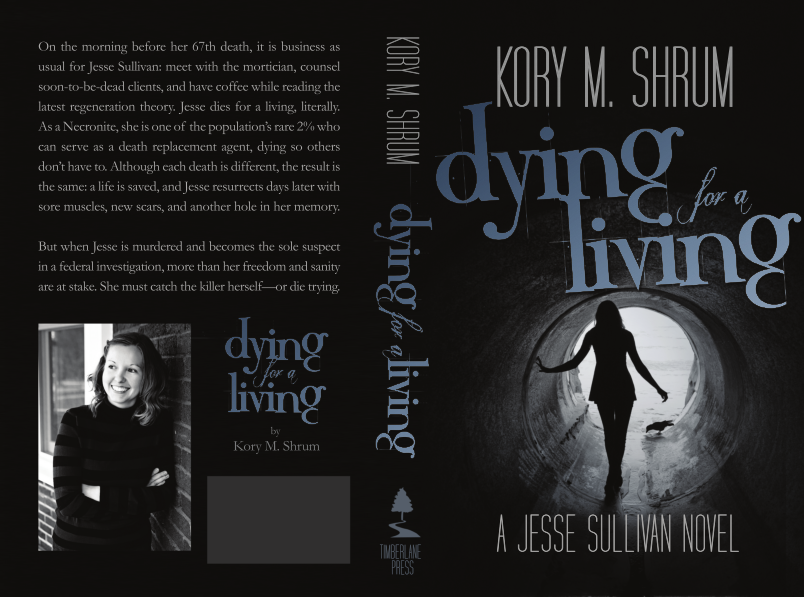 Paperback cover for Dying for a Living
I'm super excited about this cover. John K. Addis is making changes to the colors, however, because the proofs we received turned out to be a little darker than expected. And that weird little square by my picture is for the barcode.
It was so much fun working with John, and all for the price of a couple of bottles of booze and some Chinese food! How lucky am I to know so many talented, creative people?
I am a little worried because now the printed-page count has breached 400, which makes for a thick book, even though the novel is just a little over 80,000 words. And the sequel is 100,000 words! YIKES!
So what does everyone think? Eye-catching? Intriguing? Aren't you wondering what is going on with the bird and the tunnel? Are you feeling the urge to read it and find out?
Please share your thoughts. :)
Kory
November 9, 2013
BCB revision
Thank you to the lovely Katie Richie Pendleton for the current draft of my back cover blurb. What do you think, lovelies? Is it better? The only thing I dislike is the very last line:
On the morning before her 67th death, it is business as usual for Jesse Sullivan: meet with the mortician, counsel soon-to-be-dead clients, and have coffee while reading the latest Necronite Regeneration theory. Jesse dies for a living, literally. As a Necronite, she is one of the population’s rare 2% who can serve as a death replacement agent, dying so they don’t have to. Although each death is different, the result is the same: a life is saved, and Jesse resurrects days later with a fatter bank account, new scars, sore muscles and another hole in her memory.
But when Jesse is murdered and becomes the sole suspect in a federal investigation, there’s only one way to clear her name. She must catch the killer herself, but staying alive becomes harder than she thinks.
On the morning before her 67th death, it is business as usual for Jesse Sullivan: meet with the mortician, counsel soon-to-be-dead clients, and have coffee while reading the latest Necronite Regeneration theory. Jesse dies for a living, literally. As a Necronite, she is one of the population’s rare 2% who can serve as a death replacement agent, dying so they don’t have to. Although each death is different, the result is the same: a life is saved, and Jesse resurrects days later with a fatter bank account, new scars, sore muscles and another hole in her memory.
But when Jesse is murdered and becomes the sole suspect in a federal investigation, there’s only one way to clear her name. She must catch the killer herself, but staying alive becomes harder than she thinks.