Kory M. Shrum's Blog, page 14
February 8, 2016
#Mondayblogs: 3 Challenges in #Listening #BetheChange
So my first week of listening has been a success. I've been actively working on absorbing more information than I put out, I've been practicing RASA, I've worked on my nonverbal communication (both in sending and receiving) and when I found I was being a poor listener, I try to adjust accordingly.
In just this short time, I have discovered several challenges to listening however. In addition to the fact that listening is a very active (exhausting) task, there are other problems:
1) It is difficult to listen because the WHOLE world is talking.
The media. The internet. Advertisements. Radio. Television, etc--not just people themselves. So much information is coming at me from all directions that it can be extremely difficult to focus on one person/idea at a time worth listening to.
Possible solution(?): Minimize distractions. Turn off the radio, the TV, the phone--the outside world. If talking one-on-one with someone, simply ask: "It's really important to me that I hear what you're saying. I really want to give you my full attention but it's pretty hard in this space. Do you mind if we move somewhere a little quieter?
2) Everyone wants to talk. No one wants to have a conversation.
This might seem obvious since I took on this February challenge for the purpose of improving my own listening. Yet, what seems to have happened is that as I listen more, I'm becoming aware of just how often people talk at me rather than with me. I am not sure if it is because of my introversion, or the sheer volume of people I encounter and speak to everyday (at least 30--yes I counted). But listening has quickly become very tiresome. No one enjoys being talked *at* for lengthy periods of time and I am no exception. But in the spirit of practicing, I've become the perfect sound board for people dumping their opinions, fears/concerns, etc on me.
Possible solution: I don't have one yet. So, to be developed? If you have an idea, I'm all ears! :D
3) Listening can be a very lonely, one way street.
This is different from #2 for a reason. It's no so much that listeners are dumping grounds, it's that the whole point of talking and listening (or so I thought) was about connecting, feeling understood, conveying experiences, emotions and ideas and having them resonate with others.
However, if you are having a conversation with someone who isn't listening, who is only waiting for their turn to talk, or who wants to give you advice rather than listen, or who wants to top you with their own tales, it creates this sense of disconnect. It can leave the speaker feeling disconnected and "outside" rather than connected.
Possible solution: Understand that when people are talking to me (sometimes) they want to make that connection. If I reciprocate well (using RASA), then I might be able to give them that satisfying connection they deserve.
So in conclusion, it seems I need to develop a few tools for controlling conversations (and making them less negative and one-sided) and to somehow be a good listener but also conserve my energy. I'm not there yet, but hopefully as my research and practice continues, the answers will come.
I'm still running the giveaway for my Jesse Sullivan audiobooks here. And what better way to celebrate the power of listening than by listening to an audiobook?! ;)
In just this short time, I have discovered several challenges to listening however. In addition to the fact that listening is a very active (exhausting) task, there are other problems:
1) It is difficult to listen because the WHOLE world is talking.
The media. The internet. Advertisements. Radio. Television, etc--not just people themselves. So much information is coming at me from all directions that it can be extremely difficult to focus on one person/idea at a time worth listening to.
Possible solution(?): Minimize distractions. Turn off the radio, the TV, the phone--the outside world. If talking one-on-one with someone, simply ask: "It's really important to me that I hear what you're saying. I really want to give you my full attention but it's pretty hard in this space. Do you mind if we move somewhere a little quieter?
2) Everyone wants to talk. No one wants to have a conversation.
This might seem obvious since I took on this February challenge for the purpose of improving my own listening. Yet, what seems to have happened is that as I listen more, I'm becoming aware of just how often people talk at me rather than with me. I am not sure if it is because of my introversion, or the sheer volume of people I encounter and speak to everyday (at least 30--yes I counted). But listening has quickly become very tiresome. No one enjoys being talked *at* for lengthy periods of time and I am no exception. But in the spirit of practicing, I've become the perfect sound board for people dumping their opinions, fears/concerns, etc on me.
Possible solution: I don't have one yet. So, to be developed? If you have an idea, I'm all ears! :D
3) Listening can be a very lonely, one way street.
This is different from #2 for a reason. It's no so much that listeners are dumping grounds, it's that the whole point of talking and listening (or so I thought) was about connecting, feeling understood, conveying experiences, emotions and ideas and having them resonate with others.
However, if you are having a conversation with someone who isn't listening, who is only waiting for their turn to talk, or who wants to give you advice rather than listen, or who wants to top you with their own tales, it creates this sense of disconnect. It can leave the speaker feeling disconnected and "outside" rather than connected.
Possible solution: Understand that when people are talking to me (sometimes) they want to make that connection. If I reciprocate well (using RASA), then I might be able to give them that satisfying connection they deserve.
So in conclusion, it seems I need to develop a few tools for controlling conversations (and making them less negative and one-sided) and to somehow be a good listener but also conserve my energy. I'm not there yet, but hopefully as my research and practice continues, the answers will come.
I'm still running the giveaway for my Jesse Sullivan audiobooks here. And what better way to celebrate the power of listening than by listening to an audiobook?! ;)


February 5, 2016
#amreading a #poem; #poetry #Friday
You may write me down in history
With your bitter, twisted lies,
You may tread me in the very dirt
But still, like dust, I'll rise.
Does my sassiness upset you?
Why are you beset with gloom?
'Cause I walk like I've got oil wells
Pumping in my living room.
Just like moons and like suns,
With the certainty of tides,
Just like hopes springing high,
Still I'll rise.
Did you want to see me broken?
Bowed head and lowered eyes?
Shoulders falling down like teardrops.
Weakened by my soulful cries.
Does my haughtiness offend you?
Don't you take it awful hard
'Cause I laugh like I've got gold mines
Diggin' in my own back yard.
You may shoot me with your words,
You may cut me with your eyes,
You may kill me with your hatefulness,
But still, like air, I'll rise.
Does my sexiness upset you?
Does it come as a surprise
That I dance like I've got diamonds
At the meeting of my thighs?
Out of the huts of history's shame
I rise
Up from a past that's rooted in pain
I rise
I'm a black ocean, leaping and wide,
Welling and swelling I bear in the tide.
Leaving behind nights of terror and fear
I rise
Into a daybreak that's wondrously clear
I rise
Bringing the gifts that my ancestors gave,
I am the dream and the hope of the slave.
I rise
I rise
I rise.
Maya Angelou
With your bitter, twisted lies,
You may tread me in the very dirt
But still, like dust, I'll rise.
Does my sassiness upset you?
Why are you beset with gloom?
'Cause I walk like I've got oil wells
Pumping in my living room.
Just like moons and like suns,
With the certainty of tides,
Just like hopes springing high,
Still I'll rise.
Did you want to see me broken?
Bowed head and lowered eyes?
Shoulders falling down like teardrops.
Weakened by my soulful cries.
Does my haughtiness offend you?
Don't you take it awful hard
'Cause I laugh like I've got gold mines
Diggin' in my own back yard.
You may shoot me with your words,
You may cut me with your eyes,
You may kill me with your hatefulness,
But still, like air, I'll rise.
Does my sexiness upset you?
Does it come as a surprise
That I dance like I've got diamonds
At the meeting of my thighs?
Out of the huts of history's shame
I rise
Up from a past that's rooted in pain
I rise
I'm a black ocean, leaping and wide,
Welling and swelling I bear in the tide.
Leaving behind nights of terror and fear
I rise
Into a daybreak that's wondrously clear
I rise
Bringing the gifts that my ancestors gave,
I am the dream and the hope of the slave.
I rise
I rise
I rise.
Maya Angelou
February 4, 2016
Dying Light #Audible and #ebook #Giveaway
Hi everyone!
I'm taking a mini-break from my 2016 Power Project #BetheChange campaign to make a Jesse Sullivan service announcement.

The fourth novel in the series, Dying Light is now available on audiobook. I know! It's so awesome. Hollie was amazing as always and I can't wait to put it in your hands.
In celebration of the release, I'm hosting a giveaway. So interact with the rafflecopter below for your chance to win! :) If you simply cannot wait, or have audible credits to burn, you can find the book here.
xox
Kory
a Rafflecopter giveaway
I'm taking a mini-break from my 2016 Power Project #BetheChange campaign to make a Jesse Sullivan service announcement.

The fourth novel in the series, Dying Light is now available on audiobook. I know! It's so awesome. Hollie was amazing as always and I can't wait to put it in your hands.
In celebration of the release, I'm hosting a giveaway. So interact with the rafflecopter below for your chance to win! :) If you simply cannot wait, or have audible credits to burn, you can find the book here.
xox
Kory
a Rafflecopter giveaway
February 3, 2016
#BetheChange February #Resolutions
So, as is keeping with the 2016 Power Project, I need to have a few resolutions to guide me through my exploration of The Power of Listening.
Here are the few I've chosen so far, and why I think they'll help me be a better listener:
Listen more than I speak. If I am going to be a better listener, it should probably start with me keeping my mouth shut more. I considered taking a vow of silence to help support the developing of my listening skills, but I realized that my students probably wouldn't like having their writing classes delivered via mime.
Meditate every day. This connects with the idea of listening to myself. But I also think the practice of mindfulness will lead to developed listening skills too. After all, by practicing being present in the moment, I'm more likely to remain present during conversations as well, making me a better listener. Ditto for recognizing when I'm distracted and how to return my focus and attention to the person in front of me.
Practice RASA. This comes from Julian Treasure's TedTalk, but I've also seen the same concepts expressed in several listening articles from the .edu sites I've been trolling. RASA stands for: Receive, Appreciate, Summarize, Ask. He explains it more in the video, and I've seen the same ideas expressed over and over again in the articles, but it's basically a guideline on how to conduct oneself in a conversation.
3 minutes of silence a day. To recalibrate my hearing. This will probably be best enacted when I switch places (from work to home, home to work, etc). But a conscious recalibration is the idea.
Savor sounds. To form a deep appreciation for what I hear, the priviledge of hearing, and all the power this ability affords me. I suspect I will begin to hear sounds I never even noticed before. :)
Here are the few I've chosen so far, and why I think they'll help me be a better listener:
Listen more than I speak. If I am going to be a better listener, it should probably start with me keeping my mouth shut more. I considered taking a vow of silence to help support the developing of my listening skills, but I realized that my students probably wouldn't like having their writing classes delivered via mime.
Meditate every day. This connects with the idea of listening to myself. But I also think the practice of mindfulness will lead to developed listening skills too. After all, by practicing being present in the moment, I'm more likely to remain present during conversations as well, making me a better listener. Ditto for recognizing when I'm distracted and how to return my focus and attention to the person in front of me.
Practice RASA. This comes from Julian Treasure's TedTalk, but I've also seen the same concepts expressed in several listening articles from the .edu sites I've been trolling. RASA stands for: Receive, Appreciate, Summarize, Ask. He explains it more in the video, and I've seen the same ideas expressed over and over again in the articles, but it's basically a guideline on how to conduct oneself in a conversation.
3 minutes of silence a day. To recalibrate my hearing. This will probably be best enacted when I switch places (from work to home, home to work, etc). But a conscious recalibration is the idea.
Savor sounds. To form a deep appreciation for what I hear, the priviledge of hearing, and all the power this ability affords me. I suspect I will begin to hear sounds I never even noticed before. :)
February 2, 2016
The Power of Listening, A TedTalk Playlist #BeTheChange
For those of you who want to begin your quest into the world of listening, here is a fun playlist:
Listen Up 9 Talks to Help You Be a Better Listener
It's hosted by Ted and it's very good.
If you don't just have hours to sit around watching videos today, I suggest that you just watch the first one. It's already got me thinking a great deal about listening, as a biological function and also as a powerful tool.
For example, consultant Julian Treasure mentions our "filters":
Culture
Language
Values
Beliefs
Attitudes
Expectations
Intentions
all of which guide and govern our perception of what we hear. He goes on to say profound things about how listening shapes our reality and dictates our experience with the flow of time.
By the time he mentions how the importance of good listening has declined through the ages, I'm already thinking about Homer and oral storytelling--which is a way to say this is very stimulating talk and I think you'll enjoy it a great deal.
Thank you for listening to me today!
Listen Up 9 Talks to Help You Be a Better Listener
It's hosted by Ted and it's very good.
If you don't just have hours to sit around watching videos today, I suggest that you just watch the first one. It's already got me thinking a great deal about listening, as a biological function and also as a powerful tool.
For example, consultant Julian Treasure mentions our "filters":
Culture
Language
Values
Beliefs
Attitudes
Expectations
Intentions
all of which guide and govern our perception of what we hear. He goes on to say profound things about how listening shapes our reality and dictates our experience with the flow of time.
By the time he mentions how the importance of good listening has declined through the ages, I'm already thinking about Homer and oral storytelling--which is a way to say this is very stimulating talk and I think you'll enjoy it a great deal.
Thank you for listening to me today!
February 1, 2016
#Mondayblogs: #New Month, New Challenge #BetheChange
So it's February and in keeping with my 2016 Power Project, it's time for a new challenge. This month's focus will be The Power of Listening. Again you might be thinking, "Kory, you just did the Power of Letting Go, why another passive power? Where's the ass kicking?!?"
Well, my ankle is still sprained little padawan, so the ass kicking hasn't commenced yet. Okay? OKAY? But really, if you don't see the value in listening and still think that living powerfully is all about the knives and black belts, then this Power Project is for you!
You may want to start with the Power of Letting Go though, as it seems like you might still have some assumptions about what power truly is.
So back to listening and why I'm dedicating a whole month to it.
First of all, as people we are pretty terrible listeners. We only hear about 25% of what is said to us and as you can imagine this leads to a lot of problems. More interestingly, a lot of people believe that listening is very important, but also suffer from the delusion that they don't need to improve their own hearing because they are so awesome.
I am not one of those people. While I've been told I'm a good listener, I think I can be a lot better, so I've decided to dedicate February to learning how to listen to people.
As you can imagine there are a lot of benefits to listening well:
*Great listeners make great leaders (power!)
*Great listeners are better at resolving conflict in a way that benefits all those involved (power!)
*Great listening fosters cohesive bonds, commitment, and trust. It makes you a better friend and partner. And is an aid in forming lasting alliances. (power!)
*Listening more than you speak puts you in a powerful position. (power!)
*Listening really well helps you to understand people and their motivations, giving you the upperhand in many situations. (power!)
Now I know those last two in particular seem a little malevolent, but I'm only advocating that we use our powers for good, padawan! So for this month, I intend to do a lot of reading of articles, books and watching of TedTalks to get a sense of listening techniques--and of course PRACTICE, PRACTICE, PRACTICE!
Since I have 85 students that I talk to five days a week, a partner, and a circulating group of friends, I will have PLENTY of opportunities to practice.
But I'm not focusing on verbal listening as well.
I also intend to throw visual listening into the mix. That's right! I want to also learn how to be a good "listener" (reader) of body language and nonverbal cues. In this regard, I'm starting with two Paul Ekman books, Emotions Revealed and Telling Lies.
And there's a third component too, behind listening to others' words and "listening" to others' bodies--I also want to explore listening to one's self.
People can be as dismissive of their own voices as they are other people's. So I'm hoping that as I learn to listen to others better, I also get a little better at listening to myself.
This seems like a very ambitious challenge for the shortest month of the year, but I think it's absolutely important to The Power Project.
So let's get started!
Well, my ankle is still sprained little padawan, so the ass kicking hasn't commenced yet. Okay? OKAY? But really, if you don't see the value in listening and still think that living powerfully is all about the knives and black belts, then this Power Project is for you!
You may want to start with the Power of Letting Go though, as it seems like you might still have some assumptions about what power truly is.
So back to listening and why I'm dedicating a whole month to it.
First of all, as people we are pretty terrible listeners. We only hear about 25% of what is said to us and as you can imagine this leads to a lot of problems. More interestingly, a lot of people believe that listening is very important, but also suffer from the delusion that they don't need to improve their own hearing because they are so awesome.
I am not one of those people. While I've been told I'm a good listener, I think I can be a lot better, so I've decided to dedicate February to learning how to listen to people.
As you can imagine there are a lot of benefits to listening well:
*Great listeners make great leaders (power!)
*Great listeners are better at resolving conflict in a way that benefits all those involved (power!)
*Great listening fosters cohesive bonds, commitment, and trust. It makes you a better friend and partner. And is an aid in forming lasting alliances. (power!)
*Listening more than you speak puts you in a powerful position. (power!)
*Listening really well helps you to understand people and their motivations, giving you the upperhand in many situations. (power!)
Now I know those last two in particular seem a little malevolent, but I'm only advocating that we use our powers for good, padawan! So for this month, I intend to do a lot of reading of articles, books and watching of TedTalks to get a sense of listening techniques--and of course PRACTICE, PRACTICE, PRACTICE!
Since I have 85 students that I talk to five days a week, a partner, and a circulating group of friends, I will have PLENTY of opportunities to practice.
But I'm not focusing on verbal listening as well.
I also intend to throw visual listening into the mix. That's right! I want to also learn how to be a good "listener" (reader) of body language and nonverbal cues. In this regard, I'm starting with two Paul Ekman books, Emotions Revealed and Telling Lies.
And there's a third component too, behind listening to others' words and "listening" to others' bodies--I also want to explore listening to one's self.
People can be as dismissive of their own voices as they are other people's. So I'm hoping that as I learn to listen to others better, I also get a little better at listening to myself.
This seems like a very ambitious challenge for the shortest month of the year, but I think it's absolutely important to The Power Project.
So let's get started!
January 30, 2016
4 Realizations & Recap of "The Power of Letting Go" #BetheChange
So I've reached the end of my first month. So far so good. My 2016 Power Project seems to be off to a great start and I'm excited to leap into next month's challenge: The Power of Listening
But right now, I want to take a moment to reflect on The Power of Letting Go and what I've learned this month.
Realization #1: The Power of Letting Go, while seemingly passive, is actually a very active and powerful approach.
It takes a lot of self-restraint not to reach across the table and snatch someone's eyeballs out of their sockets. Talking myself down from a rage takes a lot of control. It's a challenge to not go to war over nothing and instead put down my weapons. Sustained, active attempts must be made in the process of letting go, so if anyone tells you it's a cake walk, they're horribly ignorant of the Power of Letting Go. The idea is simple, but the practice is far from easy.
Realization #2: The Power of Letting Go is an important first step to any task. It goes something like this: When living powerful, step 1: Let go. Any time I encounter negative emotions or conflict, the VERY FIRST thing I must do is let go. Let go of my ego. Let go of my attachment to an outcome. Let go of my belief that whatever happened was a personal attack. Let go of my assumptions and indignation. Everything. When I fail to let go, I'm tying my hands and thwarting my access to my power. And in the face of challenge is the moment I need my power most. So to get those generators going at full blast, I have to first flip the "Let Go" switch, and get all the resistance out of the lines.
Realization #3: In addition to being a first line of defense, letting go is a continuous practice, with awareness at the core of its effectiveness.
Letting go is not one of those things that you learn to do once and then never have to think about again (bicycles, texting, etc). It's a continuous practice that requires a great deal of awareness. You have to get really good at noticing when you ARE NOT letting go and then implement your "letting go"action plan immediately. So patience and dedication to the approach is essential in making it work. So even when letting go becomes especially hard in the heat of a moment, it's absolutely essential to remember how valuable and absolutely worth it is to let go.
Realization #4: We all struggle to let go in our own unique way.
We are each different people, with our own personalities. Due to circumstances and life events, we each have a variety of triggers. Identifying what you commonly attach to and struggle to let go of can be a really beneficial first step in harnessing The Power of Letting Go. For example, I have a few specific areas where I can also always catch myself attaching. I struggle to let go of:
*Negative self-talk and instead practice self-acceptance
*The need to be right
*A desired outcome (I want it to happen like this and NOW)
*The need for approval or external validation
*perfection
...and so on. By knowing that I'm prone to attach in any situation where these triggers are activated, it helps me to be more aware of my behavior and to engage my "let it go" sequence. But just because these are my triggers, doesn't mean they are the same triggers for other people.
So overall, I've definitely seen the power in letting go and how it can transform my outlook and relationships with other people. I hope to continue to work on letting go as I move into next month's challenge.
But right now, I want to take a moment to reflect on The Power of Letting Go and what I've learned this month.
Realization #1: The Power of Letting Go, while seemingly passive, is actually a very active and powerful approach.
It takes a lot of self-restraint not to reach across the table and snatch someone's eyeballs out of their sockets. Talking myself down from a rage takes a lot of control. It's a challenge to not go to war over nothing and instead put down my weapons. Sustained, active attempts must be made in the process of letting go, so if anyone tells you it's a cake walk, they're horribly ignorant of the Power of Letting Go. The idea is simple, but the practice is far from easy.
Realization #2: The Power of Letting Go is an important first step to any task. It goes something like this: When living powerful, step 1: Let go. Any time I encounter negative emotions or conflict, the VERY FIRST thing I must do is let go. Let go of my ego. Let go of my attachment to an outcome. Let go of my belief that whatever happened was a personal attack. Let go of my assumptions and indignation. Everything. When I fail to let go, I'm tying my hands and thwarting my access to my power. And in the face of challenge is the moment I need my power most. So to get those generators going at full blast, I have to first flip the "Let Go" switch, and get all the resistance out of the lines.
Realization #3: In addition to being a first line of defense, letting go is a continuous practice, with awareness at the core of its effectiveness.
Letting go is not one of those things that you learn to do once and then never have to think about again (bicycles, texting, etc). It's a continuous practice that requires a great deal of awareness. You have to get really good at noticing when you ARE NOT letting go and then implement your "letting go"action plan immediately. So patience and dedication to the approach is essential in making it work. So even when letting go becomes especially hard in the heat of a moment, it's absolutely essential to remember how valuable and absolutely worth it is to let go.
Realization #4: We all struggle to let go in our own unique way.
We are each different people, with our own personalities. Due to circumstances and life events, we each have a variety of triggers. Identifying what you commonly attach to and struggle to let go of can be a really beneficial first step in harnessing The Power of Letting Go. For example, I have a few specific areas where I can also always catch myself attaching. I struggle to let go of:
*Negative self-talk and instead practice self-acceptance
*The need to be right
*A desired outcome (I want it to happen like this and NOW)
*The need for approval or external validation
*perfection
...and so on. By knowing that I'm prone to attach in any situation where these triggers are activated, it helps me to be more aware of my behavior and to engage my "let it go" sequence. But just because these are my triggers, doesn't mean they are the same triggers for other people.
So overall, I've definitely seen the power in letting go and how it can transform my outlook and relationships with other people. I hope to continue to work on letting go as I move into next month's challenge.
January 29, 2016
#amreading a #poem; #poetry #Friday
Whatever slid into my mother's room that
late june night, tapping her great belly,
summoned me out roundheaded and unsmiling.
is this the moon, my father used to grin.
cradling me? it was the moon
but nobody knew it then.
the moon understands dark places.
the moon has secrets of her own.
she holds what light she can.
we girls were ten years old and giggling
in our hand-me-downs. we wanted breasts,
pretended that we had them, tissued
our undershirts. jay johnson is teaching
me to french kiss, ella bragged, who
is teaching you? how do you say; my father?
the moon is queen of everything.
she rules the oceans, rivers, rain.
when I am asked whose tears these are
I always blame the moon.
Lucille Clifton
late june night, tapping her great belly,
summoned me out roundheaded and unsmiling.
is this the moon, my father used to grin.
cradling me? it was the moon
but nobody knew it then.
the moon understands dark places.
the moon has secrets of her own.
she holds what light she can.
we girls were ten years old and giggling
in our hand-me-downs. we wanted breasts,
pretended that we had them, tissued
our undershirts. jay johnson is teaching
me to french kiss, ella bragged, who
is teaching you? how do you say; my father?
the moon is queen of everything.
she rules the oceans, rivers, rain.
when I am asked whose tears these are
I always blame the moon.
Lucille Clifton
January 27, 2016
Happy is Hard #TheBestofMe #BetheChange
I have a friend who kind of like the human version of Eeyore.
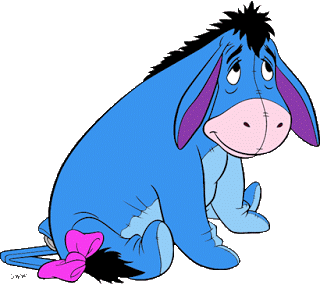 Everything out of his mouth is incredibly negative. Not only does he talk bad about the crappy people in his life (jerk coworkers, a woman that betrayed him/left him) etc, he also talks really poorly about himself as well. He will call himself stupid or say things like “maybe I should just give up on everyone and everything” and so on. The exception of course is that he never says anything negative about me; he’s always been very positive and kind in that regard.
This negativity makes it really difficult to interact with him, which is sad. But no amount of sympathy or “what can I do to help you?” seems to alleviate the situation.
So today, after another round of negativity I asked myself how I might I apply the concept of “letting go” to this situation.At first, I was like “He needs to let go! He needs to take responsibility!”
I wanted to shake him and remind him that he is blessed, his life is good. So many people out there in the world have it so much worse than he does! He might not like his job, but he has a job! He can pay his bills. He might not like certain people in his life, but he is free to go find new people. And so on. I wanted to remind him about women being sex trafficked against their will, abused children, or wrongly imprisoned captives. “You have no right to wallow! Unlike a lot of people you can change your life and you should! If you’re miserable, you’ve no one to blame but yourself.”
I didn’t say any of this of course. My first act of letting go was in letting go of my intense desire to tell him to have a little accountability for himself. No matter how badly I wanted to say, “stop blaming everyone else for your misery. You create your misery”, instead I asked “Can I help?”
He said “No, not really…I think I will just get plastered.”
Me: “You’re an adult. You can drink if you want.”
“I don’t drink.”…Me: “Smart!”
“No I’m stupid!!!”
“You are very negative in the way you talk about yourself. I don’t like it.”
“I have always been that way I am just a good actor”
“Not that good as it seems you do it a lot. How would you feel if you had to listen to me talk about how stupid, or fat, or ugly I am?” (this is where I start to attach again and then struggle to let go)
Him: You are none of those things.
….and so on and so forth. So from this I can tell it isn’t that he is incapable of positivity, but he is horribly negative to himself? So how did I let go:
--I let go of my desire to change his mind. (I’m not going to convince him he is the captain of his destiny, if he doesn’t want to hear it.)
--I let go of my desire for a certain outcome. (to make him realize his tendency to blame rather than accept responsibility for his own happiness)
--I let go of my idea of what he “should” be. My friend has as much right to move through the world as a taciturn whiny creature as I do as a happy, positive one. When I decide his morose nature is “wrong”, I’m judging him. I’m holding onto certain beliefs or notions that may or may not be accurate. So it is better for both of us if I let go of these notions and the expectations that accompany them.
--I let go of the belief that have control over anyone but myself. I may not be able to control his outlook, speech or behavior. But I can control my reaction to it.
--Acknowledge that while I’m willing to practice “letting go” not everyone is capable or willing to do so at this moment. I may want my friend to wake up and realize that he doesn’t appreciate his life and all his opportunities. I may want him to take responsibility for his happiness and to work harder at making himself happy. But happy is hard work and not everyone is in a place where they can accommodate that kind of commitment. And I have no right to ask them to do so.
--Be the change I want to see in the world. I want to interact with happy and positive people because whiny/depressive people just suck all the energy right out of me. This means that when I am whiny and depressive I’m probably also quite the soul-sucker. So instead of complaining about my friend, I should consciously work harder to be the positive happy person I want to be around—not only for myself—but so that positivity can benefits others' lives
Note: What I’m describing is hard to do if someone you love is clinically depressed however. But I’m not talking about clinical depression which requires professionals and perhaps medical intervention. I’m just talking about people with negative personalities.
 Everything out of his mouth is incredibly negative. Not only does he talk bad about the crappy people in his life (jerk coworkers, a woman that betrayed him/left him) etc, he also talks really poorly about himself as well. He will call himself stupid or say things like “maybe I should just give up on everyone and everything” and so on. The exception of course is that he never says anything negative about me; he’s always been very positive and kind in that regard.
This negativity makes it really difficult to interact with him, which is sad. But no amount of sympathy or “what can I do to help you?” seems to alleviate the situation.
So today, after another round of negativity I asked myself how I might I apply the concept of “letting go” to this situation.At first, I was like “He needs to let go! He needs to take responsibility!”
I wanted to shake him and remind him that he is blessed, his life is good. So many people out there in the world have it so much worse than he does! He might not like his job, but he has a job! He can pay his bills. He might not like certain people in his life, but he is free to go find new people. And so on. I wanted to remind him about women being sex trafficked against their will, abused children, or wrongly imprisoned captives. “You have no right to wallow! Unlike a lot of people you can change your life and you should! If you’re miserable, you’ve no one to blame but yourself.”
I didn’t say any of this of course. My first act of letting go was in letting go of my intense desire to tell him to have a little accountability for himself. No matter how badly I wanted to say, “stop blaming everyone else for your misery. You create your misery”, instead I asked “Can I help?”
He said “No, not really…I think I will just get plastered.”
Me: “You’re an adult. You can drink if you want.”
“I don’t drink.”…Me: “Smart!”
“No I’m stupid!!!”
“You are very negative in the way you talk about yourself. I don’t like it.”
“I have always been that way I am just a good actor”
“Not that good as it seems you do it a lot. How would you feel if you had to listen to me talk about how stupid, or fat, or ugly I am?” (this is where I start to attach again and then struggle to let go)
Him: You are none of those things.
….and so on and so forth. So from this I can tell it isn’t that he is incapable of positivity, but he is horribly negative to himself? So how did I let go:
--I let go of my desire to change his mind. (I’m not going to convince him he is the captain of his destiny, if he doesn’t want to hear it.)
--I let go of my desire for a certain outcome. (to make him realize his tendency to blame rather than accept responsibility for his own happiness)
--I let go of my idea of what he “should” be. My friend has as much right to move through the world as a taciturn whiny creature as I do as a happy, positive one. When I decide his morose nature is “wrong”, I’m judging him. I’m holding onto certain beliefs or notions that may or may not be accurate. So it is better for both of us if I let go of these notions and the expectations that accompany them.
--I let go of the belief that have control over anyone but myself. I may not be able to control his outlook, speech or behavior. But I can control my reaction to it.
--Acknowledge that while I’m willing to practice “letting go” not everyone is capable or willing to do so at this moment. I may want my friend to wake up and realize that he doesn’t appreciate his life and all his opportunities. I may want him to take responsibility for his happiness and to work harder at making himself happy. But happy is hard work and not everyone is in a place where they can accommodate that kind of commitment. And I have no right to ask them to do so.
--Be the change I want to see in the world. I want to interact with happy and positive people because whiny/depressive people just suck all the energy right out of me. This means that when I am whiny and depressive I’m probably also quite the soul-sucker. So instead of complaining about my friend, I should consciously work harder to be the positive happy person I want to be around—not only for myself—but so that positivity can benefits others' lives
Note: What I’m describing is hard to do if someone you love is clinically depressed however. But I’m not talking about clinical depression which requires professionals and perhaps medical intervention. I’m just talking about people with negative personalities.
January 26, 2016
Mo' #Money, Mo' #Problems #thebestofme
Through money or power you cannot solve all problems. The problem in the human heart must be solved first-- The Dalai Lama
A lot of people have said it in a lot of different ways, but it comes down to this: there comes a point when you no longer own possessions, but your possessions own you.
Like most people, I am not insanely wealthy. Not even a little bit wealthy when you hold my student loan debt up to the light, but it seems, nonetheless that I acquire more and more things as the years go on. At 32, I have a house, a car, a dog, a soon-to-be wife-- and all the furniture and accessories that accompany each.
Now, if you are materialistic as I tend to be, you might think--oh but you could have a nicer house, a nicer car, a nicer soon-to-be-wife (you'd be wrong on this account, however, since she is the loveliest creature on the planet) and a better dog (wrong). I could also get a boat, a motorcycle, more clothes or shoes, a riding lawnmover, more, and more and more...
But here is the thing about wealth: it makes us rather lazy and worthless. We no longer learn how to do things for ourselves, we pay others to do them for us. Instead of developing skills, we hand over the opportunity. We no longer spend our free time how we please--we spend it acquiring more things (which I guess that's fine if that's how you'd like to spend your time) or we spend our time taking care of all the things that we've acquired.
We become a slave to our possessions. We think I'll own a dog. It'll be great to own a dog. But anyone with a dog knows that the dog owns us. Especially if the dog is a puppy. We arrange our work schedules and our sleep schedules to accommodate potty breaks. We organize our furniture and possessions in a way to prevent chewing and before we know it the dog has impacted OUR behavior far more than we have impacted its behavior and the same is true for possessions.
Let's consider my dining room table, for example. My dining room table is by far the most expensive possession in my home. It's a very nice table, and cost me thousands of dollars.
Now because it is a table and because we decided to use the nice table rather than preserve it with shrink wrap, it has scratches now. This happens. BECAUSE IT IS A TABLE. (insert any possession here...table, car, clothes, etc). We buy possessions so that we can use them, when they are used they become worn. (Let's leave the expensive Chinese vases out of this example, for now. The puppy is going to knock it over and break it later anyway).
So how much energy did I expend fretting over my table when I first got it? How much polishing? How much research on how to remove scratches? How much shopping for runners and place mats and vaccumming of my fancy cushy chairs--that got dog hair on them because, you know, I also "own" a dog.
Too much time is my conclusion.
Now this is where letting go comes in. Buy the nice things. Sure. If they make you happy. But then it's important to LET GO of my desire to keep them perfect. LET GO of the illusion that somehow they make me "better" as a person--more powerful, more affluent (anything but more ridiculous) when the reality is they weaken me. They distract me, they blur the priorities of my mind--the soon to be wife is my most important love in the world--yet I would yell at her for scratching the table--it's ludicrous and evidence of the power possessions have over me rather than vice versa me.
And maybe you'd say, well Kory you just need to be RICHER. Then you can truly have all the things and not care about them. Okay, let's go all the way to the top. Kory is the first zillionaire. She can buy what she wants and if a table is scratched, no problem! Throw it out! Burn it! Buy another. But here is the rub. That kind of throw-away consumerism goes against one of my core beliefs and desires for a sustainable planet. It feels the belief that it makes me lazy, wasteful, and not at all powerful.
So bottomline, I've concluded that money does not necessarily make you powerful. In fact, too much can be trouble--as is the case with too little. So, I think it is better to walk the middle way. Do my best to tread lightly on the earth, take as little as I need, and do not for a second believe that more money means more power.
It is one of the greatest delusions of our time.
A lot of people have said it in a lot of different ways, but it comes down to this: there comes a point when you no longer own possessions, but your possessions own you.
Like most people, I am not insanely wealthy. Not even a little bit wealthy when you hold my student loan debt up to the light, but it seems, nonetheless that I acquire more and more things as the years go on. At 32, I have a house, a car, a dog, a soon-to-be wife-- and all the furniture and accessories that accompany each.
Now, if you are materialistic as I tend to be, you might think--oh but you could have a nicer house, a nicer car, a nicer soon-to-be-wife (you'd be wrong on this account, however, since she is the loveliest creature on the planet) and a better dog (wrong). I could also get a boat, a motorcycle, more clothes or shoes, a riding lawnmover, more, and more and more...
But here is the thing about wealth: it makes us rather lazy and worthless. We no longer learn how to do things for ourselves, we pay others to do them for us. Instead of developing skills, we hand over the opportunity. We no longer spend our free time how we please--we spend it acquiring more things (which I guess that's fine if that's how you'd like to spend your time) or we spend our time taking care of all the things that we've acquired.
We become a slave to our possessions. We think I'll own a dog. It'll be great to own a dog. But anyone with a dog knows that the dog owns us. Especially if the dog is a puppy. We arrange our work schedules and our sleep schedules to accommodate potty breaks. We organize our furniture and possessions in a way to prevent chewing and before we know it the dog has impacted OUR behavior far more than we have impacted its behavior and the same is true for possessions.
Let's consider my dining room table, for example. My dining room table is by far the most expensive possession in my home. It's a very nice table, and cost me thousands of dollars.
Now because it is a table and because we decided to use the nice table rather than preserve it with shrink wrap, it has scratches now. This happens. BECAUSE IT IS A TABLE. (insert any possession here...table, car, clothes, etc). We buy possessions so that we can use them, when they are used they become worn. (Let's leave the expensive Chinese vases out of this example, for now. The puppy is going to knock it over and break it later anyway).
So how much energy did I expend fretting over my table when I first got it? How much polishing? How much research on how to remove scratches? How much shopping for runners and place mats and vaccumming of my fancy cushy chairs--that got dog hair on them because, you know, I also "own" a dog.
Too much time is my conclusion.
Now this is where letting go comes in. Buy the nice things. Sure. If they make you happy. But then it's important to LET GO of my desire to keep them perfect. LET GO of the illusion that somehow they make me "better" as a person--more powerful, more affluent (anything but more ridiculous) when the reality is they weaken me. They distract me, they blur the priorities of my mind--the soon to be wife is my most important love in the world--yet I would yell at her for scratching the table--it's ludicrous and evidence of the power possessions have over me rather than vice versa me.
And maybe you'd say, well Kory you just need to be RICHER. Then you can truly have all the things and not care about them. Okay, let's go all the way to the top. Kory is the first zillionaire. She can buy what she wants and if a table is scratched, no problem! Throw it out! Burn it! Buy another. But here is the rub. That kind of throw-away consumerism goes against one of my core beliefs and desires for a sustainable planet. It feels the belief that it makes me lazy, wasteful, and not at all powerful.
So bottomline, I've concluded that money does not necessarily make you powerful. In fact, too much can be trouble--as is the case with too little. So, I think it is better to walk the middle way. Do my best to tread lightly on the earth, take as little as I need, and do not for a second believe that more money means more power.
It is one of the greatest delusions of our time.