Meghna Jayanth's Blog, page 5
April 9, 2016
Games That Affected Me Like A Disaster
This is the text from my talk at the wonderful Now Play This festival last year, where I was in august company with Em Short & Merrit Kopas speaking on the theme of Games and Intimacy. Thanks so much to Holly and George for giving me a chance to be part of the festival, and for the opportunity to talk about my relationship with games in a much more personal and confessional way than I ever have before, in a public venue.
-
“I think
we ought to read only the kind of books that wound and stab us. […]
But we need the books that affect us like a disaster, that grieve us
deeply, like the death of someone we loved more than ourselves, like
being banished into forests far from everyone […] A book
must be the axe for the frozen sea inside us. That is my belief.” - Kafka
The title
of my talk is “games that affected me like a disaster” - but the
more I thought about it the more I realised I was stretching the term
“disaster”. I wanted to talk about the games that affected me,
that made me feel and scraped me raw – in good ways and bad. I
think it probably says something more about me that the word that
seemed most appropriate to describe being made to feel something
is “disaster”. Books do this to me all the time – characters
and situations reach out from the pages of the text. Books have
wounded me – both in the sense of grief and in the sense of
catharsis. There are books I know I will never read again that I
refuse to get rid of – they sit on my shelf, more monument than
book, a physical reminder of that moment of connection.
That’s
really what I want to talk about today: a sense of connection. Books
connect with me all the time but games so rarely do. Every now and
then, not very often at all, a game – an experience – connects
with me, acknowledges my humanity. And while each individual
experience, each particular moment is meaningful on its own
particular terms the thread that runs through them is a sense of
intimacy, mediated through a variety of forms.
Let’s talk
about fear. I think this is probably one of the most common ways in
which mainstream videogames manage to stumble into creating intimacy
– the intimacy of risking digital death, of failing a challenge in
a roomful of peers, of admitting defeat. The first time I remember a
game making me feel fear is the Aladdin game for the SNES – the
magic carpet level in the cave. If you’ve played the game you know
what I mean. The game – which has up until then been gentle
platforming – suddenly asks you to navigate more freely on this
magic carpet – the screen autoscrolls faster and faster, waves of
lava rise up and reach for you as you swerve to avoid the cave walls
closing in. It was a lot for a six year old. It terrified me.
The moment
that level loaded up, I’d call my dad in from the other room, hand
the controller over to him and tuck myself behind him on the sofa,
shouting warnings and covering my eyes when he had a close call. I’d
feel a perverse pleasure when he occasionally died and perverse pride
when he beat the level on the first try. He never made fun of me for
being afraid. He never made me feel like I was being a girl
about it – or even if I was – that being a girl about it was a
bad thing. He’d hand back the controller – reluctantly – and
watch me continue. I never did learn to beat that level, but those
times remain some of my abiding memories of my childhood – those
shared moments, me, my dad and the Aladdin game – intimacy and
connection as an accidental consequence of the game’s design.
When I
think about my important experiences with videogames, most of them
fall into this category – catalysts for emotional or social
connections outside of the game, more so than a connection with
the game. Games as shared experiences, or things you feel things with
rather than things which make you feel. But there are exceptions:
I’ve always loved the Bioware games – though the one which I’ve
played most is the often unfairly maligned Dragon Age: II, and it’s
because of the characters. I can load up almost any of my – thirty
or so? - saves and work out where in the plot I am not through quests
but through the progression of my character relationships. I remember
my – real-life – partner walking into the room during a
particularly fraught emotional conversation with Anders, my romantic
interest – and I felt – not embarrassment at being caught out
romancing a digital construct but a flare of resentment. I had earned
this conversation through friendship and care – he was trusting me
– protagonist, player, person – with his truths. It was private.
The fact that I had a controller in my hands and he spoke to me from
a television screen did not, at that moment, matter. Nor did it
matter that my partner had played Dragon Age II before, and probably
experienced this very same conversation. Of course it didn’t matter.
This is the same urge that drives players to recreate multiple
endings or particular
outcomes in their own
playthrough even if they’ve seen it on youtube – it’s different
when it’s your game.
When you’ve pressed the buttons and chosen the dialogue options. When
it’s your sweat on the controller. Playing the game is an act of
shared creation, and there is nothing more intimate than that.
(Hilariously
- every time I replay Dragon Age II I try to romance a different
character but I always end up with Anders – it always feels like a
betrayal to flirt with anyone else.)
I
feel like it would be remiss not to talk about the companion cube a
little bit – the companion cube in Portal is often held up as the
gold standard for creating an emotional connection in videogames.
It’s an abstracted companion, a physical object with only one real
“expression” - perfect for the player to project onto. And – er
spoilers – the big moment where the companion cube is sacrificed,
it’s tragic and terrible. People happily admit they shed a tear. I
have to confess – I didn’t cry. Look, I felt bad, okay? I’m not a
complete monster – but did I grieve? Did I feel it as a wrenching
loss? I’m sorry, I didn’t. There’s something too ironic and
distancing and clever about
the companion cube’s “death” to make it truly affecting –
because it’s an inanimate object, we can grieve for it with hipster
melodrama. It’s always smacked me as slightly insincere.
Real
feelings – in my experience anyway – always have an edge of
embarrassment. There’s something a little bit naff, a little bit
uncool, a little bit awkward
and unfashionable about real feelings.
Going
back to Dragon Age – I was playing Inquisition a few months ago,
and ended up going on a date with Cullen – he’s an ex-Templar, I’m
a mage, so, y'know, if you’ve played the game you know it’s already
pretty fraught. So we’re walking along the battlements, having this
pretty serious, incredibly awkward conversation – for all the
fantastical trappings and drama, it’s a conversation that feels
familiar and true – the underlying questions are familiar anyway:
can we really care about each other? Are we brave enough, or stupid
enough, to admit that to each other? The music swells in the
background, and the characters lean closer together on the screen –
and one of their underlings interrupts them with a report. The camera
lingers on the embarrassment on your protagonist’s face, and I felt
it too – the moment’s been shattered. The underling is sent away
and as your protagonist begins to mumble some excuse so she can get
the hell out of there, Cullen turns and kisses you. It surprised me.
It charmed me. It felt
joyous and delightful and spontaneous and made me smile till I caught
myself at it – it felt momentous, because videogames so rarely
startle me into a genuine emotional response.
And
it was a result of writing and pacing but also the character models –
vastly improved over the previous games – the edge of a smile on an
NPC’s face that doesn’t trigger that uncanny valley discomfort. All
too often the graphics and attempted realism of videogames actually
distance me from them rather than pull me in, but
this moment in Inquisition gives me hope – because it is the last
thing from spontaneous – it is designed and manufactured and pretty
mainstream – but somehow manages to feel as though it is. And I
think that part of it is because it’s a little awkward, a little
silly – it isn’t a perfect romance novel moment, with all the edges
and imperfections sanded down too smooth.
For
all that it’s made by a triple-A studio it still feels like it was
made by people – the money and production don’t quite manage to
obscure that. I think that’s important. Intimacy necessitates
vulnerability – I think it’s harder to be vulnerable with something
expensive and smooth and corporate and impersonal. Which
is why some of the most intimate gaming experiences I’ve had have
been with Twine games – they are often much more directly a
dialogue between game-maker and player, often about personal,
confessional topics, many dealing with identity, gender, sexuality.
If I tried to tell you about all the twine games that affected me
we’d be here until day after tomorrow so instead I’ll just tell you
about With Those We Love Alive by porpentine – one of my favourite
games of last year. It’s a game about love and power and
self-destruction. About the intimacy of oppression. In porpentine’s
nightmare-fantasy world we can’t escape participating in
institutional violence, no matter how carefully we make our choices.
We’re victims and perpetrators and more than each of those labels
might imply. Porpentine also asks us – at various key moments in
the game – to draw symbols on our bodies to represent particular
events and choices. The game makes a tool of the player to pull
itself out of a purely digital space, to impinge on the physical.
Alice O'Connor wrote a great piece on Rock Paper Shotgun about this,
saying that
drawing these symbols “is
a lark until you realise you’re marking and changing yourself in
response to cruel and oppressive things”.
But
the fact of the matter is – you’ve done it to yourself, you’re
doing it to yourself. While the game illuminated the path, you’re the
one who chose to walk down it. It’s a physical reminder of your own
responsibility, your culpability – it makes of it a game mechanic.
The
physicality of it makes it feel more human, too, I think. As does the
very distinctive and particular lyricism of porpentine’s voice. Just
like when you’re reading a book, it’s an engagement with an authorial
voice, with another human being’s work. They’re
exposing themselves on the page or
screen,
and so it’s easier to expose yourself in the reading – I think
that’s why intimacy is
so much easier to design and experience in text
or live games and physical
experiences, because the protections are pulled back, for the
performers and the players both.
The
first time I realised I wanted to make games was when I saw
Punchdrunk’s the Masque of the Red Death in 2007 – it’s an
immersive experience where you are both spectator and participant.
You’re given plague-doctor masks as you walk in, and you – and
everyone else in the audience – wanders around a painstakingly
decked out space, weaving in and out of stories, actors brushing past
you and entangling you in their scenes without any of the distancing
luxury of a stage. My friends and I came out of Masque of the Red
Death and spent hours at the pub after swapping stories, sharing
experiences – discussing some of the places of overlap, seething
with jealousy over some of the more personal, unique stories that some
of us were lucky to stumble into. One of my friends got pulled aside
for a one-on-one retelling of the Telltale Heart.
A
few of us happened to be standing around a room when the clock
chimed, and we were ushered into a locked study where a man declaimed
the Raven and finished his tale in a swirl of cape and thrown
feathers. The six of us in
that room felt a sense of connection, of something momentous and
shared – even if we hadn’t met before, even if we never would
again. The game designer part of me knows perfectly well that there
were hundreds of people every night that got ushered into the locked
study, and had that “unique experience” as well – but the
audience member, the player – still felt a sense of specialness, of
ownership. It was my personal story within a shared experience –
and the fact that it’s “uniqueness” was sleight-of-hand didn’t
actually diminish it. Punchdrunk manufactured intimacy every night –
it designed for it. I
think it showed me that you could design for serendipity without
making it inauthentic – I think that is something that is
particularly within the possibility-space of games. Each player makes
their own story out of the tools the game provides them – playing a
game is an act of creation, even more acutely than reading a book or
watching a film.
2007
was a good year for me, as interactive experiences go – that was
also the year I experienced Ontroerend Goed’s ‘The Smile Off Your
Face’ at the Edinburgh Fringe Festival. It was almost the inverse of
the Punchdrunk experience – I was not part of an audience but
entirely alone, outnumbered by performers. Instead of giving me a mask
to confer a sense of freedom, to bring me within the world a la
Masque of the Red Death, I was blindfolded and put in a wheelchair. I
was not allowed to wander, to explore, to self-direct but I was
directed, made powerless and vulnerable as I was put through various
sensory experiences.
The
sound of a cigarette lighter catching – such a familiar and welcome
sound to a smoker such as myself – made me flinch back in the dark.
Music began to play and I was pulled to my feet and slow danced with
a stranger – an actor? Another audience member? Dancing with a
stranger in the dark without the benefit of pounding music or alcohol
or even the ability to make nervous small talk is strange and
unsettling and oddly, painfully intimate – I never saw his face but
I remember the sound of his breathing, the scrape of my shoes against
the cement floor, nothing else to distract me from the physicality of
the thing – the almost-embrace of slow dancing together.
I
was put back int the chair
and wheeled around again – I had
no sense of the scale of the space, how far I had gone. It was a
twenty minute experience but time and distance felt dilated somehow.
I had to accept that loss of control – it was an experience
designed to make me lose control in increments, to accept further and
further intimacies until they could crack me open – and they
managed it – I ended up lying on a bed with someone whispering
their secrets to me, and then they asked me to tell them a regret.
Something secret, that I hadn’t told anyone else. That I wondered and
worried about.
And
I should have felt disoriented and vulnerable and under pressure but
instead I felt open and honest and unburdened, and I told her a
secret I hadn’t even known I was keeping. It took me days to be able
to describe the show to anyone else – and even now, I’m not sure
whether I’ve done it justice. I never thought I would be able to let
go of control, to accept being vulnerable – but the studied
progression of the experience, the movement from physical and sensory
intimacy to emotional intimacy – created a space for me to feel and
be raw. The careful way the show took away my control but not through
oppression but through taking responsibility for me – the first
time I was pulled to my feet and stumbled and the actor caught me and
held me up. They tested my boundaries to show me I could trust them,
as much as I was there in
that moment they were there with me too, they were there for
me.
Punchdrunk
and Ontroerend Goed
understood that presence
is intimate – but the broader lesson for games is I think that
participation is
intimate. I don’t think it’s
a coincidence that three of the experiences that affected me – With
Those We Love Alive, Smile off Your Face, and Masque explicitly play
with power-exchange between participants and creators. Game
designers, I think, could learn a lot from BDSM etiquette – Merrit
Kopas’s twine game Consensual Torture Simulator – a game about
hurting someone who wants it, should be required reading – it is
such a great example of how making and playing should be approached:
as a negotiation.
It’s
strange to me that most games seem to pretend that the player doesn’t
exist, or rather can only conceive
of the player as the originator of a series of prompts and rote
responses rather than a resource to be called upon – as players our
minds and our bodies and our creativity and the frozen seas of our
emotions are waiting to be engaged, to be used. What
we make of something is almost always as interesting as the thing
itself – but that’s a difficult lesson for a designer.
The
urge, I think, is to create something whole and hermetically sealed
and perfect, but it’s impossible for players to get purchase on
perfection. To tear it up and let it tear into us. I’ve been talking
about intimacy as an act of trust – but it isn’t just about being
able to trust the game or game-makers with our playlerly
vulnerability. We also need to be able to design games with
trust – with trust for our
players. Intimacy doesn’t work when it’s only one way. Those moments
of connection, I think, spring from a shared exposure, a willingness
to risk failure and silliness and naffness and
messiness, because feeling things, truly and deeply, is always, a
disaster.


December 6, 2014
The Isle of Cats
The Isle of Cats is my latest guest island for Failbetter Games’ Sunless Sea: my first was the Shadowless City of Varchas on the Elder Coast, a city of careful ritual inflected with ancient Hindu traditions.
Writing a Sunless Sea guest island after working on 80 Days draws the contrasts into sharp relief: 80 Days is all small, characterful incidents - small but followed down deep, chronological, specific, everything taking place over the course of a few snatched hours, an afternoon. Some spooling plotlines might days or even weeks, but each day is broken down, packed with incident and particularity. Mundane and sublime are shaken up together; heating the shaving water to the correct degree is as vital as hunting down a murderer in an airship’s gas-lit corridors. Whereas Sunless Sea is sense-of-place: colours and shapes of buildings and the smell of the zee. A painterly application of words.
In 80 Days there is a constant buffeting internality to the protagonist (he is Passepartout, and the choices you-the-player make only further define his Passepartout-ness). Whereas Sunless Sea feels more like defining interiority through negative space: accretions of words and experiences. The protagonist of Sunless Sea is a patina, an inverted bricolage. (Which is why the vividness, the ripeness and lushness of the text is not overripeness - there’s all that extra space where a person would be.)
In fact, I have always thought that one of StoryNexus’s particular strengths was its ability to create a sense of place. Perhaps it is something about the physicality of the system’s central metaphor - cards might stand for buildings, decks for districts or towns, and so on. The structure of StoryNexus seems to infuse stories with a kind of thematic permanence, whereas Twine has to be wrestled into existence. And even then, there’s a kind of (glorious) haziness to the hypertext of Twine. StoryNexus has particular rhythms: there are particular kinds of slowly-unfurling stories that StoryNexus allows a writer to tell.
When I asked @alexiskennedy about the Isle of Cats he described it as “like Tortuga, but smugglier”, which was the atmosphere I tried to create. Though less Golden Age of Caribbean piracy and more colonial Far East. The entire Island is a paean to a particular (Surface) place and moment in time. Think: opium trade and lascars, Borneo and the straits of Malacca, corrupt colonial governors and merchant-kings draped in silk and ivory.
But this is the Neath, and nothing is so simple. The crimson cats that give the isle its name are perhaps more than metaphor, and the island’s wealth is steeped in a trade more gruesome than mere blood.
Presiding above it all is the Pirate-King Leopold Raffles, and his two trusted lieutenants: the golden-veiled Lady of the Cages who tends her garden of deadly roses, and the fluidly-gendered King’s Claw who enforces the peace amongst the cut-throats and smugglers with a jewel-draped hand. (It is rumoured that they are something more than merely trusted lieutenants, but those are, of course, merely rumours.)
Will you choose to pledge yourself to the Lady or the Claw? How far are you willing to go to gain the attention of the Pirate-King? What will you sacrifice? What will you risk? The pirate’s life, so the Catties say, is not for the faint of heart.
November 14, 2014
failbettergames:
The Isle of Cats, where an invisible tiger...
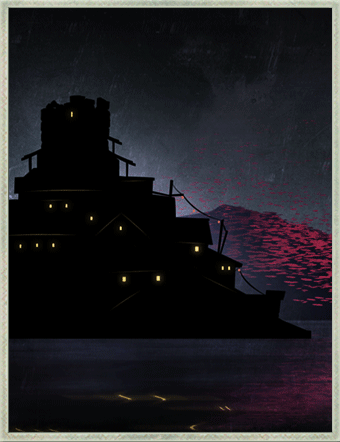
The Isle of Cats, where an invisible tiger stalks and deadly roses grow. Unravel a tale of memory, cruelty and desire, with the King’s Claw, the Lady of the Cages, and a mystery from Fallen London's past…
A substantial story for Sunless Sea in the form of a guest island written by Meg Jayanth.
Meg Jayanth is a freelance writer and game-maker in London. Her recent work includes 80 Days - a decolonised, steampunk adaptation of Verne’s adventure classic, for iOS - and Samsara, a rich historical fantasy of dream-walking and intrigue set in Eighteenth Century Bengal, which lives on our own StoryNexus.
Follow Meg @betterthemask
megjayanth.com
"Welcome to the Isle of Cats," the Wide-Eyed Dockmaster says brightly. "Would you like to bribe me not to write down your details in this nice official ledger?"
Click New Stories Available to get this story, and enjoy.
Well. It rather looks as though I’ve written an island full of sin and rose-petaled decadence in Sunless Sea.
October 17, 2014
"Mr. Bak cited the example of McDonald’s passing out potato seeds to Indian farmers years before the..."
- http://mobile.nytimes.com/2014/10/17/world/nairobis-latest-novelty-high-end-mac-and-cheese-served-by-whites.html
Fantasy, History and Respect
In her great piece about 80 Days at KillScreen (80 Days is the Alternate-Reality, Anti-Colonial Adventure We All Deserve), Jess Joho quotes one of my answers to her question about history, fantasy and parallels to the modern world at great length. But I wanted to post my full original answer as it is the fullest, and most collected, statement of purpose about my approach to writing 80 Days:
Between fantasy and history, there’s a third axis here, for me, and that’s respectfulness. We wanted our inventions and devices to be grounded in local cultures rather than overwrite them with a purely British notion of steampunk. I wanted to write an anti-colonial adaptation, and part of that was trying not to appropriate or disrespect people’s struggles and history. I did not want to exoticise or stereotype the indigenous steampunks I invented, and so informing the fantasy with historical research was enormously important to me. I tried to think about what kinds of resources are available, what kinds of pressures a culture might be facing, how our fantastical inventions are going to impact the geopolitics of the region and the wider world. The history of the period is so fascinating and tumultuous, our retrofuturist lens just skews it a little.
But there are also times we use fantasy to enable us to tell the kind of story we wanted to be able to tell, to redress some of the colonialism, sexism and racism of the period. If you’re inventing a world, why not make it more progressive? Why not have women invent half the technologies, and pilot half the airships? Why not shift the balance of power so that Haiti rather than barely postbellum United States is ascendant in the region? Why not have a strong automaton-using Zulu Federation avert the Scramble for Africa? Why not have characters who play with gender and sexuality without fear of reprisal? History is full of women, and people of colour, and queer people, and minorities. That part isn’t fantasy - the fantastical bit in our game is that they’re (often but not always) allowed to have their own stories without being silenced and attacked. That their stories are not told as if they’re exceptional.
That’s still a bit of a fantasy for many of us, even now.
Just today on twitter a couple of people retweeted one of our reviews - which basically said “I loved this game, but there are gay characters that I don’t have the option to turn off”. The vast majority of people have either been welcoming about this inclusivity, or haven’t batted an eyelid - but there is still a vocal minority who find even the acknowledgement of the diverse world we actually live in too much. Challenging that in the stories we tell is barely even politics, it’s just decency.
It’s even more important to challenge that mindset in games, in historical fiction, and in steampunk which all, to be blunt, don’t have the best track record in representation and inclusivity.
Which brings me to how Verne is relevant to the modern world. Verne’s novel is an adventure story, but it’s also a story of empire and colonialism - really, it’s about one Englishman stalking the boundaries of his estate, and that estate is the world. Verne’s attitudes to other cultures might seem outdated and racist to us now but they’re not completely alien. We live with the legacy of colonialism, with slavery, and the oppressions that Verne sort of glances at in his novel but doesn’t quite address. (Twenty Thousand Leagues Under the Sea is a lot more critical of empire, in its way, but still bounded by Verne’s assumptions and perspective.)
Fundamentally Around the World in 80 Days is about two white guys and their incredibly important journey around the world - other cultures, other people, they’re just set dressing for this narrative of white male heroism. You don’t have to work hard to think of ten contemporary Hollywood movies that do the same thing. We tried to challenge that by giving other characters and cultures in our game as much agency as we possibly could - the world of 80 Days turns, but it doesn’t turn around you. Not everyone is there to be a help or a hindrance to your adventure. Other people have their own stories and agendas and revolutions to fight. We hope our game works for a modern audience because the criticisms it makes are still relevant, even if the particular details are historical.
September 26, 2014
http://toomanyfeelings.tumblr.com/pos...
Ok I just gotta say, my partner and I have been playing the adventure game “80 Days” (as in, around the world in) by inkle studios and so far:
- an equal number of side characters are men and women regardless of occupation and you meet an incredible variety of personalities
- there are…
Totally my favourite response to 80 Days. Really wonderful to see people respond to the diversity and inclusiveness; those are the aspects which make me most proud.
September 21, 2014
nerdybutflirty:
Interview with Meg Jayanth, Writer of 80...
Interview with Meg Jayanth, Writer of 80 Days
Last week, I reviewed the amazing 80 Days from Inkle Studios. Today, I have an interview with writer Meg Jayanth! I really appreciate Meg taking the time to answer my questions.
Thanks to the lovely folks at Nerdy But Flirty!
August 5, 2014
"The pattern is much more conversational: you say something, the game says something back, then you..."
- Jon from inkle talks about mobile, interactive writing, pace and design in '80 Days: Building the perfect text adventure for mobile' - Mike Rose, Gamasutra
August 3, 2014
80 Days is out
…and it’s Editor’s Choice on the App store!

We’ve all been so blown away by the response to the game. Writing this game has been an extraordinary pleasure as well as a monumental task steeped in blood and love. Working with the wildly talented folks at inkle has been nothing short of wonderful. It’s genuinely incredible to watch people journey around the world we built together.
If you’ve been playing it (or even if you haven’t!), you simply have to check out Jaume Illustration’s incredible character art at his blog. His fantastical contraptions and stylish characters are, impossibly, even more gorgeous up close.
And Laurence Chapman’s adventurous and playful 80 Days suite can be listened to and downloaded from his website. It is currently on repeat in my house, and should be in yours too.
Thank you everyone who has played, reviewed, tweeted, mutinied, romanced, adventured, sickened, swashbuckled, trysted and tarried with us - and here’s to more of you doing the same.
Looks like reading isn’t dead after all. :)
July 30, 2014
Don’t Be A Hero – 80 Days the Game
Transforming Around the World in Eighty Days into an interactive story Meg Jayanth is the writer of 80 Days - a steampunk interactive …
I wrote about adapting a classic Victorian text into an interactive adventure, and creating an alternate world which encompasses the stories of women, minorities and marginalised people. Where the protagonist isn’t the only hero, and his story really isn’t the most important one you encounter.
This article could also very easily be titled: Rejecting the White Saviour Myth, one choice at a time.