Elizabeth Fitzgerald's Blog: Earl Grey Editing, page 23
July 20, 2017
My Current Podcast Playlist
I’m a podcast fiend. I find they’re a great way to keep me entertained while I’m doing housework. Over the last few years, I’ve ended up with quite a few shows to listen to. They fall into three broad categories:
Books, Media and Culture
This is far and away the biggest category. It includes podcasts featuring interviews, discussions about fandom, and reviews of books, movies and TV shows.
Fangirl Happy Hour: This Hugo-nominated podcast is hosted by Renay of Lady Business and Ana of The Book Smugglers. They review books, movies and graphic novels, as well as discuss what they’ve been reading or watching more generally. They also talk about the state of SFF fandom and often segue into political commentary and discussions of mental health.
Galactic Suburbia: This Hugo-Award-winning podcast is hosted by Alisa Krasnostein, Tansy Rayner Roberts and Alexandra Pierce. Much like Fangirl Happy Hour, they discuss the state of SFF fandom, albeit from an Australian perspective. The two podcasts occasionally end up in dialogue over vital issues, such as what can be classified as cake. The ladies of GS also discuss the culture they’ve been reading, watching or otherwise consuming.
Not Now, I’m Reading: A new podcast just started by Chelsea of the Reading Outlaw and Kay Taylor Rae which focuses on reviewing genre books and media. As a keen reader of romance, I appreciate that their focus is a little wider than just SFF and the way they’re unapologetic about their passions.
Overinvested: Gavia Baker-Whitelaw and Morgan Leigh Davies review movies, TV shows and comics. Most are genre, though not all. These ladies are savvy critics who really know their stuff and are also not afraid to love material they know is rubbish.
The Skiffy and Fanty Show: This Hugo-nominated podcast is headed up by Shaun Duke and Jen Zink with a large cast of co-hosts. They do multiple segments of varying kinds, including signal boosts, interviews and Torture Cinema (wherein a panel reviews a movie deemed to be awful by pop culture).
Radio Free Fandom: Another new podcast, in which Claire Rousseau interviews guests about their fandoms. I’ve only listened to the first episode so far and am still getting a feel for it.
Reading the End: I usually prefer my podcasts to be solidly genre, but I make an exception for the Demographically-Similar Jennys. Gin Jenny and Whisky Jenny do often discuss and review genre books, but are just as likely to be reviewing contemporary literature. They also discuss their favourite instances of particular tropes and occasionally delve into research on space, the sea and Arctic explorers. At all times, they remain utterly charming.
SFF Yeah: Book Riot’s new SFF podcast. Sharifah and Jenn discuss SFF news and favourite literary tropes. I’m still deciding if this one is for me.
Sheep Might Fly: A podcast of serialised fiction by Tansy Rayner Roberts. Tansy alternates between previously published work and completely new stories. It’s a delight to hear them in Tansy’s own voice.
Tea and Jeopardy: This Hugo-nominated podcast is hosted by Emma Newman. Each of the guests she interviews has a connection to SFF and each interview takes place in a different (fictional) lair arranged by her morally-dubious butler (voiced by Peter Newman). Guests often find themselves in a bit of difficulty as they leave. The fictional framework doesn’t work for everyone, but I find it fun.
The Math of You: This is a relatively recent discovery from me. Lucas Brown interviews a range of guests about the pop culture that influenced them while growing up. Not strictly SFF; this is geekdom in many flavours. Lucas is a warm and enthusiastic interviewer.
The Writer and the Critic: Kirstyn McDermott and Ian Mond review a range of speculative fiction. I initially picked this up due to its Ditmar nomination this year and have liked it enough to keep it on. The contrasting perspectives make it engaging. However, I’m also adverse to spoilers, so haven’t yet delved into many of the episodes.
Gaming
This is the newest category in my podcast list and focuses exclusively on tabletop RPGs (which, I’m sure, surprises no one).
The Gauntlet Podcast: Primarily hosted by Jason Cordova, the podcast interviews game designers and signal boosts RPGs being crowdfunded. The hosts also discuss the games they’ve been playing and what has been inspiring them.
The Gauntlet crew also run several other related podcasts. I’ve not yet listened to +1 Forward, but it has recently been nominated for an ENnie Award. However, I have listened to Pocket-Sized Play. I don’t usually go in for Actual Play podcasts, but I’ve been loving their Monsterhearts campaign, Mercy Falls.
Writing Advice
The last category in my list is short. While I appreciate some measure of discussion about craft and industry, I find too much counterproductive for me (it’s hard enough to mute my inner editor).
Ditch Diggers: Hosted by Mur Lafferty and Matt Wallace. I picked up this one because it was nominated for a Hugo this year and I wanted to judge it fairly. Mur and Matt discuss craft, answer questions and interview other creators. It’s a solid show, though I occasionally find it abrasive in ways that weren’t intended.
Writing Excuses: These short episodes are hosted by Brandon Sanderson, Dan Wells, Mary Robinette Kowal and Howard Tayler. Each season has a distinct theme and guest co-hosts. I appreciate the diversity of voices (though it remains sadly US-centric). Each episode ends with a practical exercise.
Altogether, these make up my current playlist. Does anything catch your attention? What would you recommend I check out?


July 16, 2017
Trust by Kylie Scott
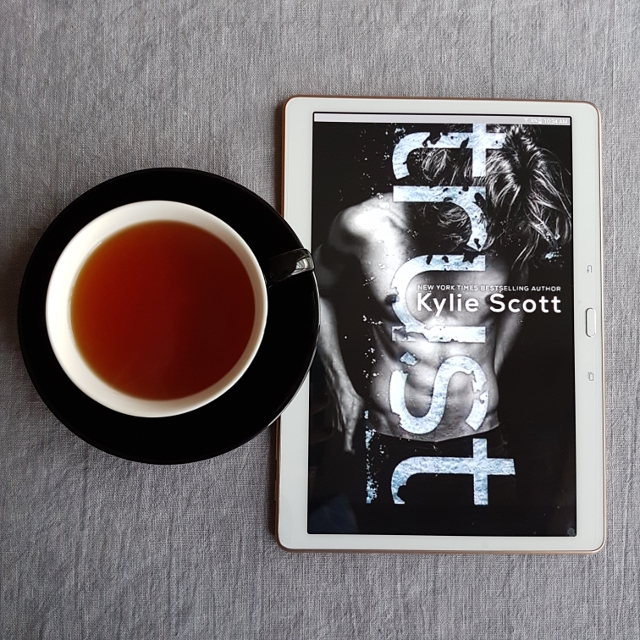
Published: Self-published in July 2017
Format reviewed: E-book (mobi)
Genres: Young adult, contemporary romance
Source: NetGalley
Reading Challenges: Australian Women Writers Challenge 2017
Available:Amazon ~ Barnes & Noble ~ Book Depository ~Kobo
Disclaimer: I was provided with a free copy of this book in exchange for an honest review.
Being young is all about the experiences: the first time you skip school, the first time you fall in love… the first time someone holds a gun to your head.
After being held hostage during a robbery at the local convenience store, seventeen-year-old Edie finds her attitude about life shattered. Unwilling to put up with the snobbery and bullying at her private school, she enrolls at the local public high school, crossing paths with John. The boy who risked his life to save hers.
While Edie’s beginning to run wild, however, John’s just starting to settle down. After years of partying and dealing drugs with his older brother, he’s going straight–getting to class on time, and thinking about the future.
An unlikely bond grows between the two as John keeps Edie out of trouble and helps her broaden her horizons. But when he helps her out with another first–losing her virginity–their friendship gets complicated.
Meanwhile, Edie and John are pulled back into the dangerous world they narrowly escaped. They were lucky to survive the first time, but this time they have more to lose–each other.
Trust is Kylie Scott’s first foray into Young Adult and I certainly hope it won’t be her last because I was pretty impressed.
There was so much that was great about this book. I appreciated its diversity. This includes race and sexuality–two of Edie’s new friends are lesbians and the other Vietnamese–but it also goes beyond that. Edie herself is an unconventional protagonist. She may be white and blonde, but she’s also considered overweight and has no desire to change that. She has seen her mum go through the constant torture of diets and would rather be happy than subject herself to the same. Of course, she is bullied for being a socially-unacceptable body shape but never by the narrative. Instead, she is also shown as being desireble–and desirable by someone who has a socially-acceptable body shape.
Another thing I loved about the story is the way it advocates for healthy relationships and boundary setting. Edie is not shy about cutting people off if they violate her privacy. She has zero time for other people’s bullshit. While her relationship with John didn’t start under the best circumstances, it is a healthy one–with each one supporting the other through the changes they’re making in their lives. There is also one scene that takes a bit of a dig at Twilight when John unexpectedly shows up at Edie’s bedroom window one night.
This is not a book that pulls its punches. It kicks off with the robbery Edie and John get caught in at the convenience store, and takes us all the way through that traumatic experience. It has all the bodily fluids (and I really do mean all). There’s onscreen sex–and, being a romance writer, Scott isn’t shy about it. There’s awkward sex and sexy sex, and good consent practices at all times.
All in all, I loved Trust to pieces and I’m hoping we’ll see more YA from Kylie Scott.


July 13, 2017
Loose-leaf Links #43
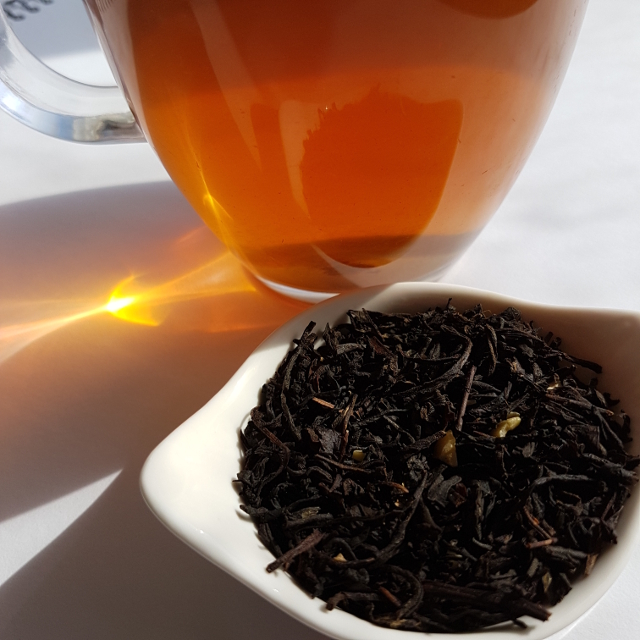
Loose-leaf Links is a feature where I gather together the interesting bits and pieces on sci-fi, fantasy and romance I’ve come across and share them with you over tea. Today’s tea is Amaretto from the Tea Centre. This flavoured black tastes strongly of marzipan, making it a favourite of mine.
Follow Up
Earlier this year, Forestofglory wrote a guest post calling for help in naming the new YA Award to be associated with the Hugos. The committee responsible for looking into the award have just released their report (PDF). Their recommendations are that the award be presented unnamed next year and thereafter be known as the Lodestar.
Awards News
Speaking of the Hugo Awards, a reminder that voting closes this weekend!
The 2017 Aurealis Awards are now open for nominations. Eligible works must be created by an Australian citizen, or permanent resident, and published for the first time this year. Entries close 7 December, but as a former judge, I highly recommend submitting sooner rather than later to avoid the last-minute rush.
Community and Conventions
Fireside Fiction is undergoing a change of management, with Brian J. White stepping down. Pablo Defendini is taking over as publisher and Elsa Sjunneson-Henry as managing editor. Julia Rios and Mikki Kendall are also joining the team.
On Equity
From Kotaku comes this article on the influence of female creators in shaping Dungeons and Dragons.
K. Tempest Bradford reminds us that cultural appropriation is indefensible.
Kelly Robson shares why her futures include disability.
The Asexual and the Asexual Journal are new online spaces for the ace community. They share articles and creative pieces from ace creators.
For Writers
The forthcoming Mothers of Invention anthology, edited by Tansy Rayner Roberts and Rivqa Rafael, is currently open for submissions. They’re accepting stories of 500-5000 words on gender as it relates to the creation of artificial intelligence. Submissions close 31 August.
Leife Shallcross discusses her experiences with Hodderscape’s open submission process.
Leife and several other members of the Canberra Speculative Fiction Guild share the advice they’d give to their younger selves in relation to writing.
Over at the Tor/Forge blog, Michael F. Haspil suggests 5 gaming tools to help your writing. These were not what I expected, being mostly focused on idea generation. I’m also not familiar with any except the first, but they seem like solid suggestions.
For Readers
Thoraiya Dyer reveals the gorgeous cover to Echoes of Understory, the sequel to her debut novel Crossroads of Canopy.
Ticonderoga Publications has announced The Silver Well, a collaborative collection from Kate Forsyth and Kim Wilkins.


July 9, 2017
Corpselight by Angela Slatter
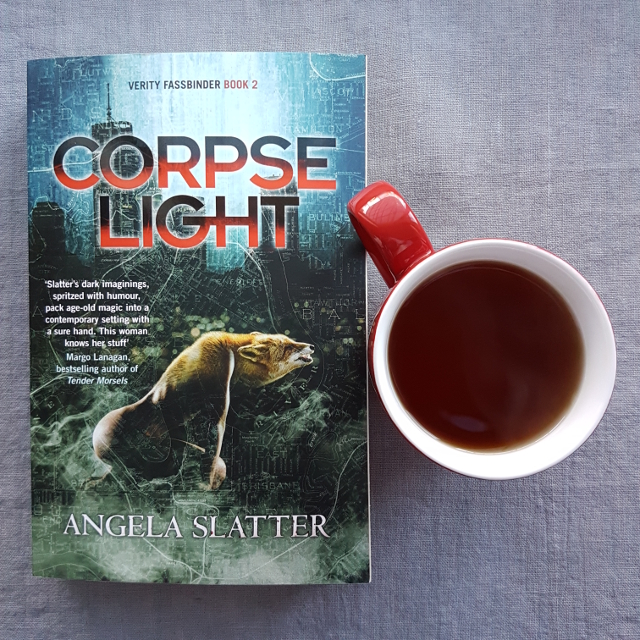
Published: July 2017 by Jo Fletcher Books
Format reviewed: Trade paperback, 386 pages
Series: Verity Fassbinder #2
Genres: Urban fantasy
Source: Hachette Australia
Reading Challenges: Australian Women Writers Challenge 2017
Available: Publisher (print) ~ Abbey’s ~ Amazon~ Book Depository ~ Booktopia ~ Dymocks ~ Kobo
Disclaimer: I was provided with a free copy of this book in exchange for an honest review.
This review contains spoilers for previous volumes/books.
Life in Brisbane is never simple for those who walk between the worlds.
Verity’s all about protecting her city, but right now that’s mostly running surveillance and handling the less exciting cases for the Weyrd Council after all, it’s hard to chase the bad guys through the streets of Brisbane when you’re really,reallypregnant.
An insurance investigation sounds pretty harmless, even if it is for ‘Unusual Happenstance’. That’s not usually a clause Normals use — it covers all-purpose hauntings, angry genii loci, ectoplasmic home invasion, demonic possession, that sort of thing — but Susan Beckett’s claimed three times in three months. Her house keeps getting inundated with mud, but she’s still insisting she doesn’t need or want help . . . until the dry-land drownings begin.
V’s first lead takes her to Chinatown, where she is confronted by kitsune assassins. But when she suddenly goes into labour, it’s clear the fox spirits are not going to be helpful . . .
As I’ve mentioned before, I love a good urban fantasy and Angela Slatter’s Verity Fassbinder series is turning out to be one of my favourites. Corpselight does some unusual things with the genre.
For a start, it’s refreshing to see a pregnant protagonist. And I don’t mean just pregnant, I mean almost-ready-to-drop pregnant. This raises the stakes in some interesting ways. Verity has scaled back her activities as an investigator for the Council, but events conspire to draw her in. She’s forced to weigh her duty to the Weyrd community against her daughter’s safety.
The theme of motherhood plays out in several strands of the book. In particular, it is concerned with neglectful mothers and examines where this can be fairly benign all the way through to where it facilitates abuse. Readers should be warned the story is quite dark in places, involving off-screen family abuse and on-screen suicide.
The book is not without humour, however. Fassbinder’s Law of Handbags made me chuckle, and I cackled out loud at numerous points of the story. I also appreciate a book that takes its cake seriously… though marshmallow and caramel sounds a bit sweet for me.
One of my criticisms of Vigil was its depiction of Verity’s love interest, David. I was pleased to see him get a little more screen time in Corpselight. He’s still a relatively shallow character–but this is by design. It reverses the gender dynamics often present in male-led urban fantasy and noir. David is the supportive spouse, there to love and enable Verity. While this was also true of Vigil, his added screen time gives weight to the affection he and Verity share.
The story kept me on my toes. Every time I thought I’d figured out the direction it was going, it proved me wrong. The ending, in particular, shook things up and I’ll be interested to see how events play out in the sequel.
Overall, I found Corpselight to be a thoughtful example of urban fantasy and an excellent continuation of the series.


July 6, 2017
Mt TBR report: June 2017
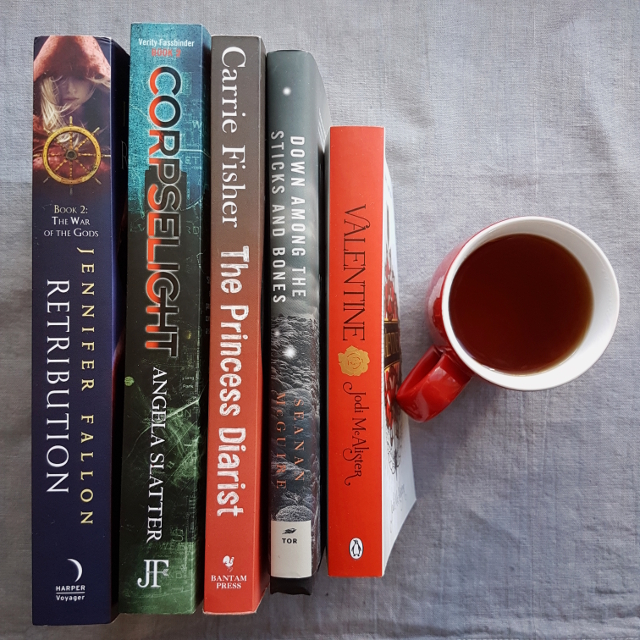
2017 is now half over and I have met my initial annual reading goal of 100 books. I’ve decided to go ahead and set a new target. Without the Aurealis Awards to spur me on, my reading pace has slowed, so I think 200 books isn’t realistic. However, 150 books should be achievable.
June was my slowest month for reading yet, with just 11 books finished. I put this down to attending Continuum. I should also note that I was very restrained with my acquisitions at the convention; most of this month’s acquisitions are for review.
Mt TBR Status
Mt TBR @ 1 January 2016: 327
Mt TBR @ 31 May 2017: 334
Mt TBR @ 30 June 2017: 334
Books Read
95. Rosemary and Rue by Seanan McGuire. Reviewed here.
96. Nimona by Noelle Stevenson. Read for the Sisterhood of the Travelling Paperback podcast. Previously a web comic, it tells the story of a young shapeshifter who becomes the sidekick to a villain… and perhaps does a better job of being the villain than the man she’s assisting. I enjoyed seeing the art style evolve, and there were some lovely moments of vulnerability in the story.
97. This Census-Taker by China Mieville. Read for the Hugo Awards. A young boy potentially witnesses the murder of his mother by his father, but is nevertheless left by the village in the care of his father. A strange, experimental story that I never quite grasped.
98. The Furthest Station by Ben Aarnonovitch. Reviewed here.
99. Beyond Innocence by Kit Rocha. Post-apocalyptic erotica. Sixth book of the Beyond series. As a trained courtesan, Jared knows he’s most valuable to the O’Kayne’s by staying undercover and collecting intelligence. However, an encounter with Lily, the newest O’Kayne, makes it just that little bit harder. This had a slightly different voice to the previous novels, which I appreciated. I also loved the way Lily not only rescues herself but the people she cares about, rather than ending up as the damsel in distress.
100. The Vision by Tom King. Read for the Hugo Awards. The Vision seeks normality and settles into suburbia with the family he has created for himself. It soon starts to go awry. While I appreciate the way it wrestles with bigotry and admire its incorporation of elements from classical tragedy, neither the art style nor the story appealed to me.
101. Behind the Mask edited by Tricia Reeks and Kyle Richardson. Reviewed here.
102. A Frost of Cares by Amy Rae Durreson. Contemporary m/m romance. Luke is a historian who is offered the chance to catalogue the archives of a remote seventeenth-century mansion. However, he gets a little more than he bargained for when he attracts a malicious ghost and is forced to turn to the taciturn but attractive groundskeeper for help. A sweet story with some pretty spooky scenes. I found the choice to defuse some of the tension by having Luke tell it as a memoir was a curious one, and overall I felt it wasn’t quite as good as Durreson’s Spindrift.
103. Beyond Happily Ever After: Closed Doors by Kit Rocha. Post-apocalyptic erotica. A short story set between the sixth and seventh books of the Beyond series. Lex, Jasper and Noelle take it upon themselves to make sure Dallas unwinds after work. It was nice to revisit these characters, but it didn’t ultimately add anything to the series. It’s a story squarely aimed at fans.
104. Beyond Happily Ever After: Blank Canvas by Kit Rocha. Post-apocalyptic erotica. A short story set between the sixth and seventh books of the Beyondseries. Cruz takes Ace and Rachel on a road trip. I loved the premise of this story, which really played into the personalities of these characters. Another story aimed squarely at fans of the series.
105. Retribution by Jennifer Fallon. Reviewed here.
Books Acquired
Control by Mary Calmes and Cardeno C.
Down Among the Sticks and Bones by Seanan McGuire
Valentine by Jodi McAlister
The Princess Diarist by Carrie Fisher
One Last Drop by Nicole Field
In Darkness Burning by Bailey Queen
Sunvault edited by Phoebe Wagner and Bronte Christopher Wieland
Corpselight by Angela Slatter
Trust by Kylie Scott
The Epic Crush of Genie Lo by F.C. Yee
Ashes by Amanda Pillar
Online Reading
our compass needle standing still by brilligspoons. A retelling of Elizabeth Gaskell’s North and South set in space. I loved it to pieces, so thank you to the incomparable Kay for recommending it. My only complaint was that it wasn’t longer–unsurprising when you compress a 500-page book into under 3000 words–but the author did a fantastic job, nevertheless.


July 2, 2017
Retribution by Jennifer Fallon
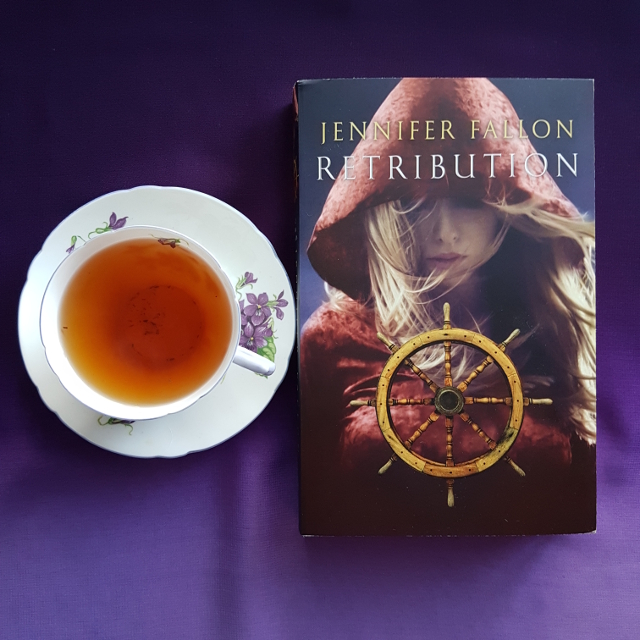
Published: May 2017 by Harper Voyager
Format reviewed: Trade paperback, 420 pages
Series: Hythrun Chronicles #8, The War of the Gods #2
Genres: Epic fantasy
Source: Publisher
Reading Challenges: Australian Women Writers Challenge 2017
Available: Abbey’s ~ Amazon ~Book Depository ~ Booktopia ~ Dymocks ~ Kobo
Disclaimer: I was provided with a free copy of this book in exchange for an honest review.
This review contains spoilers for previous book.
Since fleeing Winternest to avoid King Hablet’s wrath when he discovers the truth about her parentage, leaving her slave, Charisee, to take her place, Rakaia has been on quite an adventure. She has met the demon child, traveled the continent with the charming minstrel, Mica the Magnificent, enjoying more freedom then she ever imagined trapped in the harem in Talabar. But her freedom has come at a cost. Mica has committed an unthinkable crime, worse even, than stealing the golden lyre, and she is now his unwilling accomplice, sailing the high seas on a Tri-lander pirate ship, doing everything she can to avoid upsetting the man she once thought she loved, but has now realized is quite insane.
Meanwhile, Charisee, still pretending to be Rakaia, is trying to make the best of her new life as the Lady of Highcastle. But Rakaia’s past will catch up with her, even as her own lies are in danger of being exposed.
As Adrina struggles to hold Hythria together, and Marla tries to deal with the fallout from the shocking events that take place in the Citadel during the treaty negotiations, Wrayan Lightfinger and the apprentice sorcerer, Julika Hawksword, must travel to Sanctuary to find out why the fortress is back. What they will discover is shocking and will affect the entire world, even though they don’t realize it.
The Lyre Thief was one of my favourite books of 2016, so I was delighted to get the opportunity to review the sequel. It didn’t disappoint.
Being an epic fantasy, the book has a large cast of characters. I didn’t stop to reread the first book, instead choosing to dive in. It was a bit of an effort to remember who everyone was, but I soon got my feet under me. The book also has a cast of characters in the back to help, should you need it.
One thing I loved most about this series is that there are women everywhere. Most of the POV characters are female and they drive the action forward at every turn. Although the setting is a generically medieval-influenced fantasy comprised largely of patriarchal societies, the author uses her female characters to examine this set-up and to undermine it to some extent. Sophany and Rakaia are caught in relationships with dangerous and abusive men. Both try to protect people they care about and influence the situation by playing to very traditionally feminine roles. This provides an interesting contrast to Charisee and Adrina, both of whom are more secure in their power, even if it is borrowed from their husbands. These two women use this power to defy the patriarchy more directly, to varying degrees of success.
These women are without their flaws. Some of the minor female characters are downright horrible. And, as with the first book, the POV characters often act selfishly–but this is often a short step from survival and it’s never the sum of who they are. There’s always someone they care about and this helps them to remain likable.
There are a few places where the book wears its influences plainly. This was most notable when a childish king declared it was his mission to drive out the elves and make his nation great again. The story is dark at times, so this may not be the best choice for readers looking for a light escape.
However, if you’re looking for a more hopeful, more feminist alternative to A Song of Ice and Fire, Retribution may be the book for you.


June 29, 2017
Loose-leaf Links #42
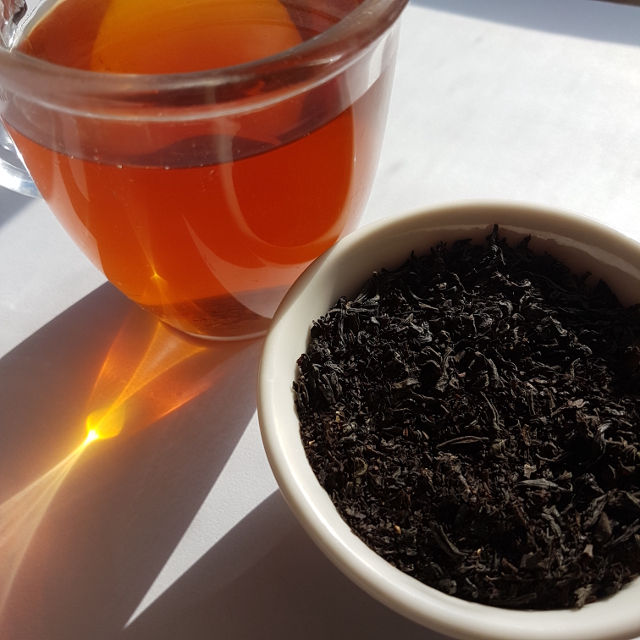
Loose-leaf Links is a feature where I gather together the interesting bits and pieces on sci-fi, fantasy and romance I’ve come across and share them with you over tea. Today’s tea is one I picked up while at Continuum: Vic Market Mornings by McIver’s Tea and Coffee Merchants. I like my teas strong, but this verges on a little too bitter for me to drink straight.
Follow Up
Somewhat related to my post on feminism, diversity and tabletop RPGs, Katherine Cross wrote a great article for Bitch Media about erotic content in roleplaying games–both online and tabletop. Being formerly a Forgotten Realms fan, I appreciated her examination of the setting’s lack of sex positivism. She also points to some great work being done in the Numenera setting by Shanna Germain–who was mentioned to me separately by my fellow Continuum panel member Laura Wilkinson.
Awards News
The winners of the 2017 Locus Awards were announced. Congratulations to the winners and nominees!
Kathleen Jennings walks through designing the trophy for this year’s Ditmar Awards.
Along similar lines, local glass artist Spike Deane unveils the gorgeous trophy she designed for the Australian Fairy Tale Society‘s new award. No official announcement of the award is yet available online.
The winners of the fifth annual Bisexual Book Awards were announced. However, the winner of the YA category caused some contention, as the book doesn’t in fact feature a bisexual main character.
Local writers should be aware that nominations are open for the ACT Book of the Year. Eligible books must have been published in 2016 and written by an author residing in the ACT. Deadline is 28 July.
Community and Conventions
Via File 770 comes news of a couple of bids to host Worldcon. Boston has withdrawn its bid to host in 2021 and has been replaced by Washington D.C. Of slightly more interest to Antipodean fans, New Zealand has a bid for 2020, which I hope will see a lot of support. Australia will have to wait its turn until 2025 and hope that Perth can beat out the US Pacific Northwest. I will certainly be keeping an eye on the situation.
Local writers may be delighted to learn that Isobelle Carmody was named the 2017 Writer-in-Residence at the ACT Writers Centre. She’ll be running a writing workshop on 2 September.
On Equity
Over at No Award, Stephanie Lai discusses racial microaggressions at SFF cons and strategies for calling them out.
Muhammad Aurangzeb Ahmad sketches out the Muslim tradition of sci-fi and speculative fiction.
Uncanny Magazine is taking over Lightspeed Magazine’s Destroy series with Disabled People Destroy Science Fiction. The issue will feature a team of guest editors who are all disabled themselves, and will be funded by a Kickstarter to be launched on 24 July.
For Writers
The Canberra Speculative Fiction Guild has announced that Chris Large and Leife Shallcross will be editing their forthcoming anthology. Titled A Hand of Knaves, it will be open for submissions in August.
Rosarium Publishing is also seeking submissions for their anthology Trouble the Waters: Tales from the Deep Blue. Stories up to 7K should be submitted by 1 November.
Jeannette Ng shares five tips about writing fictional cultures. The article is aimed at video game design, but could be applied to books.
For Readers
Hodderscape delighted Twitter by announcing they’re publishing Becky Chambers’ next Wayfarers book, Record of a Spaceborn Few. Sadly, we’ll have to wait until next year for it, though pre-orders are open already.
YA author Amie Kaufman is perhaps best known for her team-ups with Megan Spooner (The Starbound Trilogy) and Jay Kaufman (The Illuminae Files). However, she’s just announced her first solo book. Ice Wolves, the first in the Elementals trilogy, will be out next year with Harper Collins.


June 25, 2017
The Furthest Station by Ben Aaronovitch
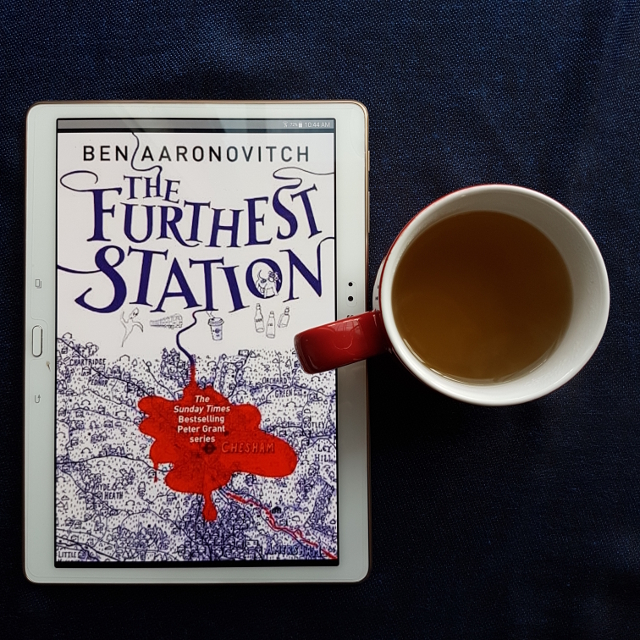
Published: June 2017 by Subterranean Press
Format reviewed: E-book (mobi)
Series: Rivers of London/Peter Grant #7.5
Genres: Contemporary fantasy
Source: NetGalley
Available: Publisher (print and electronic) ~ Amazon ~ Barnes & Noble ~ Book Depository ~ Booktopia ~Kobo
Disclaimer: I was provided with a free copy of this book in exchange for an honest review.
There have been ghosts on the London Underground, sad, harmless spectres whose presence does little more than give a frisson to travelling and boost tourism. But now there’s a rash of sightings on the Metropolitan Line and these ghosts are frightening, aggressive and seem to be looking for something.
Enter PC Peter Grant junior member of the Metropolitan Police’s Special Assessment unit a.k.a. The Folly a.k.a. the only police officers whose official duties include ghost hunting. Together with Jaget Kumar, his counterpart at the British Transport Police, he must brave the terrifying the crush of London’s rush hour to find the source of the ghosts.
Joined by Peter’s wannabe wizard cousin, a preschool river god and Toby the ghost hunting dog their investigation takes a darker tone as they realise that a real person’s life might just be on the line.
And time is running out to save them.
The Furthest Station is a quick novella that retains the spirit of the series but which remains unsatisfying.
Peter’s distinctive voice is present; even though the novella is short, there’s still space for his digressions and pop culture references. There’s even a few footnotes addressed to his American counterpart, though I found these a bit disruptive. They call into question the nature of the story, particularly as there is no framework set up to indicate Peter is addressing someone particular.
The story does a reasonable job of introducing who Peter is and what he does for a living. However, I’m not sure I’d recommend it as an entry point to the series. For example, the oddness of Molly is never explained for a new reader and the references to Beverley and her family are cursory. There’s a lot of background present which is likely to make it confusing.
I enjoyed seeing Peter spend more time with Abigail, though there’s never any real change in their relationship. Preserving the status quo for the novels in such a way leaves it ultimately feeling like filler.
The main plot held up fairly well until the ending. While it was nice to see an acknowledgement that not all police work ends tidily or in a dramatic fashion, the number of loose ends made it unsatisfying to me.
All in all, The Furthest Station was a pleasant read, but not one of Aaronovitch’s better works.


June 22, 2017
Feminism and Tabletop RPGs

At Continuum 13, I had the pleasure of sitting on the Tabletop Gaming panel with Aidan Doyle, Darryl “Owlbear” Brown, Laura Wilkinson and Bryce Campbell. The discussion was a mix of designer and player perspectives, and remained an upbeat conversation throughout. We could have continued for hours.
One of the things I touched on in the panel was feminism and gaming. I wanted to elaborate a little on that here.
The rise of Kickstarter has brought a new golden age for indie RPGs. As the panel mentioned, you can now find something for everyone. This includes games that have strong feminist influences and encourage diversity. A few of the games that have come across my radar include:
Bluebeard’s Bride by Whitney Strix Beltrn, Marissa Kelly, and Sarah Richardson. This gothic horror RPG is still in production, but you can still preorder and check out their Kickstarter pitch video. Players collectively form Bluebeard’s Bride, playing different aspects of her psyche as she explores her husband’s mansion. Although the game uses the structure of the original fairytale, it encourages players to tell their own versions, allowing space for the empowering as well as the tragic.
Eclipse Phase by Posthuman Studios is a cyberpunk game which has just Kickstarted its second edition. This game is perhaps a little less explicitly feminist than the others. However, being concerned with posthumanism, it allows space for exploration of gender and disability through mechanisms for swapping and augmenting bodies. Perhaps unsurprisingly, it has more of a complicated rule system than the other games (which are all Powered by the Apocalypse).
Monsterhearts by Avery Alder is one of my favourite RPGs. It’s an urban fantasy about teenage monsters. As you might expect, teenage sexuality is an important element of the game. This may be why it is the first (and, so far, only) game I’ve ever seen discuss asexuality and allows space for that within the rules. It is also built around the premise that everyone is fundamentally bisexual and can be turned on by characters of any gender–though players always retain the choice of whether they wish to act on these feelings.
Night Witches by Jason Morningstar. Set in WW2, players are members of the all-female 588th Night Bomber Regiment in the Russian Army. The game touches on the discrepancy between the Soviet philosophy of equality and how the women were actually treated. It also explicitly mentions queer relationships and one of the playbooks allows for a genderqueer character.
The Watch by Anna Kreider and Andrew Medeiros. A low magic fantasy wherein a mystical enemy known as the Shadow invades. Able to enter and subvert the minds of its enemies, the Shadow is particularly effective against men. It’s up to women and non-binary femmes to form the Watch and defend their lands. This is another game still in production, but you can still check out their Kickstarter. I appreciate the explicit inclusion of non-binary femmes in their pitch. The game also looks like it will have some mechanisms which deal with mental health.
These games have diversity and inclusivity baked into their premise and mechanisms. While I will always value these sorts of games the most, they’re not the only way of promoting diversity in RPGs. As I mentioned in the panel, simply including diverse people in the accompanying artwork can go some way towards fostering an inclusive environment. The fifth edition of Dungeons and Dragons has made some improvements in this fashion (even if the setting retains some problematic elements).
The games I’ve mentioned here are surely just the tip of the iceberg. If you’re a keen tabletop RPGer, I’d love to hear from you: Which feminist RPGs have you discovered?


June 18, 2017
Rift Riders by Becca Lusher
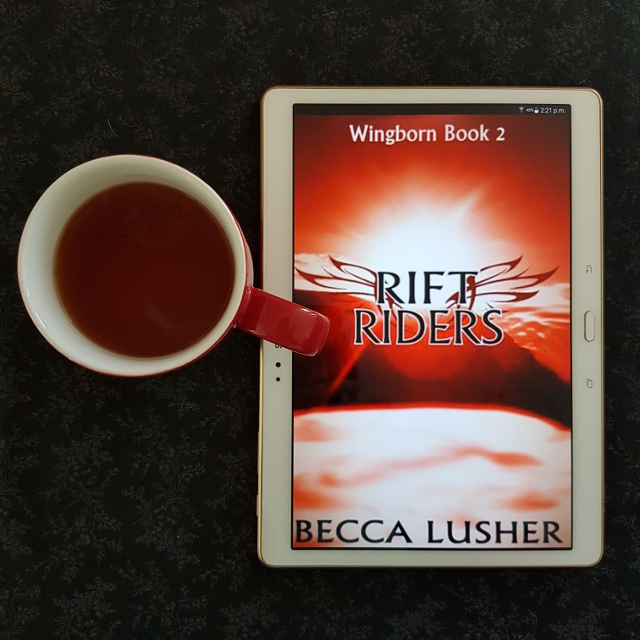
Published: Self-published in March 2017
Format reviewed: E-book (mobi)
Series: Wingborn #2
Genres: Fantasy
Source: Author
Available: Amazon ~ Barnes & Noble ~Kobo ~ Smashwords
Disclaimer: I was provided with a free copy of this book in exchange for an honest review.
The author is a friend. I have done my best to give an unbiased review.
This review contains spoilers for previous books.
On a world cursed to be covered in clouds, protected by the elite Rift Riders who fly on the backs of giant eagle miryhls, Lady Mhysra Kilpapan and her friends are making history. Women are now firmly back within the Rider fold and the future looks bright.
But even though Mhysra and her Wingborn Cumulo have survived their first year as students, there’s more to becoming a Rift Rider than lessons and training. Especially when trouble is brewing in the Wrathlen and the kaz-naghkt are looking for revenge.
Return to the Overworld for the next exciting Wingborn adventure, where strength, loyalty, honour and friendship are about to tested to their limits and beyond.
I am a huge fan of the Wingborn series. What’s not to love about a magical Regency-influenced society where the military ride giant eagles? Wingborn did an excellent job of setting up that society: showing the bond between rider and eagle, as well as the expectations the upper class have of their children.
Rift Riders takes that and shakes it up. Now that the world has been established, a serious threat steps forward. Yullik, a man with mysterious powers, manages to unite the pirate captains of Wrathlen for the first time in history. Allied with savage draconoids, the kaz-naghkt, they may prove unstoppable–even for the Rift Riders. This new threat builds great tension and raises the stakes. It also makes Rift Riders quite a different book to its predecessor. The more domestic aspects of the story, such as society life and the Kilpapan family dynamics, are left behind in favour of a more traditional epic fantasy narrative.
While this was slightly disappointing, the transition works well, with Rift Riders becoming more of an ensemble piece. Mhysra remains an important part of the narrative, but her friends get a greater share of the spotlight, with a few stepping forward to become point-of-view characters. This enables us to see more of what’s going on, particularly when battles break out on several fronts.
The relationships between these characters remain a strength of the story. The groundwork for a few romances was laid in the previous book, but this are dialled back or absent entirely. Instead, the focus is on friendship and duty. Mhysra and her friends do their best to support each other as they struggle to survive and defend the realm. The banter between them is never entirely absent, lightening what could otherwise be quite a grim story. Nor is this friendly teasing limited to the students–Lieutenants Lyrai and Stirla are equally as bad.
Managing such a cast of characters can be a handful, but the story does an excellent job of reintroducing everyone in the beginning. It does so through a tight action sequence which handles both aerial and ground-based combat in a way that sets the tone for the rest of the novel.
All in all, Rift Riders was a delight to read. With at least one more novel to come, and with the shift of tone between books, I’m curious to see what is in store for the remainder of the series.