Jason Matthews's Blog, page 30
August 4, 2011
Ebook Covers, do People still Judge them?
People judge a book by its cover, so it logically follows that people judge an ebook by its cover too. Because that's true to a degree, many Indie authors prefer to hire out for this even though costs can range anywhere from $50 to thousands. However, it's also true that effective ebook covers can be designed for free. It's a bonus to be able to make changes yourself anytime and to save money if you have multiple titles.
Take a minute to check out the top selling books on Amazon – http://www.amazon.com/gp/bestsellers/books/. These are paper books, not ebooks, and it may surprise you to see how simple many of the covers are. It should also inspire you knowing that books with average covers can still sell in large quantities.
My theory is that the ultimate success of a book is determined by what's inside. Over time, reviews and referrals sell ebooks. Would you rather have a 5-star cover and a bunch of 1-star reviews warning others to stay away, or the opposite?
Besides, ebook covers are seen as fairly small pictures. People don't inspect them up close as when browsing in a bookstore. For simple yet effective designs, there are many things you can do for free. Here are a few methods for obtaining and working with images online.
Take photos yourself.
 Use a digital camera and take photos either of yourself or things that are in line with the themes in your book. Many cover images include the author or background landscapes that are simple pictures with appropriate text around them. With image/graphic editing software you can create additions to complement the photo. Or you can take photos of something related to your ebook. This worked for my first novel, The Little Universe. My artistic friend held out her arm with a paintbrush in hand. She stood in front of a black background, and the resulting photo worked great. Her arm and paintbrush were cut out with a free editing program and pasted over another image, a public domain one.
Public domain images.
 Public domain means anything that is not owned by someone with copyright restrictions. Like the term open source, it's free to use so long as you're not selling the image itself. For a book cover, public domain pictures are fair game. This is a public domain image for The Little Universe. It's a photo of a spiral galaxy taken by the Hubble Space telescope. Since NASA is a government outfit paid for by our tax dollars, the American people collectively own those images. If you like amazing astronomy pictures then definitely see the collection at http://www.hubblesite.org/gallery/. However, most of your ebooks probably won't have much to do with astronomy. Here's a list of websites that offer tens of thousands of free, public domain images:

http://www.public-domain-photos.com/
http://www.publicdomainpictures.net/
http://www.usa.gov/Topics/Graphics.shtml
 If you want a better selection, you can buy royalty free images for about a couple of bucks apiece. This worked for my second novel, Jim's Life, where it cost just two dollars for the rights to use an image of a young man's hands with colorful light energy all around them. It was perfectly in line with the theme of my novel. The image was found by searching Google for royalty free images. There are dozens of places where you can browse millions of images and pictures for book covers and buy them for about one to four dollars apiece. You can also search the stock photos by keywords to narrow the results.
There are plenty, but here are two great sites for royalty free images:
http://www.bigstockphoto.com/ – where the image was found for Jim's Life.
http://www.istockphoto.com/ – another good place and very affordable.
Photo and Image Editing software.
 Simple photo editing might be all you need for creating a simple yet pleasing book cover. With Picasa 3 it's easy to manipulate the images and add some text, although Picasa is severely limited in what it can do compared to graphic editors. But even if using more complex software, Picasa or Flickr are good to have. People argue over which one is better, but for the purposes of creating an ebook cover, Picasa is great. It's free, managed by Google and super user-friendly. Simply download Picasa 3 and follow the prompts.
Here's the short list of photo/image editing software, and more are available through a search:
http://www.picasa.google.com/ – perfect for simple things like image enhancement, cropping, resizing and text additions.
http://www.flickr.com/ – similar to Picasa, owned by Yahoo, preferred by people who want to share their photos with potentially large communities and by many avid WordPress bloggers.
Open Source Image and Graphic Editors.
These are more complicated and capable than Picasa, but if you're familiar with the original Macintosh Paint program or Microsoft Paint, then you can learn to use these types of software. These programs can alter images in every way imaginable, plus they can create outstanding images from scratch. Remember to watch tutorials and follow along with video lessons.
 Using one of these graphic editors is what made the cover of this ebook, How to Make, Market and Sell Ebooks – All for Free. The cover design probably won't win any awards, but it's perhaps as good as some of the best-selling books on Amazon. Remember, books are ultimately judged by the value within, and people mostly read books that are recommended to them.
Here's a partial list of sites with free editing software:
http://www.inkscape.org/ – makes vector images, much higher quality than pixels. Inkscape was used for this cover, which is fairly simple but gets the job done. However, art isn't my specialty, so many of you might be able to use Inkscape to come up with incredible designs from scratch.
These are also recommended image and graphic editors:

http://www.getpaint.net/ - works with Windows only.
http://www.seashore.sourceforge.net/ – works with Mac only.
Now, you should spend some quality time here and come up with a cover design that makes you happy. Remember that it doesn't have to be perfect, but you want it as good as you think it can be. No need to rush through this one.
–
Subscribe to this blog for updates on whatever I learn for those who want to sell ebooks.








August 3, 2011
Power of Blogs for Indie Authors
 The power of blogs for Indie authors cannot be understated.
We all know that social media and online presence matter. It's nearly impossible for Indies to sell ebooks and paperbacks without utilizing internet tools like Facebook, Twitter, YouTube, forums, blogging and more. If you talk with enough authors, it's clear they each have preferences. Many swear by Twitter, but this can be a difficult/confusing tool to start out with. Others prefer Facebook or LinkedIn. Some love spending time in forums, like at Goodreads, Amazon or Authonomy.
My preference is doing a little bit of everything, but regular blogging for me has been the single most important element in building an internet presence and selling ebooks online. It's just from my own experience, but the power of blogs ranks number one for making connections with perfect strangers from all over the world.
Why, and what's a perfect stranger? A perfect stranger, to me, is someone who finds my blog by searching for the subject matter of what my blog is about. They use Google or another search engine, type in a term like "sell ebooks on Kindle" and then happen to click on my blog listed among the pages of search results. Of course it makes a huge difference when my blog comes up on the first page and near the top, hence the need to learn/practice good SEO habits and also use a great host like WordPress or Blogger (which also provide free blogs).
The other question is why are blogs my preference over other social media methods like Facebook, Twitter, YouTube, forums, etc? The answer is because a blog post acts like a perpetual billboard over time, discussing a topic that will become searchable for years to come. Hundreds to thousands of people the world over will see my individual blog posts covering an array of related subjects, and since there is relevancy in my posts (and books) to their search terms, the chance they might buy my books is much higher than just someone seeing a general listing in a forum or on Facebook.
Blogs bring targeted customers to your website. What you discuss is relevant to what they want.
I maintain a free blog at both Blogger and WordPress. The one at blogger is dedicated to my novels and personal life. The WordPress one (this one you're at), is dedicated to Indie authors selling ebooks and e-publishing in general.
There are just a few rules for successful blogging. One rule is to add posts regularly, at least weekly and as often as daily (if possible). Some very successful bloggers I know, Joan Reeves of Slingwords and Jana Matthews of New Moon Manifesting, usually blog several times a week and have great results from that.
Another rule is to use your own voice. It can be professional or downright personal and filled with slang. People want to see the real you, and a blog is great for that. Be true to yourself, and the right people for your books will come back.
Another rule, and the most important, is to use great SEO habits with each post like the ones outlined in Get On Google Front Page. My WordPress blog has only been in existence for 18 months, yet it's had over 2,000 search terms lead perfect strangers to it and to my books. What follows is a list of last week's search terms that led people to my blog, just one week's worth of searches totaling 125 search terms, words/phrases typed in by people to search engines which resulted in both this blog being listed in the results and people actually clicking on the link for this blog. It's an indicator of how well a WordPress blog and some regular posts with good SEO will attract people from all over the world in a relevant search to the products offered here. (You may want to scroll through it quickly, since it is rather long .)
2epub
red moon chronicles trotman
jason matthews ebook
best way too sell ebooks
jason matthews author
ebook piracy
selling ebooks on wordpress
createspace ebook
kindle ebook sell
how do i market my e books
can you publish on both kindle and nook
selling ebooks on amazon
sell ebook amazon com kindle ebook
selling ebooks with protection
uploading ebooks for sell
iriver cover story actual size
percentage of ebooks with drm
kindle ebook table of contents
how to sell ebooks on amazon
self promotion
sell ebooks on wordpress
selling ebook ibookstore amazon royalties price
best way to price amazon ebook
amazon or authors who set 99 cent price?
ebook sales slow at kindle
where to sell ebooks in japan
kindle direct publishing japan
free word to mobi conversion
indie authors forum
kindle tags are back
how to tag my book on the internet
how to make, market & sell e-books epub
selling ebooks
how to sell e-books on google store
how do i turn my manuscript into an ebook to sell on amazon?
why does amazon lower price to 99 cents
how can i sell more kindle books
amazon indie promtion
formatting ebooks for amazon
top markets to sell ebooks
sell ebook in germany
ebook
ebooks process in google
sell ebooks nook ebook
selling ebooks in wordpress
how do i sell my novel as an ebook?
amazon kdp
how to set ebook price
best place to sell ebooks for independent publishers
how to make wordpress site to sell ebook
kobo touch
how to make bookmarks for an ebook
amazon author forum
how to publish a social sciences ebook on amazon
publishing ebooks with drm
sell ebooks on your wordpress site
making ebooks
where to upload and sell ebooks with lr
how to make table of contents for kindle
ebooks a fad?
indie authors
using bookmarks and hyperlinks for kindle toc
wordpress sell ebooks
indie authors grammar
amazon author link does not show on ebook page
ebook navigation control file
sell ebooks on amazon kindle
how to make free e book for sell
how do i price my ebook to sell on amazon
selling e-books on amazon
how to do hyperlink book mark in wordpress
how to sell ebook on pubit
how to sell ebooks blogs
where does the ncx file go?
e-books blog
complaints about kindle ebooks
forums for indie authors
doc tomobi
get a free website for uploading ebooks on.
resell e-books amazon
how to get more amazon tags
market for spiritual books 2010
kindle
google ereader compare to kindle
doc to mobi
free website to sell ebooks
creating a toc in html for amazon kindle docs
how to get more tags on amazon
blurb create ebook
selling e-books
Интернет
how to market ebooks in uk
wordpress themes for authors selling ebook
books on keyword research
low price ebook drm
best places to sell ebooks 2011
kdp.amazon.com
jason matthews ebooks
how to sell self published "ebooks"
jason matthews how to make sell ebooks
amazon forums threads
what is the best price to sell ebooks in an ebook store
sell ebooks on amazon
how to make front page in google
images of kindle
how do i market an ebook
royalty payments to authors for ebooks
nook formatting for authors
how to market ebook on pubit
inserting pictures kindle ebook
kindle use bookmark to create table of content
createspace ebook store
best way to sell ebooks
nook color manual
smashwords best ebooks august 2011
indie ebook authors high price or low price
how to make changes to ebook on amazon
how to make and sell ebooks
companies that market ebooks
beginning bookmark kindle
jigsy no longer free
i have a blog and want to sell books on it
typos in sample ebook amazon
how to make, market and sell ebooks – all for free
That's quite a list, and hopefully yours will be similar soon if it's not already. My advice is to start blogging if you've been putting it off. Check out WordPress and Blogger for great free blogs. Stick to topics related to your books or products. Keep posting at least once a week for as long as you can. Use good SEO habits like the ones in Get On Google Front Page. It might amaze you who shows up in time.
–
Subscribe to this blog for updates on whatever I learn for those who want to sell ebooks.







August 2, 2011
Where to Sell Ebooks? Not Everywhere
 Frequently writers ask me about a certain new e-publishing company for selling ebooks online. Without naming names, there are dozens of new start-up companies every month, popping up worldwide with all the needed services for authors to sell ebooks. Packages include converting file types, formatting, optional editing, cover design, setting up a webpage in their e-bookstore and also uploading to the major retailers. The fees vary from a flat subscription to a small percentage of the sales. Either way, they do make money from your ebook and in most cases, using them really doesn't make much sense (in my opinion).
You might ask, "Why not? Isn't it smart to sell ebooks everywhere possible?" To some degree that's true, but the energies needed to market ebooks online can easily be gobbled up with more proven methods like blogging, participating in forums, writing articles and more. Trust me, this other stuff is mandatory for Indie authors just starting out and will take up plenty of time in cyberspace. There's no need to spread yourself too thin.
Here's the fact of the matter and a better reason not to worry about submitting ebooks to all these new companies. They don't make e-reading devices. These days, millions of people buy and read ebooks. Take a rough guess (estimating here) which devices 98% of those book customers read on? The answer is a combination of Kindles, Nooks, Sony Readers, Kobo Readers, iPads, iPods, other tablets and then further on down the line things like cell phones and computers. The fact is this; Kindle owners buy from Amazon. Nook owners buy from Barnes&Noble. iPad and iPod owners buy from Apple. Kobo and Sony Readers buy from… you guessed it, Kobo and Sony. Of course there are some exceptions to this rule, but the vast majority of ebook purchases are from the exact same companies that supply the devices.
And it makes sense for the customer. The likelihood of having a perfectly formatted ebook for their device is much higher this way. If there's any problem, returns shouldn't be an issue. Customer service with those major players is typically far superior to start-ups, especially from foreign countries.
Want more proof? Over 99% of my ebooks are sold from Amazon, Barnes&Noble, Apple, Kobo, Sony, Smashwords and my own websites. As for the half-dozen of these other ebook retailers, my ebooks basically don't sell at all, or hardly ever (occasionally at Scribd). My advice is just to upload to the biggies: Amazon, Barnes&Noble, Apple, Google, Smashwords and such along with selling pdf and epub copies from your own website and blog. Besides, all of that can be done for FREE.
However, one way to maximize potential from these smaller ebook retailers is to allow a sample, like 30%, of your ebook to be read for free. Then at the end of the sample, you can include links to the major retailers where it can be purchased. This is my method at Scribd, and it seems to be working as there are thousands of documented reads for 6 titles and even a rare sale happens. See my documents here at Scribd. This approach will save you time to focus on the more important things for selling ebooks online, like regular blogging.
–
Subscribe to this blog for updates on whatever I learn for those who want to sell ebooks.







August 1, 2011
Authonomy, How to Get Published or Not?
 Can Authonomy help with your writing goals? Yes and no, of course it depends what those writing goals are. If you're wondering how to get published, then probably not, but it's still a great place for that. Confused? Perfect, because it does have that effect on people.
Authonomy is many things to different people. It's primarily an online writing community sponsored by British publisher, HarperCollins, a major player in the publishing world. It's also a place to network with other authors and spend time in the writing forums. It's even a means to pull out your hair and run kicking and screaming that you'll never return.
That interest you? Then you might be wondering, how does it work? Most authors begin by creating a profile, uploading an avatar photo and then uploading some chapters or all of their book. Books do not have to be complete to participate. When others read from your book and "back" it (like giving it a positive vote) by placing it on their "bookshelf" or "watchlist," your book gets points in the form of a better ranking and green arrow. As your book climbs higher in ranking (from #10,000 toward #1), you watch a little green arrow and the corresponding number change daily. On the other hand, if your book slips in popularity and goes backwards, a red arrow will appear next to it. Green-good, red-bad. Your "talent spotter" status has a similar feature of green and red arrows depending on how well you "back" books that are on the rise.
At the conclusion of each month, the 5 titles with the highest rankings (#1 through #5) are chosen by HarperCollins (HC) to get reviewed by their professional editors and, if they are deemed publishable, offered a publishing contract by HC. This monthly effort of making it to the editor's desk (or ED) can be enormously time-consuming with no guarantees.
Authonomy bills itself as being "much more than a community of book lovers. An online community of discovery where writers become authors. Help great books get published." This slogan seems more accurate than the previous one that simply read, "beat the slush pile." Authonomy actually is a gigantic slush pile all its own, although there are some great benefits to the site that you can't get during a prolonged stay in a conventional slush pile at an agency or publishing house.
What can Authonomy do for you? In a nutshell, it can be a fine place to network with other writers; some are just starting out and learning the craft, some are gifted writers who need their first big break, and others are self-published Indies making a name for themselves.
What can you expect from joining?
Expect to meet lots of people interested in writing and being published. Most want traditional publishing from HC or some other big house, and a few (like me) are content with self-publishing and networking.
Expect to do read swaps where authors each agree to read a chapter or two of each other's book and make comments. This can be a great way to get in-depth critiques for the first few chapters. It's less likely that people will read your entire manuscript, though arrangements can be made.
Expect to become a bit addicted to the place and the writing forums. It can turn into a time-consuming habit to say the least, and a full-on addiction in worst cases.
Expect to be spammed by desperate writers wanting to rise in the rankings to make the editor's desk.
Expect to meet people from all over the world.
What should not be expected after joining Authonomy?
Do not expect to make it to the editor's desk without spending many months there in a full-time effort of reading, critiquing, spamming and begging others to "back" your book.
Do not expect HarperCollins (or anyone else) to publish you even if your book does make the coveted editor's desk. They hardly ever publish these books. Do not expect to meet agents or publishers, and if you do, make sure they are legitimate.
Do not expect people to always be honest or do a good job during swaps for critiques. Usually they are working with integrity and have good critiques, but not always.
My advice on how to use Authonomy is this:
Swap reads with a dozen or more writers to make sure your first few chapters are at their best. Try to make these swaps with skilled writers, as they will provide the most valuable feedback. Use the editing advice you get during those critiques to carry throughout the rest of your manuscript. If you find good readers who want to swap reads for entire books, do it.
Network with other authors, especially those self-publishing. Learn what they know about Facebook and Twitter, blogging, Amazon/Barnes&Noble/Smashwords, anything related to the e-publishing business. Even if your dream is to be published traditionally, whatever you learn about marketing will be of great value.
Don't get caught up in the daily games or spamming efforts to back books.
Don't get caught up in the green and red arrows. In fact, you'll probably be happier if you never look at them (like me).
Have fun with it. There are some genuinely wonderful people to be found (the diamonds in the rough).
HarperCollins has a young adult version of Authonomy called Inkpop for authors with books aimed at this audience.
–
Subscribe to this blog for updates on whatever I learn for those who want to sell ebooks.







July 31, 2011
Monthly Indie Author's Thread at Amazon Kindle Forum
 Every month Indie authors who want to sell ebooks have a place in Amazon forum threads dedicated just for them to share blurbs/links about their ebooks with perspective readers. This e-publishing solution happens at both Amazon.com (USA) and Amazon.co.uk (United Kingdom).
The thread in the US is run by Blue Goddess, the handle of a long-time forum participant. It's done in memory to a passed and well-known/loved supporter of Indies named dog (case sensitive as his handle was). An example of the past month's US thread:
In memory and in honor of our beloved forum member, dog, I am starting the Indie Author's Thread for July, 2011. *raises a glass to the heavens, and toasts dog* Thank you, dog, and everyone who is now, or has ever served in the military.
For those of you who do not know, dog was a beloved forum member who was taken from us much too soon. He was a supporter of indie authors, good will towards each other, peaceful communication, and good humor. dog could stop a thread from turning ugly with a wily joke or an impassioned statement.
dog was the originator of the monthly Indie Author's thread. When he passed, I merely picked up where he left off, to keep his memory, and the tradition alive. While we no longer need a "safe haven" for the authors, I think it is important to remember dog, and to give each month a fresh start for new kindle owners.
You can read more about dog at the thread below. Fellow forum member, Corky, has put together a fantastic list of dog's greatest hits.
Please note that dog's posts now say they were made by Selena, as his daughter took over his account when he passed. Here is the thread she started on that fateful day -
Readers…enjoy the wonderful books you find here! Authors, good luck!
And then the Indies begin posting blurbs with links to make readers aware of their work and hopefully sell ebooks on Amazon. This is the example of the thread from July, 2011.
Amazon UK has adopted a similar thread. Their July example can be seen here.
Since today is the final day of July, the August thread should be coming out any minute at both locales. Look for it in the US at the Meet Our Authors forum and in the Uk at the main Kindle forum. This blog post will be updated with those August links as soon as possible. It's a great way to participate in the Indie threads, to showcase your ebooks before potential readers and to network with other Indeopendent writers.
***Updated for August***
August Indie Author's Thread aka – Viva la dog! (US-Amazon)
August Indie Author's Thread (UK-Amazon)
–
Subscribe to this blog for updates on whatever I learn for those who want to sell ebooks.







July 30, 2011
The Indie Chronicles: Science Fiction Showcase
 For Indie authors specializing in science fiction, there's another great blog to showcase your work. It's called The Indie Chronicles: Science Fiction Showcase. This was discovered by perusing the thread topics in Amazon Kindle's Meet The Authors forum, a smart thing to do now and then.
Just the other day the blog ran a special blurb for my novel, The Little Universe (although I prefer to think of its genre as spiritual/philosophical/inspirational with just a touch of sci-fi. You're familiar with that genre, right?). The specific blog post for The Little Universe is here, while the home page for the blog will update regularly and shows all the books archived over the months.
Interested in seeing if The Indie Chronicles: Science Fiction Showcase will put their spotlight on your novel? Just contact Barbara Peterson through this Amazon Kindle Meet The Authors link since it wouldn't be right to post her email here.
–
Subscribe to this blog for updates on whatever I learn for those who want to sell ebooks.







July 29, 2011
KDP Amazon Facebook, A Group Indie Authors "Like"
The world of e-publishing and social media just got a tiny bit more connected.
 KDP Amazon (Kindle Direct Publishing) now has a Facebook page. Actually its been there for 4 weeks, but they just informed me the BIG news yesterday. (Dogs and cats have Facebook pages, so it's a tad surprising it took KDP Amazon until July 2011 but still a good thing.) From their newsletter:
Recently, Kindle Direct Publishing launched a Facebook page to help independent authors and publishers become more successful with helpful tips and news about KDP. Help us get the conversation started on the right foot and spread the word to your friends by commenting on the Wall of clicking "Like" on the page. http://www.facebook.com/KindleDirectPublishing
What you can do if you're an Indie author trying to sell ebooks, is regularly visit this KDP Amazon Facebook page and participate on their wall. This is the link for the most recent comments – http://www.facebook.com/KindleDirectPublishing?sk=wall&filter=1. Share comments, leave links, talk about your books, crack jokes, make friends and have fun with it. Many people already spend an hour per day at the site. Might as well make it business time.
–
Subscribe to this blog for updates on whatever I learn for those who want to sell ebooks.







July 28, 2011
DRM for Ebook Security, Fight Piracy or Not?
 Many Indie authors who sell ebooks directly from websites and blogs ask me, "What's the best way to ensure ebook protection against piracy? Should I encrypt my files to be DRM protected?" These questions get asked a lot. Since we live in a digital world there is always going to be some degree of electronic piracy; nothing you can do to stop it entirely. My feelings about this topic may surprise you.
DRM stands for digital rights management, an encryption code that Amazon and other retailers use to impose limitations and protect certain products from piracy and unauthorized use, giving authors ebook security. Most ebooks bought through retailers like Amazon and Barnes&Noble have DRM built in. However, others do not, like at Smashwords. While DRM sounds good at face value, there are reasons not to like it, which we'll cover below. And even though many Indie authors are worried about ebook piracy and illegal downloads, what they really should be worried about is obscurity, or no one reading their words.
 Mark Coker is the founder and CEO of Smashwords, a haven for Indie authors to market and sell ebooks as well as a format converter and distributor to all major retailers. What are Mark's thoughts on DRM? From his free Smashwords Style Guide: All Smashwords books are sold DRM-free, without copy protection or encryption. This means you're trusting your customers not to pirate your books. In our experience, the vast majority of customers are honest. Yet without proper education and reminders, a well-intentioned customer might feel inclined to share your book with someone else.
Mark further elaborates on his feelings from this blog interview, http://www.selfpublishingreview.com/blog/2009/02/01/interview-mark-coker-founder-of-smashwords/: The problem with DRM is that it treats law-abiding customers like criminals, because it limits how and when and under what circumstances customers can enjoy your book. The truth about DRM is that it just irritates your customers, and there's little evidence it slows piracy. DRM is easily cracked by hackers, and the people who pirate your book are unlikely to pay for it anyway.
 Think of it like this; if you buy a paper book, you own it. You can lend it to multiple friends afterwards, donate it to the library, or even sell it to a used book store for some of that money back. Your one-time purchase went a long way. But if someone buys an ebook with DRM, she doesn't actually own it. She can't even give it to a friend later, and she can't sell it to a used ebook store. Additionally, DRM sometimes has issues with certain conversions and reading devices that can cause problems for customers to enjoy their purchase. Sometimes buyers cannot access their ebook, and they are typically restricted to one device to view it.
But here's another argument against DRM (or fear of ebook piracy), and you might not have thought of it before.
 If hundreds or thousands of readers across the world were ripping off your ebook and sharing it because it was so wonderful… would that really be a problem? It would not be a problem because more than anything you want to establish a base of readers enjoying and referring it. So if thousands of people were ripping off your ebook and recommending it, then almost certainly thousands of others will buy it legally. Perhaps the more people that rip it off, the more referrals to paying customers will happen! Piracy could be the best thing to ever happen to your ebook!
What should be the real concern for Indie authors selling from their own websites or blogs? Is it ebook security or ebook obscurity? This answer is easy. When it comes to e-publishing, ebook obscurity should be your greatest concern.
Okay then, what can you do to limit the piracy bound to happen to any ebook that people really want?
My advice is to keep your prices reasonable. Most of the people pirating ebooks are targeting the expensive ones, those that are $20, $30, $50 or even more. Some ebooks are ridiculously priced at over $100. No wonder people are ripping them off! Would you want to pay $100 or even $25 for an electronic document? Regardless if the price is justified by the value within, who would want to pay that? Low prices are the best form of ebook security.
That's why I charge $4.99 for How to Make, Market and Sell Ebooks All for Free. Many customers have told me the book is worth ten times the price, that they are perplexed as to why it's so affordable. The reasons are simple: to sell more ebooks faster to delighted customers who will refer it, and to reduce the likelihood of illegal sharing.
–
Subscribe to this blog for updates on whatever I learn for those who want to sell ebooks.







July 27, 2011
Amazon Forum, Meet The Authors for Indie Writers
Spending time in forums (fora) is a great way for Indie authors to sell ebooks, and there's one e-publishing locale that immediately comes to mind: Amazon Kindle forum. The community there is divided into many discussion groups including Romance, Mystery, Fantasy and so on, as well as the main Kindle Forum where by far the most people frequent. In the recent past, Indies often promoted their books in the main Kindle Forum even though it was against Amazon's TOS (terms of service). Over time this special community section turned into a spectacle of "snark" and "snarkiness" with readers and authors routinely taking shots at each other in cyberspace. After enough justified complaints from readers, Amazon created a distinct forum just for Indie authors to promote their books and for readers to meet the authors, not surprisingly called Meet Our Authors.
 The Meet Our Authors forum is the place set aside by Amazon for Indie writers to blatantly (or shamelessly) promote their ebooks/paperbacks and even leave links to websites or blogs. Fortunately, it's a safe haven where Indies can feel free to promote/spam without worrying about the consequences of breaking the rules and being turned in, which can result in loss of privileges. Unfortunately, it can be hard to stand out when everyone is shouting, "Me, me, me, here's my book, look at my book, buy my book!" It's like being one voice in thousands and seeing who can cry out the loudest, not exactly how a respectable, self-published author wants to present herself/himself.
 There are some strategies to make the most of it from my perspective, so maybe this will help if you venture there to spread the good word about your future best-seller.
Introduce yourself along with your genre or subject matter. The thread title is all readers and other authors (who also read, by the way) will see among the list of topics to decide if they want to click on yours and read more. Instead of simply having an introductory thread that reads, Meet The Author – Jane Special, it's better to include something that tips off the subject or genre like, Meet Jane Special – Fitness Guru for Chocolate and Junk Food Lovers. That bit of elaboration will get a lot more clicks and by people already drawn to the subject. Then in the thread Jane can post more info about her book, why she wrote it and a mention for anyone with questions/comments to join the discussion, which will hopefully continue for days and weeks.
An alternative to a direct introduction is to begin a thread on a certain subject covered in your book. For example, in my novel The Little Universe, one of the main themes is the abundance of life that exists throughout the cosmos, that we are certainly not alone. So I created a thread topic by this title, Abundant Life in the Universe? This way, instead of just being a promo for my book, it's an open discussion for anyone with interest or opinions on alien life, other worlds, the mysteries of the universe and more. Both readers and other authors can chime in and even mention other books with similar themes. Remember you can always add a Product Link to send interested readers directly to the Amazon page for your Kindle ebook or paperback.
 Create a fun/interesting theme just to connect with new people. Part of forum networking is simply participating with the crowd and getting to know each other. When you're constantly selling yourself or a product, that can come across as being pushy and unattractive. A completely different approach is just to make a fun or interesting thread as a chance for people to share input and get to know one another. In the past I created a thread based on the concept of Gilligan's Island after Amazon banished all the Indie authors to one forum. It was a fun way to let go of some concerns with the new forum arrangement, and it turned into a good time with input from both readers and authors without any promotions. I've also recently created a Tell us a Joke thread for people to share humorous stories, again just with the thought of networking and getting to know other people. (Feel free to visit those threads and leave a comment or joke, although I think Amazon deleted one of mine for deeming it dirty. Whoops.)
Bump your own threads from time to time. Over the days, new posts appear at the top of the forum board and constantly push older posts down the pile. In just a day or two, your threads may appear as far back as four to ten pages deep on the thread list. Then it may never get seen by newcomers and brought back to the first page. When this happens, you can always leave a new comment at the end to "bump" the thread back to the beginning of the entire list. You should only do this occasionally as it will appear odd if you're the only person commenting on the thread to keep it alive, as if you enjoy talking with yourself or will stoop to any level for self-promotion.
Other ideas on ways to use the Meet The Authors forum at Amazon Kindle? Share them here with comments.
–
Subscribe to this blog for updates on whatever I learn for those who want to sell ebooks.







July 26, 2011
How to Price an Ebook for Indie Authors, 5 Best Ebook Prices
 For Indie authors who sell ebooks, typically the most common question is, "How to price an ebook?"
This is not a one-size-fits-all answer and responses spark controversy in many writing forums (fora) as themes of book valuation, author's time/effort, and the future of e-publishing come into play. Without getting overly opinionated, let's look at some options.
Of course, in e-publishing the author may set any ebook price she/he wants. There are a few main options depending on the length and quality of book itself, factored in with the goals of the writer. Let's run through some e-publishing situations, which might help you decide a price-point for the sale of any ebook. Because Amazon Kindle is currently the king retailer of sales, they will be my example for figuring royalties. Other retailers will have similar numbers, like for Barnes&Noble Nook and Apple iBookstore. Also for Amazon UK or Germany note this;
Amazon.co.uk and amazon.de list prices that are set automatically based on your US Dollar list price are converted using the exchange rates in effect on the date that they were initially calculated. If the converted list price would be outside of the minimum or maximum list price (see below) we accept for the currency, your list price will be converted so that it is equal to the applicable minimum or maximum list price for that currency. List prices automatically set for your existing books are displayed in the above table.
The list price you provide is VAT-EXCLUSIVE. The VAT we will add for sales to customers in EU countries from amazon.co.uk and amazon.de will be 15%. VAT rates, where applicable, vary for other countries.
 Option #1 – $2.99 to $9.99 range. This is where many Indie authors will price ebooks because this range offers the highest royalty payment at 70% of the sale going directly to the author. That's a nice royalty! Any more or less of a price reduces the payment in half. (Yikes, what a difference.) My novels are priced at the lower end of this spectrum ($2.99) while my How-To books are priced closer to the middle ($4.99). Some Indie authors who are just starting out price ebooks at the higher end of this spectrum and typically have very slow sales. Is your ebook worth $9.99? Of course it is, but many readers are unwilling to pay that for an Indie author so it's a risky price-point. That's not my recommendation, but you can always try it and lower the price later.
 Option #2 – 99 cents to $2.98. In my opinion, this price range should really just be for 99 cents since that's the lowest Amazon will allow an Indie author to price an ebook and so many books are listed at 99 cents. This range offers royalty payments of 35%, so a 99 cent ebook makes 35 cents per sale while a $2.98 price gathers $1.04 (and charging one penny more at $2.99 makes double the royalty of $2.09). For obvious reasons, you won't find ebooks at Amazon priced for $2.98. Typically, all ebooks in this range are for 99 cents. The philosophy is to make the sale attractive to bargain hunters as Kindle owners are notorious for loading up on cheap ebooks (even if they don't read them– weird). You may ask, "Can an author really make money this way?" Absolutely YES, by selling volumes and volumes. John Locke is famously doing it and even has an ebook out explaining this price-point and its benefits. Amanda Hocking is fast becoming a millionaire on 99 cent ebooks (mixed in with her $2.99 prices). Even friends of mine like Joan Reeves are becoming major successes with 99 cent ebooks, selling tens of thousands each month. This option makes a lot of sense for authors with multiple books. Readers finish one and happily move onto the next. The idea is to produce new books routinely, even if they are short, to keep readers buying new books. It can also be a good way for an author to get a reader-base going even for just one book.
 Option #3 – Free. Give it away for free because many readers LOVE freebies. This option makes sense if your soul purpose is to establish many readers quickly and get the ball rolling with sales and reviews. You may say, "Okay, but how since Amazon doesn't allow Indie authors to publish free books?" It's called price-matching from another retailer like Smashwords, where you can set the price at another venue to anything (including free). Once the ebook is available elsewhere for free, Amazon bots will eventually discover the cheaper price and set the Amazon price to match. Voila, your ebook is free on Amazon and suddenly being downloaded by thousands of Kindle readers. You make no money, but the rewards of gaining readers and other possibilities of networking may be worth that. Eventually you can make adjustments at Smashwords and then at Amazon to raise the price once a buzz has already been created. (Notice that it may take weeks or even months to get all of the prices properly changed at multiple ebook retailers and a fair amount of working with customer support.)
 Option #4 – Sell it for $10 or more. This returns you to the 35% royalty range, so an ebook that is priced at $9.99 will earn $7 royalties, but a higher priced ebook would have to sell for $20 to make the same $7 royalty. This makes absolutely no sense to me, as Amazon should have an intermediary royalty, unless you plan to sell your ebook for much more than $20. Will it sell for more than $20? Possibly, but it's highly doubtful as we have entered the age of inexpensive media in all forms.
Below is the list from Amazon explaining all the ebook pricing and specifications.
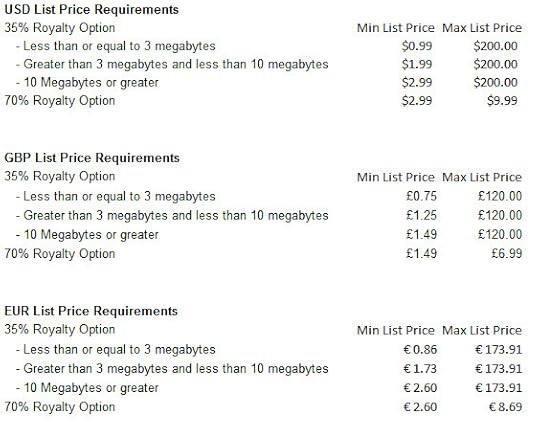
* Please note: 70 percent royalty option applies only to purchases of qualifying Digital Books by customers in the U.S., U.K., Canada, Germany, Austria, Switzerland, Luxembourg, and Liechtenstein.
That's the skinny of how to price an ebook. My advice for price points are these 5 choices: Free or 99 cents or $2.99 or $4.99 or $9.99. You decide depending on your book and your goals.
–
Subscribe to this blog for updates on whatever I learn for those who want to sell ebooks.