Keith Snyder's Blog, page 5
May 17, 2014
Sus—
Like most of us who are not dead yet, I have weaknesses and strengths. I’m bad at paperwork, for example, and dumbstruck by the jargons of medical insurance and school bureaucracy—which are their purposes, I’m pretty sure—but there are things I’m good at. Sloth and gluttony are particular talents.
Saturday, May 17, at 4:00am, the Princeton 300K began.

If I DNF, it won’t be for lack of fussiness.
I made that to print and take along with me. You can click and make it bigger. The rows of numbers across the top are hours. At top is a 20-hour ride, and if you trace your finger down from any number, that’s where I need to be at each hour to finish in 20 hours. Because the route is so hilly, the even spacing of the numbers isn’t really accurate—during some periods, I’ll be crawling up a hill at 3mph; during some much briefer periods, I’ll be descending at 40—but that’s the general overlay of a successful finish that uses every minute of the allotted 20 hours.
It also gives me a “reverse lookup” of the same information: Whenever I get to a certain place, I can look above it and see which finishing time I’m on pace for: 20 hours, 19 hours, 18 hours, 17 hours.
20 will be just fine with me.
***
With sloth and gluttony as my main strengths, and catching every single flippin’ school illness running a close third, conservation of talent dictates that edujargon and hill-climbing must remain weaknesses. We can’t all be good at everything.
I DNF’d on this ride in 2010.
***
This blog entry will go live at 9:08am on Saturday. That’s when controle 3 closes. (The red squares are controles.) At that point, if nothing’s gone wrong, I’ll have been hauling five pounds of rice cakes around New Jersey for five hours.
I’ll try to tweet my arrival time at each controle here. Hopefully when you click that, it’ll say something like CTRL 3 1307. Because if it says CTRL 3 1309, I’m already out of the game.
***
I hope the new chain catcher works.
Filed under: Bicycling, Bikes, Favorite, Randonneuring



April 18, 2014
Breezy!
“DON’T WORRY about it. I can be the controle goy.”
Hopefully I didn’t sound flippant. It actually tickled me to do. Because it wasn’t kosher, he couldn’t buy anything to get the receipt.

“IT’S NICE TO see you finish with some comfortable time.”
I finished in 10:39. This is only three minutes longer than the fastest 200K I’ve ever done, which was in Malibu and didn’t have headwinds, but did have a folding bike with concrete commuting tires and a wacky rear hub.
“What do you think made the difference?”
I said, “I’ve been doing a lot of commuting,” but on reflection, I think it’s more that this year, I know I can probably afford to take another shot if I DNF, so I can push harder and risk wearing myself out early.
“YOU DID THIS one your first year.”
That was the most shocking thing all day: Someone knew that? And:
“I saw a rider going past _______ Road and I thought, that looks like Keith.”
It was! But I realized it half a block later and turned around. I think I went off-course three or four times, but my total bonus miles were less than one.
People pay attention when you don’t know they’re doing it. Weird. I always think I’m fated to fly solo.
“NICHOLAS AND ZACHARY SAY MOOOOOOOO!”
The cows do not respond.

High-tech map case
A 30° TEMPERATURE range: 49° in the morning, 79° in the afternoon. I own two pairs of bike shoes: Clipless winter boots and clipless sandals. No normal ones, just those.
I dithered for a week. Then I brought sandals and Sealskinz socks. They were perfect. And I remembered to spray my feet with sunblock in the parking lot where the Sealskinz finally got peeled off. They were the last winterizing layer to go. Jacket, skullcap, glove liners, neck gaiter—a spring brevet is a six-hour striptease and then sunburn.
I WASN’T lanterne rouge.
I wasn’t lanterne rouge.
Don’t get cocky, kid. Princeton’s coming up. You DNF’d at Schooley Mountain last time. It’s 300K of hills.
Humility: Reinstalled.
(Wasn’t lanterne rouge.)
I LIKE MY tires. Schwalbe Durano Plus don’t have quite the buttery road feel of Schwalbe’s pure racing tires, but they’re more puncture-resistant, and, say…85% butterfat.
I learned in 2012, on this very brevet, that when the voice asks politely if you think you ought to change your tires yet, “Nah, still some life in them” is the wrong answer. The voice is itself the answer. If it’s saying anything at all, they’re already time bombs.
SELF-RESPECT TIPS its hat. Nod back but don’t stop pedaling. You’re not done. Eat on the bike, drink on the bike, bask on the bike.
I SPENT CONSIDERABLE time on this brevet trying out different ways of saying, “Breezy!”
(There were 30mph headwinds all the way down the Jersey shore.)
The delivery that works best is the one that sounds like I’m very pleased. But nobody understood it. Doesn’t matter, that was the one.
MILE 105 OF 126, I’m sitting on grass, waiting for a bonk and caffeine headache to stabilize. I have three hours in the bank and a spring-lever tea ball in three inches of water in a bidon. I don’t actually call them bidons. I call them water bottles. I make a point of enjoying the scenery. I respect the moment and pay attention. I really see. Now I don’t remember anything. I think there was a fence.
Three hours in the bank minus ten minutes sitting on grass equals this was not my best 200K finishing time ever, but was instead 3 minutes over.
I bought a bike food cookbook after I got back.
“YOUR SHORTS ARE ripped all up the back,” said a guy in the paceline that came up behind me at a stop. His voice was raised. The headwinds were punching us all right in the kisser.
“They are? Here?”
“Yeah.”
“The funny thing is, I wore these because my other ones had a hole in them. THERE IS NO ESCAPING DESTINY!”
I got a laugh.
“Breezy!” didn’t play, though. Everyone is wrong about this. It is the proper delivery.

Arrivée

“T HERE’S A 6:40 train.”
“You know how to get there?”
“I do.”
I put my helmet back on. “Let’s go.”
So we sprinted for the station. Well, I sprinted. From the outside, it probably looked like I was drafting.
“HAVE YOU recovered?” (Two days later.)
“Besides the achy quads and intermittently firing brain cells? TOTALLY.”
AND NUMB PINKY finger and toes, and bruised hands. I’m going to miss this bike for all the best reasons, but the new one’s going to fit.

Filed under: Bicycling, Bikes, Randonneuring, Senseless acts of beauty


April 1, 2014
Lately I’ve gotten interested in my Strava heatmap. The r...
Lately I’ve gotten interested in my Strava heatmap. The randonneuring doesn’t show up on it much–I can see Patrick’s Queens-Montauk route, and little pieces of George’s up in the Hudson Valley, and the entirety of the Shore By Night, and I’m proud of those–but I didn’t get the Garmin until recently, and I didn’t use the iPhone much on brevets because it always died halfway through.
What I like is my tracks all over the grid of Manhattan, and the vectors radiating from it in all directions–East into Brooklyn and Queens, Northeast into Westchester, Northwest and Southwest into New Jersey. I’m a New Yorker, and I know these streets the way only a cyclist knows them. My legs drove every revolution of every wheel. I dodged all the cabs and potholes. It was me and the street and the bike in downpours, blizzards, blasting heat and perfect breeze. I did the uphills, I did the downhills, I dodged the trucks and stole interference from buses and deked around jaywalkers, and I fixed it or walked when it broke, or I broke it, or a mechanic broke it in a way that took 30 minutes or 3 days to show up. I leaned it against delis, I hit bad joints on bridges, I dropped roadies, I got dropped by guys with butts fatter than I accept that mine could possibly be.
“This is my city” is a nonsensical, gritty line written by writers who need another edit, but fuck yeah, this is my city. I laid the streets, I built the bridges, I mapped it. I rode it. This is my city. Whatever yours is, is yours. This one’s mine.

Filed under: Bicycling, BikeNYC, Bikes, Commuting, Favorite, Randonneuring, Senseless Acts


October 28, 2013
RIDE REPORT: Seven Gates 50K Petite Brevet
A BREVET STARTS when you wake up. Ride preparation is backstory. It ended last night. This morning, in medias res, you do what randos have always done:
Eat
Dress
Stop singing and find your hoody

Controle 1, P.S. 314, 08:00

IT WAS EIGHT in the morning, but the gray chill wasn’t easing up. “You’ll warm up as we go,” I assured my companions, who were wearing their new real bike shorts, and we went R OUT OF CONTROLE ONTO BROADWAY.

THE SEVEN GATES 50K is a three-controle out-and-back. It starts and ends in Inwood, at the top of Manhattan, so the first thing we do is leave New York City.
Marble Hill used to be part of both Manhattan, the actual island, and Manhattan, the borough, which back then were the same thing. When the Harlem River was rerouted to truncate the tip of the island, Marble Hill got amputated. In all meaningful ways, it’s now fused to the Bronx; but civically, it’s still a ghost digit of Manhattan, the dotted outline of a toe up where no toe should be. It’s populated by the tormented spirits of doomed New Yorkers, stranded forever in a twilight existence where the subways vanish. But the Broadway Bridge goes there.

STRAIGHT ON over Harlem River: The whir of drivetrains, the wailing of despondent souls
ON THE OTHER SIDE, my companions offhandedly mentioned they might be feeling the slightest sensation of coolness, so I berated them. “Are you randonneurs or children?” I sneered. “Are you riding? Like hardmen? Or OHHH, should we stop for COCOA at some nice little WARM PLACE?”

Cocoa at warm place
MILE 1.3: ENTER VAN CORTLANDT PARK BIKE PATH. If you don’t have a cue sheet, but you know where to jink over to the left past the bones of the abandoned train platform, where it doesn’t necessarily look like you should, you’ll be on a dirt-road-looking thing that soon narrows. If you did it accidentally, the sensation of being in the wrong place may stop you. You didn’t see any NO BIKES signs, but you might decide not to go in.
But if you know…
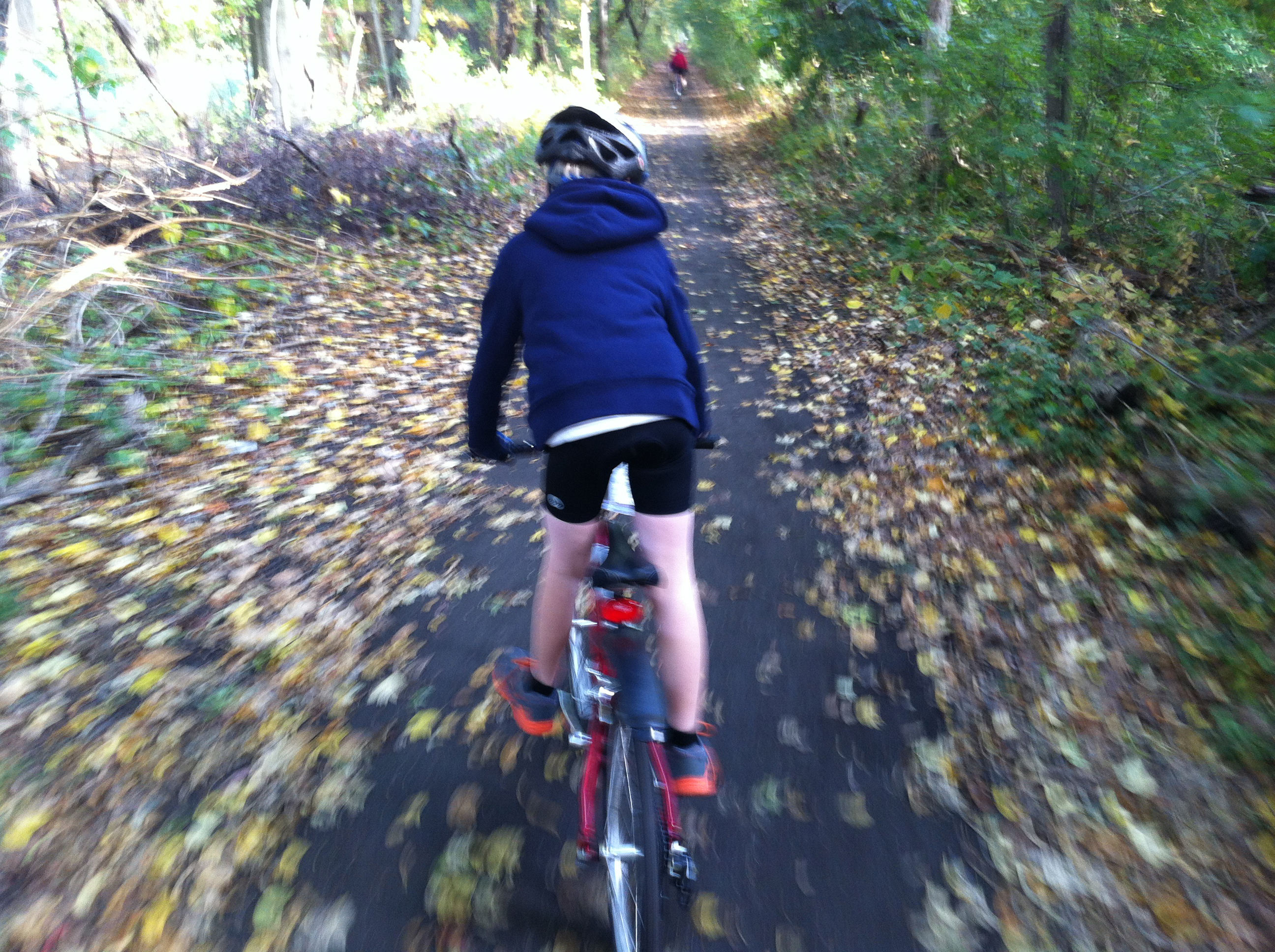
The bottom mile and a half of what used to be the Old Putnam Railroad is now rideable hardpack, sometimes with a little mud—or more than a little—and always with stray roots and rocks and half-buried railroad ties. Then so sharp you can feel the surveyor’s line, the paving starts, and soon after this passage into Yonkers comes a passage both more profound and more nasal: Dad has promised to reveal to you the secret of the snot rocket.
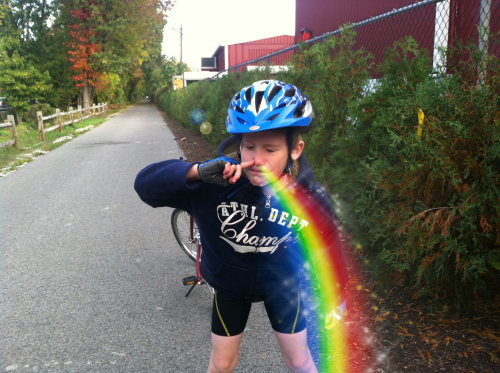
Photoshopped for reduced disgustingness
Boys!
Stay right!
THE PHRASES, “NOT as steep as Henshaw, but longer” and “just downshift and you’ll be fine” trickled away almost as soon as Dad said them, weeks ago. “Two-mile climb” has remained solid in memory, and you have the nebulous sense it’s coming up. Is this it? No, this is flat. Is this it? No, this isn’t it. Is this it? Are we climbing? No. Then this isn’t it.
But now the surface has been tilted slightly up for a ways, and it’s tilting up slightly more. “Is this it?”
“This is the beginning of it…”
“STOP!” BELLOWS THE voice falling further behind. “STOP! WAIT UP! STOP! HEY! HEY! HEY!“
Like much of this route, the leg we’re on wavers more-or-less straight, with no intersecting trails or cross streets. There’s nowhere to go but forward or backwards. Instructions have been given a thrice of thrices: If we’re separated, we’ll meet up at the top of the climb, which is Gate 1.
But this rider, who on the flats enjoys passing his clubmates and wiggling his hiney at them, can be lazy on hills, a laziness that turns to indifference when he’s passed and fury when he’s dropped. His subsequent tactic is to allow the escape group to build their lead until the gap seems too wide to bridge, and then, many heartbeats after seasoned observers will have written off his chances, to brake, plant his feet, stand in the middle of the lane, and holler.
There’s mild discussion at the front of the group, but these domestiques have been riding with him a long time. They don’t slow any more than the climb and their need to stay upright have already made unavoidable. They continue to gain elevation. The occasional two-story roof shows through breaks in the treeline; the toys in those houses’ front yards look like toys. The echoing sounds of outrage become more distant.
Then an increase in volume and a decrease in echo, the words now intelligible: FINE! I’M SO MAD, I’M GONNA PASS YOU! repeated several times, and soon a red-hoodied blaze churns past on the left, past his companions, one of whom latches on and sprints. The other companion smiles silently and watches them race around the final bend—to Gate 1.
YOU DID THE two-mile climb. What do you get on the way back?
A two-mile descent!
Stay right!
EVERY PETITE BREVET—yearly, except I couldn’t get it together last year—I add another element. Last time it was more distance. This time it was more distance and a cue sheet.
Seven times between Manhattan and Elmsford Falls, the rail trail crosses a street or entry road. Cars could turn onto the trail if there was nothing to stop them, so there are not just bollards, but gates.
It may be conceivable that this only happens six times, and that the route designer, who’d already ordered medals with SEVEN GATES 50K engraved on the backs, had to go looking for a seventh gatelike thing on the final pre-ride, but this could not be confirmed by press time. Regardless: This cue sheet has a column called GATE, in which appear the numbers 1 through 7, for riders to whom monitoring TOTAL and LEG seems like less fun than you should have on a Saturday.

A seventh gatelike thing
Stay right!
Bike up, hold your line!
“IT FEELS A lot stronger after lunch, doesn’t it?”
“My legs feel brand new!”
Mile 15.8 is the turnaround, Elmsford Deli.
Around mile 18, a boy paying too much attention to giving his brother a very sweet pep talk and not enough to—something, we’ll never know what—went down. I heard the tone of sincere encouragement passing between them ahead, and then there was a low tangle of bike, boy, and lost shoe, and that sound of short metal tubing and forty pounds of flesh hitting pavement and sliding.
I have failed him at this moment before. When he got creamed on the flat between the two Little Red Lighthouse descents, and I carried a 16″ bike and screaming six-year-old down to the bottom, I was angry. It was with myself, but that distinction clarifies too late to make a difference to a hurt child. And when he ate it on the playground and the first-aid pack with FAMILY BIKE on it in green marker wasn’t in my pannier, I had to borrow whatever little Band-Aid was offered from the bottom of a purse.
So first I did not run him over, and then as he shrieked so hard, still sprawled and tangled, that his voice distorted like a guitar, I leaned my head tube against a bench back and unbuckled the pannier and dug out the first-aid pack.
If this story had a different ending, my first words being Pick it up would now be slotted in behind the other things I regret in painful detail years later. But gently and firmly, opening the pack: Pick it up, you can get up, and he did. I helped him out of his frame. His brother retrieved the shoe.
The wailing had stopped. I noticed the suddenness.
His hands were okay—half-gloves—but there was road rash. Dirt was ground into abrasions up his leg and there was a good half-inch rip filled with blood, and a couple of smaller versions of it.
“It just stings,” he said. His voice was shaky. I felt my surprise change my face. “It’s fine,” he said again, still uncertain. “It just stings.”
I gave him a wipe and had him gently cleanse the wound while I got the big Band-Aid ready. How the heck had he done that? He didn’t know.
“I think you were doing a good job of encouraging your brother, and talking to him a lot, so you weren’t paying attention to the road.”
He said, “The thing about helping people is you don’t help yourself.”
“I’M VERY IMPRESSED with you right now,” I said as I bunched up the first-aid wrappers to shove into an outer pannier pocket.
“I’m acting like Johnny Hoogerland right now,” he said.
As we rode out, he murmured, “I didn’t know I was like that.” He said it again, maybe twice more, only partly to me.
MILE 20.1: X SAWMILL PKWY, R INTO CONTROLE. Controle is unstaffed, so timestamped receipts take the place of a signature.

Starbucks Cake Pops: Not as good as expected
RANDONNEURING, LIKE MOST things, is mostly about the basics.
Eat again.
While you are doing your shoulder check, do not run off the road.
If your penis hurts, put Lantiseptic on it.
The Lantiseptic will warm up.
Is this the two-mile descent?
No.
Is this the two-mile descent?
No.
Is this the two-mile descent?
Are we descending?
No.
Then this isn’t it.
Heads up!
Stay right!

“THEY SMELL THE BARN,” says Laurent, the man I followed around for my first year randonneuring, to explain why bicycles speed up at the end of a brevet.

MILE 29.6: SOUTHBOUND BROADWAY SIDEWALK. CAUTION: PEDESTRIANS, DRIVEWAYS.
We’re moving in 2014, and not sure where yet, so the randonneuring element I’ll add a year from now may reveal itself when we get there. If not, time limits to the controles are the obvious addition. For what is a brevet without a faint, constant trickle of fear?
But months before the Who Knows Where We’ll Land 75K, there will be the 40-mile (64-kilometer) Five-Boro Bike Tour, a fitting goodbye lap of the city where you were born, and with it maybe a little more understanding that even compared to grownups, a little dude like you can sling some respectable skills.
Or it may just be a bunch of whining—you never know what’s coming, this far out.
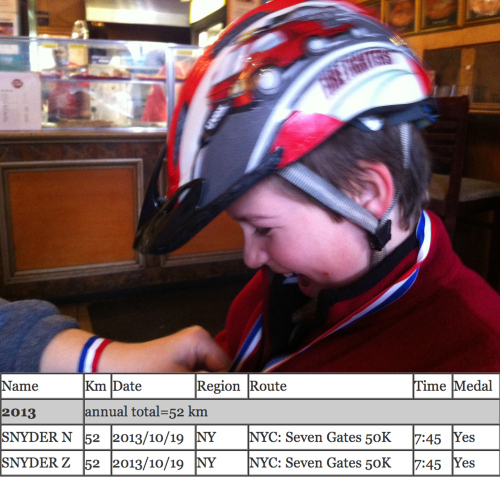
Johnny Hoogerland was hit by a car and thrown through the air into a barbed-wire fence within minutes of our sitting down to watch our first Tour de France together. Parts of him were torn to ribbons. He finished the stage.
Every rider has a rider he dreams about.
I dreamed of one day being as good as Barthélemy.
—The Rider
Tim Krabbé
Filed under: Bicycling, BikeNYC, Bikes, Family, Fatherhood, Favorite, Inwood, Kids, Parenting, Petite brevet, Randonneuring, Senseless acts of beauty


October 25, 2013
Seeds
LAST NIGHT WALKING BACK from a special-treat dinner at a pharmacy counter, my eight-year-old scientist asked if rum, whiskey, wine, beer, alcohol, and scotch were all the same kind of alcohol. So I told him about it, and since he recently learned about percentages, I explained what a liquor’s proof number means. He sees me with a glass sometimes, but never drunk, for which his only references are Captain Haddock in TINTIN and the sentries Toshiro Mifune gets soused on sake before he kills them in SANJURO.
That led to a conversation about the stages of drunkenness, which led to revelation of the existence of alcohol poisoning, and how it works, which led to the contexts in which it’s most likely to happen, which led to teenagers, young adults, and parties.
Which led to silence as I tried to decide what to tell them, what would scare them, and what they’d misinterpret.
So I asked what would happen if they drank, and the scientist said he’d want to run around and act silly, and I said what if you drank more and kept drinking? And he guessed he’d want to punch people for no reason, and I said, you’d pass out. Then I had to clarify what “pass out” means and this whole time, I’m wondering how much he even gets anything I’m saying. So if you pass out, I asked, what can happen to you?
You could fall down. People can laugh at you.
Take your money, I said. Punch you in the face. Draw on you with permanent marker. So here’s what you need to know. And I thought, am I going all the way with this tonight? Are they ready for this? Can I make it general enough that it doesn’t freak them out? So here’s what you need to know. What if you’re with someone who passes out? Then people can do those things to them. So if you’re with someone who passes out, you should probably watch out for them, and make sure those things don’t happen. Especially if it’s a girl.
Well that’s okay, he said, because girls don’t like to drink alcohol.
Sure they do, I said. Some do, some don’t. Some of your ideas about boys and girls are—they can do all the same things.
OK, he said.
But if it’s a girl who passes out…if you’re ever at a party and a girl passes out, sometimes there can be boys who will want to do bad things to her and hurt her.
But why? Why would anyone do that?
Because they’re not good people.
But why?
Because they’re not good people. So if you’re ever at a party, and there’s a girl who passes out, you be the one who looks out for her and keeps her safe. Right? So—what would you do?
I would punch them in the face!
Well, uh—no, you don’t have to punch anybody in the face, just make sure she’s safe, and tell the other people to knock it off.
Tell them to knock it off! That’s like how a grownup talks.
Yeah. But you be the good guys. Right? You be the ones who don’t let her get hurt. Got it?
Got it.
And then over to the silent boy who’s been holding my other hand: You interested in this?
Not really.
But he’s the one who listens when you don’t think he’s listening, and who nurtures and protects every child on the playground, and who a father once swore he wanted to marry his little daughter after he championed her safety during some swingset contretemps, and who thinks he’s a superhero, and whose safety my heart clutches for the most when he gets his chance to stand the good stand against villains he doesn’t realize use actual fists and boots, and it’s Dad who told him to do it.

Filed under: Being a grownup, Bravery, Family, Fatherhood, Favorite, Gender, Kids, Parenting


October 1, 2013
The work-at-home bike commute
In 2009 I lost my job on Wall Street.
(I assume you know me well enough, but I’ll remind you anyway: Wall Street, not WALL STREET.)
Wall Street is at the bottom of Manhattan, and I lived way up at the top where cabbies think you’re trying to trick them into going to the Bronx. Three days a week, I rode my folding bike twelve miles downtown, folded it up, hoisted it up onto a shoulder (it was a Dahon Matrix; at the time, I didn’t get small wheels) and carried it into the building. And then—I was cheery. I rolled with idiocy. Crisis? No crisis. Problem? No sweat. After solving everybody’s problems in the whole world, I rode twelve miles back home, where I was also cheery, and nice to my family. Then the recession came and I lost the job. Well, sort of. I got insulted by a poorly handled pay cut and took my desk fan and walked out.
And very soon was not cheery, and did not roll with idiocy, and was not nice to my family.
I know people do lunch rides, but I just won’t, ever. There are probably reasons for this. I don’t know what they are. But thing was, I had found the secret magic that got me riding: my commute. It took the same time as the train, and—the real thing—it didn’t have to be wedged into my day between other things. I didn’t have to find time to ride; my hour of exercise was simultaneous with the hour I couldn’t avoid spending on transporting my person to work anyway.
So I got my 24 miles and my cheeriness and it didn’t displace a single other part of my life. Sunlight glittered. Angels hummed Count Basie.
Then recession and a new business—which meant working from home! I can go climb Fort George Hill at lunchtime! I thought, and I’ll be surprised if I do that even once!
It’s not that far to Fort George Hill:
View Larger Map
It’s just that for those unknown reasons, I won’t.
The solution didn’t come for I don’t know, a year of complaining how I missed my commute. But here it is. Somebody’s going to read this and look surprised and go DUH! out loud and wonder why neither of us thought of this sooner, and buy a new pannier and change their whole life.
Here’s what you do.
You get a pannier that carries a laptop. (I have an Arkel Bug.)
You get a laptop suited to your work that fits in the pannier. (I have a MacBook Pro 17″. I didn’t buy it until I took the Arkel Bug to Tekserve and had the guy put the computer in it and made sure the zipper would close.)
You find a Starbucks twelve miles away. It doesn’t have to be a Starbucks, but you get where I’m going here.
That’s it. That’s your commute. Mount up on your Xootr Swift (because now you do get small wheels) and ride there in the morning and work.
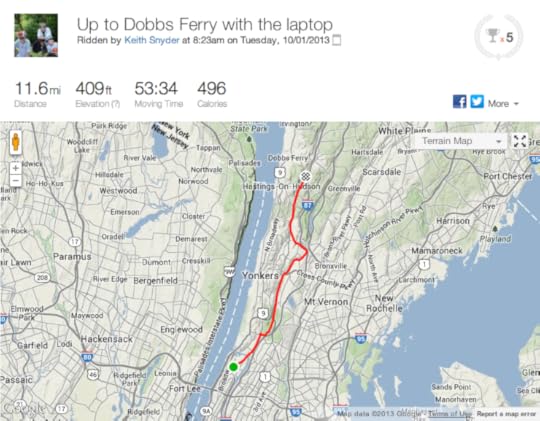
Then when you’re done, ride back home and don’t be all cranky and resentful because Congress. Be cheery and harmonious because leaves and sunshine and roots and railroad ties on the South County Rail Trail.
Or, you know. Distant caravans silhouetted along the Nile. Whatever they have in your neighborhood.
If you do it, would you tell me? Obvious as it is, it’s still one of the better things I ever thought of, so I’d like to know.
Filed under: Bicycling, BikeNYC, Bikes, Commuting, Employment, Freelancing


September 19, 2013
A thought about an experiment in translation
This is on my personal blog instead of the RIDE blog because it’s just me thinking aloud.
Any literary translators out there?
So I was thinking it would be nice to have RIDE available in other languages, but then I thought, No, each translation would probably cost too much to make sense.
So then I thought, what about a royalty split? Translator gets a percentage. But then I thought, No, I had to stop doing royalty splits with authors because the accounting is so impossible, plus it’s kind of insulting to say, Hey, do all this work and you might get a fraction of what I get out of it.
So then I thought, what if the translator just gets all the sales income and I don’t get any part of it?
And then I thought, I’m not actually seeing a down side for anybody here. I wouldn’t make any money, for either my editing/design/production or my own story, but that’s not the same as a loss. The story authors and the artist would be in a similar situation: they’ve been paid and aren’t seeing anything more coming in after that anyway, and any author/artist who didn’t want to participate could just say no thanks if their work reaching a more global audience wasn’t worth it to them. The translator wouldn’t get paid up front, but they wouldn’t have to spend anything, either, and after doing the work, they’d be the foreign publisher. So the first penny that came in on that edition would go directly to them—and so would the ten-thousandth penny.
Since we’re not dealing in physical copies, but rather in .epub, .mobi, and .pdf files, and I’d do the production work (slotting the translated stories into existing files where the English stories currently reside, changing the title on the cover from RIDE to whatever word now goes there, sending the files to the translator) without compensation as part of the experiment, there is no out-of-pocket expense for anybody, just some work for me and some work for the translator.
Translator starts their own accounts at Amazon, Lightning Source, B&N, iBooks, etc., uploads the files, talks it up online, and gets some money. How much money? I have no idea. Not a ton; RIDE isn’t The Hunger Games, and it only exists because I love bikes and wanted to read short stories about them, not because I did any market research. But the money also wouldn’t be zero.
But that’s the experiment’s main question: Is this a viable plan? Would everyone benefit enough to keep doing it? Would there be any kind of “rising tide floats all boats” effect? Would the expansion of the series into more languages help each edition sell more because the series itself becomes better known? Would anybody but the translator end up getting anything out of it? Would the translator get more than a few bucks?
I don’t know. It’s all question, no answer, at this point. But that’s my half-formed idea. What do you think?
If you comment, please include who you are, where you are, and what you do, so I can understand what perspective to read your comment from: Writer, publisher, translator, reader, know-it-all (pick just one, please), continental U.S., Fiji Islands…
Filed under: Anthologies, Books, ebook production, Fiction, Short stories


September 12, 2013
4 bike thoughts during a break
I STILL CAN’T ADJUST a drivetrain, but it’s no longer because I believe my dad, who told me I’m no good at anything mechanical. Now I understand better. I’m good and fast at typesetting, for example, which is a tricky thing I won’t be good and fast at next year if I don’t do it every day. I’m still learning things about body copy, and I’ve been setting it for years. I’ve barely learned anything about drivetrains after a few dozen sincere but sporadic stabs at adjustment.
PEOPLE APPARENTLY HAVE the capacity for being uplifted and burgeoned by a gorgeous sunset over a mountain pass. I look at the sunset dutifully and sometimes try to get my burgeon on, but I’m disappointed in myself. I don’t have that. I just have knowing it’s where I should be, and putting a check in that box: Where I should be. The check feels like approval. A good review I don’t need you for.
MY ROAD BIKE has a broken spoke so the brake rubs, even with its release lever open, and my folding bike is still in the suitcase that took it to Los Angeles and back, because it needs a new derailleur hanger before I should bother putting it back together, but I wrote today.
LEARNING HOW RANDONNEURS relate to each other has given me perspective on life off the bike. There’s a hierarchy that you can ignore without anyone thinking less of you, but if you try to insert yourself into it and you figure your level wrong, then you live with that. Acting like you’re still something you used to be is poison unless they know about the injury. If they don’t, you’re an awkward problem for them. That one’s lost. Don’t try to chase it into a win. Shut your mouth, heal up, ride a lot. Let them come back to you, if they’re coming, which they may never do. Oh well. Just put your check marks in your boxes.
I FINISHED HALF of today’s work list, delivered a couple of proofs, and just thought I’d enjoy mentioning those things before the second half of the climb. Have a good ride. Check.
Filed under: Bicycling, Design and production, ebook production, Employment, Favorite, InDesign, Randonneuring, Senseless Acts


September 9, 2013
Two things I designed recently, and the kind of clients I’m looking for
I also posted this at the TYPEFLOW blog.
Books come from authors. Directories come from databases. Both have their quirks. Databases drink less.
I wasn’t sure whether talking about directories here would make me seem less like a book person, but the truth is, I love both. For either, my job comes down to transformation: A novel is transformed from an ugly, unhelpful Word file into something like fine art; a directory is blobs of raw data refined into attractive, functional listings.
Typeflow does both. Here are some examples:
(Click to see a bigger version that you can zoom in on.)

A little about each:
Fancy Food Show Directory
Client: Specialty Food Association
That Fancy Food Show directory underwent a minor facelift and major database change at the same time, but the client was smart; we did a test run months before the next production cycle. So when it was time to create the directory for the Summer 2013 show at the Javits Center, everyone could be confident that the production design end of things would go just as smoothly as always–which it did. This is one of two repeating show directories for which I’ve been responsible for both the database import system and the production design, the other being for the Fashion Footwear Association of New York. (Can’t show that one, unfortunately.)
The Griffin Series
Client: Philip Williams
Genre: Science fiction
Formats: Print and ebooks
In addition to making directories, lots of ongoing work for Scholastic Books (if you have kids, or were one, you’ve owned some of these), writing an educational module about Nook Quality Assurance, and doing a bunch of small-press novels and nonfiction (which I like a lot), I’ve been designing a new science fiction series for Philip Williamson, an independent author. The first in the series was released on September 1, with the rest coming soon.
I really enjoy designing a fiction series. For this one, I brought in Elisabeth Alba, whose work I saw in some Scholastic books I typeset, to create the chapter header illustrations.
Clients I’m actively looking for in 2013/2014:
Small presses who wish they had a production department
Large publishers who need typesetting or ebook production on a contract basis
Trade associations that need their directories or magazines put together quickly and accurately
Anyone who does manuals, directories, listings, other long documents. What do you need?
Is that you? Let’s talk.
I’d like to show you more than just these two jobs, but I can’t fit it all into one blog entry, and I’m too busy to write three or four. Other recent stuff: newsletter production, multi-language medical manuals, big mass-market children’s picture books. If you’ve got something, I’d love to hear from you: keith | at | typeflownyc | dot | com.
Filed under: Books, Design and production, ebook production, InDesign, Self-promotion


September 4, 2013
The traditional Rosh Hashanah blog
A couple of times a year, any uncertainty about what is a Jew dissipates, and I become a true member of a singular tribe, the American Jews of the diaspora, when I perform, with sincere and profound humility, our only major tradition: Googling to see when the holiday is, what we’re supposed to already have started cooking, and what the greeting is.
1. Tonight; 2. brisket and sweet stuff; 3. L’Shana tovah.
The brisket is in; the jumble of blocky tzimmes precursor is heating around it. The boys have been guided by paternal threat and prattle through the evening pouring of the cheap red wine over meat, the morning grocery shopping with their own carts, the splendor of beef turned purple by grapes so it looks like a giant tongue, with sound effects, and onion-chopping best practices with The Good Knife. They will be recalled from the Wii for kugel insertion and the basting ceremony. I don’t know that basting is necessary when observing loose tinfoil protocol, but also can’t see a down side to it. Teach your male children to baste.
Tonight’s challah is round instead of braided because so is the cycle of creation; this is, after all, a new year’s celebration. It’s sweetened because so may your year be sweet.
This has always bothered me as a metaphor, ever since I was a child, because it’s just too facile to be recognizable. Years aren’t sweet or bitter; life is sweet and bitter. Even horrible years have the stray golden raisin in there, and good years harbor the roots of bad ones to come—much as savory tzimmes contains root vegetables (see, it’s genetic; that took no effort).
What I wish for you, and for myself, is that what has taken root in the past, no matter what kind of manure or burnt field it first sprouted in, bears good fruit in the future. I also wish you an easing of droughts and destructions, so that orchards can once again be maintained by one standard orchard’s worth of toil.
May your troubles convert to gelatin in the heat of your efforts, as melts brisket collagen at temperatures over 180°F.
May you question and break free of the traps of your childhood, just as we all, at some point, ask, “Why am I drinking Manischewitz?” And may you pass your mistakes on to the next generation, just as in the same breath, we pour Manischewitz for our own children, so that they in turn may taste the fuller flavor of rejecting the overly sweet nonsense of their parents.
L’shana tovah. May you be signed in the…sealed in…crap, I don’t know. I googled it twice already. Here:
Eat up.
Filed under: Cooking, Family, Fatherhood, Favorite, God, Heresy, Kids, Music, Parenting, Religion, Senseless Acts, Whatever