Sophfronia Scott's Blog: Sophfronia Scott, Author, page 27
June 15, 2017
The Intentional Writer: Diana Butler Bass
Diana Butler Bass delivered two insightful keynote addresses at Princeton Theological Seminary recently for the Frederick Buechner Writer’s Workshop. The first, “The Accidental Writer,” described how the author whose latest book is Grounded: Finding God in the World, A Spiritual Revolution, fell into her writing career by way of the academic world and then journalism. “Cherish your own path,” she said. “There is no one path to becoming a writer.”
There’s also no one way of being a writer, but it seems to be an area where many writers or writers-to-be struggle. That’s why successful authors are forever asked questions about their routines and their writing practice. Diana answered all these questions in her second presentation and I found the title quite enlightening: “The Intentional Writer.” In other words, once you decide you’re a writer, you can be intentional about the way you go about your work—to be serious and professional about it. You are intentional about how you learn, how you write, how you connect with people. She described intentionality as “moving from just falling into stuff to paying attention.” In other words, you’re making conscious choices about your writing life.
She shared with us the eleven things she does regularly and with intention that help her be a writer. They are all excellent—in fact I do all these things too!—so I’m pleased to share these habits/practices with you.
1.) Haunt bookstores. Diana said, “If you’re a writer and you don’t go to bookstores, I don’t know what’s the matter with you!” In bookstores you find out:
–what people are reading
–what books are being featured on the racks and tables
–what titles seem to pop, what the popular cover colors are, if there’s a design trend going on
–what’s the cultural conversation going on around books
Diana also suggests befriending booksellers and, when hanging out in bookstores, paying attention to what people are buying. This is your fieldwork as a writer.
Your fieldwork should also including reading The New York Times Book Review, The New York Review of Books, and Publishers Weekly.
This next add is a big one: attend author events! I know this can be difficult if you don’t live in an area that’s a popular book tour stop, but making the trip is worthwhile. You get to make a face-to-face connection with an author and sometimes (this is especially true of events in New York City) that author’s editor and literary agent.
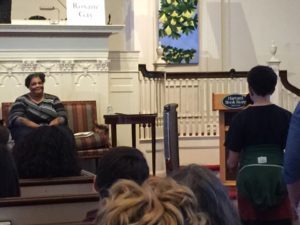 This week I drove over five hours round trip to hear Roxane Gay read and talk about her new book, Hunger: A Memoir of (My) Body. I feel the book is an important work and I wanted to show my support by showing up for one of Roxane’s events. This was the closest one I could attend. I took my 12-year-old son with me and we stood in a line to get in but it was so worth it to hear him whisper to me that he wanted to ask Roxane a question and then, when she was signing his book, see his face light up when she told him she writes comic books. I can’t say it enough: attend author events. Go for the author, go for the bookstore, go for yourself and your writing life.
2.) Read books! Diana notes the importance of being committed to your own reading. Again, I agree. As writers we must know what’s being written, what’s challenging, what’s good. We must read so that, as the poet Jane Kenyon said, “you have good sentences in your ears.” It’s vital to your work. I use Goodreads to curate my reading and I have a regular goal of reading 40 books a year.
3.) Write daily. I know this isn’t possible for everyone, but Diana counts a lot of things as writing. Even posting on Twitter is writing. “If you can post five amazing tweets, you’re writing,” she said. “It’s like writing poetry.” She also journals. “I’m paying attention to my own spiritual life and to what the world needs.” Find your own way of writing every day. “There’s all kinds of ways to put pen to paper or fingers to computer keys,” Diana said. When you can’t write, she said, do something creative. She colors in coloring books. “Sometimes it’s easier to just take the pencil and color in someone else’s lines,” she said.
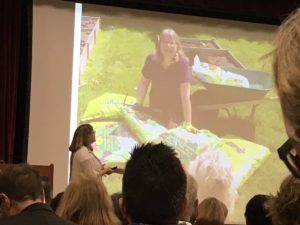
Photo by Barbara Figge Fox
4.) Get out and move. Walk, exercise.
5.) Talk to strangers. Be connected to the world. You’ll never know whom you’ll meet or what you’ll learn.
6.) Instead of asking what a writer is writing, ask them what they’re reading. I loved this suggestion. So many writers don’t like discussing work in progress, especially if it’s very new. But talking about books is so much fun.
7.) Pay attention to your own voice. Diana likes to think about “How can I be Diana in this conversation?” I think this is a helpful question when embarking on a piece about a topic very much in the social conversation such as a tragedy or political event.
8.) Make time for silence, prayer, and meditation. Yes, yes, yes.
9.) Do what you write about. You don’t have to do it perfectly, Diana said, but you do want hands-on experience so you can have authority.
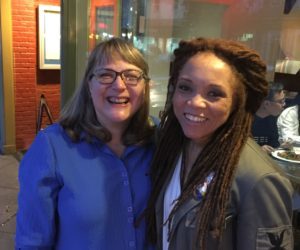
Photo by Mihee Kim-Kort
10.) Make friends with other writers and people who do what you do in the world. Social media is a great way of doing this, and so is attending author events.
11.) Make friends with your audience. Diana said, “The real honor of writing is when someone reads it. It fills me with gratitude, makes me want to respond, to try to care about what my audience cares about.” She knows this isn’t always easy
Diana finished with these thoughts: “Always remember your words will go somewhere and connect to the lives of people you don’t know. Take tender care with this. That’s where the magic happens.”
I loved meeting Diana and I’m looking forward to our growing friendship.

Visual notes by Beth Nyland


June 7, 2017
Words on Writing from Anne Lamott
Anne Lamott delivered the keynote address for the opening of the Frederick Buechner Writer’s Workshop at Princeton Theological Seminary. It’s my second year leading sessions at this powerful event and I was thrilled to learn Ms. Lamott would be here. I arrived at Miller Chapel extra early to grab a good seat.
During the Q&A I was able to ask the author of Bird by Bird how she decides what to write about in today’s tumultuous political climate—does she write what’s on her heart or does she feel impelled to address issues directly? I liked her answer, at least what she could share—she noted she could write for hours on this question. But the abridged version is simply this: you try to write what helps. People need to laugh, she said. What can she write to help people laugh?
She made us laugh during her talk. She was warm and funny and she spoke about writing in a calm, clear, smart way that I’m sure was comforting and helpful for just about every writer in the room. I especially liked hearing her talk about teaching Sunday school at her church.
Here are some of her words that I scribbled down while I listened. I hope you enjoy them. By the way, her latest book is Hallelujah Anyway: Rediscovering Mercy. I now have an autographed copy and I’m looking forward to reading it.
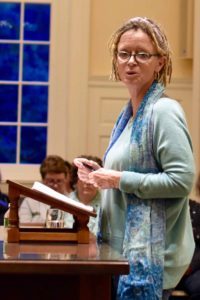
photo by John P. Leggett
From Anne Lamott:
I love the sound of paper, I love the smell of paper…paper was my salvation. When I have my nose in a book I can breathe again.
On writing and getting started: The first thing you do is you stop not doing it. The best thing on earth that can happen is to stop not doing it.
Writing is an act of faith. You just do it. Butt in chair. More will be revealed.
There’s no such thing as “as soon as…” You do it as a debt of honor. There’s never a good time to write.
Writing is painting with words.
In writing we’re trying to capture our deepest truths that might be meaningful for others to hear.
You’re never going to be in the mood and you’re not going to have self-esteem.
You should be writing that which you love to come upon, the thing that makes the inner you go “Ooh! Ooh!”
“I’m really good at 5 or 6 things. And I’m hilariously incompetent at everything else.”
“You don’t want to find yourself at 78 asking, ‘Why wasn’t I outside every day looking up?'”
From Sophfronia: Here’s to being outside as much as possible. Here’s to looking up at the sky.
May 25, 2017
Inspired by Louis Jordan
I knew Louis Jordan’s music long before I knew his name. My daddy loved B.B. King so I grew up listening to B.B. King and one of my favorite songs he sung was “Caldonia.” I think I liked how Caldonia is pretty close to rhyming with Sophfronia! Anyway, in the early 1990s a show called “Five Guys Named Moe” premiered on Broadway featuring the music of Louis Jordan. For me, it was love at first show.
I recognized so many of the songs—“Let the Good Times Roll” and “Don’t Let the Sun Catch You Crying” and, to my surprise, “Caldonia.” The energy of the show was positively contagious. Would I get up and dance when the Guys asked us to? You bet! I saw the show three times on Broadway and once in London. Of course I own the cast recording and I still smile and want to dance and sing out loud whenever I hear it.
As I wrote my novel Unforgivable Love, set in Harlem in the 1940s, Louis Jordan’s music was on my mind as part of the soundtrack of my character’s lives. When Val Jackson is playing baseball, the game he adores, with his friends on his aunt’s lawn I heard “Let the Good Times Roll” playing on a record in the background. When I wrote about Mae Malveaux’s desire to sweep a guy off his feet and take him to Paris I heard “Azure Te.”
I hope you too will have this music in your ears as you read Unforgivable Love when it’s published in September. I’ll share with you here video of Jordan himself as well a few of my favorite songs from “Five Guys Named Moe.” Enjoy the energy and the fun.
May 19, 2017
Book Review: Living in the Weather of the World by Richard Bausch
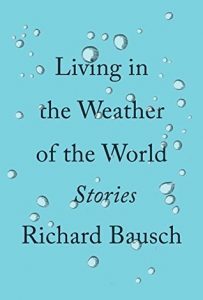 This book made me reconsider the word “story”—not the definition of story but our experience of story in its ages-old form before it had the word “short” in front of it; before it was bound in hardcover and made eligible for awards. Before all that there was someone talking and someone, often many someones, listening. And what they heard caused them to utter the equivalent of “Oh God.”
This still happens today. We tell stories in bars, in beauty shops, on tennis courts, on buses. A hand flies to the mouth or fingers lightly touch the base of the throat and the same utterance occurs: “Oh God.”
Richard Bausch is a master storyteller—a description/phrase that gets thrown around a lot but is pin-point accurate for him. He deftly strips a narrative down to the essence of story so in reading his work, finely represented in this new collection, you want to read it fast because you’re so engaged you can’t wait to learn what happens next. The characters are enduring the shifting, unpredictable weather of emotions and drama that befalls all of us. The hook for each piece could easily be the topic of eager discussion at a backyard barbecue, a girls night out, or while waiting in line for movie tickets.
Did you hear about that poor guy who went to mug someone and his victim turned out to be an off-duty cop?
Hey, they brought Freddie into the emergency room. His wife thought he was at the movies with his brother.
That guy at the museum? Isn’t he the one who ran over that kid?
My mom tried online dating and it ended in tears—but not hers!
See her? Her fiancé dumped her and she knocked him out cold.
Forget about Bausch’s accolades and long literary history. Read these stories because they’re great stories. Read them and pretend you’re with a friend, or out with the guys or gals trading tales. Only you’re really in the privacy of your own head, listening to Bausch. How long before you utter “Oh God”?
My guess? Not long.
Enjoy the book.
May 9, 2017
Book Review: Living in the Weather of the World by Richard Bausch
This book made me reconsider the word “story”—not the definition of story but our experience of story in its ages-old form before it had the word “short” in front of it; before it was bound in hardcover and made eligible for awards. Before all that there was someone talking and someone, often many someones, listening. And what they heard caused them to utter the equivalent of “Oh God.”
This still happens today. We tell stories in bars, in beauty shops, on tennis courts, on buses. A hand flies to the mouth or fingers lightly touch the base of the throat and the same utterance occurs: “Oh God.”
Richard Bausch is a master storyteller—a description/phrase that gets thrown around a lot but is pin-point accurate for him. He deftly strips a narrative down to the essence of story so in reading his work, finely represented in this new collection, you want to read it fast because you’re so engaged you can’t wait to learn what happens next. The characters are enduring the shifting, unpredictable weather of emotions and drama that befalls all of us. The hook for each piece could easily be the topic of eager discussion at a backyard barbecue, a girls night out, or while waiting in line for movie tickets.
Did you hear about that poor guy who went to mug someone and his victim turned out to be an off-duty cop?
Hey, they brought Freddie into the emergency room. His wife thought he was at the movies with his brother.
That guy at the museum? Isn’t he the one who ran over that kid?
My mom tried online dating and it ended in tears—but not hers!
See her? Her fiancé dumped her and she knocked him out cold.
Forget about Bausch’s accolades and long literary history. Read these stories because they’re great stories. Read them and pretend you’re with a friend, or out with the guys or gals trading tales. Only you’re really in the privacy of your own head, listening to Bausch. How long before you utter “Oh God”?
My guess? Not long.
Enjoy the book.
April 25, 2017
Happy 100th Birthday Ella Fitzgerald
 Today is the 100th birthday of the Queen of Jazz, Ella Fitzgerald. Her music and bold personality have always been an inspiration for me so it’s no wonder that one of her songs should find its way into my writing. Her “A Sunday Kind of Love” features prominently in my forthcoming novel UNFORGIVABLE LOVE, which is set in the year of the song’s release, 1947.
Have a listen and pretend you’re lounging in Aunt Rose’s parlor at her Westchester estate on a warm summer evening contemplating your next move on your desired one. Enjoy!
The book’s publication date is September 26 from William Morrow but you can pre-order it now online using these buttons or at your local bookstore.





April 15, 2017
Inspired by Jackie Robinson
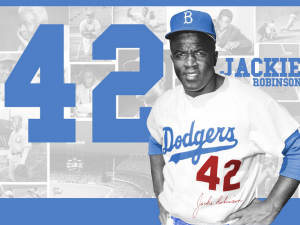 Seventy years ago today, on April 15, 1947, Jackie Robinson crossed the color line to play for Major League Baseball’s Brooklyn Dodgers. In my forthcoming novel, UNFORGIVABLE LOVE, my character Valiant Jackson is present in the stadium for that historic moment. When he witnesses Robinson’s classy behavior in the face of the abusive slurs rained upon him, Val begins to glimpse the notion that there might be a reason to be a good person in the world. How that notion grows and what happens to the rakish Val and the women in his life as a result is the story of UNFORGIVABLE LOVE. Find out the rest on September 26 when the novel hits the shelves from William Morrow HarperCollins. Pre-order today online or at your local bookstore.
March 14, 2017
Book Review: Lincoln in the Bardo
 Lincoln in the Bardo by George Saunders
My rating: 5 of 5 stars
Any writer can break the rules of our craft. If he does it poorly the resulting pieces remain at our feet and the confused reader is left to kick at them unsatisfied, like viewing the aftermath of an accident. But if the writer succeeds, he breaks rules to the point where he actually plants the resulting debris and a new form grows. The reader takes in the nascent creation with either bewilderment and possible dislike or sheer wonder. From the comments I’ve consumed about Lincoln in the Bardo, readers report from both viewpoints. Here’s my take. I started on the bewilderment side and ended this book in wonder.
George Saunders’s debut novel is set in a time of upheaval, the early days of the Civil War, when the country was only beginning to realize the horrible depths it was careening toward. President Lincoln’s young son Willie, age eleven, takes ill and dies. His body is placed in a crypt in a cemetery populated by a whole community of less than restful souls. But one night Lincoln, burdened by worry and grief, feels impelled to return to the tomb to visit his lost child. What he leaves with and how he does so is a striking fulfillment of this tale.
Here’s where the rule-breaking comes in: The story is told at a distance, through the observations of the dead souls and through historical source material Saunders uses abundantly though I couldn’t tell which of these many footnotes were based on real material and what was imagined. Fiction craft lessons often teach writers to create characters who are active, not passive, and who can bring urgency to the narrative while at the same time inciting emotion, positive or negative, from the reader. When I began reading Lincoln in the Bardo, I was skeptical. I didn’t see how Saunders could conjure urgency, action, or emotion when the main character, President Lincoln, is for the most part a quiet, introspective, grieving presence and everyone else, a host of strangers without historical significance, was dead.
My curiosity kept me reading and I’m glad I did because Saunders succeeds in all this and that is the miracle of the book. I won’t say how he creates urgency, but I will speak a little on the emotional aspect.
At first I wasn’t interested in these ancillary characters. They spend a lot of time talking, stating their cases, and telling their own death stories. They rarely listen other than to appraise another person’s situation and compare whether they are better or worse off than the other. I kept wanting to get back to Lincoln: Where is he? What’s he doing? But there came a pivotal scene, which I won’t reveal here, where that situation changes and I realized or recognized something I can only describe using the lyrics from John Lennon’s “I Am the Walrus”: “I am he as you are he as you are me/ And we are all together…”
They are us. These characters represent all of us.
The scene provides a kind of light for the lost souls and one character, Mr. Vollman, observes, “My God, what a thing! To find oneself thus expanded!” These souls are essentially seeking, as we who are living are also seeking, a sense of connection—a certain wholeness. How they come to it is one of the most touching parts of the narrative. Their realization opens the world for them and, for me, turned the book into a profound statement of empathy, compassion, and what it means to be human. As a reader I felt moved; as a writer I felt delight over what the author had accomplished. I wanted to read the book again, immediately, so I could better understand and appreciate how Saunders, with such expert craftsmanship and many twists and turns, had built the book.
Writers read for enjoyment, yes, but we also read to learn what art is possible to craft from our tools, which range from basic words and sentences to scintillating, airborne imagination. With Lincoln in the Bardo, an impressive demonstration of skill and imagination, Saunders, simply put, shows a new way of presenting a story. I hope he inspires many writers to let loose in mind and spirit, and see what we can share in our own ongoing quests, acknowledged or not, for wholeness.
February 26, 2017
The Dispatch concludes its look at African-American artists and entertainers in the Columbus area and beyond
By Eric Lagatta
The Columbus Dispatch
With her agent shopping her debut novel, Sophfronia Scott felt the sting intensify as the string of rejection letters piled up.
As many as 20 publishers had turned down her book, she said, before St. Martin’s Press showed interest in the story of a black woman whose brother struggles with drug addiction.
“All I Need To Get By” was published in 2004.
The success boosted Scott’s confidence, and now the Lorain native is anticipating the release of two more works: Her second novel — a retelling of the French classic “Dangerous Liaisons,” set in 1940s Harlem — will be published by William Morrow this year, a HarperCollins imprint; and next year the Ohio State University Press will publish an essay collection, based partly on her experience living in Sandy Hook, Connecticut, at the time of the 2012 attack on the elementary school, which her son attended.
February 2, 2017
When Writing Seeds Sprout
I have so much on my plate for 2017 but it’s all exciting and you will see many changes. Look for my new novel, Unforgivable Love, from William Morrow. The publication date is September 26, 2017. The cover design is underway and I’m thrilled to share it with you because I’ve been writing about the book here for a few years now. I can’t tell you how satisfying it is to see this historical fiction, a retelling of Dangerous Liaisons set in 1940s Harlem, come to life!
 To celebrate the book I’ll launch a new website featuring a new blog and of course I’ll be traveling! I’m already scheduled to teach at the Frederick Buechner Writers Workshop in Princeton and Pasadena, the Writing for Your Life Workshop in Nashville, and the Hobart Book Village Festival of Women Writers in the Catskills. Next week I’m headed to Washington D.C. for the conference of the Association of Writers and Writing Programs (AWP) where on February 11 I’ll speak on a panel, “Writing White Characters,” with fellow faculty members from the Regis University Mile-High MFA.
Also coming up: My essay collection Love’s Long Line Alone has been acquired by Ohio State University Press for its 21st Century Essays series to be published on its Mad River Books imprint. And I’m hard at work on a spiritual memoir about raising a child of faith in a secular world. Paraclete Press is publishing it and I’ll let you know when it and the essay collection have their publication dates. This fall you’ll be able to read more of my spiritual writing in Forward Day by Day, a publication of daily meditations produced by the Episcopal Church. I wrote the daily meditations for all of September 2017. You’ll want to get it, either online or at a church near you. I’m honored to share, hopefully in a helpful way, with the more than a half million readers worldwide who use Forward Day by Day as a resource for daily prayer and Bible study.
I’m still writing regular posts for the blog at Ruminate Magazine. In fact, one of my pieces, “The Importance of Non-Writing Writing” was Ruminate Magazine‘s most read blog post of 2016! You can read it by using this link. I’m happy to continue creating for one of my favorite literary journals.
I feel as though all of the writing seeds I’ve been planting for the past five years, starting with my work earning my MFA at Vermont College of Fine Arts, are finally beginning to sprout. Of course there’s more work to do and I’m on it. But I believe in taking the time to express gratitude for the beautiful garden of words I see coming up around me. I hope you’ll stay with me as we see how it all grows.
In the meantime, please enjoy this fun interview I recorded recently for Word After Word: A Podcast On Writing. Paul Matthew Carr, David Hicks, and I talk about my writing habits and the genesis of Unforgivable Love. You can listen in at this link. More soon so stay tuned. I’m glad you’re here.
Yours,
Sophfronia