Sophfronia Scott's Blog: Sophfronia Scott, Author, page 26
December 5, 2017
The Voice of Unforgivable Love: Adenrele Ojo
I’ve long harbored a dream of having an audiobook version of a novel I’ve written. Daddy never learned how to read and he often listened to spoken word recordings of sermons. I remember well the voice of the Reverend C.L. Franklin (singer Aretha Franklin’s father) filling our car via the magic of 8-track tape. I think Daddy would have liked hearing a story of mine read to him. I also have several friends and family members who prefer consuming books through their ears so I was thrilled to learn HarperAudio had chosen to record Unforgivable Love.
Executive producer Caitlin Garing sent me audio samples of possible narrators for the book. I had fun listening to and considering them all, but one actor’s voice in particular seized my ear and my imagination: Adenrele Ojo. The clip I’d heard was from The Turner House by Angela Flournoy. She’s also narrated scores of popular works including Brit Bennett’s The Mothers and Alan Light’s What Happened, Miss Simone? Adenrele’s voice is rich and elegant, exactly the sound I wanted for Unforgivable Love, which is set in a rich and elegant world of 1940s Harlem. She could also render male voices naturally and with gravitas—important because one of my book’s main characters is a man, the rakish playboy Valiant Jackson.
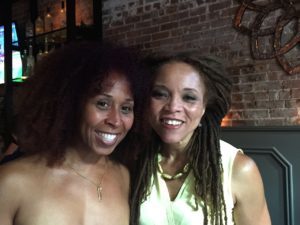 Adenrele has acted since childhood and even describes herself as a theatre brat. Her dad, John E. Allen, Jr. was Founder & Artistic Director of Freedom Theatre, the oldest African American theater in Pennsylvania. She’s a trained dancer, a talented photographer, and is known for roles such as Martha Pentecost from August Wilson’s Joe Turner’s Come and Gone. Adenrele hails from Philadelphia and Brooklyn and she lives in Los Angeles now, where she recorded Unforgivable Love.
When I heard she would be in New York City recently I jumped at the chance to meet Adenrele in person. The audiobook of Unforgivable Love is magnificent and even though we’d never met before, I felt we had already connected and collaborated through the material. I wanted to express my gratitude to this wonderful actor for giving voice to my characters and learn more about her artistic process in recording the novel. The following is our interview. The audiobook of Unforgivable Love is available digitally from Audible and as a beautiful CD set, perfect for gift giving. I hope you’ll give it a listen.
SS: How did you prepare to narrate Unforgivable Love? Was this the same as your usual preparation or did you have to do anything different for this book?
AO: With all my fictional audiobook stories, I use the same approach and process. First, I always read the book. That is a must. I read out loud, which helps me bring voice to the characters. It’s like storytelling time to myself. Through the writing I begin to get a feel for the characters and what they sound like. As I am reading out loud their voice will come to me. At that point, I tend to record quick samples on my phone for reference, especially if there are a lot of characters. Then I take time to research any words I may not know how to pronounce. Lastly, I will reach out to the producer for anything I cannot locate or need clarity on.
SS: I really love the pace of your reading. How did you come to settle on the pace? Are you matching the rhythm of the words or is this something the director/producer helps you with?
AO: The pacing is in the writing and it’s really easy to find if the story is good. It’s like narrating a suspense thriller, or an action filled book, or a love story. They all have a different feel and it changes from moment to moment. There were so many colors in the writing of Unforgivable Love that left me a ton to play with, especially with each character having his or her own distinct personality: sexy, playful, demure, child-like and so on.
SS: How did you decide on the sound of the male voices in the book?
AO: I find all my voices the same way. When I begin reading I first learn the facts provided by the author, i.e. age, dialects, voice quality, personality. If he is a lead male and a lover, there might be a sexy or suaveness to his voice. While reading out loud my interpretation of the character along with those facts inform my decision of what the character might sound like.
SS: Which was your favorite Unforgivable Love character and why?
AO: Oh no! Though I enjoyed playing with Mae and Val, I think my favorite may have been Elizabeth Townsend. I loved voicing her kind of demure, lady-like personality. I enjoyed her trying to hold it all together while at the same time she is internally wrestling with herself. That was so much fun to play and experience through voice.
SS: Do you sing? How did you approach the music in the book?
AO: WHO ME?!?! You would never offer me a record deal, though I can be thrown in the chorus. The story sings. I am a fan of period pieces. Period pieces have their own style and musicality. I just follow that.
SS: Did you ever get emotional while recording Unforgivable Love? (Feel free to add “Spoiler Alert!” if necessary!)
AO: I most certainly did!!! People are just going to have to listen to it for themselves! I am not giving anything away. I want the listener to have their own visceral reaction just like I did. That being said, all of the characters are wanting the same thing in one way or another, LOVE. It’s about fears that stand in the way and choices made to get that 4-letter word.
When I was doing my reading prep, I got to the place where one of the characters had gone through so much to break free in attempting to allow love to come in and they got deeply hurt as a result. There is this moment of them coming out of their melancholy and self-pity. It’s so beautifully written and kind of twisted at the same time. As I was reading, I was smiling, but then I realized “it’s not what I think it is or is it?” And when I started guessing what I thought was about to happen, I immediately stopped reading. I had to put my tablet down and walk away. I just paced back and forth talking out loud to myself (because that’s what I do) about what I thought was about to happen. I did not want it to be true. I finally picked my tablet back up and braced myself. I read it and I wept.
SS: I was able to voice a preference choosing you to be the narrator of my book, so it felt like we were in collaboration even though we didn’t meet until after you had recorded the manuscript. Do you often get to meet the authors of the books you narrate and what’s it like?
AO: I actually do not get to meet the authors whose work I record. In the ten years I’ve been narrating, I have only met two in person. The second author I met wrote a story about a slave woman named Mumbet who was the first slave to sue her slave master and win her freedom—an amazing story that we never hear about. The author invited me to come to Mumbet Day, which is celebrated in Massachusetts where Mumbet resided. She asked if I would come and read an excerpt from the book. Since I was going to be on the east coast during that time I was thrilled to go and participate in such a historical celebration. Afterwards, we received a tour of the house where Mumbet lived and a tour of the area and a few of the cemeteries that held the graves of many of the historical people noted in the book. It was so beautiful to see where Mumbet rests. I have a picture of it on my Instagram page.
Other than that, I am Facebook and Twitter friends with several of the authors.
SS: What would you most like readers to know about your work?
AO: Like (singer) Erykah Badu says, “I’m an artist and I’m sensitive about my sh%t!” Lol. No, but really, I take pride in what I do. I’m an actor, an artist who wears many hats. I want people to love what they hear (or see). I do my best to bring my A game. Trust me, no one beats me up harder than me if and when I feel like I’m coming up short.
SS: What was the hardest part about recording Unforgivable Love? What was the easiest?
AO: Wow! The hardest part was that we ended up having to push out the schedule for me to start recording because I got sick and on top of that, I had to get it done because I was leaving to head out of town for a couple of months. We needed it recorded in enough time for it to be proofed and for me to come back into the studio for any pickups before I left. On Day 1 I was feeling better, but not 100%. Most narrators sit while recording because you are recording for long hours in a day. However, I wasn’t going to be able to get enough breath sitting because you are kind of contracted in the diaphragm area, so I had to request that the studio set me up to stand for the entire five days of recording. It was actually great! (Many narrators do actually record this way all the time.)
Toward the end of my first day of recording I started to lose my voice. My second day of recording was a quick turnaround scheduled for the next morning. But when I woke up, I had no voice. I let the studio know and I went in anyway hoping it would come back. I drank some tea and just tried to give my voice a moment to wake up. It wasn’t happening. As it was Friday, I decided not to attempt recording and got some acupuncture (which I love) and went on vocal rest for the weekend. I had to text my mom and tell her, “I am not talking!”
My acupuncturist gave me two sets of herbs. I had to take 15 of each three times a day. That’s 90 pills a day! When Monday arrived, I was doing much, much better. However, due to the fact that I had started losing my voice during that first session and I wanted and needed this book to be perfect, I requested to re-record the last twenty pages I had done.
The easiest part was living the characters because they were so well written and vivid.
SS: What audiobooks of yours should fans listen to or look out for next?
AO: I have a ton of audiobooks that I’ve recorded consisting of both fiction and non-fiction that I really like or love. It would not even be fair to attempt to list them all. I will give you two and only because I believe they are so important and relevant to where we are today as a people. I think we need to get informed, educate ourselves and have a lot more compassion for humanity. The first is Carl Sagan’s last book, Billions and Billions and the second is Radical Hope: Letters of Love and Dissent in Dangerous Times edited by Carolina De Robertis.
Again, I have many that I love. If listeners are interested in hearing more, they can search my name on Amazon or its subsidiary, Audible.com.


October 4, 2017
A Walk in Harlem
The word Harlem sounds to me like a song and it slips through my lips like that—easy and familiar. I’m often asked if I ever lived in Harlem and the answer is no. I lived in Manhattan’s Upper West Side, about 40 blocks south. But I took the subway north regularly, about every 6-8 weeks, to get my hair done in Harlem. That routine ended years ago. I live in Connecticut now.
Today, though, I have returned to Harlem for a walk. I’m seeking remnants of the seeds that led me to choose it for the setting of my novel Unforgivable Love: A Retelling of Dangerous Liaisons. The book’s story takes place in the 1940s in many locations, from the rural Anselm, North Carolina to the more refined bucolic setting of Westchester County. Paris, France plays a role as well. But the launch pad for the action is in Harlem. When I imagined where my characters lived, where they went to church, and how they entertained themselves, I saw the places as only being in Harlem. A few sources of inspiration are still here today but I know mostly I’ll find only ghosts of what is no longer here.
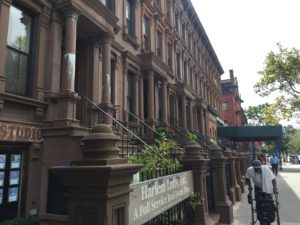
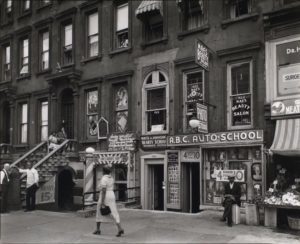
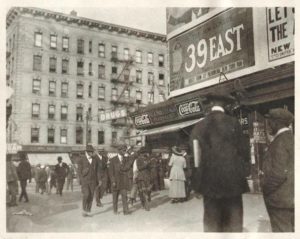
Lenox Avenue, 1940s
Whenever I arrive in Harlem, whether by subway or, as I did today, by minivan, I’m always struck by the scents and how familiar they are. I smell a blend of hair oils, incense, frying food, and a kind of mustiness I can only describe as dust. I grew up in Lorain, Ohio but my childhood home smelled like this too as did the houses of every relative and friends of my parents we visited. This is why I have my character Val Jackson stepping outside on the streets of Harlem and having his senses immediately taken over by smells that strike him with a feeling of home, home, home.
I’m walking down Lenox Avenue, also known as Malcolm X. Boulevard, one of the main thoroughfares of Harlem. The avenues of Harlem are broad, the sidewalks wide. Compared to the narrower, crowded streets of Manhattan neighborhoods to the south, there’s not only room to walk here, there’s room to breathe.
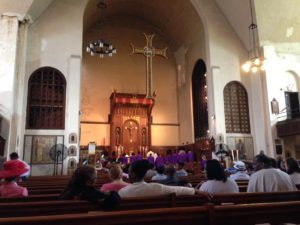
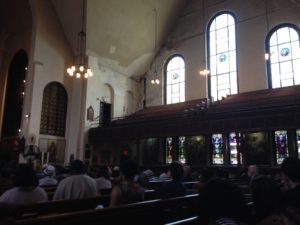
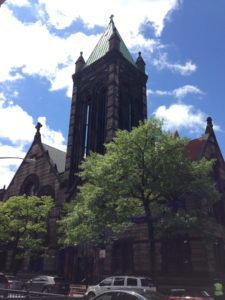 I start at 122nd and Lenox at St. Martin’s Episcopal Church. St. Martin’s, built in 1887-88 in an architectural style called Romanesque Revival, is a striking presence on the corner. It is not as well known as the famous Abyssinian Baptist Church (I’ll come to that later) but when I pictured the inside of Mount Nebo, the church attended by Mae and the other characters, it looked like St. Martin’s. The balcony is not too high and close enough for a person sitting there to see and be seen easily by someone sitting in a central location below. There’s something warm about the design, as though it is embracing the congregation.
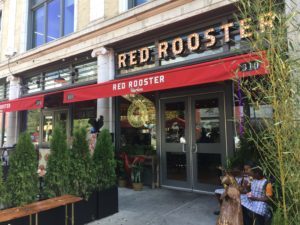
Making my way north on Lenox Avenue I pass Red Rooster, a restaurant celebrating the roots of American cuisine as channeled by famed chef Marcus Samuelsson. I recommend the catfish sandwich, served with the spicy tang of jerk mayo. You can find a mix of live music here as well as in its sister venue downstairs, Ginny’s Supper Club. The elegant club was designed, as its website explains, “with a hat tipped to Harlem’s Renaissance…a modern reincarnation of the glamorous speakeasies and Harlem nights of the Twenties.”

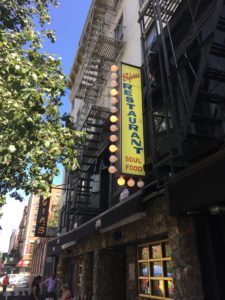 Just a few blocks more I come upon Sylvia’s Restaurant. Owner Sylvia Woods was known as the “Queen of Soul Food.” She founded this Harlem mainstay in 1962. She passed away a few years ago but her family continues to run the business. “Our main ingredient is love,” Sylvia’s granddaughter, Tren’Ness Woods-Black, said in a recent interview. “Our fried chicken is iconic… the way we even flour our chicken—it’s like magical.” I agree with her! Also on the menu: shrimp (grilled, fried, or barb-b-que), sautéed chicken livers, and beef short ribs prepared in Sylvia’s Secret Brown Gravy.
The street teems with life. Groups of teens and preteens in school uniforms laugh and tease each other. Street vendors offer colorful dresses, scarves, and jewelry. A guy sitting on the sidewalk has a large speaker lofting rhythm and blues music out into the air. A singer croons I love you, I love you, I love you over and over again.
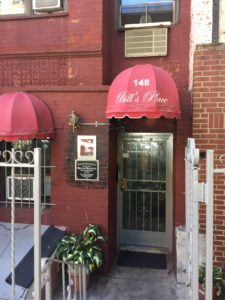
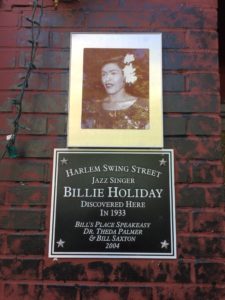 I make a left at West 133rd and go in search of Bill’s Place, a renown jazz establishment. The large flashy jazz clubs of the past like the famed Cotton Club are long gone but smaller venues like Bill’s Place have had a recent revival. The brownstone housing Bill’s Place was once a speakeasy in the early 1920s. Billie Holiday got her start there and Fats Waller was a regular as well, tickling the ivories for a delighted audience. These days co-founder Bill Saxton, a seasoned saxophone player known as Harlem’s Jazz King, can be heard Friday nights jamming with the best musicians around.
I take a right and go north on Adam Clayton Powell Boulevard. A man and his toddler daughter cross the street in front of me. They are reminiscent of the pair my character Val Jackson encounters later in the book while he’s visiting his attorney. Seeing them makes me smile.
At West 138th Street I make another left and I come to the block known as Strivers Row (the homes on West 139th are also included in this noted neighborhood). This area served as my inspiration for the home of hair product heiress Mae Malveaux. Construction on the buildings began in the late 1800s, a project of a wealthy developer named David H. King.
The popular architect Stanford White of McKim Mead and White designed the homes along with a team of other hotshot architects: Bruce Price, Clarence Luce, and James Lord Brown. White designed the northernmost rowhouses on 139th Street in Italian Renaissance style brick and brownstone. Price and Luce designed the other side of the street and the north side of 138th Street in Federal Renaissance-style yellow and buff color brick. Lord chose a Georgian influenced red brick and brownstone mix for the south side of 138th.
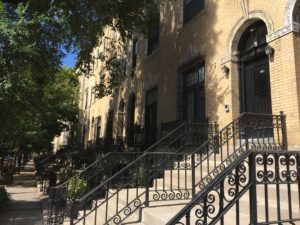
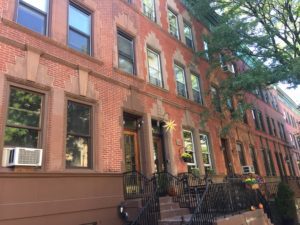
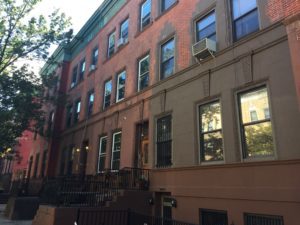
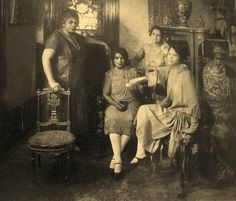
King meant the area to be a haven for the wealthy but the homes failed to sell. Many sat vacant. But black residents weren’t allowed to buy in the neighborhood until the 1920s. At that point white residents were abandoning Harlem. That’s when the name Striver’s Row came into vogue. I found online an image of these fabulous Strivers Row ladies from the 1940s.
There’s a realtor sign on one of the buildings. I gave up the possibility of living in a brownstone long ago but I admit such signs still tempt me to daydream.
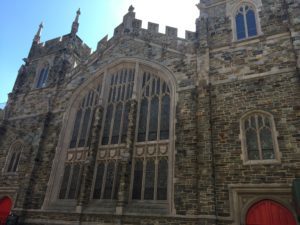 I walk back to Adam Clayton Powell Boulevard, cross it, and arrive at the Abyssinian Baptist Church. This is the granddaddy of Harlem churches. During the 1940s the flock, ministered by Rev. Adam Clayton Powell Jr., grew to 10,000 making Abyssinian, according to the church’s website, “one of the largest and most influential black churches in America and one of the largest Protestant churches in the world.”
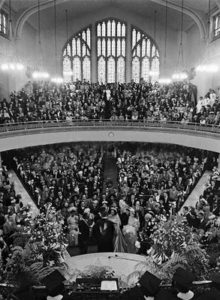 While this is definitely the spirit of the church I created for Mount Nebo Baptist in Unforgivable Love, Abyssinian’s physical size and design were a little too big for me. Check out this image from the 1947 wedding of singer Nat King Cole to his bride Maria. It’s hard to even know where to look and it seemed it might be hard for my characters to notice each other in such a space. But it’s certainly grand!
Continuing east on West 138th Street I return to Lenox, make a left and walk uptown on the east side of the avenue. In a few blocks I come to a marker noting the spot where the Savoy Ballroom once stood. This raucous public dance space enjoyed its peak in the 1940s. It inspired the Diamond, Val Jackson’s club in my novel. The fact that the Savoy was crowded with people from all walks of life made me think about how a character like Mae Malveaux wouldn’t be caught dead in such a place. That led me to create the Swan, a more refined setting for Mae and her cohort.
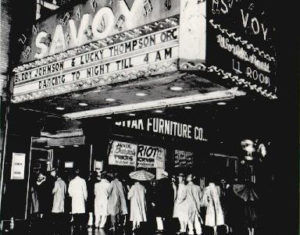
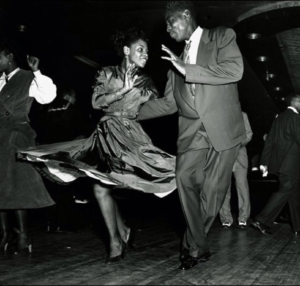
The marker for the Savoy Ballroom is placed at the entrance of the apartment complex, Savoy Park, that now resides on the property. Something about the plaque makes me sad for the loss of the institution and for the music and the footsteps of its happy dancers. But as I turn south again I catch once more the scent of delicious food, and the hunger it inspires makes me feel the promise of everything Harlem is now. I go in search of sustenance, the bright noonday sun beaming down on my face.

NPR Weekend Edition Interview with Sophfronia Scott
Sophfronia Scott spoke with NPR Weekend Edition host Lulu Garcia-Navarro about the inspiration for and complicated characters of her novel Unforgivable Love.
The interview can be heard at this link. A transcript of the interview is available here as well.
Unforgivable Love a People Magazine Pick
Unforgivable Love is featured in the October 2, 2017 issue of People Magazine (Prince William cover) as one of the “Best New Books” of the week. “Scott’s retelling of Les Liaisons Dangereuses is marvelously dramatic and brings its era to life with lush detail.”
Essence Magazine: Unforgivable Love a “sumptuous new tale”
Unforgivable Love is featured in the October 2017 issue of Essence Magazine. Reviewer Patrick Henry Bass called the book a “delicious and infinitely enjoyable read.”
The full review is available at this link on the Essence website.
September 7, 2017
Unforgivable Love an Anticipated Historical Fiction Release
UNFORGIVABLE LOVE is listed in the BookBub Blog’s round up of “the biggest new historical fiction releases coming out this fall” along with books by Heather Webb, Elise Hooper, Devin Murphy, Alice McDermott, Jennifer Egan, and Janet Fitch.
Read the complete list here.
From the BookBub website: BookBub is a free daily email that notifies you about deep discounts on acclaimed ebooks. You choose the types you’d like to get notified about — with categories ranging from mysteries to cookbooks — and we send great deals in those genres to your inbox.
BookBub doesn’t actually sell books. We simply alert you by email to fantastic limited-time offers that become available on retailers like Amazon’s Kindle store, Barnes & Noble’s Nook store, Apple’s iBooks, and others. Book publishers offer deals at these sites for promotional purposes, and our staff works with them to determine the best ones to feature to our members.
BookBub features ebooks ranging from top-tier publishers to critically acclaimed independent authors. Our team of experts makes sure that we’re only featuring great deals on quality books that you’ll love.
August 24, 2017
Curating the Awst Press Anniversary Essay Series
Recently I had the honor of being asked by Awst Press to curate, along with the author Susanna Childress, its annual essay series. Awst is an independent literary publisher located in Austin, TX. Awst is Welsh for August, the month in which the press was founded, and the essay series takes place each August to celebrate the press’s anniversary. Last year I had the pleasure of contributing an essay, “Of Flesh and Spirit,” to a series with the theme of “Outsiders.”
This year’s theme is similarly thought-provoking and important: Religion. Here are the thoughts Susanna and I posted this week on our topic:
https://awst-press.com/essay-series/thoughts-from-our-2017-essay-series-curators
It’s been great taking on the subject of religion and spending the past few months recruiting writers and working with them on their essays. Over the next month we’re featuring the writing of Ayesha Ali, A. Anupama, Sarah Faulman Arthur, Eman Beshtawii, Alicia Jo Rabins, Allison Schuette, Michelle Webster-Hein, and Sarah Wells. Their essays are amazing. I hope you’ll follow the series and catch them all.
Here’s the first essay, “The Lord’s Name,” from the excellent Sarah Wells. I love that she invokes the late Brian Doyle. The Annie Lennox quote is pretty cool too!
Enjoy the journey.
July 26, 2017
Kirkus Review of Unforgivable Love
Kirkus calls Unforgivable Love “a dazzlingly dark and engaging tale full of heartbreak, treachery, and surprise.” Kirkus critics also list the novel as similar to A Hundred Summers by Beatriz Williams and The Bonfire of the Vanities by Tom Wolfe.
July 5, 2017
The Music of Unforgivable Love
This lazy summer day, for me, brings to mind a moment in my novel Unforgivable Love when Val Jackson, enjoying after-dinner cocktails with Elizabeth Townsend and his Aunt Rose, puts on a record he’s purchased for his aunt. It’s a new song by Ella Fitzgerald called “A Sunday Kind of Love” and Val is using it as an opening move in the hot weather game he’s just begun.
When I embarked on the adventure of creating Unforgivable Love, I knew I wanted to write a story where money obviously wasn’t an issue, and to have it take place in settings I wanted to spend time in: lush gardens, large gorgeous rooms filled with sumptuous jazz music. I liked having the sounds of Duke Ellington, Louis Jordan, and Ella Fitzgerald flowing through the book’s pages. I wanted to relate a vision of elegance, of well-dressed people strolling down the street or through a park. In the coming weeks as we near the publication of the novel I will introduce you to the elements that served as both inspiration and the building blocks that make up the world of Unforgivable Love. When you have the book in your hands come September, I hope you’ll feel as at home as I did during the time I spent with the characters who live there.
Let’s start with the music.
When you listen to this music you’ll soon notice I favor a lush jazz sound, full of bright trumpets and sexy, intoxicating saxophones. I consider it the baseline soundtrack of the book, the music running like an underground spring through my mind as I wrote. As noted, some of these songs appear in the book and have direct story implications. Others served as pure inspiration and a few are songs favored by my characters based on influences on them.
I’m curious to hear your thoughts after listening to the playlist. Feel free to come back to this page and comment. I’m happy to make additions to the list if you feel there’s a piece that absolutely has to be here. Have fun with it. Enjoy!
A Sunday Kind of Love, Ella Fitzgerald (as referenced above.)
Nature Boy, Nat King Cole (A song sung by the character of Sam in a nightclub scene.)
Lady of the Lavender Mist, Duke Ellington (Mae Malveaux’s signature song at the nightclub.)
Let the Good Times Roll, Louis Jordan (One of the songs played outdoors at Aunt Rose’s during an event.)
Azure Te, Louis Jordan (This song isn’t in the book, but it served as inspiration for the novel’s scenes in Paris.)
As Long As I Live, Lena Horne (Elizabeth finds herself humming this song.)
Take the “A” Train, Duke Ellington (This and the following tunes by Ellington, Monk, Davis, and Parker, are indicative of the music of the time. To me it’s playing somewhere even if not directly mentioned.)
I’m Just a Lucky So and So, Duke Ellington
I’m Afraid (Of Loving You Too Much), Duke Ellington
Satin Doll, Duke Ellington
‘Round Midnight, Thelonius Monk
Donna Lee, Charlie Parker and Miles Davis
Scrapple from the Apple, Charlie Parker
Confirmation, Charlie Parker
Zouzou: C’est lui, Josephine Baker (The younger Mae Malveaux is a fan of Baker so here are a couple of songs Mae would have listened to, possibly with her friend Alice.
Jai deux amours, Josephine Baker
Boo-Wah Boo-Wah, Cab Calloway (The tune being played by the jazz band in the Parisian club Tabou when Mae visits with a conquest.)
June 24, 2017
Book Review: Hunger-A Memoir of (My) Body by Roxane Gay
“I don’t know how I let things get so out of control, but I do.” These words, repeated a few times in Roxane Gay’s memoir, hold the tension of this important work. The tension is the push and pull between strength and vulnerability, courage and fear, reality and illusion, knowledge and confusion. This tension is where the author lives. “…here is my heart, what’s left of it. Here I am showing you the ferocity of my hunger.” I admire this stance. I like how Gay, in a world that adores happy endings and experiences neatly dissected for meaning, “went there,” showing the pain and frustrations she continues to endure. She isn’t afraid to admit the story is ongoing. But hope is present in her life, in tiny glowing balls that remind her she is not totally in darkness: she is loved, her work is affecting lives, she is seeking the geographic place her heart most wants to call “home.” For this reason, the fact of its clear-eyed and difficult truthfulness, I believe this book will do more for more people than a truckload of all those happy ending books could ever do. Gay says this was a hard book to write. I am glad she managed to do it.
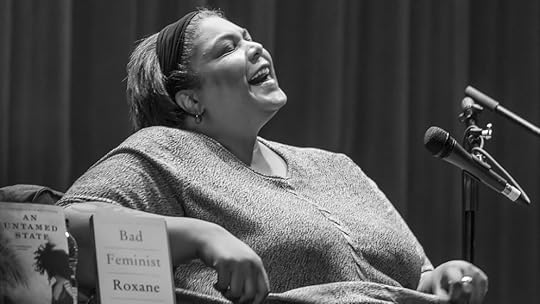
Photo by Eva Blue