Ken Brack's Blog, page 4
April 14, 2016
Season of gratitude
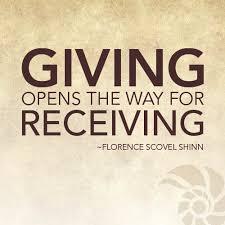
“Giving and receiving are one.” — Lau Tzu
My wife plans to buy some really good thank-you cards today.
It’s been an uplifting week, actually two in a row, and we anticipate another to come at the month’s end.
This is a season of gratitude. From people like you to Denise and myself. Then back at you as we recharge. Reverberating wherever hearts stay open, refusing to close.
There’s something uncanny about this reciprocity. Finding it helps break through the storm clouds. Reaching back to it, we disperse negative forces that seem to mount everywhere else.
Maybe it’s more than the old adage, “What goes around comes around.” Or good karma—not that I truly understand all that, not yet anyway.
I offer that there’s something more to this giving back stuff. When it involves an alignment of your life’s work, or passion, with people who also get it, everyone can lift each other through their trials. You may not even realize it’s happening. Then you feel the rays of first light loosening the frost.
“This circle of gratitude is infectious. And I hope it spreads.” — Rev. Lyndon Harris
We’ve discovered a ripple effect in this reciprocity that is not just a cliché. It involves real people. Those who step forward to show they care, as they can; others among circles a few removed from ours who, once touched, come forward to reach others.
Yesterday morning, eight of Denise’s friends and colleagues at Hope Floats Healing and Wellness Center joined us around a table in Hyannis, where she was being recognized for her service to the community. One of our yoga teachers, Linda Sheldon, had nominated Denise for an American Red Cross Heroes award.
She was among an eclectic group of people thrust into being lifesavers, or having trained in law enforcement or the armed services for the very moment when the call came. A Coast Guard crew flew a team of three doctors through a crippling winter storm to aid a neonatal patient on Nantucket. An employee with Down’s syndrome at a gym found a man facedown in a whirlpool and quickly got him help.
Each one answered with grace under fire.
As keynote presenter and author Casey Sherman noted, none of the recipients likely considered themselves heroes. (Sherman is co-author of The Finest Hours, which chronicles the daring 1952 rescue of 32 men trapped in a sinking oil tanker off Chatham, now a heralded film.)
Denise, for one, felt more lifted by those who took the time traveling early in the morning to show their support—and love.
The previous evening, after attending a pre-awards reception, we talked again about those people who keep showing up. And those, like some of our son Michael’s friends, who circle back with positive energy when they can. The rain had ended, and after seeing a rainbow with an uninterrupted arc on Cape Cod, the last light was brilliant and evocative, layering the thinning clouds like eons of sedimentary rock.
The Red Cross event was a hub of good energy. This, I told her, absolutely felt like the right place to be.
There’s something more to this giving back stuff.
We are also grateful for the efforts and support of the April 3 fundraiser for Hope Floats. Thanks to Skating 4 The Nation, its crew and sponsors, for a great afternoon! We look forward to seeing many of you guys on the ice again.
Also a brief preview: registration is cranking for Hope Floats’ 3d Annual Memory Walk on April 30! We already have about 250 participants, up from last year!
We hope you can make it Saturday, perhaps on a team to honor someone you love—or for the camaraderie of the morning. It promises to be another great day. 
A few years ago, while meeting people for my forthcoming book, I was struck by how some 9/11 families experienced a similar gratitude. Elevated by random acts of kindness from neighbors and strangers in their hour of need, a few picked up the ball and ran hard. They needed to run, they needed to do something, and instilling service or tributes to the fallen transformed their lives.
On the edge of Ground Zero in Manhattan’s financial district there is a historic church, Saint Paul’s Chapel. George Washington prayed there, and the church continues to stand as a sentinel amidst the cacophony of everyday business, having born witness to one of the most heinous crimes against humanity.
A few days after the 9/11 attacks, Saint Paul’s opened its sanctuary as a respite for rescue and later recovery crews. Volunteers provided water and coffee, there were cots, counsellors, and foot massages. Men who stayed at a shelter grilled burgers while firefighters grabbed a couple of hours in a pew. The center stayed open continuously for 260 days; some half million meals were served. Daily celebrations of the Eucharist were reserved for rescuers.
As the center closed the following May, the Reverend Lyndon Harris thanked more than five thousand volunteers. He then offered:
“Emerging here is a dynamic I like to refer to as a ‘reciprocity of gratitude’–a circle of thanksgiving–in which people have risen to the scriptural challenge…’to try and outdo one another in showing love.’ Both giver and receiver have been changed by it. This circle of gratitude is infectious. And I hope it spreads. I hope it turns into an epidemic.”
Hallmark, do you have the appropriate cards for us?

Courtesy Plant Wisdom.com


March 3, 2016
Skating for a good cause
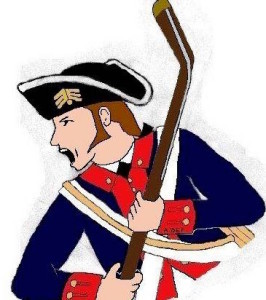 Quite often, away from the blather of loud egos vying for our attention, people like Ben Rabinovitz quietly do good work to help someone else.
Not that Rabinovitz is downplaying the event he is organizing on April 3.
His group, Skating 4 The Nation, will put on a charity hockey game to benefit our bereavement center, Hope Floats Healing & Wellness Center.
It’s going to be a fun afternoon, from 3-6 at the Rockland Ice Arena, 599 Summer St, in Rockland. And very affordable for all, with a $5 admission, and free for children under five.
On the ice will be a team that includes some friends of the 28-year-old Weymouth resident, plus National Guard veterans who helped Rabinovitz’s group raise money for returning soldiers and their families a few years ago.
The South Shore Colonials will take on our Hope Floats Dragonflies. Some of our son Mike’s friends, longtime players, are expected to join in!
Please join us for a light afternoon with friends and families. There will be face painting for the kids, raffles, an appearance by the Plymouth Pilgrims’ mascot Gobbles giving out season’s passes, delicious eats, and more.
These guys are doing it for the love of the game; that’s what it comes down to. — Ben Rabinovitz
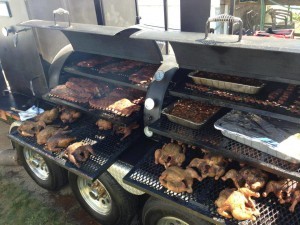
Courtesy Smokey Stax BBQ of Hingham
Big Frank from Smokey Stax BBQ of Hingham will be on hand with his pit smoker for some bites.
A group of riders from the Patriot Guard are expected to make an entrance on their bikes to rev things up.
There will be a championship cup, blasting goal horns, and players’ board hopping on to the ice.
Rabinovitz, who began organizing hockey games in 2012, still needs some players–mostly forwards and defenders–and volunteers. He can be contacted at skating4thenation@gmail.com, and on the group’s Facebook page.
Volunteers can show up on game day; there is a $40 fee for players that includes a jersey and after-party.
“When you put it together, the gamesmanship and fundraising, that’s a perfect Sunday right there,” he said. “These guys are doing it for the love of the game; that’s what it comes down to.”
“It’s a chance to do something, and a chance for local talent to come out and get recognized,” he added.
Ben was introduced to Hope Floats last year by his boss at Edmar Floor Care Center in Plymouth. Edmar’s affiliated company, Bissell Big Green, is helping sponsor the event.
Rabinovitz, who grew up in Hingham, ran—or skated—with the idea of doing hockey charity when his best friend’s cousin returned home from Afghanistan with the National Guard in 2012. Learning about the every day items many families of active duty members need, he set out do something. For two weeks he drive around with fliers, and the first match benefitted the National Military Families Association.
Proceeds from a second game the next year also went to the national association, raising about $2,000.
This year, we are grateful that Ben has set his sights locally—which he wants to continue.
In our seventh year supporting families who face life crises, Hope Floats can use your help.
This winter we are providing nine free support groups, many in partnership with Cranberry Area Hospice, including those for parents who’ve lost a child, suicide loss, partner-spouse loss, and a teen grief group. Last fall, Hope Floats began a support group for survivors of drug addiction and opioid loss, and soon we will offer a proactive group to help those who have attempted suicide.
We are the only bereavement center in the region offering such an array of supports and complementary wellness programs. Hope Floats is located at 4 Elm Street, Kingston, and the Hope Floats Foundation is a 501(c)3 non-profit. See you along the boards!

Thanks to our sponsor for the Skating 4 The Nation April 3 fundraiser: Edmar Floor Care, dba Bissell Big Green!
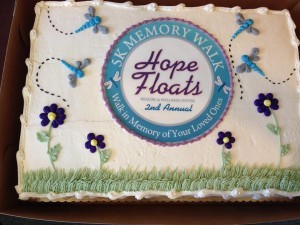
Cake from 2015 Memory Walk courtesy of Sugarplum Bakery in Kingston! Hope Floats’ 3d annual Memory Walk is April 30, 2016!
February 23, 2016
Overcoming the negative

Source: geograph.org.uk, courtesy Wikimedia Commons
Raise your hand if you feel awash in uncertainty and negativity like I do so far this winter.
For some of us, the mid- or late-winter blahs have been compounded by a clutch of bad news from both near and far.
For me, there is the near demise of a close friend who seems unwilling to face his demons. Illnesses threatening people we love. Then a specter of distant wars uprooting hundred of thousands of innocents.
Regardless of how far we look, it can be pretty bleak. And as my wife reminds me, before we know it, we can also get sucked into that hole.
Yesterday’s full moon is widely called the “snow moon,” once a signature of hunger and other scarcity. From varied Native American traditions, we learn that February’s moon connoted an especially stark stretch. Hunting was often restricted by heavy snowfall and tribes huddled for warmth.
In a season of uncertainty, beware of a scarcity of heart
The Cherokee call it “bone moon,” since traditionally there was so little food that people ate bone marrow soup. Lakota call it “moon when the trees crack because of the cold,” while the Passamaquoddy note a time “when the spruce tips fall.”
Perhaps to quench their spiritual hunger, the Hopi, at least, consider it a moon of purification and renewal.
Another sense of purification, in the Arapaho understanding of this moon, is “frost sparkling in the sun.”
What can we glean from this? Even when the seasonal cycle is harshest or most dormant, we’re reminded that new growth is poised to stir if we’re prepared to take certain steps. To overcome a scarcity of heart.
While it may appear almost illogical to suggest this in the face of family crises, or intractable events from Flint to Damascus, we have to keep reminding ourselves. Where I live, the pussy willow outside our house is budding as usual, and crocuses have already poked out in the sunnier spots.
“Repetition is a sign that you need to change.” — Deepak Chopra
Another way to look at this is offered by the author Deepak Chopra. In an essay on overcoming negativity, he suggests that much of the problem is our tendency to repeat negative thoughts, our anxieties and fears. To overcome them, he suggests we must step back and create “viable strategies.”
“Repetition is a sign that you need to change,” Chopra wrote. ”A part of you is calling out to get your attention.”
(I wonder about applying this truism to the repeated, battering egos of presidential wannabees in this consumptive, absurdly long election spin cycle. But that is an overlaying negative for others to comment on. Resisting the temptation of being sucked into this vortex is tough.)
I won’t try to relate all of Chopra’s wisdow, which is available in this article. A few salient points include:
* Forming an action plan. “Write down the possible steps you can take that will be positive, achievable actions,” he suggests.
* Use mindfulness or self-awareness to forge “new grooves,” and step out of the old ones.
* Aim for lasting, higher satisfactions by “developing a vision of what your life is about.”
* Reinforce your successes. Chopra says negativity “acquires its power through repetition, being unconscious, judging yourself and focusing on setbacks.”
Alternately, positivity “gains its power by celebrating our successes, associating with people who are good role models, learning to be emotionally resilient, being objective about your situation and, above all else, acquiring self-awareness.”
Heady stuff for a doldrums’ day.
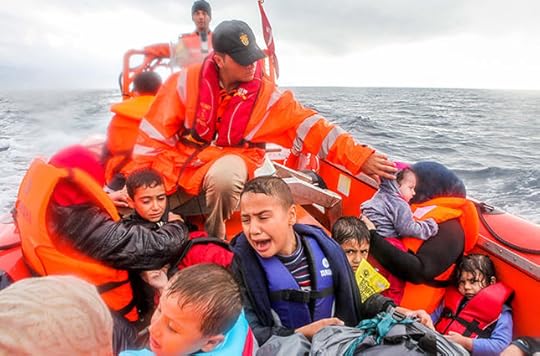
A stark reminder of what’s wrong with the world — and questioning why we would ‘build more walls.’ Syrian children rescued in the Aegean Sea off Turkey while trying to get to Greece in 2015.
Photo: UGUR YILDIRIM/SABAH
January 13, 2016
Shrinking in an expanding world

Photo by Tony Webster, Minneapolis, Minn. 2010. Courtesy of Wikimedia Commons.
Maybe gun control proponents should try harder to understand those fears, and where they come from.
Following a life-altering event, many of us are faced with two starkly different choices.
We can contract and withdraw into ourselves. Or we can gradually expand, grappling with both the acute pain and a new reality that’s dawning.
We may seek answers that will fit what we already think.
Or we might glimpse that since the world as we know it has been shattered, another response is possible.
Following watershed experiences such as a sudden loss of a loved one, a life-ending illness, or some other calamity, there is often a profound opportunity to grow in positive directions. Yet in order to adapt and go forward, we may need to look at things differently. And reassemble those pieces in a new way.
Psychologists call this modifying our assumptive world, applying Piaget’s theory of accommodation to how we process trauma. Rather than trying to fit the oversized jigsaw pieces from our old life back together—discovering that the new information, the new reality, cannot be shoehorned into what we’re used to–we’ve got to reimagine and solve a new puzzle.
I may be going out on a limb here, so please bear with me. I wonder if some of this applies to the distressing intransigence towards reducing gun violence in this country. Please of course jump in with your comments, or otherwise set me straight. Perhaps I am entering a political fantasyland.
Yet I wonder if there’s a connection between these individual responses to trauma and whether we expand or contract in our understanding of preventing mass shootings, and gun control.
Circling the wagons, blaming others, is a time-honored response.
For sure, this is such a complex issue. Both sides appear so polarized, and are often stereotyped as such by a lazy mainstream media that appears driven mainly by the latest extreme video footage. The vitriol that occasionally spews from gun owners who claim that the government is attacking their constitutional rights, or from liberals who know nothing about how firearms are legitimately used, or appear too aloof to acknowledge people’s fears—the noise can be deafening.
Yet isn’t this intransigence (often on both sides) an example of people contracting en mass? Withdrawing into their opinions, avoiding other worldviews–and even facts? Denying that there is common ground to find solutions?
Recently, a gun owner who lives in my region of Massachusetts wrote a letter to the The Boston Globe. He directed it to a man who had sat next to him on the commuter rail, an “angry liberal” whom he overheard ranting about the gun lobby such as the National Rifle Association.
The writer, an NRA card-carrying member, had a legally owned 9mm pistol in its holster, which he apparently carried for the extremely remote possibility of defending against a shooter on the train. The gun owner didn’t respond to the vocal gun opponent, writing:
“I don’t hate you. I don’t have any ill feelings toward you. I don’t wish to do you harm. And I don’t regret sitting next to you. On the contrary; I feel bad for you. It must hurt carrying that much hate inside of you.”
Last week, the truly modest executive orders on gun control announced by President Obama were predictably derided.
The measures include expanded background checks through a clarification of existing regulations, clear definitions of a licensed gun dealer’s responsibilities, and increased funding for mental health care. Before the massacre of nine people at a South Carolina church in June, the alleged shooter bought a .45-caliber handgun despite admitting to drug use. The New York Times reported that the F.B.I. director said a breakdown in the background check system had allowed the man charged to buy the gun.
The president, I believe to his credit, called out in an op-ed piece: “We all have a responsibility.”
What I will characterize as denial on this issue is systemic. Gun sales spike across the country following each mass shooting or proposal from the White House. Some of us might consider this response to be insidious, evidence that the gun lobby is accountable to no one and how fear-mongering reigns.
Yet perhaps gun control proponents should try harder to understand those fears, and where they come from.
Circling the wagons, blaming others, and arming oneself, is a time-honored response. To survive. To remain independent of an overreaching bureaucracy. To restore one’s sense of control in a world gone mad.
And slip that information into the fold of what one already believes.
To continue reading, please click here for my blog on Psychology Today. Be well.
December 15, 2015
Conscience matters in a ‘mute world’
A suggested anecdote to demagogues who urge us to know nothing and suspect everything.
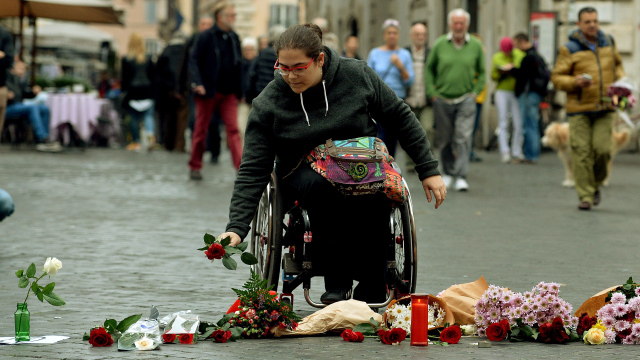
A woman brings flowers outside the French Embassy in Rome after the deadly attacks in Paris. (Photo credit: Tiziana Fabi/AFP/Getty Images)
Columnist Roger Cohen of The New York Times wrote Monday, “It would be hard to imagine an atmosphere better suited to the politics of fear.”
He’s spot on.
We’re on the precipice of being consumed by our fears. Of jihadists infiltrating the country. Of a failing strategy to “demolish” the rising Islamic State. Watching Europe being overrun by Middle East immigrants spurs similar concerns at home.
Perhaps most potently, we’re scared of examining the true causes of these fears. Aren’t they really symptoms of something else?
We feel worn down by events that we have no control over. We need scapegoats to pin our anxieties on. Our children’s future—finding good jobs, and climate change threatening other generations—is in doubt. Afraid of looking deeper at the root of our fears, we grab at easy answers.
It is precisely at this juncture when we must rise to the occasion.
We see images of ruthless people executing innocents, and imposing brutal Sharia law in ancient places that we’ll never go to, less understand. Mass shootings at home that make us feel helpless while pathetic elected leaders do nothing in response. We see outrage in the streets of Chicago, Baltimore, and Ferguson—and where’s the latest violation?
All of this alarms us–until the repetition of events and distorted facts become a blurred smudge. Until we don’t see and hear or feel them any more.
Yet, let’s step back for a moment. Try observing this in a different light. Because there is another way.
It is precisely at this juncture, amidst these torrents of uncertainty and fear, when we must rise to the occasion. Not by abandoning our principles, or sinking to the level of the fanatics and demagogues. We forget this at our peril. Been there, done that.
We must be guided by conscience instead. Responding to seemingly intractable conflicts by rejecting the voices of division and fear mongering.
The alternative to acting with conscience is an abyss.
An absurd life of ever-spiraling retribution and violence. A meaningless life. In which we hear only “the unreasonable silence of the world,” the French existentialist Albert Camus wrote. A “mute world.”
Another newspaper columnist, the Boston Globe’s Kevin Cullen, put this in his own estimable way. Writing shortly after a couple opened fire and killed 14 people in San Bernardino, California, apparently driven by jihad, Cullen considered how paralyzed Americans feel in the wake of such indiscriminate killings.
“Does the number of casualties make a difference?” he wrote. “Do the ages or genders of the victims?…The motivation of the shooters? Does a terrorist trump a racist? Is a zealot more noteworthy than a nut? Is there a difference?
“All questions worth pondering, as is this one: is the frequency of mass shootings and their ubiquity in all corners of our popular culture getting to the point that instead of caring more we care less, that carnage becomes so routine that it is greeted not with a shriek but a shrug?”
“The real danger in being desensitized, to anything, is the apathy that is its byproduct, the sneaking belief that nothing can be done to alter the status quo.” — Kevin Cullen, the Boston Globe, Dec. 3, 2015
Nothing can be done. In a mute world. With a view from nowhere.
Yet following one’s conscience offers a way out.
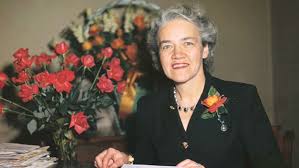
Sixty-five years ago, the first female elected to the U.S. Senate gave a speech that all Americans should heed today. Margaret Chase Smith’s scathing “Declaration of Conscience” criticized both her fellow Republicans and Democrats for failing to stand up to the demagogue of their day, Senator Joseph McCarthy. McCarthyism was in full force, cowing many Americans from speaking out.
Chase, a freshman senator from Skowhegan, Maine, stood up to the bullying noise.
 magazine concluded, “Neither counterterrorism, nor counterinsurgency, nor conventional warfare is likely to afford Washington a clear victory against this group.”
Such challenges are also transformational opportunities.
We were reminded of this last weekend by the international accord reached to lower planet-warming greenhouse gases for the first time. The hard work is just beginning, but humanity may have turned a corner to limit the most drastic effects of climate change.
It took guts, or conscience—regardless of one’s political beliefs on the issue—by President Obama to help lead this. As reported by the Times and others, negotiators in Paris said a spark plug to reach a deal was the administration issuing stringent regulations in 2014 to cut pollutants from coal-fired power plants. Taking action has become a moral prerogative.
Rising to the occasion also requires not sinking to the level of our professed enemies, or opponents. That line can become perilously thin.
I am an animal just like him. — Nathan Offen, Holocaust survivor
During the past few years I’ve been informed by the experiences of a Holocaust survivor who turned 93 just the other day. While hard-shelled and remote throughout much of his life, Nathan Offen salvaged his humanism despite the atrocities he and his family suffered.
During the Nazi occupation of Offen’s native Krakow, Poland, Nathan realized he had become just like his enemy.
Offen was on a work detail offloading injured German soldiers at a railroad substation. One soldier spoke to him, calling Offen his “friend,” imploring him to help because his frostbit “feet hurt like hell.”
Nathan didn’t flinch to inflict more pain. He banged the man’s legs on steps as he carried him, jerking the soldier across the rails and timber ties through the dark. No one heard his cries amidst the bleating engines and commotion.
Nathan felt a rush of satisfaction, his wrath uncoiled amidst the turbid coal fumes.
Yet Offen had allowed something to die within himself.
He took ownership of this later. I am an animal just like him. Returning home, Nathan broke down in tears.
“If silence persists,” Camus scholar Robert Zaretsky wrote, “where do we find meaning? What must we do if meaning is not found?”
The alternative to acting with conscience is an abyss.
****
Notes
“The unreasonable silence of the world …” Albert Camus. The Myth of Sisyphus and Other Essays, trans. Justin O’Brien. (New York: Vintage, 1991) 6. See also Robert Zaretsky. A Life Worth Living. (Cambridge, Mass: The Belknap Press of Harvard University Press, 2013.) 12.
“If silence persists …” Zaretsky. Ibid, 15.
November 4, 2015
Puzzling out your life’s work
How are you feeling about your life’s work? Who or what speaks to you?
Source: www.innovationmanagement.se
Do you ever feel that the universe is speaking to you, encouraging you to stay on the path you’re on?
Or is it telling you to change course, and get on with the true work of your life?
Lately I’ve been receiving enthusiastic signs. For five years, I’ve been immersed in writing a book on a very difficult topic. It is about how people recover from sudden loss and other trauma, growing in positive ways as they attempt to make some sense of dark trials.
Many of us have been in these trenches. My interest is in how we climb out.
I’ve found great joy putting this together and refining my writing. All despite encountering many self-doubts and other ups and downs of trying to craft my art. I’ve received some validation for taking this risk–not so much externally, though I believe that will come later when a reader finds something meaningful in my book to take away.
More keenly, I recognize a growing sense that I am on the right track. That my work is aligned with a vital purpose. Hopefully it’s the best I have to offer this world in this moment. More about this in a few minutes.
So how are you feeling about your life’s work? Who or what speaks to you?
Of course, many of our everyday jobs and tasks fail to bring a lot of happiness. Nor do they seem to make a big difference in the grand scheme of things. Among people I know best and care about, I can only hope, for example, that a friend who sometimes struggles to find work as a carpenter finds fulfillment. My brother travels so much for business in a draining cycle that seems to have escalated over the years. It’s enough to make him consider stepping off the merry go round.
Occasionally we discover that our lives are out of alignment. Similar to the gradual yet assured effect this has on wearing down the tires on one’s car, the carousel spins unevenly. And much too fast. We yearn to get off.
How do we find the courage to rebalance and make a shift?
Recently my wife and a friend introduced me to two books that address this. I feel their reach as if directly speaking to me at this juncture of life; it’s not just by accident.
The first, The Great Work of Your Life, will open your heart. Author Stephen Cope lays out the development of one’s dharma–defined as one’s sacred duty or purpose, in part–in an inventive way. He traces how eleven or so famous people devoted themselves to a purpose and achieved mastery in their fields, or made other huge contributions to humanity. Most crucially, to attain a supreme goal, they often turned aside personal ambition, “emptying the self” to be an instrument of a divine power–whether one calls it Soul Force, God, or something else.
Click here to continue reading this post on Psychology Today’s web site.
In the Eastern contemplative tradition that Cope’s book embeds with, he writes that “yoga”–meaning “to yoke”–involves “bringing every action into alignment with one’s higher purpose,” or “yoke all of one’s being to dharma.”
Pursuing one’s calling, or sacred duty, with every fibre in one’s core.
October 14, 2015
Introducing “Hope Heals”

Machias Bay, Maine. Photo by Denise Brack
I’d like to share an update on my forthcoming narrative nonfiction book, which I’m naming Hope Heals.
It is about people who find a new purpose after unspeakable loss–and how they go about it. My goal is to help lift up others going through tough stuff as they find compelling responses to loss and other trauma in these stories.
I expect the book to be published next spring, and look forward to letting you know. Thanks for your interest and support! Here is an “inside-the-jacket” description:
I needed to weave their stories together in order to make some meaning of my own.
In the predawn hours of November 15, 2002, every parent’s worst nightmare strikes journalist and soon-to-be teacher Ken Brack, who along with his wife learns that their son has died in a car crash. Trying to make sense of the unspeakable, he sets out to find how people rebuild their lives after catastrophic loss, chronicling the stories of families who heal by finding a new purpose. Meeting moms and siblings, couples, students and entrepreneurs from across the country, Brack gathers the wrenching and ultimately uplifting stories of people who step beyond themselves, often as they confront the very forces that tore apart their lives.
Driven by an arresting emotional intimacy that is anchored in the author’s narrative voice, Hope Heals offers fresh light on what comes next after horrific ordeals. Among the families Brack follows are two parents whose response to tragedy break the silence about sexual assaults on college campuses and confront a national disgrace. Other complete accounts are also gathered for the first time, including those of a volunteer firefighter’s brother and friends inspired by his unselfishness to create a day of service and remembrance honoring 9/11 victims. Three brothers from Poland who survive the Holocaust take disparate paths to confront their trauma decades later, becoming witnesses to remind the world as they find a mashed-up space to reconcile the past. Moving through such trials, many of these people rediscover gifts their loved ones left while discovering a sacred duty. Together they offer hope to others searching for answers.
Threading a grieving father’s questions into a quilt of universal voices with a hybrid of narrative, reportorial, and creative nonfiction, Brack examines the arc of growth that is possible following traumatic experiences. The book speaks directly to readers facing loss and to a broader audience compelled by stories of compassion, resilience, and our potential to heal. The author and his wife face occasional fractures as he grapples with the cause of his son’s death while she reaches out to support other bereaved parents. Six years later, in 2008 they opened a nonprofit center offering support groups, counseling, and wellness programs that became a leading resource to families in Massachusetts.
Click here in “Read a Bit – Excerpts” to see an annotated table of contents of its sections. Take care.
September 11, 2015
14 years later, a call to sustain hope
“Tragedy wasn’t the only thing born on 9/11. Hope was born, too.” — David Paine, co-founder 9/11day.org
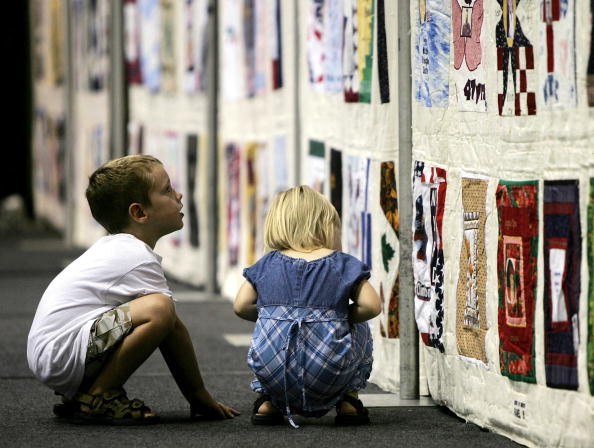
Photo by Win McNamee/Getty Images
Cindy McGinty, a 9/11 widow who refused to curl up in a ball when she was suddenly forced to raise two young boys alone, issues a call to action as we pause today to remember the fallen.
“Think about what you can do to keep the hope alive that was born on 9/11,” she says.
Moved by her neighbors’ kindness fourteen years ago and inspired by the spontaneous selfless acts across the country, McGinty challenges us to carry that spirit forward. And not just during the spotlight of this anniversary.
After losing her husband Mike, McGinty found her footing doing service work for others. Once painfully shy and a dutiful housewife, the Bristol, Conn. native discovered her voice advocating for military families and others.
Michael McGinty had been a nuclear power specialist on a submarine tender in the Navy. She helped start the Massachusetts Military Heroes Fund to assist the families of active duty service members.
Cindy also joined a national nonprofit, 9/11day.org– or MyGoodDeed–or that facilitates volunteer service projects. Its founders were the driving force behind establishing the 9/11 National Day of Service and Remembrance. Some 50 million people are expected to volunteer in a form of their own choice today.
McGinty also established a scholarship in Mike’s memory in Foxboro, Mass., when they lived in 2001. She and a core group of friends continue to hold a Family Fun Day on the Foxboro town common—which will be held again Saturday–disbursing some $90,000 in grants to high school students who are active in community service.
Energetic and fun loving, Mike McGinty was dedicated to his family, a dad who left work firmly behind when he came home. Sliding his briefcase across the floor, Mike would roar, “Where’s my dinner?”, sending their sons into screams of laughter. In 2001 he worked for Marsh Inc., the insurance brokerage firm in New York.
McGinty was starting a business meeting on the 99th floor of the North Tower when American Airlines Flight 11 struck just below him.
After getting the boys on the school bus that morning, Cindy was at their church, using a staple gun to help recover some chairs. News of the first jet crash came over the radio, followed by phone calls from her sister.
“In that instant the world stopped for me,” she said. “Everything I knew was no longer, my life, my love was gone.”
Yet something else happened in the next moment, something bigger.
That surging spirit continues to resonates across the country.
“It was as if the world stopped, took a collective breath and began breathing again,” she recalled earlier this week, returning to Foxboro to speak before a small group of Jaycees in a community hall. “Hope was born out of ashes and rubble. I know it sounds impossible. Thousand of people died. Buildings crumbled and planes crashed and the world just stopped. Consider for a moment what really happened that day.”
Setting out to help others, Cindy McGinty ultimately found her own way to heal.
“Yes, I had suffered a trauma,” she told the Jaycees, “but in the process of recovery I grew as a person. I embraced this growth and wanted to use it to help someone else. I discovered the secret: I thought I was helping people and what really happened was that I found my inner peace. I received far more than I gave.”
That surging spirit continues to resonates across the country.
Hillary O’Neill celebrates her fourteenth birthday today, one of 13,238 children born on 9/11. She already realizes the significance of her connection to it.
As she told People magazine recently, in honor of the fallen, O’Neill planned to sell lemonade and donate the money raised to Al’s Angels , which helps children struck by severe illnesses or natural disasters.
“When I realized that even though my birthday is such a bad day, and such an awful and tragic day for so many,” Hillary says, “it’s important to make the best out of it and make it something good.”
Click here to view a video interview with Hillary O’Neill.
To David Paine, one of the co-founders of 9/11day.org, “ Tragedy wasn’t the only thing born on 9/11. Hope was born, too.”
Of course, this remains a bittersweet day for Cindy McGinty. Her husband adored reading with his sons, playing board games, and sometimes returned from a business trip with a fresh CD from Strawberries for them. Born an Air Force brat in a dysfunctional, frequently moving family, he was determined to do it right.
In her former life, Cindy appeared doe-eyed and had a nondescript job doing systems documentation for an insurance company. Now in her mid 50s, she is still largely a no-frills, plainspoken person. Both her sons are young adults making their way through college, and at time she grapples with letting them figure out their mistakes.
These days, McGinty knows exactly what she wants, refusing to linger long over decisions or a minor miscue. Over dinner with some friends after her talk, she was animated, sharing stories of one son’s mishaps learning to drive her Volvo.
“If you look at people who are active in the community and serve you will see people who are energized, engaged, compassionate, and happy,” she said earlier. “I believe it is because they are a part of something bigger than themselves.”
The McGinty family’s ordeal and how Cindy found her voice following the terrorist attacks is chronicled in my forthcoming book, The Ten-Year Quilt, expected to be published early in 2016.
Photo: Associated Press/The Star-Ledger, John Munson, via WBCO-AM1540
July 30, 2015
On the cusp of victory
Courtesy of PMC
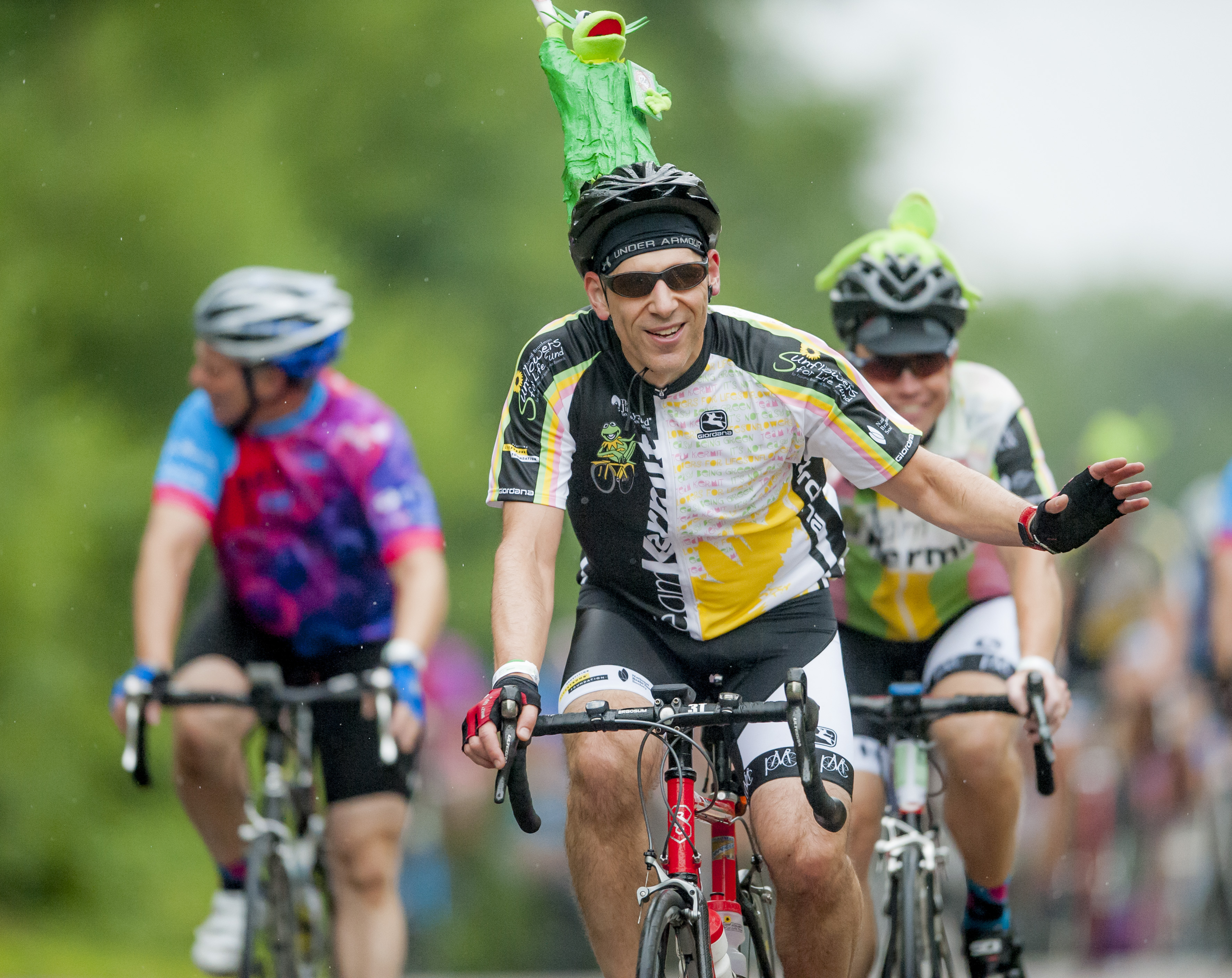
This weekend marks the 35th year of the Pan-Mass Challenge bike-a-thon benefitting cancer research and patient care.
As legions of PMC riders prepare to click in for up to 192 miles over two days, lifted by several thousand volunteers and supporters along the roadsides, it’s worth taking stock of the breadth of their contribution.
This year’s official $45 million fundraising goal will bring the event’s contribution to the Dana-Farber Cancer Institute to a whopping $500 million. Of course, it’s about much more than numbers. As chronicled in my book, Closer By The Mile, the two-day event is a fiesta of reciprocal giving that is unparalleled in the world of sports philanthropy.
Dr. Edward Benz, DFCI’s CEO, recently shared some highlights to point out “where the money goes.” Among the highlights:
* The PMC accounts for over half of all Jimmy Fund fundraising, which is the major source of Dana-Farber’s flexible or so called “unrestricted” fundraising
* PMC funds primarily support research, and also unreimbursed clinical services, like the founding of The Zakim Center for Integrative Therapies
* State of the art research facilities in the new Longwood Center, including specialized chemical fume hoods and equipment necessary to establish the chemistry and early drug development program
Where the money goes will make you smile.
* Recruiting world-class researchers in the fields of oncology, combinatorial chemistry and pediatric hematology/oncology. These chemists have already produced multiple drugs that have entered clinical trials, with some close to FDA approval.
* Supports researchers who have also made novel tool compounds (probes) that are allowing DFCI to dissect the behavior of tumors at the absolute finest details of their molecular abnormalities, and to be able to image them in a non invasive real time way.
Click here to continue reading Dr. Benz’s letter.
Last year, riders raised $41 million despite tough conditions including a driving, cold rain on Saturday that brought on hypothermia among dozens of participants. Click here for the PMC’s pie chart of where the donations went.
Although my wife and I are not riding again this year, we’re supporting several friends who are, and I was glad to help out a little at a PMC Kids Ride in Plymouth last month. We’re committed to staying involved by volunteering and riding, and look forward to being fully in the saddle again.

An enthusiast at PMC Kids Ride in Plymouth, June, 2015. Courtesy of PMC.
For more on PMC weekend, check out the PMC blog!
July 15, 2015
Fighting the rip
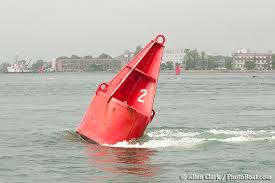
A rip in Woods Hole, Mass. Photo courtesy of CTNews.com.
A few weeks ago my wife and I were aboard a friend’s boat barreling against a strong current and the frothing eddies in Woods Hole. It’s a place that any mariner around Cape Cod worth his salt shows respect for, while only fools roll the dice.
Our boat ride coincides with a series of paradoxes that have recently surfaced in our life’s, butting from opposite directions like those rips.
One is an old friend returned to our circle, who continues to put off rather than confront the sources of his alcoholism and self pity. We enable him, enjoying our beers at cookouts while assuring ourselves that it’s his responsibility alone. Package that with another friend’s addiction, which if exposed would blow up his identity and expose someone perceived as gentle and giving to be a hypocrite.
Someone once advised me to beware of the confluence of torqued stuff like this. The point where they intersect is the most volatile space, and the ground you attempt to hold on to is the most vital.
A confluence of painful paradoxes tests our ability to cope.
For years I never quite got this. Until the clashes of pain and denial piled up so high I could no longer avoid them.
Paradoxes overflow all around us, and I see some within myself. Colliding contradictions and juxtapositions squealing metal-on-metal like spent brake pads on rotors. Ironies spit out like broken luck, with some seeping from survivor’s guilt, risk-taking, and compulsion.
We’ve entered another rip this summer, approaching thirteen years since my son was killed in a drunk driving crash.
The driver pled guilty to motor vehicle homicide and negligent driving and served two years. Cory Scanlon was a high school buddy of Mike’s, and they had just graduated a few months earlier. They went out drinking with two friends one night, and he was at the wheel speeding as much as 105 miles per hour before rolling over. Both Mike and another pal, P.J. Shaughnessy, died after being ejected from the Jeep. Somehow, since returning from prison in 2006, Scanlon has been welcomed back into the fold by many of their friends.
All of this resurfaced again a week ago. Scanlon is seeking to get a hardship driving license, a restricted license that allows one to drive for a set 12-hour period each day. Under Massachusetts law, he was expected to lose his license forever because prior to the fatal crash, Cory had been charged as a minor in possession of alcohol. Otherwise the license would have been restored after ten years.
Scanlon seems to feel entitled to get it back. As if he’s the one who endures a hardship getting to work. As if promises once made to not drink again were now negotiable.
As if he has somehow gone through enough.
Cory is married and has a young son, with another child on the way, I believe. He works as a painter, a co-worker giving him rides each day, and he earned an associate’s degree in sociology and psychology. His goal is to work with high school students as an adjustment counselor. We know this in part because, remarkably–or certainly in an especially twisted irony–we’ve seen him a few times in recent years: at two of their friends‘ weddings, and at the same funeral home where Mike’s body was lain following the death of another of their pals. Our son surely would have been in those wedding parties.
“You can’t have it both ways.” — Lynne Cipullo
Neither Denise or I wanted to attend the license hearing. We don’t oppose it being restored some day, and I gave his appeal scant attention at first. We’ve both tried to forgive Cory over the years, following what we intuit our son would want: that he be able to live a full life, one that includes honoring the memory of his friends. For years Cory has spoken to high school students about the consequences of his decision, going well beyond the community service hours set as a condition of his parole.
When we’ve met, he’s been contrite and humble. He seemed earnest wanting to help teens avoid the mistakes and causing the devastation he brought upon two families.
Yet to two observers at the hearing I spoke with, including P.J.’s oldest sister Mary, Cory’s attitude was that he had suffered long enough.
Asked whether he drank at all, he stalled, saying he had some champagne at his wedding. Then he was asked about drinking more recently. Pausing again, he said, yes, he occasionally had a drink. Then he said something to the effect of: I would never drink again if I just had my license back.
Lynne Cipullo, a victim’s advocate for the Norfolk County District Attorney’s office, looked at P.J.’s sister.
Did you just hear what I did?
A decade ago, during a probation hearing Cory said he would never drink again.
“People make that statement, and it’s difficult to sustain,” Cipullo says. “But you can’t have it both ways. You can’t say this is what you are committed to, and say, but it’s my wedding day.”
The years collide, swept away like a strong ebb tide.
Granted, things change. But Cipullo, who stood beside us back in 2002, noticed other backpedaling. The pledge was gone–and she wonders if Cory has since dropped that from his talks to students.
Several other statements made in a small conference room make us wonder if Scanlon is shifting from taking full responsibility. Once again. He said he “had agreed” to the license revocation, as if that was a concession. He said the only reason he had been driving was because his Jeep had a full tank of gas. There was more.
The years collide, swept away like a strong ebb tide.
As if twelve years were enough.
As if life just picks up where it left off.
As if we can just sail against the rip.