Ken Brack's Blog, page 2
June 14, 2019
Dads called to action
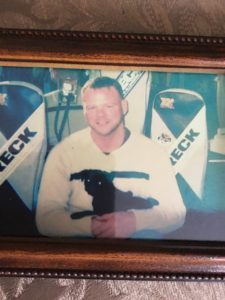
Matthew LaGreca. Courtesy of Tony LaGreca.
In the aftermath of losing a child, several dads I know now value time differently and orient their lives to helping others overcome crushing obstacles.
This is not heroic. It can be grueling with setbacks and triggers. Sometimes we rush into the very forces that took a loved one away. Which carries a cost.
Yet for some fathers, like other men, and women, becoming activists is a response to grief that makes profound sense.
It may be purely pragmatic: the handy guy able to help others literally fix things, which may extend to self-care and addressing, if not also repairing, emotional damage. Others gain a new sense of urgency, including wanting to be more present and not distracted by relatively miniscule stuff. We also appreciate the ravages and flow of time differently—especially as a son or daughter’s very being seems forever frozen in place.
Others become activists as their priorities shift. Driven by the need to make some meaning from his death, and struggling to form a new identity, we do new things at work, through advocacy, or education. We want to help others proactively.
This becomes a way to honor his or her life. Whether doing things purely locally in our community, among friends and colleagues, or on a larger scale.
And we won’t sit still.
My friend Tony LaGreca does this. He has taken on a nationwide quest to end the scourge of opioid prescriptions.
Tony adds his voice and relentless energy to the cause
His son Matthew died five years ago, a victim of the continuing epidemic. Matthew overdosed on methadone. He was addicted for many years after a football injury in college, for which his father says he was given a high-dosage prescription of Oxycodone. Matthew’s girlfriend also became addicted and died of a similar overdose.
LaGreca dug into the causes of the epidemic and became a full-throttled advocate for change and accountability. He also supports families struggling to help relatives in recovery, and co-facilitates a support group for other grieving parents. In addition to running a business, Tony finds himself crisscrossing the country for demonstrations, public hearings, and attending court cases to address those responsible for the crisis—and sometimes, offering potential solutions.
The rapid-fire speaking Bostonian is a member of Fed Up!, a national coalition to end the epidemic as well as Teen Sharing, a nonprofit representing many families. At times he rages; in other moments he listens and counsels.
With passion born from his loss, Tony adds his voice and relentless energy to the cause.
“I believe the pharmaceutical industry is responsible for this epidemic,” he told a panel of the Food and Drug Administration during a public hearing this week. The panel is considering the clinical utility of high-dose opioids for treating constant severe intractable pain. “You want to stop the epidemic, stop the unnecessary prescribing.”
During the past four years, he’s put himself out there—which not every grieving dad needs to do, or can summon himself for.
“Being an advocate, I don’t let his death be in vain,” LaGreca says. “The thing to help in grief the most is action.”
Tony has laid down on sidewalks at demonstrations and speaks at rallies. He ticks off a list of Sackler family members (owners of Purdue Pharma), chafing at their now-tainted philanthropy. Relishing the protests at museums and institutions that bear their name, he chuckles. He follows the evidence being uncovered in court cases against Purdue and other drug manufacturers in multiple states.
LaGreca remains a father first. During the FDA hearing, he choked up mentioning two grandchildren who are going without. Defiance mixed with pain in his voice. “I came hear at my own expense to stop the madness,” he explained.
Becoming an activist is a response to grief that makes profound sense
That coupling of rage and taking positive action feels so authentic to me. It can lead to a blending and even reconciliation of both. This compels other men that I know as well.
Some of them continue to seek healing four or five years after child losses. Naturally, they go about it in very different ways. For several, activism on a much smaller scale than what Tony does is a common denominator. They often support other guys and couples trying to cope with their own trauma or loss.
At some point, for many of us, taking healthy steps forward involves transitioning with a new identity. Seeking a new purpose, recognizing a changed worldview, or just reconstructing something from all the debris are part of this.
Each one calls us to act.
“To have hope under extreme circumstances is an act of defiance that permits a person to live life on his or her own terms.” — Jerome Groopman, The Anatomy of Hope


November 1, 2018
In solidarity and gratitude
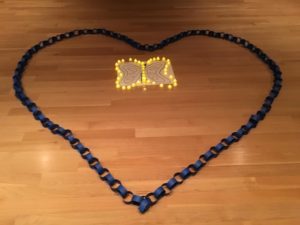 While so much feels at stake during these unsettled times, we have a celebration of solidarity coming.
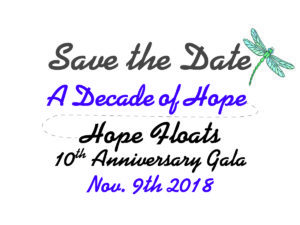
Just yesterday, a friend helped me reframe my approach to part of Hope Floats’ 10-year Gala next Friday, Nov. 9. Called “A Decade of Hope,” the gathering is both a chance to thank a community that supports grieving families and to sustain our commitment as a nonprofit.
I was talking to our emcee for the evening. Dave Kane is a longtime radio host and author from Rhode Island. Dave had seen our rough draft for the program and made a suggestion.
Rather than holding a “moment of remembrance” for our loved ones at the start of the program, he offered to introduce a moment of gratitude instead. To pause reflecting on our thanks for a loved one, “for having these people in our lives, and the contributions they have made, and continue to make.”
I fully embrace Dave’s expression.
It moves us further ahead than a stilted “moment of silence” ever can, which may feel so impersonal and cliché. And while remembrance of a loved one is so crucial to most of us—actively remembering them as we do things to honor them, or find a new purpose ourselves—expressing gratitude grounds us firmly in the present. Being grateful for what we have, both for people who physically accompany us, and for ongoing connections with loved ones, seems like a big step towards reconciling our pain.
Plus, we want the gala to be filled with light. We already feel lifted by so many participants and incredible volunteers.
A big step towards reconciling our pain.
(Brief “infomercial” intrusion: There are still tickets available for the gala, at Jones River Trading, 42 Elm Street, Kingston, Ma. Doors open at 6 p.m., and we’d love to see you there.)
Coming into this event, there’s so much gratitude to pass around.
For Denise and myself, after starting Hope Floats Healing and Wellness Center in our son Michael’s memory in 2008, we marvel that we can maintain a connection with him. Somehow his spirit or soul supports the outreach that Denise and her caring team lead for other grieving families at Hope Floats.
In his own way, Mike shows us how he continues giving his mom and myself love. He sends it to her and she gives it to everyone else coming through the center. His love helps provide her—both of us—the ability to keep reaching out to others.
He has so much love for what she has done, and it helps keep his memory alive.
Gratitude for loved ones, the contributions they have made, and continue to make.
We are also thankful for those who have entered our lives aligned with center’s work. They are among the givers who continue to lift others up.
Next Friday’s gala will support renovating part of the Hope Floats’ main house into a “Family Room” to support children and family programs. It’s really for the kids.
This includes the free support groups we call “Mike’s Club” where “littles,” “middles,” and teens gather in their age appropriate groups while adults meet as well. The kids and teens do projects tied in with remembering a loved one or expressing themselves, guided by caring facilitators and an arts therapist or social worker.
We welcome your help to do this. Other children and families need it across our region.
Solidarity centered in gratitude
Showing solidarity is so vital in many different contexts. Unfortunately this was amplified again in Pittsburgh after the shootings at the Tree of Life Synagogue last weekend. In that case, and rippling out to here, I wonder about our collective willingness to stand not only with the victims’ families, but also with the work the synagogue does to help immigrants—which apparently contributed to them being targets.
How do we bridge the divide between love and hate? How do we reconcile our worst fears?
Perhaps being centered in gratitude will help.
****
Time it was
And what a time it was, it was
A time of innocence
A time of confidences
Long ago it must be
I have a photograph
Preserve your memories
They’re all that’s left you.
— “Bookends” by Paul Simon
Performed by Simon and Garfunkel
June 26, 2018
Prying open the hurt box
 It’s crazy how unintended and even unwanted experiences bring us to new circles of friends. How our lives shift in ways that once seemed unimaginable.
I feel such a stirring as this summer unfolds. This comes in the context of helping other men cope with the loss of a child.
So many guys—myself partly included—“gut our way through” a son or daughter’s death, as described by one friend. We keep busy, we’re racked with guilt, we’re back to work, and we may not always communicate well with loved ones.
Opening up what another grieving dad, another friend, calls our hurt box can be especially tough.
It’s time to pry the box open—in my expanding circle, at least.
Our goal is to throw a lifeline to other dads sorting through debilitating loss. Welcome them to join others who get it, perhaps gathering once or twice a month. Sitting around a fire to talk, in part, and also doing hands-on things: getting out on the water kayaking or fishing, or building stuff for a loved one in the wood shop.
Trying to find some camaraderie in response to the damnedest things.
How do you deal with it other than stuffing down the pain?
We’ll likely share a variety of experiences. Getting the stories out of what brought us here. How life has changed. How we are doing that week, day, or hour. And if we’re fortunate enough to have other kids and a wife or partner, how they’re coping. Replacing cracked hoses. Oil changes. Gut checks.
Some of us know things (having lived them) about going beyond “being strong” as a (stereotypical) man to deal with a new reality. This may involve opening up to the pain locked inside. Finding a way to access and someday manage it. Even growing through life-changing trauma in positive ways. And calling out self-defeating behaviors versus healthy ones.
Many of us struggle with forgiveness and anger, or the numbness of life that can suddenly feel so meaningless. All bound up in that decrepit box.
Starting a men’s group, or club—whatever we call it— is a notion that has taken a while to awaken in me. It’s been dormant since Denise and I opened Hope Floats, our nonprofit bereavement center in Kingston, Ma., nine years ago. Very likely the idea needed to age while I continued my ruminating and writing to sort through our response to our son Mike’s death. In my case, I needed to do that internal work first.
But how I dealt with my son’s death is likely not what’s happening in your case—or his case, referring to someone you may know. And that’s part of the point.
How we cope as parents is such an individual thing. No one hands us a roadmap to navigate the loss of a child, be it from a catastrophe or long-term illness or some random, demonic violent act. Few clichés or so-called truisms apply.
We’re suddenly on our own, cut off from much of the world. Acquaintances and even friends who just cannot go there shrink. And for many men, our guilt doubles down. We may feel that we have failed in our roles as protectors and providers; we also feel guilt for surviving when our son or daughter has left this world before us.
If I cry, it’s a reminder that I failed to protect her. — Dave Roberts
All of which leads to joining a support group. Not in exactly the same way many women and couples talk together, but in a fluid way that gets to the issues guys need—but sometimes resist—getting at.
Dave Roberts is a newfound friend and a grieving dad whose experience informs my views on this. He and his wife live in upstate New York, where Dave is an adjunct professor of psychology at Utica College. A rare cancer claimed the life of Dave and Cheri’s daughter, Jeannine, in 2003. In addition to teaching, Dave is a grief workshop facilitator, a writer and speaker who also assists bereavement support groups.
Spring-boarding from his own life, he’s thought and written a lot about topics like seeking forgiveness (for the perpetrator or forces responsible for a child’s death, and for oneself, for example) and the distinctive survivor’s guilt that some men face.
“For guys it runs a bit deeper,” he says of guilt. “For me it did. Why am I still around, and not her? Why didn’t I protect her? Men are more traditionally wired to be in touch with our thoughts versus emotions. If I cry, it’s a reminder that I failed to protect her.”
I recommend Dave’s recent article “The Road to Forgiveness” to further explore this topic, which is among many articles of his that will resonate with both men and women.
Closer to our home, another friend who lost his son several years ago in a motorcycle crash already does stuff in his own way to help guys he knows going through hard times. He pledges to check in on a friend’s sons. He takes others fishing off Stellwagen Bank. He gets in the face of a grieving husband who won’t stop drinking.
Last week he and I sat in the shade talking about our vision to reach other men. We shared a bit about what we’ve gone through.
It’s time to pry the hurt box open.
Naturally, Father’s Day came up, among those double-edged swords we have to get through. That’s just one of the topics a group of guys might pass around, similar in some ways to holidays and other signature family benchmarks: how to prepare for them; how to react or not when even a relative, such as your own father, just doesn’t get it. And how the day is forever altered, even if one is fortunate enough to have other children.
How do you deal with it other than stuffing down the pain?
We’ll get this going later this summer. Into the cooling nights, suggesting tools to open up that box.
*****
Ken Brack is the author of Especially For You—Finding a New Purpose After Unspeakable Loss. Here is a link to the book trailer.
April 25, 2018
A positive shift
 You might say the shift is on.
This feels like a time to bridge the old and new. A season to clear out clutter and embrace a fresh start, while surrendering to not having full control over events.
More than doing a spring cleaning, there is a push and pull of taking healthy risks versus seeking certainty in what has worked before. Maintaining balance and not feeling overwhelmed by this will be a key going forward.
This dynamic energy is so apparent as Hope Floats prepares for our fifth Memory Walk this Saturday. Once again, Denise and I feel reinvigorated by the presence and contributions of so many people: her cadre of caring volunteers, a growing team of dedicated practitioners, and both longtime and newfound supporters.
The purpose of the walk has not changed and likely never will. We set out in memory of our loved ones. We gather in solidarity to say their names. We pause to commemorate their lives, to consider their gifts, and perhaps how we may carry their spirit forward.
Families and friends walking what can be such an isolating, damning road will join again in a common cause of support and remembrance.
Registration for the walk continues Saturday at 8:30 a.m. before the 10 a.m. start at Hope Floats Healing and Wellness Center, 4 Elm Street, in Kingston. 
Is it better surrendering to not having control over events and going for it?
Meanwhile, a big year is unfolding as Hope Floats expands its outreach. As you may know firsthand, the needs seem to keep growing—families suddenly dealing with the inexplicable loss of a child, parent, or partner, and others coping with a drug overdose or suicide loss.
To reach more children and teens directly, during the past two years we started the Mike’s Club support group. We expect to add another session later this year for children and families dealing with cancer and life-limiting illnesses.
To help accomplish this, we will be reaching out for the community’s help with a Mike’s Club building campaign. Our idea is to renovate a two-car garage into a “family room” for the children’s and family nights, and make the old house at 4 Elm Street handicapped accessible.
Soon to enter our tenth year, on Nov. 9 Hope Floats will hold a gala at the Jones River Trading Post with the theme “A Decade of Hope.” It will be both a celebration and gathering to thank and cultivate sustaining sponsors.
As we grow, that age-old question about taking risks rears up again:
Is it better surrendering to not having control over events and going for it? This certainly tests how far we can stretch. Letting go of some certainties, and casting off whatever baggage that clings there, may actually help recharge the batteries.
How does this play out for you?
****
 If you have another minute, here is a link to a post that remembers a close friend of mine in a different way—creating an “Unforgotten Garden” in memory of Doug Wright, behind Hope Floats.
It’s about honoring the space we carve out to carry forward his spirit, and others we miss. The piece was published in my column on Psychology Today’s website this week.
Piecing together our memories with some kind of renewal is a challenge. Sharp-edged components such as our regrets and failings don’t fit neatly into place.
February 16, 2018
A shameless plug
 Self-promotion isn’t my natural terrain. It’s more like me on dinosaur-era skis following my daughter snowboarding as she emulates Chloe Kim on a half-pipe.
Still, I have a favor to ask readers and friends.
To help spread word of my new book, would you consider writing a review on Amazon or Goodreads? I’ve had a couple of terrific write-ups, even from a reader not yet finished with Especially For You (thanks Maryellen!) – so I appreciate you considering this.
Also fyi, if you haven’t seen the book trailer yet, we’re doing a $50 giveaway with a Whole Foods certificate through February 20th. Please share the YouTube link if you believe it may be worthwhile for someone you know. (It currently has more than 33,000 views!)
Here is a link to write a customer review on Amazon.
Here is one for a review on Goodreads.
Meanwhile, as for most writers, the work of reaching one’s audience is a second journey for me. It is sometimes arduous and lonely, yet always compelling. It makes me believe even more in sharing these uplifting stories of people who find a way forward through sudden loss and other trials.
Whether meeting readers one-by-one or introducing the book to a group, my goal is that many of these accounts will speak to you.
I also plan to continue updating upcoming book talks along with some larger presentations in the works on my author’s website.
Last for now, if you have a few minutes, please check out this recent post on Psychology Today online. It introduces a long-distance friend of mine who is in the book and a conversation we are having about empathy and exclusion.
Empathy—or a disturbing lack of it—may not be what you typically talk about over dinner.
Yet it’s a dire conversation I am having with a 77-year-old Austrian violinist whose father was a Nazi.
Thanks again, and I’d love to hear from you.
January 17, 2018
A gentle release
 While preparing for prostate surgery more than a year ago, one of the most helpful practices I found was a meditative CD that helped loosen my anticipated pain and fears. I could envision releasing them through my toes and fingertips.
This visioning practice, if you will, helped guide me for a successful result: removing cancer along with the gland. It’s a technique I try to incorporate occasionally while doing Kripalu yoga or otherwise shedding some unwanted knotted feeling.
Yet how do we release toxicity in our relationships? How do we replace that with something akin to letting in a restorative light, the complementary part of that vision?
The benefits are clear. Yet it’s often so hard to do.
It involves doing so much internal work. Perhaps puncturing our denial or revulsion at actions and attitudes. Seeking more dialogue with less angst about the future. And meeting those who have disappointed us more than halfway on a road toward reconciliation.
Earlier this week, pausing even momentarily to reflect on Martin Luther King Jr.’s legacy, I came across an excerpt of his writing that offers something crucial to this endeavor. Indeed, it’s an age-old path to healing, if not grace.
Which feels so crucially relevant today.
Internal cleansing is so hard to do.
In a speech Dr. King gave in 1961 to white liberals—some of whom were objecting to student sit-ins and freedom rides, and preferred a more gradual approach to civil rights—he emphasized the tenets of non-violent resistance.
Those engaged in nonviolent struggle must never inflict injury upon another—not striking back if hit, nor cursing back if sworn at, he told them. Yet in addition to resisting external violence by not retaliating physically, King urged the group to go deeper: reconcile what’s inside of themselves while loving their enemy.
Nonviolence also meant “that they avoid internal violence of spirit,” he said. Which involves meeting others where they are, and embracing them unconditionally.
There’s something so gentle about this approach that one may deservedly wonder how it even applies today. Is this too naïve or soft? Yet consider being consumed by an internal violence of spirit.
Is that what prevails if we fail to search our hearts, truly opening them, to face our own roles in “external” conflicts – whether families are divided, amongst friends, or bigger forces?
That internal din suffocates forward movement and healing.
Was 2017 the year we flushed down toxicity?
Continuing the speech, King referenced one of three words in the Greek language for love: agape.
Agape, he said, “is understanding, creative, redemptive, good will to all men. It is an overflowing love which seeks nothing in return. Theologians would say that it is the love of God operating in the human heart. So that when one rises to love on this level, he loves men not because he likes them, not because their ways appeal to him, but he loves every man because God loves him.“
While it’s pretty difficult to like people who want to do you harm, for example, it’s still necessary to love them, King reminds us.
As 2017 closed, I wondered if it would be remembered as a year when we flushed a lot of toxicity away, or at least faced it. The jury is still out on that one.
Externally, if not within our own circles, will this be a year of reckoning? Of comeuppance and retaliation?
Conversely, how can I apply that message of understanding to lessen my own internal violence?
And it’s knowin’ I’m not shackled by
Forgotten words and bonds
And the ink stains that have dried upon some lines
That keeps you in the back roads, by the rivers of my memory
And keeps you ever gentle on my mind.
“Gentle on My Mind” by John Hartford
December 20, 2017
Believing again

Winter solstice at Gay Head light. William Waterway, courtesy of Creative Commons, https://creativecommons.org/licenses/...)], via Wikimedia Commons
Wishing you peace this holiday season, plus a rekindling of belief.
This is a time to rediscover joy and perhaps count our blessings. For many of us, the good cheer is coupled with a keen vulnerability: sharp pangs of lament and isolation poking through. Wounds are exacerbated during the holidays, stinging along with winter’s first hoary breath. They can numb us.
Yet this week I’ve been drawn back to something that is over-archingly positive, if not transformative. It’s a collection of expressions about the core values that guide everyday and well-known people.
I’d like to share some of these in a mixed format of excerpts that differs from my usual posts.
Ten years ago, the book This I Believe included short essays giving voice to the truths that anchor us in myriad ways.
Revising a project that the renowned broadcaster Edward R. Murrow did in 1951, these eclectic expressions also led to a refurbished public archive – although National Public Radio, a sponsor of the project, halted its broadcasts in 2011. (Some portions below are added from additional sources, which are cited.)
In this season, when our familial and national disconnects can feel so acute, when the call for compassion is so dire, we need to believe again. Here are some reminders:
“You only have what you give. It’s by spending yourself that you become rich.” – Isabel Allende, novelist
* Allende continues: “Give, give, give–what is the point of having experience, knowledge, or talent if I don’t give it away? It is in giving that I connect with others in the world, and with the divine.”
* “When I think of the suffering, and famine, and the continued slaughter of men, my spirit bleeds. But the thought comes to me that, like the little deaf, dumb, and blind child I once was, mankind is growing out of the darkness of ignorance and hate into the light of a brighter day.” – Helen Keller
“Every little thing is sent for something, and in that thing there should be happiness and the power to make happy. — Black Elk, an Oglala Lakota medicine man, from Black Elk Speaks
Black Elk continues: “Like the grasses showing tender faces to each other, thus we should do, for this was the wish of the Grandfathers of the World.”
* “Love is primal. It is comprised of compassion, care, security, and a leap of faith. I believe in the power of love to transform. I believe in the power of love to heal.” – Jackie Landry, hospital clerk
“I believe in the human race. I believe in the warm heart. I believe in the goodness of a free society.” – Jackie Robinson
* Robinson continues: “I believe that the society can remain good as long as we are willing to fight for it—and to fight against whatever imperfections may exist.”
“I believe in getting up in the morning with a serene mind and a heart holding many hopes. – Carl Sandburg
Sandburg continues: “I believe that freedom comes the hard way—by ceaseless groping, toil, struggle—even by fiery trial and agony.”
* “The essence of love and compassion is understanding, the ability to recognize the physical, material, and psychological suffering of others, to put ourselves “into the skin” of the other.” – Buddhist teacher Thich Nhat Hanh, from Peace is Every Step.
Hanh continues: “When we are in contact with another’s suffering, a feeling of compassion is born in us. Compassion means, literally, ‘to suffer with.’”
* Finally, this from one of my favorite journalists, the Boston Globe’s Kevin Cullen. In his column this week, he conveys a mom’s grace during an extraordinary ordeal.
Lisa Brown’s 23-year-old son Joshua, who was diagnosed with schizophrenia, died in a state hospital in 2009 when three correctional officers tried to restrain him—which Cullen described as attempting “to fold him over and push him down like he was an overstuffed suitcase.” A judge acquitted the officers of involuntary manslaughter. Cullen wrote:
“Christmas is hard. She hasn’t celebrated it since Joshua died. She hasn’t celebrated anything since Joshua died.
“With the criminal case over, she knows she has to move on, but to something that honors Joshua’s memory. She wants to advocate for the mentally ill in other places. She’s trying to help a mother whose daughter is in the women’s prison in Framingham. There are still so many people in prison who belong in hospitals.
“’I can’t stop,’” she said. “’I’d let Josh down. I’d lose Josh. His death would be in vain if I stop.’”
Whatever you believe in this holiday season, whatever truths and loved ones you hold up, please don’t stop.
“Mankind is growing out of the darkness of ignorance and hate into the light of a brighter day. – Helen Keller
October 12, 2017
Excerpts and Empathy
 Growing up, I was an avid breakfast reader of the Globe’s sports section, fond of the “Thoughts While Shaving” column.
In his regular piece, sportswriter Ernie Roberts offered tidbits of critiques and impressions regarding players on the doomed Red Sox and Pats, or the vaunted Celtics and Bruins.
My post today adopts some of that short form.
First, if you have not heard about this yet, please consider joining us for a book release party Saturday, October 28 in Kingston, 5 to 7 p.m., at The Beal House, 222 Main Street.
Especially For You tells the stories of people who respond to sudden loss by finding a new purpose. Often this involves lifting others up as they run with the legacy of a loved one, finding a way to heal as they step outside of their own pain and fears.
My book will be available in a few weeks on my author’s website, ordered from your local bookstore, on Amazon, Barnes & Noble, and the Seattle Book Co. More details to come!
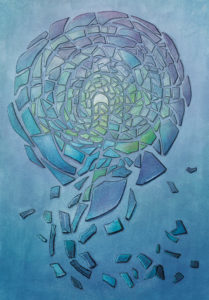
Labyrinth shards illustration by Amanda Brack
Second up are links to three excerpts from the book. I hope you can take a few minutes to peruse even a couple of these:
“You Can Do This” is a short piece about our son, Mike, his battling spirit during double sessions entering the high school soccer season.
Carrying forward our loved one’s voices and legacies – how can we ever forget? – and staying open as their lives, their souls, inform our own is a key thread of the work.
“All Right to Hurt” shows Howard Clery, another father in my book, struggling with rage and craving for revenge after his daughter’s murder.
“This Defiance for Peace” shows two of book’s principals responding with empathy – and action — to tragedies that don’t directly affect them.
As one said, “We want to find ways to express our remorse in a constructive fashion.”
This last one connects to a piece I wrote this week for Psychology Today. It makes the case to renew empathy as a way to bridge the divides when we react to gun violence, racism – you name the issue.
Best regards, and I’ll keep you posted on the book release – ebooks on Kindle, Nook, and iBooks will be first!
September 21, 2017
Especially For You set to launch
One journey completed, another just underway.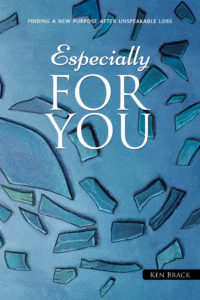
I am excited to announce that my new book will be published in mid-October! Especially For You contains the stories of families who respond to sudden loss by finding a new purpose.
While it is anchored in my family’s own story, my intent is to mostly share accounts of others who find compelling ways to move forward after catastrophe.
Please consider joining us for a Book Launch Party October 28 in Kingston, from 5 to 7 p.m. at the Beal House, 222 Main Street.
We’ll have refreshments, hors d’oeuvres, and music–open to the public!– along with a very special guest.
I believe the book will offer readers handholds of inspiration and hope, especially for those of you struggling to cope with a sudden loss or other trauma. It will soon be available to order on my website, at your local bookstore, or on Amazon, Barnes & Noble and other retailers through Thomson-Shore and Ingram. Brief updates on this to follow.
Ready for release, I hope it will make some small difference.
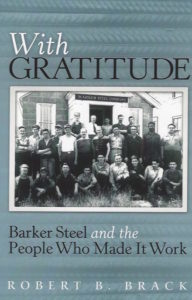 This event will be a unique, spirited co-celebration with my dad, Robert Brack. Bob is releasing his memoir, With Gratitude–Barker Steel and the People Who Made It Work, the story of a family-owned business that grew through four generations to become one of the largest steel reinforcing bar fabricators and construction suppliers in the Northeast.
I am so happy for him being able to share his narrative of Barker Steel’s growth and legacy. It’s an enduring story keyed by the many relationships formed, the contributions of colleagues amidst the tough cycles of the steel rebar industry and demanding growth during Boston’s Big Dig era.
It will be a joy to celebrate our books together.
For me, completing this work of narrative nonfiction has been a long road bumping along many potholes–and leading to a sense of solace. It’s taken seven years to research, write and polish, including meeting and interviewing some three hundred people–many with numerous conversations spanning several years.
I feel ready to release it to the world. It feels intact, and I hope it will make some small difference.
If you’d like to take a peak, please click here to read excerpts and the annotated contents.
Finally at rest, our tears still, the sweat dries; he is extant.
Thanks for your interest, and I’ll keep you posted.
August 2, 2017
Keep turning

Photo by Famartin. Courtesy Wikimedia Commons.
Without a doubt, it’s chaos out there.
A world spins out of control. Our dysfunctional divisions widen. There’s no progress in sight to tackle the burgeoning challenges of the day.
It’s enough to make one wonder: What’s the point?
What gives?
And yet, this midsummer I am reminded again to slow down and take in a broader perspective. Informed both by longtime friends and some fresh experiences, what matters is making the most of every moment—or at least, fully appreciating those moments that matter most.
Turning around to face the light. Welcoming our capacity to turn, open to gratitude, even when ugly stuff rears its inevitable head. Perhaps recognizing the mosaic of both in our lives: seeking grace amidst the confusion, and even despair.
It is a choice we can all make—or not. I’m unsure why I still need reminding of this, since the downside of not doing so is so stark, like the sudden flash of heat lightning on a humid, dull horizon.
Should we be surprised by their gratitude, their will to make the best of moments?
Someone recently introduced me to a story I’d like to briefly share about a woman who chose to live in full despite having a rare, incurable disease. Amy Frohnmayer Winn lived with a rare recessive-gene disorder called Fanconi anemia, which results in bone-marrow failure, leukemia, and worse. Her two older sisters also died of the rare, incurable disease.
Amy did not merely exist with her condition. She thrived. Like her sisters growing up in Oregon, she endured having her blood counts monitored and bone marrow biopsied frequently. Her parents, who also raised two sons who do not have the disease, made sure their children experienced everything most of us would want: being active, learning to ski and play tennis, take piano lessons, opportunities to attend college, and enjoy sleep-overs with friends.
Amy’s story was perceptibly portrayed by John Brant in “Running For Her Life” in Runners World earlier this summer, which I highly recommend. She became a dedicated daily runner, covering four miles most days on her favorite trail along the Deschutes River in Bend (an area Denise and I were able to sample last summer with our son!).
Brant writes: “The trick, the task, the challenge, the girl realized with precocious insight, was to be present in the moment; to accept with clear eyes the good or ill, grace or pain, that each moment delivered.”
That’s a potent reminder for us all.
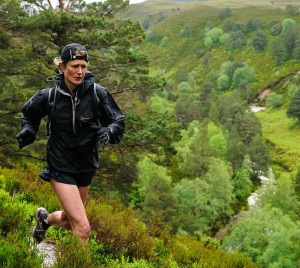
Unidentified trail runner. By Robin McConnell. Courtesy of Flickr.
The article was recommended to me by someone I’ve only met on the phone, a potential reviewer for my forthcoming book. She suggested that Amy’s passion to live in full and what her parents have done for three decades aligns with some of the people I’ve written about, whose struggles with loss and other tough stuff ultimately transformed their lives.
Her parents, Lynn and Dave Frohnmayer, started a family support group in the 1980s along with founding the Fanconi Anemia Research Fund to learn and share more about the then-little-known disease.
Each of us may know others who, in the midst of excruciating trials, decide to live each day the best they can. We are moved, even astonished, by their guts and forbearance—indeed, their grace—enough so that we catch ourselves getting upset over some relatively trifling obstacle or ordeal.
Should we be surprised by their gratitude, their will to make the best of moments?
As an old friend reminded us recently, “Any day my feet hit the floor getting out of bed is a good day.”
In my circle of friends, we recently lost sweet Marie, only in her mid 50s, after a long struggle with breast cancer that had metastasized throughout her body. “Giggles” was her nickname, and she lived that way to the end. She had an uncanny laugh, and a certain toughness that may have seemed at odds with her small frame.
“Struggle” does not seem like the best way to describe how she lived—the little I really know of her journey in recent years. When we visited her in hospice, she ate ice cream trying to keep up a once-veracious appetite. Marie was still self-deprecating, chortling about the antics of family members, fully herself. Her oldest daughter was about to get married, and she hung on to be at the ceremony.
She, too, appeared to make that choice to stay present. And how vital it felt that we had been able to reconnect a few years earlier.
So, keep on turning. Into that crazy mosaic, under that full canopy.
Mother, mother
There’s too many of you crying
Brother, brother, brother
There’s far too many of you dying
You know we’ve got to find a way
To bring some lovin’ here today.
“What’s Going On” – Marvin Gaye