
Rachel E. Pollock's Blog: La Bricoleuse aggregate and more..., page 5
May 22, 2025
AI Costume Design, Part One

After attending a conference session on using AI in costume design, I was inspired to use my university's Microsoft Copilot AI tools to write a blog post about how to use it for this purpose, aimed at a complete novice. Here's what it wrote verbatim and unedited:
Whether you're dreaming up a fantasy character, preparing for a cosplay event, or designing for a school play, creating a costume design sketch can be a fun and rewarding experience. But what if you're not a professional artist or designer? That’s where Copilot comes in — your creative partner in bringing costume ideas to life!
In this post, we’ll walk you through how to create a costume design sketch using Copilot, even if you’re a complete novice.
✨ What Is a Costume Design Sketch?A costume design sketch is a visual representation of what a character will wear. It includes details like:
Silhouette and shape of the outfitFabric textures and colorsAccessories like hats, belts, or jewelryCharacter personality reflected in the designTraditionally, these sketches are hand-drawn, but with AI tools like Copilot, you can generate them digitally — no drawing skills required!
🛠️ What You’ll NeedA basic idea of your character or theme (e.g., “steampunk pirate” or “futuristic royal guard”)Access to Copilot with image generation capabilitiesA little imagination!🧑🎨 Step-by-Step: Creating Your First Costume Sketch1. Describe Your CharacterStart by writing a short description of your character. Include:
Who they are (e.g., a warrior, a noble, a space explorer)The setting (e.g., medieval, sci-fi, fantasy)Key visual elements (e.g., flowing cape, armored boots, glowing accessories)Example:
2. Use Copilot to Generate the Sketch“A mysterious forest elf warrior with leaf-patterned armor, a hooded cloak, and glowing green eyes. The costume should blend natural elements with a sleek, agile design.”
Once you have your description, you can ask Copilot to generate a costume design sketch based on it. Just say something like:
“Create a costume design sketch of a forest elf warrior with leaf-patterned armor and a hooded cloak.”
Copilot will use AI-powered image generation to bring your vision to life!
3. Review and RefineTake a look at the generated image. Ask yourself:
Does it match your vision?Are there elements you’d like to change or enhance?Would you like to try a different style (e.g., more realistic, more stylized)?You can tweak your description and ask Copilot to regenerate the image until it feels just right.
🎨 Tips for Better ResultsBe specific: The more details you provide, the more accurate the sketch will be.Use references: Mention styles or inspirations (e.g., “inspired by Renaissance fashion”).Experiment: Try different versions of your prompt to explore new ideas.🌟 Final ThoughtsCreating a costume design sketch doesn’t have to be intimidating. With Copilot, you can turn your ideas into visuals quickly and easily — no art degree required. Whether you're designing for fun, for a project, or for a performance, Copilot helps you bring your characters to life with creativity and confidence.
In a forthcoming Part Two post, i'll share what came of trying this out. Have you begun experimenting with using AI in costume design? Comment and tell me about it!


May 20, 2025
Book reviews: Artificial intelligence research

Because my university has begun incorporating AI into research and our Microsoft Office suite now includes Copilot AI, I decided to read up on the various technologies described by the term and this post is a book list of the six most helpful books I read.
Other titles not included here struck me as either intended to drum up fear or enthusiasm about the technology, and one book that read like it had actually been written by ChatGPT. This is not a comprehensive or exhaustive list of all the titles on the subject, if you have another book about AI to recommend, please leave a comment.

Brave New Words by Salman Khan
This author is the founder of the digital learning platform, Khan Academy, and this book explores the way in which AI tutors have the potential to transform education delivery in nations with low rates of primary education for all but the children from the wealthiest families.
My takeaway on this book is that AI driven learning modules for children in rural areas of countries around the globe who might not otherwise get individual attention in learning basic skills of math, science, language will be well-served by this technology.
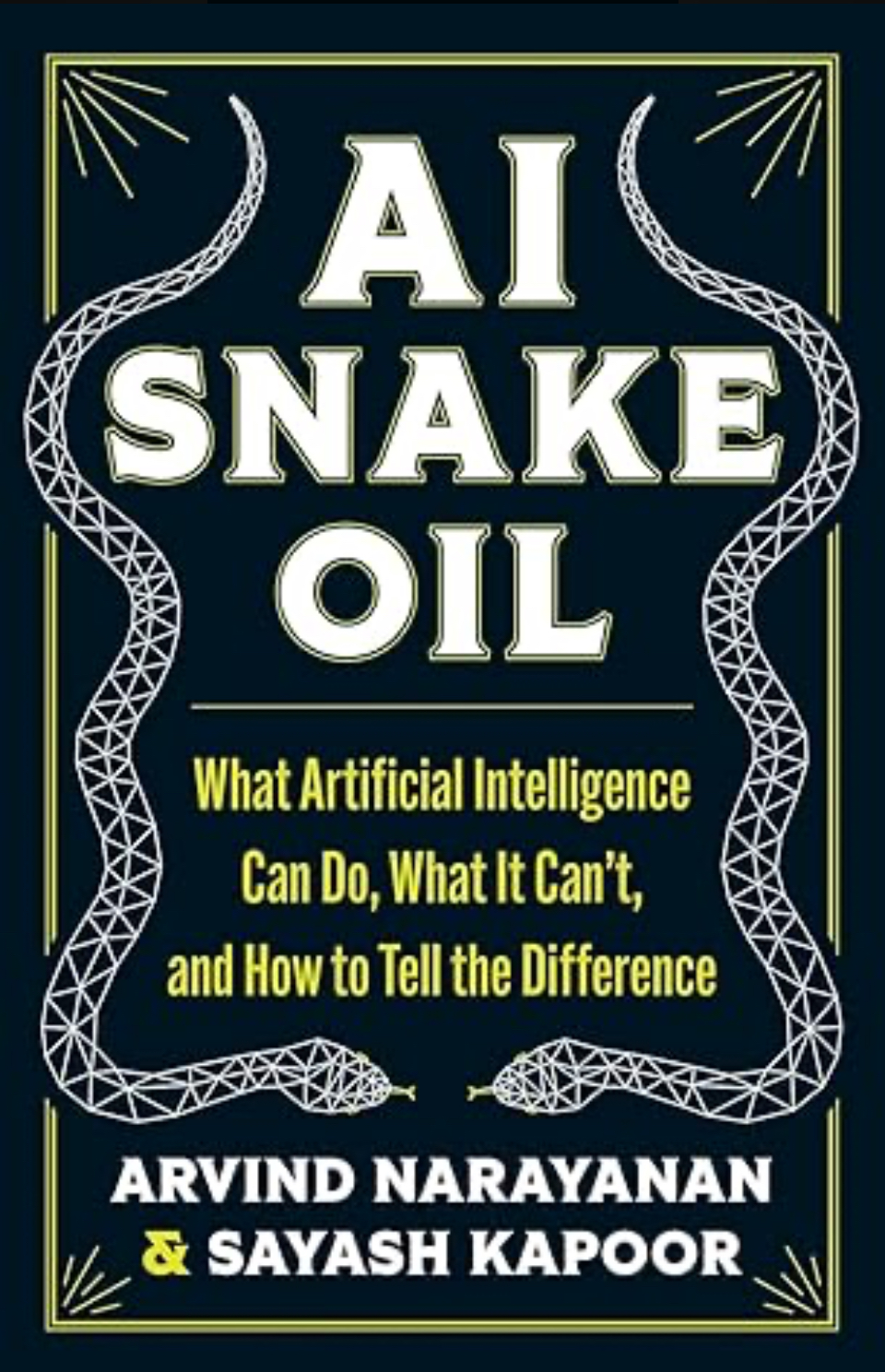
AI Snake Oil : what artificial intelligence can do, what it can’t, and how to tell the difference by Arvind Narayanan and Sayash Kapoor
These two authors are well known developers and academics in the field of machine learning. This book is fantastic for explaining the different kinds of technology referred to as “AI,” how it works and was created, what it can do and what it can’t. Not dry or super technical. Highly recommend.

Weapons of Math Destruction: how big data increases inequality and threatens democracy by Cathy O’Neil:
This title was recommended by the AI book club being run by my university’s AI development cohort.
This author is a mathematician and statistical data analyst. She writes about how algorithms manipulate everything from social media feeds to what links show up on a Google search. Sociologically fascinating, informative, and a bit scary. The algorithms she’s talking about and data sets are somewhat different from the programming and data sets involved in generative AI, so if you are looking for more information about how something like ChatGPT works, for example, this is not necessarily the book for you, but it is still probably worth a read
I

Unmasking AI by Joy Buolamwini
This Nigerian author got a PhD in machine learning from MIT, a degree she was working toward when she realized that the facial recognition software she was studying struggled to register & recognize darker skintone faces. She began to investigate how societal inequities are incorporated into the nature of AI technologies and the datasets they work with.
I didn’t expect this to read like a memoir but it does, which brings a very human perspective to the topic. I appreciate how the author interweaves her own history and story with the illuminating information about facial recognition and image processing AI technologies.

Atlas of AI: Power, politics, and planetary costs of artificial intelligence by Kate Crawford
This title was also recommended by the AI book club being run by my university’s AI development cohort.
A global perspective on the machine learning technologies now collectively referred to as AI. The author addresses inherent biases and the exploitative labor practices inseparable from machine learning of the generative sort. This could have been dry, but I found it quite readable.

Code Dependent by Madhumita Murgia
This author is an investigative journalist who has been working on reporting stories about the tech sector for years, so she brings a digital literacy to this book, but admits at the beginning that she had no idea what AI actually meant when she began writing it, and the book traces her path of understanding. A global perspective on AI that casts the various tools and platforms in individual human terms.
In all of these cases, I listened to the audiobooks and can recommend that format.
April 13, 2025
New studio storage!

I’ve recently re-organized the storage in my studio and I just had to post about these fantastic drawer storage units.
The studio was initially re-organized during the Covid lockdown, as a way to keep people safely working, who were still on contract after the theater shut down. And I’m so grateful for that initial reorganization, completed by coworkers who did not work in my space on the regular.
I didn’t reorganize everything again immediately once I returned to work in-person after the lo ckdown was lifted, because I thought I would need to work in the space as it was organized to have a clear ide how I’d like to change things.
Over time I thought about how I access, different materials and scraps, what I use frequently versus not so frequently, and what I might want to just get rid of.
The scenic crew had built me a fantastic new worktable on locking wheels, so I took a measurement of the space under that table and begin looking for storage options that would fit. I had a notebook with graph paper to plot out configurations of different storage options.
These three drawer units were the perfect height and were originally designed to go in the room of a toddler for toy storage. They came in several different colorways, including this ombré pink. I figured anything designed to stand up to heavy usage by very small children was likely to withstand costume production and be easy to assemble and clean.
These came in three drawer, six drawer, and nine drawer options. Four drawers on each side of my table worked best for the size of the space. I had to work with and gave me some extra space on one end for things that didn’t fit in these drawers.
If you were thinking of re-organizing a studio space and storage created for carpentry and home workshops doesn’t feel like it would work for you, look at children’s toy storage. If you consider the fun colors a plus instead of a drawback, you might find exactly what you’re looking for.


Resist projects by my students

This semester, I've been teaching my surface design class, the first third of which is essentially dye chemistry across classes of dye and their affect on various fiber contents of textiles. The next bit involves using that knowledge to make informed decisions about different surface design techniques. This round of projects involved resist techniques, including wax resist/batik. Check out their fantastic projects!

soy wax batik with fiber reactive dye on cotton by Jessica Land

soy wax batik using tjaps on cotton by Kris Kingsolver
 soy wax batik with fiber reactive dye on cotton by Lene Wojcik
Water based resist and acid dyes on silk by Jillian Gregory
January 11, 2025
Unusual Gondola Designs!
Learn about different styles of costume gondolas!
December 14, 2024
November 17, 2024
November 2, 2024
October 17, 2024
September 15, 2024
La Bricoleuse aggregate and more...

Right now, this space streams the RSS feed from La Bricoleuse, the blog of technical writing on costume craft artisanship that i've written since ...more
- Rachel E. Pollock's profile
- 80 followers

