
Stuart Thaman's Blog, page 4
February 9, 2021
Umbral Blade 2: Mournstead - teaser!
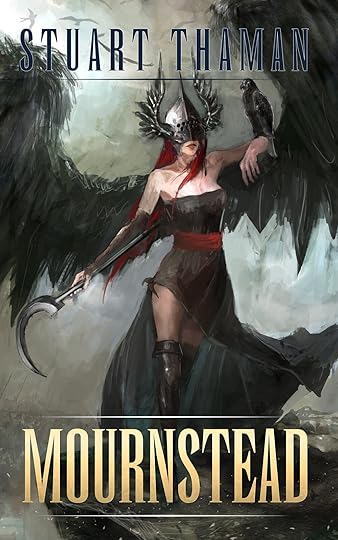 Chapter 1Unfinished
A single corpse was left behind. Two armies, marching more or less together, left it behind to rot. Palos, the Lord of Lightbridge, his head crushed to a bloody smear, hadn’t been buried. Captain Holte had let the thought cross his mind once or twice, but it hadn’t been worth it in the end. The air was dry, the sun was hot, and the men were restless. There hadn’t been the time for a proper burial, and Holte wasn’t sure the man had deserved one. But no, that wasn’t exactly true. Holte knew there was plenty of time. After all, burying a solitary body didn’t take much time with so many able backs available for labor. The crows would come, and they would feast on Palos’ broken flesh until there wasn’t anything left but bone and bits of fine-spun clothing.
Shaking his head, Holte had turned from the sight of his lord’s rotting body.
“A bastard of a man,” one of Hademar’s soldiers had said upon viewing the corpse just moments before. Holte knew the judgement had been correct. That same resentment was shared among all the men like a dark storm cloud misting their minds. With Palos dead, the cloud hadn’t dissipated at all, though perhaps it had changed. When they returned to the west, King Gottfried might handle the death of a lord and member of his court much differently than Hademar. In the back of his mind Holte wondered if returning to his home would be just a long march to his own grave.
Other ideas soon came to take up residence in his thoughts as he marched. Some of them were useless, others intriguing, but either way they helped to pass the long hours in silence.
*****
When the tomb of The Shadow King was three days behind them, Alster and Elsey felt a bit lost amidst the host of soldiers travelling on either side. Hademar’s small force had taken quite well to the two, but the royal force from Karrheim, clean shaven and brightly arrayed in blue and white, kept their distance, a bit of trepidation on their faces whenever he caught a glimpse of Alster. He was, more than anything, the boy who had slain their lord. Regardless of the fear between them, the two groups marched at a steady pace, both eager to return to the west, though for far different reasons.
It was close to dusk when the combined force made it out of the Red Mountains and back onto flat ground. Hademar’s soldiers remained half a mile or so behind the contingent commanded by Captain Holte, their older legs slow and tired on the hard-packed red soil. The men knew their epic campaign had come to a conclusion, and the weight of all their trials was finally catching up to them.
Somehow unfazed by the events at the tomb, King Hademar bore the journey with a uniquely positive demeanor—perhaps even a newfound spring in his step. He didn’t talk to many people as he marched or rode his horse, though there were always words on his lips, almost all of them directed toward his deceased wife several hundred miles away. When the wind shifted just right, everyone in the column could hear his exclamations, though no one could truly say they understood. Most only shook their heads. Alster wondered if the mad king would succeed and bring his wife back from the dead. Regardless of what would transpire, he hoped more than anything that the man’s mind would eventually find peace.
“Do you miss any of it?” Elsey asked quietly from Alster’s side as the sun made its slow descent, casting long shadows behind them toward the Red Mountains.
“My father?” Alster had been focused on Hademar, and he had to remind himself of what Elsey was probably referring to.
“No,” Elsey was quick to correct. “Just your old life. Do you miss the estate? Who you used to be?”
Alster had to think for a long moment before answering. His mind reeled with memories, and most of them were less than enjoyable. “I don’t think so,” he finally said.
“I do.”
“Who do you think you are?” Alster asked with a bit of apprehension. He could see something playing behind Elsey’s eyes in the waning light, and he had no idea what it was. Anger? Longing? Confusion? Whatever it was, it scared him. Elsey was always the strong one, the confident one. Never him.
“I… killed someone,” she quietly answered. “I know it wasn’t murder, not like that, but… I can’t stop thinking about it.”
“El—”
“How do you get it out of your head?” she asked all at once, meeting Alster’s gaze with an expression so full of pain it made him wince.
“You just have to stop thinking about it,” was all Alster could say. In truth, he hadn’t thought much about the patricide he had so willingly committed. Killing Palos had been a moment of release, one that had brought a palpable rush of joy, not something he had grown to regret. But he knew Rai’s death was different. He hadn’t seen it happen, but he knew.
“I can’t stop,” Elsey murmured. “Whenever I close my eyes, I see Rai’s frozen body next to the ocean.” Her eyes shut tight, she took a moment to collect herself before pressing on. “You killed your own father, and you keep going as though nothing has happened.”
Alster shook his head. “There’s nothing you can do about it,” he told her. “Rai is dead, and it really doesn’t matter how. He could have frozen to death just as easily as you pushed him. It doesn’t matter.” To himself, Alster began to silently wonder if he would ever grow to regret what he had done. It had only been a few days. Perhaps in time the weight of it would crush him.
“I’m a killer. And that’s exactly what someone would expect from a shadowlith…” Elsey’s voice trailed off as Ingvar approached from behind, walking steadily with his horse’s reins in his hands.
“You’ll be off to Mournstead?” the old lieutenant asked. His beard still had a bit of blood crusted in the fibers.
“To find a soul prison, whatever that is,” Alster responded. “Do you know what one looks like?”
Ingvar shook his head. “I have no idea, truth be told. But I’ve spoken to the king about you two, and I’d like to accompany you to Mournstead, if you’d have me along.”
“Why would you want to go there?” Alster asked.
“I suppose for many of the same reasons you two want to go,” Ingvar said with a long sigh. “Vecnos needs another savior, or it will soon enough. I don’t think that person will be me, but I’d like to help any way I can.”
“The last person who tried to help us is dead now,” Elsey cut in.
Ingvar halted a moment to regard her, looking for some indication that her words had been meant as a joke or something else. When all he found was hostility spread across the young woman’s face, he turned back to Alster. “I’m aware of the risks,” he said with determination.
“Then you’re free to come with us, I suppose,” Alster said. “You’ve been to Mournstead, haven’t you?”
“I have,” Ingvar answered with a nod.
“What’s it like?”
Ingvar thought for a moment before responding. “Dark. Everything there is dark and dreary. This… haze,” he mused, gesturing to the specks of black clinging to the air all around them, “it’s everywhere in Mournstead. Shadows envelope the city, and even in the brightest hour of morning, it still feels like the world is dead. We spent several days in and near the place after returning from Nevansk, and every hour brought a little erosion to the edges of my mind. I could feel myself slipping away. The haze certainly didn’t do any King Hademar any favors.”
Alster didn’t realize he had stopped walking, so caught up in Ingvar’s retelling as he was. “You’d willingly return?” he asked, taking a few quick steps to get back in line with the other two.
“Vecnos is my home,” Ingvar declared. “All of it. The east and the west are all Vecnos, and everything will fall apart if The Shadow King returns. I swore an oath to defend this country. In the past, that meant duty to my king. Now, my oath means the preservation of the people on both sides of the rift. I can better serve that oath with you two in Mournstead than I can by returning to the west.”
“Do you think we can save them all?” Alster asked. The moment the words left his mouth, he suddenly dreaded what the answer might be.
“I don’t know, Alster,” the old man conceded. He brushed a hand through his tangled beard.
Alster looked north toward Mournstead. “All I wanted to do was find Alistair’s tomb. I never asked to save the world. I just wanted to see the tomb and know that it was real. I wanted to have a past I could believe in. Now I’ve doomed us all. I’m going to die in the east. An orphan.”
Almost out of nowhere, Ingvar started to laugh. He slapped Alster on the back with a meaty hand. “With all that armor, you don’t have anything to worry about, kid.”
“Besides,” Elsey added, “you’re a Lightbridge. Saving the world from abominations like me is kind of your thing, right?”
*****
When night fell, Alster’s legs ached. He hadn’t ridden his stolen horse much, opting instead to test the strength of his newly forged limbs, and a bit of his old sadness crept back into his mind like a long-lost friend’s greeting after several seasons away. Alster rubbed the muscle along the sides of his legs, and they panged in response to his touch. “Still there,” he told the pain.
He smacked his leg hard with a nearby rock, and his left thigh flared briefly with a hint of Alistair’s armor, preventing the new pain from being added to the ever-present soreness. “Still there,” he said a second time. The budding smile on his face continued to grow as he hit himself a second time, again eliciting a flare of dull red that blocked the blow.
Across the sputtering campfire, Elsey watched Alster’s movements with one eye finding light from the side of her thin blanket. Deep down, she feared everything about Mournstead. Especially when she thought about entering the city herself, she found her mind lurking closer and closer to Alster’s armor. She knew he would protect her if anything happened, there wasn’t the slightest doubt in her mind of his loyalty and friendship, but his wondrous armor was useless against the turmoil swirling through her thoughts from within.
*****
After several more days of marching farther and farther from the towering Red Mountains, the time came for Alster, Elsey, and Ingvar to turn north while the rest of the men continued west toward the Rift and their homes. The three of them each had a horse, and Ingvar’s steed was laden with supplies, but none of it did much to relieve the unease of watching the column continue on without them.
“You’re sure about coming with us?” Alster asked from the back of his stolen horse. Even though he had ridden the animal for so long, he still felt a sense of dishonor toward its origins and regarded it as stolen.
Ingvar nodded. “We shall do what is best for the realm,” he replied. When he spoke of such lofty ideals and higher purposes, Alster couldn’t help but imagine him as a knight clad in armor flying Alistair the Fourth’s glittering banner.
Even more, Alster believed the man’s conviction. He saw a fire in Ingvar’s eyes, a passion he had never seen in anyone before, and it managed to push most of the doubt from his mind. Most of it, but certainly not all.
Not far away, King Hademar sat on the back of his own horse amidst a retinue of his retainers. Beyond them, the commingled force waited for the command to set off once more. “I’ll miss you, my friend,” the mad king called to his closest companion.
Ingvar bowed his head and placed a hand over his heart. “So long as I take breath, you have my sword, my liege,” he said solemnly. “I only leave with your permission, and when my task is finished, I will return to your side once more.”
Hademar smirked, an expression that struck Alster as odd for the somber occasion. “I have no doubts concerning your loyalty, Ingvar,” the king said, his eyes wandering.
“Thank you, sir.”
“And when Petra is safely back in my arms, we shall dine together in Whitecliff!” King Hademar added cheerfully. He turned his horse from the three, not waiting for anything more, and trotted off toward his men.
“Well,” Ingvar began, “shall we?”
“How far is Mournstead?” Elsey asked. The morning wind was strong, and it whipped her long hair around her mouth as she spoke.
Ingvar tightened his grip on his reins. “Two weeks, maybe less if we move quickly,” he answered.
The two turned to their right, to the north, almost in unison, and Alster thought he caught a glimpse of bright red in his friend’s otherwise deep crimson hair. He thought of his own eyes, of what Elsey had said about them, wondering if The Shadow King’s tomb had changed them both somehow. He wondered if the people in Mournstead looked like him. He knew most of them would share Rai’s features and accent, but he worried he would appear too much the outcast. If they thought he was a spy, there was still more than enough bad blood between east and west to lead to trouble.
Urging his horse forward, Alster had to stifle a laugh. All his life he had been an outcast, a crippled son of a noble lord. Trying to conjure up methods for blending in was a completely foreign concept, and one that struck him as nothing short of comical. Still, he knew that his eyes, should they ever catch the sun just right to glint with red, would give him away as a shadowlith, or whatever it truly was that he had become.
As the three rode northward, Alster found his right hand instinctively drifting toward the place on his belt where he used to keep Alistair’s dagger: the Umbral Blade. Something he had once thought to only exist in legends. The weapon’s absence sent an unsettling chill through Alster’s spine that he could not shake. Part of him felt like giving the blade over to its original possessor had been a mistake. He hoped desperately that he would not need to fight against shades once more, though he knew he was foolish. Mournstead was the epicenter of shadow magic. He would ride into its pitch-black heart before long, and no matter where he had chosen to go since leaving the estate, shades had always found him.
Mournstead would be no exception.
Chapter 2Refuge
It only took eight days for Alster, Elsey, and Ingvar to reach the outermost limits of Mournstead. They hadn’t seen any signs of human life along the way, and the utter absence of civilization had been unnerving to all three. The landscape south of the city was almost exclusively barren, though the empty husks of dead vegetation sprang up in occasional bursts, breaking the bleak monotony of the trek with dry, black fingers like rotten hands pointing into the hazy sky.
When they had still been two days from the farthest reaches of life, Alster had noticed the thickness hanging about the air. His breathing had become shallower, and he had needed to spit globs of blackened saliva from his mouth every few hours as the suspended particulate had found its way to his mouth. With a bit of his shirt lifted up to cover his lips, he had managed to keep most of the darkness from entering his body, and for that he was thankful. The black hanging in the air had a subtle, foul taste that he couldn’t quite describe. Though he had never been poisoned, he likened it in his mind to willfully inhaling toxic particles. The more he considered it poison, the more his body fought to make him spit it out, but ingesting the air was unavoidable. The closer he travelled to Mournstead, the worse it became, and the more he wanted to turn back.
“There,” Ingvar announced, lifting a hand to indicate the single building interrupting the otherwise perfectly unbroken horizon. They had officially arrived at Mournstead.
“Does anyone live there?” Alster asked.
Ingvar nodded. “Almost certainly,” he said. “Look around you. A lot of the east used to be inhabited with cities, farms, villages, and everything you have back in the west. Then, as the legends go, everyone moved to Mournstead as the years went by. They abandoned their homes and their farms, and the structures themselves fell apart. If anything is still standing, it likely means someone lives there currently, or else it would be gone to time as well.” He swatted at a particularly dark patch of haze lingering near his face. “Maybe whatever is in the air has something to do with it.”
“How safe is it to breathe?” Elsey asked from the man’s right. She had her shirt pulled up to her mouth as well.
Ingvar let out a single, sharp laugh. “Probably not at all,” he admitted. “But we don’t have much of a choice, do we?”
“Do people in the city wear anything over their faces?” Alster wondered.
“Not that I ever saw,” Ingvar answered. “Maybe it kills them, maybe it doesn’t. But either way, I’ve never seen someone trying to actively avoid it.” Unlike Alster and Elsey, Ingvar had not fashioned any kind of mask for himself, though he still had to lean over in his saddle to spit just as often as they did.
Alster saw more and more buildings as they drew nearer to Mournstead. Each one they passed was decrepit and barely standing, showing extensive signs of repair as though each and every day was a constant struggle to keep the roofs from collapsing. Some of the small homes had quaint patches of tilled land next to their walls, and even in those micro-farms the vegetation was sparse. After they passed a group of several shacks all leaning against each other, Alster finally saw one of Mournstead’s citizens out in the open. He was an old man, stooped with age and supporting himself with a cane, his fiery red hair gone almost entirely to silver.
“He’s watching us,” Alster said, flexing his hand over the space where the Umbral Blade used to be tucked into his belt. “Why? Are we that conspicuous?”
“Just let him be,” Ingvar casually remarked. “He’s only curious. They don’t get many travelers here, as you can imagine.”
Finally, after traversing several miles of sparsely populated outskirts, the road beneath their horses became something close to substantial, though it was still a far cry from the well-maintained thoroughfares of the west. Alster saw what he believed to be broken statues lining some sections of the road. Many of them had been reduced to square bases with feet broken at the ankles and worn smooth by the weather. He imagined the city must have been grand at one point, perhaps as spectacular as Karrheim, and he longed to know what that old grandeur had been like.
The city itself—once the trio reached its proper center—was sprawling and densely packed with buildings, though only a handful reached more than a single story into the air. The buildings also lacked any semblance of formality. There were no walls or gates, no guardhouses to facilitate policing the populace, and most of what appeared to be businesses lacked the typical adornments indicating their purpose. Where Karrheim was rigidly organized and meticulously maintained, Mournstead was the exact opposite, like a city occurred in the middle of the vast plains by accident.
“Where should we go?” Alster asked hesitantly. Some of the nearby people, their pale skin covered in splotches of dark dust, were staring at the newcomers with apprehension on their faces. The one thing they all had in common was that they were armed, and their hands weren’t far from the blades at their sides. Travelling in the west, friendly faces often outnumbered those looking for trouble by a wide margin. In Mournstead, the opposite was true. Everyone was on edge. Everyone looked like they were a single provocation from murder.
Ingvar let out a sigh. “I’m not exactly sure,” he admitted. “Perhaps to the governor? Truth be told, the government in Mournstead is much more fluid than in Karrheim. I’m not even sure they have a governor. Still, someone must be in charge, and they might be able to help you find what it is you seek.” He urged his horse toward the very center of the city, and Alster and Elsey followed closely behind.
“These people don’t look friendly,” Elsey whispered.
Alster nodded. “Stay close,” he quietly replied.
They rode for quite some time through the dirty, black-marked streets of Mournstead, twisting and turning their way toward the center. Deeper in the heart of the town, the majority of buildings they passed were full of people, usually drunk people, and Alster felt like the only industry Mournstead had to speak of was its booming alcohol trade. He noticed a distinct lack of almost everything else. There were no blacksmiths’ forges spewing smoke into the hazy air, no bakers displaying their various breads in beaded glass windows, and no markets bustling with farmers trading produce and meats. Metallic tubes reached up at odd angles from ramshackle huts all over the place. They belched white steam into the hazy, dark air, and the new clouds smelled heavily of booze.
“What do the people eat here?” Alster wondered loudly enough for Ingvar to hear. They hadn’t passed any farms large enough to feed more than a single family, and they hadn’t seen a single livestock animal either.
“Anything they can get their hands on,” the grizzled captain said over his shoulder. “Mournstead trades somewhat with Nevansk in the north, though foreign goods are incredibly expensive. But boiled shoe leather, with the right spices, is edible, or so I am told. And there are a handful of small farms on the eastern side of the city. Everything they grow is covered with the darkness clinging to the air so the crops aren’t very large or bountiful, but the people eat. When the stores get particularly low, I’m sure some of them even eat each other.”
Alster shuddered at the thought. There was no way for him to know if Ingvar was telling the truth or trying to make a joke. Either way, he made the rapid determination that he hated Mournstead. The sooner they left, the better. He saw a red-haired woman exiting one of the pubs with an infant child in her arms, and he couldn’t keep his mind from imagining the mother becoming desperate and eating her own offspring like some sort of wild animal.
Images of barbaric cannibalism had barely faded from Alster’s mind when they arrived at the collection of stone and wooden huts that Ingvar thought served as Mournstead’s administrative center. There wasn’t much to the compound, but a small handful of soldiers positioned haphazardly out front with spears and short swords told them the building was at least important.
“What must be done to gain an audience with the governor?” Ingvar asked as he reined in his horse, completely forgoing all formality.
An old soldier with black soot in his beard looked up from his boots with a grimace on his face. “What’s this about?” he demanded, brushing a bit of red hair from his face. The man didn’t correct Ingvar’s assumption about the building’s use, so he figured he had guessed correctly.
“I need to speak with the governor about something important,” Ingvar said.
“You’ll need to give me more than that,” the guard replied.
“Please, sir, I have urgent business, I assure you.”
The guard held out his hand expectantly. “You’ll need to give me more than that,” he repeated.
Ingvar shook his head and flipped open one of his saddlebags momentarily, then realized he had nothing with which to bargain. “What do you have?” he asked Alster and Elsey.
“We have some silver,” Elsey said, proffering her coin purse but not opening it. Her eyes darted from guard to guard, though none of them looked particularly suspicious, at least by comparison to everyone else in Mournstead. Everyone was suspicious, and that basically made none of them suspicious at the same time.
“Bah,” the guard spat. “Your filthy western coins aren’t going to get you far here, stranger. Mournstead runs on more useful things. Take your money elsewhere.”
Elsey put her bag away on the inside of her belt, feeling defeated. “We need a shado—”
“What is it you need?” Ingvar said loudly, cutting off Elsey before she could give them away or draw any unwelcome attention.
The guard shifted his weight from side to side, a smile showing beneath his matted beard. He eyed Elsey with a bit of a leer. “A pretty lass like that would certainly be worth a lot,” the man declared.
Alster felt a wave of hot anger suddenly spring to his mind. He flexed his hand, and a bit of red light began to shine out from between his knuckles.
“She’s not for sale!” Ingvar yelled back. He was still in front of Alster, and he turned his horse sharply to the side to be off, his mouth falling open at the sight of the boy’s armor returning.
“Get out—”
“Alster!” Ingvar shouted. Things were getting out of hand far too fast for him to get control of the situation. He moved his horse directly next to Alster’s and slapped the boy hard across the cheek. “Knock it off!”
The light faded, and Alster let his anger dissipate, though the flesh beneath his left eye stung.
“Let’s go,” Ingvar reiterated in no uncertain terms. He led the trio once more, keeping watch on the other two to ensure their obedience. When they were a fair distance from the city center, he spoke again. “We need to find somewhere that will take silver to stay for the night. Mournstead is dangerous, and doubly so with you shining your red light around and drawing attention.”
Alster hung his head. “I’m sorry,” he muttered.
“Don’t be,” Elsey added. Her voice was strong and fierce, conveying more venom than she had intended.
“No,” Alster interrupted. “I shouldn’t be so careless. I don’t know what came over me. I… I just got so mad. I wanted to kill that man.”
None of the bite in Elsey's voice faded at all. “I think we should have,” she stated evenly. “We can take them. You can’t be hurt, and I can rip their shadows apart. We should storm their pathetic capital and be done with it. Destroy Mournstead in a single day.”
Ingvar laughed. “Have you ever torn a shade from a person?” he asked Elsey.
“Yes,” she answered quickly.
“From an unwilling person?” the soldier went on. His laughter had been replaced with surprise and a bit of fear.
“Yes.”
He nodded. “Well then, you’re starting to sound like a real shadowlith after all.”
“What does that mean?” Elsey demanded.
Ingvar turned to fully regard her in the saddle. “Shadowliths were violent, bloodthirsty monsters. They killed anyone who crossed them, or so the legends say. There’s a reason your friend’s ancestor exterminated them all. And no one ever asked to bring them back once they were gone.”
Still wearing a grimace and seething just below the surface, Elsey was silent.
Thanks for reading! I know I’ve been on hiatus for about a year, but that’s going to change. I’m back at it! I really want to get Mournstead finished (we’re sitting at about 30% complete right now) in the next few months, and then I’ll be diving back into Forsaken Talents 3: A Ruined World.


October 13, 2020
Forsaken Talents: A Ruined World - Chapter 1 Teaser!
Chapter 1
So much work to do. So much to accomplish. So much… to conquer.
Vic barely registered as a flicker in my transformed mind. I’d set my thoughts to more profound ventures than simple revenge. Lady Kalma has given me visions of the world to come—of death and destruction on a scale that no mortal was truly capable of comprehending—and those visions now drive my footsteps and guides my squid-like arms. But still, Vic will die. I will give him the glorious gift of true death just the same. And the sand in his small hourglass has already run dangerously low.
I stood amidst a legion of undead minions. We were several miles outside Echelon, on the other side of the city from my necropolis, and things were steadily going according to plan.
We knew the last remnants of survivors would either flee or try to mount a resistance. Most of them fled Echelon’s walls before we arrived, but they are of no concern to me now. For the moment, my focus is honed in on Elyk. The crazed murderer wore my armor and wielded Infernum. He was a whirlwind of fire, steel, and death, slowly creeping toward outer limits of my vision. The battle had only barely begun, but already the field of corpses left in Elyk’s wake was wide and deep.
I watched the harvester with a smile of admiration like a father pleased by the performance of his beloved son. And I was. Everything Elyk had become was because of me. Not only did I give him an incredible set of equipment, but I had given him a home and a life. If I hadn’t taken him under my dark wings, he would be either dead already or fleeing Echelon right now.
I thought of Helvegen. I… I didn’t love her. No, I do not believe what we had was ever love. Perhaps we had approximated the notion of love, but we never attained it. Now we have something else. A rivalry? Perhaps. I’m not sure, and I didn’t think to ask her where we stood as her blood dripped from my tentacle arm to the floor next to my bed.
But she’s here. I felt it in my bones.
“Elyk is about to break through,” Xia said quietly, interrupting my silent thoughts for the first time in some hours.
I nodded. “Almost to the core,” I replied.
The harvester, leading over a hundred verdantly augmented undead, was pushing toward the resurrection beacon outside Echelon. It controlled the souls of all those who died on the entire continent, bringing them back in fresh bodies and seeing them go on their way. The whole concept was disgusting—an afront to Lady Kalma and her sisters of death. I was eager to bring it all to an end.
I hadn’t given the defenders much time to prepare before marching my soulless army to their doorstep. We’d moved in less than a day, but still they were at least partially entrenched. In the end, the defenders of Echelon, their barricades and bulwarks, would all be inconsequential. Echelon was the easy city to conquer. My citadel was right next door, and we gave them little time to prepare. But the other cities… they would be difficult to capture. They would have time. And they would know exactly what was coming.
Just then Elyk broke through the line of defenders, and what had begun as a pitched battle with clearly drawn line devolved into a chaotic rout. Those brave souls defending the beacon knew their time was up. My zombies flooded through their ranks, and within moments I could no longer tell where my troops ended and the defenders began.
“We need to move closer,” I told my lieutenants. “I want a better view.”
My cadre of elite players and NPCs began the slow march toward the front lines. I didn’t want to enter the fray myself, but I wanted to see what the resurrection hub looked like. I needed to know it exactly, and know what kind of area or building it was kept in, so I could easily find all the others spread throughout Wonder.
We neared the cacophony of the front lines, stepping over ruined bodies and shattered undead, and something struck me as impossible.
Somehow, my soldiers were losing.
They had broken through the defenders’ lines, but they weren’t gaining any more ground. In fact, they were losing it. I stood maybe thirty or forty paces from the action, and I struggled to find Elyk among the chaos. He was badly wounded—it looked like a spear was lodged in his shoulder through his breastplate. His helmet was missing as well.
“Sir… what do we do?” Xia asked. She sounded scared. And the warlock never sounded scared.
I had to think for a moment. If I called for a retreat, we could regroup, reassess the defenders, and then make a new assault with better planning and more information. But that would give my enemies just as much time to do the same, and if our surprise attack failed then so would a planned attack.
“Tell the zombies to pull back. Bring Elyk here as well. We’ll retreat, but only for a moment. Then I’ll lead the charge,” I commanded.
Xia obeyed my orders at once. She called the zombies, bringing back what few of them were left intact, and soon enough I saw Elyk staggering toward me. The harvester was bloody and haggard, using Infernum as a cane to support his body weight.
As soon as he was close enough to be heard, he started yelling at me. “What the hell are you doing?”
I was instantly taken aback. The man looked like he was on the verge of death, and he questioned my order for retreat? “We’re losing too many!” I yelled back. The answer was obvious. How could he not see it? “We have to regroup. We’ll make another push!”
Elyk shook his head. “We almost have them! Send the zombies back in! You’re letting them escape and respawn!”
I shook my head. Something didn’t make sense.
Elyk took another few steps closer to me, and his appearance instantly changed. He stood upright, his helmet returned to his head, and he now held Infernum in a steady grip. And he wasn’t impaled by a spear. He was fine. More than fine. Covered in gore, yes, but none of it was his.
“What the hell?” I struggled to wrap my mind around what was happening.
Elyk continued to berate me. “Send them back! Every second of delay is going to cost us more zombies. They’re respawning back there, and most of them are fleeing now. We won’t be able to catch them all.”
He was right. “Back through the lines!” I yelled as loudly as I could. “Kill them all!”
“What’s happening?” Xia asked at my side. She had readied a ball of magic between her hands, but she let it dissipate as our zombies began turning back toward the breach in the bulwarks.
Elyk readjusted his grip on Infernum’s hilt and charged. When he cleared the first two destroyed barricades, his appearance instantly reverted back to what I had seen before. He was battered and bloodied, barely clinging to life. I charged along behind him. When I was close to him once more—shoving zombies aside to make my way through the rotten, disgusting swarm—I could see him as he truly was.
Finally, it dawned on me.
Helvegen was somewhere on the other side. The painter was using her immense skill to change what I saw.
“Fuck. That’s not good,” I said to no one in particular.
“What is it, master?” Xia asked.
“Hel is painting the battlefield. She’s making it look like we’re losing. But we aren’t. We’re fucking slaughtering them all!”
I caught sight of a defender struggling to breathe through a broken jaw. He was leaking blood from a dozen or more gashes and gouges, but he was still alive. I went to him, towering above him on the ground, and wrapped my tentacle fingers around his bloody neck. I hoisted him up to my eye level so I could capture his entire attention.
“Where is Helvegen? Tell me where she is, and I’ll let you live,” I said evenly.
The man only looked terrified. His mouth moved slowly, though no words came out. He was too wounded and shellshocked to be of any use.
I crushed his esophagus in my hand and tossed him over the earthworks toward the rest of my army. After the battle, he would be converted into a mindless undead to swell my ranks.
I kept pushing forward with my soldiers. Elyk was deep in the thick of the battle ahead of me, cleaving left and right with impunity. Half of his strikes were so powerful they blasted apart two or three others in a single stroke. And he wasn’t always hitting our enemies. Zombies who got too close to him were torn to ribbons just the same as the defenders. So be it.
We reached the end of the hastily built bulwarks, and what resistance we had been facing trickled down to nearly nothing. Everyone who was still alive was running. At the end of the barricades and earthworks stood a stone and mortar building about two stories tall. It had no door, but rather each of the four walls were completely open between the pillars supporting the roof. In the center, a red orb slowly oscillated about four or five above the ground. It dripped a pinkish liquid that looked like watered down blood or thin paint.
Our zombies spread out around the stone pergola in a defensive formation, Elyk standing next to the orb with a sheen of blood reflecting from his armor.
“We have it,” the harvester said.
I watched the rotating orb with fascination. It shimmered and shined, dancing in the strong light of the day, and it captivated my attention.
“How do we destroy it?” Xia asked.
“One good hit should do it,” Elyk responded. He readied Infernum above his head like a lumberjack about to split a piece of wood. I had no doubt the legendary sword could rend the orb in half, but another plan began forming in my head.
A buzzing sound rang out from the orb, short and punctuated, and I held up a hand to stop Elyk’s movement. Everyone waited in a silence. A few seconds later, a shimmer obscured a man-sized patch of air right next to the orb. Then the man himself appeared. He was tall, perhaps in his late twenties, and the name floating above his head was George.
Something about witnessing a resurrection within the game gave me pause. In a way, it was beautiful. But at the same time, I hated everything it meant and everything it could do. Resurrection was not the will of Lady Kalma.
George blinked and held a hand to his eyes against the light. He was only level eleven. His class showed him as a crossbowman, but based on his clothing I guessed his stats and abilities were designed more for economics or crafting than combat. The man didn’t speak. He only stood with his hand to the sun and watched, his entire body trembling with fear.
Another vibration jolted out of the orb. Seconds later, the man I had killed and thrown beyond the bulwarks reconstituted in front of my eyes.
I looked to a handful of the nearest zombies. “Push the orb,” I commanded them.
They obeyed my order at once, lining up shoulder to should and reaching their foul hands to the orb. They touched it, then began to push, and the orb moved, though not much.
“More,” I said, pointing to another pair of zombies that looked a bit stronger than the first set. They had thick vines wrapping around their arms and legs, and they hadn’t been nearly as damaged during the battle as some of the others. They joined the first four, and the six of them pushed the orb with all their strength.
Finally, the orb snapped out of place. It jolted to the side like someone had cut a taught string balancing it in place. At once, the color of the orb faded to a dull grey. It lost its luster. Though it still hovered above the ground, it looked like a plain ball of metal or maybe painted wood. Everything about it that had made the orb so captivating was gone.
George shifted nervously from one foot to the other.
The other man, his name was printed in an alphabet I couldn’t recognize or pronounce, looked like he was about to bolt. His eyes were glued to a space between a pair of zombies, and he had all the weight on the balls of his feet. He was so close to running that he was nearly falling over. Honestly, he looked ridiculous. Escape was impossible.
“We need to run a test,” I said to the nervous man. “You understand, right?”
I rammed my pointed tentacles through his chest before he could respond. He gagged, sputtering blood and random gasps of air from his ruptured lungs. I spread out my fingers inside his chest, and he stopped squirming. George looked like he was going to piss himself. I shook the corpse from my arm and waited.
“Well?” Elyk said after a moment.
The orb was silent.
“I think we got it,” I said. I turned to the zombie moving crew and commanded them to push the orb all the way back to Undercroft Citadel. They started maneuvering the orb back through the bulwarks toward the breach and out of sight.
That left only George. He still hadn’t said a word.
I fixed the man with my eyes. “Well? What’s it going to be?” I asked him. Truth be told, he probably wasn’t useful enough to bother saving. He would serve my cause better as a mindless slave. Someone I would never have to worry about again.
George took a moment to gather his wits. “I’m… I’m George,” he said quietly.
“I know that much,” I said with a laugh. “But what’s going to happen to you, George? Are you useful to me? Are you going to beg for your life and come back to my citadel to serve me? Or am I going to kill you here and then drag your corpse back to my necromancer to serve me that way?”
George nodded, though I wasn’t exactly sure why. “I’ll go with you, I suppose.”
“But what makes you useful? Why do I need to save your life?” I demanded.
He thought for a moment. “I’m not very strong. I can make crossbows, but I’m not a great fighter.”
“Well at least you’re honest,” I replied. “Anything else?”
“Back… back home I was a professor. I never played the game much. Always working.”
He was becoming less and less useful every time he spoke. Unless he taught courses in bomb making or military strategy, I was going to kill him. “What did you teach, George?” I asked.
Finally, he managed to look me in the eye. “Classical philosophy. Mostly to freshman and sophomores. I only got my doctorate two years ago.”
“Like Plato and shit?” I never cared much for ancient books and their confusing prose. In the game, I cared for it even less.
George looked back to his feet. “Not Plato,” he said. “Xenophon and Diogenes. And some Eastern writers, but not many.”
“Fucking useless,” I muttered. I made my arms into something of a sledgehammer in front of me and swung hard for the man’s chest. His bones caved inward beneath the strength of my limbs, and he collapsed to the ground with his back against one of the four stone pillars supporting the roof of the pergola. I stepped in front of him and slammed his chest again. Crushed between my combined fists and the stone pillar, he died without a sound. I waited again for the telltale humming and vibrating of the resurrection module, but none came.
We won. True death was back, at least in part of Wonder. The part that mattered most.
“Alright, back to Undercroft. Everyone will be fleeing to the other cities and their resurrection hubs. I highly doubt we’ll see anyone else trying to resist on the entire continent.” I looked at Elyk, his smile as broad as my own. “We have a lot of work to do.”
October 8, 2020
The Reciprocant
The Reciprocant(I do not know why the indentation is so random when I copy the text here on the blog. Oh well. Enjoy.)
“You’ve just been working too much, Herbie,” she says. She’s been saying that a lot these days. More and more over the past few months. Sure, she’s right, I know it, but what can I do about it? My name’s the one on the front of the business—not like I can just close the front door and take a week to myself. I drop two sleeping pills into the palm of my hand and fill a glass of water. The bathroom mirror is dirty. Probably has been for a while, just like everything else. Just like me.
The pills go down the hatch, and I tilt the bottle to count how many I have left. They’re prescription, and I don’t think I’ll be able to get more before I run out. Not that I can’t afford them, I can, but when would I have the time to see my doctor again? Not to mention there’s usually a wait just to get in. Last time took me three weeks to see him for a fifteen minute consultation and a sloppily written prescription. But at least the pills work.
“Herbie?”
I forgot what she was saying. I peak around the corner from the bathroom and nod my head. “Be there in a minute, darling.” At least she still looks good. Not that I would divorce her or anything if she didn’t, but I aged like hell on legs. Looking back in the dirty mirror, it’s hard to remember when I started letting myself go. Ten years ago? Twenty? How did she manage to stay so perfect when I started wrinkling and gaining weight before I had even gone totally bald?
I shake my head, turn off the light, and pull the bathroom door closed behind me. Our bed is nice, and the sheets are always immaculate. But then again the bed better be nice seeing as I was the one who made it. My grandfather taught me woodworking and carpentry every summer once I turned ten and was strong enough to work the tools. Herbert Walker’s Custom Furniture. I often wonder about my life, my business, and how everything turned out. If my grandfather hadn’t owned a woodshop, what would I have become instead? A few of my friends from fifty years ago went on to college, but most of them stayed in town like me. Plying trades. Working with our hands, not our heads.
All those other boys I used to hang around with—where are they now? I haven’t really seen any of them in four decades. Just William, and that’s only because he owns the bank where I’ve held my accounts for all these years. But all we do is say a few passing pleasantries. If I took the rest of that bottle in the bathroom, would he care to come to my funeral? Probably. But just to save face among the townsfolk who knew we were acquainted.
“What’s wrong? You have that look again.”
She’s been saying that a lot lately, too. I work too much, I stare off into the distance, my diet has gone to hell… the usual litany.
I sigh and turn to face her. “Just thinking, that’s all.”
“Work?”
“Of a sort,” I answer.
“Want to talk about it?”
Truth be told, I do. But the pills are already doing what they’re meant to do, and my eyes can barely stay open. “Maybe in the morning,” I tell her. “I’m tired.” There’s a stack of books on my nightstand that I haven’t touched in years. I think of picking one at random and starting it, but again the pills are directing my body like a conductor at an orchestra. The books will have to wait. Just like always. I reach past them and turn off the short lamp, bathing the room in darkness.
Part of me wants to rebel. There’s a spark somewhere deep inside my chest that screams against the rest of my body, begging me to at least do something. Pick up a book. Turn the light back on. Go throw up the pills and experience life for once. Talk to my wife. Have sex. Do something!
But I can’t. I close my eyes, and the dull, placid curtain of chemical sleep wins yet again.
I haven’t dreamt in years. Just like everything else in my life, sleep is boring and uneventful. I’ve heard news stories about artists getting vivid inspiration from their dreams or police detectives solving cases in their sleep—but not for me. Just a blank wall of black. I wake up in the same position I fell asleep in, my wife already gone from our bed and downstairs making breakfast. Another tradition born over fifty years of repetition. She’s an excellent cook, and the smell of biscuits and gravy is already wafting over the sheets, a bit of smoke from peppered bacon frying in a pan mingling with the morning light. I glance at the alarm clock: 6:40am. I haven’t set the damned thing in years, but somehow my body never forgets.
I get up, slide into my slippers, and make my way to the bathroom. My back, knees, and seemingly every other part of my body clicks and creaks with the movement. It takes me ten minutes to shower, brush my teeth, and get dressed. I’ve never been one to waste any time. But as I stand in front of the mirror once more, I realize how much a lie that is. Haven’t I wasted so much? Nearly all of it, I suppose. Seventy years. Well, it will be seventy in two months. The pill bottle is standing at the edge of the white cabinet next to the sink. I give it a gentle tap, and it falls into the trash can with a few tissues, an empty toilet paper roll, and a handful of cotton swabs. If she notices, I can say the bottle fell by accident.
Downstairs, breakfast is ordinary. Everything tastes wonderful, but it is ordinary in the sense that I’ve eaten my wife’s cooking for so long that even a breakfast which should make me happy is just par for the course. Run-of-the-mill excellence.
I arrive at work right on time. 7:45am. Fifteen minutes before open. I check the day’s orders on the master inventory sheet before heading to the back of the stockroom to make sure everything is on track to be finished before the customers come in to retrieve their goods. Only a light schedule today with three pieces slated for completion. Two of them, a matching sofa and end table, are already finished. The final piece just needs one last coat of stain and then a few hours to properly dry. It’s a big wardrobe with some custom carving along the sides that a young lawyer is buying for his new fiance. The piece is stunning, but the man who bought is a real ass. Either way, money is money. It’ll keep food on the table for another month or more.
I’m getting the stain ready to finish the wardrobe when the side door opens. My apprentice, the only other person who works in the shop, comes in with a large metal cup full of coffee in his hand. “Hey man,” he says, ever the cheerful one. “How’s it going?”
“Oh, you know.”
He sets his coffee on the counter and puts on an apron over his button-down shirt. “Light day today,” he says.
I nod in agreement.
He picks up a brush and starts going over the back of the wardrobe. He does excellent work, and I have no doubt he could be making pieces in some big city somewhere for tens of thousands of dollars, but like me, he just never left town.
The two of us work in silence for a few hours until the chime on the front door rings. “I’ll get it,” he says, leaving me in the back.
A few minutes later he returns. “Hey, this guy wants a custom order. Seems odd. You should handle it, and I can finish the stain. Doesn’t need more anyways.”
I nod, wipe my hands on my apron, and head to the front of the store. The customer is dressed in a nice suit with a matching hat. He looks smart, probably college educated, but it doesn’t take a psychologist to know he’s upset from the amount he’s shifting his weight and fidgeting with the cuff on his right shirt sleeve.
“Hello,” I say, shaking his hand. “What can I make for you?”
The man offers a weak smile. “Mother died today. Or maybe yesterday. I don’t know. But in either case, I need a coffin.” He looks around the shop as though realizing for the first time that I sell kitchen tables, cabinets, and other home furnishings as opposed to the trappings of a cemetery. “Do you do that sort of thing?” he tentatively asks.
“I’ve made one or two in the past, but I can do it.”
“Good, good. What, uh, what sort of information do you need? And how much will it cost?”
I guide him to a small table and grab a notebook and pencil from my desk. “Well, I suppose the first thing I need to know is the size. Do you know her height and weight?” I write the time and date at the top of the paper.
“Well, not exactly, but she was average, I’d say. Maybe my height, thin build.”
I write it down. “Well, what kind of wood would you like? Anything particular? I think poplar and oak are the most common, but I have lots of wood to choose from.”
He thinks for a moment, his eyes downcast. “Would it be possible for me to see the wood?” he asks.
“Certainly.” I stand from the table and usher him to the back where my apprentice has just finished staining the wardrobe. Along one wall is where I keep all the different species of wood, and I point to them each in turn, explaining their qualities and telling him a rough price estimate for each. In the end, the man chooses maple. Cheap and sturdy, nothing fancy—just the style his mother would have appreciated, he says.
We settle on a price, and I feel bad for him on account of burying a parent, so I tell him I’ll upgrade the hardware to brass at no charge. He thanks me, and that’s that. He’ll come back tomorrow to retrieve the coffin and pay, and the burial is scheduled for the day after that.
My apprentice manages the front of the store, handling the few sales that come through and helping customers retrieve their pieces from the back room while I put together the strange man’s coffin. It doesn’t take long. There isn’t much process involved in making a coffin. A simple task, really, but I spend extra time making sure the joints are perfect and the wood doesn’t have any unseemly knots or ill-patterned grain.
By late afternoon, the piece is finished. I set the coffin upright near a bin I use for scraps of more exotic wood like purpleheart and mahogany, then lock the doors and head home. Dinner is on the table when I arrive, meatloaf from a butcher my wife likes and mashed potatoes from our garden. As usual, everything is excellent. We watch the news, tend to a few things around the house, and then I’m getting ready for bed once again. The routine is impenetrable.
I pull the covers up to my chest and reach to turn off the light. The books are still there, neatly stacked beneath the lampshade, and completely untouched. I grab the one on top. The Monk by some man named Lewis. I don’t know anything about it other than it looks old. Reading the first few pages confirms my suspicion. The book was probably written a few hundred years ago, and the translation has never been updated to modern English.
It holds my attention for the better part of half an hour. Finally, my wife speaks up. “How was work today?” she asks.
“Not bad.”
“Anything new?”
“Well, actually, there was a strange man who came in and ordered a coffin. Said his mother died. I felt bad for him, so I gave him brass hardware for free.” I put down the book and turn off the light.
“That’s nice of you.”
“It was a straightforward job, didn’t take me long at all.”
“You should attend the burial. If he bought a coffin from you, the cemetery must be in town. That would be a nice gesture, Herbie.” She pats my arm beneath the sheets.
“I’ll ask him tomorrow.”
I lie in bed, my eyes searching the dark ceiling, and realize that sleep is going to be elusive. I’m just working too much. That’s what she always says, but wouldn’t working too much make my mind and body tired? Shouldn’t I come home exhausted and fall asleep right away?
Minutes tick by. My wife is asleep before long—just like always—and I lie with my head on the pillow and nothing but dull boredom in my mind. When the lights are out, there’s nothing to do. Nothing to see. Nothing to think.
More time elapses. I wonder if I should set my alarm clock. If I don’t get to sleep soon, I may oversleep in the morning, and then I’d be late for work. But the shop will continue as usual if I’m an hour late. I glance toward the alarm clock, but I can barely see it in the darkness. Oh well.
I consider getting out of bed and going downstairs. I could sit on the couch and play music softly on the radio. Maybe that would lull me to sleep, but I don’t want to wake her. She’s already so peaceful. If I wait a little longer, until she’s deep asleep, perhaps I could turn on the light and keep reading. But truth be told, the book only held my interest because it was new. Something different. But that draw is already gone. And besides, I didn’t particularly enjoy it.
Another hour passes in silent contemplation, and I finally sneak out from under the sheets. My feet slide into my slippers, and I shuffle to the bathroom. I stop once as my wife stirs, her hand brushing the pillow where my head has left a warm dent, and I tell her softly that I’m only going to the bathroom. She mumbles, and then she’s out again.
In the pitch darkness, I can barely see the bathroom door. But that doesn’t matter. How many times have I walked from the side of the bed to the bathroom? Ten thousand? Twenty? How many days have I lived in my house?
I find the knob on the first try and turn it. There’s a small nightlight probably a decade old plugged into the wall next to the sink. It gives just enough light for my old eyes to see my reflection in the mirror.
Something is behind me. Something dark and vaguely humanoid. Leering over my shoulder.
I turn, my heart suddenly slamming against my ribs, but it is only the shadow made by a few errant creases in the dark shower curtain. Shit. I’m getting old. No, I am old.
I stand in front of the toilet and try to relieve myself in a vain effort to force my body to understand that it needs to sleep, but nothing happens. My eye catches the trash bin next to the toilet. The pills are probably still there. If I take two and then set the alarm clock, I’ll probably be fine.
After a few moments of contemplation I determine not to bother rooting through the trash like a racoon, and I turn back to the bed. My wife has since rolled back to her side, and she took most of the sheets with her. I don’t mind as the room is a little on the warm side. But we haven’t changed the thermostat in years, so I know it can’t be warmer than usual. Just a trick of the mind, then. A product of my imagination like the shadow in the shower curtain.
I slide once more under the sheets. I manage to find a cold spot a little to the left of where I was before, and I close my eyes to finally sleep.
More time elapses, but still my body refuses to obey. I sit up and pull the alarm clock close to read the faint, blurry letters. 4:32am. I sigh and set the clock on the top of the stack of books. With so little time before my usual awakening, it doesn’t make any sense to even bother. I rub my eyes, find my slippers once more, and stand up to stretch my back.
I spend the rest of the morning hours sitting on the couch with the radio tuned to an AM station that plays classical and old jazz. Smiling, I can’t remember the last time I actually had a moment to myself to simply to nothing. Perhaps my lack of sleep is a blessing in disguise.
My wife comes downstairs right on time at 6:30am. She’s surprised to see me sitting awake in my nightclothes, but she only gives me a gentle pat on the arm before retreating to the kitchen for our daily breakfast ritual.
“Darling, do you ever think that maybe we’re missing out?” I ask. I head for the stairs to get ready for the day, but I pause at the first step to hear her response.
“Something in that book keep you up last night, Herbie?”
“No, not that. I mean us. Our lives. Do you think we’re missing out by doing the same things over and over again?”
She turns, a pair of eggs in one hand and a tub of butter in the other. “If we’re missing out on something, I’m afraid we’ve already missed it. Our ship has sailed, so they say. I’m eighty-two years old.”
She doesn’t sound upset, merely content, so I leave it at that and ascend the steps to get ready for the day.
When I arrive at work, precisely on time, I find my apprentice has arrived before me and already unlocked the building. The lights are on inside, and there are three paper cups full of coffee sitting on the main desk.
“What’s all this?” I ask a little loudly. He hears me from the back room and comes out a moment later.
“Thought you might use some coffee today, that’s all,” he answers.
There’s a box of donuts as well. “Why three cups? How much do I need?”
He laughs. “Well, I don’t know what you like. So there’s a hazelnut latte, a regular black coffee, and a half-caff if you don’t want it too strong. Take whichever, and I’ll drink at least one of the others. I like coffee.”
“Truth be told, I don’t think I’ve tasted coffee in… well, since before you were born. We had it in the war, but after that I never had much of a taste for it. But thank you. I like hazelnut, so I’ll try it.” I lift the cup he identified as the latte in a mock toast, and he does the same with the black coffee.
“Hey…” His eyes shoot to the floor, and his sudden nervousness reminds me of the man from yesterday. “Anything you need to talk about? Something on your mind?”
His question catches me off guard. I don’t really know what to say. “Nothing out of the ordinary. Just a little trouble sleeping lately, I guess. What’s it to you?”
He shifts his weight and still refuses to look me in the eye. One of the things I liked about him when I interviewed him all those years ago was that he had a firm handshake and looked me in the eye when he spoke. “Just… I don’t know. Why… why’d you make it?” he finally asks.
Now I’m even more confused. Even though I ate only an hour ago, I take one of the donuts and have a bite while I try to figure out what he could mean. Finally, all I can do is shake my head. “I’m not sure I’m following,” I say.
“You don’t remember?”
“Remember what?”
He pushes open the door to the back room, and I follow behind him with my donut and latte, both of which taste better than I had expected. He gestures toward the coffin next to the scrap bin. “That.”
Again, I don’t really understand what he’s asking me. “Something wrong with it? Not exactly as I agreed on with the man, but I thought the brass hinges were a nice touch. Felt sorry for the man, you know?”
“What man?”
I sigh. “Listen, if you’re playing some kind of joke or trying to have a laugh at my expense, I’ll not stand for it. I never was one for pranks, especially not in a place of business. We’re serious men, and we do serious work.”
His eyes go wide. “I know, I’m sorry. I would never—”
“Now tell me what it is you’re on about!”
“No one came in yesterday! No one ordered anything, and we only got one call, but it was for a cabinet repair next week. You scared the shit out of me, talking to yourself and then just building a coffin without saying a word about it to me! What the hell! Who’s it for?”
“Now you listen here!” I try to keep my voice under control, but hate being lied to and I’ll never be tricked. Not in my own shop. “You need to knock it off with this nonsense of yours! I won’t have it. Not now and not ever! You hear me?”
The man only looks scared. He doesn’t react like I would expect from someone kidding around. “Sir, Mr. Walker, I… I don’t know what to say. Why did you build it?”
Fine. If I have to, I’ll explain it to him. Maybe he is the one not getting any sleep. “You answered the door while we were staining the wardrobe, told me someone was here with a strange request, and I took the man’s order. His mother died, and he needed a coffin. A real quiet type man with a nice suit. He’s picking it up today, and the burial is set for tomorrow. Are you daft? Do you not remember him?”
“Did… did you take an order? Write it down?” His voice tells me he doesn’t believe a word I said.
I set down the rest of my donut and head back to the desk.
“Right here, an order in my own hand. Coffin for an average size woman made from maple…” But the note isn’t there. The yellow paper with my handwriting is gone. “I know I put it somewhere. Just look for it, will you?”
We rummage through all the orders and other pieces of paper scattered around the desk, but it doesn’t turn up.
“Just wait,” I tell him. “He’s coming back today to retrieve the coffin and pay for it. You’ll see him. Again.”
“Do you remember his name?”
I think on it, but I can’t remember. “Something foreign, maybe French, that’s all I remember. I’m sure I wrote it down. Just haven’t gotten much sleep, that’s all. It’ll come back to me.”
The man just nods his head. He tells me he’s going into the back to get the day’s orders ready for customer pick-up, and then he’s gone. I go through all the orders and other papers a second time, but I know it is no use. We have a system, and orders don’t go missing.
Finally, I decide to simply finish my coffee and wait. I’ll handle any walk-in customers while I wait for the man to come and get his coffin.
Hours tick by without any foot traffic through the door. A little after lunch time a family arrives to collect some furniture they ordered last week, but other than that, everything is quiet.
When closing time arrives, the coffin is still in the back room. There’s no sign of the man. No phone call, no note.
I head out the front door and walk around the building to my car. There are several funeral homes in town, and driving to each of them to ask about the man and his mother would not take much time. I arrive at the first, an old white building with a brick facade and a fountain in the yard that hasn’t worked in two decades, and walk up the stairs to ask the undertaker a few questions.
He doesn’t know anything. Nothing about a man coming into town to bury his mother in a wooden casket.
The second funeral home I go to offers more of the same. They’re booked for the next few days, and none of the burials are for older women.
The third funeral home is apparently abandoned with a realtor’s sign in the overgrown grass.
As I drive home, now late for my clockwork dinner, I wonder if perhaps my apprentice was right to be worried. I haven’t been sleeping, and maybe the pills fogged my mind. But the man was real—that much I know.
But if he was real, why didn’t he return for his coffin?
I arrive home with no answers. Only more questions. And an uneasy feeling clouding my mind.
Dinner is excellent, but I can barely focus on the meal. Half of it goes into the refrigerator under a thin layer of plastic wrap. When my wife asks me what’s wrong, I don’t know what to tell her. I can’t explain it.
We watch the news, and when it comes time to sleep, I decide to rummage through the bathroom trash in search of the pills. To my dismay, the can is empty. Of course it is empty, Thursday is trash day.
I get ready for bed, but nothing feels right. I know I won’t be able to sleep. I’m tired—extremely tired—but I know deep down that it won’t make any difference. My mind is too active, my thoughts racing. I’m going to lie in bed for hours with nothing but the darkness until I feel too bored to keep lying there, and then I’ll return to the couch and a little bit of music.
Still, the ritual must be completed.
I lie down and close my eyes. Maybe I’m wrong. Maybe I won’t be stuck in a repeating cycle of insomnia.
An hour passes, and I know that I am right. Another sleepless night. I contemplate calling my doctor, but he doesn’t work in an emergency room or all-hours clinic, so that wouldn’t do me any good. I have to solve my problems on my own. I sit up, and my wife doesn’t stir beside me.
Wondering what to do next, I simply sit and wait as my eyes adjust a little to the blanketing darkness.
And something moves. Something within the darkness darts across the room from right to left, heading for the closed door. No, no, just another trick of the mind. A shadow from the curtain over the window to the right. Nothing more.
I rub my eyes and find my slippers, then head into the bathroom. When I’m finished, I plod slowly down the stairs to the couch. The radio station is still playing classical and jazz, so I lie down with my head toward the music and try to get some sleep.
By the time my wife descends to the first floor to make breakfast, I cannot tell if I’ve slept or not. My body certainly feels like I never fell asleep, but I also can’t remember actually sleeping. Either way, I feel sick to my stomach.
Breakfast comes and goes in a bit of a blur. I can’t really focus on anything, but I manage to drive to work nonetheless, but muscle memory doesn’t seem to mind a bit of mental fatigue. I’ve driven the same route to the same store for decades. Ironically, I wonder if I actually could do it in my sleep. Probably.
My apprentice arrives a few minutes after I do, and he’s sadly bereft of coffee and donuts. The half-caff from yesterday is still in the break room refrigerator, so I take it, drop a few ice cubes into it, and drink it anyway.
“Hey.”
“Hey.” I wave.
“Feeling any better?”
I shake my head. “Haven’t really gotten any sleep in the past couple days. I, uh, accidentally lost some pills that help me fall asleep.”
He walks to the counter and puts his lunch in a cupboard for later. “Anything I can do to help?”
I’m not sure how to answer him. “No, I think I’ll be alright.”
He nods and heads back to the desk to check the day’s schedule.
It only takes a few minutes before the agony of not knowing a damned thing about the coffin has consumed my thoughts. I have to know what happened to the man. And today is the day of the burial. He’s going to need the coffin, and I don’t want to be the one to deprive him of it.
While my apprentice finishes a set of cabinets for a rich family’s new kitchen, I load the coffin into the back of a white pickup I bought a few years ago for deliveries. It hasn’t been run in a few months, and the tires are nearly flat, but it starts on the first try.
I try the nearest cemetery first. It’s behind a church, and there aren’t any cars either in the cemetery or the church parking lot, so I move on to the next.
Finally, something promising.
The second cemetery is a private one with lots of greenspace and tall trees older than anyone knows. It probably costs a hefty sum to be buried there, but everything is so beautiful that I wouldn’t blame someone for choosing it. In one of the plots near the front, I spot a gruffy man in coveralls working a small backhoe. It looks like he’s almost finished with a fresh grave.
I put the truck in park and approach the worker, offering him a friendly wave. I have to imagine people in his profession seldom entertain visitors.
He sees me and stops the backhoe, waiting for me to approach.
“Can I help you?”
“I hope so,” I answer.
Then he spots the coffin in the back of my pickup and seems to recognize it. “Oh, you’re the guy who made the coffin! Excellent! I can help you bring it here.”
I laugh and tell him I’m not as old as I look, and I can carry the weight of a simple maple coffin all on my own. I might be tired, but I’m not weak. The day I can’t lift something so basic is the day I finally retire.
The gravedigger only laughs and waves me off, content to let an old man keep his pride.
I bring the coffin right next to the grave and set it down gently on part of the tarp where the digger is laying all the dirt. “You know, it doesn’t quite make sense,” I say when I have a moment to collect my thoughts and think about what I’m doing.
“How’s that?” the digger asks.
“The coffin’s empty. You need a body to bury before you get to the cemetery, right?”
The digger turns off his backhoe and climbs out of the cab, rubbing his dirty hands on his green uniform. Something about the uniform strikes me as a little familiar, but I can’t place it. I’ve probably just driven by the cemetery before and seen a few workers about their business.
The man reaches out a hand, and I grasp it. He has a firm handshake, something I’ve always appreciated. “Help me lower the coffin, will you?”
“Sure.” I grab the foot of the coffin and lift it over the edge while the digger does the same with the head. We lower it down together until we’re both on our knees. The coffin drops into place, and I finally realize where I remember the uniform. It looks a lot like the one I wore sixty years ago in a trench on the southern side of the Marne. “Hey, were you ever in the war?” I ask, but I know the answer as soon as I ask the question. The man is far too young to have fought.
“Sir, I—”
I lose my balance on the side of the grave. I’m too damn sleep deprived to keep my grip on the slick mud and the tarp, and I tumble head-first into the grave. My head hits the side of the wooden coffin and sends bright streaks of pain through my vision.
“You alright?” I hear, and suddenly there are more voices than just the gave digger. Hundreds more. Did the rest of the funeral guests arrive? Surely they didn’t reach the cemetery all at once.
I prop myself up on my elbows to get my bearing.
The man reaches a hand into the grave, and I take it quickly. There’s blood on the back of my hand. And… there’s blood on his hands as well. Lots of it.
“You took a hell of a hit there, Walker! You alright?”
For the first time, I notice that I’m wearing the same uniform that he is. A handful of other men peer over the side of the grave, and they’re all similarly clad.
“You alright?” the man yells for the third time. How did he know my name?
“I think so,” I answer, but there are so many other voices shouting and yelling nearby that he can’t hear me. I have to shout a little louder. “I think so! Just a little tired! Haven’t slept in a few days!”
He laughs and pulls me out. “None of us have, Private Walker, none of us. And if we don’t take Hill 142, Captain’s gonna have our asses! Now pick up your rifle and fall in, soldier!”
September 1, 2020
Webstore Discount!
Code: R/LITRPGThanks for checking it out!

August 30, 2020
Free Book Alert!
Grab a free copy of Blood and Ash! Click here!
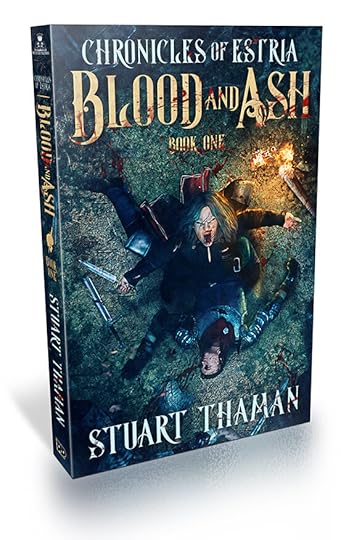
An epic adventure wrought with peril...
The punishment for vampirism is to be burned at the stake. Necromancers, should they be captured, are hung.
I am both.
My master bestowed upon my shoulders a monumental task, one that has become my life's ambition. Should I fail, at least I will burn with a smile on my face, knowing that I did not live by my father's rules, the life he would have forced upon me as his heir.
I have brought a legion of slaughter to the foot of the altar where I will soon carve my destiny, and I know that more bloodshed will follow. I welcome every drop.
August 7, 2020
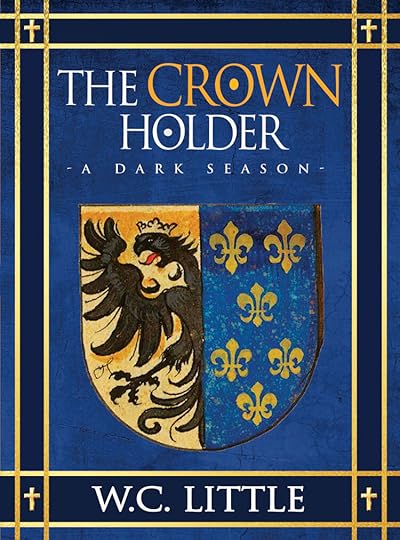
Interview with Author W. C. Little - Awesome Historical Fiction!
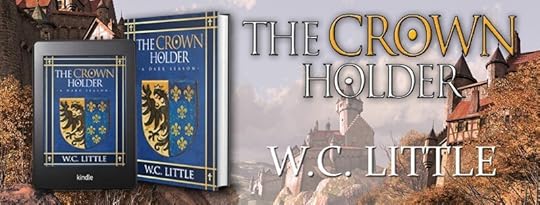
Click here to check out the series on Facebook
Congrats on releasing your first book! Tell us a little bit about it and what inspired you to write historical fiction.I wanted my first attempt at writing to cover a monumental period, but one that is rarely covered by writers. The story of Charlemagne – the extent of his great power – and the rapid decline in the authority of his successors, specifically caught my interest. At its zenith, Charlemagne’s empire was very impressive. Equally impressive were the forces around the empire that posed a risk: Vikings, Saracens and pagan tribes of the east meant that the empire was under constant threat.Also, because of the lack of contemporary histories and accounts of the people and events of the period, there was a lot of blank canvas for me to work with. I felt a freedom in developing several fictional characters to balance those that are documented.What would be the biggest challenges for someone living in the Carolingian Empire? Survival. Just the daily struggle for the necessities of life and trying to overcome disadvantages that come with a person’s class. Where am I getting clean water and food? I try to capture the minute details from time to time because the basic elements of survival are ever-present. The common man/woman has to deal with these keys to survival more than those of higher classes. I like to acknowledge as much to my readers.What are a few of your favorite examples in the genre? Which time period do you enjoy reading about the most?I enjoy reading Conn Iggulden and Bernard Cornwell the most. They have different writing styles, but the pages seem to turn quickly for me. I particularly liked Conn’s take on the War of the Roses. Cornwell is known for his gritty, battle-focused narratives. I love Cornwall’s series The Last Kingdom and look forward to reading the final book of the series. What do you have planned for the future? When can we expect to see your next book coming out? I see The Crown Holder series taking up most of my writing time for a while. I envision the series taking up 5 to 6 books in total. I think that a book a year is a pretty safe average. Grab your copy today!
June 20, 2020
Interview with author Antoine Bandele - Check it out!!
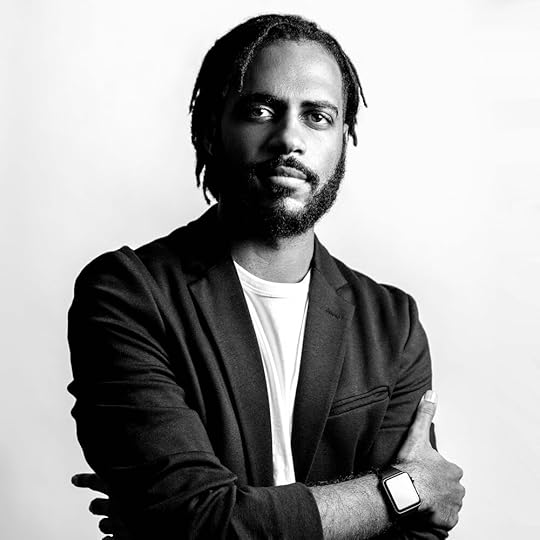
Thanks for doing an interview! Right out of the gate, tell us about your new book! By Sea & Sky has been a long endeavor. My debut The Kishi, was a great learning experience. That first book was more in line with dark fantasy and mythology, which I still want to continue with, but I also really like action-adventure stories, thus, By Sea & Sky, the first of a sky pirate chronicles series. One thing folks should know about the book is that it’s about the first airship in this setting, so we’re right at the transition between sea vessels and flying ones. I always like transitions and beginnings. Oftentimes in fantasy works that include airships, we see them integrated right away, but I’m really intrigued by the idea of seeing how all that builds out slowly from the start—much in the same way the world reacted to gun powder, or electricity, or the printing press. And then, with fantasy, I can top that off with the idea that great nations used to rule of the backs of flying mounts (now extinct in the setting), and new empires would try to replicate that force. But none of this would matter without some compelling characters, and I really love the cast I put together, whether it’s with Zala and the pirates she interacts with, human and non-human alike, or Karim and the military/political intrigue he gets worked up within. Each of the protagonists, while on opposing sides, mirror one another within the arcs of their respective factions. And of course, there’s a battle or two in this, hah.
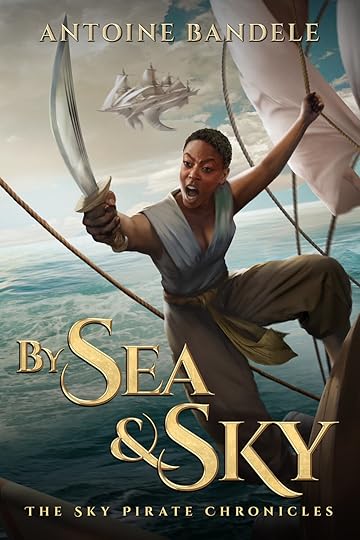
One of the best covers out there!
Which authors are your biggest sources of inspiration, and when did you start realizing that you wanted to write fantasy? Single novelists have never been my biggest source of inspiration, or rather, it was an amalgamation books, movies, television, and video games that sparked my interest in storytelling. I supposed my biggest influence was my mother, who encouraged my younger brother and I to draw and write down our own stories that we scribbled on notebook paper and stapled together. I’ve gone through a lot of storytelling phases, from pictures books, chapter books, comic books, and films (I’ve a few lightsaber videos online that are quite popular). No matter what venture I embarked on though, I have always circled back to narrative prose via novels, with cross-influences from Miyazaki, Butler, Konietzko and DiMartino, Sanderson, Lucas, Rowling, Martin, Jemisin, Jackson, Spielberg, among others. I don’t think I have ever “realized” that I wanted to write fantasy, I just… did. Talking about both the books and the movies / shows, which do you prefer and why: Lord of the Rings or Game of Thrones? For books, I’d have to go with A Song of Ice and Fire. I actually never could get into the Lord of the Rings books. I find Tolkien’s prose a bit dry for my preferences. Martin, on the other hand, is exactly the kind of prose I enjoy, vibrant, filtered through character, and relatively concise. But when it comes to the silver screen (or plasma in Game of Throne’s case), even if GoT lackluster ending was great (or even good), I’d go with LotR. It’s a complete story with perfect casting, one of the best bromances ever, with heroism that isn’t bogged down by the moral greyness. It’s just a joy to watch for me. I mean… I can literally go up to any LotR fan and say “you bow to no one” and instantly the image of Gondor with a crowd bowing to a band of hobbits springs to mind, and, soon after (I hope) a bit of watering at their eyes. Being a writer is hard work. What aspects of the author life have you enjoyed the most and what’s been a pain? I love editing, I love the process of sharing, getting feedback, and beefing up my works. But I hate hate hate HATE starting. First draft writing, especially after coming off a completed work with full characters, a well-paced plot, and solid prose is so hard to do. I don’t have an issue actually creating the vomit draft but at each keystroke, I question myself at every turn. What’s next on the horizon for your writing career? Oh my… I’ve got myself schedule well through the next decade, with the continuation of these sky pirate books, then onto a military fantasy set in this same world, then going back to the mythology stuff, alongside a young adult series I’m working up that takes place in modern times. There’s much more than that but I don’t want to bore the reader with all my plans. The one broad throughline for all these stories, however, is that they all tell Pan African stories, whether based in Africa or its diaspora. Thanks for doing the interview! Where can readers go to find more?
https://www.antoinebandele.com/
April 15, 2020
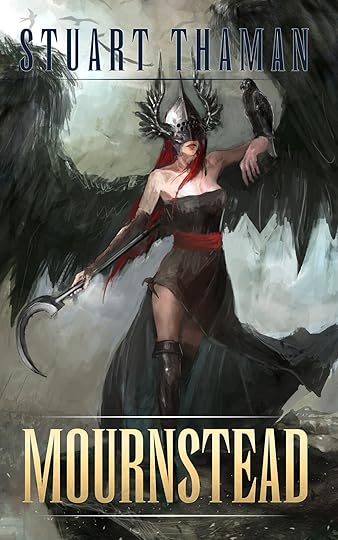
April 8, 2020
Grab a couple FREE books during quarantine!

3 of my books totally free! Enjoy! Stay at home and read. I know I’m certainly enjoying the nice weather with a bunch of cigars and awesome books.
Click here to get Killstreak: Respawn for free!
Click here to get Forsaken Talents: A Dark Path for free!
Click here to get The Minotaur King free!

Click here to use your coupon on the webstore!
January 12, 2020
Copy of Interview with Henrik Rohdin, author of The Oaken King
Tell us a little about your new book: My new book is “The Oaken King,” intended to be the first novel and jumping off point for a forthcoming dark fantasy series called the Soulsword Cycle. I’ve only written science fiction previously, for the most part, but I’ve read considerably more fantasy over the years so this is in a way me returning to my roots. The book follows about 6 different POV characters as they navigate the aftermath of a demonic attack early in the story that decapitates the leadership of an alliance of kingdoms called the Oaken Pact, or as I like to call it when I talk about the book, “medieval NATO.” You’ve got your standard plucky orphan thrust out into the wild world, in this case a stableboy named Soren, but I also have some characters I’m really excited about hailing from cultures based on non-Western European sources. My personal favorite is a swordswoman from a desert culture inspired by the Bedouins named Naqah, who is hired by a strange priest to escort him as he investigates the cause of the demonic attack, and a plotline that is almost all table-setting for future books featuring Koyik, a Ranger up in the frozen north who hails from a people based on the Inuit, who is torn between her faith and her people’s culture and heads on a scouting mission that goes terribly awry. There are some fun worldbuilding surprises I’ve got waiting for readers, as I don’t use any stock fantasy races, but you’ll recognize where I’ve drawn inspiration for some of my creatures and cultures from more non-traditional sources. Who are some authors who inspire you?Without a doubt the fantasy gold standard for me is Tad Williams, specifically the “Memory, Sorrow and Thorn” trilogy that I devoured as a teenager. It’s a series that everyone has heard of but has sort of fallen by the wayside since it was released due to the popularity of some of its derivates like Game of Thrones (George RR Martin was inspired by Williams before setting out to write ASOIAF) or The Wheel of Time, which similarly mixes traditional high fantasy with more serious grounding. The vibe of Williams’ trilogy as well as A Song of Ice and Fire are definitely what I’m aiming for with the forthcoming Soulsword Cycle. I haven’t exactly been shy over the years in broadcasting my admiration for Tad Williams when discussing my writing publicly, and getting to interact with him on a Reddit AMA when his sequel trilogy “The Last King of Osten Ard” was a huge fanboy moment and highlight for me!
Lord of the Rings or Game of Thrones?I’ve always loved Lord of the Rings and grew up watching the trilogy frequently, even binging the whole extended edition one New Year’s Eve with my dad when I was in high school. That said, the aesthetic of Game of Thrones fits my writing style more; grittier, more grounded settings, a little darker overall. I’ve studiously avoided stock fantasy races like elves or dwarves, because personally I think Tolkein set the bar and everyone else is a pale imitator when it comes to those two. Tell us a little about some of your writing process:I love the actual writing piece, sitting down and trying to come up with how to phrase a sentence, poring over my notes and outlines, that “aha!” moment when I have a new idea I hadn’t considered. Marketing is a huge pain in the rear, though, and is my greatest (and it is quite substantial) Achilles heel. I’m terrible at online marketing and figuring out how to get attention for my novels. Working on that, though! What’s next on the horizon?I’m working on the sequel to the “Oaken King” right now, tentatively titled “The Swordmaid of Harash.” I plan on eventually finishing my original flagship series, the “League of Planets Adventure,” which only has a seventh book left, but after writing the sixth entry in that series I was so burned out I wanted to try my hand at something new… so of course I dabbled in epic fantasy, an even more challenging genre! Then we’ll see! I tend to follow my muse wherever it takes me. A big goal of mine is to invest more time into trying to build a reader base with such a substantial backlist. Where can readers find more:Readers who are interested in following what’s next from me are welcome to follow me at:Facebook - https://www.facebook.com/henrikrohdinauthor/Twitter - @HenrikRohdinI also am fairly active on the r/fantasy subreddit under the handle KingSweden24.


