
Brian J. Walsh's Blog, page 34
March 5, 2014
exodus journey
dust swirls
sticks to skin
peer through grit
sand in eyes


No Place for a Woman
March 1, 2014
How it will Come
at dawn.
With light behind the smokestacks,
February 28, 2014
Creation, Fall and the Two Kingdoms
February 23, 2014
Longing for Home
A single word that enables
me to label
another based on something that I do not understand.
February 11, 2014
Facing Down Racism
February 2, 2014
Child of Covenant
January 20, 2014
God is Not in Control
January 4, 2014
So This is Christmas (War Is Not Over)
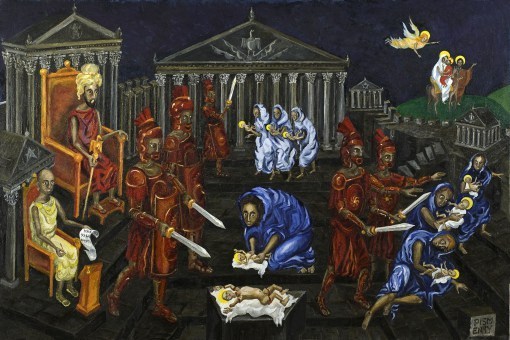
by Jennifer Galicinski
Today is one of the days in the church calendar that I most appreciate – the Slaughter of the Holy Innocents. During the 12 days of Christmas, there is a day to remember that the birth of the Prince of Peace threatened the Roman Empire so much that it resorted immediately to the tool that marks every empire – violence. With a lust for power and control, King Herod ushered a decree that baby boys under the age of two be massacred, in hopes of killing the one who was deemed to be the true King. It was a state-sponsored infanticide, thousands were murdered, and the Holy Family fled as refugees.
As I’m writing this my nieces and nephews are squealing with delight as they run around and play with each other. The two youngest are under two years of age, and I cannot imagine the horror of an army coming around and murdering them in cold blood. (Later, at the dinner table, I was discussing this article, and my dad asked why the “Holy Innocents” are so “Holy”. My 9 year old nephew wondered if it was because being holy is being set apart for God, and these infants died instead of Jesus, so they were set apart in heaven. Genius.)
My appreciation of this awful day might seem a little masochistic. After the peace and beauty and joy that we’re supposed to feel at Christmas, the Slaughter of the Holy Innocents plunges as back into the reality felt by most people in the world: life is cruel and marked by suffering. It’s authentic.
As I speak, violence is rising in the South Sudan and the newly formed country is quickly deteriorating – with hundreds of innocents slaughtered in the past two weeks and a friend of mine having to evacuate the country.
The number of Syrian refugees continues to rise well over the million-mark.
Disaster is still wide-spread in the Philippines after the horrendous typhoon.
The empire of globalized capitalism consumes its slave-labour victims year by year.
In Canada, where I live, First Nations people were ruthlessly slaughtered by European colonists. To this day, Canada’s First Nations are perpetually and systematically thrown aside on their own land. So-called “reserves” are more like majority-world countries. First Nations commitment to stewarding their land, in opposition to the advances of Big Oil are ignored by the settler state, and the majority of Canadians.
This day provides the opportunity to cut out all the bullshit that sometimes comes with Christmas – the other-worldly angelic joy, the commercialism of it all, the pretending that Christmas has saved us all – because it hasn’t…yet.
The Massacre of the Innocents introduces us to what Christ faced in his lifetime. It’s what we are up against in ours.
For Christ, there was a violent empire that when challenged, would not hesitate to kill and destroy all in its path. The same is true for us. The penalty for following this Prince of Peace into darkness and suffering will ultimately threaten the empires that rule today (if we are doing it right).
Hell hath no fury like a threatened empire. So what do we do?
Anne Lamott says in her new book Stitches: A Handbook on Meaning, Hope, and Repair:
“We are not served by getting away from the grubbiness of suffering…we have to stand in the middle of the horror, at the foot of the cross [like Mary], and wait out another’s suffering where that person can see us….To be honest, that sucks. It’s the worst, even if you are the mother of God.”
Presence and solidarity with those who are suffering, without any cute platitudes like “God’s plan is perfect” is hard. Such statements only makes things worse, which is why true presence and true solidarity are so essential. They are good places to start.
But then what? Lamott continues
“Most of us have figured out that we have to do what’s in front of us and keep doing it. We clean up beaches after oil spills. We rebuild towns after hurricanes and tornados. We return calls and library books. We get people water. Some of us even pray. Every time we choose the good action or response, the decent, the valuable, it builds, incrementally, to renewal, resurrection, the place of newness, freedom, justice. The equation is: life, death, resurrection, hope. The horror is real, and so you make casseroles for your neighbour, organize an overseas clothing drive, and do your laundry…we live stitch by stitch, when we’re lucky.”
We can do something equally dramatic. To do so, we must go and be present with those who suffer most in our world. Together, we can work for justice in whatever ways we are gifted and able.
One of my seminary professors once said:
“Every act of social justice (or simple kindness) is a foretaste and foreshadowing of the coming Kingdom of justice, peace, and flourishing for all.”
So today, we remember. We educate ourselves, and others. We lament. We are present with the suffering. We get stitchin’. But first, we must let go of our sadness and meager attempts to love God. From the Anglican Book of Common Prayer:
Almighty God, our heavenly Father,
whose children suffered at the hands of Herod,
receive, we pray, all innocent victims
into the arms of your mercy.
By your great might frustrate all evil designs
and establish your reign of justice, love, and peace;
through Jesus Christ our Lord,
who lives and reigns with you and the Holy Spirit,
one God, now and for ever.
Amen.
This blog originally appeared on Jennifer Galicinski’s website, Sacred Imperfections, and has been lightly edited.
Filed under: Jennifer Galicinski


December 23, 2013
A New Way Home
by Andrew Stephens-Rennie
It’s that time of year again. That time to journey home, the place of anxiety, fear, frustration and pain. Home. It’s where the hurt is. Yet again this week, in light of the Duck Dynasty Debacle, social media lit up, and along with it, the renewed call from various folks for the death of Christianity specifically, and religion in general.
Somehow, it’s just easier to believe that Phil Robertson’s Christianity represents all Christians. Somehow it’s just easier to invoke Dawkins’ and Hitchens’ simplistic critique. Religion is the source of evil in the world. Religion must die. QED.
Lord Have Mercy.
Christ Have Mercy.
Lord Have Mercy.
It’s in instances like these that I wonder whether or not we should be relieved that ignorance isn’t restricted to religious fundamentalism.
But there are deeper implications to consider here. As we approach Christmas, it will do us no good to deny the anxiety, fear, frustration and pain that comes with this season. Sure, it’s also about peace, joy, hope and love. But this year, I have on my mind friends whose Christmases will be fraught with difficult conversations and awkward family silences. Whose Christmases will involve familial prayers that they leave the old life behind and return to a Jesus they never left (and who never left them). As if to rub it in, their family will say “this Christmas, we made a donation to Living Waters, on your behalf,” and on, and on.
Each year we celebrate the birth of a misunderstood, deviant Saviour born in the midst of a totalizing empire, in a time of infanticide. In light of all that’s happening today, what do we do with that information?
Earlier this week, Tyler Smither posted these words:
“The current research suggestions that teenagers that are gay are about 3 times more likely to attempt suicide than their heterosexual peers. That puts the percentage of gay teens attempting suicide at about 30-some percent. 1 out of 3 teens who are gay or bisexual will try to kill themselves. And a lot of times they succeed. In fact, Rev. [Frank] Schaefer’s son contemplated suicide on a number of occasions in his teens.”
What does it mean to receive the gift of life, this Christmas? What does it mean to receive as gift, the life whose path, whose call, whose orientation, and whose unwritten story is as yet unknown? Can we receive it with love, no matter what? Or are there qualifications to the love that we will extend in the name of Christ?
While folks like Steve Deace in USA Today style Robertson as a modern-day John the Baptist, he could just as easily be clothed in the Herod archetype. Does Mr. Robertson not, in fact, point out the Herod present in each of us? Does he not, in fact, point out the Herodian impulse in each community that demands the blood of its young in order to preserve its “rightful” hegemony?
Smither suggests we’re past the time for debate. That peoples’ lives are at stake. And that, whatever your thoughts on homosexuality (the issue) the best thing to do is to embrace our gay and lesbian brothers and sister, sons and daughters, mothers and fathers (you know, the people) with love. Self-sacrificing, vulnerable love for real, live human beings.
And so, while I worry and fret over the prayers being prayed on behalf of my friends, this year, I have my own prayers.
Prayers for new life. Prayers for embrace. Ultimately, I pray for wise men, women, and communities who will steer clear of Herod’s trap. This year, may we find a new way home. This year, may we find a way that witnesses to life.
Filed under: Advent, Andrew Stephens-Rennie, Christmas, Sexuality


Brian J. Walsh's Blog

- Brian J. Walsh's profile
- 14 followers

