
Robb Ryerse's Blog, page 11
January 17, 2013
True Confession: I Don’t Want Jesus to Come Back
Whenever I read blogs like Jesus Needs New PR or Christian Nightmares or The American Jesus, the posts that most capture my attention are the William Tapley videos or the Nic-Cage-as-Kirk-Cameron in a Left Behind reboot speculations or the dueling live coverage of the return of Jesus.
For some sick reason, I’m drawn to the drama of end times prognostications.

I think this is because I grew up in fundamental Baptist churches that were obsessed with the end times. We would often have eschatology conferences where we would string a bed sheet across the front of the sanctuary and map out with certainty all of the details relating to the end of the world. The details we didn’t know for certain, we would argue about – like where America can be found in the book of Revelation or who the AntiChrist is.
The underlying message of our approach to the end of the world was that everything was getting worse and worse. Life on the planet is spiraling out of control. The only hope any of us had was Jesus returning to rapture us out of the mess. And so, we should look forward to his glorious returning more than anything else in life.
That’s the part that always got me.
I was a good fundamentalist. I attended church with my family without complaint. I was very involved in our church youth group. I worked at our Christian camp. And eventually, I went off to Bible college to become a pastor.
Nonetheless, I wasn’t really looking forward to the return of Jesus. If I was forced to make a true confession then it would have been this: I don’t want Jesus to come back.
What I wanted was a chance to live my life. I wanted to get married and have sex. We decided in Bible college that the cruelest irony would be for the Rapture to happen during your wedding reception – after the “I do” but before the honeymoon. I wanted to have a family. I was (and still am) looking forward to the Cleveland Browns winning the Super Bowl. I always felt guilty that in my heart of hearts, I wasn’t really looking forward to the return of Jesus because I figured that the second coming was going to spoil my life.
More than a decade later, when I went through a profound theological transformation, which I now refer to as a fundamorphosis, one of the things I jettisoned from my Christian upbringing was the pessimistic view of the future and the associated feelings of guilt.
I now embrace an optimistic theology based on hope. Rather than despairing over the problems of the world, I’m trying to be an activist regarding the issues I feel passionately about. Rather than treating people with suspicion and finding conspiracy theories around every corner, I’m trying to embody the grace of suspended judgment. Rather than expressing unwarranted certainty about how the future will unfold, I’m trying to embrace the mystery and enjoy the ride. Rather than thinking I’ve got to wait for Jesus to return, I’m trying to find Jesus in every face and in every day.
And, rather than feeling scared and guilty because of the pronouncements of the William Tapleys of the world and the pessimistic theology of my upbringing, I now see it all as eschatological silliness. And it makes me laugh … a lot.
As your reward for reading this post, here is William Tapley in all of his glory:
The post True Confession: I Don’t Want Jesus to Come Back appeared first on Robb Ryerse.


January 16, 2013
Book Reflection: Jesus Wants to Save Christians
This year at Vintage, I am preaching through Exodus. (The podcast of week 1 is available here.) A couple years ago, we journeyed through the epic story of Genesis. It feels like it’s time to explore the sequel. And so, in preparation, I recently re-read Jesus Wants to Save Christians by Rob Bell and Don Golden.
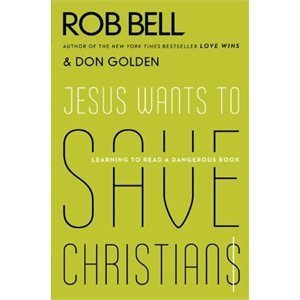 I’ll be honest. The first time I read JWtSC, I didn’t like it very much. Its heavy reliance on re-telling biblical stories seemed boring to me. It felt way too political and polemic. It just didn’t resonate with where I was at at the time.
It’s amazing how things change.
This time through, I was completely enamored with Jesus Wants to Save Christians. It captured my imagination and got me thinking in the kind of way that I always hope a book will.
The theme of the book is that the central story of the Bible, our redemption, can be understood through the rubric of Exodus. In essence, God is calling people out of slavery to empires of oppression and into the freedom and liberation of God’s kingdom. It’s a story that moves the idea of salvation beyond just the realm of personal salvation – a get-out-of-hell-free-card – to a more global and holistic vision of what it means to live by faith and with justice.
Bell and Golden highlight the centrality of the exodus throughout the biblical narrative. I love to see relationships between things. I love to connect the dots. Reading JWtSC this time was like pulling at a loose thread. Everything was connected to everything. The story of exodus doesn’t just happen in Exodus. It happens again in Solomon’s reign over Israel and again with the prophets and again in the life of Jesus and again through the writings of Paul and again in John’s Revelation.
The book inspired me to think again about my role as a peacemaker in the world and as someone who ought to work for justice. In the face of so much oppression and injustice, I have the choice – to serve and build the empire or to serve and build God’s kingdom.
And I was struck by the profound inconsistency of it all. (I don’t like things to be inconsistent. If you say something, do it. If you believe something, live up to it.) As I was reading JWtSC, I was thinking about some of the changes Vanessa and I have made in our lives to be more socially responsible, to more fully pursue peace and justice. And I was blown away by how far we have to go. I read JWtSC on my Apple-made iPad, sitting in a Starbucks, wearing clothes from Banana Republic.
The irony was not lost on me.
Jesus Wants to Save Christians is a how-should-we-then-live kind of book. It doesn’t just draw parallels between various Bible verses, it paints a picture of human existence that calls me to action. I’m glad that I’ve got a community with which to experiment as we live the new exodus together.
And … just because it’s that awesome, here is Tracy Chapman’s song Fast Car, the perfect anthem for a new exodus.
The post Book Reflection: Jesus Wants to Save Christians appeared first on Robb Ryerse.
January 15, 2013
Formative: Malcolm Gladwell
When I first began to learn about how our culture was shifting/had shifted from modernity to postmodernity, I became very intrigued with the idea that narrative was replacing proposition as the means by which information and truth was transferred.
The fundamentalism in which I grew up, especially in Bible college, loved proposition. We were taught that the Bible is propositional truth and that God revealed himself (and it was always “himself”) through propositional statements. Any stories in the Bible simply served as a vehicle for propositional statements about God.
That approached worked in modernism, but we aren’t living in the modernism any more. For myriad reasons, we think differently now. And narrative has replaced proposition. This really changed how I read the Bible, opening up for me new and wonderful appreciation for both God and the story of reconciliation told in the Bible.
I was embracing this shift on an intellectual, dare I say propositional, level, but I wasn’t always clear about what it would look like in the real world and how it would impact more disciplines than just biblical studies … until I read Malcolm Gladwell.

Every once in a while I have a strange experience. A book will get mentioned to me by different people in different contexts several different times. About 5 years ago, that happened with Gladwell’s book The Tipping Point. My boss asked me if I had read it. Then I heard about it on NPR. Then I read an article that referenced it. Then I saw a friend reading it. I’ve learned that whenever this happens, God or the universe or something is trying to get me to read this book. And so I bought and devoured The Tipping Point. And I’ve devoured all of Gladwell’s books since. (Here‘s where I blogged about a couple of them.)
Malcolm Gladwell is the author of four books as well as numerous articles in and other places. He is a fascinating man with an interesting look. His mother is Jamaican, but he spent much of his growing up years in Canada. After failing to get into graduate school and failing to land a job in advertising, he began writing. And the world is better for it.
A couple of years ago, Vanessa and I heard Gladwell speak in Fayetteville, and it was amazing.
Gladwell writes and speaks about academic and scholarly research. He examines statistics and surveys. He recounts theories and tests the relationships between ideas. He is a brainiac … who is thoroughly grounded in reality.
You see, when Gladwell writes about some big idea or some new research, he doesn’t throw a set of propositions at you, nor does he simply list statistics in mind-numbing monotony. Instead, Malcolm tells stories.
When Gladwell wants to explore success and achievement, as he does in Outliers for instance, he doesn’t merely list test scores, he weaves together captivating stories of people who have become successful in life, skillfully using statistics to underscore the point. In Blink, for instance, when he explores what makes a song popular, he tells colorful stories about the people who make music rather than putting the black-and-white notes on a page through the scientific method.

In Gladwell, we find a more expressive, compelling, and contemporary way to pass along information and to make it memorable. His books have made me a better preacher, teacher, and father. He has helped me to see how a very important idea – that narratives have supplanted propositions – can come alive. And for that, he has been formative to me.
How about you – have you read Malcolm Gladwell’s books? What did you think about his style?
Get the whole Formative blog series here.
The post Formative: Malcolm Gladwell appeared first on Robb Ryerse.
January 14, 2013
Some Reflections on the Emergence Christianity National Gathering with Phyllis Tickle
This weekend, Vanessa and I attended the Emergence Christianity National Gathering, a conference/book party to celebrate the publishing of Phyllis Tickle‘s new book Emergence Christianity. Phyllis is a singular person in American Christianity. Because of her keen mind and unique experience, she has been able to best document the fundamental changes that have been occurring in the church over the past several decades. I’m fond of calling her the fairy godmother of the emergent church.
[image error]
(c) Courtney Perry
Four times in two days, Phyllis held court in the magnificent sanctuary of St. Mary’s Cathedral in Memphis TN. Without notes or hesitation, she traced church history with detail, insight, and humor. All 450 of us in the room were held spellbound when she spoke. There were other speakers and panel discussions and liturgies and conversations and meals. But they were all the sideshow. Phyllis commanded the center ring of the circus. And we gave her two standing ovations.
You have to listen fast when Phyllis speaks. She covers a lot of ground. She offers profound insights as throw-away comments. You want to laugh at her very dry wit but you’re afraid that if you do, you’ll miss something important. She doesn’t work a crowd. She goes. And you try to keep up.
I’ve read Phyllis’ books. I’ve studied church history. I’m well-versed in this whole emergent church thing. I felt like I could keep up. Until Phyllis said something that sent my mind spinning down some other trail. I kept mentally trying to stick a pin in an idea to come back to later.
But before I share a list of some of my pinned items, let me first give a clarification for anyone who might not be familiar with the term “emergence Christianity.” This term refers to a wide swath of the church, now a major tributary in Christianity. Emergence Christianity is a movement within the church that recognizes that profound, fundamental shifts have taken place in technology and culture that impact the way we live out our faith. It takes many forms – self-identifying “emergent churches” like Vintage Fellowship or neo-monastics or slow church adherents or “hyphenated” emergents who populate mainline denominations.
Given how diverse the conversation is, it may be impossible to nail down a strict definition. However, there needs to be an understanding that a broad group of Christians now have more in common with one another than they do with other Christians. At the Reformation, there was a realization that Protestants were a new tributary to the river of Christianity. Phyllis has documented that Emergence now needs to be recognized as another new tributary in its own right.
–
Having dispensed with that, here are some of the topics or ideas that got pinned in my mind:
Phyllis made a strong connection between emergence Christianity and the charismatic movement. She drew a bright, straight line between the pentecostal inbreaking at Azusa Street and emergence Christianity. She touted John Wimber as a tremendously important figure for emergence Christianity. I think Vanessa had to pick my jaw up off the floor when she said it. It’s not that I necessarily disagree with Phyllis on this; but as a person who is decidedly non-charismatic, it’s just that I had never made the connection.
Phyllis’ whole approach to church history is built on the observation that every 500 years, we go through a major upheaval. She suggested that these upheavals can be grouped in fours, creating sets of 2000 years of human history. Further, Phyllis suggests we understand these ages through a trinitarian rubric. The charismatic movement is peri-emergence because it ushers in the Age of the Spirit. I’m left with a couple of questions about this approach. First, does it seem artificial? Second, what happens 2000 years from now when the Age of Spirit is over? What then? I’ve got more noodling to do on all of this.
–
Phyllis didn’t just look back; she also keenly addressed the current challenges for emergence Christianity. She suggested that we face four big questions:
What is our authority?
How do we exist in a pluralist society?
What do we do about the atonement?
What does it mean to be human?
I sniffed around the edges of these questions in Fundamorphosis. On the question of authority, I talked about how my understanding of the Bible has changed and how labeling something as “biblical” no longer resonates with me. On the question of pluralism, I suggested that we adopt the optimistic attitudes of hope and grace toward one another, especially when we disagree on the most basic issues of life. On the question of the atonement, I suggest that our understanding of the death of Jesus needs to be better contextualized, even to the point of suggesting a new atonement metaphor. On the question of humanity, I described how I’ve come to think that the essence of humanity is similar to the essence of God – found in community.
I say all of this not to toot my own horn but rather to recognize the affirmation that I am on the right track in my thinking. Further, I felt that in some ways Phyllis was giving me my marching orders. If these are the big questions facing emergence Christianity, and I have already been dabbling in them, then I must go beyond dabbling and dive in. Being in conversation about these big questions is one of the big projects I must undertake.
–
The point in the conference that made me want to stand up and cheer was when Phyllis said that Brian McLaren‘s book A Generous Orthodoxy was the 95 Theses of Emergence Christianity. I could not agree more. I’ve written before about how Brian McLaren saved my faith. In many ways, A Generous Orthodoxy has been my theological blueprint. Brian McLaren is my Martin Luther.
–
Phyllis made my mouth drop open a second time during the conference. It was right near the end, when she drew parallels between the pharmacology that led to the birth control pill and the rampant biblical illiteracy in American society. With grace and understanding but not judgment or condemnation, in my estimation anyway, she lamented the breakdown of the family unit – whatever that family might look like – and she lamented that children are not being taught the Bible via the church calendar in their homes.
I didn’t see that coming. I didn’t hear Phyllis nostalgically calling us to return to the Leave It to Beaver era. Instead, I heard an invitation to creatively craft for our children a handmade, homemade, local, and organic experience of the faith that will capture their imaginations and stick with them. While I can’t speak for Vanessa, I think we were both inspired by the vision Phyllis seemed to cast.
–
There is much more to digest and consider from the Emergence Christianity National Gathering. I think I will be ruminating on it much over the coming weeks. If you were there – or just following the #EC13 and #bigtickle conversations on Twitter, I’d love to hear your thoughts.
The post Some Reflections on the Emergence Christianity National Gathering with Phyllis Tickle appeared first on Robb Ryerse.
January 8, 2013
Formative: Conan O’Brien
I remember where I was when I first heard the name Conan O’Brien. It was one of the days that I was working in the kitchen at Baptist Bible College, of all places. David Letterman had jumped shipped to CBS, and NBC needed a replacement. An unknown comic writer got the job. I’m not quite sure why we were talking about it, but the kitchen staff at my Bible college met the news with a resounding Who?
 I also remember the first time I watched an entire episode of Conan’s show. Vanessa and I were living on Staten Island, making a new life for ourselves. One night, we couldn’t sleep. And so we watched Conan’s Late Night show. He did a bit where he went to some town in Texas where his show aired at like 3 in the morning. He searched the town for people watching his show. It was hilarious. I was hooked.
My favorite Conan Late Night show was the one dedicated to U2. The band were the only guests. They participated in the bits, including a “In the Year 2000″ sketch (always my favorite Conan bit). For a fan of both Conan and U2, this whole episode was different, memorable, and awesome.
I was thrilled when Conan got the promotion to The Tonight Show. We used to watch Jay Leno, just because it was on, but I have never been a fan. I know that a lot of people don’t think Conan did a good job on The Tonight Show, but I enjoyed, even if it was less quirky. Nonetheless, 7 months wasn’t enough time to get his footing. When NBC caved to the insecure insanity of Jay Leno and fired Conan, I was annoyed and offended. I vowed to never watch Leno again – and I haven’t.
There are two things that I will never forget about the end of Conan’s run on The Tonight Show. First, the last couple of weeks of shows were absolutely fantastic, must-see-TV. He cut loose and was himself in a way he hadn’t been up to that point. The shows were funny and poignant and great. It makes me think that if he had been that way from the start, maybe he never would have lost the job.
The other thing I will never forget about that time is the grace with which Conan handled all of it. It was obvious that he was devastated. It was obvious that he was getting screwed. And yet, he carried himself with honesty, humor, and humility. It made me love him.
Now, let me be clear. I don’t want to be overdramatic about what happened on NBC. In the scale of great global injustices, a millionaire getting screwed over by another millionaire and a billion dollar corporation doesn’t rank anywhere close to human trafficking or poverty or just about anything. Don’t think that I am crying tears over Conan.
But …
What happened to him was a very personal and public humiliation for Conan. And – for whatever reason they occur and to whomever they occur – personal and public humiliations are gut-wrenching to watch and, even more so, to experience. I’m not sure how most of us would react to being so personally repudiated and so publicly humiliated as Conan was. But I’m pretty sure that a lot of us wouldn’t be as gracious as he was.
And that is what about Conan has been formative for me. I have dedicated my life to trying to exhibit profound, overcoming grace in every circumstance and with every person. Sometimes I succeed but often I fail. And to see someone I admired exhibit such grace with authenticity and humor … it gave me hope that it’s possible.
On his last episode on The Tonight Show, Conan said these words. They are hanging in my office and are on the desktop of my computer:
But if you work really hard and are kind, amazing things will happen.
In the face of personal and public humiliation, when venom and revenge could have been justified, with the whole world watching, Conan didn’t resort to what most of us would do or say. He exhibited optimism and hope. And it’s that kind of grace that makes me a forever member of Team CoCo. And it’s also why Conan O’Brien has been formative in my life.
The post Formative: Conan O’Brien appeared first on Robb Ryerse.
January 7, 2013
Win a Copy of Fundamorphosis
On Monday, January 21, I’m going to give away a free copy of my new book Fundamorphosis: How I Left Fundamentalism But Didn’t Lose My Faith. All you have to do to be entered to win is sign up to receive my newsletter. You can do that right over there, in the form on the right side of my website.
Don’t worry – I’m not going to send the newsletter out often. Trust me; I won’t spam you. Every once in a while, I’ll send you a newsletter with some updates about what I’m up to – on this site and in my life.
So … sign up today and get entered to win a free copy of Fundamorphosis.
The post Win a Copy of Fundamorphosis appeared first on Robb Ryerse.
Formative: a new blog series
Over the past week, football coaches have been on my mind. This is because my dearly beloved Cleveland Browns are searching for their 14th full-time coach in franchise history. I watched a good chunk of the Fiesta Bowl so I could scout out Oregon’s Chip Kelly. And I spent way too much time on Friday and Saturday tracking on Twitter Kelly’s dinner plans. He was the Browns’ first choice, but when he went wishy-washy, they walked away.
And now, they’re back to square one. They are making lists of candidates and interviewing potential coaches. The off-season is always the most hopeful time to be a Browns fan.
In a coaching search, one thing is always a big concern – that particular coach’s family tree. Whom did he learn under? From whom did he get his coaching philosophy? Who are the other coaches he coached with? Interesting (to me, anyway) articles have been written about the various NFL coaching trees – those who came from Paul Brown, those who came from Bill Walsh, those who came from Bill Parcells, those who came from Bill Belichick.
The question of coaching trees is a question of formation. Who formed you? With whom have you rubbed shoulders that has made you the way you are? These are important questions, not just when you are picking a new head coach for your football team, but also when you are evaluating your own life.
I tell you all of this as a way of getting to my point. Which is … in my attempt to blog more frequently and more consistently, I am excited to let you know about a new series here on my blog. I’m calling it FORMATIVE.
Each week, I’m going to blog about someone, some place, some book, some event, some thing of some kind that has been formative in my life.
I find it interesting to here about the stories about how people have become the people they are.
Who has influenced them?
Why do they care about what they care about?
What’s the backstory?
What unexpected thing captured their attention and changed their life?
And so I’m going to tell you some of mine. Just like anybody else, I have my own list of people, places, and things that have formed me. Some are probably expected while others might surprise you. Tuesdays are going to be the day that I tell you these stories.
I think it’s important to recognize and even celebrate those things and people that have been formative in our lives. It is a humbling discipline to intentionally admit that I did not get here on my own. I have been influenced. I have been encouraged. I have been shaped by the lives, thinking, words, and actions of others. I would not be who I am if I had not come into contact with these others. That’s what Formative is about.
So … get ready. Get excited. Get down and boogie. Formative starts tomorrow. And maybe the Browns will have a new coach by then too.
The post Formative: a new blog series appeared first on Robb Ryerse.
January 4, 2013
Be a Good Christian. Disagree with Your Pastor.
Growing up in church, I was always conscious of what constituted a “good Christian.” The fundamentalist churches I grew up in had a lot of rules against which we could judge ourselves (and others). We couldn’t go to movies or drink alcohol or wear jeans to worship services. And we were taught that good Christians conformed. We were not to conform to the world, but we were supposed to conform to each other.
The fundamentalism of my youth always seemed to push us toward homogeny. People were expected to dress in similar ways, to have similar haircuts, to talk the same way, to use the same version of the Bible. And this push for homogeny went deeper. We all had the same worldview, voted for the same candidates, and believed the same things about God, humanity, and life.
But I don’t necessary think it should be that way.
Many churches, especially fundamentalist churches but certainly not limited to them, are held together by the sheer force of the pastor’s personality. He (and it’s always a “he”) stands as the mediator between God and church people. So many people choose a church – or choose to leave a church – on the basis of whether or not they agree with the pastor.
Standing at the center of this homogenous universe was the pastor of the church. His preferences, his convictions, his beliefs dictating life for his congregation. We were taught that because the Bible says to “touch not God’s anointed,” we were not to disagree with our pastor.

In fact, I have come to believe that disagreement is a Christian virtue.
I think one of the best signs of health in my own church is when people disagree with me and each other.
Granted, disagreement is a scary thing because it can expose possible fissures and put relationships in jeopardy. If a friend and I disagree about something, there arises the possibility that our disagreement could balloon into something big that drives us apart. When we don’t disagree, our relationship is less vulnerable.
But vulnerability is one of the hallmarks of authentic relationships. Because it introduces vulnerability into a relationship, disagreement is, in fact, one of the best things for relationships. There is something beautiful about a friendship that crosses the boundaries of what is conventional, that broadens our perspectives, that drives us to something deeper than what we have always known.
Disagreement also makes Christian unity possible. Many churches substitute various kinds of unity for truly Christian unity. Unity based on shared political positions or common ethnic and socio-economic experiences or even theological agreement is not Christian unity. Christian unity is based on a common experience with Jesus. The apostle Paul taught that the Christian vision of unity is not about gender, ethnicity, or cultural standing. It is unity that is rooted in the Trinity, unity in the midst of diversity.
All of this has me dreaming.
What if we started to celebrate disagreement and what John Franke has called the plurality of truth? What if our churches were full of people from across the political spectrum? What if we had folks from vastly different denominational backgrounds and theological presents doing life together? When it comes to commerce, education, family, and just about everything else, what if we embraced the fact that we value much different things? What if we disagreed on so much and yet couldn’t be more unified?
So, go ahead, be a good Christian. Disagree with your pastor.
The post Be a Good Christian. Disagree with Your Pastor. appeared first on Robb Ryerse.
January 3, 2013
Book Reflection: All Is Grace by Brennan Manning
If your life were to be summed up in a single sentence, what would it be? If you could encapsulate all that you have experienced, all that you have tried to pass on to your children and others, all that your life has been about in a few words, which would you choose?
 How about these:
God loves me unconditionally, as I am and not as I should be.
Could that impossibility be true? It seems too good to be true, doesn’t it? It sounds so unfair, so unrestrained, so unqualified. It sounds so much like we are being let off the hook, given license, given permission to take the love of God for granted. It sounds so vulgar.
Appropriating the phrase from Robert Farrar Capon, Brennan Manning calls it vulgar grace. And vulgar grace has been the story of his life.
–
I was first introduced to Brennan Manning in 1995 when I read The Ragamuffin Gospel. I don’t know how I heard of the book, but I devoured it. I can honestly say, of all the books I read in college, both those assigned and those I chose myself, no book was more formative for me than Manning’s classic. It spoke to something deep inside of me that longed to be loved and cared for. I had grown up with a distant and angry God who was looking for the best possible moment to expose my sin and destroy my life. The Ragamuffin Gospel painted a better picture of God – a God who loves me, no matter what – and that is the God I’ve been searching for ever since.
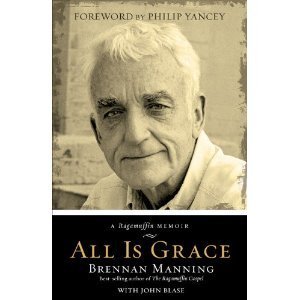
In his memoir All Is Grace, Brennan Manning shares the story of his a life, a story about how he has been searching for this God too.
The story starts, appropriately, with his mother, Amy, an orphan who ends up raising a family that is distant, untrusting, and more than a little harsh. In time, Brennan goes off to college, and then abruptly joins the Marines, and then abruptly becomes a Franciscan priest, and then abruptly joins the Little Brothers of Jesus in Europe, and then abruptly starts a new community in Mobile Alabama, and then abruptly …
You get the picture. Brennan’s life is full of fits and starts, new beginnings, new adventures, like he can’t sit still for any amount of time.
Eventually, he – somewhat less abruptly – leaves the priesthood to marry Roslyn, becoming in a moment a husband and father. Their story is touching and tragic. But this is not a happy-ever-after tale of a former Catholic priest turned Evangelical rockstar. It’s more vulgar than that.
Roslyn is not the love of Brennan’s life. Alcohol is.
With heartbreaking authenticity, Brennan shares about his lifelong struggle with alcohol. At times, it’s difficult to read. I don’t want to picture one of my spiritual heroes staggering about like Nicolas Cage in Leaving Las Vegas. But that’s precisely the vulgar picture Brennan paints of himself. And in the midst of it, there is God, loving him unconditionally, as he is not as he should be.
It’s beautiful and heart-wrenching and inspiring and so very hopeful.
–
Last year, I read The Pastor by Eugene Peterson. It is a wonderful memoir of a sweet and simple pastoral ministry. It made me long for the kind of gentle grace that is the hallmark of Peterson’s life and ministry.
All Is Grace is the other side of the same coin. Complicated and brash and void of any easy answers. It makes me long for the kind of vulgar grace that has sustained Brennan Manning all these years.
Vulgar. Messy. Angst-ridden. Full of failure and new hope. This is grace. Because this is life.
The post Book Reflection: All Is Grace by Brennan Manning appeared first on Robb Ryerse.
January 2, 2013
My Resolution for the Church in America
New Year’s resolutions are the grace of God. Granted, many of us make them, and we often fail miserably. And yet, with the turn of the calendar each twelve months, we are given a chance to evaluate, reconsider, and commit ourselves to act differently, to try something new, to be who we have only dreamed of being. We can choose to abandon something that has outgrown its usefulness and embrace new things that would be beneficial to us. It is the grace of God that we can become, change, develop, evolve.
This year, I’m making a New Year’s resolution for the church. From the presidential election to the Chick-Fil-A debacle, the Facebookization of American Christianity in 2012 needs to be evaluated and reconsidered. I’m thinking that we need to commit ourselves to act differently. I’m thinking there is something we need to abandon.
My 2013 New Year’s resolution for the church is that we would abandon the Remnant Mentality.
The Remnant Mentality is the collective mindset that we are just a small, cloister of faithful followers of God left to fend for ourselves in the midst of great apostasy and compromise. You read it in Facebook statuses and blog posts. You hear it preached from pulpits all across the country. You hear it in conversations with dear saints who love the Lord but can’t make sense of the world in which they find themselves. The Remnant Mentality feeds a sense that we are the only people who have preserved fidelity to God and that we just need to stick to our guns (sometimes, quite literally) until we are rescued from this wretched world.
The Remnant Mentality has its roots in the biblical story. When the people of Israel and Judah were carried off into captivity, some of the people who were left behind did what they could to preserve their old culture and customs. They bolstered their commitment to preserve the old way of doing things by clinging to the hope that they were a remnant, not forgotten by God but awaiting divine vindication.
It’s an inspiring story. But it’s not the story of American Christianity.
American Christianity is not a remnant; it is a majority. American Christianity is not the object of oppression. In the great civil rights struggles in American history, the church has been on both sides of just about ever issue. American Christianity is not marginalized. For better or for worse, it remains at the center of American culture, American politics, and the American way of life.

And that’s why it’s so silly when Christians posit that they are being persecuted, oppressed, and driven from the public square. Real persecution and oppression of Christians happens. But not in the United States. It happens in places like Iran and China. When Christians in America claim to be persecuted, they make a mockery of their brothers and sisters who actually live in harm’s way, who actually are a remnant.
The Remnant Mentality is as ridiculous as the Cowardly Lion. But it may also be dangerous.
The Remnant Mentality can drive Christians into fight or flight mode. When Christians fight, they take up political battles in hopes of preserving a culture in which they are most comfortable. This obsession with our own comfort distracts us from our primary task, which is to love. And worse yet, it often turns us mean, ungracious, and inhospitable toward others. The Remnant Mentality reinforces the us-versus-them mindset that is so very antithetical to the way Jesus lived his life.
When Christians flee, they create their own bunkers and fortresses. They become obsessed with their own safety. Safe music. Safe schools. Safe movies. Safe ideas. Safe cultures. They are scared of anything that might be safe. They can even become paranoid and convinced of conspiracy theories about “the government,” “the liberals,” and all those who threaten their either their perceived rights or their treasured safety. Scared to engage, they retreat and wait for the apocalypse which will be their rescue and vindication. The Remnant Mentality is driven by fear. And fear is the opposite of faith.
So, my resolution for the church in 2013 is that we would stop living by fear, stop being ungracious, start loving and living by faith. And abandon the Remnant Mentality.
The world does not need more depressed and despairing Christians. What the world needs is the kind of Christians who make friendships, share joy, demonstrate hospitality, are animated by optimism, hope, and faith, and who engage people with whimsy and grace. Is that too much to ask? I hope not.
What resolution are you making for the church in 2013?
The post My Resolution for the Church in America appeared first on Robb Ryerse.


![[image error]](http://pbs.twimg.com/media/BAbAF4bCMAAePo8.jpg)