Stephen Morris's Blog, page 44
March 30, 2015
Palms and Willows
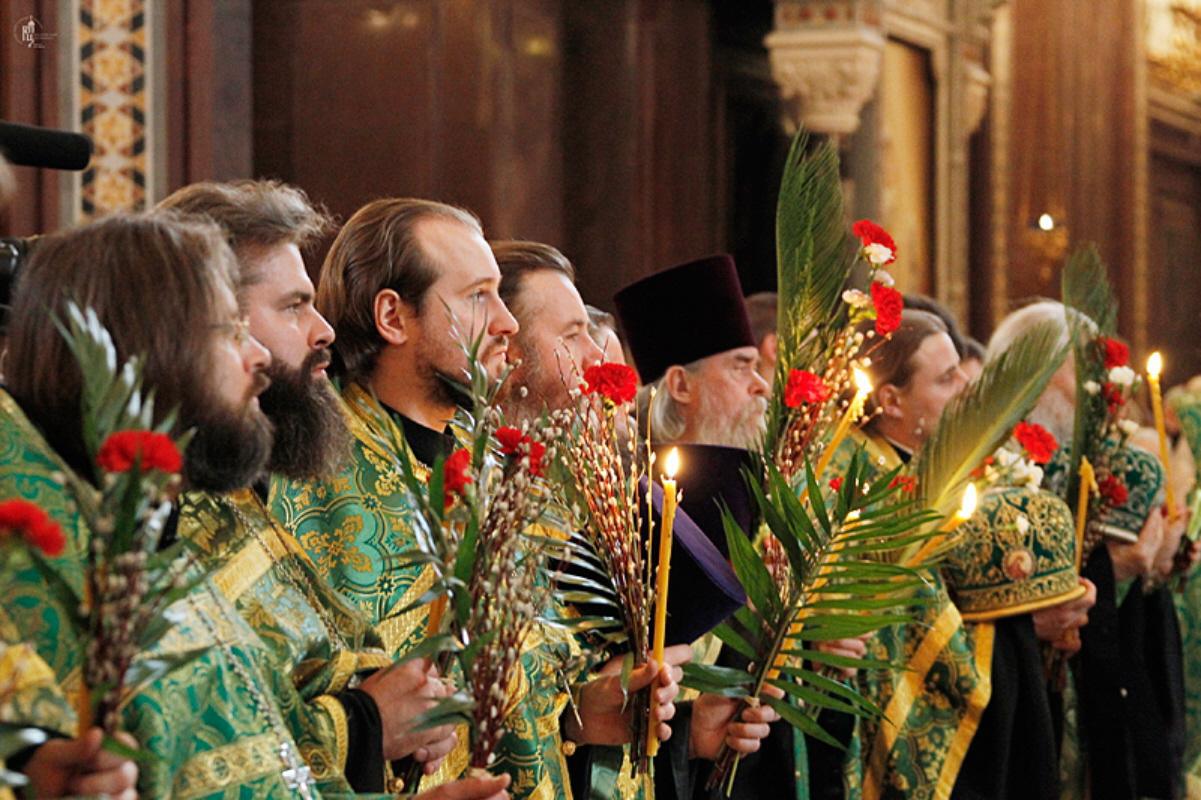
Palm Sunday in Moscow (2011); the clergy are holding festive bundles of palm fronds and pussy willows.
The Christian world celebrates Jesus’ emntrance into Jerusalem on the last Sunday before Easter(in the English speaking world) or PASCHA (most other traditional Christian cultures/languages) and this celebration of Jesus’ entrance into the Holy City is commonly called “Palm Sunday.” When Christianity came to northern and eastern Europe, no palms were available so the local plants which sprouted earliest were used in the celebrations. Even now, willows, osiers and weeping willows are consecrated on Palm Sunday in most of Central Europe and Eastern Europe.
In Lithuanian folklore, the osier — a kind of willow with male spores — was regarded as an unusual tree. Folklore tells that the osier grew out of a secretly murdered man. A fife made of osier wood, speaks in a man’s voice. Evil spirits avoid it because of its red color.
Many palm bunches have a branch of juniper in them. Juniper is green year round, with late ripening berries (which are used to flavor gin) and with a peculiar odor. Cranberry, mistletoe, filbert and oak branches together with dried baby’s breath and ferns are sometimes also used with the palms or willows. Pussy willows are especially common in the Eastern Orthodox churches. Among the Czechs and in the Baltic States, there is an old custom of whipping each other with the willows from church. Having returned home with consecrated fronds, one whips the head, back shoulders of those who stayed home, repeating all the time, ” illness out, health return”. The following words were spoken or sung, when striking with the palm:
“I am not the one striking
The Palm is striking
You are not in pain
The Palm is in pain
Soon it will be Easter!”
OR
“It is not I who is thrashing, but the rod
It will thrash until it breaks
The great day is in a week
It will entertain everyone
Remain the same as you have been
Be healthy as a fish.”
Lithuanian writings of 1573 say that to protect from devils and thunder, crosses were made from the consecrated palms and were thrust behind doors, windows and gated. Most often the palms were placed behind pictures of saints until the junipers dried and began shedding. The juniper branches are burned and these ashes, together with juniper sheddings, are placed in attics to protect roofs from storms. As thunder knocks, a palm is placed on the windowsill, on the side of the storm.
The smoke of a burning palm, scents all corners of the house and protects from thunder. Palms were nailed to beehives so that bees would swarm in great numbers. Palms were tied with colored, wooly yarns. This yarn was used to bind women’s wrists, to keep away pain. That was the most popular healing method during harvest work. Before animals were let out of barns in the spring, they were incensed with a burning palm. It was also said that if a palm was planted near water and it began to sprout, there would be no water shortage.
There are several other folk practices associated with the palms and willows:
1 – he who goes to church on Palm Sunday without a palm in his hands, the devil will shove his tail into the hands.
2 – collecting branches to make palms, select those with many buds. The more buds, the longer will be your life.
3 – if you plant consecrated palms on both river banks, when it is the end of the world and all waters vanish, there will be drinking water where the palms are growing.
4 – one should not comb hair on Palm Sunday, because fleas will grow to the size of the palm, or buds on the branches.
5 – if the palm lasts three years, then when black clouds cover the skies, take the palm and cross the clouds with it.
6 – old palms should be burned and their ashes sprinkled over cabbages, to protect them from worms.
Want to see my other blog posts and photos about Palm Sunday, willows, etc,? Click here and here.
The post Palms and Willows appeared first on Stephen Morris, author.


March 22, 2015
“Happy New Year?!” Lady Day 2015
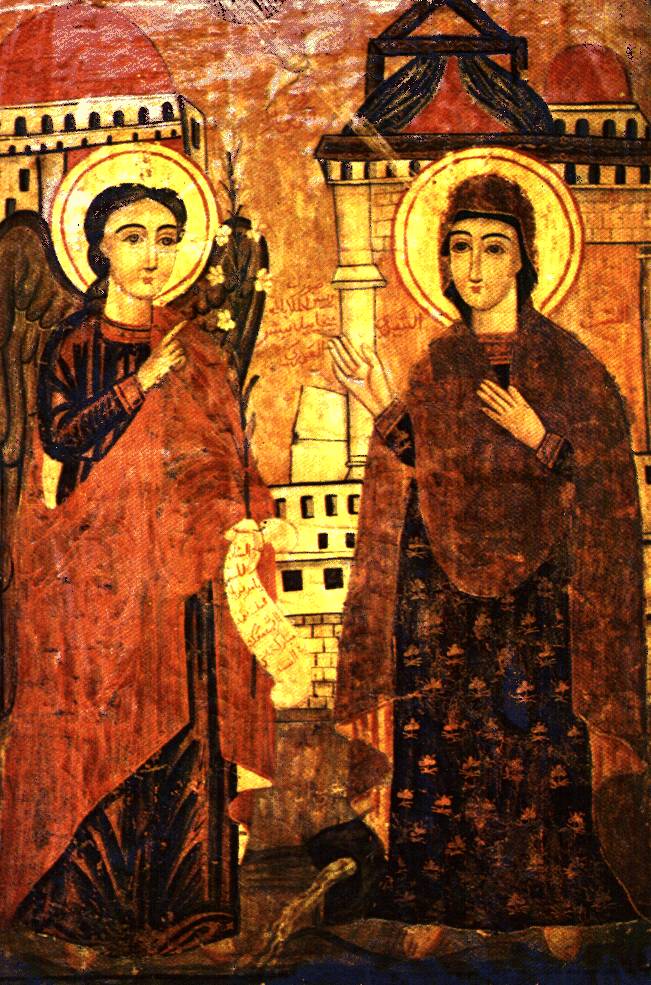
A Coptic icon of the Annunciation, showing the angel Gabriel presenting a lily as he announces the Incarnation to the Mother of God.
Lilies are often associated with the celebration of Annunciation. When Eve was driven from Paradise, lilies bloomed wherever her tears fell onto the earth and Gabriel presented lilies to the Virgin Mary when he announced that her Son would re-open Paradise to mankind. Other legends say that lilies blossomed from drops of milk from Hera’s breasts that fell upon the earth and that the lily was therefore the only flower with a soul. Lilies are traditionally considered to drive away ghosts and evil (esp. the Evil Eye) and can break love spells. The first lily of the season strengthens whoever finds it.
Roses are also associated with Annunciation and are used to cast love spells or in healing magic. If you plant roses in your garden, they are said to grow best if you have stolen the seeds from someone else and will then attract the faerie folk.
The Annunciation is celebrated on March 25 (the traditional date of the springtime equinox). Not only was Annunciation — and the equinox — vital to keeping track of time for secular purposes, many ancient and medieval authors claimed that the Annunciation/equinox date were vital at many points of salvation history: the birthday of Adam and the Crucifixion were said to have occurred on March 25 as well. Some also said that March 25 marked the fall of Lucifer, the parting of the Red Sea, as well as the day on which God said, “Let there be light!”
Sometimes called “Lady Day,” the Annunciation was kept as New Year’s Day in many places; the last to give up Annunciation as the New Year’s Day was England and its American colonies in 1752. The correct synchronization of the equinox with the Annunciation is a critical element in the calculation of the date of Easter and the medieval and Renaissance disconnect between the Annunciation and the equinox prompted Pope Gregory XIII to reform the calendar in 1582.
The post “Happy New Year?!” Lady Day 2015 appeared first on Stephen Morris, author.
March 16, 2015
Dead Things and Broken Souls

The Eric Carter trilogy by Stephen Blackmoore is one of the best series of urban fantasy on par with Dresden Files in its imaginative use of folklore, myth, and artistic creativity.
Eric Carter, a necromancer who not only sees dead people but can cross back-and-forth between the ream of the living and the dead and can cajole the dead in various ways, flees from Los Angeles to keep his family and friends safe from a gangster who is threatening him through them. But his sister is murdered and he returns to LA to find the killer and bring him (or her?) to justice. Discovering that the murder was not only horrific but magickal as well, Eric is forced to seek the assistance of Santa Muerte, one the goddesses of death. This assistance comes — of course! — with a hefty price tag which comes due in the second book of the series. (The third and final installment of the series is due out this July.)
I highly recommend the Eric Carter trilogy and suggest you pre-order the third book at the same time that you buy the first two so that you don’t miss out on the release of the culmination of Eric’s dealings with Santa Muerte and a whole host of gods and demons and ghosts who would like nothing better than to count him among their number!
The post Dead Things and Broken Souls appeared first on Stephen Morris, author.
March 9, 2015
Mother’s Day in Mid-Lent

Remember the smudges on the foreheads of so many people on the streets of Manhattan back on Ash Wednesday? I don’t think I’ve ever seen so many “Ashes-to-Go” stations out on the streets and corners of the city before. (One woman stopped me on a street in front of a church in the West Village which hadn’t opened yet and asked if I knew where she could get ashes. Luckily, I had just passed one such “ashes-to-go” station close by and was able to direct her to the corner of West 13th Street and Seventh Avenue to receive her annual reminder “that [we] are dust and unto dust shall [we] return.”)
How many promises to foster better habits and resolutions to give up something detrimental have fallen by the wayside now that we are approaching the mid-point of Lent? One custom associated with mid-Lent that will surprise most North Americans is that the Sunday which marks mid-Lent (this year it’s March 15) was traditionally treated like “Mother’s Day” in medieval Europe — and still is in the UK! On this mid-Lent Sunday, grown children would be expected to visit with and give roses to their mothers. (In connection with this, the Pope would often send a golden rose to a monarch who had been especially supportive of the Church during the past year. Henry VIII received such a golden rose, shortly before his break with the papacy over his divorce of Catherine of Aragon.)
The liturgical texts for this Sunday spoke of the heavenly Jerusalem as the mother of all believers. Fasting and ascetic disciplines were relaxed on this day and rose-colored vestments were worn instead of the purple vestments worn on the other days of Lent. Following this brief “vacation” from Lent, the festivity of this “Mothering Sunday,” fasting and discipline could be taken up again. It was an opportunity to try again at keeping lenten resolutions that had perhaps already fallen by the wayside.
It’s still a good day to get back to whatever good intentions we may have started Lent with — giving up a bad habit, exercising more self-control over a problematic area of our lives — as well follow J.K. Simmons’ advice at this year’s Oscars ceremony: “Call your mom, call your dad. If you’re lucky enough to have a parent or two alive on this planet, call ‘em. Don’t text. Don’t email. Call them on the phone. Tell ‘em you love ‘em, and thank them, and listen to them for as long as they want to talk to you.”
The post Mother’s Day in Mid-Lent appeared first on Stephen Morris, author.
March 3, 2015
New werewolf book is in the works

In WOLFBANE, Alexei inherits his grandfather’s magical wolf-pelt and thereby assumes the position of village “metsatöll” (Werewolf) in rural late 1880s Estonia to protect the area by fighting the terrible storms in the sky that could devastate the farms and fields. But he breaks the terms of the wolf-magic and loses the ability to control the shapeshifting, becoming a killer. Heartbroken at what he has become, Alexei flees his home in hopes of finding an enchanter who can free him from the curse.
My short story/novella Wolfbane was released in August 2013. One customer review on Amazon posted, “An interesting new twist on werewolves… I can’t wait to see where he takes us now.”Although I had hoped to release a full-length novel featuring Alexei by the end of 2014, another project took my attention but I now have the time to come back to Alexei. I have begun the research and planning necessary for the novel and have written two chapters in Alexei’s unfortunate series of adventures which will take him through Latvia, Lithuania, and Poland or Slovakia and Bohemia. Although these are now individual nation-states, there had been unions of Estonia-Latvia and Latvia-Lithuania dating from the Middle Ages, making for broad sweeps of common cultural heritage(s). There is a wealth of fascinating folklore and history to draw on from these regions which, combined with the social upheavals of early industrialization during the 1800s, promise exciting twists and turns as Alexei makes his way in search of liberation and redemption.
The post New werewolf book is in the works appeared first on Stephen Morris, author.
February 24, 2015
Best Selling Book Genres
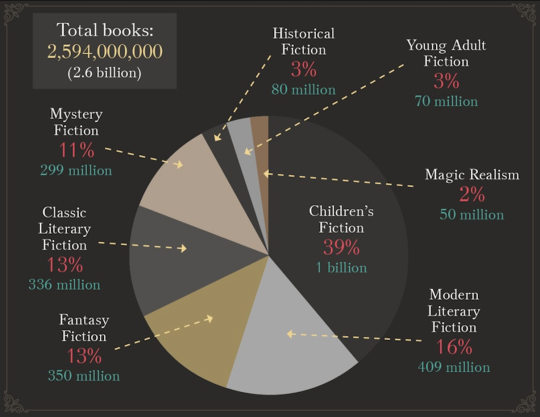
Best selling book genres illustrated
I found this chart online and thought it illustrated a fascinating breakdown of the book markets. The best selling genres are clearly presented and if one has a crossover title — a book that appears in two or more categories, such as the Harry Potter books are both “fantasy” and “children’s fiction” — then a runaway bestseller is more likely. Where does Come Hell or High Water fall in this pie chart? Well, there’s “historical fiction” as well as “fantasy fiction.” So maybe that New York Times bestseller list isn’t so far away, after all!
The post Best Selling Book Genres appeared first on Stephen Morris, author.
February 16, 2015
Nimrod
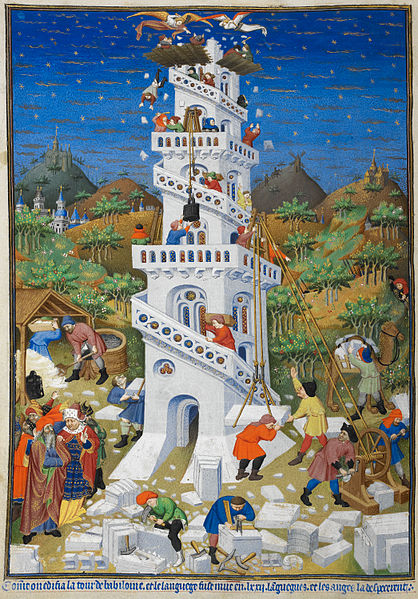
Building of the Tower of Babel, manuscript illumination from approx. 1410 (British Library Add MS 18850 f17v)
The constellation Orion, also identified in some folkloric traditions as Nimrod, is seen most clearly in the night skies of the northern hemisphere from January-March each year. Also, with the approach of Ash Wednesday and the beginning of Lent, Nimrod appears in classical Christian hymnography and sermons as one of the archetypal images of opposition and rebellion against God.
In Hebrew and Christian tradition, Nimrod is considered the leader of those who built the Tower of Babel in the land of Shinar, though the Bible never actually states this. (The illumination above shows Nimrod supervising the construction of the Tower of Babel in the lower left corner.) Nimrod’s kingdom included the cities of Babel, Erech, Accad, and Calneh, all in Shinar. (Genesis 10:10) Therefore it was likely under his direction that the building of Babel and its tower began; in addition to Flavius Josephus, this is also the view found in the Talmud and later midrash such as Genesis Rabba. Several of these early Judaic sources also assert that the king Amraphel, who wars with Abraham later in Genesis, is none other than Nimrod himself.
Judaic interpreters as early as Philo and Yochanan ben Zakai (1st century AD) interpreted “a mighty hunter before the Lord” (Heb. : לפני יהוה, lit. “in the face of the Lord”) as signifying “in opposition to the Lord.” Some rabbinic commentators have also connected the name Nimrod with a Hebrew word meaning ‘rebel’.
The historian Josephus wrote:
Now it was Nimrod who excited them to such an affront and contempt of God. He was the grandson of Ham, the son of Noah, a bold man, and of great strength of hand. He persuaded them not to ascribe it to God, as if it were through his means they were happy, but to believe that it was their own courage which procured that happiness. He also gradually changed the government into tyranny, seeing no other way of turning men from the fear of God, but to bring them into a constant dependence on his power. He also said he would be revenged on God, if he should have a mind to drown the world again; for that he would build a tower too high for the waters to reach. And that he would avenge himself on God for destroying their forefathers.
Now the multitude were very ready to follow the determination of Nimrod, and to esteem it a piece of cowardice to submit to God; and they built a tower, neither sparing any pains, nor being in any degree negligent about the work: and, by reason of the multitude of hands employed in it, it grew very high, sooner than any one could expect; but the thickness of it was so great, and it was so strongly built, that thereby its great height seemed, upon the view, to be less than it really was. It was built of burnt brick, cemented together with mortar, made of bitumen, that it might not be liable to admit water. When God saw that they acted so madly, he did not resolve to destroy them utterly, since they were not grown wiser by the destruction of the former sinners; but he caused a tumult among them, by producing in them diverse languages, and causing that, through the multitude of those languages, they should not be able to understand one another. The place wherein they built the tower is now called Babylon, because of the confusion of that language which they readily understood before; for the Hebrews mean by the word Babel, confusion …
Nimrod, the great hunter, is also said to hunt the newborn Abraham and attempt to slay him, much as Herod slew the infant boys of Bethlehem in an attempt to slay the infant Christ. Nimrod has thus remained in both Jewish and Islamic tradition an emblematic evil person, an archetype of an idolater and a tyrannical king, and often called “Nimrod the Evil.”
The post Nimrod appeared first on Stephen Morris, author.
February 9, 2015
“Love is a Many Splendored Thing!”
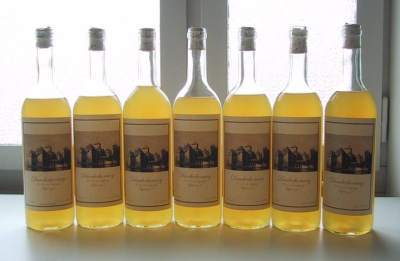
It was a Norse custom to give a newlywed couple enough mead (i.e. honey wine) to last for a month. Hence, our term “honeymoon” ti describe the first weeks of marriage.
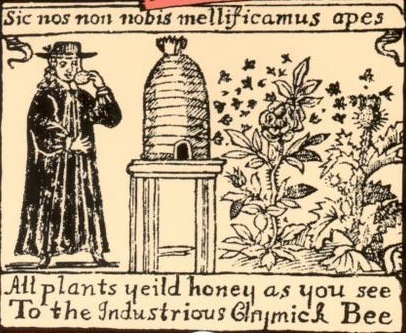
Collecting the honey to make mead or use to preserve/sweeten food.
With the modern celebration of Valentine’s Day nearly upon us, can thoughts of love magic be far behind? A number of traditional ways to win another’s heart have been used over the years. One way a woman could win a man’s heart was by feeding him food into which she had mixed some of her own blood (menstrual blood was especially effective). Catching the reflection of mating birds in a mirror on Thursday was the first step in a more complicated love spell. After catching the reflection, a person would give the mirror to his or her chosen and once the receiver looked into the mirror, they would be irresistibly infatuated with the mirror-giver. Or a woman might resort to the much more simple use of caraway seeds, cloves, or coriander to win the affection of the man she had chosen. One English love potion included the kidney of a rabbit, the womb of a swallow, and the heart of a dove while an ancient Greek love potion used a stallion’s semen or a mare’s vaginal discharge.
Garlic, saffron, ginger, or even vanilla(!) were more likely to be used in erotic magic, which was less concerned with affection, and more likely to be aimed by men at women. Wax images could be pierced by pins to incite lust. Striking the intended with hazel or willow branches was also thought to inspire lust. Or you could obtain a few hairs from your intended’s head, tie them in a knot with twine, and then keep the amulet on your thigh or around your genitals to draw your intended’s attentions.
Of course, there were ways to deflect this sort of magic as well. Lily or lettuce could break love spells or decrease lust and thwart unwanted attentions. Just be sure not to confuse which herbs you feed to which guest at your table!
The post “Love is a Many Splendored Thing!” appeared first on Stephen Morris, author.
February 1, 2015
Candlemas, 2015
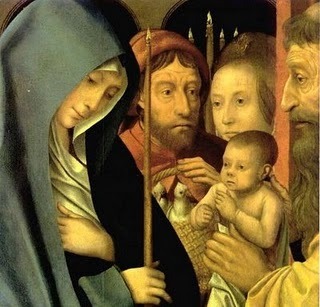
Marking the 40th day after Christmas, Candlemas celebrates the triumph of light/spring over darkness/winter. Candles blessed on this day were among the most powerful talismans available to ordinary folk in the Middle Ages.
Candlemas, the name taken from the custom of blessing the year’s supply of candles on this day, is the 40th day after Christmas and marks the day Jesus was brought into the Temple by the Mother of God and acclaimed by the elder Simeon as “the light of revelation to the Gentiles and the glory of … Israel.” He also told the Mother of God that a sword would pierce her own heart during the ministry of her Son.
Candlemas, attached to the older feast of Imbolc and the quarter-day between Winter Solstice and Vernal Equinox and thus marking the first day of spring, was even more popular than Christmas in many areas (such as those under the influence of Byzantium and Byzantine Christian culture). People would flock to the churches to obtain the candles blessed on this day as the power of these candles to dispel darkness, death, illness, demons, and nearly anything else that might be considered dangerous to humans was widely reputed to make them the most powerful weapons in the medieval arsenal against evil.
It was also common in western Europe for new archbishops or other leading churchmen to receive their pallium (the “stole,” a vestment similar to a scarf that drapes around the shoulders) on this day, woven from wool sheared from lambs on St. Agnes’ day (January 21). But Pope Francis announced last week that this year the new archbishops will instead be invited to Rome for the feast of SS. Peter and Paul in June (better weather than January?) and then be given their pallium back home by the local papal nuncio.
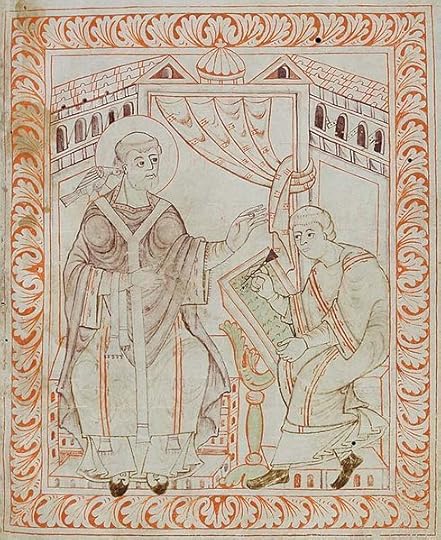
10th century illumination of St. Gregory the Great wearing his pallium.
[The post Candlemas, 2015 appeared first on Stephen Morris, author.
January 26, 2015
Imbolc, the First Day of Spring? And Groundhogs!

Blackthorn blooming at Imbolc.

Snowdrops at a creek announce Imbolc. The first blooms of snowdrops or blackthorns or the first birth of the new lambs were often considered the announcement of Imbolc’s arrival. (photo by Tony Eaglehart)
Although #Blizzard2015 might make it hard to believe, the Celtic — and magical! — festival of Imbolc, celebrated February 1-2, was considered the first day of spring in Celtic cultures and across Europe in general during the medieval period. Although we nowadays generally consider the solstice or equinox the first day of a season (December 21 as the first day of winter, March 21 as the first day of spring, June 21 as the first day of summer, and September 21 as the beginning of autumn), those days were previously considered the mid-seasons. (That is why we can sing Christmas carols about “midwinter” in December and have Midsummer night dreams in June!) The traditional changes of the seasons were the “quarter days” which marked the midpoints between the mid-seasons. So we get the Celtic/magical festivals of Samhain (October 31, the first day of winter), Imbolc (February 1-2, the beginning of spring), Beltane (May 1, the first day of summer), and Lammas (August 1, the beginning of autumn).
Because Imbolc is the beginning of spring, it is often associated with various means of predicting the coming weather which is so crucial during the planting season of agricultural societies. Hence, we consult the groundhog to determine if he sees his shadow or not in order to know if cold and snow will last another six weeks or not. In Serbia, a bear who wakes from his hibernation to stumble out of his cave and see his shadow will know whether to go back to sleep for another six weeks or not, based on whether he sees his shadow.
Imbolc was believed to be when the Cailleach—the divine hag of Gaelic tradition—gathers her firewood for the rest of the winter. Legend has it that if she wishes to make the winter last a good while longer, she will make sure the weather on Imbolc is bright and sunny, so she can gather plenty of firewood. Therefore, people would be relieved if Imbolc is a day of foul weather, as it means the Cailleach is asleep and winter is almost over. At Imbolc on the Isle of Man, where she is known as Caillagh ny Groamagh, the Cailleach is said to take the form of a gigantic bird carrying sticks in her beak.
The post Imbolc, the First Day of Spring? And Groundhogs! appeared first on Stephen Morris, author.