Stephen Morris's Blog, page 43
June 8, 2015
Wedding Magic: Cranes
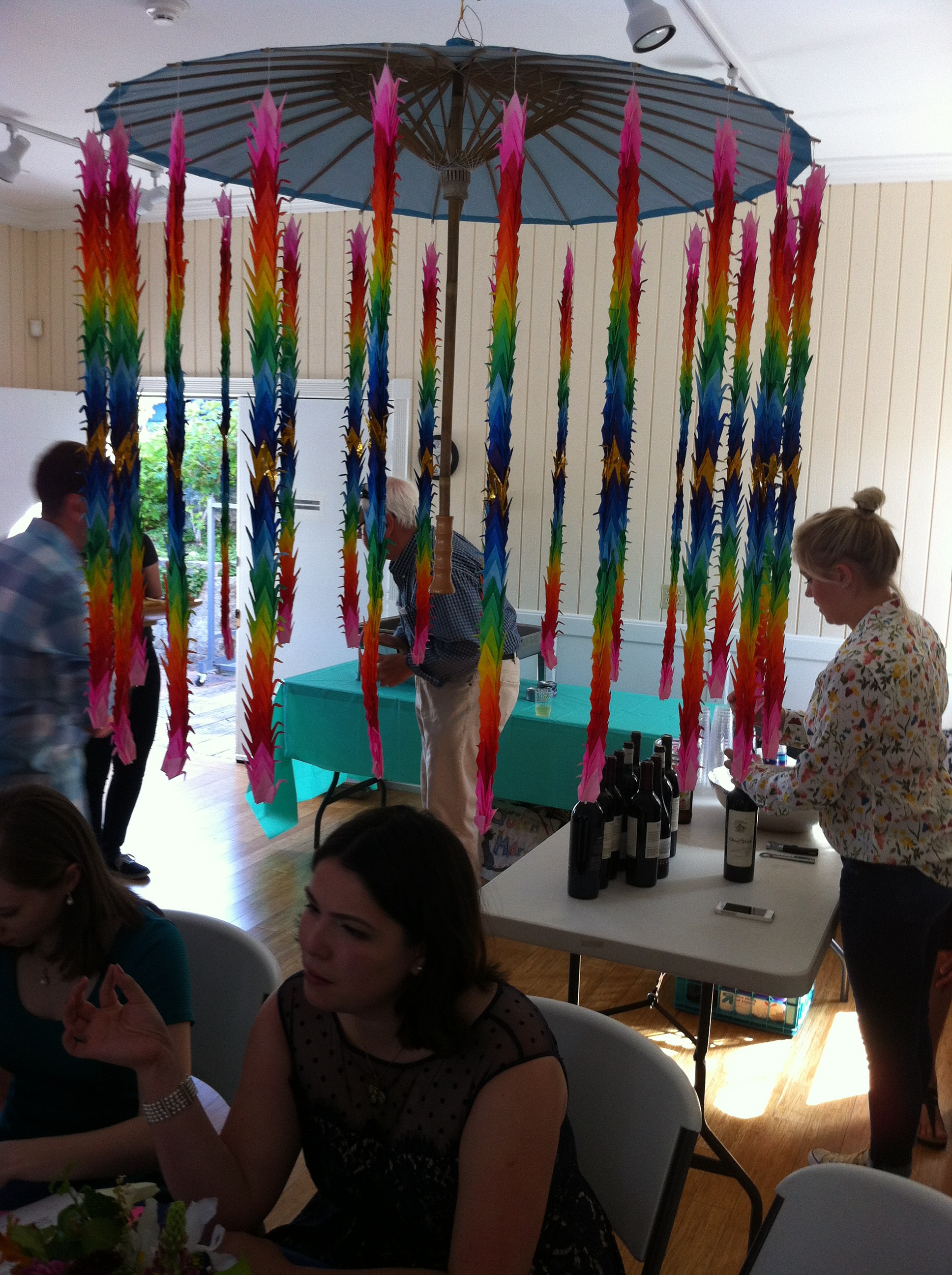
My niece sitting beneath the umbrella adorned with 1,000 paper cranes at her wedding rehearsal dinner.
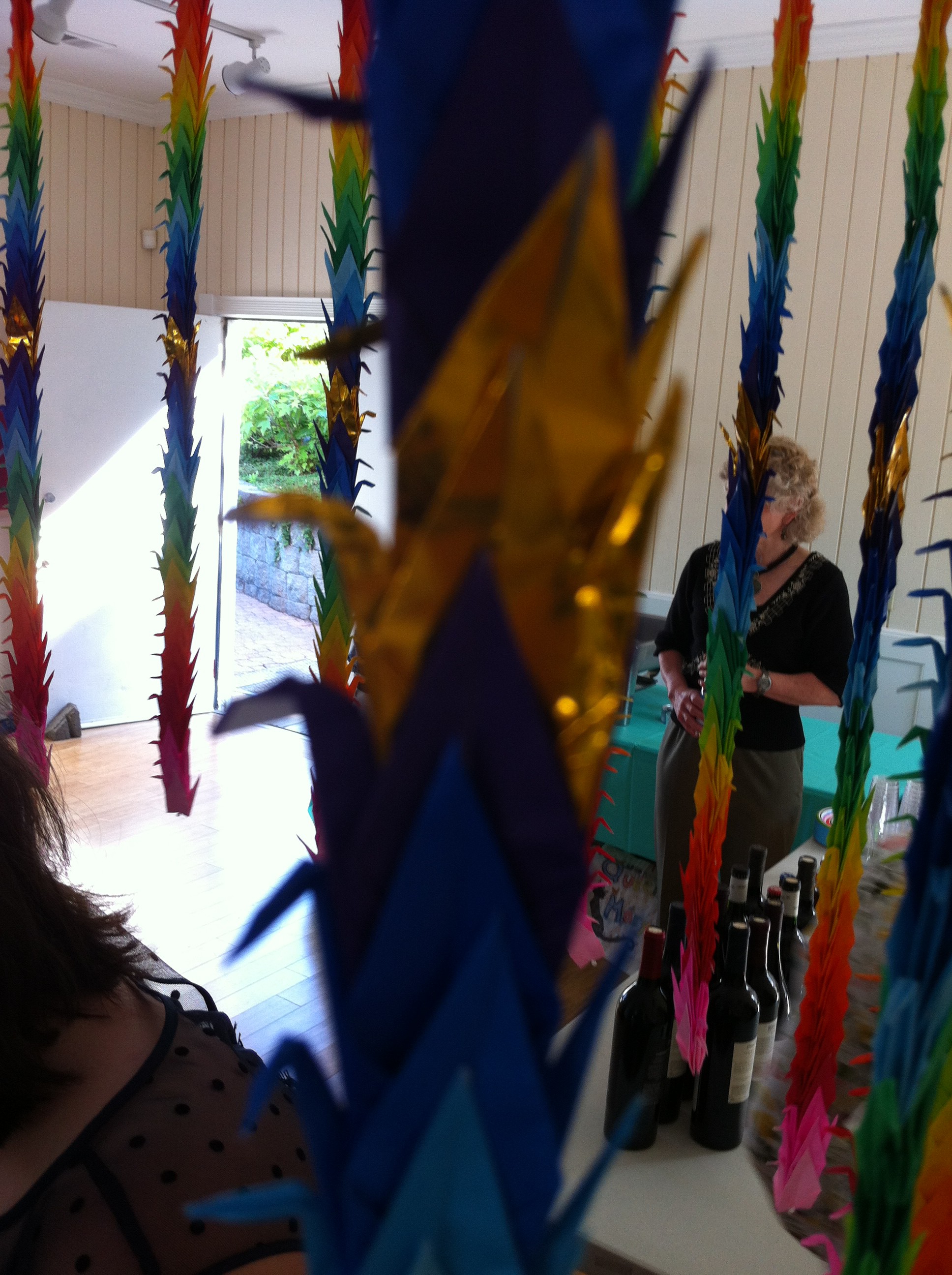
A close-up of the 1,000 origami cranes my niece and her new husband folded for their wedding.
I was thrilled and honored to attend the recent wedding of my niece in Seattle. As part of the festivities, she and her husband-to-be had folded 1,000 origami cranes to display at the rehearsal dinner and wedding reception.
Why 1,000 origami paper cranes? An ancient Japanese legend promises that anyone who folds a thousand origami cranes will be granted a wish by a crane. Some stories believe you are granted eternal good luck, instead of just one wish, such as long life or recovery from illness or injury. This makes them popular gifts for special friends and family. The crane in Japan is one of the mystical or holy creatures (others include the dragon and the tortoise) and is said to live for a thousand years: That is why 1000 cranes are made, one for each year. In some stories it is believed that the 1000 cranes must be completed within one year and they must all be made by the person who is to make the wish at the end. Cranes that are made by that person and given away to another aren’t included: All cranes must be kept by the person wishing at the end.
Although the thousand paper cranes are traditionally given as a wedding gift by the father, who is wishing a thousand years of happiness and prosperity upon the couple, in this case my niece and her husband made the cranes themselves (in alignment with the custom that the cranes must be made by the person receiving the wish). Cranes can also be given to a new baby for long life and good luck. Hanging them in one’s home is thought to be a powerfully lucky and benevolent charm.
A hearty “Congratulations!” to Mary and Erik and may the 1,000 cranes bring all the prosperity and good fortune any couple could hope to receive!
The post Wedding Magic: Cranes appeared first on Stephen Morris, author.


June 1, 2015
 Stephen Morris, author
May 25, 2015
Pentecost Greens
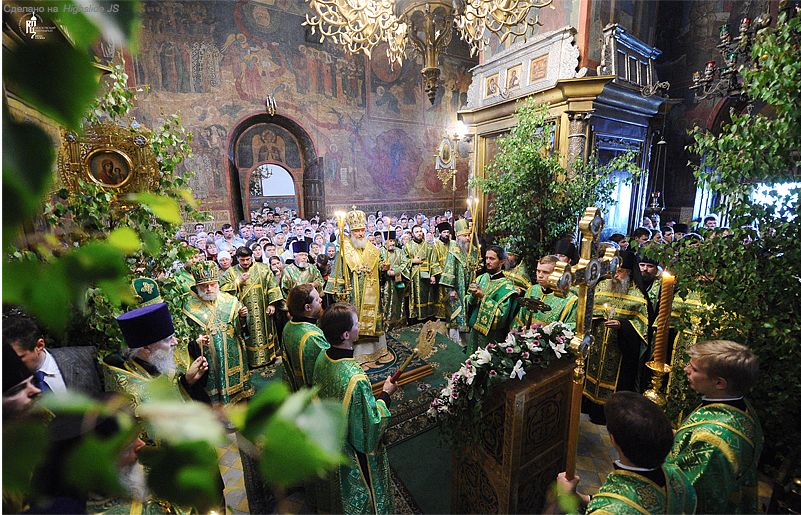
This celebration of Pentecost in Moscow shows the green vestments and the green branches decorating the church.
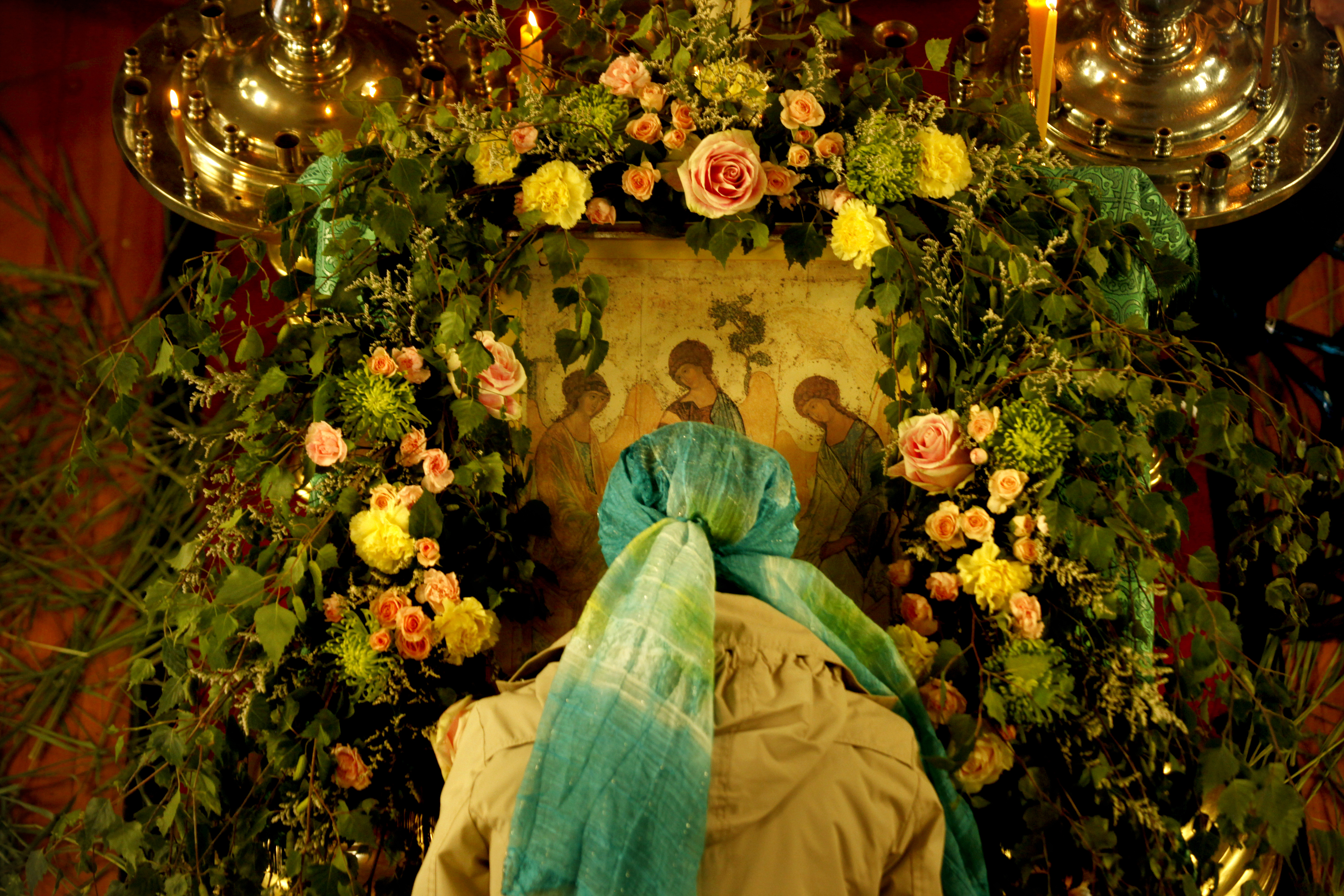
A woman, wearing a green headscarf, venerates the Pentecost icon adorned with greens and flowers.
In the Eastern Orthodox Church, Pentecost is one of the Great Feasts and is second in rank only to PASCHA, the Easter/Resurrection Sunday. Orthodox churches are often decorated with greenery and flowers on this feast day, and the celebration is intentionally similar to the Jewish holiday of Shavuot, which celebrates the giving of the Mosaic Law.
In the Orthodox Tradition, the liturgical color used at Pentecost is green, and the clergy and faithful carry flowers and green branches in their hands during the services.
Green week (Зелёные Святки, also known as Семи́к – Semik) is an ancient Slavic fertility festival celebrated in early June and closely linked with the cult of the dead and the spring agricultural rites. It usually fell upon the Thursday of the Green Week (better known as Trinity Week in Russia and the Whitsuntide week in Great Britain).
The Rusalki were (water nymphs) believed to be at their most dangerous during the Green Week (Russian: русальная неделя), and were supposed to have left their watery depths in order to swing on branches of birch and willow trees at night. Peasant women sometimes hung offerings to appease them. A cross, a magic circle, incense, garlic, wormwood, a pin or poker and verbal charms were used to render the rusalki harmless. Swimming was strictly forbidden, lest mermaids would drag the swimmer down to the river floor.
On Semik, funeral services were held for those who had not received a proper burial. Peasants decorated the insides and outsides of their houses with birch branches, and they selected a birch tree to decorate with ribbons and beads. The birch was usually left in the forest, but was sometimes brought into the village. The birch (referred to as “semik”, just like the holiday itself) was seen as a symbol of vegetative power and stood as a focal point for girls’ singing and dancing. Vows of eternal friendship were made here. Like Kostroma during Maslenitsa (the “Butter Week” before Great Lent begins), this fertility symbol was destroyed at the end of the festivities. Usually, it was drowned “in order to provide the needed rainfall for the sprouting crops”.
There is a similar holiday celebrating Pentecost in Romania, called Rusalii. Also in Germanic tradition there is a similar tradition, for example, Pfingstbaumpflanzen in Germany.
For more about Eastern European folklore about Pentecost, see The Dancing Goddesses: Folklore, Archaeology, and the Origins of European Dance, by E. J. W. Barber on Google books.
The post Pentecost Greens appeared first on Stephen Morris, author.
May 18, 2015
Ascension Day, Part 2
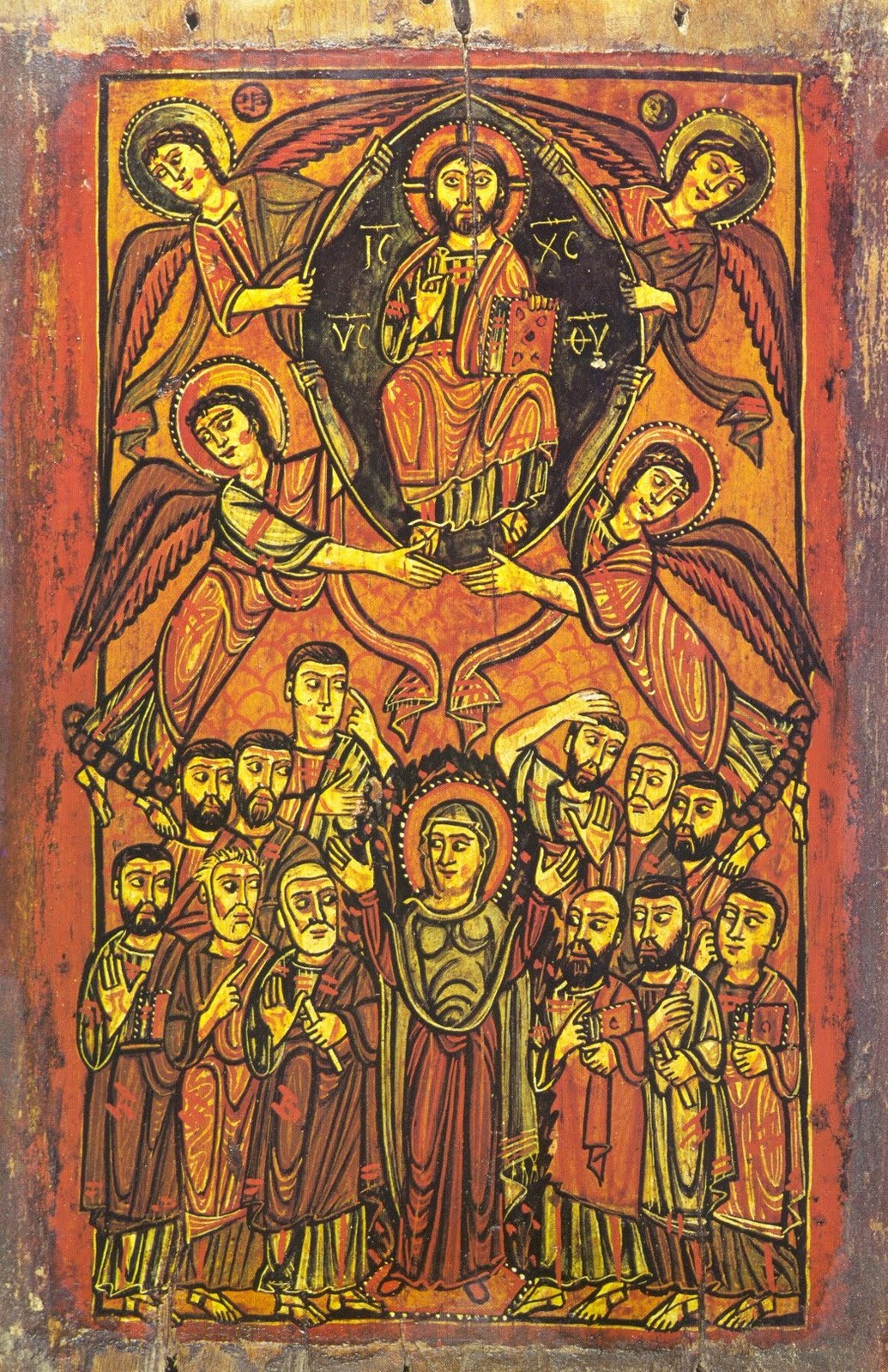
Icon of Ascension Day, showing Christ enthroned in glory above with the apostles and Mother of God below. The Ascension icon can also be viewed as an image of Christ coming at the end of time to judge the world.
Ascension Day is an important day in the church calendar and in the rural, farming calendar as well. It is also an important day among the Pennsylvania Dutch (The Pennsylvania Dutch, commonly called “Amish,” maintained numerous religious affiliations, with the greatest number being Lutheran or Reformed, but many Anabaptists as well.)
Among the Pennsylvania Dutch sewing on Ascension Day is strictly forbidden. Other work of many kind, especially farm work, is also eschewed. Lightning has been reportedly striking those sewing or working on Ascension Day. Rain water from an Ascension Day storm is thought to cure eye and vision problems if used to wash the eyes with. Not only does rain fall and thunder rumble down from the heavens above, these are generally associated with Thursdays; as Ascension is always a Thursday, making the 40th day after Easter, thunder came to be associated with Ascension as well. (The Pennsylvania Dutch name for “Thursday” is a variant of the word for “thunder.”)
Reportedly in Bulgaria the grandmother of each family will go to the cemetery on Ascension Eve and lays face down atop the grave of the most recently deceased family member. She prays there a while for that family member and for all the deceased ancestors, following which she nicks her left breast (above the heart) and lets a few drops of blood fall onto the grace to feed the ghost(s) and bring blessing to the deceased for another year. Happy ancestors will bring fertility and good luck to the family, their farms and farm animals until the next Ascension Day.
For more, see the excerpts from Eastertide in Pennsylvania: A Folk-Cultural Study.
The post Ascension Day, Part 2 appeared first on Stephen Morris, author.
May 15, 2015
 Stephen Morris, author
May 11, 2015
Ascension Day: “Beating the Bounds”
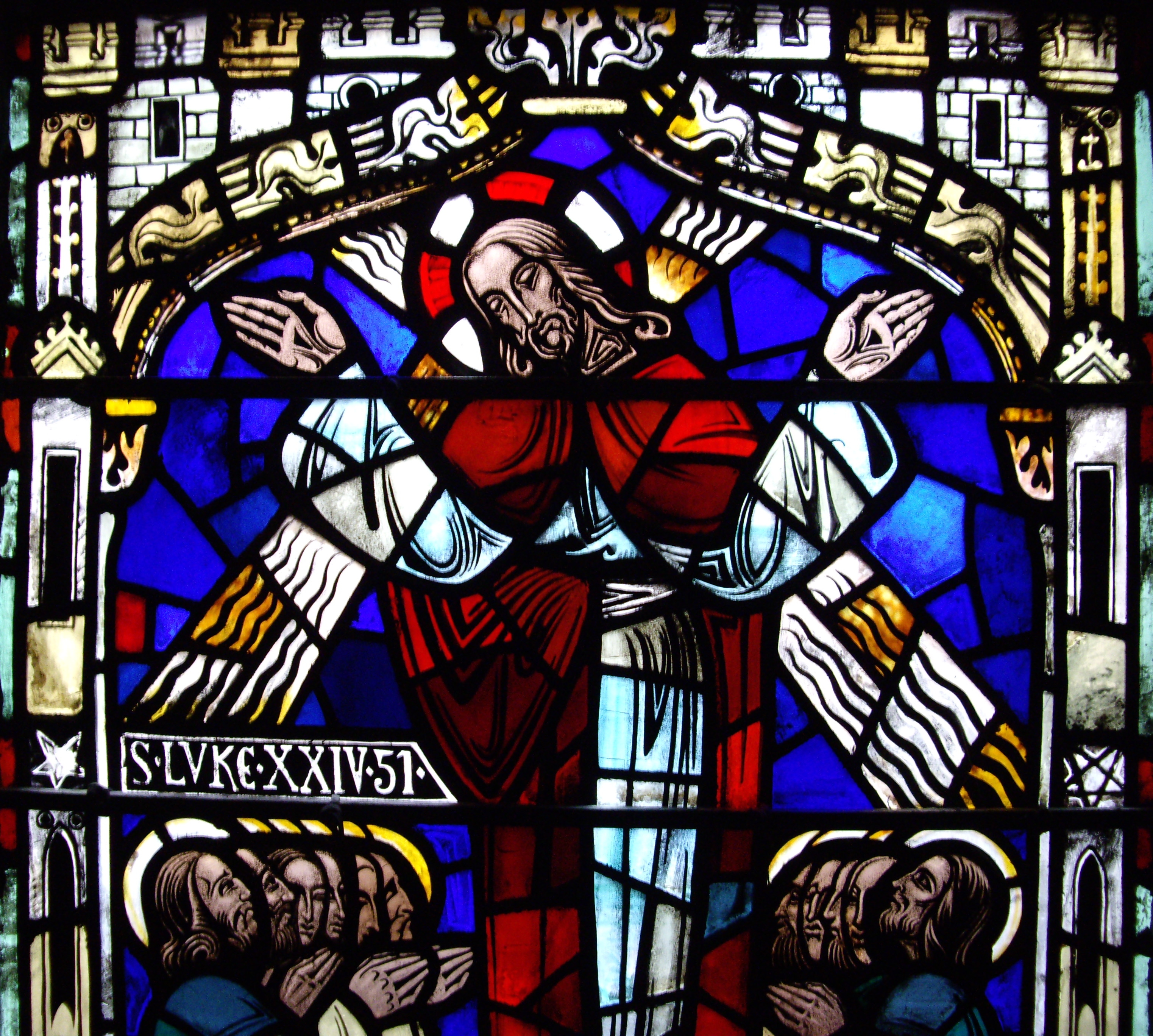
Ascension Day, celebrated on the 40th day after Easter, is always a Thursday and marks the last post-Resurrection appearance of Christ to the apostles.
Ascension Day was a vital day in the pre-modern and agricultural cultures of Christian Europe. In many places it marked the beginning of the ploughing and planting seasons and in England there were processions to ask for God’s blessing on the crops to be planted. These processions often included “beating the bounds,” a practice in which young men would be led around the boundaries of each local farm and their backs lightly beaten so as to impress upon them where the limits of each farmer’s lands were; beating the boys’ backs helped stamp the landmarks and boundaries of each field into the boys’ memories so that any future disputes between farmers could be resolved by asking the boys what they remembered of the processions.
Some parishes continue the custom (e.g. the church of St Michael at the North Gate in Oxford). Today members of the parish walk round the parish boundaries, marking boundary stones (e.g. by writing on them in chalk) and hitting them — rather than the boys of the parish — with sticks. In addition to settling disputes between farmers, knowledge of the parish boundaries was once important since churches had certain duties such as the care of children born out of wedlock in the parish. One of the purposes served by beating the bounds was that of warning the young men of the parish that any sexual misbehavior ought to take place with women who lived outside the parish.
In Venice the ceremony of the Wedding with the Sea was traditionally celebrated on the Feast of the Ascension, while in Florence the holy day was observed by having a dove slide down a string from the high altar of the cathedral to ignite a large decorative container filled with fireworks in front of the main entrance of the cathedral.
There is a veritable treasure trove of folklore and folk practices associated with Ascension Day in the Encyclopedia of Superstitions, Folklore, and Occult Sciences, which you can read here. You can also read more in the very interesting study Eastertide in Pennsylvania which describes Pennsylvania Dutch customs.
The post Ascension Day: “Beating the Bounds” appeared first on Stephen Morris, author.
May 4, 2015
Near Record Set! 2nd Most Visited Day

We had the second-most visits ever on Friday, May 1, 2015! HUZZAH!
I was flabbergasted! I checked on the statistics for this site last week — who doesn’t like to know how often people are checking in and reading something you have to say? — and guess what? There were 135 visits to the site on Friday, May 1! That is the second most busy day we have ever had here at stephenmorrisauthor.com! The most popular post on May 1 was the one featuring the Lily of the Valley, the Folkloric “flower of the month” for May.
Another surprise was that 100+ of those visits on May 1 were from readers in France! 
What was the #1 most busy day, you might wonder? That was April 4, 2014 when we had 145 visits — only 10 more visits than last week! The most popular post on that day was the one about Emerald, the traditional birthstone/gem of May. May folklore certainly seems to be popular! (These two posts are generally among the most popular in the archives here but the daily visits rarely reach into the stratospheric heights recorded on April 4 last year and May 1 last week!
I also discovered last week that there are 78 readers who follow my blog through the Goodreads website. (That’s in addition to the 400+ readers who follow the blog via Facebook.) It was great to see how many people follow the blog through so many different venues. I’m amazed!
The post Near Record Set! 2nd Most Visited Day appeared first on Stephen Morris, author.
April 27, 2015
When Brothers Dwell in Unity

I have just learned that my study of Byzantine attitudes toward homosexuality, to be published by McFarland in the Fall-Winter of 2015, is now available for pre-order here!
As McFarland says on their site,
“In the world of early Byzantine Christianity, monastic rules acknowledged but discouraged the homosexual impulses of adult males. The admission of adolescent males as novices was forbidden. John Chrysostom, the archbishop of Constantinople (397–407), virulently denounced homosexuality but was virtually the only Byzantine cleric to do so. Canonical prohibitions of anal sex distinguish among eight possible sexual pairings, the most offensive being a husband-wife, the least offensive being two unrelated males. Other forms of male-male sex were considered little more than masturbation.
Penances traditionally attached to heterosexual sins—including remarriage after divorce or widowhood—have always been much more severe than those for a variety of homosexual acts or relationships. Just as Byzantine churches have found ways to accommodate sequential marriages and other behavior once stridently condemned, it is possible for Byzantine Christianity to make pastoral accommodations for gay relationships.”
I will be sure to let you know more as the release date gets closer!
The post When Brothers Dwell in Unity appeared first on Stephen Morris, author.
April 20, 2015
GO NOW! Prague Is Among the Cheapest Vacation Spots

Prague, currently among the cheapest vacation spots in Europe, is waiting for YOU!
Quick! Book your tickets! If you’ve read the Come Hell or High Water trilogy — one or all of the books — but have not seen Prague yet, NOW is your chance! The Prague Post reports that because of the strength of the US Dollar in currency markets, Prague is currently among the cheapest European vacation destinations in Europe. You can use the Come Hell or High Water books as guides to the local historical sites (the Old Town Square, the Little Town across the river, the spectacular Charles Bridge, the castle-cathedral complex of buildings — including Golden Alley — overlooking the city) as well as the WONDERFUL self-guided walking tours that I have links to on the lower right of my website home page.
I have never been disappointed by Prague’s beauty, no matter what time of year I arrived. This is your chance to stay in the Biskupsky Dum hotel (where Elizabeth, the Dearg-due killed a victim or two), walk along the Charles River (where both a tourist and an Evil Conference professor each met a bad end), and stand in the plaza at the apse-end of the cathedral where Svetovit was worshipped with the sacrifice of black roosters!
Or just bring me along with you as your private tour guide!
The post GO NOW! Prague Is Among the Cheapest Vacation Spots appeared first on Stephen Morris, author.
April 14, 2015
Rainbow Book Fair

The 7th annual Rainbow Book Fair, the oldest and largest LGBT book fair in the country will be held in New York City on Saturday, April 18, 20015. Come by my table to say “Hello!” if you’ve already read the Come Hell or High Water trilogy or come get an autographed book — or three!
See you there!
The post Rainbow Book Fair appeared first on Stephen Morris, author.