
C.P.D. Harris's Blog, page 53
February 11, 2015


February 10, 2015
Teaser Tuesday
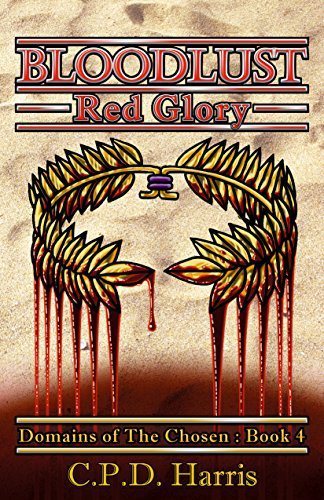
I am putting up the eBook for Bloodlust: Red Glory tomorrow on Amazon.com. That makes this the last Teaser Tuesday before release, which is an interesting feeling.
Let’s start with the advertising blurb.
FROM DEATH COMES OPPORTUNITY. WE WHO ARE ABOUT TO DIE SALUTE YOU.
��Across the ocean, in the furthest outpost of the Domains, a Chosen has fallen. As treachery and xenophobia threaten to spill over into war, an ancient covenant dictates that a great tournament must be held in order to replace him. As news reaches the heart of the empire, the machinations of the powerful are suddenly forced to a frenzied climax as each vies to influence the outcome of the Grand Championships. The Golden Laurels and the balance of power will go to the cunning and the strong.
Let the trumpets sound! Let the people cheer! Let the Gladiators clash! Onward to victory and red, red glory.
And here is a little snippet of the end.
And, at the heart of it all, flanked by the sky-piercing Obsidian spire of the Halls of the Chosen and the brooding mass of pillars and domes that is the Assembly of the Covenant, the Grand Arena stands watch over the People���s Square and its sacred Oathstone. The heart of the city is quiet now, for the first time in many months. The sands are clean and perfectly arranged, save for a small, ugly tree. The stands and private boxes are empty, though a few privileged stalwarts still gaze down from the Platinum Circle Lounge. Below the sands, in the bowels of the arena, creatures from all over the world snarl and slumber, awaiting blood and glory, while their attendants sigh and seek to recover from the great event.
But the arena, despite the quiet, does not rest. It waits. The seats yearn for the audience that will fill them. The arming rooms yearn for the Gladiators and the clatter of weapons that they bring. The white sands of the fighting grounds hunger for booted feet and for the blood that will follow. Above all, the Grand Arena, this temple of sport and battle, longs for the cheers, a half million voices raised as one, and for the cry of the trumpets, to be reborn at the call to red glory once more.
Wish me luck.


February 8, 2015
Understanding Red Glory
It looks like my next book, Bloodlust: Red Glory will be out in eBook format on Wednesday (or at least submitted to Amazon on that date, sometimes it takes a while for it to propagate). With that in mind, I will be concentrating on discussing and promoting the book for the next few days.
Red Glory is a return to a more unusual format. Readers of my books will be familiar with the basic structure from Bloodlust: A Gladiator’s Tale and Bloodlust: Will to Power, where each chapter is set around a match in Gavin Valcoeur’s career in the arenas of the Domains. Red Glory follows that basic structure, with most��chapters being centered around a match in the arena.
The disadvantages of that kind of structure are obvious: it requires a hell of a��lot of fight scenes, and such a rigid��structure can get in the way of narrative flow. However, many readers enjoyed the episodic, predictable build of the story moving from chapter to chapter almost like a TV series or a connected set of short stories. I decided to return to this for Red Glory, which is another story about the arena, but instead of following a single Gladiator, I follow six fighters seeking to win the ultimate prize.
At its heart Bloodlust: Red Glory is the story of an event. The Grand Championships themselves are a character in the story, at least that is how I see it.
After finishing Bloodlust: The Shield Maiden, I sat back and reflected on what I have wrought and written. The Grand Championships are barely covered in Bloodlust: Will to Power, despite being the pinnacle of the whole series. Gavin gets inserted into them purely through the will of the people and the manipulations of others. In the first books��the readers��only get to read about his��involvement in a single match in the whole event, and in the interludes where Sadira fights Karmal. In retrospect��those few chapters do not quite capture the epic scope of the Grand Championships.
Some events shape the societies that celebrate��them. The great religious pilgrimages. The state of the Union and massive election campaigns in the states. The moon landings. The Super Bowl, The Olympics, and the World Cup. Each of these events brings the��far flung reaches of the��civilizations that birthed them together, uniting even the most diverse peoples for a time. They also exhibit particular characteristics. The Olympics foster��a sense of fellowship through competition, bringing nations together through sport, but sometimes this competition becomes more than sport. Meanwhile the Super Bowl and the World Cup are rowdy, flashy events where the corporate sponsors are very much in evidence. These attributes give grand events a personality of sorts, which is something that��inspired me in Red Glory.
I have already written of how the Great Games are a violent collision of sport, hero worship, and politics. The enemies of the Domains are humble by its Gladiators in ritual combat. The Gladiators, in turn, perform to gain the favour of the people, which is the only way that any��Gifted��will ever be trusted enough to join the ranks of the Chosen.
But I felt the need to further characterize the games, to breathe life into the Grand Championships. The Grand Championships are the pinnacle of the arena, an event that defines the Domains of the Chosen. Bloodlust: Red Glory is the tale of this event. The Gladiators, the Chosen, and the Citizens, victors and victims both, are caught up in the tide of feverish expectation. Like all such events, the Grand Championships take on a life of their own, crushing some and bringing prosperity to others. It touches everyone, even those who are repulsed by the vicious underpinnings of the fighting grounds.��Defining this event in detail gives the reader a better idea of the culture of the Domains.
In the end I needed to write Red Glory to better define the Domains for the series to come. The Domains are modern in some aspects, and we all understand imperialism, but the bloodier aspects of the arena are harder for us to grasp. At the heart of it all lies the fear of the Reckoning, and the covenant that the Chosen made with the people of Krass to survive. Underneath all of the bread and circuses, what can we learn of them?


February 5, 2015
The Shadow Wolf Sagas: Blade Breaker 1.52
Thursday is here, our weekly toil is almost at an end (to be followed up by the weekend toil, no doubt), and tis time for some Shadow Wolf.
You know the drill.
Here is the first post: link
Here is last week’s post: link
Here is the guide: link
Lord Torvul’s ambitions died in the tunnels under the Old Port, a half forgotten ruin that just happened to house an old Waygate that he knew how to open. Some of his men escaped, but many of these fell victim to the other denizens of that lost realm. We took his head with us when we left, just to be sure. I tossed it in the sea as soon as the sun touched my face.
We did not leave our dead behind. It is a hard thing to climb out of such a place, with such a burden, but it can be done.
<>
Armed with the list that we had recovered from the alchemist Stazz and Sons we rounded up all of the people that the Devout were forcing to work for them. Murith used what she learned from questioning��these hapless souls to find where the Devoit had been lairing; a smugglers cave in a cove not far from the city. There were even a few of the bastards left in it when we got there, happily.
<>
Like Sapphire, the woman whose death had started my involvement in this, Madame Glorianna was laid to rest in accordance with the rites of the Sirutiran God, Kamesin Greeneyes.
The priest invoked the freedom of the steppe, the cries of the��eagle, and said that she would find her place in the blue sky. I found that oddly touching, and I hoped that it was true. Madame Glorianna had died bravely, choosing to end her life rather than being used as a shield by her enemy.
The visitation afterwards was attended by thousands. The entirety of the Doxies guild, save those slain in the Devout attack, turned out. The men and women, whores, bouncers, toyboys, and pimps looked sad and resplendent as they bid their leader goodbye. The twins were among them, tears hidden behind black lace veils.
In a show of solidarity the city watch turned out in their dress uniforms, Murith front and centre, and more than a few members of the Guild stood sentinel on the rooftops. It was touching.
<>
The body of Harald Magnison was set in a ship. When the sails caught the north wind, the ship was set free, given eave to run toward home. His eldest remaining son fired a burning arrow into the ship, setting it alight. I watched from the back of the crowd, tolerated but not acknowledged.
<>
I was there when Madame Glorianna’s will was read. The room was tense. After all, with Madame Glorianna gone��the��top spot in the Doxies Guild was open, and solidarity was wearing thin by then.
I was mostly there to support the Twins, who were considering making a play. I was not surprised, however, when my name was called. After all, Madame Glorianna was my first employer in the city, and she and I had an excellent working relationship.
She left me��a letter. The contents surprised me.


February 3, 2015
Teaser Tuesday
Tis Tuesday, and time for a little teaser from my upcoming book Bloodlust: Red Glory
���How illuminating,��� quipped Sapphire Kiss, darting forward. As she closed, she wove a grasping roots spell that snared White-Sands-Red���s foot. Then she whipped her Flying headcatcher in a downward arc. In spite of the hold on her foot, White-Sands-Red twisted out of the way and then parried the whirling back-swing. Snarling, Sapphire Kiss kept up her forward momentum, bulling into the Light-Elf and slamming her into the ground.
Primal Surge filled Sapphire Kiss with vitality, giving her a strength that White-Sands-Red simply could not match. On the ground they grappled, weapons forgotten, as Sapphire Kiss tried to apply the law of strength and crush her opponent. With a solid grip she could end it quickly. Unable to escape, White-Sands-Red summoned one of her spirit forms, allowing it to take hold of her. Her skin took on an iridescent sheen, fangs, popped from her mouth, and her hair began to writhe.
Holding her opponent by the throat, legs locked around her arms and torso, Sapphire Kiss drew the short sword on her belt, raising it for a downward thrust. As she did so, the transformation took hold of White-Sands-Red whose thick dreadlocks became serpents, which reared up and bit Sapphire Kiss, their fangs pumping venom into her. Despite the sudden assault she rammed the sword down. The sharp point thrust deep into White-Sands-Red���s shoulder. The snake-thing screeched and its mouths let go of Sapphire Kiss, who toppled to the side, vision blurring as the venom burned through her veins.
White-Sands-Red, now a serpent faced monstrosity, her head wreathed by long necked snakes, hissed triumphantly, only to stagger as the wound in her chest took its toll. Blood ran down her chest, dripping into the sand below.
Sapphire Kiss, her nerves aflame from the poison, rolled onto her stomach and pushed herself to her knees. Distantly, she heard the roar of the crowd and saw White-Sands-Red stumbling toward her. She still had her sword in hand. As White-Sands-Red closed on her she gathered her strength, gulping air and willing the poison to run its course.
This illustrates a few of the elements at work in Bloodlust: Red Glory. First off is the kind of silly trashtalking banter that I expect one would hear on the fighting grounds. It might seem cheesy, much like the chants, but it is the bread and butter of performance combat��like WWE and seems right to me. It also adds character to some of the fighters.
Next is broadening the types of magic. White-Sands-Red demonstrates a type of magic that I have not covered before called��Luminescence, which is basically light magic. The spells ��include blinding flashes, blasts of light like laser beams, and bending light to become almost invisible. It is somewhat less common that other forms, but I wanted to introduce it.
White-Sands-Red also uses spirit binding, a magic that she appropriated from The Pale. It is a form of magical imperialism ��(cultural appropriation of a mystical bent?) that the magic of their enemies has made its way into the hands of the Domains and is now practiced by one of its Gladiators whose arena persona is also that of a savage. Culture clash and imperialism are part of the broader themes of the series.
I’m hoping to have the book��very soon. The last edits are in and I am in the process of putting it together.


February 1, 2015
Reviews: Hegemony: Rome and Fury (the tank movie)

This weekend, in between bouts of editing Bloodlust: Red Glory and starting book five (not sure yet on the title) I finished a computer game that I have been playing for a little while called Hegemony: Rome and watched a movie called Fury, both of which interested me enough to write a review and comment on.
Spoiler Alert!
Fury
Fury is Brad Pitt’s latest venture, a old style war movie with modern sensibilities. Pitt stars as a tank commander with the monicker “Wardaddy”. Many people have compared this character to Aldo Raine from Inglourious Basterds. These people need to learn to spot nuance. Wardaddy is aggressive I suppose, but where Aldo Raine is gleefully and majestically murderous, it is fairly obvious that Wardaddy is very, very tired and just wants to do his duty and get his boys home alive. His boys in this case are the remainder of the tank crew that he has kept alive for the last three years of the war — a miracle of skill and luck, considering the difficulties faced by American tanks in WWII.
Fury starts just after��the loss of a member of that team. He is replaced by Norman, a clerk who is misplaced and sent to join these hardenned veterans.
There is a wonderful scene near the beginning of the movie where the crew is driving back into camp. The weariness on their faces is reminiscent of the old photos that I poured over as a tank obsessed child. I could not understand that look then, but I can fathom it now. It is the look of someone who has just gone through a mile of hell and realizes that they have to get up and go through it all again the next day and the next until the war is done or they are dead. It was nicely conveyed.
The best scene of the movie is when four sherman tanks come face to face with a Nazi tiger. The odds of a Sherman tank defeating a tiger in such a confrontation were historically unfortunate, requiring that the allies expend several tanks for each kill. ��Fury takes that ugly fact and turns it into a tense, brutal scene. You get a real sense of the desperation of such an uneven battle, right up until the point where the crew of Fury get close enough that they can outmanoeuvre the German behemoth and score a direct hit on the weaker rear armour. These are actual tactics from tank battles in the period, recreated and not glorified. I loved the scene.
Fury is full of well crafted scenes, including a tense conversation between the lads and two German women and several brutal battles against German infantry and anti-tank weapons. They all hold together well.
The plot of Fury is pretty understated. It reminds me a great deal of modern fantasy. Wardaddy tries to accommodate Norman to the realities of war while keeping his crew alive. The tank crew manages a stall a German advance at the cost of their own lives. Norman manages to survive, but when his told he is a hero he looks more confused than anything. The last shot of the film is him looking back at the tank that they all fought and died to protect. Wardaddy called it home. It is poignant and yet somehow transcends the usual tear-jerking male glory that I get out of war movies, leaving me thoughtful instead of emotional.
I would heartily recommend Fury to anyone who has an interest in tanks, or wants to see a war movie that does not come off as simple action porn.
Hegemony: Rome
I picked up Hegemony Rome in steam early access because I loved ��the��Hegemony Gold game. Hegemony Gold was a slower paced, thoughtful RTS that included a supply chain logistics system that gave it a unique feel. When I first played the new game��wasn’t optimized then so I let it sit for a while. I gave it another try in the new year and found that it is now is now decently polished, and optimized.
The Hegemony series is in antithesis of the dominant form of RTS (Starcraft Style). It is a slow playing ballet that builds over hours where a handful of units can have a large impact and a single raid can cause problems for an unwary empire. The way supply and manpower are handled in this series is brilliant, creating a very thoughtful style of gameplay that I would love to see more often.
The bigger your empire, the more difficult it is to protect it, and manage getting the needed food and manpower to the right place.
The four story campaigns follow the career of Caesar in Gaul in exacting detail. You will invade Britain, you will cross the Rhine, and you will see your province torn apart by rebellion. By the end of it you will feel like you have conquered the place yourself, and maybe feel a little shell shocked at having to deal with pesky raiders constantly picking at your flanks.
The game is by no means perfect. If you are not a patient gamer, or a thoughtful exploiter of gaming systems you may not enjoy it. The scope of the game might have been a little too ambitious for such a small studio, and it occasionally falls apart. It is slow to start, but that humble beginning only lets you appreciate the epic scope once you get there.
Pros
-Supply lines and manpower mechanics define how the game is played. Raids can be devastating, and concentrating an entire army in one place will often cause you to lose as you run out of food or your empire is picked apart by raiders.
-New Experience System lets you specialize Legions, and even promote officers from veteran legions to��generals which you can assign to any legion. In this way you can use your best Legions as a sort of officer school to power up other units. It is kind of awesome.
-Flanking and positioning make an enormous difference.
-You can built forts and bridges, and customize cities.
Take it or Leave it
-Siege warfare is brutal. Better plan it out.
-Naval Warfare can be finicky
-Not a lot of different varities of unit, however the differences become very meaningful as you learn how to use them,
Cons
-Slow to start
-The supply mechanic is not for every gamer
-Not as flashy as a AAA title
I will let it sit for a while longer then I’ll try the sandbox campaign and some mods I think, then update my review. Good on you Longbow, I always hoped for another after Hegemony Gold and I am glad to see it.


January 30, 2015
The Shadow Wolf Sagas: Blade Breaker 1.51
In my rush to get through some editing on Bloodlust: Red Glory, I completely forgot it was Thursday. And so, late, but��with feeling, here is the wolftime!
This is a serial story, here is a link to post #1.
Want to re-read last week’s post? here it is.
And finally, a guide.
Torvul’s eyes��shifted from me to Sildus before they lost focus and he slumped to the ground, his last breath rattling red bubbles through his ruined throat. His gaze was meaningful. Perhaps he meant to convey to me that I would not have been able to kill him without the help of��the assassin.
Behind me, the sounds of fighting had been replaced with the moans of the dying and the wounded. I still heard some shouting in the distance; part of the fight had spilled into the tunnels, it seemed. Quiet was descending on the chamber. The Devout fought to the death, although it seemed that they saw little reason to sell their lives now that Torvul was dead. No doubt their self-style lord had not bothered sharing the lore required to re-activate the ancient elven way-gate with any of his followers. Knowledge was power, and the Devout did not share power. The conspiracy would die with him, it seemed.
“I can’t believe she did it,” said Sildus, kneeling beside Madame Glorianna. “What a show of will.”
There was admiration in his voice. I wish I felt the same. Madame Glorianna’s death was worthy by the standards of my people. She showed courage, not allowing herself to be used as a pawn or a shield, choosing her own death over a greater disaster. Sadly, lying there, her noble blood mingling with that of Torvul, I saw only my own failures. There had to have been a way to save her.
“She died well, old wolf,” said Thyra, putting her hand on my shoulder. “Let it be. You cannot change the past. Harald is dying, he wishes to speak with you.”
I sighed.
Harald was sitting with his back against a pillar, three of his sons around him. He looked up at me as I strode over to join him, motioning his boys to let me pass.
“Ripper��blade,” he said, half-amused. “If they pull it out. I will die, if they move me, I will die, if they leave it in, I will also die. Garm’s luck! Wounded in battle by sword and axe more than a dozen times and here I am done in by a little knife.”
Ripper blades were popular among certain types of fighters. They created a ragged��wound that was hard to fix with mundane or magical healing. No doubt this one had powerful enchantments as well. The Devout were nothing if not utterly invested in brutality. I knelt in front of Harald, my eyes still level with his even though he was sitting.
“You owe me no tears Ragnar,” he said. “I only wish to know one thing. Is the man who slew my son dead?”
“Lord Torvul has fallen,” I said. “Bjorn can rest easy now, and so can you Harald Magnison.”
He smiled his eyes glazing over. For a moment I though that was the end of him, but with a great effort he stole a little more time from the grave and his eyes latched onto mine once more.
“I misjudged you, exile,” he said. “You had no reason to help me and mine, but you did. Here in the dark, as I die, I call upon the gods to bear witness and do you just honour. You are true, Ragnar Grimfang, I see it now. My boys will carry word of your deed to the North. My word��will not be enough to stay your exile on its own, but perhaps it will help tip the scales in the end. Boys, give the man your oath on this.”
They did. And we stayed for a while until Harald joined his son.


January 27, 2015
Teaser Tuesday
Tis Tuesday and time for another teaser from Bloodlust: Red Glory, which is agonizingly late in the editing cycle but should be ready soon.
Hummingblade was lost. In her arming room, moments before the match, and she was having trouble setting aside her thoughts and finding her centre. Ravius loomed large in her thoughts, of course, but now she wondered what she truly wanted from this confrontation.
Was she testing her courage by facing Shagra the Bloodless? Did she want to show that she was not afraid of death?
Did she even truly want to be a Chosen? It would be a boon to her people to have another Quickling Chosen to be sure, but Hummingblade preferred quiet spaces and deep thoughts and she wondered if she would ever get to enjoy those as a new Chosen. Did she owe it to her people to risk death for their glorification?
Did she still need to prove herself? She had shown her skills on the fighting grounds and they were not lacking. Did she have more to prove? Would defeating Shagra bring her peace of mind or further knowledge?
And finally, did she want to kill for power? She could surely stay her hand in an execution, but Death-Matches frequently ended in a kill without a show of thumbs.�� Even a tough Gladiatrix like Shagra could lose her life to a lucky strike to the throat or heart. Would climbing to power over the corpse of someone Hummingblade truly had no quarrel with not taint her victory? The old tales were full of heroes who became monsters somewhere on the fighting grounds. Hummingblade did not want to be one of them.
���Why��couldn’t��it have been someone like Scarmaker?��� she muttered, mustering her thoughts as the trumpets called her to judgement.
The Gladiators of Red Glory are often faced with difficult decisions in their quest for the Golden Laurels. Motivation is key. Unlike Gavin who was after vengeance against Valaran, or the ultra-competitive Sadira who blazed head confidently against every challenge, Hummingblade is still conflicted about her role in the Great Games. Where will this lead her in the Grand Championships?


January 25, 2015
Corruption, Pollution, and Modern Fantasy.

Blighted creatures from Dragon Age
Blight, pollution, and corruption are a pervasive element in modern fantasy. I began to track the idea while reading one��of��Roberts Jordan’s Wheel of Time series,��while playing Starcraft and Legend of the Five Rings. It struck me as interesting that the Blight in Jordan’s series, and area of corrupted land from which Trollocs and other monstrosities issue was so similar to the creep, the sludge that formed in the territory of the��Zerg, a monstrous alien race that used mutation and adaptation to overcome their enemies.��Both were dangerous, alien areas, obvious “through the looking glass places” as well as being fantastical. But we can find plenty of places like that in Fantasy Fiction. Digging deeper, however, it is the element of purposeful corruption and pollution that link these two, and many more, together. Further thought uncovered a rich theme that permeates modern fantasy.
Jordan’s Wheel of Time series is seminal in this regard. While the elements of corruption, blight, and twisting land and creatures can be found in Tolkien and older works, Jordan codifies them exceptionally well. In his world the blight is a region, similar to Mordor in that it is corrupted, poisonous, and home to monsters and all manner of evil. The Blight stains��the world in a similar fashion to the way that the male half of the Power is corrupted by The Taint. Both are a source of conflict. The Blight births monsters and poisons the land, The Taint makes it so that male channeling eventually leads to madness, birthing monsters in another fashion. Both are��purposeful corruptions, manifestations of the will of the Dark One in the series.
Tolkien’s use of corruption is subtle. I overlooked it when I first read the series as a young man. The ring of power corrupts, obviously. Mordor is blighted and twisted, like a festering wound on Middle Earth. His��use of corruption is easy to miss when blinded by battles, thrilled orcs and undead, intrigued by lore, and bored by Bombadil. The first orcs, for example, are either twisted elves or attempts by Morgoth to copy the elves, failing due to his corruption, which is very interesting. It mirrors the corruption of Smeagol into Gollum by the ring, an idea that pursuit of certain ends can rob us of our humanity/hobbity goodness. The blight around Isengard (and later, more obviously around Saruman’s factory in the shire) is a direct reference to the pollution of industrial endeavors, linking wanton��pollution��to the more primal evil of Morgoth and his rebellion against Illuvatar and the natural order.
��The Zerg, from Starcraft, also make use of the blight. In this case they are an invading organism, an ecosystem that can corrupt entire worlds. This is definitely a pollution metaphor, but also a reference to urban sprawl. The creep spreads��from Zerg buildings in the game, IIRC, changing the natural environment in the same way that North American suburbs seemed to swallow pristine wilderness and replace it with ugly strip malls in the 90s. The Zerg can also corrupt other creatures, including one of the main character’s Kerrigan. The organic nature of the creep and the Zerg gives their corruption a more diseased quality.
The Shadow Lands in Legend of the Five Rings, an old AEG role-playing game falls nicely in the middle as well. When Fu Leng, the Dark Brother, was cast down he fell into the shadow lands. The shadow lands are a blighted area that corrupts those who travel through it without protection. Monsters issue forth from within, terrorizing the empire. The Crab clan build a mighty wall to keep it at bay. The corruption of the Shadow Lands is both physical and mental. I probably like this one better because it was codified and examined by game systems and thus seemed very concrete.
There are many more examples of corruption and pollution in Modern Fantasy, including Grimdark where it is portrayed as inescapable, perhaps even the natural state of being. The Tyranids and Chaos from Warhammer games, the Vord in Codex Alera (purposefully similar to the Zerg), and the Dragonblight in the Iron Kingdoms are all among my favourite variations on the themes of corruption and pollution that can be found in Fantasy and genre fiction. So what does it all represent?
Disease (Ancient): Beyond even religion and mythology, the very idea of corruption and pollution can be attributed to the effects of sickness and infections on the human body, rot on our food, and other natural processes.
Original Sin (older): Every mythic structure has to explain the presence of evil. Original Sin is the one most familiar to western audiences, that terrible knowledge that corrupted Adam and Eve and led to their expulsion from the Garden of Eden. This original sin taints every living person. I’m not interested in the doctrine here, since it gets complex, but it does have a definite seed for the idea of corruption in fantasy fiction. Of course there are many discussions of what this means as a metaphor, and they all tie in nicely with uses of pollution and corruption within genre fiction.
The Fall (older): The Fall of Lucifer in Judeo Christian religions is another element that serves as the basis for the idea of corruption, blight, and taint. The origin is the same as original sin, but the metaphor is very different. Every order has a something that will rebel against it, causing chaos.
Pollution (modern): Anyone who has stared at the scum caused by river pollution or gazed out at the damage cause by a burst pipeline can see the direct correlation to corruption and pollution in fantasy. Industrialization is power, pollution is downside of that power, one that often gets out of control due to irresponsible greed. Oil is a good example, but far from the only one.
Radiation and Nuclear Waste (Modern): Be it the idea of a world changed by a nuclear event or the grim effects of radiation, our understanding of Nuclear forces has certainly influenced genre fiction. The idea of taint, and invisible force that sickens and changes, and the way that it is portrayed in fantasy owes a lot to studies of radiation.
Corruption and Pollution are a very strong set of themes for any genre fiction tale. Everything good comes with the potential of a little rot, corruption, or taint that can poison us if we let it fester. It is a metaphor for the rot that sets into human systems if they are not properly attended to as well as the moral rot that can occur if we do not exert a little self control.


January 22, 2015
The Shadow Wolf Sagas: Blade Breaker 1.50
Tis time to join join Ragnar and crew for my weekly serial, the Shadow Wolf Sagas
Want to read it from the start? click��this link.
Want to read last week’s post again? click this link.
Want to read a little about the world? click this link.
As Madame Glorianna wilted to the ground, I felt the grey mantle of failure settle over me as it had at Spearmarch. It was as if I was seeing the Old King fall once more.��Torvul’s spells��buffeted me, pushing me back again and again, but anger lent me strength: I would not give up while I could still stand.
As I pushed forward, struggling like a man trying to move against a hurricane gale, a knife��whirled��from the shadows. Torvul cursed and knocked the flashing steel from the air, stunningly quick. I took advantage of his distraction, gaining a few steps before he slammed me with another wall of force. Growling, I pushed forward.
Sildus, a ghost in the dark, threw two more knives. Torvul, whose mastery of the blade appeared to rival Renoit’s, caught both. Each time, however, I gained ground.
Torvul’s forehead was glistening with sweat now. The effort of keeping me at bay with his magic while watching for Sildus was taking its toll. I gave a shout and surged forward, raising my axe. I came within two strides before he gestured and a gout of flame washed over me. The world turned orange and my skin snag with pain, but my heart did not waver. I was no stranger to the kiss of fire, having fought burning elementals in the ash plains of Kaemoul. Torvul, angry at my stubborn refusal to die, kept up the spell. I felt me skin begin to blister and my clothes began to burn. Sildus, sensing distraction, emerged from the shadows.
I could barely see the assassin through the jets of flame. I saw him leap toward Torvul. The Devout Warlord turned, catching Sildus’s strike and pushing him back. Before he could turn back to me however I was on him.
I caught Torvul’s��blade with my pick and brought my axe arcing down��toward his head. His hand caught my wrist, impressively strong for such a thin man. I leaned into it, slowly bring my size to bear. Torvul’s teeth showed. He opened his mouth. I slammed my forehead into his face. He stumbled. Taking advantage of his momentary lapse, I brought the pommel of my axe down on his skull. Torvul fell to his knees, taking a swipe at my leg as he fought to get up. I kicked him in the chest, sending him reeling back before the blow could connect. Then I pounced, leaping onto him, aiming to split his skull with my axe.
Torvul shouted through broken teeth, a wave of force crashed into me as I came down on him. My fall abruptly reversed course. I hit the ceiling of the chamber with a crunch and then started to fall again. Torvul, nimble as a cat, was getting to his feet. Sildus leapt at him from the shadows. Torvul turned to face him, stepping out of my way.
Perhaps Torvul though he had finished me. He was certainly caught off guard as I grabbed his sword arm on my way down. It was all the opening Sildus needed. He rammed a dagger, poisoned I would guess, hilt deep into the Devout Warlord’s throat. We both fell to the ground. Torvul’s eyes met mine for a moment as he gurgled in the ruins beside me. He looked up at Sildus, his mouth trying to form a word. I smirked at him and spat. then it was done.


