
C.P.D. Harris's Blog, page 35
May 31, 2016
Teaser Tuesday
This week’s teaser is from Bloodlust: The Shield Maiden (Domains of the Chosen #3)
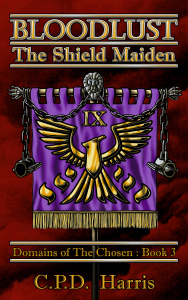
In the first two books readers only encounter automatons as fodder for the Gladiators in the arena. Hephus is the first important artificer and Bastion is the first Automaton with any real ‘character’. In the upcoming Seeds of Ruin we meet another artificer and hear more about Hephus and Bastion, though I am mostly ‘planting seeds’ for book seven and eight with the later.
Vintia was watching Hephus at work; the Artificer was testing one of his creations, a man-shaped automaton more than twice her size. Barrel chested and broad shouldered, with gleaming metal plates for skin, the clockwork golem was working through a kata with a long spear and a huge shield. Unlike other automatons that Vintia had seen in her travels and fought in the arena, Hephus’s creation did not cough smoke or bellow steam, nor was it as noisy. The clanking sound of gears had been replaced by a smooth hum. She could detect some elemental magic flowing within it, but was unfamiliar with the rest of the magical pattern she could sense; artifice was not her strong point.
“What makes you say it is a he?” asked Hephus. “I don’t see how a sexless automaton can have a gender identity.”
“He looks like a man,” said Vintia. “And he moves like a man. Gender identity does not reside solely in the genitalia Hephus. Much of it is in the way we see ourselves.”
Thrusting the tip of its immense spear into a ring barely thick enough to take it, the metal warrior showed impressive precision as it followed Hephus’ instructions. Vintia swallowed a comment about the phallic nature of the demonstration. She was not yet comfortable in her new surroundings.
“True enough,” said Hephus. “I suppose I did model the automaton’s movements on my own, at least unconsciously. I call him Bastion.”
Lazily sensing the strands that made up the automaton’s patterns, Vintia saw a flash of activity as Hephus said the automaton’s name. Hephus did not react, so she assumed it was normal.
“What are you planning on doing with him?” asked Vintia.
“Bastion is an experiment,” said Hephus. “He is one of the reasons why I’m with the Legion. Of the organizations in the Domains that can supply me with the materials and money that I need, the Legion affords me the most creative freedom. As long as I share my research and Bastion can fight, they are happy.”
“Can Bastion do more than fight?” asked Vintia, watching as the huge robot stepped to the side and thrust again, perfect and precise.
“One day, he’ll be able to do whatever you might care to teach him,” said Hephus, “provided he has the proper components installed. I’m working on a cannon and a self-repair module for him, I hope to get them finished before we set sail.”
<>
The First Shield continued. “I am filling in for Nerus until the men can choose a new Legate, as per Marian campaign law. Several of you are new to your duties as well, filling in for the fallen. Being a Centurion in the Legions is often a quick path to the pyre, so make sure to follow the lead of your seniors. This brings me to a slight irregularity. The Eighth Cohort, damned engineers, have recently elected their new centurion: Hephus Krassius.”
Hephus smiled, but for every thankful face in the room, there was a frowning one; by law the Gifted could not command the Legions. Even the Chosen had an established protocol when dealing with the armies of the Domains.
“Technically, the men voted for Bastion,” said Hephus. “And while I appreciate their enthusiasm, I don’t expect I will remain in the position longer than the next battle or two. I would not want to tip the ship.”
“There is precedence for the Gifted commanding in the Legions,” said the First Shield. “But the politics of it are ugly to be sure. Crazy engineers. I accept the Eighth’s choice, but my successor might care more for his or her political future Hephus.”
“Thank you, First Shield,” said Hephus, moustache twitching. “I won’t let you down.”
This little passage is important, as it creates a controversy that begins to come to a boil in the Seeds of Ruin. The Gifted are not allowed to hold command ranks in the Legion, as a check on the power that an individual Gifted or even a Chosen can gain in the Domains. The situation in Ithal’Duin is so bad, however, that the men of the Ninth just push forward the best candidate with no thought to the politics at home, which leads to trouble down the road…



May 29, 2016
RPG Building: Runepunk #3 (Dice Mechanics 1)
I could have titled the post resolution mechanics because I was considering using cards this time around. The idea of attributes controlling a card pool that the player builds over the career of their character is interesting, but merits more than my amateurish part time tinkering.
So dice it is[image error]
In the last post I decided that the game would use three main attributes (Power, Finesse, and Cunning) for most tasks, encouraging the player to choose which attribute they use approach a roll as a matter of simple role-playing, as well as tactical thinking.
I started thinking about what other attributes I wanted to use to describe the character, how should skills work, do I want to use classes, etc. But before I get there, I think it is best to write about the dice mechanic I am inclined to use.
As an aside; I love dice. They are just fun to play with and you can use four sided dice as caltrops in a pinch.
So what do I want from a dice mechanic for my homebrew Runepunk Game? (The goals for the game are set out here). BULLET TIME!
Consistency. When I ask a player to roll the dice, I want them to know what to roll without consulting their character sheet for dice types. This requires that I use the same pool of dice for everything, an idea put forth by the d20 system (D&D, Pathfinder), but not taken far enough by most versions. I do not have the same legacy issues, so I will use the same dice for everything. Higher is better in all cases.
Bell Curve: I want to use 3-4 dice to provide a strong bell curve on each roll. Rolling a single die is not as satisfying as rolling a small handful in my opinion, but the main idea here is provide a more predictable average roll. My gaming group for this game is very large, so the players get fewer rolls.
No Custom Dice: This one should be obvious, but I am feeling a little butthurt after discovering that two of my FFG star wars dice packs contain some custom dice from other FFG games. Grrr.
Elegant Resolution: The important idea here is that I want to make the most out of every roll and keep the action smooth. One of the things I do like about dice pool games like Shadowrun and FFG star wars is counting successes. It is pretty easy for every player to grok, a lot faster than adding a number to the roll. The problem lies in assembling the dice pool to begin with. I think consistency gives D&D the edge in this.
Exploding Dice: Earthdawn 1 was one of my favourite games partly because I loved the idea of exploding dice. I would love to find a way to use that in my little homebrew runepunk game.
So I am currently thinking 3 or 4d6 with some sort of exploding dice. More on this next week!


May 26, 2016
The Rune (1.3)
After much soul-searching, I have decided to write a few short stories, unrelated to the other works, before continuing on with the next of the Shadow Wolf Sagas, just to keep it fresh. As always, this is raw and uncut; enjoy responsibly.
<>
“Took you long enough.”
My head was still swimming, my eyes unfocused in the sudden light. The voice was female, but not friendly. My knees were weak and I could not stand. As my eyes cleared I looked up at her.
“Fuck, what?” I was starring down the barrel of an enormous gun. There were runes etched on the barrel; dire and potent. “I… I…”
“Eyes up here, newcomer,” said the girl. “I don’t like the way you are looking at my gun.”
An enormous black mohawk, with the tips died red and white like the crest of a warrior’s helm from ancient history, framed dark eyes. Silver skulls dangled from her ears and her septum was pierced with a ring. She wore a black leather jacket decorated with iron studs. She must be a scavenger, but she obviously knew the runes.
“Well?” she asked impatiently.
“What?”
“I’m waiting for you to prove that you’re not a fucking ‘cog,” she said.
Cog was slang for cognitive aberration enforcement agent. She though I was working for the people who had imprisoned me.
“Um… I can see runes like you can…”
She laughed, delighted, and removed the barrel of the gun from my face.
“Are you fucking mental, chum?” she said.
“What do you mean?”
“Do you honestly think that the ‘cogs don’t have people who can read runes?”
“Its illegal…”
“For us.”
“I guess that makes sense.”
“Your story is just too dumb for me to shoot you. You must be genuine. The last guy through this wayrune had an answer for everything. He turned out to be a cog, just like I figured. I’m good at spotting fucking cogs.”
In truth I should have realized the truth of it immediately. How else would they hunt down aberrant like myself, people who could read the runes, if they had no understanding of what they were looking for. I was a fool.
“That’s a pretty sour expression, fella,” she said, laughing at my discomfort. “Alright, time to get moving. Stand up slowly. If you try anything, Sweet Lucy here will put a hole in you and I’ll leave you for the groaners to finish off.”
I did as she asked.


May 24, 2016
Tuesday Teaser
This week’s teaser is from Bloodlust: Will to Power (Domains of the Chosen #2)
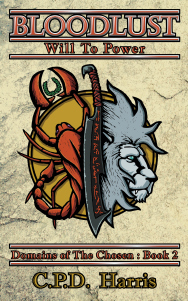
The Cover for Bloodlust: Will to Power
Omodo is one of my favourite characters from the whole series, and I know he has his fans. In some ways he is a another reader identification hero, as his struggles (acceptance, confidence) are far closer to those faced by most readers than those of Sadira (overconfidence, anger, lonely at the top). He has an interesting (cameo) role to play in the Seeds of Ruin, although he does not show up in person…
Neither fighter let up. Omodo drove Gavin back ceaselessly, smashing his shield with punishing blows whenever he caught him out of position. Gavin danced forward, landing a masterful lunge that caught an unarmoured side. The crowd cheered this, but Gavin’s triumph was short lived as Omodo hooked the edge of Gavin’s shield with the back spike on his own weapon, then pulled it out of the way before ramming his horn into Gavin’s chest.
Sadira winced. She had been on the receiving end of attacks like that often enough on the training grounds. Omodo was more comfortable with his body now and he used his horn to great effect.
Thrown backwards by the attack, bloody spit arced out of Gavin’s mouth. He rolled awkwardly to his feet, looking much the worse for the exchange.
Omodo charged. Gavin stood his ground, drawing his spear back for a throw, channelling power. He threw. The spear arced wide. Omodo crashed into Gavin’s shield, knocking him off his feet again. The crowd cheered as the Armodon raised his hammer. Sadira sensed, rather than saw, the burst of power that reached out from Gavin and swung the spear around in mid-flight redirecting it towards the Armodon. Perhaps Omodo sensed it too, or he might have anticipated the attack; with a slight flourish he turned, stomping a heavy foot down at Gavin while knocking the flying spear away with the haft of his maul.
It was deftly done Sadira had to admit.
Gavin avoided the bone-crushing stomp. He rolled to the side and came to his feet with a twist, his short sword was in his hand. He thrust at Omodo. The Armodon was attempting to strike him with the haft of his weapon as he turned back to face him. Both of them struck home. Gavin’s thrust drew blood from the Armodon’s thick hide. Omodo’s haft smashed into Gavin’s shoulder-guard and chin dislocating his jaw. The sheer power of the blow knocked him off his feet. He was standing up again, readying a thrust and a mental blast as the match-time ran out and the trumpets sounded.


May 22, 2016
RPG Building: Runepunk #2
A few weeks back I decided to work on a new homebrew RPG to replace my Shadowrun game. The first post set forth my goals.
In this post I want to focus on attributes. I want attributes to be the basis for character creation and advancement.
Attributes are the most descriptive terminology for a character. While we tend to concentrate of vocation in the modern day, if someone stands out as strong, smart, or agile that is the first thing that we think of them. Meanwhile if someone is exceptionally skilled at something, it does not always leap to mind when we thing of that person.
For a relatively simple system it is easier to center the mechanics of play around a handful of attributes rather than a comprehensive skill list.
I have been toying with the idea of a triumvirate of active attributes based around how the player approaches a problem.
POWER: The attribute for direct action. Power represents strength, will, and presence. Emphasizes brute effect.
FINESSE: The attribute for subtle, circular action action. Finesse represents agility, unconventional intellect, and charm. Emphasizes critical.
CUNNING: The attribute for trickery. Cunning that represents deception, cheating, exploitation, and manipulation. Emphasizes side effects.
With these active attribute the player can choose how to approach a specific problem. Let us take a melee attack as an example. A character can use POWER to batter their way through an opponent’s defences with brute strength and unrelenting aggression, FINESSE to make a swift, graceful attack that slips through the targets defences, or CUNNING to trick the opponent into reacting with a feint and then hitting them.
So what’s the point? If the player can choose what attribute to choose in any situation, what is to stop them from going top-heavy into a single stat and focusing on that? The idea is that different stats are opposed by different defences/difficulties which allows a versatile player to tune their actions. My goal here is to give players tool to approach problems in the game from different angles, rewarding versatile characters without punishing specialists.


May 19, 2016
The Rune (1.2)
After much soul-searching, I have decided to write a few short stories, unrelated to the other works, before continuing on with the next of the Shadow Wolf Sagas, just to keep it fresh. As always, this is raw and uncut; enjoy responsibly.
<>
To admit that you can see a rune, even hint that you can, is practically a death sentence. Runes are subversive; those in power do not like what they represent and that they cannot, directly control them. A rune is more than just a few scratchings from a mystical alphabet; it is more than the sum of form and intent. Some say that the runes are the remnants of the language that was used to re-write reality by the Machina, which would make runes akin to fragments of code.
I don’t know. In fact I have always been utterly terrified to experiment with them at all. If the rumours are true then the Runes can grant great power. Then again if that were true, then why did people like me bow down to The Orthodoxy?
My life up until this point had been simple. I was getting used to hiding my talents and avoiding the temptations that would lead me to seek out more and more knowledge until I was caught. I took pride in blending in, in fact. I was very good at hiding in plain sight. But I had become complacent, missed something, and here I was.
The rune drawn on the wall before me promised escape. I am uncertain how I knew that the simple lines and the complexity underneath would transport me from the cell, but every time I looked at the thing, I was certain of its intent.
Now I could see that it was definitely fading. At first, I though it was my it was imagination, but the rune on the wall was diminishing noticeably. If I ignored it much longer it would fracture or just wink out of existence soon enough.
“Yes, but is it salvation, or is it a trap?” I asked myself, out loud or in my head.
If it was a trap, touching the rune would confirm what I was, even if it did not kill me outright. Of course, it seemed that my captors already knew. If it was some odd form of execution, then how much worse could it be than slowly going mad in a cell or starving to death?
Logically, I had to activate the rune. I tried, but could not work up the courage. In the end it required faith in something that I did not trust, in something that I was raised to hate and fear.
My misgivings seemed insurmountable, but in the end I did it. The rune flashed neon, blinding me. I felt my stomach lurch and lost my balance, thinking, ‘oh, they really did opt for the ironic execution method after all’, but I survived.
I was no longer in the cell. I wasn’t even in a building. I was lying on the ground in a grove of… trees… real, healthy trees. I just lay there and looked around.
“Took you long enough.”


May 17, 2016
Teaser Tuesday
This week’s teaser comes from Bloodlust: A Gladiator’s Tale, first book in my Domains of the Chosen series.
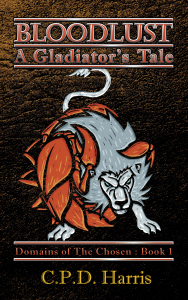
Cover for Bloodlust: A Gladiator’s Tale.
Ravius Vergerus, aka Ravishing Rude Ravius, is a long-time acquaintance of Gavin introduced in a Gladiator’s Tale. His cheerful nature compliments Gavin’s introspective demeanor. He figures into the upcoming book, Bloodlust: Seeds of Ruin as well.
“I’m telling you Ravius: it was luck.”
“No, it was instinct Gavin. We’ve been drilling since we were six years old, little brother. We’ve fought hundreds of training duels with live weapons; moves like that are second nature to us, little brother.” Ravius’s voice dripped cheerful self-assurance; an annoying trait in Gavin’s view. “Your body and subconscious knew how to position the spear even if your conscious mind did not command it.”
“Ravius, I’m pretty certain the Spike Hound impaled itself on my spear accidentally,” responded Gavin, trying to show his exasperation.
Ravius Vergerus was one of Gavin’s classmates from the Campus Gladius, where young gifted were trained in magic and where they both had decided to become Gladiators. He was slightly shorter than Gavin, with a wide tangle of blond hair, dark blue eyes, and always smiling as if the world was one big joke, at least in Gavin’s mind. The two had met Ravius in a pairs training duel when he was fourteen and the other had spent the last three years of training taking Gavin “under his wing”. Ravius was smart, bold, a little egotistical, and always trying to break the quiet Gavin “out of his shell.” Ravius also called anyone he spoke to “little brother” or “little sister”, even if they were larger than he was; this too, irritated Gavin… he had a good two inches over Ravius.
Gavin did not seek his company; Ravius was over-fond of talking and did not seem to understand that some people enjoy quiet solitude, are serious by nature, and that introversion is not an aberration that should be cured. Gavin had hoped that Vergerus would forget about him after graduation, but this was apparently not to be. He’d come to Gavin’s second match and had gone out of his way to help him make a full recovery afterwards. Now Gavin was having trouble reconciling his distaste for Ravius with the fact that the man was showing himself to be a true friend; he was beginning to wonder if his aversion to the blond Gladiator’s friendship was a reflection of his own internal conflicts and not true dislike.
Upon further thought, he resolved to be nicer to Ravius. Perhaps true friendship required that he accept the other person’s foibles. Besides, it would be useful to have a training partner.


May 15, 2016
Politics & Fantasy: Plato, Trump, Andrew Sullivan, and the Defence of the System
Often, on this blog, I write about ideologies, systems, and institutions and how the shifting of these powers make for interesting narratives. My arguments include the idea that the functionaries of a particular ideology, system, or institution will do whatever is in their power to defend it. The rise of Donald Trump, for good or for ill, is a fantastic example of this in real life.
Let us set aside how we ourselves, judge Mr Trump. It is enough to know that many people, some even in his own party, see him as a Demagogue. Many of the Elite in the GOP have spoken out about him with incredible vitriol, as have the media everywhere. 2016, one way or another, looks pretty much like the Donald Trump show up until now. Even far more serious events than US politics quickly drown in the maelstrom of Love/Hate for Trump.
Recently Trump shut out his opponents in the GOP, ending any chance that he would not represent the republican party in this year’s election. As the chances of stopping him dwindled many of those threatened by the changes he might bring to the party spoke out against him.
One of the best written of these pieces is Andrew Sullivan’s Democracies end when they are too democratic, written just before Trump won Indiana and his opponents bent their knees. It is a wonderful example of a functionary striding forth to do battle in defence of his particular ideology.
Andrew Sullivan is an excellent writer, one who emerged from the early days of political blogging to gain power and influence. His article begins with a breakdown of Plato’s criticism of Democracy from the Republic, namely that democracies can become lawless as their populations gain too much freedom and lead to the rise of a demagogic tyrant. In this piece the tyrant is Mr Trump, and it is because we have become too free that we have turned to him.
Mr Sullivan takes a small amount of blame for political pundits (himself) and even some for his beloved party and ideology. His writing is deep and passionate and convincing, at least until one comes to the meat of what he sees as the problem, the real reason that Mr Trump is ascendant, and the real people to blame for this potential tyranny; you see while Mr Sullivan’s article is a superb rhetorical piece it is nothing new. He blames everything on those damned liberals.
“This is an age in which a woman might succeed a black man as president, but also one in which a member of the white working class has declining options to make a decent living. This is a time when gay people can be married in 50 states, even as working-class families are hanging by a thread. It’s a period in which we have become far more aware of the historic injustices that still haunt African-Americans and yet we treat the desperate plight of today’s white working class as an afterthought. And so late-stage capitalism is creating a righteous, revolutionary anger that late-stage democracy has precious little ability to moderate or constrain — and has actually helped exacerbate.” Democracies end when they are too democratic, Andrew Sullivan, 1 May 2016.
This is an argument as audacious as it is facetious. Had he led with this paragraph, Mr Sullivan would be roundly mocked. But this comes after several thousand words, an invocation of a revered Greek philosopher, and plenty of seeming introspection where Mr Sullivan seems perilously close to taking responsibility himself.
It is a tried and true technique, and if you have not read conservative pundits writing about the rise of dictators and nationalists around the world, it might actually convince you that Mr Sullivan is sincere. Instead this functionary is offering a well-heeled defence of his chosen ideology hidden withing his lofty pontificating, deflecting the blame for Donald Trump away from those who chose him. (Which shows you what he thinks of the base that votes for the ideology that he supports, incidentally — by removing their agency, he reveals that he thinks of them them sheep. Never mind the fact that Mr Trump has positions that might be appealing to working class whites — like his stance on trade deals.)
“For the white working class, having had their morals roundly mocked, their religion deemed primitive, and their economic prospects decimated, now find their very gender and race, indeed the very way they talk about reality, described as a kind of problem for the nation to overcome. This is just one aspect of what Trump has masterfully signaled as “political correctness” run amok, or what might be better described as the newly rigid progressive passion for racial and sexual equality of outcome, rather than the liberal aspiration to mere equality of opportunity.” Democracies end when they are too democratic, Andrew Sullivan, 1 May 2016.
Mr Sullivan tries to obfuscate the filthy nugget of his argument in dense layers of reason and nods to philosophy and history, as if thick layers of artisanal bread will disguise the taste of the wet turd that resides within.
For some they might. As I wrote, it is a tried and true technique.
The argument itself is not exactly hard to take apart. Firstly, Plato’s republic is a complex work, with much reading between the lines required. If one were to take Plato at face value, then his preferred system of Government is a King, albeit one steeped in philosophy. I don’t think that either of these are amenable to modern circumstances. We call kings dictators these days and they tend to be notoriously unsuccessful, unless propped up by outside powers.
Secondly, the idea that the United States of America is too free is rather laughable when examined directly. Sure there are laws allowing gay marriage laws and we might elect a woman president right after a black man; but the incarceration rate of the US is the highest in the world, people can face enormous fines for stealing music and the image of a cartoon mouse invented in 1928 (an idea that would be baffling to Plato), not to mention all those regulations that conservative pundits keep telling us are stifling the economy. I doubt the citizens of Ferguson and Flint would agree with the idea that we are “too free”.
But then again, the usual suspects have been warning about the dangers of too much freedom since the Powell memo. Nixon dredged up the arguments to launch the War on Drugs, which he then used to attack hippies and minorities after the victory of civil rights movement. TASTE THE FREEDOM!
Of course, political correctness can be odious. But despite constant outcry from right-wing pundits eager to warn us about the ever-present danger of university students”checking your privilege” is rarely outside of campuses, political punditry, and the kind of boardroom scrums that produce faulty signs. Political correctness has been a constant back and forth since at least I was in university… 20 years ago. If you want to go that far back to blame someone for the rise of Donald Trump as demagogue, you may as well just go for blaming his parents. There’s nothing new there, either way.
The idea that Liberal Permissiveness has given rise to Mr Trump is feeble. The main branches of Demagoguery that launched Mr Trump this political season have been the idea of building a wall to keep Mexicans out and forcibly deporting illegal immigrants. I don’t hear him screaming about gays getting married or even joining the current right wing rebellion against trans-gendered rights. Mr Trump does not really seem to care about who uses what bathroom. Ted Cruz, his main opponent was a far stronger Champion against so called liberal permissiveness, and even tried to attack Mr Trump on abortion, the bathroom thing, and so on. He went so far as to call Mr Trump a RINO (Republican In Name Only), because of his apparent lack of interest in the Culture Wars, the pinnacle of the GOPs counter-attack against those damn elitist liberals taking freedom too far.
If Mr Trump’s supporters are so angry about their enemies forcing these things down their throats then why did they not pick Mr Cruz who has a far more consistent pedigree of resisting and speaking out against gay marriage, abortion, feminism, and exceeds him in almost every other arena of the Culture Wars? It does not make sense, unless there is something else that draws them to Mr Trump.
I can only conclude that Mr Sullivan’s article is a smokescreen, an attempt to blame the revolt of the Republican Base on Liberals in an attempt to defend the ideology of the party elite should Mr Trump prove to be an unfit candidate.
Could it be that it is another form of permissiveness that draws people to Mr Trump? What about a group of people who constantly write and speak about the dangers of political correctness in a time when a standing President of the United States has been called a liar during an official speech. I wonder what the reaction would have been to a Democrat done the same thing to a Republican. What about the Representative who sent out a series of Christmas songs called “Barrack the Magic Negro”?
In fact, if the forces of Political Correctness are so overwhelmingly powerful, then how do we explain George Zimmerman seeking to sell the gun that he used to kill Trayvon Martin? If the PC police can’t stop that, then they are hardly the force that they are made out to be.
But that’s the point, isn’t it. While the permissiveness of Mr Sullivan’s chosen ideology has certainly empowered Mr Trump, they don’t want to take responsibility for him unless he is a success. After all, they could have easily spoken out against him when he was spouting on and on about President Obama being a secret Muslim, instead they gave him the freedom to air his views at their official events and a platform on Fox news which he used to build a massive audience which was loyal to him.
They let Mr Trump infiltrate the party, ignored him while he connected with their voters, and dismissed him when he showed his power early in the race; he clearly took advantage of Republican freedoms, for good or for ill.
This one’s on you and yours, Andrew.


May 12, 2016
The Rune (1.1)
After much soul-searching, I have decided to write a few short stories, unrelated to the other works, before continuing on with the next of the Shadow Wolf Sagas, just to keep it fresh. As always, this is raw and uncut; enjoy responsibly.
<>
The cell envelops me. It is cold and dark, a womb of stone and iron bereft of sun, warmth, and comfort. A little stone bench and a chamber pot are the only furnishings of consequence. Small tubes eject water and nutrient capsules at regular intervals.
The cell across from me is dark. Those yawning shadows could conceal any number of horrors and my eyes often dart, furtively, toward them. Yet no sound issues forth from the darkness, save perhaps a faint breathing.
Every fiber of my being felt screams that I am being watched, and yet I cansee no evidence of eyes upon me. There are no visible cameras or wires in the cell, but they have to be watching me.
Unless they just brought me here to rot…
How long have I been here? Three days? On the first day two inquisitors came to the little cell and asked me a litany of questions. They were interested in the test, of course. I assured them that the results were aberrant, and that if allowed to take the test again, I would prove myself to them. I would then return to my safe little life, ten hours of battery per day, followed by six to eight hours of gaming and occasional socialization, followed by fitful sleep, wash, rinse, repeat, die.
Except they didn’t buy it. I try in vain to remember the test questions, to guess which of the questions had invoked my doom. Surely they could not stake a person’s life on a single answer…
Unless it was not an answer, but a question that gave me away. A question that only someone like me could see…
I can see the runes. I have been able to see them for years now, tried to hide it, but the test got me… It always does they say…
I look around the little cell for the thousandth time.
I try to ignore the massive rune on the wall right in front of me.


May 10, 2016
Teaser Tuesday
A flashback insight into Ragnar’s past from Blade Breaker (The Shadow Wolf Sagas #1)
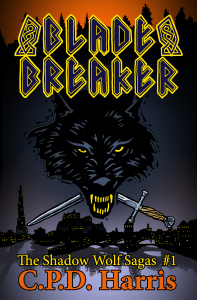
The Shadow Wolf Sagas is meant to follow the same structure as a series of detective novels (like the Dresden files if you are a fantasy fan), with the central character appearing in a series of episodic novels that build over time. The central conceit is that little clues into Ragnar’s past and the mystery surrounding it build over time.
They call the place the Spearmarch because the tall pines loom like the pikes of an army alongside the old, well-travelled roads. It was peaceful, deep within the royal Domains and surrounded by the lands of the Great Clans on every side. No one expects an ambush in such a place.
We only had a handful of scouts and outriders. These were overwhelmed instantly. Thus, when the depths of the Spearmarch disgorged a horde of Skraelings fit to overrun an army ten times our size, it stunned me. How could such a thing happen, here in the bosom of our lands? Such was the sense of disbelief that men who would normally throw themselves into danger lost heart. When the enemy charged, shaking the ground under their innumerable boots all seemed lost.
Yet, Siggurd Stormbreaker, the High King of all the North, refused to run. He moved calmly to the front of the army, pushing his way through his protesting Kingsguard, myself the only member of the Shadow Wolf Clan honoured with a position among them in more than a hundred years. His gaze swept the enemy and then he spat dismissively and lifted his sword, Garmsbita, above his head. Invoking the Gods to witness the battle he rallied. His last line, the last words from my king are still clear in my mind.
“Stand with me now brothers and let us show Gods and Ancestors that we are brave and true; Come ruin! Come glory! Come courage and red joy!”
We met them head on, charging into the onrushing horde instead of taking up a defensive position. Thyra was beside me, bright and strong. At first we made great headway. We formed around Siggurd and clove into the screaming, frenzied Skraelings, seemingly unstoppable. Were we not the men and women of the North? Was Siggurd Stormbreaker not the very king who had routed The Devout in his youth?
Bright blades rose and fell, red with blood. The air was thick with the war-shouts of the North and muttered oaths to the Gods of my people. We killed and killed and killed, and although the enemy was all around us, we did not waver.
Then a Murder-Wight, fearsome and fell-handed came upon the High King at the forefront. Dread was the blade it wielded leaving a trail of shadow in the air. It cut down two of the best men among us in a heartbeat and then it was upon the King. They fought and it seemed to me that both armies paused and parted to watch the struggle. The Wight was swift and strong, but the king was hard as iron and battle-wise. A sudden stumble caused my heart to leap, but it was just a ruse. Cunning Old Siggurd caught that terrible sword on Garmsbita and then struck the Wight’s head from its shoulders in a single blow. It was glorious.
For that one moment we felt as if we could do anything. We howled and my voice mingled with that of Thyra screaming next to me. Our weapons were light as air, our armour was unbreakable. Each man that fell was a hero. We pushed on; full of life, all cares forgotten.
Then, just as the enemy seemed sure to break, I caught sight of a shadow behind the High King and then he was gone. There is something broken in my memory of that moment. My mind cannot make sense of the image, and it is as if the identity of the killer was ripped from me. This recollection was no different.
When Siggurd fell, the tip of our spear was blunted. Confusion reigned; and we faltered as word of the king’s death spread like wildfire in dry grass.
The remaining Murder-Wights rallied the Skraelings and drove them forward once more. They pushed into us. We tried to hold, but we could not reform our lines and, as flooding waters will find the holes in a dike, they surged through the gaps. Our formation disintegrated. Men went down, too fast, too many. All those who died were as brothers to me.
We fought in knots, then pairs, then finally alone. For every Skraeling we killed two more took its place. The tide of bodies drew me away from Thyra and my heart fell as a monstrous Wight came upon her, brandishing a smoking red blade in one hand and the heads of my brethren the other. The berserk came upon me then and much of what happened next is lost to me.
Thyra made her name on the field that day. Where most were killed or cursed, she stood her ground and became a legend. The tale of Thyra Hurnsdottir, The Unbroken Spear, of how she and her band of ten guarded the High King’s body from the horde until reinforcements came, is well known. They were they only survivors of the Drajinskyg, the Kingslaying at Spearmarch.
As for me, I remember fighting for what seemed an eternity, consumed by rage and heedless of my wounds. Somewhere along the way, my hand was cut off, but it seemed a small matter then. Then suddenly the berserk ended. The enemy was all around me. A blade blossomed from my chest. My mouth was full of blood. It was impossible to draw breath. Looking back, my eyes met the dead gaze of a Murder-Wight. It tossed me to the ground and the Skraelings closed on me hacking and biting, filling my eyes with red.
I died and rose again, seven days later, dragged out of my grave by wolves, only to be branded a coward and exiled by my clan, despite Thyra’s protests.



