Julia McDermott's Blog, page 26
January 15, 2013
Julia McDermott, Make That Deux, romance – The Independent Author Network

Julia McDermott is the author of Make That Deux, a romance
via Julia McDermott, Make That Deux, romance – The Independent Author Network.



January 14, 2013
Books, Movies and Les Misérables
The movie Les Misérables (Les Mis, or “Lay-MIZ”) won ‘Best Comedy or Musical’ at last night’s Golden Globe Awards, a fact which made me très contente.
The ‘Best Drama’ award went to my other favorite movie of 2012: Argo.
I didn’t watch the Golden Globes — I was just too tired after watching the Atlanta Falcons come back to beat the Seattle Seahawks in the last 34 seconds of the NFL playoff game yesterday afternoon, but that’s another post. I love to know who wins the Globes (and the Oscars), but malheureusement, I don’t always hardly ever stay up to watch the award shows; pour moi, seeing the highlights (and the outfits) the next morning suffit.
I’d only seen 2 or 3 of the other films being considered (I just saw Les Mis last week), though I plan to watch most of the rest. Pourquoi? Parce que I LOVE movies, almost as much as I love books.
Les Mis has a special place in my heart and mind for many reasons. One reason, of course, is that the story is adapted from the French novel by Victor Hugo. Another reason is that it’s a musical, an opera really, and the songs are fantastique; I grew up in a household where musicals weren’t admired, so maybe that’s why my rebellious self loves them that much more.
But the third reason I love Les Mis is that one of my sons acted in the play in high school a few years ago, playing the role of the innkeeper Thénardier, and he was amazing, funny, and terrific.
The Playbill

This son (who had played basketball, baseball, soccer, football and had run cross country) began acting and singing in high school plays at the age of fifteen. Two years later he joined a wonderful cast to sold-out crowds; the production, now a legend at his school, was marvelous, and standing ovations were standard. It was a high school play, like unlike any other.
I saw the film Argo not long ago, and found it intriguing and fascinating. Based on real events,* it takes place in 1979-1980, the time setting of my new novel MAKE THAT DEUX. I was captivated not just by the story or the actors, but their clothes and hairstyles, since Jenny and her friends in MAKE THAT DEUX were in college during that era.
So it was a bit like seeing the Golden Globe “casual” outfits of my novel.
Which brings me to books. I love them, more than movies, and the best movies are those that are adapted from books: novels, non-fiction, even children’s books.
My favorite children’s books are those written by Dr. Seuss, and I believe one of them was made into a very entertaining movie a few years ago (“A Person’s a Person, no matter how small.”)
While browsing in a shop today, I came across these 2 Dr. Seuss editions that I just had to purchase (guess why?)

Hmm…if only I’d had these when my kids were little. Then, they would might have learned to speak français as well as English…
* A captivating and compelling book about the Iranian Hostage Crisis of 1979 is Mark Bowden’s Guests of the Ayatollah. I highly recommend it.


December 28, 2012
La Sensibilité et la Thérapie
The French word sensible means sensitive, not sensible; sensible/sensible and sensibilité/sensibility are examples of faux-amis (literally, “false friends”) — they look alike but mean very different things. On the other hand, thérapie/therapy are vrais-amis (“true friends”), or words spelled alike with the same or similar meanings.* As the year draws to a close, il est naturel to look back, to look ahead, and to reflect…a process that causes my own sensibilité (and my need for la thérapie) to surface.
First, la sensibilité. While others seldom accuse me of being too sensible, many feel the need to point out my (over-)sensitive nature. Through the years, I’ve worked hard to reduce the “over-” part, at the same time not wishing to lose the “sensible/sensitive” part, or to slide into insensitivity. I’m an emotional person, and while some in my family are, too, some aren’t. They’re the tough ones, the ones who find it easy easier to compartmentalize, to bypass the drama, to keep cool. To move on, confidently — or at least, to seem to.
By contrast, I’m more likely to live by these words in a song by Joan Armatrading**:
Show some emotion
Put expression in your life
Light up, if you’re feeling happy
But if it’s bad then let those tears roll down
Does emotion, and la sensibilité reside in the heart or the head? Jenny, le personnage principal in my new novel MAKE THAT DEUX, considers this question, and I won’t say what she decides. But two years ago, after an extremely talented neurosurgeon at Duke skillfully removed a tumor in the center of my son’s brain, I read that some doctors believe the area is connected with our ability to make decisions and experience feelings. Miraculously, my son survived his cancer and thrives in college, feeling, thinking and learning (I trust) every day.
Back to my sensitive nature. I take the kindness — and the unkindness — of others to heart (or maybe, head). With loss and tragedy happening all around in this world, perhaps it’s good not to focus on “the little things,” but to be tougher, stronger, more reserved. But sometimes it is the little things: if we really dislike someone, then every little thing they do is annoying. Maybe that’s when it’s time for sensitivity toward others, empathy and understanding.
Which brings me to la thérapie. No, not the kind you’re thinking; other than a massage therapist, a paid professional doesn’t work for me. Reading does, and talking to a close friend (ideally, my best friend, mon mari) works even better. But I find the best therapy to be (creative) writing. I don’t know why it works, but it does, heureusement.
Now back to my Work In Progress (WIP), my second novel…and la thérapie!
Bonne année 2013!
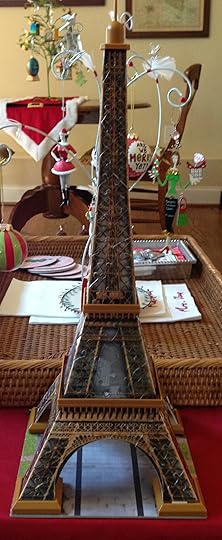
Un puzzle 3D de la Tour Eiffel: la thérapie pour quelqu’un d’autre dans la famille (pas moi; je n’aime pas les puzzles!):
* For more on faux-amis, see my post “L’esprit de l’escalier, spiral staircases and faux-amis”
** Another Joan Armatrading song is the title of Part 3 of MAKE THAT DEUX. Savez-vous pourquoi?


December 21, 2012
Joyeux Noël, Elno
The cartes de Noël have been sent (and many received), the tree has been trimmed, the decorations — and lights — carefully placed, and the stockings hung…
but I’m not quite ready for Christmas.
It’s my favorite holiday, with Thanksgiving a close second. I love l’automne (the fall) best of all the seasons, and here in Atlanta, l’hiver (winter) feels like autumn (and sometimes almost like summer). Earlier this month, when my daughter and I visited New York City for a special birthday weekend trip, le temps was very, very cold and windy…
But we still walked down 5th and 6th Avenues, Madison Avenue, Broadway, Canal Street, through Central Park and the World Trade Center Memorial (but not in that order). Other than a few taxi rides, we saw Manhattan à pied (on foot), during the day and at night, with its spectacular illuminations de Noël:
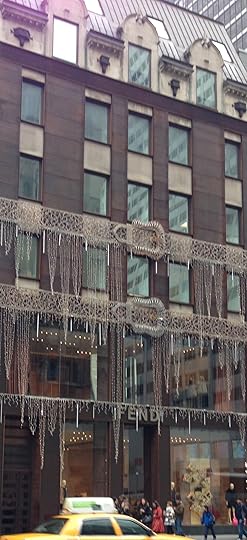
On 5th Avenue
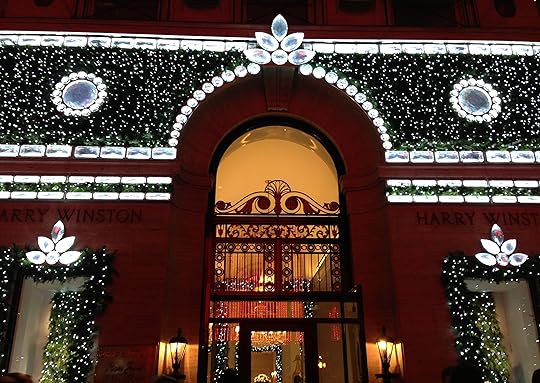
There were plenty of other touristes in New York, and we did a lot there in less than 72 hours — more than I dare to write about in this space. Because what happened in Manhattan…well, you know.
But both of us were ready to come back home that Sunday, where more most people are very polite and friendly, and speak a little more slowly. And we were happy to toss our heavy warm not-warm-enough-for-the-north coats back in the closet.
But it was worth every freezing moment.
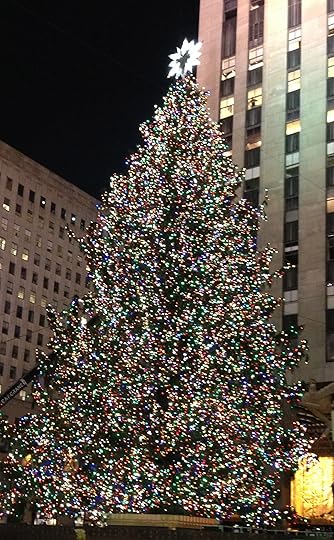
Back home, we’ve done a lot in the last three weeks, though I made a serious effort (again) not to go overboard with decorations. I think I succeeded without being too Grinchy: I forced myself to leave left a couple of boxes of holiday “stuff” that had seen better years in the storage room; I (almost always) resisted the urge to buy new “stuff”; and, because I hurt my back somehow (it’s just finally feeling better now, phew), I took things a little slower. And if they didn’t get done, oh well.
Because those things aren’t what Christmas is about, anyway.
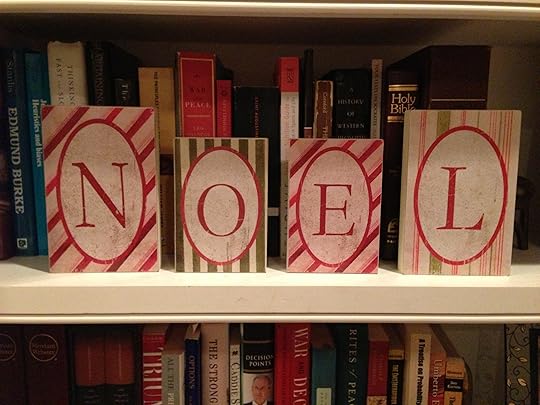
When we were first married, my husband and I couldn’t afford to buy Christmas decorations, but we had a few that that my parents had given us because they didn’t want them anymore. One such item was two matching tacky adorable elves holding signs that said “NO” and “EL.”
My husband, always the joker, used to reverse their order on the shelf, so that “EL” was before “NO.” All it was missing was an apostrophe before the “E” and maybe one more “L,” and it would have been, well, a little bit French.*
After five moves, four kids and three decades, we don’t know what happened to “EL” and “NO” — they got lost, sadly. So this year, while shopping one day I spotted a replacement (sort of), and decided we had to have it (plus, it wasn’t expensive):
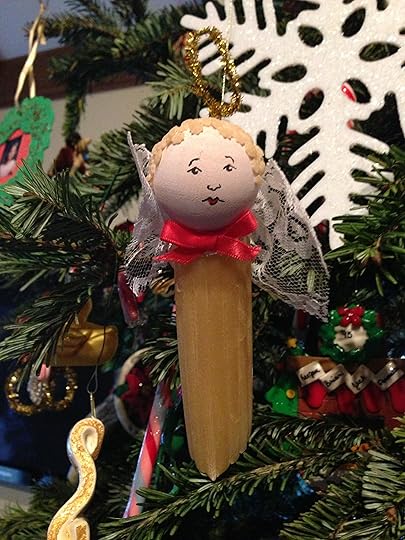
Finally, here’s a photo of one the ornaments hanging on our Christmas tree. It’s very old (also inexpensive), kid-hand-made, and was recently repaired by a dear friend who doesn’t judge me for my phobia of super-glue:
Are you ready for Christmas? I’ve still got a few gifts to buy and a party to host, but other than that, I’m close, and I’ll keep the following lines from Dr. Suess (and from my favorite card received so far this year) in mind, as the 25th approaches:
It came without ribbons. It came without tags.
It came without packages, boxes or bags.
And he puzzled and puzzled ’till his puzzler was sore.
Then the Grinch thought of something he hadn’t before.
What if Christmas, he thought, doesn’t come from a store?
What if Christmas, perhaps, means a little bit more?
Merry Christmas!
*Or Spanish. In my new novel MAKE THAT DEUX, there’s a character called “El.” Read and find out who!


December 12, 2012
The Negresco: a very nice hotel in Nice — for deux
It was the first hotel where my husband and I stayed in France, and it was the nicest.*
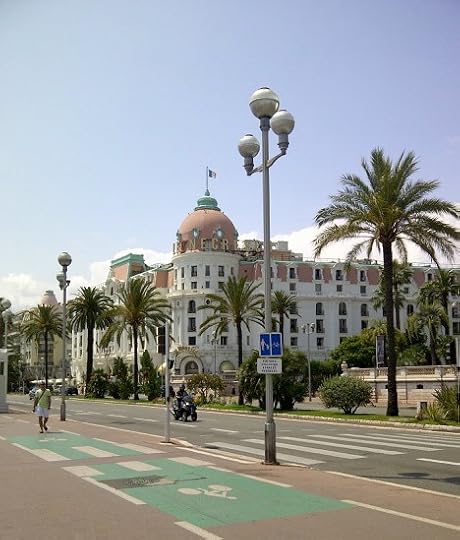 Our plane had arrived that morning from Lisbon. We took a taxi to the Hotel Negresco, a bit of a splurge but well worth it, we agreed. That evening, after strolling along the Promenade des Anglais and through the vieille ville, then visiting not one, but two smallish museums (Matisse and Chagall), we landed at the hotel bar, Le Relais.
I didn’t know the history of the hotel, nor that 2012 was its 100th anniversaire until the other day when I read about it in an entry in The Provence Post titled What Happens at Negresco…
Oh-la-la. Il faut que vous le lisiez! (You HAVE to read it!)
Unaware that it had been recently redone (but still appreciative of it), we had dinner that first evening at La Rotonde. We sat outside on the terrace, looking out on the Mediterranean Sea, both of us (well, mostly me) trying out our French as we sipped our wine. The following evening — our last one in Nice — we would have loved to dine at the Chantecler, the hotel’s two-star restaurant. But we hadn’t booked a reservation ahead of time. So we found a table at another nice restaurant just steps away.
Le temps (the weather) — though a bit warm during the day — was perfect at night. Walking back to our hotel, I took this photo:
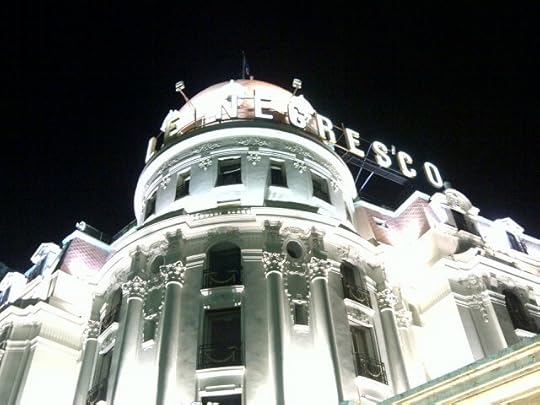
Before we left the next day to head west along the Riveria in our rented voiture (whose GPS ne marchait pas — even the extremely helpful valets at the Negresco couldn’t get it to work), I took this photo of the view from our room, just over La Rotonde (located at the far left side of the hotel in the first photo above):
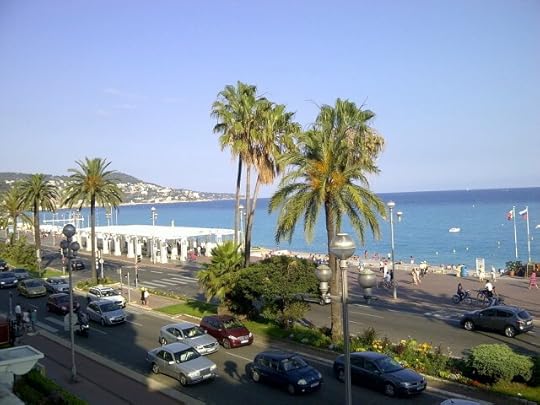
Staying at the Negresco, even for just two nights, was a very cool experience, and I want to go back someday avec mon mari. I had never seen the hotel when, during my year in France, I stopped for an afternoon in Nice on the way home from Italy. I won’t say what year it was, just that it was long after Richard Burton left Liz’s jewels at the bar by mistake, but way before Michael Jackson installed a dance floor in one of the rooms and rehearsed there…
Somehow, I think my husband and I sensed the history and eccentric personality of the Negresco during our forty-eight hours as guests there in July, and were awed by it. He’s more into history than me (he was reading Alistair Horne’s LA BELLE FRANCE during our vacances), and though he has his idiosyncrasies, I’m a bit more eccentric. You might even say I’m quirky, as a friend did** last month at a launch party for my new novel MAKE THAT DEUX.
*But the two other hotels where we stayed in France were lovely, too: the Hotel St. Christophe in Aix-en-Provence and the Best Western Hotel Le Guilhem in Montpellier.
**In a very NICE way.


November 28, 2012
Letter to France
Dear France,
As someone tells Jenny in my new novel MAKE THAT DEUX,
“you ‘ave captured my heart.”
I’m not sure exactly when you did it. The first time I saw you, I was a little bleary-eyed, and I felt a little awkward. I had been looking forward to meeting you for so long — years — and I had started to believe it would never happen.
You were just so, well, distant.

When I started to feel comfortable with you (and you know it took weeks), it was almost like I’d always known you. I was so at home with you. It was like déjà vu. Sort of.
I didn’t know everything about your past…but what I did know, intrigued me. What I didn’t know didn’t seem to matter.
You understood me, even when I struggled to express myself. You encouraged me and seemed happy to have me. You shattered the stereotypes about les français – your people — when they politely welcomed me with a “Bonjour, Mademoiselle!”
They listened patiently as I spoke your language, learned its expressions and worked on my accent. They charmed me with their own accents when they practiced their anglais, particulièrement when your (good-looking) young men said “ze” for “the” and “zat” for “that.”
I know you had greeted millions of girls before me who studied traveled had a blast abroad for a year. Some of them loved you as much as I did, but, I dare say, not all. Some of them were just playing with you. Some just wanted to shop and drink wine, discovering but later forgetting about your certain, well, je ne sais quoi.
Mais pour moi, c’était impossible.
I never forgot you, even as my French vocabulary dwindled and my memories of our time together faded. I kept my few pictures of you, not knowing that (or how) I would use them someday. For years, I dreamed I would come back to visit you with the man I love.
Then, un jour in the summer of 2012, I did.
I had spent months getting ready to see you again, studying your language — listening, reading and practicing it weekly. I had written my novel (set in your south) and was getting ready to release it this fall. I had planned an itinerary for our visit en juillet, but our emploi du temps was flexible and open to spontaneity.
Which was fortunate, because our unplanned moments with you were the best ones.
I loved seeing my husband discover you: the Côte d’Azur, Provence, Languedoc, Beaujolais… Paris. I loved hearing him try out the French phrases he had learned. I loved going with him to see parts of you that I had never seen. I loved taking him to see other places that had once been very familiar to me, that I had been while thinking of him.
He already knew me well, but now he knows me – and my heart — even better.
A la prochaine,
Julie


November 19, 2012
Fitting into un grille-pain (toaster), and Thanksgiving
Not long ago, a dear friend (let’s call her “Lisa”) sent me a kitchen/tea towel that fits me perfectly.

Lisa’s birthday is tomorrow, and I messed up and didn’t send her a gift (or even a card). So I wanted to wish her a bon anniversaire here…and tell her I miss her and am thinking of her this Thanksgiving.
We live thousands of miles apart, but many years ago, we were roommates in college. Back then, she didn’t cook either, but she does now. I discovered this a few years ago when she came to visit us and helped my husband with the cooking for our annual Christmas fête. I wasn’t amazed — many women people can, and do, cook. But Lisa went above and beyond the call of a special weekend guest, chopping, stirring, baking and assembling — and loving it. She also complimented my husband’s cooking abilities and asked him for recipes.
Which made him feel très apprécié.
Perhaps because he is such a great cook, early in our marriage he and I lived for many years without a toaster, or un grille-pain (but we did own a funky gadget that produced croque-monsieurs.) I guess we weren’t much into toasted bread or bagels back then (and I try to stay away from them now). We finally bought un grille-pain when frozen waffles became a preferred (and easy) breakfast item for our kids.
(Let me just stop here and say that, though the word grille-pain looks painful — and I suppose it is, to the bread/pain — it sounds très cool en français.)
Last summer, when we were weekend guests in a French home in Lyon,* we noticed their grille-pain: it was so différent from any we had seen back in America. Made to toast pieces of French bread (baguettes) that have been sliced through the middle, not from the top, it was an interesting appliance, with its long shape and wide, long slots. My husband added it to the list of French cuisine products, ingredients, and customs (like a cheese plate after dinner) that he admired and wanted to acquire.
Unfortunately, we haven’t been able to find one yet, but I may cherche (look for) one as a Christmas gift.
Back to cooking…
Since our wonderful American holiday Thanksgiving is just days away, mon mari et moi (well, more him than me) are planning the menu for Thursday. We will only have seven people at the table, but he will prepare plusieurs plats traditionnels. I will contribute two simple dishes: a sweet potato casserole and fresh cooked cranberries. I’ve done them almost every year for decades, but making them will still be a challenge.
Since they don’t fit into a toaster!
[In my new novel MAKE THAT DEUX, Jenny and her roommates are a little lonely at Thanksgiving. I won't say what they do about it, but I will say that their solution isn't ideal....and it doesn't fit into un grille-pain...]
* for more, see my post Lyon and Beaujolais, with the French and a faux pas, 11-6-12


November 10, 2012
Dinner parties, fêtes, et la politique
In my novel MAKE THAT DEUX, Jenny and her friends — like most other college students — go to a lot of fêtes (parties), and to at least one French picnic. But they don’t go to any dinner parties.
And they hardly ever discuss politics — or the events going on in the world – during their year en France.
For the French, “plus ça change, plus c’est la même chose” is a favorite reference to politics. For Americans, it’s often one, and I think it applies to last week’s election very well, no matter what your feeling about the result.
J’aime bien les fêtes et les dîners, and so do the French. My husband and I have hosted (and attended) quite a few of both during our years together. And, comme tout le monde, normalement we politely avoid the subjects of politics and religion.
But we’re also members of a dinner-party group in which those topics, though not our primary discussion, are not exactly taboo.

Our friends’ table before a recent dinner party
We four couples meet for dinner three or four times a year, and we’ve been doing it for over a decade. In the American fashion, we each bring a course to share and some wine; the host couple provides the entree. We’re all about the same age and have been together for about as long, and — I guess because we know each other so well — we feel comfortable bringing up our differences, and discussing our ideas.
We begin with cocktails around 7:30, and almost always stay at the table long after dessert, til the wee hours of the morning. We talk about typical dinner-party subjects, like movies, books and sports, but almost inevitably, current events come up, and that leads to politics….and to differing opinions. And sometimes, bets are made on the outcome of elections.
But we always end the evening as friends who respect each other, and each other’s different views. Last summer, when my husband and I visited Versailles,* I found myself thinking about 18th century French nobility, and how they handled their differences, when I took this photo in the King’s apartments:

Back to our own group. Besides discussing politics, we catch up on each other’s lives and families, we eat good food and we share a lot of laughter. Over the years, we’ve had so many memorable evenings, that I wish I’d recorded what happened.
Because truth is stranger than fiction.
Our next evening together probably won’t occur until 2013. However, next month, we will invite these friends and many others to our annual Christmas fête.* At the party, politics never rarely comes up in conversation. People typically chat about the holidays, their families and their recent activities, and share funny stories.

Our table at last year’s gathering
In MAKE THAT DEUX, Jenny is away from home for Noel. I won’t say if she goes to any parties, but she has a memorable Christmas in the Alps.
Avec les émotions et les amis, et sans la politique!
*more on Versailles — and Noel — in upcoming posts…


November 6, 2012
Lyon and Beaujolais, with the French and a faux pas
In my novel MAKE THAT DEUX, Jenny sees a lot of western Europe, but only a little of France itself. On school breaks, she travels mostly with Americans, staying in youth hostels and seeing the sights without the aide of les français.
Which is a shame. But that may keep her from committing too many faux pas in front of the French. Goodness knows she experiences enough embarrassing moments as it is…
Par contre, one of the highlights of our trip to France last summer was the weekend my husband and I spent with a French couple in Lyon. My faux pas (and I hope it was just the one) happened on Sunday…
Luc and Juliette met us at the train station on Saturday morning. Earlier, we had exchanged letters and emails – en français et en anglais – about our visit, a stop on the way from Montpellier to Paris. Near our age but with twice the number of children, they were très agréable, insisting that we stay at their belle maison rather than pay for un hôtel.
Luc doesn’t speak much English (though he made un effort) and my husband knows little French, but Juliette’s anglais is very good. She and Luc were surprised at my ability to speak French, very encouraging and complimentary.
(The men’s language barrier wasn’t a problem, since Juliette and I could talk to each other — and translate for our husbands — and since, well, men are men.)
For two days, she and Luc entertained us, showing us around Lyon and the surrounding area like only the French can do.

Above is a postcard they sent us one Noel. That Saturday, I took this photo of a similar view:

On the Presqui’île – a peninsula between the Rhône and the Saône Rivers — we toured the Musée des Tissus et des Arts Décoratifs and the Musée des Beaux-Arts, then stopped for une boisson at a café off the famous Place des Terreaux.

Refreshed, we crossed un pont (bridge) and explored vieux Lyon. We stopped to look in the window at the famous Musée Miniature et Cinéma and then wandered into a traboule between two main streets. Luc explained that these hidden passageways came in handy during World War II for the French to hide from — and fool — the Germans, and that people still live in the apartments which share covered spiral staircases:

Luc and Juliette were wonderful hosts, even helping us navigate the Versailles site web on their ordinateur (computer) on Sunday, in preparation for our visit to the palace the following week.
That afternoon, they decided we should explore the nearby region known as Beaujolais. We happened upon a vrai (real) French Renaissance Festival in the medieval village of Ternand just in time to watch a play (complete with horses and jousting) performed en français.
But earlier that day, after mass at their church just down the street, and during our visit to Les Halles in Lyon,* I made an erreur.
As we walked through the vast indoor market, Juliette made a few purchases, and I noticed poultry, fish, meat and cheese displayed in ways I had never imagined. Then Luc suggested we sit down at a café for a glass of vin and some raw huîtres — oysters. He ordered for us.
I listened and thought he had requested 3 oysters for each of us. Since I love oysters (and didn’t realize that Juliette already had un repas waiting for us at home), I interrupted en français and asked that he double it.
Oops.
Luc had actually ordered 24 oysters, not 12. But being a polite Frenchman (and perhaps assuming that Americans like more of everything), he changed the order to 48. Which I didn’t hear understand until they arrived.
Good thing oysters are so low calorie. They were delicious, I was embarrassed, and later, we all ate a very light dejeuner et dîner!
*for more, see my post “Les écharpes, le fromage et café crème (scarves, cheese and espresso with cream)”


October 29, 2012
From “Unwritten” to Published, with confidence (la confiance)
A few years ago, I told a close friend en toute confiance (confidentially) about my dream of writing a novel and my plan to begin that fall. Rather than looking at me like I was crazy, she was excited for me, and very encouraging. A short time later, she gave me a song to play for inspiration, a few lines of which I quote:
“I’m just beginning, the pen’s in my hand, ending unplanned. Staring at the blank page before you. Open up the dirty window. Let the sun illuminate the words that you could not find.”
- Natasha Bedingfield, “Unwritten”

I didn’t have a lot of confidence in myself as a writer, but I believed in my idea. I had a finished outline, and I had the time to work. And I had a passion for my story.
So I sat down and stared at the blank page — on my computer screen — and began.
I also confided in another friend who knows me well. She said: “Don’t ever let anyone tell you that you can’t do it.” Believing in myself – la confiance en soi — has been always been difficult, no matter what my accomplishments or abilities. I’m usually quick to listen to those who say I can’t, and slow to prove to myself that I can.
But like Jenny, the main character in my recently published novel MAKE THAT DEUX, I like to challenge myself. I wrote the first draft that school year. Later, as I worked on revisions (and on my next novel, a Thriller), I decided to re-learn to speak French.
Even though I had once spoken it fluently, I had just moved to a place where few people spoke French. With lack of use, my French-confidence started to wane. Others’ lack of impression with my ability to speak French translated into my lack of belief in it and myself. As the years passed, I lost much of my ability and knowledge of the language as I got (and stayed) busy, with life.
Malheureusement.
De toute façon — anyway — over a year ago, I let a French friend know of my wish to study the language, and he recommended a small weekly class. I met with Madame, and soon I was doing devoirs — homework — organized in a binder. I started using French language apps on my iPad. I met and began a friendship with Zeina, my mother’s Lebanese neighbor; because she is so agréable, we speak French when we rendez-vous.
And last summer, when my husband and I spent ten days in France, I tried my French at every opportunity…and I had many.
Le résultat: Though I still (at times) struggle with the simplest phrases, I’ve increased mon vocabulaire considerably. And although I continue to say (even en français) that “I don’t speak it well,” mon prof de français (and Zeina) insist that I do. It’s a question of confidence, not one of ability. But I continue to study, speak, read and learn.
And write.
“Today is where your book begins.”