Bill Cheng's Blog, page 129
February 14, 2013
My private belief, as I think I have mentioned before, is that...

My private belief, as I think I have mentioned before, is that Jeeves doesn’t have to open doors. He’s like one of those birds in India who bung their astral bodies about—the chaps, I mean, who having gone into thin air in Bombay, reassemble the parts and appear two minutes later in Calcutta. Only some such theory will account for the fact that he’s not there one moment and is there the next. He just seems to float from Spot A to Spot B like some form of gas.” Right Ho, Jeeves, P.G. Wodehouse
Seems fitting that Pelham Grenville Wodehouse would leave the world on Valentine’s Day


“My private belief, as I think I have mentioned before,...
“My private belief, as I think I have mentioned before, is that Jeeves doesn’t have to open doors. He’s like one of those birds in India who bung their astral bodies about—the chaps, I mean, who having gone into thin air in Bombay, reassemble the parts and appear two minutes later in Calcutta. Only some such theory will account for the fact that he’s not there one moment and is there the next. He just seems to float from Spot A to Spot B like some form of gas.” Right Ho, Jeeves, P.G. Wodehouse
Seems fitting that Pelham Grenville Wodehouse would leave the world on Valentine’s Day
February 13, 2013
myimaginarybrooklyn:
Academic Freedom Vindicated in...
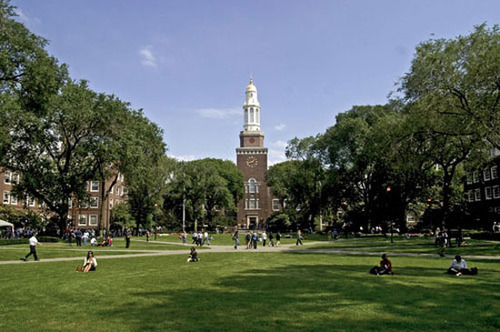
Academic Freedom Vindicated in Brooklyn
By STANLEY FISH
Debates about academic freedom almost always begin in confusion and end in confusion, but the recent controversy at Brooklyn College is a welcome exception to that rule. When the dust settled, the right thing had happened, the right things had been said, and the wrong things had been repudiated.
First, what happened. On Thursday evening, Feb. 7, in a forum co-sponsored by a student group and the Department of Political Science, Judith Butler of the University of California, Berkeley, and the Palestinian activist Omar Barghouti explained and defended the agenda of the Boycott, Divestment and Sanctions movement ( B.D.S.). The point of the movement, said Butler to an audience of several hundred, “is to withdraw funds and support from major financial and cultural institutions that support the operations of the Israeli state and its military.” (The transcript of Butler’s address was published at The Nation.com).
Among the cultural institutions a boycott might target are those Israeli universities that are judged to be either actively in league with the government’s policies toward the Palestinians, or complicit with those policies by virtue of remaining silent while they are being implemented. To the charge that a boycott of academic institutions is a violation of academic freedom, B.D.S. supporters reply that because the state of Israel abrogates the academic freedom of Palestinian professors and students (by denying them funding, access and mobility), it is an affirmation, not a derogation, of academic freedom to refrain from engaging in intellectual commerce with Israeli universities. You can’t invoke academic freedom, they say, when you’re denying it to others. So the lines of battle are set with both sides claiming to be academic freedom’s champion, and it is easy to see why a college might be thought to be an appropriate venue for a discussion of the matter.
But a number of New York city politicians didn’t see it that way, and they proceeded to say the predictable wrong things. On Jan. 29, nine members of the Council of the City of New York wrote in a letter to the president of Brooklyn College, Karen L. Gould, to declare that, along with others, they found it “offensive” that the college was giving “official support and sponsorship to speakers who equate terrorists with progressives and the Israeli people with Nazis.” Indeed so offended were they that they reminded Gould, in a tone of unmistakable threat, that as legislators they had many calls on the funds at their disposal, and that by persisting in its plan to host the event, the college risked financial loss: ‘We do not believe this program is what the taxpayers of our city…want their tax money to be spent on.”
The answer to this is simple: taxpayers, through their representatives, decide whether to support a college, but once that decision has been made in the affirmative, taxpayers and their representatives must allow the institution they have created to carry out its mission, which is not to reflect or ratify the ideas the public favors, but to subject all ideas, including those the public dislikes, to the scrutiny of rational deliberation. It can’t be the case that a program or a course must be approved by popular vote before a college can sponsor it or put it in the catalog. What taxpayers have bought when they fund an institution of higher education is the independent judgment of credentialed teachers and scholars. If they wanted an echo chamber that sent their own views back to them, they could have funded a talk-radio show,
At the end of their misguided letter, the nine council members declared that “We believe in the principle of academic freedom.” But then, in the very next sentence, they revealed a total misunderstanding of the principle they claimed to espouse: “However, we also believe in the principle of not supporting schools whose programs we, and our constituents, find to be odious and wrong.” Or, in other words, you can freely say anything as long as it is something we approve. (Who elected these guys?)
Another team of worthies, self-described as “progressive elected officials,” proved equally adept at making fools of themselves. TheirJan. 31st letter to President Gould (who must have been wondering which politician she was going to hear from next) began, “We collectively believe that the B.D.S. movement is a wrongheaded and destructive one, and an obstacle to our collective hope for a peaceful two state solution.” This is ( to use their own word ) wrongheaded in two ways. First, what they believe about the Middle East conflict would be relevant were they voting on an appropriation (three of them are members of Congress), but neither they nor their beliefs have any relevance to a college’s decision to invite and/or approve an outside speaker. Were Brooklyn College to alter its behavior because of the beliefs of “progressive elected officials,” or anyone else for that matter, it would at that moment become a political rather than an educational institution.
Second (and in the same vein), while individual faculty members might have views about the desirability or feasibility of a two-state solution, the college that employs them cannot appropriately express a view or imply an endorsement of one by welcoming some speakers and excluding others. Nothing a college does should be done with the intent of furthering a two-state solution or any other; that’s not the business it is in.
I am not saying that the college should be neutral, but that the college should not have political issues on its radar at all except as possible objects of academic analysis. The trouble with invoking neutrality, as many who objected to the program did, is that the next step is to demand “balance” and the equal representation of all viewpoints, precisely the demand made by the “progressive” (read hopelessly confused) officials when they complained that the event as planned excluded “alternative positions” and was therefore “one-sided.” But “balance” is a political, not an academic requirement; it looks not to the intellectual interest of a proposed topic, but to the political interest of appeasing various constituencies.
When academics consider what materials to include in a syllabus or what programs to sponsor on a campus, their concern is the illumination and edification of students. Would it help them to read this? Is this point of view one they should hear because to be ignorant of it would be to have a gap in their knowledge? (Note too that introducing students to a point of view signals neither approval nor disapproval of it.) But when academics look nervously to external constituencies in making their pedagogical choices — I had better include one of these or Alan Dershowitz is going to come after me — the choices they make are no longer academic; they have abandoned the search for truth and are instead searching for political approval. The progressive officials declare that refusing “to permit all voices to be heard … is the antithesis of academic freedom.” No, the antithesis of academic freedom is the demand — in the sense of you must do this — that all voices be heard, for that is to be dictating from the outside (and for blatantly political reasons) how a class or an extracurricular event should be configured. (The choice of how many voices to include is the prerogative of the teacher or conference organizer, not of a congressman or member of the city council.)
These two public efforts at intimidation drew a vigorous response from educational experts and from officials at Brooklyn College and its parent, the City University of New York. President Gould hit the nail on the head — and put a nail into the coffin of the overreaching politicians — when she explained in a statement that “Brooklyn College does not endorse the views of the speakers visiting our campus next week, just as it has not endorsed those of previous visitors to our campus with opposing views.” Or, in other words, you just don’t understand what goes on in a college or university. Barbara Bowen, president of CUNY’s Professional Staff Congress, in a letter to the hapless public officials, skewered the “balance” argument: “Academic freedom is ‘the free search for truth and its free exposition.’ Academic freedom is not ‘balance’; it is not the requirement that departments support only forums that advocate equally strongly for two ‘sides.’ ”
But the coup de grace was delivered on Feb. 6 by Mayor Michael Bloomberg who hung back (as Christine Quinn did not) so that he could deliver the fatal blow. He began by saying that “he could not agree more strongly with an academic department’s right to sponsor a forum on any topic they choose” and, in a direct hit at his less astute fellow politicians, he declared that “[t]he last thing we need is for members of our City Council or State Legislature to be micromanaging the kinds of programs out public universities run … I can’t think of anything that would be more destructive to a university and the students.”
By the time the event occurred and went off smoothly, some of the hasty signatories to the two letters had withdrawn their names and others had softened their stance. Had they been in attendance, they would have heard Judith Butler give a letter-perfect account of what academic freedom is. She said to the assembled audience, “I presume that you came to hear what there is to be said, and so to test your preconceptions against what some people have to say, to see whether your objections can be met and your questions answered … and if the arguments you hear are not convincing, you will be able to cite them, to develop your opposing views and to communicate that as you wish.” Whether they heard Butler or not, as an academic I hope that the City Council members and representatives learned something in the course of this tempest-in-a-teapot; but as an observer of the behavior of politicians, I doubt it.
{One of my alma maters.}
Been a CUNY kid through and through.
sagansense:
First Mars Image One of the earliest images from...
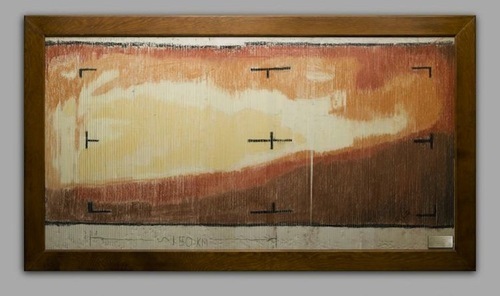
First Mars Image
One of the earliest images from Mars is this strange picture from the Mariner 4 mission in 1964. Too anxious to wait for the official processed shot from the spacecraft, engineers at JPL simply converted the image data into integers and then hand colored it in like a paint-by-numbers drawing.
Mariner 4 transmitted the first close-up pictures of another planet and revealed Mars to be a dry, desert-like world.
Image: NASA/JPL/Dan Goods
scottcheshire:
Writing Beauty and Terror:
Gotham Writers’...

Writing Beauty and Terror:
Gotham Writers’ Workshop: Phil Klay, Paul Fussell, Kenneth Koch
This past Tuesday at the Gotham Writers’ Workshop we not only got to talk about Phil Klay’s super story “Redeployment” - published first in Granta and now in the lovely new anthology of war writing Fire and Forget http://www.amazon.com/Fire-Forget-Short-Stories-Long/dp/0306821761 - but Phil was kind enough to provide me with a few supplemental materials that have clearly influenced his work.
We looked at Paul Fussell, an excerpt from The Great War and Modern Memory:
http://www.amazon.com/Great-War-Modern-Memory/dp/0195133323
“One of the cruxes of the war, of course, is the collision between events and the language available—or thought appropriate—to describe them…”
And we read “To World War Two,” the extraordinary poem by Kenneth Koch. The full collection is here:
http://www.amazon.com/New-Addresses-Poems-Kenneth-Koch/dp/0375709126/ref=sr_1_1?ie=UTF8&qid=1360778934&sr=8-1&keywords=new+addresses+koch
But here are a few choice lines:
“I’m glad you ended. I’m glad I didn’t die. Or lose my mind.
As machines make ice
We made dead enemy soldiers…”-
Fussell actually claims that soldiers have no real trouble at all with the available language for describing war. The problem rather is discovering “that no one is very interested in the bad news they have to report. What listener wants to be torn and shaken when he doesn’t have to be? We have made unspeakable mean indescribable; it really means nasty.”
This speaks to the very heart of what I’m hoping this class will accomplish. That is to awaken our senses to the more difficult things, terrors both everyday-banal and explosive, and write about them. Why? Because in order to write about them in such a way that the reader sees them, really sees them, the writing must be beautiful - as there are indeed moments of great beauty in Klay, Fussell, and Koch, even amidst all that terror. And in order for the writer to write this way, we must look. We must really look.
March 5th at Seeds::Brooklyn

I’ll be reading A NEW STORY at Seeds::Brooklyn on March 5th, 8PM.
I haven’t read in public in maybe 2 years… SO IT’S BOUND TO BE GREAT.
Thankfully, I’ll be joined by Nick Dybek and Catherine Chung with Carmiel Banasky at hosting duties.
Will it be amazing? Will it be a disaster? THE WONDER OF LITERATURE IS FINDING OUT! (no, seriously though it will be great. Come. We’ll drink together.)
February 12, 2013
poetrysince1912:
—Pablo Neruda, Poetry, January 2000Pablo...
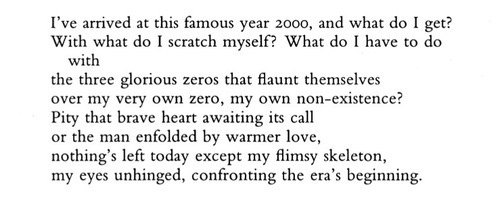
—Pablo Neruda, Poetry, January 2000
Pablo Neruda’s remains to be exhumed in order to investigate the cause of his death.
The City of Devi by Manil Suri

Just got back from Manil Suri’s reading of The City of Devi at B&N UES (86th and Lexington in New York)— and man does the book sound fantastic. It had sex and violence; it had atomic bombs; it had a powerpoint presentation!
He’ll be back tomorrow evening so stop by!
And if you’re not in NY, check out his other appearances here.
Another Great Book of Words and Sentences: A Book Report by Lincoln Michel
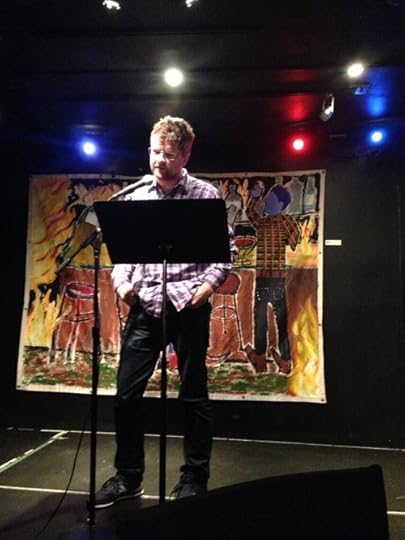
A book report on Moby-Dick constructed from random sentences in negative Amazon and Goodreads reviews.
First, let me tell say that despite the fact that my maiden name is Melville, and Herman is a relative way way back, I began this book with high hopes. I bought it about two years ago for 17 US Dollars. Might need the knowledge if I’m ever the Phone A Friend on Who Wants to Be a Millionaire?, I said. My daughter had an assignment to read it over the summer, but she can’t read in the car without turning green. Turns out this is not pornography of any kind.
In this book there is a whale and some men…I will not give away any names. Boy gets whale. Boy loses whale. Whales are lovely, peaceful creatures. Whale foreskins makes me want to stab my eye. They leave you with that, “I hate myself” feeling you get after accidentally destroying a major city with a hydrogen bomb.
It’s gauche, jejune, primitive. Don’t get me wrong, I don’t object to unfamiliar words. Quite the contrary, I enjoy adding obscure words to my vocabulary and sprinkling them in my conversation. The whole time I kept thinking, what the hey is this?? Out of nowhere it goes into this dull drum solo. It reminded me a bit of Ayn Rand’s philosophy, whatever that is called.
Look, I’m not some high school student. I have a degree in English Education, and my son in law is an English major. I’m a very well-read 42 year old. I consider myself an easy-going person. OK, so yeah, I have a master’s degree in literature. I bought this book for a friend in jail. Yep if my kids ever kill someone, they’ll be forced to read Moby Dick. A book for a 7 year old. Yet the print is painfully small for my 63 year old eyes.
On the plus side, the basic plot is certainly a classic, essentially the plot to “Jaws.” The problem with this is an extremely irritating sing-song pattern, combined with his squeaking, yelling, and mumbling. It’s unlike any dialog that has ever taken place between any actual humans anywhere, ever. I mean: pages devoted to the act of just plain sleeping, and then more pages devoted to eating? Yeah, the “symbolism” is so deep. Maybe Melville was the Justin Bieber and “Twin Peaks” of his day, talentless and meaningless.
In conclusion, Herman Melville would have been the star of Polish literature classes in the Eighties. He’d FOLLOW YOU INTO THE BATHROOM and keep talking to you about whales while peering over the side of the stall and trying to make eye contact with you the whole time.