V. Moody's Blog, page 91
April 8, 2013
Guidelines Not Outlines
Some people like to have detailed outlines before they start writing. Others prefer to wing it and enjoy the process of finding out what the story’s
about as they go.
Both styles are perfectly fine and workable, it comes down to a question preference.
If you have a method that works for you, that’s the one you should use.
The problem for some people is that working it all out beforehand is
too constricting AND leaving it all to inspiration is too vague. Neither
approach works.
Slavishly following a blueprint leaves little room for working in things
that only occur to you while writing. And free writing hundreds of pages only
to discover you’ve gone down a dead end can be soul destroying.
What might help is to have enough of an outline so you aren’t going to
waste loads of time, but without pinning down all the details of what happens to whom.
Bear in mind that whatever approach you take, eventually you will have
a complete draft that is roughly the story you want to tell. From then on it’s
a matter of revision and refinement. That means the grind of being creatively
locked into a set storyline with only tedious redrafting is unavoidable. That’s
what writing is. So if you are totally against that, stick to short stories and
poems.
But as long as you are prepared for the hard work, you can help
yourself by having a rough idea of where you are going by not working out what
happens in a scene, but by working out what gets in the way.
If you can spend a little time thinking about the obstacles your
characters will be facing, and invest enough time to make them interesting,
hard to deal with problems, then there’s a good chance you will have enough of
a guide to know which direction to go, but also enough to keep your brain engaged
when you get there.
So, for example, if I was writing a story about a hot air balloonist
who decides to use his skills to rob a bank (don’t ask me, I’m making
this up as I go along), then I might decide to start with him taking customers
up for a sightseeing tour, but they get caught in a tornado (no idea how they’ll
survive—maybe some won’t). Next scene is him deciding give up the glamorous
world of ballooning but his boss blackmails him into staying, no idea how. Then
he meets his new team who he has to train, but they’re high school children...
My point is that I can spend
time working out each scene in plenty of detail (and I’m suggesting taking your time
to come up with some interesting obstacles—certainly more time than I'm taking coming up with my example). Not just a difficult predicament, but one that you'd be interested in seeing played out.
But because the focus is on problems
not solutions, you can spend as much time as you want on details and when it comes to writing out the full version there’ll still be plenty
to do.
Now, you may feel that finding out what each scene is about is
something you enjoy discovering with your characters, in which case that’s
perfectly okay. But for those looking for something in between this may offer a
third way.

If you found this post useful, please give it a retweet.
*
Check out my latest stories for free on Wattpad.


April 6, 2013
Focus On What Matters

Characters
in stories tend to be single-minded. Either they’re driven by some internal need, or circumstances force
them, but they rarely live a carefree existence going from one thing to the
next as they please.
There’s a
reason for this. Once a reader is interested in what a character’s doing, they
want to know the outcome. Of that story.
If you go
off in various tangents, even if you intentionally do it in an attempt to
generate tension or suspense or mystery, there’s a good chance you’ll just
annoy or frustrate those readers.
But there’s
a problem here. In order to make a story dramatic and layered,
you actually need to go off in different directions, to pull the reader off the
main road every now and again.
The trick is
to divert the reader’s attention by using even more pressing matters.
There’s no
point having a character stop looking for her missing daughter to drop into an antiques store
because she's into collecting old china plates.
But pausing
in the search to rescue another child kidnapped by the same madman does make
sense.
You have to
put yourself in the mind of your character, make it clear to yourself what the
main goal of that character is, and then only let them deviate from their
target for things that merit it. Even if she really adores old china plates, now's not the time.
What's considered important enough to accept veering off is going
to be different for different characters (and different genres), but it
has to feel worth it. Both in the mind of the character and the reader. Rather than just going wherever your
mind takes you and hoping the reader won’t mind too much. They will.
There are also ways to integrate scenes so you don't have to stop one thing to do another. If, for example, the detective discovers where the killer's cabin is located then he's obviously going to head there straightaway. You can't decide to wait until morning because you have a great scene planned over dinner between the detective and his partner.
However, you can make the cabin a three hour drive away, and he can have the discussion planned for dinner in the car instead.
It’s not
enough to change the character’s focus because it suits the story or if its
importance is to be revealed later, you have to provide a fitting excuse for
taking the reader away from the main storyline up front, or you have to find a way to do it at the same time.
As long as you do that, the reader will happily go off with you, maybe even enjoy the diversion.

If you found this post useful, please give it a retweet.
*
Check out my latest stories for free on Wattpad.

April 5, 2013
Emotions Belong To Readers

When it
comes to using emotion in a story, the person whose emotions should be most
important to you is the reader.
An
emotionally invested reader is more likely to go wherever the story leads, and
also more likely to make allowances for parts of the story they aren’t too sure
about.
You can
still keep readers engaged through intellectual curiosity or general drama and
action, but grabbing them emotionally is always going to be the most intense
experience for them.
The simplest
way to do this is to mirror emotions. The character in the story feel happy or
angry or scared and the reader feels the same.
But you can
also create scenarios that induce different emotions in reader and character. A
killer taking great pleasure in his kill won’t engender the same in the reader.
A daughter pretending she doesn’t know her own mother in front of her cools
friends can make the reader weep while the characters on the page all behave
with barely any emotion at all.
The ability
to juxtapose characters in such a way as to spontaneously combust into emotion
for the reader is a tricky thing to achieve but can be a very powerful an
experience for the reader.
The cause of
emotion rather than the display is where to focus. In order to do that
effectively, you need to understand how actions create emotions.
This can be
difficult since in real life we just feel what we feel and ascribe blame
retroactively. I feel angry at Jack, therefore what Jack did must be worth
getting mad about.
But that
isn’t necessarily true. I could just be an over-sensitive whiner who likes to
fly off the handle whenever challenged by a reasonable person. Judging actions
by the emotions they create within you personally is not the best barometer.
You have to
be able to step outside of your own personal feelings and view things
objectively, see where the emotion is coming from (or isn’t) and adjust
accordingly.
If a girl
sees a snail on the way to school every day, and one day the snail is dead and
the girl is upset, will the reader be upset too?
Maybe.
If the girl
is bullied at school and ignored by busy parents, and uses the snail to confide
in, telling it her fears and worries, even though the snail doesn’t respond in
any way, when it dies will her anguish be felt by the reader now?
If the snail
is killed by the school bully who drops a brick on it, can I switch sadness into
rage?
If she takes
the snail home and the mother is disgusted and throws it over the garden wall,
and the girl retaliates by taking the mother’s pearl necklace and flushing it
down the toilet, can I create sympathy for the girl? The mother? The snail?
Any given
situation can be turned in any given direction emotionally if you understand
the link between what people do and what they feel. How well it works is a
matter of skill, but the emotion in the reader is waiting to be turned on. You
just have to decide which switch you want to flick.

If you found this post useful, please give it a retweet. Cheers
*
Check out my latest stories for free on Wattpad.

April 4, 2013
Differentiating Through Dialogue

While
there’s nothing wrong with making characters sound different by giving them
specific accents, it’s not something you can do for every character in a story.
Not unless your tale takes place at the United Nations.
And while
giving them vocal tics is useful, yeah? It helps identify them quickly, yeah?
It also gets old just as quickly, yeah?
Rather than
using how people speak to make them stand out, it is much easier and more
effective to use what they say rather than how they say it.
If one
person is for the new helipad on the local hospital and one is against, and a
third is only interested in getting the other two to stop arguing, then their
individual positions on the matter is what marks them out.
In order for
this to work you have to streamline the conversation a bit. In real life,
people may go off on tangents or use chit chat to pad out lulls in a
conversation, but doing that in fiction will only undo any work you’ve done to
establish which character is taking which stance.
Obviously,
you can still use dialogue tags and the characters’ names to identify them, but
even if you do that, it can become confusing in dialogue heavy sections if you allow them to go off-topic.
You don’t
just want a reader to be able to follow who’s saying what if they carefully
read every single word at full concentration, you want them to be able to get
into the flow of things and automatically get a feel for who’s speaking.
By staying
focused on the matter on hand, whether it’s robbing a bank or going shopping
for shoes, and giving each character a distinct objective, who’s speaking will
become much easier to work out.

If you found this post useful, please give it a retweet. Cheers.
*
Check out my latest stories for free on Wattpad.

April 3, 2013
Choosing Character

There are
two basic types of character: the ordinary person and the special person.
The special
person is really good at their job, has skills most people don’t, or maybe even
possesses powers beyond those of regular folk.
The ordinary
person is like you or me.
Once you
decide which type your main character is, the important thing is to get the
reader to see the character as someone worth reading about.
Both types
have certain drawbacks which, while not a problem, need to be addressed.
The ordinary
character often starts off his story with not much going on. It’s necessary to
establish the kind of life he leads, but this can easily become boring.
There’s
no reason why everyday life has to be a chore to read about, but just
portraying a character’s existence accurately isn’t going to be enough to hold
the reader’s attention.
The risk
with the specialist character is that they will deal with their problems too
easily. The plot can be so well suited to their particular set of skills that
it ends up feeling contrived.
The guy who was a hero in the army beats up ten
guys, builds a gun out of spare parts and makes an impossible shot to save the
day. Luckily, those were the three things he was really good at.
In both
cases, you need to show the character as more than one dimensional. And to do
so as early as possible. You can do this for both types in a very similar
manner.
The ordinary
character still has to deal with mundane issues before things get crazy, and
how he deals with them will reflect his personality, even if that personality wants
to run away and hide.
The special character can’t use his special skills in all
situations. If a meter maid insists on giving him a ticket he can’t just karate
chop her in the neck.
We all have
to deal with unglamorous problems that have nothing to do with saving the world
or finding love, but rather than rushing through them to get to the main plot,
those are the moments you can use to your advantage.
If you make
those moments socially awkward and difficult to navigate, how your character responds will
establish the kind of person he is very quickly.
If the
character is in a rush and is told to wait, you can show them waiting and getting
frustrated, but that doesn’t reveal anything. If you show how they get around a
minor obstacle in an unexpected way it will show the kind of person they are,
and it will also make the scene more interesting.
The key is
not to allow them to just do as they’re told. Give them a reason why they can’t
wait and then see what they do.
A character
who is forced to cut in at the head of a line when normally they would never
do that will reveal a side of themselves in a dramatic way without the need for
guns and car chases. If you can come up with a good enough reason for why they
can’t back out, the rest will take care of itself.
And often how the character
handles the situation will surprise even the writer.

If you found this post useful, please give it a retweet. Cheers.
*
Check out my latest stories for free on Wattpad.

April 2, 2013
Beginnings And Their Endings

My view has
always been that great first lines are overrated. Famous opening lines tend to
become famous after the fact. Once a book becomes acclaimed or well-loved, the
opening takes on a significance that it didn’t have to start with. Nobody read
“Call me Ishamel” and thought, Genius!
First paragraphs
are overrated too. Orson Scott Card has a theory that the first paragraph is a
freebie, and I’m inclined to agree with him.
The first
paragraph can be in a different POV, be generic or introductory, set the tone,
or be the lyric from a song. It doesn’t really matter and readers don’t really
expect it to be consistent with the rest of the book.
Ever since
somebody came up with Once upon a time... readers have understood that.
First
chapters, however, are important.
They didn’t
used to be, or at least not as much as they are now, but with the way ebooks
are sold, allowing only access to the first few pages, it is much more likely
that reader will read that sample and use it to decide on whether or not to
make the purchase.
That isn’t
how I would choose to judge a book. My experience is that openings of books
rarely give an accurate indication of whether the rest of the story will be any
good. Sometimes a book starts great and stays that way till the end, but
rarely. Sometimes they start well and fade, other times they’re slow to get
going and then come into their own.
However, the
emphasis on the first chapter is changing because of online sites offering the
first chapter for free. And not only
does it matter that you give the reader something to draw them in, it also
helps if the end of that chapter makes them want to keep reading (i.e. buy the
book).
Of course,
this will lead to a lot of gimmicky ends of first chapters of the kind where
something outrageous and inexplicable happens to make the reader want to know
what happens next. Despite knowing it’s a writerly ruse, enough people will be
unable to resist to make it a ruse worth considering.
Whatever
your thoughts on what should be happening in your first chapter, if you hope to
sell it online, it’s worth bearing in mind how important the opening few pages
will be, and while not every story should start like a cheap thriller, it might
be an idea to think of chapter one like
the first part of a serial.

If you found this post useful, please give it a retweet. Cheers.
*
Check out my latest stories for free on Wattpad.

April 1, 2013
An Awesome Idea

For this
year’s A to Z Challenge I will be doing a series of hints and tips on how to
get from the start to the end of the writing process. I will be keeping these
posts relatively short (for me). And a big thank you to Arlee Bird for creating the
A to Z Challenge. Cheers, Lee!
*
Some people
can sit down with a blank page and start writing. Come to think of it, we can
all do that. But some people actually like what they end up with. And by some
people I mean not me.
What most of
us need before we start writing is an idea. A good one.
I don’t mean
a complete story or vision for what you plan to write, I’m talking about an initial
spark to get you going. It is possible to start without that, but I wouldn’t
recommend it.
It could be
an image, a photo, a line of dialogue, a scene, an object. Whatever it is that
first excites your imagination into story mode, the usual advice is to stick it on the wall above
where you write, make it the wallpaper on your computer desktop, pin it
somewhere you can see it all the time.
I find it
more useful not to do that.
Take the
thing (if it’s an idea or a line of dialogue, write it down or make a Word
document) and put it away. In a drawer, in a folder. Obviously put it somewhere
you won’t forget. Label it clearly. Then don’t refer to it again until at least
after the first draft.
The longer
you can manage the better.
At some point
in the writing process you will get lost. Your enthusiasm will desert you and
you’ll start to imagine that what you’re writing is a big pile of poo.
That’s when
to get out your inspiration and remind yourself what started you down this
road.
Because familiarity
makes things lose their lustre. Depriving yourself of the thing that inspired
you in the first place helps it keep its magic. It won’t necessarily help you
solve any problems or come up with great new ideas, but it will, hopefully, respark your enthusiasm for the project.

If you found this post useful please give it a retweet. Click on the AZ badge to see the list of other participants.
*
Check out my latest stories for free on Wattpad (I'm experimenting with this site).

March 28, 2013
Lost In Transitions

When a character is focused on a single objective, the flow of the
story is fairly easy to maintain. Detective Sherry Sharp is after the psycho
who killed her sister. She hears about another victim found downtown and she’s
in the car on her way, enraged and determined.
How you get Detective Sherry from one place to another, and how you
manage her emotions from one state to another will more or less take care of
itself.
If, however, you have various objectives and storylines to contend
with, things can get tricky.
If FBI Special Agent Harrison is assigned to the case and he and
Sherry start to develop an attraction so that you have a romance element to the
story that gets hot and heavy, there’s nothing wrong with that. It’s quite a
common type of premise. But switching between the horror of finding mutilated
corpses and cheeky flirting between colleagues isn’t something that you can do
at will.
Sherry stormed into her office
and slammed the door. How dare he come in to her precinct and take over her
case. Nobody was going to stop her from catching the son of a bitch who killed
Julie. Nobody. Just because he had a shiny FBI badge and broad shoulders and
kissable lips, that didn’t mean he could tell her what to do.
That sort of switch of tone is going to be noticeable and jarring.
The reader will understand what’s
happening in different parts of the story, but it’s a bit like going down a
river, hitting a sand bar and having to drag your boat over the ground until
you find more water, and then getting back in.
It’s not that you can’t do it if you have to, but it’d be a lot easier
if you found a way to stay in the water.
The first thing you can do to avoid this is to maintain a consistent
tone. If Detective Sherry is torn up about her sister’s death, she isn’t going
to be making goo-goo eyes and swapping snappy one liners. You can still have
them end up in bed, but fun and flirty might not be the route to take them
there.
Or, iIf you want to have witty banter, then maybe the murder side of
things needs to be toned down.
However, people are complex
beings and are capable of compartmentalising. If you wish to explore that side
of them, then at least make them self aware. If Detective Sherry recognises
that she’s behaving inappropriately with the FBI agent, with her sister lying
in the cold ground, then that will lead her to react in a more realistic manner
(guilt, shame, anger....).
That approach can even help deepen POV and let us get to know the
character better, and maybe like her more (even if she is a wanton slut).
The other technique that can be helpful is to use subtext. What the
reader feels without being explicitly told or shown has a powerful effect
without getting in the way. If the FBI agent has to change his shirt and Sherry
notices how big his muscles are, that might clearly demonstrate that she’s
attracted to him, but that kind of bluntness also overwhelms the tone.
If she argues with him all the time but when he goes missing and she’s
ordered to go do something else, but she disregards and goes after him on her
own, that tells you how she feels about him without hitting the reader over the
head with a hammer.
Integrating various storylines so they are consistent and concurrent
isn’t always possible, but finding ways to make different aspects of a story
equally important emotionally helps make the transition smoother.
So Detective Sherry wanting to find her sister’s killer and also
wanting to go to bed with Special Agent Beefcake is going to be difficult to
transition between.
Finding her sister and wanting to stop Agent Harrison also getting
killed, much easier to integrate.
But if the two elements are too far apart then you need to consider
making a more drastic change. Maybe it isn’t light-hearted banter that brings
them together, maybe it’s vulnerability and despair. Or perhaps her sister was
killed many years ago so the pain isn’t as fresh and only emerges when
triggered by specific events.
Once you identify the problem, there’s always going to be adjustments
you can make to fix it. Of course the fix may not be something you want to
write about, which is also okay because there’s always more than one fix. Just
might take a little longer.

If you found this post interesting, please give it a retweet.
*
I've started posted some stories over at Wattpad. Please visit if you're a member (or even if you aren't). My page can be found here.

March 25, 2013
A Good Solution Needs A Good Problem

For a character’s story to be interesting, they have to do interesting
things.
Activities and pastimes we enjoy depend on our personal preferences. A
writer’s passion can make a subject matter more accessible, but you need more
than that to engage a reader fully, regardless of their personal preferences.
The tale of Jack Jackson who went surfing for the weekend and had a
really fun time catching awesome waves is only going to be of interest to Jack
Jackson and people who are really, really into surfing. And who can also read.
When it comes to stories, interesting means something different.
In order to make a story interesting for the reader you have to create
a situation where a character wants something they can’t have, and then see
what they come up with to get it.
What they want can be a pot of gold or to get out of a haunted house
alive, the only requirement is that it isn’t easy to obtain.
Once you know that, putting ridiculous obstacles in the character’s
way is the easy part. Providing entertaining and satisfying solutions is where
things can get unstuck.
The danger is that because the writer has the ability to make anything
happen at any time there’s always a way out of any situation for the character.
Or cheating as it’s also known.
On the other hand, if you do set your character’s an interesting
challenge, you then have to fulfil the expectation that they’ll be able to able
to meet it. If Johnny is the smartest boy in the world, you then have to write
him in a way that proves it. And if the
princess demands the prince give her a gift that shows he loves her most in the
world, then you have to come up with a gift that satisfies both the princess
and the reader.
It’s obviously far easier to rely on perseverance than inspiration.
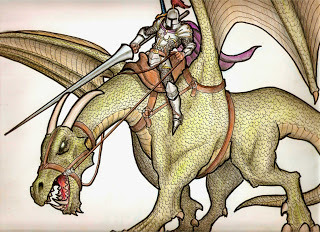
The knight defeats the dragon by fighting as hard as he can. The man climbs the
mountain by gritting his teeth and refusing to give up.
But coming up with a solution isn’t enough, it has to be a solution
worth reading about. And the only way to
do that is to paint yourself into a corner. You have to take away all the easy
answers, the obvious answers, the answers that are within reach, and then see
what you can come up with.
If the knight is fighting a dragon whose hide is invulnerable to
weapons and its flame can burn through any metal, then what?
Of course, then the problem becomes the writer’s. How do you defeat
the undefeatable?
This is where reading comes in useful. Not for finding solutions you
can ‘borrow’ (although that is definitely one option) but because when you read
a story where the problem seems insurmountable, and then it gets surmounted (is
that a word?) your mind opens up to the possibilities of not only how to solve
problems but also how to present them so that they seem unsolvable when they
aren’t.
Because that power the writer has to make anything happen, that works
for the question as well as the answer. Once an idea starts to form in your
mind, it doesn’t have to be perfect. You can adapt the scenario to fit it
better.
If it occurs to me that my knight might not want to kill the dragon
and instead make a deal with it, then I can go back and make dragons in this
world intelligent and capable of understanding speech. As far as the reader
will be concerned that was always the case. They don’t get to see earlier
drafts.
It can be a bit scary trusting your brain to come up with something
useful, especially if you’ve been thinking about it for a while and nothing
seems to be happening. But all the best ideas are annoyingly shy and withdrawn.
And sometimes you will fail and have to think of another approach. But
sometimes you will succeed (most of the time in fact), and because you made it
so tough for yourself, the solution will be all the more impressive for it.
If you fond this post in some way useful, please give it a retweet. Cheers.

March 21, 2013
Tell The Reader Why Part 2

In the last post I took a look at making it clear what was behind a character’s
actions and suggested that in most cases it's preferable to just tell the
reader what's going on up front.
In this follow up I will attempt to clarify how and when to use
telling to get the most out of a scene. As with any technique, a lot still
depends on how well you execute it, but knowing the advantages and
disadvantages should help.
For the purposes of this, the example I’ll be using will be a man
breaking into a house.
There are three ways to do this in terms of character motivation.
1. I don’t tell you why he’s breaking into the house and either let
you figure it out for yourself or reveal his reasons after the fact.
2. I show you in a previous
scene why he needs to get into this house.
3. I tell you his reasons as
he breaks in or just before.
1. Jerry squeezed through the
window and dropped to the floor. He crouched, frozen, listening for any sounds.
In terms of making it clear what going on, you can do that very easily
simply by relating what he does as he does it. There should be no confusion
about the fact he’s in a place he shouldn’t be, that he’s worried about getting
caught, and establishing tension should be pretty straightforward.
The way he acts, the care he takes to not get caught, will create
suspense and drama and draw the reader into the story.
But how long will the reader wait to find out what he’s up to? And
what does the writer gain in making them wait?
2. “I swear on
my life,” said Miranda. “I left your mother’s ring on the bedside table the day
we broke up. I don’t have it.”
Jerry nodded
his head. “You’re a lying bitch, Miranda.”
In order to show Jerry’s reason for house breaking
you would need to go back in time (either through flashback or by starting the
story earlier). This requires extra work.
You obviously want any scene you write to be dramatic and interesting, and you
have to make a judgement about whether it’s going to be worth it.
You will be affecting the pace and entry point, and
you may also be opening the door on a bunch of other reasons and motivations.
If you’re going to show all motivations, where will it end?
And another issue is that it’s only possible to show
fairly simple motivation. Anger or guilt or jealousy can be dramatised quite
easily. Anything more complex or subtle isn’t quite so straightforward.
If Jerry’s breaking into his ex-faincee’s house to
get back the engagement ring she claims she no longer has, and the reason it’s
important to him is that he suspected she cheated on him but he could never
prove it and if he finds the ring in her house, that would prove she was a liar
and so indirectly prove him right for dumping her... how would you show that?
3. Jerry stood in Miranda’s bedroom and
thought, If I was a lying, conniving bitch, where would I hide an engagement ring
that didn’t belong to me?
How much info I choose to give the reader, and what
tone I use (Jerry is apparently still quite upset with Miranda) is a matter of
personal preference. But the question I would pose is this: does informing the
reader about the character’s motivations take away from the reader’s curiosity
about what happens next?
Because often the reason writers decide it is worth
allowing the reader to be confused is because of the extra sense of intrigue it
produces. But in truth, as long as the character’s reasons are valid, they won’t
be any more interesting by revealing them later.

If you found this post useful, please give it a retweet. Cheers.