V. Moody's Blog, page 89
May 6, 2013
Your Book In One Sentence Pt 2

The recent post I did (HERE) on condensing your
story into a line or two received some interesting feedback so this follow-up
post will take a deeper look at the techniques involved in summing up the story into something short, easy to understand and yet
interesting. And the pitfalls along the way.
Bear in mind the idea isn’t to come up with
a beautifully crafted slogan that makes people want to rush out and buy the
book on the strength of the logline alone. Your job isn’t to invent bubblegum
that tastes like a three course meal. If people want to experience those
flavours they should just eat a three course meal.
This will be more about telling somebody what the
story's about, whether they be an agent or your mother.
I’m going to base my examples off the movie Jaws. This is because you will already
be familiar with the story (even if you’ve never seen it). But since you
already know the story and are aware of how successful and well-received it is
in popular culture, it’s going to be hard not to bring your preconceptions to
it.
So, if you asked me what it was about and I said,
“It’s about a big shark that eats people,” that would be enough for you to
recognise the movie. But if you’d never heard of Jaws you might say, “And?”
In many ways this is the main problem with trying
to capture a whole book in one line. You are the person who’s seen Jaws and can immediately see the story
behind the short description above. But the person you’re telling hasn’t even
heard of it. In fact the idea that fish eat people is something completely new
to them.
Whatever you come up with to describe your book,
you already know the extrapolated version that is your novel. A word or a turn
or phrase will have significance for you that it won’t have for the person
you’re telling.
Here’s an example of what I mean:
When a great
white shark terrorises Amity Island, the Police Chief combines forces with a
veteran fisherman and a marine biologist to catch the killer fish. What they
don’t realise is they’re going to need a bigger boat.
Now, that sort of sums up the movie. But the added
verve my little pitch has from the line “need a bigger boat” comes from the
fact that you already know that it’s one of the most famous lines in movie
history.
If you didn’t know that, it wouldn’t have anything
like the same effect.
Even though intellectually you get what I mean,
it’s still hard to fully accept. That bigger boat line, you might say to
yourself, could still have some impact. It sort of suggests problems ahead,
something for which they’re unprepared, but that feeling comes from an
inability to put yourself into the mind of someone who truly has no
preconceived ideas.
Without that pre-knowledge, it’s just a strange
way of saying it’s a very big fish. Meaning what? That it’s a mutant shark the
size of an oil tanker? That they set off in a rowing boat? It’s too vague to
have any real meaning.
Even now some of you are probably thinking, It’s not that vague, because to you it isn’t. To you, no matter how hard
you try to look at the line objectively, a residue of its meaning will remain.
And if it’s that hard to disassociate yourself from
an old movie that you had nothing to do with, imagine how hard it is when it’s
your story that you’ve completely immersed yourself in for months, maybe years.
When a writer tries to give their logline a bit of
pizzazz to make it stand out and be more memorable, they might use a turn of
phrase that’s cheeky or intriguing or clever. But often it will only make sense
once you’ve read the book. Which is pointless, since the whole reason to write
the logline is to entice the person to read it in the first place.
A common ‘solution’ is to try and condense the
whole story into one very long line. As though if you squeeze it all in and it’s
grammatically correct, no one can say you didn’t give them a clear idea of what
it’s about.
Police Chief
Brody’s job is to look after the people of Amity Island, a small seaside resort
where not much happens until a great white shark decides to turn the beach into
its feeding ground, but the Mayor doesn’t want to make a fuss and create panic
on July 4th weekend, the biggest (and most profitable) holiday of
the year.
The problem should be pretty clear; it just goes on
and on, and I haven’t even got to what they decide to do. Frankly, give me the
room and I’ll fill it.
What it comes down to is having to decide which is
the important part of the story that will tell people what they need to know
and focus only on that.
Easier said than done.
Police Chief
Brody wants to close the beach after a shark attack, but it’s July 4th,
the biggest weekend of the year for local businesses, and Mayor Vaughn insists the
police chief is overreacting.
Is that the crux of the story? Or:
A cop, a
marine biologist and a fisherman hunt down the great white shark that’s turned
the beaches of Amity Island into its feeding ground.
Either way, I’m going to be leaving out loads of stuff
that makes the movie great.
It can feel like you’re not doing the story
justice. And it can also be tempting to fix this with more details; then the
people who aren’t interested in one part might be won over by another.
When it comes to your own book, these feelings get
magnified to an even greater level and it can leave you paralysed.
The most likely place to start is with the inciting
incident, the moment when things change for the main character in your story
and they realise they have to deal with whatever they have to deal with.
You don’t need to fill in details and provide an
introduction. If Jody moves to a new town with her recently divorced mother and
starts to get bullied at her new school, you only need to tell us Jody’s being
bullied at school.
And if Jody reacts by trying to talk to the bully,
then the teachers, then her parent, until finally driven to desperate measures
she kidnaps her bully, you only need to mention the last bit.
Interesting problem that arises and what it leads to. That’s all.
Once you decide the angle you want to take, you
have to forsake all others. For now. You still have a whole book with all those
other good bits (and probably also the dreaded synoposis *shudder* to write),
so it’s not like those other ideas will never see the light of day.
Back to Jaws.
The story problem is that a great white shark decides to make its new home in
the waters around a beach packed full of tourists. This leads to the local
police chief having to gather a motley crew to go out and catch a killing
machine with over 300 teeth in its head.
I'll still have to fiddle around with word
selection and word order to make it sound as entertaining a proposition as
possible, but at least I now know which parts I need to use to get the story across.
Feel free to let me know how you would sum up the movie in one line in the comments.

If you found this post useful, please give it a retweet.
*
You can read some of my latest WIPs for free on Wattpad. And don't forget to check out The Funnily Enough for the latest posts on writing by other bloggers.


April 30, 2013
Zen And The Craft Of Writing

When I first started writing fiction I read a lot of books about how to
write. How to write attention grabbing stories. How to engage emotionally with
the reader. How to keep the story moving forward. The inciting incident. The danger
of excessive adverbs. Why you should show instead of tell.
I’ve read widely enough to have a fairly well developed sense of taste.
I know when something’s really good. I know when something’s bad. I know when
it isn’t quite working.
The difficult part though is knowing what needs to
change, and how to change it.
Reading the ideas of great writers and teachers definitely helped. What
they said made sense. Not that there is a fixed way to do anything, but it gave
me a sense of the basics and a foundation to build on.
The other route to educating myself was to start critiquing other
writers at a similar level to me, and getting my own efforts critiqued by them.
This improved my writing by leaps and bounds. Not only by getting
feedback on my work (it can be quite the
eye-opener when you realise the discrepancy between what you meant by something
and how it was taken), but also by seeing how others do it and which parts have
an impact and which parts leave me cold.
In fact, I would say reading the WIPs of others has been the greatest
teacher I’ve had.
Initially I would stick to technical comments, grammar, better sense of
setting, use of the five senses and so on. All of which are definitely useful.
But I was reluctant to say whether I thought the idea was any good, if it held
my attention or if I glazed over.
I didn’t want to hurt anybody’s feelings, and in any case what difference
did it make what I thought? My thinking
was: Look at what they’re trying to do, help them do it better. Keep personal taste out of it.
But as all of these ideas about good writing became more ingrained inside
me, a strange thing happened. I began to notice that a lot of the books that
were successful did not necessarily follow these tenets.
Even books by writers famous for their thoughts on the writing process
(Stephen King and Elmore Leonard both spring to mind) departed from their own
advice in their own novels.
In addition, many of the books that were selling like gangbusters
seemed to be be very poorly written and edited.
These were books repped by big
agencies, distributed by major publishers. I’m not talking about some self-published
hit which was then taken up as a money-making exercise. I’m talking about
authors that passed all the strict requirements of agents, went through many
drafts, got accepted by a big six publisher, were edited by the best in the
business, and then released to the public.
And they were awful. But hugely successful.
What did it mean? How could it be so important to follow all these
guidelines and jump through so many hoops when that didn’t seem to be important
to the book buying public at all?
At this point my own writing was getting a fairly positive response
from those who read it. Polished, formatted correctly, clear goals and
characters. But something wasn’t quite working or connecting.
I began to realise that as I was afraid to tell people what I really
thought about their work, so they were afraid to tell me. So I changed my
approach. I started to tell people exactly where I lost interest, what I didn’t
like, where I thought it felt like something was missing.
As you might imagine, some people did not take kindly to this. But some
did. They were relieved to finally have someone treat their work seriously and
hold it up to a standard they’d actually like
to reach.
And they also took it as permission to tell me what they really thought
about my work and exactly which were the boring bits.
And it was awesome. My
writing really started to come together.
That’s not to say all the technical stuff wasn’t useful or important, but I
had my priorities the wrong way round. First the story has to be something worth
telling a story about.
I know, hardly a staggering insight, but it's not just one of the things that needs to be in place, it's THE thing.
What that means in practice will vary from person
to person, but it’s still the place to start. Everything else can be fixed or
tweaked.
And it really helps to have someone just tell you if it grabbed them or not. Obviously it’s just an opinion, and
different people will tell you different things, but developing a sense of
judgement about how others respond is an integral part of the process too.
Does it still sting when someone tells me my new chapter seems
superfluous? Of course. But I let it go. I remember how frustrating it was when
everyone was telling me everything was great and I was getting nowhere. And then
I write something better.

If you found this post useful, please give it a retweet.
*
Check out my latest stories for free on Wattpad.

April 29, 2013
Your Book In One Sentence

When someone asks you what your book is about, it can be a very
difficult thing to sum up in a line or two.
Even after you’ve finished it,
capturing the essence in a way that does it justice can be more frustrating than
writing it in the first place. I usually end up rambling like I have no idea
what I’m talking about.
Not only would it be very handy
in social situations, but also professionally. A clear concise way to tell
people about the book in a way that lets them know what it’s about, but also
hooks their interest in some way.
So how do you do that?
This is one of those things where most advice is fairly generic or you’re
presented with a lot of examples of famous books and films that are so well
known the title alone grabs people’s attentions. It’s difficult to learn
anything from those sorts of examples.
My first thought was to consider how non-fiction books differed in this
regard. If I was writing a non-fiction book and you asked me what it was about,
I think it would be fairly easy to answer. It’s about how to build your own
time machine.
Now, if that was what the book was about, would I need to give you any
more information (I mean before you’d consider buying it, or at least having a
closer look)?
I would suggest not. You know whether it’s a subject that interests you
or not. Whatever the subject, you only need to know that basic information.
If, on the other hand, I was writing a novel and you asked me the same
question, and I said it’s about a guy who builds his own time machine, would you
need more information?
I would guess yes you would.
The difference, I think, is that in the non-fiction book, once I have
the information what I choose to do with it is up to me. Once I build the time machine
(and believe me, I’d build it), I may not know where I want to go with it (or
when) but that’s okay, I can take it from here.
In fiction, since I don’t get to choose how the guy in the story uses
the time machine, I’d like to know a little more about his plans. If I’m going
to join him on this journey, I don’t want to find out his goal was to go back
24 hours and stop himself from eating that whole tub of Haagen Dazs.
So it seems to me that what we need to know is what the character’s
situation (he builds a time machine) and what he plans to do with it (let’s say
he want to go back and kill Hitler).
If you think his intentions are interesting, perhaps you will want to go
back with him. If you think it’s predictable and clichéd, perhaps you won’t.
You don’t need to reveal how things turn out, just enough information to show
the intention.
Having come up with this idea, I thought I should test it a little
more. Let’s say the non-fiction version is a book about women who fell in love
with the boyfriend or husband of a close friend or family member. A bunch of interviews
describing various experiences in this area.
Would people buy that book? I think they will at least know very
clearly if it’s their sort of thing, which is after all why they want to know
what it’s about.
The fiction version, a woman falls in love with her sister’s husband. And...
let’s say she decides to break them up. Is that enough to tell you what it’s
about and whether it’s something that would interest you?
I think so. Of course, if you do
that and your story doesn’t sound particularly enticing, it may need some tweaking.
Establish the situation, then give the consequence of that situation
for the character.
It may take a little fiddling with the wording to capture the tone of
the story, but I think you might be able to get across the gist of the story
just by doing that.

If you found this post useful, please give it a retweet.
*
Check out my latest stories for free on Wattpad.

April 27, 2013
X-Factor That Sells Books

While it’s fairly self-evident that there’s more to creating a
bestselling novel than good grammar and a well formatted manuscript, working out
exactly what it is that lifts one book above the crowd is not so obvious.
It should also go without saying that I’m not going to be providing a
magic bullet at the end of this post that will turn your book into a million-seller.
But then the experts in this field, the
publishers and agents, have no better idea of what the secret ingredient to a
popular book is either.
I don’t mean to be snide (even though I do find it very
easy), I’m simply referring to the numbers. Of the thousands of books carefully
selected each year because they reach the high standards expected by the industry,
which are then polished to a high sheen by the top editors in the business, 90%
make no money.
So I decided to take a look at the really big sellers of recent years
just to see if there were any common factors they all shared. The following
will be highly scientific so please have your slide rules and nerd glasses at
the ready.
First, I just wrote down the first thing that came to mind when I
thought of the books that have made the biggest splash over the last few years:
A boy goes to wizard school.
A girl fights in a competition
to the death.
A clue in a painting leads to the Holy Grail.
A sparkling vampire falls in love with a schoolgirl.
At this point I thought, Well done, Moody, you genius you. You’ve
spotted the link: a person does something unusual or dangerous. Quick, clear some
space for the Pulitzer.
Then I got to this one:
A journalist uncovers some nasty family secrets with the help of a punk
hacker, plus lots of rape.
It occurred to me that although the investigation into a rich families
dark side would probably have made a successful novel, the x-factor in this
particular book was the girl with the tattoos.
And what makes her so special? She’s a gifted computer hacker, she’s treated
very badly, she gets her revenge in no uncertain terms.
This set me to thinking about the other books. Harry is an expert
wizard, but treated very badly by his family.
Katniss is an expert archer, but endures great suffering.
Robert Langdon is an expert cryptologist, but I’m not sure if I can find
any great disadvantages he’s faced.
Bella is the reverse, suffers greatly (even when there seems little to
cause it), but has no expertise.
For the Da Vinci Code, I would say it follows a detective model,
perhaps in the Sherlock mode. There it’s the mystery that maybe adds the x-factor.
With Twilight, it’s a romance novel, and so it gains from the crazed
hormones of young girls.
But with Hunger Games and Harry Potter, and also Girl With the Dragon
Tattoo, they present an interesting mix of brilliant and abused, expert and
underdog. Could I have found the magic bullet after all? No. But maybe something to
consider with your main character.
If they're expert at something, is everything else against them? If they're downtrodden, could they benefit from an ability no one else has?

If you found this post useful, please give it a retweet. if you can think of several examples that prove I'm talking rubbish, let's pretend I never said anything. It's been a long month.
*
Check out my latest stories for free on Wattpad.

April 26, 2013
Writer's Waning Willpower

No matter how dedicated and determined you are to be a writer and
produce the next great novel, there will be times when you don’t feel like
sitting in front of your computer and tapping at the keyboard.
You know it’s the right thing to do, and once you get into it you’ll
probably not want to stop, but you just can’t be bothered.
What people don’t realise though is that how you feel mentally is a
biological process. You may think you’re angry because Bill at work was an ass,
but the actual anger in your body is created by chemicals and hormones and
various things floating about in your blood (I should point out that I am not a
doctor, but I have seen nearly three episodes of Gray’s Anatomy, so I know what
I’m talking about).
And, because it is a biological process, you can take steps to ignore
the problem and find ways to change your body chemistry to something more
useful. These are short term solutions, so I’m not suggesting this is how to
live your life.
In order to keep up your energy and maintain sharp focus you should eat
properly and exercise regularly. That’s what you SHOULD do. But who has the
time? Or the ability to resist cake?
Here are some short cuts.
1. Make lemonade.
I don’t mean this metaphorically, I mean it literally: drink a sugary
liquid. Low blood sugar makes a big difference to how motivated you feel, and
brain activity is a big user of energy (even if expanding parts of your body
suggest otherwise). Doesn’t have to be fizzy pop, can be fruit juice. Diet
drinks don’t work. Liquid is better than solids for this because they absorb
quicker.
(Remember, I am not a doctor. If all your teeth fall out, I take no
responsibility)
2. Fresh air and sunshine
You may of course live in a part of the world that has very little of
either of these, but get it when you can. Sticking your head out of a window
and taking some deep breaths puts oxygen in your blood. Sun on your face boosts
serotonin. Five minutes of sunshine without sunblock can do wonders.
(Remember, I am not a doctor. If all your skin falls off, I take no
responsibility)
3. Stretch
When you’re feeling tense or tight, you will automatically stretch and
move around. But it’s not always that obvious. Even though you may be tense and
your muscles are all bunched up, the body gets used to it so you don’t feel any
dramatic pain, just a dull ache or general discomfort. And, rather perversely,
if you stretch, loosening up those muscles can create more pain initially as
the body readjusts.
But the release of that tension, especially in the back, shoulders and
neck, can also change your state of mind.
(Remember, I am not a doctor. If you pull a muscle and can’t move for a
week, I take no responsibility)
4. Intense exercise
Obviously, regular exercise taken in responsible fashion is something we
should all be doing. However, assuming you haven’t quite got your schedule for
that triathlon sorted out, a quick burst of physical activity will change you
blood chemistry.
I don’t mean anything involving a gym or weights, just twenty sit ups
or a run around the block will do the trick.
(Remember, I am not a doctor. If you pull a muscle and can’t move for a
week, I take no responsibility)
5. Get a nemesis
This one isn’t particularly healthy, psychologically speaking, but
still, it can be quite effective. If there has been someone in your life who
has annoyed you deeply (maybe a family member, someone you used to go out with,
someone you went to school with), then thinking about their stupid, smug face
that deserves punching (hypothetically speaking), can get you out of your funk
and into a more active state of mind.
There is a danger that if thinking about this person really upsets you
it may send you into a depression and running back to bed. That isn’t the
intention. But the idea of ruining their day by having a bestselling book with
your name on it can provide the incentive you need to get to it.
(Remember, I am not a psychiatrist. If you end up crying into a tub
of ice cream, I take no responsibility)
If you found this post useful, please give it a retweet. Cheers
*
Check out my latest stories for free on Wattpad.

April 25, 2013
Visualising Story
In many ways the written word is the most visual way to tell a story.
The images you can create inside a person’s head can be the most arresting and
memorable they’ll ever experience. In high definition and fully 3D without the
need for glasses.
For many aspiring writers, the use of language to create pictures you
can literally see, people whose faces are in your memory even though they don’t
exist, places that are real as any place that you’ve actually been, is what
being a writer is all about.
That’s why they spend so much time trying to paint a picture with their
words. But a lot of the time it doesn’t work. It feels stolid and longwinded,
and a chore to read. Why?
I’m not one of those people who believe any kind of detailed
description is bad or old fashioned. The idea that Victorian writers were
allowed to be florid and sweeping but times have changed, is not one I believe.
There are plenty of modern writers who can create a stunning vista inside your
head by using lots and lots of words.
However, if I asked most aspiring writers to sit in front of tree and
to write a description of the tree in their notebook, even though what I might
get would probably be immediately recognisable—maybe with evocative adjectives
that allowed me to sense the tree, its sounds and smells and the way the
sunlight etc. etc.—what I would also probably
get is a long, boring description of a tree.
But there are many times you will read a passage in a story that is the
metaphorical equivalent of that tree. And yet it is engrossing and interesting
and seems to be a vital part of the story . But technically speaking, it’s
still just a description of a tree.
What’s easy to miss is that in those cases of great writing, the writer
isn’t describing what it first appears they’re describing.
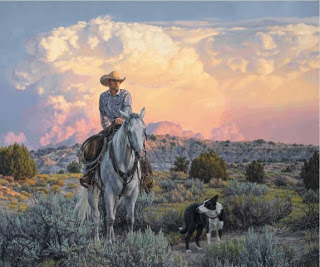
He rode easily, relaxed in the
saddle, leaning his weight lazily into the stirrups. Yet even in this easiness
was a suggestion of tension. It was the easiness of a coiled spring, of a trap
set.
The above is the introduction of the titular character from a Western
called Shane by Jack Schaefer.
It comes at the end a page of description of what he looks like. A boy
is watching a man on a horse approaching. We get a detailed description of his
clothing (His shirt was finespun linen,
rich brown in colour), his hat, his face, his eyes.
It’s all pretty simple and exhaustive, but within this bland list there
is something else.
He was not much above medium
height, almost slight in build. He would have looked frail alongside father’s
square solid bulk.
There are little observational details sprinkled throughout. The boy
compares this stranger to his father, a comparison the story is built on; the hard-working
farmer and the tired gunslinger. His father is the more solid man, but Shane is
something else under the surface.
So why not just keep the more
pertinent, meaningful bits and lose the rest? Who cares how dusty this guy’s boots
are?
Many writers do just that. They find a way to capture a character or a
setting in a single line. Fitzgerald describes Jay Gatsby as: His tanned skin was drawn attractively tight
on his face and his short hair looked as though it were trimmed every day.
That little detail about his hair tells you volumes.
Asimov describes the planet Trantor as “the densest and richest clot of humanity” in the galaxy. The choice
of the word ‘clot’ is enough to give you a feeling of something congealed and
unwieldy.
But writing that way should be a choice. If Schaefer had only included
the more revelatory lines, it would have been very obvious what was going to
happen. If he just made you sit through lines and lines of description before getting
to the point, it would send you to sleep.
Combining the vivid imagery and the sense of more than meets the eye—is
what pulls the reader in. It’s the words that put the image in your head, it’s
the purpose behind the image that makes it stick there.
Going back to our tree, if I told you three men had been hanged from
that large bough. In fact, if you look closely you can still see the rope marks.
Now describe the tree...
I’m not saying you will suddenly have a whole new vocabulary at your
disposal. The words may be very much the same. But now you’re not trying to
tell me what a tree looks like. I know what a tree is. Now you have something
more to tell me.
Similarly you don’t really need to tell me what a person looks like or
what a town looks like, not beyond very basic details. But that isn’t why you’re
describing them. Once you figure out
what it is you really have to tell me, you will find the words not only flow
easier, they mean much, much more.

If you found this post useful, please give it a retweet. Cheers
*
Check out my latest stories for free on Wattpad.

April 24, 2013
Unified Theory Of Writing

It’s important to know that no matter how obvious and sensible a piece
of writing advice might be, there are always going to be circumstances when it
won’t hold true. Or when there are other, equally effective ways to tell the
story.
It’s all open to debate and depends on context and specific examples. An unmitigated disaster for one writer, may be an unqualified success in
the hands of another.
It would be a lot simpler if there were solid,
unquestionable, carved in stone rules that we could all learn and then go from
there. So here are three universally
true things that apply to all writers at all times in every situation (I am 1,000,000% not exaggerating for effect).
1. Turn off everything and sit down with pen and paper or at the computer
and you will write something.
I mean turn off everything. Phones, internet, music (I know some people
need music to write, but even you). No turning to books or magazines for
inspiration. No distractions.
Will something come immediately? Probably not. Ideas to go do something
else probably will. But if you stay where you are and don’t let your brain
escape and just think about story ideas, they will come.
I’m not sure what the evolutionary advantage is in the brain trying to
avoid doing the thing you want it to do (doesn’t seem very helpful) but you can
overcome it just by putting bum in seat.
2. There are no essential scenes in your story.
You might prefer some scenes. You might have written the whole story
purely because of one or two scenes that inspired you. But there is nothing in
your story that you can’t replace with something as good or better.
That doesn’t mean you can just take a scene out and the story will
still work. You have to come up with an alternative, and you have to spend
enough time on it to make it good. But you have that ability.
The reason you might want to get rid of a great scene is this: when a
story isn’t working, you may think you can change that or that, but you definitely
can’t change THIS scene. This scene is pivotal to the whole thing.
No, it isn’t.
Sometimes a brilliant scene in a bunch of scenes that need to go, needs
to go too.
Obviously you can write another equally great scene (you wrote the
first one), but it’s hard work. Replacing bad scenes seems worth the effort,
but a perfectly good scene?
You can still find ways to come up with a workaround that allows you to
keep the scene, but it isn’t because you had no choice. There is always a
choice, and often it’s reworking the ‘essential’ scene that frees up your
approach to the rest of the story.
3. Nobody can make you change anything.
Okay, possibly this isn’t true if you’re signed up to a big publisher
and they insist on changes or they’ll cancel your multi-million dollar
contract. Although in that case I imagine you would just tell you agent to
speak to his Mafia contacts to have a word (that’s how the publishing industry
works, right?).
Whenever somebody reacts badly to a criticism of their work (and it’s
usually criticism that’s been invited, making it even more absurd) the key
thing to bear in mind is that the person who has any power in that relationship
is the writer.
If I think every word of your hundred thousand word manuscript is an
affront to human civilisation, I can do exactly nothing about it.
I can tell you how I feel, try to convince you to make changes, get
other people to agree with me in an effort to psychologically browbeat you into
submission, but in the end the only person who can physically change the words
on the page is you. And if you decide not to, your vote wins.
I’m not saying you should be stubborn or listen to no one. Advice, even
the wrong-headed kind, is worth hearing. If nothing else it can help clarify
your thoughts. But you’re the undisputed monarch of this kingdom.
If you found this post useful, please give it a retweet. Cheers
*
Check out my latest stories for free on Wattpad.

April 23, 2013
Theme And Truth In Story
Every story has a theme. You may not know what it is. It could be vague
or hidden. Or there could be multiple themes that make things unclear. But
there is always a theme in there somewhere.
Theme is the underlying truth.
What the story’s really about. But
sometimes the underlying truth is the same as the overlying truth. This can
lead to a feeling of being spoonfed or being told the obvious.
Some people are afraid of being too heavy handed about theme. They don’t
want the story to be about an issue or force characters to behave in a
particular way. But that won’t remove it from the story. There will still be a
theme. It just might not be very clear what it is.
Or, if you’re lucky, it might all fall into place by itself. I think
that’s what most writers hope for, but it really happens that way.
If you can get identify the underlying truth of your story, then you
can harness it to make the events in your story much more powerful and
affecting for the reader. And one of the best ways to do that is to try and
prove yourself wrong.
If Buddy is going to fight in a war he doesn’t believe in, and it
becomes apparent that the war is in fact a waste of time where horrible things
happen for no good reason, the point would be better made if Buddy sets out a
patriotic soldier and gets the scales knocked from his eyes.
Similarly, if the point at the end is that sometimes war is a good
thing that saves lives, perhaps Buddy should start out jaded and misanthropic.
Both those examples are grossly simplified (although when it comes to
war stories, grossly simplified is usually what you get), but if you’re making
a suggestion that the world is a particular way—and that’s what theme basically
is—it helps for you to make the counter argument as strong as possible.
Like any viewpoint, if you cheat the set up in your own favour, it only
makes the results less convincing.
If Johnny finds it hard to talk to girls, his best mate should be able
to charm them off their feet in seconds.
If beautiful Mandy can’t get a guy to be faithful to her, her ugly best
friend should have the most faithful boyfriend ever.
These counterpoints aren’t just there to give the narrative some
interesting places to go, they challenge the validity of the worldview you’re
creating. And in doing so it will be much harder to dole out pat answers or generic
clichés.
As you question the truth of what your characters believe and how they behave,
the true theme will emerge.

If you found this post useful, please give it a retweet. Cheers
*
Check out my latest stories for free on Wattpad.

April 22, 2013
Story Spectrum

We can all agree that there are two kinds of books:
good books and bad books.
What we might not be able to agree is which ones
are which.
There are obviously a broad array of genres and
sub-genres. And there are also people with varying tastes and preferences.
But surely we can agree on some basic requirements
for a good book. A truth, so to speak, universally acknowledged.
Let’s start with the most basic of basics. The
writer has to be able to write to a decent standard, right?
Weeeell, not exactly.
There are plenty of
bestselling books that are somewhat grammatically challenged. I don’t mean they
aren’t full of beautiful, lyrical prose, I mean:
"The room was familiar; it had been belonged
to me since I was born."
That’s an example from Twilight, but she’s by no
means atypical. Dan Brown, Clive Cussler, Jeffrey Archer... these are all
multi-million selling authors and they very often have passages in their books
that seem to have been translated from some foreign language by Google.
And yet, people enjoy their books, pay money for
the hardback version, eagerly await the next one.
But wait, there are some things that never work.
Don’t start with a character waking up (Hunger
Games), don’t have it all be a dream (Alice in Wonderland), don’t make children’s
books over a certain length (Harry Potter), a good romance has the protagonists
end up together (Wuthering Heights). Frankly, you think of a reasonable piece
of advice about writing and I’ll give you an example of a world famous book
that did the opposite.
Times change, though. What was once popular isn’t
going to get the same reaction today. People don’t want to see the same story
over and over.
Really? Really? Have you seen the bestseller list
lately? Watched a movie in the last thirty years? Stories aren’t just about new
and original and broadening minds. It’s also about escapism and comfort and
reassurance. Thrillers and romances, the two major genres, serve a purpose, and
they can serve it and reserve it in a very familiar package with no loss of
interest from the paying public.
Yes, but once a character has done what they have
to do, that’s their turn over. Bring on the next guy.
Actually, I think probably the opposite is true. If
a character does something well, people want to see them do it again and again.
Even if some get bored, many don’t, and new people are being born all the time.
In fact, if the character deviates from their
normal behaviour, it can lead to uproar. And if the author dies, the publishers
just hire someone else to keep milking the cash cow.
The point of this post is to say this: there is a
broad spectrum of types of stories, and there are fans of every part. If you
are a writer and you’re not sure if people are going to want to read what you
come up with, be assured that there are.
That’s not to say you’re guaranteed a spot on the
New York Times bestseller’s list—I’m sure there have been many wonderful books
that never got noticed and nobody’s ever heard of—but the thing stopping you
isn’t a lack of a market for what you’re selling.
A passionately written tale will transcend many of
the sins of poor writing or clichés or being unfashionable. I’m in no way
suggesting you shouldn’t try to write well and in something approaching
serviceable English, but first fall in love with your story and tell it in a way
that conveys some of what you feel about the characters and events.
Every book is a good book or a bad book to someone.

If you found this post useful, please give it a retweet. Cheers
*
Check out my latest stories for free on Wattpad.

April 20, 2013
Reading Not Like A Reader
Often, when a writer asks for feedback on a work in progress, they will
ask for the reader to pay attention to things like story, character, pace, and
to not bother too much with spelling or grammar or other nit-picky elements at
this stage.
The reason for this is pretty obvious. It’s early in the development of
the story and most of those minor errors will be taken care of during the
polishing and fine-tuning stages which will happen once the story is more or
less completed.
Right now, all the writer wants is an overview of how things are taking
shape and whether the premise seems interesting and engaging.
Which is fair enough. But there is a slight problem.
Those small nit-picky errors are distracting. They can make it hard to
get into the flow of the story. Is your attention wandering because of them or
because the story isn’t holding together?
However, I can see the benefit of getting some feedback on the general
engagement level of the story early on, so I try to ignore most of the minor
errors in favour of getting a feel for the characters (do I like spending time
reading about their adventures?)and the premise (do I care what happens next?).
In order to do this, I have to concentrate quite hard. As a writer, I’ve
trained myself to pay special attention to the little errors. Now I’m trying to
disregard them.
But a strange thing happens when
I do that. Not only do I overlook all the questionable grammatical issues and
the typos and the run on sentences, I also stop worrying about dialogue and
description and setting.
In fact, when you focus that hard, the things that stand out are: Why
is the character doing this? What’s the point? Why now? Who cares?
Is this how a reader would read the story? Probably not. But then few
readers would get the manuscript in this rough and ready manner.
Once you strip away the incidental stuff, the good and the bad, you can
see the story much more clearly. And you really don’t need someone else to do
that for you. Simply go through your draft and write down, chapter by chapter,
who does what in a chapter, what the reaction is, what they decide to do next
and why.
If you do that, it will become very easy to spot when characters do
things for no good reason. Jane visits Mike on a whim. Dave cleans his car
because he’s bored. Amy joins the army because she lost her job at the Post
Office. Whenever someone acts without purpose, a real reader reading the
published book will stumble or yawn or start daydreaming.
If you want to know if the story definitely works, a lot of that is
down to personal taste and the kind of story you want to write—it’s a difficult
thing to know for certain. If you want to know if the story definitely doesn’t
work, that’s a lot easier to spot.
Although occasionally I point things out to writers and their response
is, Oh, yeah, I know. I’m going to sort
that out later. Which makes me wonder what was the point of showing it to
me in the first place?

If you found this post useful, please give it a retweet. Cheers
*
Check out my latest stories for free on Wattpad.