E.C. Ambrose's Blog, page 12
April 8, 2015
Steve Bein, Author of the Fated Blades series
Joining my occasional series of author interviews today I’m hosting Steve Bein, who writes the Fated Blades novels, contemporary fantasy thrillers set in Japan.�� The latest title, Disciple of the Wind, just came out this week!�� As a Kurosawa fan myself, I really enjoyed getting to know Steve a bit better. . . and totally agree that everyone should know about the Association for Renaissance Martial Arts.

The cover of Disciple of the Wind, Steve Bein’s latest novel.
What was the inception of the project you’re most excited about?
It���s hard to say which of the two current projects has me more excited. I have a new novel, Disciple of the Wind , and a new novella, Streaming Dawn . Together they wrap up the saga of the Fated Blades. A book release is always a thrilling event; even though this is my third time around, I���ll rush right out to the bookstore to see the novel sitting on the shelf. I still take a picture of it, and it still gives me a little buzz whenever friends text me pictures from their local bookstores. But this time Streaming Dawn may be the more exciting event, if only because I���ve never done anything quite like it before.
��But since you asked about inception, let���s go with Streaming Dawn
, because it has its inception in Disciple of the Wind
. It was originally the third storyline of Disciple
, chronicling the exploits of Kaida, the pearl diver and runaway fan favorite of Year of the Demon
. In Demon
we meet her before she begins her career as a ninja badass; in Dawn
we get to see what an unstoppable terminator she has become. (Batman fans may recognize the homage to Frank Miller���s Year One
and The Dark Knight Returns
.) In the end my editor and I decided that Disciple of the Wind
was just too long, and my choices were to remove one of the three protagonists or to dramatically trim down all three story arcs. I think this is the best book of the series, and it couldn���t have stayed that way if I made deep cuts into the story. To keep it pure, Kaida slipped out���being a ninja, she���s good at that���and snuck herself into her own standalone project.

the cover for novella Streaming Dawn
What were your first steps in building that idea into a viable story?
��All of my novels intertwine stories from different ages of Japanese history. In Year of the Demon the principal characters were Mariko the 21st century cop, Daigoro the 16th century samurai, and Kaida the 15th century ninja-to-be. All three were to return in Disciple of the Wind , but Mariko and Daigoro had too much to do. (Their enemies are much more powerful in this one.) Extracting Streaming Dawn could have been nightmarish if I���d written the novel as a novel���that is, as one big storyline that just so happens to skip around in history. But I don���t write that way. I write all three storylines one at a time, as if each one were intended to stand alone. Every character gets my undivided attention. That���s part of why Streaming Dawn can stand on its own: it did stand alone, at least at first.
��But the process was a lot more complex than a simple cut-and-paste job. Weaving all the stories together changes them all. New themes emerge, and then I go back and draw them out for each character. And of course each story is originally written in service of the novel; I write them individually but not independently, if that makes sense. The other storylines are always looking over my shoulder. So Streaming Dawn as it is now isn���t the story I wrote before I wove it into Disciple of the Wind , and it isn���t quite the story I extracted from Disciple either. It���s better than those; the characters matured with each iteration, and the plot unfolded and refolded into new and more interesting shapes.
What kind of research did you do before beginning Disciple of the Wind?
There���s that old proverb, ���write what you know,��� and what I know is samurai movies. Somehow I discovered Kurosawa in junior high���specifically Ran , his re-envisioning of King Lear in 16th century Japan. I���ll admit most of the Shakespearean themes were over my head; at that age I was more interested in the samurai slashfest. But my fascination with the bushido tradition started there, and it has only grown since then. Today I have a whole shelf of samurai history books, along with all my philosophical volumes on bushido and the Zen/bushido connection.
��So that���s the body of background research I���m starting from in writing all of these novels. As I���m writing, it���s more about the specific details���family crests, waypoints on the great roads, that kind of thing. That work is never done. For Disciple of the Wind , I had to delve into marriage and divorce law of the Kamakura era. That was an unexpected turn.
��How does your research inform your world-building? Can you give a specific example?
��I think the world-building is born in the research. I decide what emotional tone I want to set in a given scene, and then I dig around for the right details to make that tone sing out. For example, in Streaming Dawn there���s a moment where Kaida is feeling trapped, and she has to meditate on what she���ll do next. I put her in a dingy attic crawlspace, the sleeping quarters for all the manual laborers in the castle she���s infiltrated. This made me look for the right source of lighting, something dirt cheap, ideally with the greasiest, foulest smoke imaginable. Lo and behold, there it was: poor Japanese servants used to use sardine oil lamps.
��That���s the sort of discovery you can���t make up. You only find it by being true to the world and being true to the character, and then letting them tell you what you need to do next.
��What’s your first-draft process?�� Outline, edit as you go, speed-writing?
I���d love to do speed-anything when it comes to writing, but for me the whole process is quite slow. For Disciple of the Wind , it was two volumes of hand-written notes before I could create an outline, then another hand-written volume that was filled in gradually as I ran across unforeseen wrinkles to iron out.
��Even if I were a pantser instead of a plotter, I don���t know how I could write these books any more quickly.�� They���re more complex because the stories are braided together. Each protagonist���s storyline has to be structured so that it reveals the right information only at the right time. Otherwise one character���s high-tension moment is a spoiler for the next character���s moment.
How do you start revisions?
I always write Mariko last, because she���s the one who ties the whole book together. Once she���s done, there���s a massive cutting and pasting process to create what can really be called the first draft. This will open with Mariko, then cut away to a historical piece, then return to Mariko, then go back in history��� you get the idea. Once I���ve got that, then I can read the whole thing through and look for problems to solve, themes to tease out, that kind of thing.
��I revise the whole manuscript at least once before I allow anyone else to see it. Then it goes to my agent, and maybe to other beta readers. By then I���ve had more time to mull it over, so the next stage of revisions can change the book quite a lot. Only then does my editor get a look at it.
If you could choose a few descriptors that would go in a blurb on the front cover of your book, what would they be?
Bestselling novel in the history of publishing. Translated into 100 languages.
��Just kidding. One reviewer compared me favorably to James Clavell; that was a big deal to me, because I���m such a fan of Clavell���s work. I get a lot of my world-building techniques from China Mi��ville, so I���d be delighted to see someone compare me to him. That would be a nice blurb to see on the cover: a quote from George R.R. Martin, singing my praises by comparing me to Mi��ville and Clavell. As long as we���re dreaming here, I���ll dream that.
What cool thing would you put in the DVD extra version that didn’t get into the published work?�� Any research or created detail you had to cut or couldn’t use?
There are little details about characters that never make it into the book. Mariko listens to the Black Keys. Daigoro is a hell of an archer on horseback. One of the characters���I won���t say who���is about 100 years older than s/he appears to be. If the book had a DVD commentary track, I could drop in little tidbits like that.
Where should readers go to find out more about your work?
I post updates, appearances, interviews, and all that stuff at http://www.philosofiction.com. You can also like me at facebook/philosofiction and follow me on Twitter @AllBeinMyself.
Care to share a link (aside from your own work) to something amazing you think everyone should see or know about?
I just love ARMA���s site. That���s the Association for Renaissance Martial Arts, and they have all kinds of interesting stuff on swordsmanship, ranging from the historical to the hypothetical. A major time suck for history nerd martial artists like me.
��Bio
��Steve Bein (pronounced “Bine”) is a philosopher, photographer, traveler, translator,��martial artist, and award-winning author of science fiction and fantasy. His short fiction has appeared in��Asimov’s ,��Interzone ,��Writers of the Future , and in international translation. His first novel, Daughter of the Sword , was met with critical acclaim, and his second novel, Year of the Demon , was named one of the top five fantasy novels of 2013 by Library Journal . Steve���s newest book, Disciple of the Wind is in stores now, and his new novella, Streaming Dawn , is available now for your e-reader. You can find his work at Powell���s, Barnes & Noble, Amazon, and Audible.
��Steve teaches philosophy at Texas State University. He lives in Austin with his partner Michele and their Lab, Kane.



April 2, 2015
The Truth about Bird-brains, Crows and Fantasy
I was delighted to see this video recently on the Huffington Post about a girl who, after feeding the crows in her yard for years, has started receiving gifts from them in return.�� Elisha Magus (" target="_blank">now out in paperback) features crows on the cover, and in the pages–crows who are devoted to the woman who loves them.

Cover of Elisha Magus, by amazing artist, Cliff Nielsen
My own interest with corvidae (the avian family that includes crows and ravens) might be traced to a panel I served on with a few other authors about the role of ravens in fantasy.�� To prepare for the panel, I studied up on these great, dark birds, so often associated with doom and despair (thanks, Poe!).���� If you do a quick search on Youtube, you can find all kinds of videos featuring crows and ravens doing clever things, things that birds were not, until recently, regarded as clever enough to do.�� At least, according to Christian Europeans.
Norse mythology includes the two ravens who keep company with Odin, [Hugin (thought) and Munin(memory)] while Northwest coast natives, and many other Native Americans, tell stories about Raven as a trickster–a role you can’t get without being clever.�� Crows have been caught on camera helping themselves to an ice fisherman’s catch–by watching for the flag to go up, then pulling up the line with their beak, holding down the slack with a claw, and pulling up more until the fish is theirs.�� They also learned how to operate a vending machine for corn by dropping shiny things in the slot.�� In the right environment, a person could do pretty well by partnering with the corvidae, in spite of their tricks–and authors like Charles de Lint have a lot of fun with them.
Recent studies suggest that crows are about as bright as your average seven-year-old.�� They use tools, have complex social behavior, and learn by watching one another.�� We could do worse than to be bird-brains like this.
But it’s also true that they are carrion birds, hence their association with death and dying, and other references in fantasy, like calling Gandalf “storm-crow” because he often shows up when there’s going to be trouble, and, of course, Feast for Crows, by George R. R. Martin draws upon the image of the battlefield decked with corpses, and picked at by scavengers.�� In my own work, Rye, the crow-magus tells Elisha that the birds like him–because where he goes, they are sure to eat well.
It is this rich combination of intelligence and resonance that makes crows and ravens such fascinating creatures to write about, and to interact with.�� When I took my falconry workshop, I was told to watch out for crows because they will mob a raptor, and the falconer spoke of having to cancel a demonstration when too many crows showed up and the hawk refused to fly.�� This behavior also makes them handy for the wildlife watcher. I was lead to a pair of great horned owls by a very noisy and insistent crow.�� (the owls didn’t look too happy either).
When I see their silhouette in the sky, or hear that distinctive cry, I have a new measure of respect for these birds, carrying a world of stories upon their wings.


March 27, 2015
Satirists, Lost and Found
Last week was an interesting one in the realm of satirical literature. It brought us word of the sad passing of a modern master, Terry Pratchett, author of the Discworld novels, and also of the re-discovery of the grave of Miguel de Cervantes, author of The Ingenious Gentleman Don Quixote of La Mancha, and a founder of the genre.
I am a Don Quixote fan from way back, beginning with the musical version, “Man of La Mancha,” starring Peter O’Toole (another master).�� I once wrote an essay for my Themes in Literature class relating Oedipus’s choice to blind himself at the end of Oedipus Rex with Quixote’s arch-nemesis, the Knight of Mirrors:�� it is a hard thing to face one’s self and what one has become.�� I own three copies of Cervantes’ novel:�� a big, fat paperback which I read while on a backpacking journey through Spain, a leatherbound edition from the 1800’s with each “book” in the novel in its own separate volume, and the Modern Library edition, illustrated by another of my favorites, Salvador Dali.
Pratchett and Cervantes both used the tools of story-telling to convey their meanings, and hold up that dreaded mirror to their contemporary lives.�� They created engaging characters, brought them through great adventures, and made readers laugh along the way.���� Entertainment was the vehicle that carried their questions into the hearts of their readers.
Both men, Cervantes and Pratchett, have been viewed in their own time primarily in that light, as entertainers, authors of funny books easily read and passed along.�� But Cervantes’ long legacy suggests the greater depth of his work, and a close reading of the adventures of Don Quixote and Sancho Panza finds the author poking fun at government, at chivalric ideals, at literature itself.
Similar concerns may be found in Pratchett’s marvelous novel, The Nation, in which a young man’s home is destroyed, and must be painstakingly rebuilt–in an area known as the Mothering Sunday islands, a jab at the British explorers who traipsed about “discovering” and re-naming many things that already had perfectly good names to begin with.�� What constitutes good governance? What values should rule society and who gets to decide them?
As Cervantes suggested, there is a fine line between madness and vision.�� In the grand tradition of the king’s fool, the entertainer is often the carrier of truth, the sorts of truths we find hard to examine.�� We turn away from our own reflection, but the funhouse mirror of a good satire beguiles us into a closer look. After all, it’s only a story.
Archaeologists and academics around the world hope that discovering Cervantes’ grave and the publicity surrounding this event will result in a resurgence of interest in his work.�� Will Terry Pratchett, one of his literary heirs, one day be celebrated in such a way?�� Only time will tell.


February 27, 2015
Ancient Aliens vs. Good, Hard Work
While recovering from recent illness and exhaustion (and under duress by another family member) I wound up watching a couple of episodes of a program designed to convince us that many of the great ancient monuments of the world were built by aliens. Yep, that old saw is still around.�� Actually, what they say now to avoid *some* of the consternation of claiming that ancient peoples (particularly non-Europeans) weren’t capable of building their own architecture, is that the aliens brought tools and techniques, which the locals then applied.
The theme that came up over and over again as these predominantly white middle- or upper- class white collar authors and “experts” spoke was that, really, if people had to make the pyramids from scratch it would be such Hard Work.�� And I was struck by the fact that these are people who have probably never had to do that kind of physical labor. Is it hard to be a researcher or an author or an academic?�� Yes, but in a very different way from the hard work of being a manual laborer.�� To these people, the idea of doing such work, likely very distant from their own upbringing, seems alien in itself.
The speakers on the show probably chose their professions.�� They probably had a range of possibilities open to them, from family and educational options that showed what a wide range of things they might do.�� Let’s scroll back a few hundred or a few thousand years.�� What career options existed?�� There is the military, of course, with its own hierarchy of leaders and followers–many of whom were likely drafted only as needed.�� For the upper class, maybe a priesthood or a role with the nobility.�� For those in the middle, maybe scribe or healer, maybe foreman or artisan (potters, weapons-makers, weavers, painters–a more skilled variety of labor).
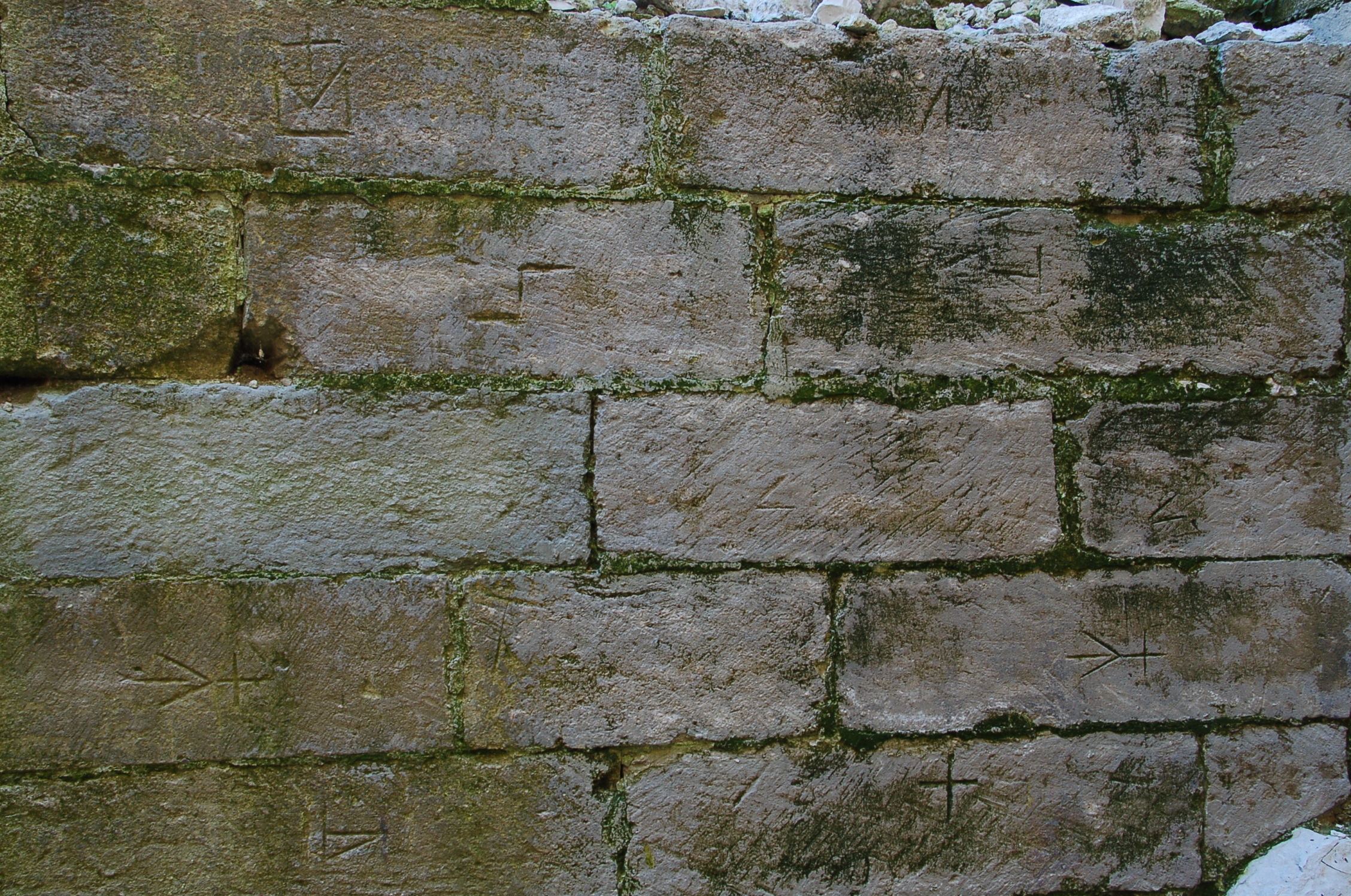
Medieval mason’s marks ensure the masons get paid for the stones they cut.
And for everybody else there was manual labor.�� Whether they were farmers, masons or ditch-diggers, they were working hard all day, every day. It’s what they did, and what they expected to do.�� In some societies, a good worker might learn the more skilled aspects of their job, or supervise others.�� (And many people around the world today are living in these same circumstances, working physically demanding jobs all day, every day.)
For the fortunate, this job came with some sort of pay, possibly in food rather than wages, and the chance to go home to one’s family.�� For many, the “job” was, in fact, slavery, and involved the bare minimum of care needed for survival and continued labor.
The speakers wondered why the ancients would have made such huge stones, then had to move them, rather than making many more smaller stones–but stone-cutting is a craft requiring education and dedication, while stone-moving is a combination of brute force and a clever transportation system.�� If you have thousands of people at your disposal (perhaps literally), you train some of them, and for the rest, you hand them a rope and tell them where to walk.
How much work is it to build a pyramid?�� A whole, heaping lot. Years or decades worth.�� But when you have thousands of people who are doing their job, and are good at their job–whether that means cutting stone or hauling it–they can, and will get that job done, especially when they are motivated by immediate punishment or reward, or–and here’s another key to the “mystery” of how the ancients got stuff done–by religious conviction.
Those who believe that their work serves the cause of one or more deities are capable of great things indeed. They’re not building stone temples on a whim, but because the good of their entire society may depend upon how well they do it–the elegance of the design, the alignment with celestial markers, the beauty of the final product.
I wanted to slap the so-called experts every time they wondered how it was possible for someone with primitive tools and techniques to carve a symmetrical design.�� These guys never tried it.�� I have, actually.�� Is it hard?�� Sure:�� it is both mentally and physically challenging.�� If I dedicated the same amount of time every day to learning to carve stone that I have to my own profession I’d get pretty darn good at it, especially if I had started from childhood, under the care of a master-carver.�� The ancients were experts, too.�� They worked from an early age to learn all the tools and techniques available to them, and to apply those things to good advantage.
The really mind-blowing thing about those ancient monuments is how much our ancestors accomplished when they put their minds and backs into it.�� I stand in awe of these accomplishments when I think of how hard it is to carve a stone or to shift even enough dirt or rocks to build a patio.�� To build an entire step-pyramid, complete with elaborate carvings and painted murals is, indeed, nothing short of genius.
These ancient alien theorists underestimate so much about humanity. They underestimate the inspiration of religious faith to motivate both leaders and workers.�� They underestimate the efforts of thousands of people, willingly or unwillingly working together on a large project.�� They underestimate the ingenuity of such people to devise new techniques when they want to achieve something significant and have the time and willpower to work on it.�� Most of all, they underestimate the value of simple and effective hard work.


February 18, 2015
Defense Against the Dark Arts: Warding off Witchcraft
This month’s Archaeology magazine has some photos from Knole House in Kent showing a series of hatch marks carved into the floor beneath where the protestant King James I would have slept in the early 1600’s.�� The marks are intended to protect the king from “witchcraft and demonic possession.” (you can read the article here.)�� It got me thinking about the many ways that people tried to defend against such supernatural attacks.

Primrose illustration from an herbal text.
In my own book Elisha Magus, Elisha finds the kitchen at the prince’s hunting lodge hanging with betony and primrose, two of many herbs which are said to prevent the incursion of witches.�� Herbs like this would be hung around doorways or in barns to ward off witchcraft.�� Hazelnuts in some circumstances were said to be proof against witchcraft as well, and could be thrown at witches to discourage them.
As in Knole House, mentioned above, houses often had defenses built in, most commonly around entrances. Knole House has its hatch marks near the fireplace as well, because witches were said to use chimneys, like some kind of nasty Santa.�� Thresholds are popular places to conceal anti-witchcraft charms, often boxes or jars containing protective herbs and amulets, bits of bone or other relics.�� One dwelling cave at Amman, Jordan, has the skull of a dog buried outside.
Iron has long been associated with the ability to ward off magic (faeries are said to recoil from it), and often figures in both household charms–including “lucky” horseshoes, and iron knives buried beneath the threshold–and in amulets carried on one’s person. Tim Powers uses nails driven into wood as a proof against some supernatural evils in his book The Stress of Her Regard, which, like many of Powers’ books, is deeply informed by 18th century beliefs about sorcery.
It also figures in another form of buried protection, the witch bottle.�� These were a sort of curative when a victim had already been struck by an illness or misfortune attributed to witchcraft.�� The�� victim would place personal relics, like hair, nail trimmings, navel lint and urine, into a clay jar along with items said to be proof against witchcraft (iron nails, brass pins, minerals like brimstone), and bury the sealed jar upside down.�� This amalgam of intimate leavings would attract the witch’s power, drawing it away from the victim and thus curing him.
It’s interesting that if you look up many of these items on-line, you are likely to find a string of websites associated with pagan religions and Wicca in particular, offering spells and recipes for creating your own charms.�� (You can also purchase your witch bottle from Etsy or E-bay, but presumably you have to supply your own urine).�� These contemporary individuals are using the same techniques of the Middle Ages and Early Modern period to defend themselves and their petitioners against Black Magic.�� Even during the Middle Ages, there was a sense that some magic was good, and some was not, thus people had no qualms about seeking advice from one local practitioner to dislodge the Evil Eye of another one.
Official Church doctrine about magic swayed between poles, from similarly accepting this idea of White Magic, to condemning all magic as defying the Lord.�� One of the most powerful weapons against magic of any kind is, of course, Holy Water–but running water itself has long been thought to prevent passage of certain forms of evil.
Salt is another preventative, and if you’ve ever thrown a pinch of salt over your shoulder, you know this belief persists in a custom many have forgotten.�� Witches are said not to be able to eat salt, and that pinch of salt will ward off the devil.�� Nowadays, I think most of us take fears about sorcery with more than a grain of salt.


February 12, 2015
Finding a Balance: Cultural Appropriation and Under-representation
Writing fiction has lately become a bit of a minefield where, if you write about another culture, you risk charges of appropriation, and if you fail to include representatives of other cultures, then you are exclusionary.
I have always operated under the assumption that a respectful exploration of someone else’s culture is acceptable, possibly even praise-worthy, in the way that one would research mores and customs or try to learn some of the language before traveling to a foreign country.�� How much easier it is to relate to other people if we have the opportunity to learn about them in a variety of ways, and offer ourselves as receptive and listening when we have the chance to learn from them directly.
As an author among other authors, I have seen that many of my fellow writers have a similar perspective.�� We are fascinated by people, especially people different from ourselves–whether by gender, culture or experience.�� Hence, books like Writing the Other, by Nisi Shawl and Cynthia Ward have been gratefully received by those who want their fiction to reflect the wider range of human possibility.
Yet if we don’t want to risk offending people, the safe course would be to write only from the perspective most similar to your own, and to avoid writing about or from the perspective of others.�� At its most severe this would mean writing only about characters of your own age, culture, education, political bent, and socio-economic level.�� That sounds a lot like. . . mainstream fiction of not very long ago, and is certainly a thread that persists when professors write books about professors, and authors about authors.�� It also sounds like a very flat and boring landscape for writers and readers both, especially when authors representing minority perspectives continue to struggle with finding publication and readership.
In recent years, there has been a greater effort, certainly in the SF/F community, to encourage other voices and the awareness of these issues.�� We are seeing more translations, more authors from different backgrounds represented at conventions, in anthologies and on award ballots, all of which are changes to be celebrated.�� Do these developments go far enough?�� Not yet, but, like most of human existence, it’s a work in progress as people develop a greater awareness of the experience of others.�� And, perhaps more critically, a greater openness to that experience.
Sadly, that openness on behalf of the majority population often comes first, not from the authentic voices of representatives of other cultures, but from the representation of such individuals within a more comfortable and familiar context:�� a work by a member of their own group that introduces these representatives and brings the other culture to their awareness.�� Sometimes, such a work creates a movement, as when Uncle Tom’s Cabin, a book about black slaves, written by white woman Harriet Beecher Stowe inspired abolitionists.
Yeah, I know, many people of African descent are now rolling their eyes.�� Is the book an accurate portrayal?�� Not really.�� It substitutes a different stereotype of African-Americans for the images prevalent in that time. (The book is also a product of its time, when the fictional presentation of character was handled differently from today.�� If you don’t like this example, you can consider most books by Mary Doria Russell, Ursula LeGuin’s island peoples, Pearl S. Buck’s�� The Good Earth, the cross-cultural thrillers of Martin Cruz Smith)�� Is it a sincere attempt to reveal something others may not have seen, or may have avoided understanding?�� Yes, absolutely.�� Should authors become aware of and avoid perpetuating the stereotypes and misperceptions of other cultures?�� Most definitely.
Should they be discouraged from using their art to explore and reveal what they are learning about others, in the fear that they might offend someone?�� Hmmm. . . The sincere and open-minded author would seek every opportunity to create a convincing and well-rounded image of every character, including those from communities different from the author:�� listen to the voices of that community, invest in the community (Buck lived in China for years, but not all of us have that opportunity), seek feedback from its members, take a respectful approach to your learning.
Writing, and other forms of artistic expression, are one of the ways that individuals process what they’re thinking and express ideas to be shared with others.�� Is the author’s impression correct?�� Is it suggesting something deep and human and engaging?�� Does it encourage a different kind of thought and reaction in the mind of the reader?�� Writing is a dialog.�� The work poses ideas, questions, theories–the reader responds to them.�� And the most moving, most disturbing, most beautiful ideas are often those that examine humanity in all of its forms and interactions.
It’s definitely a complicated, multi-layered issue, but I tend to come down in favor of art rather than fear.�� In spite of the minefield, I still feel that representation and openness are important objectives, and I would like to see more support given to authors who are engaged in these goals, rather than to see authors vilified when they step outside their comfort zone–and try to bring their readers with them.


February 4, 2015
The Arisia Convention and Interstitial Genders
If you have attended a science fiction and fantasy convention lately, especially here on the East Coast, you may have notice a fair number of people wearing pronoun ribbons.�� Badge ribbons in general have been quite the rage, usually advertising one’s allegiance to a particular Worldcon bid or specialized Fandom (a movie, book, or tv show you love), and often featuring cryptic phrases only recognizable to those in the know.
These pronoun ribbons are a relatively new addition, and a more serious one.�� In a world of ever-increasing awareness that gender is less fixed and obvious than we thought, pronoun ribbons (which announce one’s preferred pronoun reference) give some guidance to one’s fellow fans.�� While she/her/hers is pretty clear, other options include ze/zer/zers (or “zhe”), and variations like Hi/hir etc.�� They have also made ribbons suggesting the singular “they”�� a convention adopted on Facebook, and in other places, but one which still makes my grammar-training twitchy.
The first time I remember encountering alternate pronouns, it was in a story by (I believe) Ursula LeGuin, and I found it simply confusing.�� Now that I have (I hope) greater awareness of the issues involved, I find myself more aware of, and open to, their use. It seems like a recent phenomenon, and most day-to-day reference points suggest that gender is and has always been binary, but even the wiki page about gender-specific pronouns points out that alternatives have been suggested since the 19th century–though at that time, more to avoid referring to an unknown person as “he,” which was then the default.�� On this blog, I tend to alternate, not always in a strict fashion, whether my dear reader is ‘she’ or ‘he’, and I hope this approach is acceptable.�� (I suspect this is more disconcerting to men who identify with that gender than to others.)
Yet the new interest in such pronouns is linked more to individual’s gender-identification or lack thereof–or even the question of why it is important to be gender-identified at all.�� It makes me think of the ranks of people with interstitial genders through the centuries.�� In many cultures and folktales, hermaphrodites–individuals with characteristics of both male and female–have particular roles, often as mediators between the genders, or between humanity and the gods or spirits.�� Sometimes, these individuals are referred to as “two-spirits” among Native American communities.
People are often uncomfortable around androgynous individuals whose gender is not made clear through their personal appearance.�� I once met such an individual who worked as a private detective–an intriguing career choice, it seems to me.�� Western culture tends to be more judgmental, as seen in the trial of Joan of Arc, one of whose major offenses was to wear men’s clothing (which, I should note, almost all of the women I know would be guilty of doing by 15th century standards.)
Individuals with third-gender or other non-binary self-definitions have always been with us, and pronoun badge ribbons are the latest way to push for a more open definition of humanity, less bound to binary gender.�� I am proud to be part of the fandom community, which encourages exactly this kind of openness.�� And now I am more curious than ever to rediscover the stories of inter-sexed individuals in mythology and culture as another way to invite conversation and acceptance.�� What stories do you know?


January 28, 2015
The Year of the (dead) Goat: astrology and inner Asian sports
Chinese Astrology follows a twelve-year cycle of animals who represent the character of the year ahead, and may have an influence over individuals, based on their own astrological animal, (and all kinds of other factors).�� The Wall Street Journal welcomed the Year of the Goat by talking about the Goat Simulator game, which apparently is all the rage, and involves the player controlling a goat avatar that, as the WSJ puts it, “rampages all over town.”
When I saw the image of this goat flying through the air, what it brought to mind was the national sport of Afghanistan, Buzkashi.�� We in America claim baseball, and maybe American football as national pastimes, pursuits in which highly trained athletes take a rigidly structured field to win points based on their manipulation of a small ball.�� Buzkashi, literally translated to “goat grabbing” is a whole other thing entirely.
It may have been the precursor to that most upper crust of sports, polo, in which riders on specially trained mounts gallop along the field, swinging long mallets to strike a ball toward the opposing team’s goal.�� However, in Buzkashi, variations of which are found throughout the steppes of inner Asia, instead of having a ball for a target, and a long stick to strike it with, the riders compete for control over the carcass of a goat.�� It takes an expert rider to snatch the goat, balance it on a saddle and ride for the win.�� The Afghanistan Online website has an explanation and two variations of the game, one requiring the rider simply to escape the other riders with his grizzly prize, the other in which the rider must carry the goat out and around a marker then return to a target zone in order to score (see, touchdown–just like football, only smellier).
Here in New England, people are all excited about the Super Bowl, and about the so-called “inflategate” scandal, in which the Patriots are suspected of using underinflated footballs.�� I suspect in Buzkashi, it is when your goat gets, er, over-inflated, that things become especially exciting, given that a traditional game might have lasted several days.
I first learned of the game during my research into Mongolia, suspected to be its place of origin, when my sister asked me to help her make a pseudo-goat for the purpose of playing the game with her horse-minded recreationist friends at a Mongolian-themed equestrian event for the Society for Creative Anachronism.�� The tricky bit in making a fake goat is getting it to have enough structural integrity. An underinflated goat would be very difficult to grab and ride with, so it needed to have some sort of stiffening inside to remain sufficiently rigid.�� We used a complete goat, while the Afghan website above specifies a headless one.�� That would eliminate a couple of useful handles and no doubt elevates the game to a more professional level.
The wikipedia article on Buzkashi includes some photos, and also a variety of film and book references, where you can learn more about it. However, if you prefer to celebrate the Year of the Goat in the Chinese fashion, you can go for the firecrackers and lion dancers, and leave the dead goat to others to enjoy.


January 24, 2015
GalaxyQuest and the Everyday Hero
I’d been wanting to watch “GalaxyQuest” again after quite a long time, and finally made the chance last night.�� Yes, it’s just as much campy Trekkie fun as it was before, but this time, I was paying attention in a different way, because the film not only pokes some fun at fandom, it also speaks to some very real truths about being an entertainer, whether you are an actor (as they are in the film) or a novelist.

GalaxyQuest inspirational poster
Actually, the first point applies whether you are an entertainer or just about any kind of professional grown-up, and that’s Imposter Syndrome.�� This is when you find yourself in your public role, say signing autographs at a convention, and keep thinking that someday, someone will find out your secret:�� you’re really just an ordinary guy, not special at all.�� Not worthy of all this attention, not worthy of that promotion.
It’s easy to see how this feeling of being an imposter could come about in an area like writing, where most of us are having a great time as authors, and still suffering from the secret guilt of being paid to do what we love and share it with others.�� However, the more people I talk to in various walks of life, the more I think almost everyone suffers from this kind of anxiety, from teachers who feel inadequate to the task of leading a high school class, to software developers who are keeping just one manual ahead of their job’s technical requirements.�� And most of these professionals are not called on, as the actor-heroes of “GalaxyQuest” are to save an entire race of aliens who believe they are heroes.
And this leads me to point two, that of the everyday hero.�� At the start of the film, Tim Allen’s character is treated like a hero, in spite of just being an actor, and at the end, he has become heroic through his actions.�� He has become worthy and overcome his imposter syndrome.�� Cool.�� But what about those crazy aliens who believed in him?
They stand in for the hope of every entertainer, every author who crafts a work of heroic fiction, and that is to inspire others to greatness.�� Entertainment is fun, sure, just as the humorous aspects of the film are laugh-out-loud funny, but the greatest entertainment holds higher ambitions.�� While there are many authors who read someone else’s disappointing book and thought “I could do that,” I think the real source of the drive to create is in reading the kind of work that gives you something to aspire to–“I *could* write a better book than the crummy one, but what I want is to write a book as excellent as the best.”
And these great works have the potential to inspire the greatness of their readers.�� The movie aliens had lost their way, until they found their inspiration, a model for a new approach to life, in the television series Tim Allen starred in.�� In the same way, when someone reads a great book, he or she invests in the characters, and wants to be like them.�� When they close the cover, some of that aspiration lingers, encouraging the reader to a new level of strength and courage, offering models of heroic behavior that may lead that reader to strive for things they didn’t know were possible, just as Tim Allen begins the film as an imposter, and becomes a hero, when he sees the potential for heroism reflected in the brave aliens he once inspired.
#SFWA


January 8, 2015
The Mentor Who Knew Too Much
I often read unpublished manuscripts, either because I am paid to critique or edit them, or because I am trading beta-reading with author friends.�� Recently, I’ve read several manuscripts with a common flaw:�� a secondary character who knows almost everything, and is driving the plot by manipulating the other characters or by withholding and revealing the information at the right time.�� Often, this secondary character is meant to serve as a mentor for the protagonist, but his or her own great power and influence makes the story revolve around the mentor rather than being driven by the protagonist.

Dumbledore in his hall of knowledge. (Warner Brothers Studio, England)
Some classic mentors include Gandalf, in the Lord of the Rings, Obi-wan Kenobi in “Star Wars”, and, of course, Dumbledore in the Harry Potter series. They represent three different approaches to the mentor role.�� Gandalf is a powerful figure set apart from the protagonist, but never all-powerful, while Obi-wan is a person more advanced than the protagonist, but on the same journey.
Of these, I find Dumbledore to be extremely problematic, in exactly the way of the omniscient mentors in the unpublished books I noted above.���� He knows almost everything that’s going on, often without being told.�� He provides invaluable assistance at the right time, and when he fails to do so, there is rarely a good reason for it. After reading a few of the books, it kinda felt to me like Harry and the other kids are out doing Dumbledore’s dirty work, when he could have cut the whole thing short early on and prevented a lot of trouble and heartache.
Gandalf is an interesting sort of mentor. He’s very wise, he has some mysterious powers, and he is often in the right place at the right time. However, Tolkien also sets him up very carefully.�� He is fallible–he doesn’t know everything, and sometimes takes a while to work through the answers, just as you or I might do. He must try “various incantations” until he remembers the right solution.�� He also does lots of research to confirm hunches or to put together the clues.�� He goes to consult with others, like Galadriel and Saruman, and only later discovers this might have been a mistake.�� He does his best to defend the hobbits and the fellowship when he’s with them, but he often isn’t–and he never manages to slide a sword into a hat and have it delivered just at the right moment by his pet phoenix.�� If he’s not there, they have to bloody well do the job themselves–and they know it’s going to be much harder without him.
This is, of course, why mentors have to die, or it becomes increasingly hard to justify to the reader/viewer why the mentor isn’t just undertaking the quest himself.�� Readers like to watch over the shoulder of two primary types of protagonists:�� those who have lots of powers/strengths/coolness factors (like James Bond, ie, protagonists the reader wishes he were), or those who are *already* like the reader, they have weaknesses, vulnerabilities, day jobs, families or other things that make the quest difficult, and which they seek to overcome or to be worthy of.
The right mentor/protagonist pairing balances both of these elements.�� So Luke Skywalker is a young man with ambitions and responsibilities (like the viewer), and he is paired with someone much more knowledgeable and powerful, someone he–and the viewer–might aspire to become.�� In this case, he has that potential, and when Obi-wan dies, Luke moves on to an even greater mentor, and ultimately becomes a master himself.�� In some ways, this is a very down-to-earth model of mentorship.�� You might imagine a young inventor or author learning from an established professional, and going on to supersede his mentor as he reveals his own talents as a result of the mentorship.
The hobbits admire, fear and trust Gandalf.�� His presence gives them courage, his absence and his challenges prod them to greater achievements within themselves, but there’s no point at which they might conceivably take on his role as Luke does when he becomes a Jedi master in Obi-wan’s footsteps.�� By the end of the book, the hobbits have grown because of their adventures, and with Gandalf’s guidance.���� Frodo’s personal journey is such that he accompanies his mentor into the West at the end.
Interestingly, the hobbits are often presented as having a childlike relationship with�� powerful people like Gandalf. In Harry Potter, the protagonist literally *does* have that relationship with Dumbledore, and I wonder if this accounts for some of the differences, and for some of the ways they become problematic.
One challenge in writing Young Adult novels, and one difference between these and Middle Grade novels, is the role of adults.�� Adults are not meant to solve the problems faced by the teen protagonists of a YA novel.�� MG novels, in part because they are bought primarily by librarians and grandparents, feature stronger, larger roles for adults, and the adults who purchase them like to view themselves as Dumbledore:�� kind, wise, all-knowing, the source of strength and positive intervention.
But as the readers and the characters age, that mentor relationship is no longer as appropriate to the fictional set-up.�� The protagonists need to be free to make harder choices, to live with the consequences of those choices, and to have adventures in which they make discoveries, not merely confirm that what the mentor suspects is, in fact, true.�� Harry increasingly turns toward people like Sirius Black, and others–people more in the Obi-wan vein: they know more than he, and they are more powerful than he, but they are also fallible. They require assistance as much as they give it.�� The protagonists can grow into an adult relationship with them, in the way that Luke grows into his potential as a Jedi master.
Where does that leave Dumbledore?�� This suspicious reader felt increasingly frustrated that Dumbledore seemed to be manipulating events and individuals and calling all the shots.�� I think I would have found the story more satisfying if he had died much sooner, leaving the kids to discover and take risks on their own at an earlier point.
If you are reading a mentor relationship, how do you find it working?�� Do you believe in the vital link between the protagonist and his teacher–that the teacher provides the tools for the protagonist to solve his own problems?�� Or is the teacher standing in for the author, delivering whatever is needed to the story without regard to the protagonist’s efforts and motivations?
If you are writing a manuscript with a mentor character, think about which model of mentorship you’re following.�� If you have a hugely powerful and knowledgeable character, why isn’t that person leading the fight, instead of merely prodding the protagonist along?�� Is the mentor someone the protagonist might eventually become, or is he outside the plane of the protagonist’s life, someone to be looked up to, perhaps, but as an inspiration, not as a model.
And if you are a mentor, consider when it is time to stand aside, and allow the student to soar (or to slip) on his or her own potential.
#sfwa