
Man Martin's Blog, page 214
December 11, 2011
Anadiplosis December 11, Figures of Speech
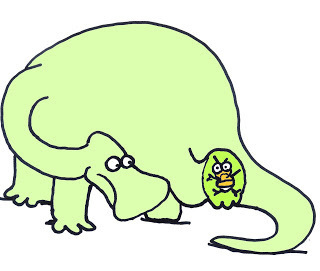 An Anadiplosis discovering it has
trodden on an unwary anapest
Anadiplosis: From the Greek, anidiploun, "to double back," it sounds like the name of one of the larger and stupider dinosaurs, but as anyone can tell you, it's the rhetorical repetition of a word or phrase at the end of one sentence at the beginning of the next. I come across this sort of thing all the time, reading my tenth graders' essays: "This report is about Shakespeare. Shakespeare wrote a play called Julius Caesar." Julius Caesar is about Brutus. Brutus is the one who killed Caesar. Caesar was killed by Brutus and some other people. The other people who killed Caesar were..." And like that.This isn't anadiplosis, though, because though it's got gobs of repetition, it ain't rhetorical. Rhetorical means the writer's doing it on purpose, for an effect, and not just being lazy. A better example, not much better, is when Yoda says, "Fear is the path to the dark side. Fear leads to anger. Anger leads to hate. Hate leads to suffering. I sense much fear in you." Mostly I'm afraid of running into someone that talks like Yoda. An even better example of anadiplosis, is Whitman's, "When I give, I give myself," or Byron's, "The mountains look on Marathon, and Marathon looks on the sea."

 An Anadiplosis discovering it has
 trodden on an unwary anapest
Anadiplosis: From the Greek, anidiploun, "to double back," it sounds like the name of one of the larger and stupider dinosaurs, but as anyone can tell you, it's the rhetorical repetition of a word or phrase at the end of one sentence at the beginning of the next. I come across this sort of thing all the time, reading my tenth graders' essays: "This report is about Shakespeare. Shakespeare wrote a play called Julius Caesar." Julius Caesar is about Brutus. Brutus is the one who killed Caesar. Caesar was killed by Brutus and some other people. The other people who killed Caesar were..." And like that.This isn't anadiplosis, though, because though it's got gobs of repetition, it ain't rhetorical. Rhetorical means the writer's doing it on purpose, for an effect, and not just being lazy. A better example, not much better, is when Yoda says, "Fear is the path to the dark side. Fear leads to anger. Anger leads to hate. Hate leads to suffering. I sense much fear in you." Mostly I'm afraid of running into someone that talks like Yoda. An even better example of anadiplosis, is Whitman's, "When I give, I give myself," or Byron's, "The mountains look on Marathon, and Marathon looks on the sea."


December 10, 2011
Apostrophe December 10, Figures of Speech
Apostrophe: Addressing an absent person or inanimate object as if it were present and capable of understanding. Wild Bill famously uses apostrophe in Romeo and Juliet, when Romeo standing under the balcony says, "Arise fair sun and kill the envious moon who is already sick and pale with grief." Romeo isn't talking to the sun, which would be an apostrophe in itself, but to Juliet, who, though he can see her, hasn't spotted him, and evidently doesn't hear him, although he's reeling off yards of iambic pentameter right under her window. Comparing her to the sun is a metaphor, while ascribing emotions to the "envious" moon is personification. (Parenthetically, is it also foreshadowing? Is Romeo unwittingly inviting his own death, that if Juliet is the sun, he must be the moon, since he only comes out at night and he himself is sick and pale and he's "mooning" after her? But I digress.)
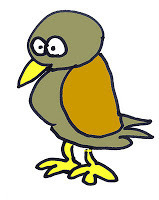 If Keats doesn't think this is a bird,
I'd like to know exactly what he
thinks a bird is.Keats also uses apostrophe in "Ode to a Nightingale," "Hail to thee, blithe spirit, bird thou never wert." (Again, parenthetically, Keats is dead wrong about the nightingale, that it never wert a bird, a bird is exactly what it wert.) The Romantic poets generally were big on apostrophe, always talking to West Winds, dead ladies, and sunsets and stuff. Check it out.
But apostrophe is not limited to Wild Bill and poets who go around talking to nightingales and using words like "wert." You can hear apostrophes made all the time, the man who addresses his insensate car on a cold morning when the battery is weak and the engine is weakly growling and sputtering, "C'mon, c'mon, start!" The commuter who curses at the driver who just cut him off changing lanes. "You %@#!!" Is it apostrophe when people talk to their pets? Usually no, we have a reasonable expectation that Rover understands when we say, "Come!" or "Bad boy!" even if he doesn't respond. Once, however, I overheard a woman rebuking her dog, "No barking? Now what have I said about this?" Now that's apostrophe.
How apostrophe came to be a punctuation symbol, I honestly cannot discover. The comes from a Greek root apostrophos, "to turn away." (Perhaps the punctuation is so named because of its curved, "turning away," shape?) (Parenthetically, an apostrophe does not have to address an absent or insentient being, any "turning away" from the stream of discourse, as in a digression, is also an apostrophe. This includes parenthetic remarks such as this one.)

 If Keats doesn't think this is a bird,
I'd like to know exactly what he
thinks a bird is.Keats also uses apostrophe in "Ode to a Nightingale," "Hail to thee, blithe spirit, bird thou never wert." (Again, parenthetically, Keats is dead wrong about the nightingale, that it never wert a bird, a bird is exactly what it wert.) The Romantic poets generally were big on apostrophe, always talking to West Winds, dead ladies, and sunsets and stuff. Check it out.
But apostrophe is not limited to Wild Bill and poets who go around talking to nightingales and using words like "wert." You can hear apostrophes made all the time, the man who addresses his insensate car on a cold morning when the battery is weak and the engine is weakly growling and sputtering, "C'mon, c'mon, start!" The commuter who curses at the driver who just cut him off changing lanes. "You %@#!!" Is it apostrophe when people talk to their pets? Usually no, we have a reasonable expectation that Rover understands when we say, "Come!" or "Bad boy!" even if he doesn't respond. Once, however, I overheard a woman rebuking her dog, "No barking? Now what have I said about this?" Now that's apostrophe.
How apostrophe came to be a punctuation symbol, I honestly cannot discover. The comes from a Greek root apostrophos, "to turn away." (Perhaps the punctuation is so named because of its curved, "turning away," shape?) (Parenthetically, an apostrophe does not have to address an absent or insentient being, any "turning away" from the stream of discourse, as in a digression, is also an apostrophe. This includes parenthetic remarks such as this one.)
December 9, 2011
Synecdoche December, Figures of Speech
Synecdoche from Greek, sunekdokhe, "to take out." This is the familiar "part for the whole." When the captain bellows, "All hands on deck!" he expects more than the hands to show up. A rancher who has a thousand head of cattle is not just interested in the heads. Some outdated slang, "Nice threads," "Nice wheels," are also forms of synecdoche, as is "giving your hand in marriage." This is a type of metonymy because it is a form of meta-name, calling something not by its own name, but the name of some related aspect. There is a difference between synecdoche and metaphor, however. If you tell someone, "Get your ass over here," that's synecdoche. If you call someone an ass, that's metaphor.
In the old days, teachers used to distinguish a certain type of synecdoche as "the container for the thing contained." "The White House said today..." "He drank the entire cup and then ate the whole bowl." James Thurber reversed this, pointing out sometimes we use the thing contained to signify the container.
Woman to Husband in Grocery Store: "If you don't stop that, I'm going to hit you with the milk."

In the old days, teachers used to distinguish a certain type of synecdoche as "the container for the thing contained." "The White House said today..." "He drank the entire cup and then ate the whole bowl." James Thurber reversed this, pointing out sometimes we use the thing contained to signify the container.
Woman to Husband in Grocery Store: "If you don't stop that, I'm going to hit you with the milk."
December 8, 2011
Metonymy, December Figures of Speech
Metonymy: "The White House said today..." "The pen is mightier than the sword." "It's all about the Benjamins."
These are forms of metonymy, from the Greek meta- "transfer" and onoma "name." What you do is call something as something else with which it is closely associated. In fact, the examples above are so commonly cited, they might as well be metonymy for metonymy.
A special kind of metonymy is synecdoche, using a part for the whole, which we'll look at tomorrow.

These are forms of metonymy, from the Greek meta- "transfer" and onoma "name." What you do is call something as something else with which it is closely associated. In fact, the examples above are so commonly cited, they might as well be metonymy for metonymy.
A special kind of metonymy is synecdoche, using a part for the whole, which we'll look at tomorrow.
December 7, 2011
Puns December, Figures of Speech
Pun. What has four wheels and flies? A garbage truck.
Usually dismissed as the "lowest form of humor," the noble pun has a long and varied heritage. From the Italian puntiglio, a quibble. Keats uses a pun in his "Ode on Melancholy" when he refers to "her peerless eyes." Ah-ha-ha-ha! Keats, you're a knee slapper! And Frost uses a pun in "Mending Wall," when he writes, "Before I built a wall, I'd ask to know/ What I was walling in or walling out,/ And to whom I was like to give offense." Get it? "Offense." "A fence"? Stop it, Frost, you're killing me. There are puns in the Bible as well. The Book of Micah in prophesying destruction of the people uses a pun called paronomasia which plays on the names of cities. These are lost in translation but modern equivalents would be "Gainesville will be lost, Edenton will be eaten, and Ashville will be ashes."
So before you disparage the pun, remember to what use it has been put and at whose hands.
A man was about to be executed for cracking such execrable puns. Just as he was on the scafold and the hangman was about to spring the trap, the king interrupted. "I will pardon you," the king said, "on condition that you never, NEVER, make one of those idiotic puns again." "Well," said the man, the rope still around his neck, "no noose is good noose!"

Usually dismissed as the "lowest form of humor," the noble pun has a long and varied heritage. From the Italian puntiglio, a quibble. Keats uses a pun in his "Ode on Melancholy" when he refers to "her peerless eyes." Ah-ha-ha-ha! Keats, you're a knee slapper! And Frost uses a pun in "Mending Wall," when he writes, "Before I built a wall, I'd ask to know/ What I was walling in or walling out,/ And to whom I was like to give offense." Get it? "Offense." "A fence"? Stop it, Frost, you're killing me. There are puns in the Bible as well. The Book of Micah in prophesying destruction of the people uses a pun called paronomasia which plays on the names of cities. These are lost in translation but modern equivalents would be "Gainesville will be lost, Edenton will be eaten, and Ashville will be ashes."
So before you disparage the pun, remember to what use it has been put and at whose hands.
A man was about to be executed for cracking such execrable puns. Just as he was on the scafold and the hangman was about to spring the trap, the king interrupted. "I will pardon you," the king said, "on condition that you never, NEVER, make one of those idiotic puns again." "Well," said the man, the rope still around his neck, "no noose is good noose!"
December 6, 2011
Synchysis December, Figures of Speech
Syncysis is the rearrangement of words from their conventional order. This is somewhat similar to metathesis, which is the rearrangement of letters. Poets before the 20th Century used synchysis like hot sauce, sprinkling it on everything. Alexander Pope writes, "Matter too soft a lasting mark to bear." Another form of synchesis is to pile up all the adjectives in one part of the sentence and leave the nouns to another. Green, crunchy, the dragon devoured the knight. Doesn't quite work, does it? In Latin, it wouldn've made perfect because the adjectives would have had inflections to tell which went with which, but English, last I checked, wasn't Latin, and when we use Synchisis, it's likely to be a plain old misplaced modifier.

December 5, 2011
Litotes December, Figures of Speech
Litotes - Expressing a positive by negating a negative, from a Greek word litos, meaning "plain." The beauty of a litotes is its subtlety and nuance; it's not exactly a ringing endorsement to say someone's "not incompetent," or the a meal's "not bad." It can also be a mildly humorous method of understatement. "Nec pluribus impar," "Not unequal to most," was the motto of Louis XIV, whose other sobriquets were Louis the Great, the Sun King, and who also is famed to have said, "L'etat cest moi," "The state, it is I." Because double negatives are creeping into our language as a means of emphasis, litotes are losing their effectiveness and clairity. (An Eighteenth Century grammarian would have taken "You're not going nowhere!" to mean you are going somewhere. Now it just means you're really not going.) James Thurber's playful litotes, "not unmeaningless," takes so many steps to decode, we don't realize for a bit it doesn't mean anything. But that's the idea.

December 4, 2011
Metathesis, December, Figures of Speech
Metathesis is the transpotion of sounds in a word, as in the childish pronunciation of Pasketti for Spaghetti, and Homer Simpson's pronounciation of "noo-kyu-lar" for "nuclear." Metathesis has been responsible for a few genuine words in English, "butterfly" from "flutterby," and "sideburns" from "Burnsides," but it rarely rises to the level of a bonafide figure of speech. A rather nice simile, "calm as a clam," benefits from its metathesis, and the Reverend Spooner, (from whom Spoonerism, the transposition of initial consonant sounds) gave us wonderful methatheses such as "half warmed fishes" for "half formed wishes," but mostly metathesis is the provence of mispronunciation and the Freudian slip.

December 3, 2011
Timesis, December, Figures of Speech
Tmesis. Hard to pronounce, but so much fun, comes from a Greek word, "to cut," and that's what it is. A word is broken in two, and another word inserted, as in "in-freaking-credible." Another, is the strangely emphatic, "West, by God, Virginia." Shakespeare uses tmesis in Romeo and Juliet, "This is not Romeo, he's some other where," but then, Shakespeare has a rather idiosyncratic sense of word order anyway. In the same play, Juliet calls Romeo, "sweet my lord," instead of "my sweet lord," and the apothecary refuses to sell Romeo the poison he wants, worrying that "Mantua's law is death to any he that utters" it. "Any he?" Don't they teach pronoun cases in apothecary college? Tmesis still abounds today, and one piece of tmesis, has become so familiar, that some people have difficulty reconstructing the orginal single word which spawned "a whole nother."

December 2, 2011
Hysteron Proteron, December, Figures of Speech
During December, I'll be blogging about unusual figures of speech.
Hysteron Proteron is one I was trying to recall over Thanksgiving during a conversation with my sister Chris. It comes from two Greek words meaning, "latter before." (An oxymoron similar to preposterous, "before after.") The idea is that the normal sequence of events is reversed, as in this example from The Arte of English Poesie "My dame that bred me up and bare me in her wombe." But frankly, that's a rather watery example, which perhaps explains why Hysteron Proteron, in spite of its cool name, is used so infrequently: it's hard to find occasion to do it, and even harder to do it in a way that seems interesting and not merely careless, as in the typical example you may have heard, "Put on your shoes and socks." Usually, it just comes out as nonsense, as in this headline from the Huffington Post, "Muammar Gaddafi Killed, Captured In Sirte." However, in expert hands like Woody Allen's, with his almost vaudevillian sense of a punchline it can create a little masterpiece of incoherent fury: "I'm going to kill that magician. I'll dismember him and then I'll sue him." Dante, lacking Allen's stand-up experience, fails to get the laugh, but manages to convey to super-rapidity of an arrow's flight:
"Beatrice gazed upward and I gazed on her;/ And in the time perhaps it takes an arrow/ To strike the bull's-eye, fly, and leave the bow…" Less certain is the purpose of Shakespeare's line from Antony and Cleopatra, "The Antoniad, the Egyptian admiral, with all their sixty, fly and turn the rudder." Is Antony's retreat meant to be so rapid that he's actually in flight before he thinks to turn rudder, like one of those Warner Brother Cartoons where the Coyote plummets off a cliff, but his head is briefly left behind, his neck stretching to it like a hyper-extended rubberband? Or is just that "turn the rudder and fly," was too iambically uninteresting?
Still taking answers for November 30th Stoopid Contest. New Contest December 31st!
Hysteron Proteron is one I was trying to recall over Thanksgiving during a conversation with my sister Chris. It comes from two Greek words meaning, "latter before." (An oxymoron similar to preposterous, "before after.") The idea is that the normal sequence of events is reversed, as in this example from The Arte of English Poesie "My dame that bred me up and bare me in her wombe." But frankly, that's a rather watery example, which perhaps explains why Hysteron Proteron, in spite of its cool name, is used so infrequently: it's hard to find occasion to do it, and even harder to do it in a way that seems interesting and not merely careless, as in the typical example you may have heard, "Put on your shoes and socks." Usually, it just comes out as nonsense, as in this headline from the Huffington Post, "Muammar Gaddafi Killed, Captured In Sirte." However, in expert hands like Woody Allen's, with his almost vaudevillian sense of a punchline it can create a little masterpiece of incoherent fury: "I'm going to kill that magician. I'll dismember him and then I'll sue him." Dante, lacking Allen's stand-up experience, fails to get the laugh, but manages to convey to super-rapidity of an arrow's flight:
"Beatrice gazed upward and I gazed on her;/ And in the time perhaps it takes an arrow/ To strike the bull's-eye, fly, and leave the bow…" Less certain is the purpose of Shakespeare's line from Antony and Cleopatra, "The Antoniad, the Egyptian admiral, with all their sixty, fly and turn the rudder." Is Antony's retreat meant to be so rapid that he's actually in flight before he thinks to turn rudder, like one of those Warner Brother Cartoons where the Coyote plummets off a cliff, but his head is briefly left behind, his neck stretching to it like a hyper-extended rubberband? Or is just that "turn the rudder and fly," was too iambically uninteresting?
Still taking answers for November 30th Stoopid Contest. New Contest December 31st!


