A.D. Croucher's Blog, page 6
March 31, 2016
Organic vs. outlining
There are an infinite number of ways to be inspired, but when it comes to putting your story down, you’ll have to choose between two approaches.
The first is the organic approach. That’s where you just write. Ideas, characters and story unfold with each keystroke. If you’ve ever had to improvise an all-new story for an insomniac child, where you surprise yourself with every new plot twist that comes out of your brain without you even knowing it was there… it’s like that. Only, you’re the one asking, what happens next? Continuity, character development, setting and so much more can be added and finessed in the next draft(s). (Spoiler: there will be many drafts). You can think of this as the riffing stage. You’re just picking up your guitar and noodling around, letting licks and riffs and chord progressions fall out any which way while you record it. This is strictly inspiration only. And it’s kind of awesome.
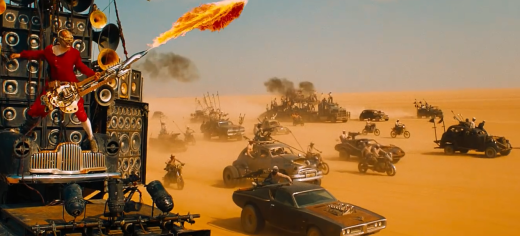
Any excuse to use this photo again. Hypothesis: the Doof Warrior does not outline
Working on pure impulse is fun. It’s almost meditative, a trance state. But it leaves a lot of the hard work for the drafts that follow. It’s like making dinner with whatever you grab from the fridge — you’ll have to clean up all those tubs and plates afterward. Same with writing — you grab any ideas that come your way, and it feels great. Just be aware that later, you’ll be in front of your metaphorical kitchen sink for a long time scrubbing.
(Quick sidebar: your first draft will always be a messy, unwieldy beast. You’ll probably hate it. But think of it this way: your first draft is PERFECT! Yes, we said it. Perfect. Why? Because it contains everything you need, and a lot more besides. You’ll be surprised just how many future narrative problems will be solved by seemingly random things from that out of control first draft. This is why you should never, ever censor your first draft.)
If the dread of that massive cleanup prevents you from enjoying the meal, then rejoice, for there is another way: the outlining approach might just be the best thing for you. This involves creating an outline of your entire story. You’ll work out your characters’ arcs in advance, then determine what story beats you’ll need to further those arcs. You’ll break out what your acts are (e.g. three acts for a movie or novel, 5 or 6 for a network TV script), and how your character development and action flows through them. This is the blueprint of your story. The “what happens next” of it, which is often what prompts hours of looking out the window instead of at your screen. With an outline, you have what happens next. When you go to start actually writing the story, you’ll get into the “how it happens” phase.
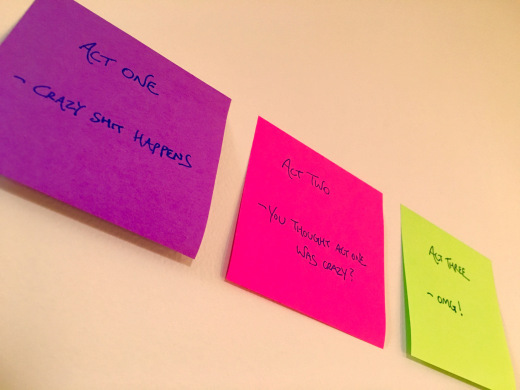
We’re patenting this story structure
Creating an outline, whether in a notebook, on post-it notes, index cards or flip charts, can save so much time when writing and editing. (If you don’t outline, and use your first draft to work out what your story needs to be, you’ll potentially have a lot more heavy-duty rewriting and restructuring to do in draft two). It can also help inspire your story as you write. We’ll be honest, it’s not the most fun part of writing. Like making a film or recording a song, the prep work is important and saves you time and energy in the end… but it is work.
So, what does outlining look like?
In its simplest form, it’s you working out and writing down ahead of time who your characters are, and what happens to them. A good place to start is with your main character(s) — who are they, and at a high level, what is their arc? Are they good, and going bad? Vice versa? Are they discovering something about themselves that changers their lives forever? Where will they be at the end, and how is that different from the start? Once you know who you’re writing about, and the basic emotional/psychological journey you want them to take, you can think about what needs to happen to get them there. This is focusing on character first, and using that to determine plot. As you do this, your other characters can come into play — who will help your protagonist, and who will get in their way? Who is their nemesis, their enemy? What are all of their arcs? Because all your characters should have some kind of arc or journey that they’re on. This keeps them from becoming cardboard cutouts that you’re just moving around for the sake of the plot.
It doesn’t take much to give your characters depth and nuance. Look at Sergeant Al Powell in Die Hard (which is possibly the most perfectly constructed piece of pop culture of all time — all the writing lessons you’ll ever need are in that movie). Al joins the action in Act Two. He could have just been a random cop without much going on other than being a device to ask John McClane questions to help keep the audience in the loop. But he’s so much more than that. It starts with his intro: he’s in a gas station buying twinkies when he gets the call to go to Nakatomi Plaza. That detail on its own is something, but it wouldn’t have been enough — but we get the spin — they’re for his pregnant wife, which adds a layer of “we don’t want anything to happen to him!” and also allows for a brief joke with the guy behind the till. That scene is at its core “cop gets the call,” but now it’s full of little details and dimensions that help give his character a little something more (and give the actor something to play).
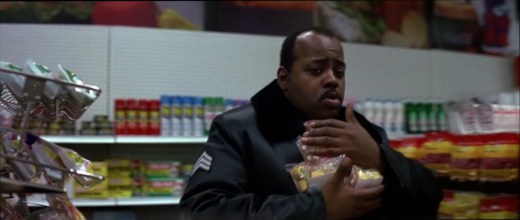
Al. And the Twinkies.
This continues for him throughout the movie — and it’s not just adding random details either — each piece of his story means something to the movie, and to his arc, and to McClane’s arc. Your homework is to watch Die Hard and analyze how they make Al relatable, accessible, interesting, and, with his backstory and arc, utterly necessary for the movie to succeed. Then think about how you can do this for your “minor” characters — because really, none of them are truly minor. If they are in your story, they’d better have a good reason to be there.
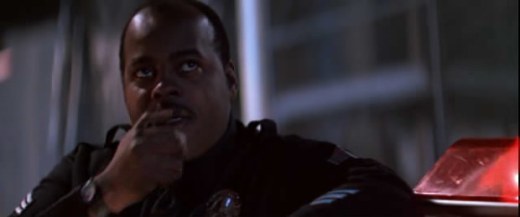
From Twinkies to ringside seat at Nakatomi Plaza: character development very much pictured
Once you have your main character and their arc, and some of your other characters, fleshed out, and you’ve worked out what your basic story could be, then you can drill down to the next layer of outlining: breaking that story down into more manageable units. It’s helpful to think of your story in acts, whether it’s a movie in three acts, or a TV show in five or six. You can start deciding which pieces of story might go in which act. The ends of your acts will need to push the audience dramatically into the next act, whatever kind of story you’re writing. Once you have that, you can drill down again, to the level of sequences (composed of scenes), and individual scenes. For a novel, you can do this, and also be thinking about chapters too. Where will your major story points occur? Where (and how) will you reveal information to your readers/audience? You can chart this in many different ways — whatever works for you is what you need to do. As you start seeing how you scenes and beats can be laid out across your story, more of the story will come to you.
That may all sound too clinical or analytical, but just because outlining like this involves a lot of discipline doesn’t mean that it has to diminish your artistic flow. Outlining is the halfway house between the riffing stage, and the engineering stage that is editing. You’re still improvising as you lock down your story’s structure, you’re still feeling out those characters, and thinking of cool shit for them to do… it’s just a more organized kind of riffing. And once that outline is locked down, you can just dive into the writing and not be held back by not knowing where your plot needs to go — you can make that first draft really sing and get inspired.
And remember, there’s always discovery. You always have to be open to the cool idea, the new direction. The outline is there to make the process easier — but it’s not necessarily set in stone. You may find that your story needs to go in a different direction, and that’s OK. You can just update the outline, and keep on trucking.
Different approaches work for different writers, sometimes on different projects. What worked for your novel may not work for your screenplay. The key thing is that you find the process that works for you. The way of writing that gets you to the promised land of actually finishing what you started.
And that’s the ultimate goal: whatever your story is, you thought of it, which means that you can finish it. Your creativity isn’t that cruel — if your muse delivers a beautiful idea to you… trust her. She wouldn’t send it your way if you weren’t capable of executing it (the idea, not the muse!).
Do what’s right for you as a writer. And see it through. Don’t exist in a dense forest thicketed with unfinished projects. Make your writing life clear and open by turning those beautiful ideas into beautiful realities. It feels good.


March 10, 2016
Things We Like: The Smashing Pumpkins, MACHINA/the machines of God
16 years ago, on February 29, 2000, The Smashing Pumpkins released a thundering powerhouse of an album, the gargantuan and gonzo MACHINA/the machines of God.
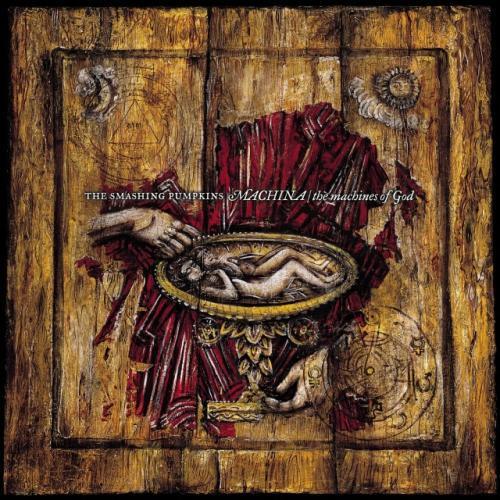
It was the Mad Max: Fury Road of albums, a monumental epic that roared wildly along alt-rock’s highway, knocking everything out of its path. And when you listen to it, you half-suspect that guitarist James Iha’s guitar is genuinely shooting flames.
But we digress.
It’s a classic, although it wasn’t considered as such at the time, receiving mixed reviews and being one of their lowest selling albums at that point. Which is just wrong, because this is the ultimate Pumpkins album. It’s a massive, 15 song, 73 minute set… but oddly enough, this was the short, compromised version — band leader Billy Corgan initially intended it to be a double album, but was refused by the record company. Even in its “reduced” state, MACHINA is an extraordinary, genre-busting achievement, bursting at the seams with alternative concept rock cybermetal pop balladry. It’s a thrilling mix of delicacy and heavy distortion, driven by angst and emotion, and a whole lotta love.
Above all else, it has really great songs (all written by Corgan). MACHINA is overflowing with powerfully catchy hooks, skyscraping choruses, and deep, driving, relentless grooves that keep it all flowing. Opening track The Everlasting Gaze sets the tone, kicking things off with some gloriously fuzzed out guitars and bass and crushing drums, as Corgan tells us “you know I’m not dead”… and that’s the quiet part of the song. It soon lifts off, racing through stratospheric atmospherics as Jimmy Chamberlain’s drumming transforms into a godlike thundering, while Iha’s guitar becomes a roaring furnace in front of a 100 foot Marshall stack and the whole thing achieves lightspeed transcendence.
It’s not folk music.
Somehow, the album gets better from there, jammed with huge choruses, gleaming atmospheres, and a whole bunch of kick-ass rock songs. It’s the sound of a band giving it everything they’ve got, wringing every last drop of intensity from every note, every word, every moment. Which is what was happening: it was designed to be the Pumpkins’ last album, a goodbye, and thanks for all the fish. Corgan’s plan had been to reconvene the original line-up of the band one last time, and go out on a high with an album that was about a fictionalized version of the band. He re-recruited Jimmy Chamberlain, who had left the band a a few years before. Their previous album, Adore, did not feature Chamberlain: it’s a quiet, hushed affair that never unleashes itself. It’s a beautiful, slinky album, but when Chamberlain came back for MACHINA, his muscular drumming changed everything. If Adore was Black Widow, MACHINA is the Hulkbuster. The band wanted to throw everything they had at these songs. Iha would add effects pedal after effects pedal to his guitar set-up to create the monstrous roar that powers much of this album, while Chamberlain would wreak furious havoc on the drums. However, partway through recording, bassist D’Arcy Wretsky chose to leave, wrecking the band, and Corgan’s plans. The album had to be refocused and started over; former Hole bassist Melissa Auf der Maur was drafted in for the live shows.
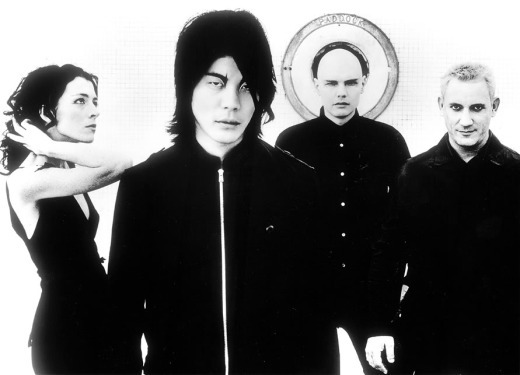
The official lineup for the album release and tour: Melissa Auf der Maur, James Iha, Billy Corgan and Jimmy Chamberlain
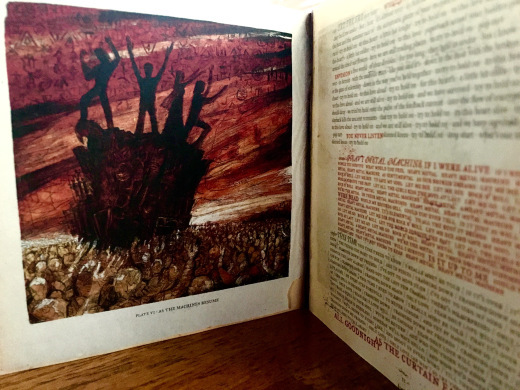
It’s a concept album — come back! — but one you can air guitar and air drum the shit out of. And, yes, it can be exhausting if listened to from start to finish — but exhausting in a good way, because the music really does consume you. Once you get past the event horizon of the pyrotechnics of the first few songs, you get pulled deeper into the intense gravitational pull and pressures of each successive track… by the end, as you fall through the glimmering soundscapes of With Every Light, the mesmerizing interstellar beauty of Blue Skies Bring Tears and the gleaming alternative pop of Age Of Innocence, you will almost certainly feel like you’re Matthew McConaughey in fifth-dimensional space. But that’s a good thing! Never has something so radio-friendly been so uncompromising in its vision. The CD booklet contains eerie, haunting artwork like the below, full of the dreams and nightmares of Corgan’s original vision of this as a “musical theater” piece based around a rock star called Zero (which had transformed by the time the album was done to Glass, and his band The Machines Of God).
It’s certainly not lacking in ambition, and it refuses to yield in its vision. MACHINA is full of emotional storytelling through almost mythically outsized songs. It marked the end of the 90s; luckily, it did not mark the end of Corgan’s ever-revolving collective. It was a forward-looking record, gazing unflinchingly at a glaringly bright future horizon that it raced towards. 16 years on, it stands as a testament to believing in your creativity, and even more importantly, seeing your creativity through, no matter what.
If you have an idea, make it your own… and make sure you actually make it.


February 25, 2016
Finding inspiration
Sometimes reading about the craft of music and listening to the best of the art form is enough to spark the creative flame of songwriting. Other times, you find the beat and the words flow as if they were forged together. Then there are those moments no writer wants to think about. When the words just aren’t there. You can sense them in the distance, but they won’t venture close enough to grab. Like your cat when it’s time to go to the vet.
Call it what you will, writer’s block, being creatively stymied, Twitter time, Hell… whatever you name it, there is only one cure for it.
Write.
Just write.
Play through the pain. Even if it’s crap, write until it’s not. Obviously, this is much easier to say than do. Nothing is as daunting as a blank page, or a cursor slowly flashing in a way that is surely mocking you, like a slow clap for your lack of words. Thanks, cursor. But inspiration is a tricky thing. It comes in all sorts of forms, from a picture to a phrase to a feeling, and you have to be open to catch it before it passes by.

The tyranny of the blinking cursor. Sarcastic attitude very much pictured.
While songwriting has to speak the truth, it doesn’t have to be pure autobiography. It can be, sure — Taylor Swift has brilliantly tapped the resource of her broken heart and connected with millions — but you don’t have to use your romantic crashes and burns to create a connectable song. It’s not a bad thing, as TayTay and Adele would agree, but it’s not the only way. You don’t have to translate the ins and outs of your journal into verses and choruses, but you do have to invoke your feelings: Loyalty. Trust. Love. Betrayal. Shame. Hate. Jealousy…
In a writing class many years ago, a fellow student read their work out loud. It was a short story about fickle love. It was brutal to listen to. The honesty of how it feels to be in the warm glow of love, and the soul-crushing shadow that steals your soul when it’s taken away, hit a nerve with everyone who heard it. After the piece was done, everyone asked the author if he was okay — assuming he was in Adele proportions of heartbreak. Turns out he was fine… he wrote the story about his cat.
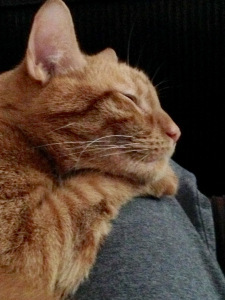
Smug bastard.
You don’t have to bungee jump off a bridge to convey the fear of falling and the relief of being saved at the last moment. We’ve all been there in some way or other, that train you thought you missed, that time you tripped and almost fell but steadied yourself in time. Use those feelings and create a story for them. Use whatever is around you and write about it. And keep writing until you hear your story’s beats.


February 11, 2016
Writing songs: make us feel it
Every writer knows that if you want to write a novel, you have to read a lot of books. And not just in your genre — you have to venture into all of the categories of your kindle. It’s the same for songwriting. In order to understand the craft of putting a song together, you first need to expose yourself to as much music as you can. Keep listening until you can hear the musical and lyrical structures of the nearly countless variations of songwriting out there. And then listen some more.
Whether it’s pop, which currently tends to have simpler, more repetitive lyrics over intense production, or rap, which usually focuses on telling a story over production-heavy loops and beats, or country, which almost entirely tells stories via vivid imagery and hooks, sometimes with a stripped-down sound, sometimes with arena-ready production gloss, you’ll learn the many nuances of songwriting from all of them. All kinds of styles are calling to you; let them in.
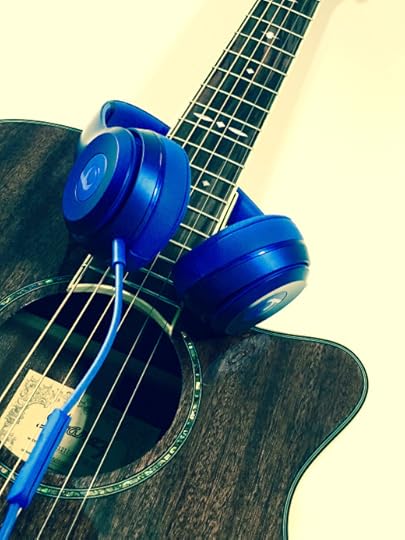
As you jump out of the For You section of your streaming service, you’ll notice almost all music shares one objective: emotion. Every song wants you to feel something. And to do that, they tell a story, whether it’s in one chorus chanted over and over again, or in an epic poem type style that provides you with characters, locations, events and even a timeline.
We’ve grabbed some of our favorite songs that tell stories in an original way, with inventive use of rhymes, imagery and phrasing. Add them to your playlist:
Chris Stapleton, “Whiskey and You” (written by Stapleton with Lee Thomas Miller). The opening line says it all: “There’s a bottle on the dresser by your ring, and it’s empty so I don’t feel a thing.” You have the whole story right there — that’s economy of imagery and phrasing. The rest of the song uses the differences between “whiskey and you” to say how the singer feels about his ex. It’s concise, hyper-effective storytelling using whiskey as the vehicle to attack his true feelings.
Kacey Musgraves, “Dime Store Cowgirl” (written by Musgraves with Shane McAnally and Luke Laird). Musgraves takes an insult screamed at her by another girl’s mom when she was a kid, and turns it into this statement of intent and identity. The phrase itself is evocative and catchy, and she weaves it into a stream of memories as she doubles down on where she’s from (“it don’t matter where I’m going, I still call my hometown home”).
Eminem, “Stan” (written by Eminem, Dido and Paul Harmon). One of the greatest examples of storytelling in rap, or any genre, this bleak but brilliant track is narrated by Eminem as Stan, one of Eminem’s biggest fans. It details Stan’s descent from happy fanboying to homicidal rage as his idol seemingly ignores all his attempts to get in contact. At the end, Eminem raps as himself again. The track is full of psychological and emotional moments that vividly illustrate Stan’s journey — Stan rationalizing that Eminem probably didn’t get his letters because his handwriting is too sloppy, Eminem ignoring Stan and his little brother when they were waiting in the cold outside one of his concerts, Stan laying out how he and Eminem are the same, even as Stan’s rage begins to creep into his phrasing more and more. It’s a masterpiece of sharp, memorable imagery used to convey a complex series of emotions, and to track a psychological breakdown.
Jessica Roadcap, “Always Find Me” (written by Roadcap, David Dorn and Rose Falcon). Roadcap uses a sparkling flow of imagery to detail her failed attempts to escape a memory: a fast car, an ocean, running, hiding, breaking free, Vegas, one night stands, ghosts… but always ending up realizing, “your memory always finds me.” This is how you take a hugely relatable feeling (wanting to forget the love of someone who’s gone) and make it instantly evocative to the listener using well-chosen imagery.
Beyoncé, “Single Ladies” (written by Beyoncé, The-Dream, Kuk and Christopher “Tricky” Stewart). This falls into the category of anthemic statement of intent, with its heavily repeated call to “all the single ladies” over a stuttering, relentless beat. It makes its point in pointed fashion, with its poetic “you had your turn, and now you’re gonna learn, what it feels like to miss me,” and its instantly iconic, “if you liked it then you shoulda put a ring on it,” which distills the meaning of the entire song into one bladed phrase.
Keith Urban and Eric Church, “Raise ’em Up” (written by Tim Douglas, Jaren Johnston and Jeffrey Steele). That title is used in a multitude of ways that get ever more profound: raising your glass in a toast, your hands in prayer, your tear-filled eyes up to the sky, your kids as they grow up. It’s a beautiful song that transcends that simple phrase by layering on the meanings.
Howlin’ Wolf, “Smokestack Lightning” (written by the Wolf). A classic, old-time blues, this uses a ruthlessly stripped-back image to drive the song: the sparks coming out of the smokestack of a train rushing past into the night (“smokestack lightning, shining just like gold…”). That becomes symbolic of the relationship that the character is losing (“where did you sleep last night… why don’t you hear me crying…”). Even musically, the song sits in one hypnotic chord throughout as the image is used again and again, making this in some ways a precursor to modern pop (we’ll take that Pulitzer now).
Whatever genre you listen to, the lessons of the best are clear: choose unusual imagery that hooks you in and tells you a story in its own right; play with words and phrases, layering in more than one meaning to give a song more depth; give your words a dynamic rhythm that sticks in our minds; but above all, keep it authentic, keep it true, keep it relatable, keep it real.
Make us feel it.


January 28, 2016
Books about songwriting
Sometimes putting a song together is easy — like when you beatbox to your pets as you put out their food. (Don’t worry, we don’t judge and they don’t judge… unless they’re cats, because, you now… cats.)
But if you want to put something together that will please more than Mr. Wooferson’s floppy ears, a little research is recommended. Songwriting is an art and a science, and you can study it just like any other art form. Anytime you’re reading about writing (songs, or novels, or scripts), you’re learning and getting inspired. You can’t stop it; your brain loves this stuff!
Here are three books that we’ve found particularly useful and inspiring when it comes to country music, but to be honest, most of what you’ll find here could apply to any kind of musical storytelling.
First up, we have Writing Better Lyrics, by Pat Pattison.
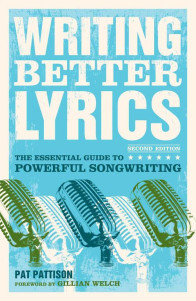
This is a sharp, insightful, unflinching, not-taking-any-of-your-BS look at writing lyrics. It’s jammed with great perspectives and exercises to help you get out of the familiar and easy pattern, and find genuine and fresh inspiration. Whatever level you’re at, you’ll find something here that will jolt your imagination. It’ll get you thinking about lyrics, choruses, verses, the flow, and even words, in a different light. Whatever genre you write in, this book will have something for you. If you’re struggling through writers’ block, try one of Pattison’s exercises — you’ll be writing a new song before you know it.
Next up, Nashville Songwriter, by Jake Brown.
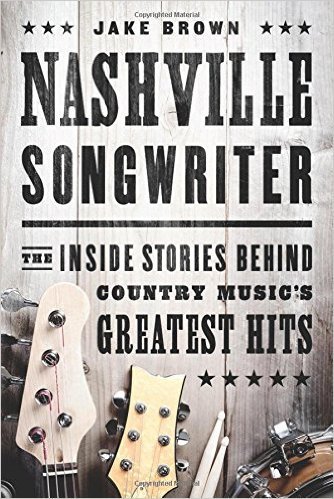
This is a fascinating series of interviews with some of Nashville’s finest and most storied songwriters, talking about how they wrote some of their biggest songs. If you want to learn about the process of songwriting, you go to the source: Merle Haggard, Ashley Gorley, Kelley Lovelace, Chris DuBois, Whisperin’ Bill Anderson, John Rich, Sonny Curtis, and many others. They each talk about the moment of inspiration for one or more of their hits, the way their initial idea was sketched out into the bare bones of a verse or two, before finding the chorus, then re-finding it with new inspiration, and how they got through to the final hit version. These are the people doing the work, talking about how they do the work. Even if you’ve never heard of some of the writers or songs, you’ll learn something about the many different ways that songs come into being.
Lastly, and more specifically focused on Nashville, is If You’ve Got A Dream, I’ve Got A Plan, with the epic subtitle How to get your songs heard by music industry professionals and get your foot inside a closed-door business. Damn!
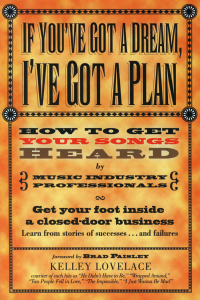
It’s by the aforementioned Kelley Lovelace, who has cowritten many of Brad Paisley’s hits. It’s over ten years old now, but its core principles remain true. Lovelace looks at the business of writing songs in Nashville (and outside if you can’t move there) from top to bottom, giving useful insights into the mechanics of the country music industry, including writing, cowriting, pitching, open mic, royalties, and much else. Lovelace knows the industry from the inside out, and writes in an engaging, accessible and inspiring way.
These are just three — there are whole libraries of books about songwriting, as well as, of course, the internet. You can find countless interviews with songwriters recounting their moments of inspiration and the detailed process of how they shaped their song. Taste Of Country has a great series called Lyrics Uncovered on its site. This installment focuses on how Kacey Musgraves, Shane McAnally and Brandy Clark wrote Musgrave’s hit Biscuits. Check it out, then take a look through their archives.
What it all comes down to is this: keep exploring. That’s the best way to grow and to stay inspired, which means you won’t only be impressing Mr. Wooferson, you’ll also be ready when the muse comes knocking on your door.


January 14, 2016
Songwriting and storytelling
We’ve focused a lot on movies and novels in previous posts, but there’s another kind of storytelling that drives a lot of what we do: songwriting.
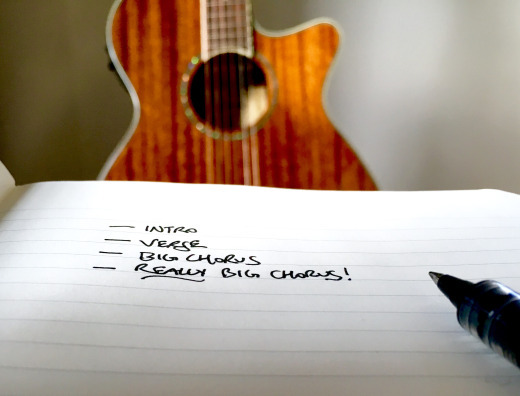
We love all kinds of music, whether it’s the beautiful inventive craziness of pop, the gritty edge of rap, the straight-up epic-ness of soul, or the gorgeous storytelling and soul-baring of country music. The through-line for us is songs that tell us stories, whether it’s a verse by verse evolution of things happening, or the evocation of an emotional moment in time. That kind of songwriting is a very precise form of storytelling, even more so than a short story, which is one of the most precision-based ways to get a story across, given the lack of time and space. Characters, situations, emotions, arcs, set-ups and pay-offs all need to happen immediately. Just as with short stories, there’s no runway with a song; you need a vertical take-off for the tale you’re telling. You have to grip the listener from the start with vivid, specific imagery that resonates. You need to use whatever tools you can to grab us and hold us close. Clever analogies, innovative wordplay, a flow; there’s a lot more in common with rap and country than you’d think.
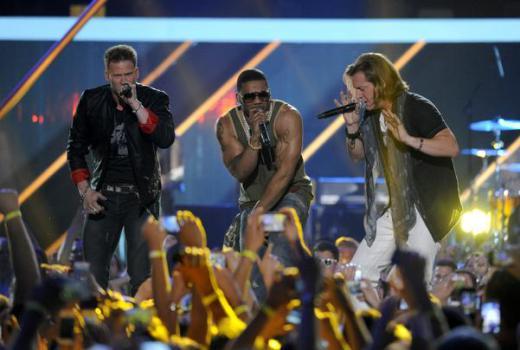
Florida Georgia Line and Nelly, rapping and… country-ing?
For us, the nexus of this kind of songwriting is Nashville. Dive deep into country music, and you’ll find everything you need to know about songwriting. It’s no coincidence that Taylor Swift, who has spent the last 15 months dominating the world with the epic, glossy, futuristic, confessional pop of the 1989 album and tour, learned how to get there by writing country songs.
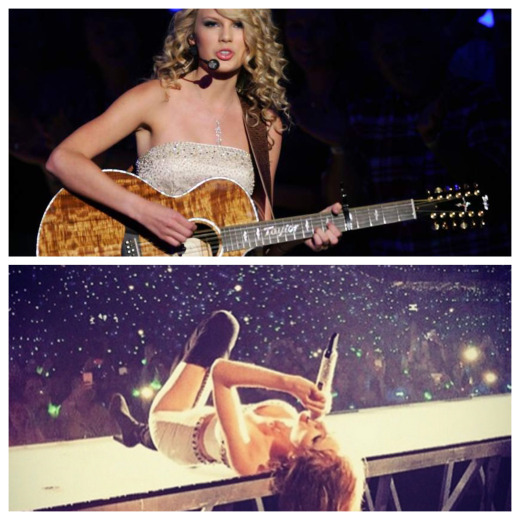
Great country songwriters transport you from the first line, and grip you until the last (and beyond): Eric Church, Mark Irwin, Shane McAnally, Kelley Lovelace, Miranda Lambert, Jessica Roadcap, Kacey Musgraves, Chris Stapleton, Ashley Gorley, Chris Dubois… They tell heartfelt, vivid tales, wrapped up in hooks and melodies. Here are two examples of how to tell a story through verses and choruses (listen to the way these songs are constructed, the way they phrase the things they say, the way imagery is set-up and paid-off):
Miranda Lambert, “Automatic” (written by Lambert with Natalie Henby and Nicolle Galyon). This digs deep into a nostalgic vibe, and does so by brilliantly layering meaning upon meaning on the word ‘automatic.’ The theme of the song is yearning for a time when you had to work for what you got, whereas now everything’s just automatic. Analogies flow fast and smartly, as do memories of taking the long way around (ironically, given the speed with which they poetically hit the theme). Driving stick, taking photos (“the kind you gotta shake”), writing letters… very specific experiences become universal as Lambert reaches out for a time “back before everything became automatic.”
Tim McGraw with Taylor Swift and Keith Urban, “Highway Don’t Care”, (written by Mark Irwin, Josh Kear and Brad Warren). Irwin and his co-writers do something very smart here, taking the chorus of a song that the character is listening to on the radio, and making it the chorus of the song itself. It adds another dimension to this story of someone driving angrily away from a row with their loved one, which is already made unusual by being from the POV of the person being driven away from. It’s a flawless example of how to take a story, and tell it in a fresh way, from a fresh angle. Irwin and co.’s approach gives the song life and heart; using the highway as the anchor for the song (“the highway won’t dry your tears, but I will… the highway don’t care, but I do”) makes it grab you. It’s not just someone telling you they care; it’s poetically constructed, which gives it more impact.
Smart analogies, vivid imagery, clever, complex and concise phrasing and construction: these themes reverberate through a good story and make for great music. It sounds analytical, and maybe even cold, but all this is the foundation on which beautiful, rich, heartfelt and soulful art is made.


December 31, 2015
2016: The year of doing something

Most New Year’s resolutions are about what you are not going to do: what you’re not going to eat or drink, who you’re not going to let upset you, how you’re not going to sit in front of the TV all night (thanks a lot, Netflix!).
In our eyes, starting the year with a negative isn’t the best way to embrace all the potential that 2016 could bring. So we humbly suggest resolving to DO something… to create something in 2016.
How many times have you listened to a song, watched a movie, read a book, looked at a painting or craft and thought, I could do that? Or at least… I want to do that. Well… stop thinking it and start doing it. Make 2016 all about making something.
You’ve got an idea for a novel that you constantly daydream about? Start taking notes. Write a story based on one of the characters. Or just jump in and start at Chapter One and don’t stop until you hit The End.
Just write. That’s all being a writer really is. It’s being someone who writes.
Pick up that guitar you haven’t touched in years and start laying some chords down. If you have to start at the beginning, take a few classes and go from there. It’s easy to find a teacher or class online or at your local music store. Sign up.
Play.
Turn on your video camera during your lunch break and start acting out scenes. Find your setting, your light, and most importantly, your muse. Seriously: if you’re an actor, don’t wait to get chosen anymore; choose yourself and write yourself a scene and put it online.
Pull out your paintbrushes or glue gun and start making something out of nothing.
The only thing we don’t endorse for 2016 is letting anything stop you. Keep at it. Let your work shift and change as it needs to; let it help you find your path to something that brings you joy and shows you what you are capable of.
It’s not about awards, money or recognition. It’s about feeding and nurturing that creative side of you that is unlike anyone else.
Resolve to make 2016 a year filled with taking creative risks, not being afraid to make mistakes, getting out of your comfort zone and embracing that creative genius you keep locked away (not literally; if you have an actual creative genius locked away, probably best to make them a nice cup of tea and then let them go).
To everyone’s creative genius, we wish you a very Happy New Year!


December 24, 2015
Editing your short film
Once you’ve got all your shots in the can, only one step remains: edit that sucker!
This step is many things: daunting, exhausting, thrilling, exhilarating. It’s where your movie becomes the movie it’s meant to be.
Assuming you’re all digital and not piecing together actual strips of celluloid, editing falls into a few key stages.
Watch all your footage. How long this takes depends on how much you shot. You’ll want to check out every second of every take, and make notes on things that worked or didn’t work (e.g., your actor did a great reaction 3m 42s into take 5, their co-star delivered the perfect line in response 3m 50s into take 8…). Make these detailed notes, with the times of the things that worked (or didn’t work), so that you have a complete list of every shot, and which moments you might want to use. See you in a couple of months.
Assemble. Not like the Avengers. This can be the most painstaking stage of all. This is you putting together your assembly, or rough cut. Mashing together different shots to see what works. It helps to be ultra-organized here: go line by line, reaction by reaction. Re-watch your clips for each beat, note down which parts of which shots you want to put next to each other, and away you go. Try out those combinations. If they don’t work, try different variations. (Yoda will be ok with all that trying, we promise). As you put your clips into your editing software, and then cut the small snippets of each one as you construct your movie beat by beat, you can mess with shortening them, intercutting them differently, experimenting with shots from different angles… Some takes are faster than others — you can see what speeds work, and adjust the clip lengths. Maybe that long pause that seemed to work on the day doesn’t now that it’s in context — so you can edit it down and make the scene fly. It’s mind-bogglingly slow and detailed work, but it’s fascinating and thrilling to watch your story coming together.
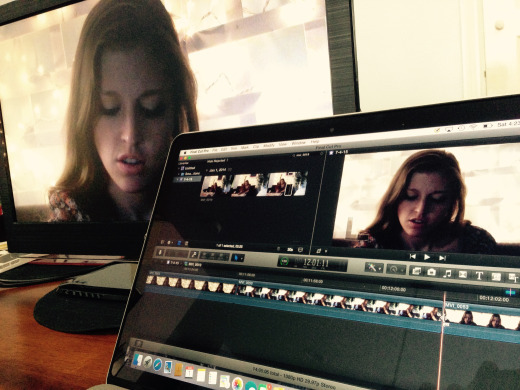
Connecting an external monitor so you’re not looking at your clips in a little 3×2 inch box is extremely helpful…
Continuity. You might be putting together your favorite shots to construct an argument that’s happening — but then you notice your actor’s hair is different (maybe they brushed it behind one ear in one shot, and the other ear in a different shot), or they’re leaning forward in one moment, then leaning right back the next. It’s not just about being guided by the best performances — you have to make sure the visuals flow and what’s happening matches up from shot to shot. So if your actor leans forward from one angle, you might cut to the next shot from a different angle that shows them continuing to move — this gives your movie flow and a good kinetic energy. The audience may or may not specifically notice, but they’ll certainly feel it. Watch out for cups moving around the table if the actors picked them up during the scene, or glasses getting more or less full, or any prop/furniture movement. There are a million details, and you need to see them all.
Audio. Be prepared to separate your sound from your visuals. You might need to take a line from one take where you’re looking at actor A, and lay it over the reaction shot where you’re looking at actor B. Or take some “room tone” from one take, and lay it over a gap in another take where you had to cut out the sound of someone banging into a table. You might need to take dialogue from an entirely different moment and lay it over a shot where it doesn’t belong in order to create a beat that wasn’t there before. The possibilities are endless. So play with it. Have fun. Editing is where your movie is truly written, so embrace the “anything can happen” feeling!
Polishing and cleaning. Once you have a rough cut, with your audio cut together too, you need to embark on the next phase: cleaning everything up. This means fine tuning each and every transition from one clip to the next to make sure your movie is tight and flows cleanly and dynamically. You’ll also work on your audio, adjusting the EQ, dealing with hiss or other extraneous noise, increasing volume in a quiet take, or reducing it if people start shouting and making the sound distort. It also means adding sound effects, e.g. footsteps, doors opening, cups clinking, background ambient noise, etc. Whatever you need to add that extra dimension to your story and evoke the world that your characters are living in.
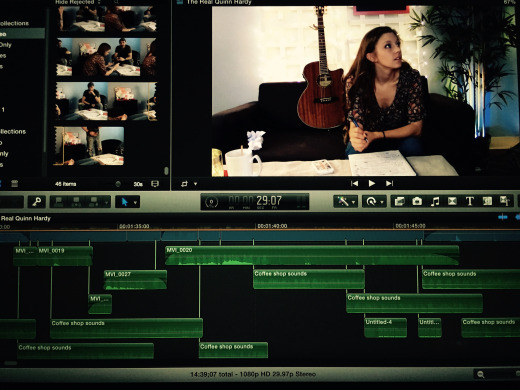
Audio clips for days… Editor’s sanity not pictured.
Color Correction. Technically part of the cleanup, this is a step unto itself, as you adjust exposure, shadows, color, saturation, in order to make your image rich and dynamic. You can really give your scenes life, warmth and a cinematic feel with this step.
Music. If you need music for your movie, this is the time to add it. Once your picture is locked, sound cleaned up, color corrected, you can add the soundtrack.
Credits. It’s up to you how and where the credits go, but they should be unobtrusive in the sense that they must fit your story and your mood. They can be simple, or they can be David Fincher in Seven-style insane (and awesome). Whatever works for your movie.
Watching your clips, cataloguing them, then piecing them together into a rough cut which you then fine tune, while you get all your audio clips cleaned up and in the right place, can take weeks, even for a 10 minute short. It’s all about making each moment sing, about doing your story justice, and making sure you do your actors justice too. They’ve worked hard for you — you need to choose moments that show them off.
Editing is where it all comes together, and the true identity of your movie becomes clear. What you thought it was, what you thought you shot on the day… that all falls away. You work with what’s there, and what’s there will tell you what works. It’s incredibly thrilling and fulling. And never more so than when you screen the finished product for the first time!


December 17, 2015
Things We Like: Star Wars Episode VII The Force Awakens
Was there ever any doubt?
Really?
Well, sure, OK, a little. We didn’t know for certain that JJ Abrams was going to deliver an extraordinary and beautiful cinematic experience. We thought he would. We hoped.
And…
[insert Poe Dameron whoop of SHEER UNSTOPPABLE JOY]
… JJ gave us the Star Wars movie we wanted and needed. The Star Wars movie we dreamed of. The Star Wars movie that we deserved.
Yeah, JJ nailed it.
From the glistening Lucasfilm logo, to that gorgeous blue “A long time ago, in a galaxy far, far away…” to the BLAST of John Williams’ iconic theme as the crawl begins… JJ nailed it and then some.

Along with writers Michael Arndt (Little Miss Sunshine, Toy Story 3) and Lawrence Kasdan (the grand master behind The Empire Strikes Back and Return Of The Jedi), Abrams has crafted something wonderful and exhilarating, moving and hilarious, devastating and thrilling, all in equal measure.
This will be spoiler free, but it’s not spoiling anything to let you know that BB-8 is a more-than-worthy addition to the droid-you’re-looking-for crew. Adam Driver’s Kylo Ren is an extraordinary bad guy, full of resonance, hurt and rage. John Boyega’s Finn is a joy to watch and the source of much of the movie’s off-kilter but brilliant humor. And, in Daisy Ridley’s Rey, we have one of the greatest characters in the Star Wars universe.
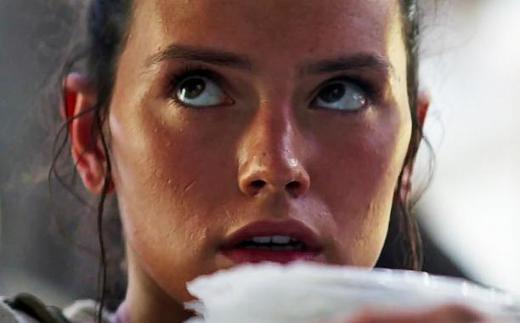
Ridley, who only had a handful of TV screen credits prior to this, plays Rey with heart and nuance, giving us loss, hope, bad-assery, ass-kicking, wise-cracking… and many more things we can’t share with you (spoilers!). Ridley’s story mirrors Rey’s in a lot of ways, and Ridley uses her natural energy to really bring Rey to crackling life.
Adam Driver, so volatile and uncontrollable on HBO’s Girls, dials that up even more here. He’s the only person who could have played Ren, and he brings a tremendous energy to it all. Boyega, who was SO GOOD in Attack The Block, kills it as Finn — he’s hilarious and heartbreaking — while Oscar Isaac is in the ZONE as the chilled-out greatest pilot in the galaxy. Bodega and Isaac make you root for them immediately, as does Ridley.
And that’s what’s at the heart of this extraordinary journey — you are invested emotionally from the very beginning, and even more intensely as the movie goes on. The story is powerful, and the movie is shot beautifully, unafraid to linger on stunning vistas and bustling scenes of alien life. But it never feels slow. This thing reaches hyperspace right out of the gate, and drops out of it only at the dizzying, thrilling end.
Throughout, this is great storytelling, with wonderful, fully-realized characters, shot in a gritty, intense way, that gives you the feels. All of them. All the feels. #feels
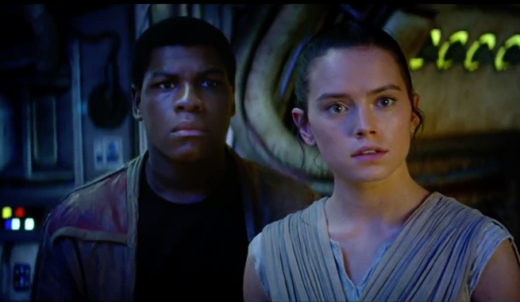
It’s exhilarating, mind-blowing, full of danger and threat, and, gloriously, joyously, wonderfully… it just feels like Star Wars.
Because, also: John Williams.
We have new John Williams Star Wars music on a Star Wars movie. And it gives you chills to hear it. As the story flows, so does his music.
The story ends where it needs to, and opens up the door to the next two movies. The blend of the old and the new is seamless, naturalistic, and provides the perfect hand-off to what is to come. We get all our Original Trilogy feels, and plenty of new trilogy feels alongside.
In short, The Force Awakens is nothing less than the reawakening of something powerful, a new force in the universe. It’s everything you want it to be.
FIVE OUT OF FIVE JEDI MIND TRICKS
Random awakenings:
HOW CUTE IS BB-8 THOUGH???!!!
The sound of Kylo Ren’s lightsaber is basically the most bad-ass thing in cinema history
Han and Leia’s theme will MAKE YOU CRY SON
Captain Phasma is cool
“Chewie, we’re home…”
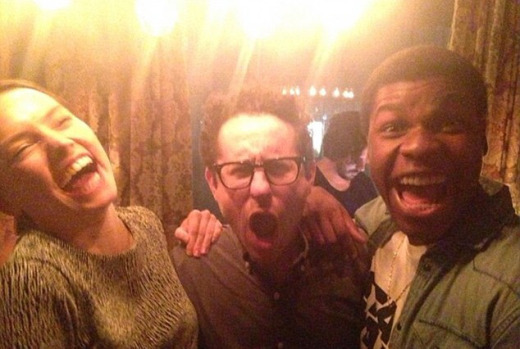
When the credits roll, this is how you’re going to feel:


December 10, 2015
Making a short film: Planning The Day
Planning the day (or days) of filming your short falls somewhere between arranging a night out hanging with friends and, well… a wedding. Like a wedding, there’re a lot of logistics and contingencies to work out, and like a night out with friends, you want to be open to genius ideas and flexible enough to deal with last minute cancellations.
How the day of filming unfolds is often determined by how much planning you do beforehand. Because each project can be vastly different, there’s no universal checklist that you can print out and use. That’s not going to stop us laying out ten super important things that you need to consider though!
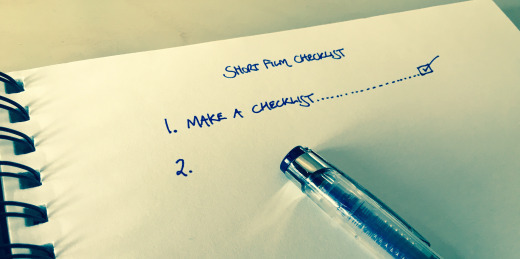
Create a shooting schedule. Chances are, you have limited time in your location and/or with your cast and crew. A table read and run-through will help you figure out how much time you’ll need in each location, and for each scene. Factor in time to build sets, eat, and take bathroom breaks. Then add at least 15-45 minutes to each block of time for interruptions or inspiration. It might sound crazy, but you don’t want to throw out a good idea just because you ran out of time to explore it.
Have a list of all your props and organize accordingly. Treat setting up your sets or locations like you would moving house. But instead of having boxes labeled by rooms, have everything packed according to the timing of your shoot. And be sure to make a note if a prop will be used in a later shot so you know to move it to the “next box” when finished.
Bring extra. If the script calls for two cups of coffee… bring three — just in case one breaks. If you are relying on your cast to provide their own wardrobe, be sure to bring alternate clothing options or accessories, in case what they bring doesn’t work with the lighting or vibe with the story — sequins only work in certain light, and patterns can be attention-sucking. And bring extra scripts. Someone will probably forget theirs.

Safety mug not pictured
Take roll call. The week before, the night before, and even the morning of, reach out to your cast and crew and make sure they’re still on board, know the time and location, and are prepped. Just send a quick, nice note about how you can’t wait to work with them and open the door to any questions or concerns they might have.
Confirm, confirm, confirm. Make sure you have your location booked, and that anything being borrowed has a pick up and drop off time. You can be more pushy with this kind of thing, especially if money is involved.
Prepare for weather to mess with you. Even if you have all indoor sets and shots, a thunderstorm can mess with your lighting and sounds. A really hot day can have the AC buzzing in your mics, and the threat of snow can cut your available time in half. Severe enough weather might force a delay in shooting, so keep an eye on the forecast and keep your cast and crew up to date. You’re going to be like your grandparents constantly watching the Weather Channel, but at least there’s an app for that now.
Make sure your crew is reliable. A short on a tight budget often means cashing in favors and handing out IOUs. When reaching out for support, do your best to find positive people who are passionate about your project, and genuinely want to contribute. People who love what they do, whether it’s acting, lighting, sound, etc. You don’t want anyone on set who doesn’t want to be there or has their own agenda. You also don’t want anyone there who’ll drain the atmosphere and prevent everyone else from reaching their creative potential. You need to set the tone, as the director and leader of this team, and choose people who bring good, creative energy. Your set needs to be a happy, creatively conducive place. With lots of snacks. Which leads us to…
Keep everyone and everything charged. Make sure you have enough chargers, back-up batteries and power cords for your lighting and equipment (especially for your camera!). And bring food. Lots of food. Loaded with sugar and caffeine. If anyone in your cast or crew has a food allergy or special diet, be sensitive and work with them to make sure there’s something safe and available for them to eat. No one gives their best when they’re starving.
First-aid kit. This sounds like it should be on a camping list. But remember that third mug you’re bringing? Whoever ends up breaking it will probably hurt themselves in the process. Hopefully you won’t need it, but you don’t want to delay filming because someone has run out for band-aids.
Find a Snapchattist. When you’re in the middle of changing a set, finding the right camera angle, or trying to shoot dialogue between rolls of thunder, you won’t have time to take candid shots of the cast and crew. But you’re going to want those shots later, either to help promote the film, or just to laugh and remember the good times once you’ve shared the finished product with everyone that came together to make it happen. This person can be a member of the cast who isn’t in every scene, or someone in the crew whose camera phone is never off.
Depending on your script, you’ll probably have a lot more to add to your list, even for a 10 minute short. Plan as much as you can beforehand, think of possible roadblocks and how you’ll get around them… and it never hurts to wake up really early. But, once you’re rolling, keep rolling. Go with whatever happens, let your cast explore their characters and ways to play the scene, and let the sun shine on your main character. Work with what the day gives you, and with any luck, you’ll wind up with something better than you could have imagined.