
Michael Matthews's Blog, page 132
January 27, 2014
The 3-Step Skinny Fat Solution
If there’s one thing about people’s bodies that frustrates them most, it’s being skinny fat.
What do I mean, exactly?
Well, a “skinny fat” physique is one that doesn’t look overweight, but lacks muscle definition. It’s the type of physique that, despite having relatively low levels of body fat, looks soft and shapeless.
Here are a few examples:




What frustrates people most about being skinny fat is they’re usually exercising quite a bit and trying to “eat clean.” They feel they’re working way too hard to look the way they do. And I understand.
Well, in this article I’m going to break down what the real issue is underlying the skinny fat look, how most people get there, and how to fix it. Let’s get started.
The Heart of the Skinny Fat Problem
A big part of the frustration related to being skinny fat comes with an irrational obsession on weight.
Many people mistakenly use the scale as the primary yardstick of their physiques instead of focusing on body composition. (Click here to tweet this!)
By body composition I mean your body’s ratio of lean mass (or fat-free mass) to fat mass. (Lean mass is muscle, fat-free mass is everything in your body that doesn’t contain fat [muscle, bone, water], and fat mass is body fat.)
Whether we’re talking health or visuals, how much you weigh doesn’t matter nearly as much as how many pounds of muscle versus fat are on your body. (Click here to tweet this!)
You see, the real skinny fat problem is too little muscle and too much fat. And the less muscle is on one’s body, the less fat is needed to see muscle definition. One can have so little muscle that little-to-no muscle definition is apparent even at relatively low body fat percentages (10 – 15% for men, 15 – 20% for women).
So, then, the “skinny fat solution” involves fixing body composition, and this almost always involves weight going up. Yes, even for women.
For example, check out the following transformations:

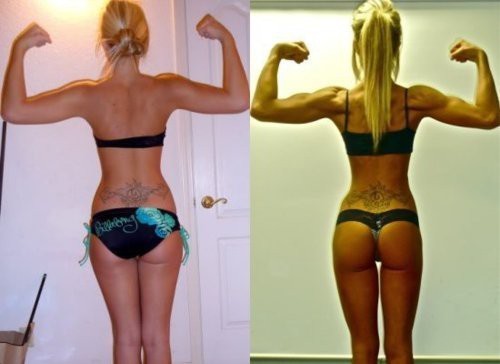


In each case, these people ended up significantly heavier–15 – 20 pounds–heavier than when they started their transformations. And that’s because muscle is very dense, and it requires a lot more muscle than people realize to look they way they want (even if they only want to be “toned”).
Now, before we get to the “skinny fat solution,” let’s talk more about the problem, and specifically how people get there in the first place and how to avoid making the same mistakes.
The Recipe for Skinny Fat
I tend to run into the skinny fat problem with women more than men, and that’s because the common diet and exercise advice given to women is basically a prescription for becoming skinny fat.
The recipe for skinny fat is:
Severe calorie restriction
Excessive amounts of cardio
Minimal weightlifting with an emphasis on high-rep training
Sound familiar? It should because that comprises the majority of mainstream weight loss advice (starve yourself, do a ton of cardio, and lift a bunch of light weights).
Why does this give you a skinny fat physique, though? Let’s break it down.
How a Severe Calorie Restriction Makes You Skinny Fat
Before I explain the relationship between severe calorie restrictions and skinny fat, I want to quickly review some basics.
When we’re talking food, a calorie is the amount of energy required to heat up one kilogram of water one degree Celsius. It’s nothing more than stored (potential) energy.
High-calorie foods contain a lot of potential energy, and low-calorie foods a little. Your body uses the energy in food to perform the millions of cellular activities that keep it alive, and it stores a portion of the energy as body fat (a bit of an oversimplification, I know, but it serves the purpose of this article).
Now, in order to lose body fat, you need to regularly feed your body a bit less energy than it uses. It will then slowly whittle down its fat stores to meet its daily energy demands.
Many mainstream weight loss diets try to skirt around the issue of calories and proper meal planning, however. Instead of explaining how weight loss actually works, they either restrict the types or amounts of foods you can eat, or both. This often leads to dramatic reductions in calorie intake, and this is where the problems begin.
You see, when you feed your body far less energy than it needs, you lose fat, but you also lose quite a bit of muscle as well and your metabolism slows down markedly.
The net effect is you stop losing fat earlier than you expect, and you can’t continue losing weight unless you eat even less or exercise even more, which means more muscle loss. Many people fall down this slippery slope and wind up showing an “improvement” on the scale, but hating what they see in the mirror.
How Too Much Cardio Makes You Skinny Fat
Contrary to mainstream broscience, cardio isn’t your enemy if you’re trying to build muscle and stay lean…but doing too much of it is detrimental to your body composition. (Click here to tweet this!)
There are two reasons for this:
1. Research has shown that endurance training directly interferes with strength and hypertrophy (muscle growth) progress.
This is why the frequency of endurance training should be kept to a minimum if the primary focus is strength and hypertrophy.
2. Research has shown that the longer your cardio sessions are, the more they impair strength and hypertrophy.
This is why cardio sessions should be kept as short as possible (long enough to aid sufficiently in fat loss, but not longer). The shorter they are, the more muscle you preserve.
These two problems are even worse when you’re restricting your food intake for fat loss because this state of “negative energy balance” reduces anabolic hormone levels and suppresses protein synthesis rates. That is, your body is primed for muscle loss when you’re dieting to lose fat, and when you introduce a bunch of long sessions of cardio into the mix, muscle loss is accelerated.
So, when you combine a severe calorie deficit with a lot of cardio, you have a powerful one-two punch for ruining body composition.
How Minimal and High-Rep Weightlifting Makes You Skinny Fat
As most people equate doing cardio with losing fat, weightlifting is normally given short shrift. This is a big mistake.
1. Lifting weights helps preserve lean mass while restricting calories for fat loss.
While you may or may not be able to build muscle while losing fat, your goal while dieting for fat loss is to maintain as much lean mass and strength as possible. Resistance training is the only way to do this.
2. Weightlifting enhances the fat loss effects of cardio, and vice versa.
These two reasons are why you need to be emphasizing resistance training when you’re dieting for fat loss. How much lifting should you be doing, though?
Well, you may have heard that you should limit your weightlifting to 2 – 3 sessions per week when cutting or you’ll wind up overtrained.
The reality is there is no one-size-fits-all answer to optimal training frequency, as some people’s bodies deal with stress better than others. In my experience, however, both with my body and with the hundreds of people I’ve worked with, it’s quite a bit harder to reach this point of overtraining than some experts believe.
Generally speaking, readers on my programs have absolutely no issues lifting 3 – 5 times per week and doing shorter, HIIT cardio sessions 3 – 4 times per week while cutting. Their success is likely due to a combination of factors:
Proper training volume (the workouts aren’t long, grueling bloodbaths)
Proper nutrition (maintaining a mild calorie deficit, using good macronutrient ratios, eating plenty of healthy, micronutrient-dense foods)
Proper rest (sleeping enough, giving muscles enough rest before training them again)
Supplementation that reduces bodily stress and inflammation, and improves overall health, such as spirulina, fish oil, and vitamin D
You’ve probably also heard the advice to focus on high-rep weightlifting when dieting for fat loss to “really bring out the definition.”
Well, that’s completely wrong. “Bringing out definition” merely requires that you reduce your body fat percentage, and high-rep training doesn’t help you do that any more than lower-rep training (in fact, research has shown that heavy weightlifting is even more effective for fat loss).
How much muscle you can retain while restricting your calories is determined by several things such as how lean you are and are looking to get, your current fitness level, your hormone profile, and more. But the bottom line is you should not lose a lot of strength or lean mass while losing fat.
The 3-Step Skinny Fat Solution
Now that we’ve fully explored what the skinny fat problem is and why many people have to deal with it, let’s talk about the solution. It’s actually quite simple.
Skinny Fat Solution Step #1
Focus on Heavy, Compound Weightlifting
As you know, the major problem with a skinny fat physique is the lack of muscle, and thus, focusing on building muscle is key.
This not only means your training emphasis needs to shift from cardio to weightlifting, but to proper weightlifting. What do I mean by that?
You should be focusing on increasing strength on compound lifts like the Squat, Deadlift, Bench Press, and Military Press.
If you’re a guy, I recommend you focus on the 4 – 6 rep range, as laid out in my book Bigger Leaner Stronger, and if you’re a girl, the 8 – 10 rep range as laid out in Thinner Leaner Stronger.
The big “secret” behind the high-rep, high-volume workouts espoused by many fitness models and bodybuilders is…drugs. It’s really that simple. Working in the 12 – 15 rep range for 2 – 3 hours per day is GREAT if you’re chemically enhanced, but it’s a recipe for disaster if you’re natural.
These two things, when combined with proper dieting (which we’ll get to), will result in rapid increases in both muscle size and strength, which slowly but surely transforms a skinny fat physique to a muscular, athletic one.
Skinny Fat Solution Step #2
Cut Back on the Cardio
As we want to focus on building muscle, cutting back on cardio helps immensely.
I’ve had many people come to me doing 8, 9, even 10+ hours of cardio per week, only to be unhappily skinny fat. Doing this much cardio is never necessary, no matter how lean you want to get.
I recommend that you limit cardio to 1 – 3 sessions per week when maintaining or bulking, and to 2 – 4 sessions per week when cutting, and that you utilize HIIT cardio to keep your cardio sessions short (under 30 minutes) while still burning significant amounts of calories.
Skinny Fat Solution Step #3
Use Nutrition Properly
How to approach diet is what trips people up most when it comes to fixing the skinny fat problem. The reality is this:
If your calorie intake is already quite low (as compared to your total daily energy expenditure), you do not want to further decrease it to try to lose fat.
Many people that are skinny fat have crashed their metabolic rates through improper dieting and training, and if that’s you, don’t despair, it can be fixed. But the key is it must be fixed before focusing on losing fat again.
Instead of further restricting your calories, you need to systematically increase intake to speed up your metabolism, which will not only help you build muscle, but it will enable you to then lose fat easily by utilizing a daily mild calorie deficit.
Check out my article on how to speed up your metabolism to learn more about this, and if this is the next step for you.
If your calorie intake is in a normal range, and your body fat percentage is too high, then you can use your diet to focus on losing fat.
If you’re eating somewhere around your total daily energy expenditure (again, check out this article to see how to calculate your TDEE), then your metabolic rate is in good shape and you can use your diet to focus on fat loss.
I recommend you focus on fat loss first if your body fat percentage is over 15% (men)/25% (women). Get it down to the 10% range (men)/20% range (women) before switching to focus on muscle growth.
In case you’re not sure how to do this, check out my article on proper meal planning, which shows you how to lose fat and build muscle eating foods you like. If you’re new to proper weightlifting, as outlined in step 1, then chances are you’ll build some muscle while losing fat, achieving what is normally referred to as a “body recomp” (changing body composition by losing fat and building muscle).
If your calorie intake is in a normal range, and your body fat percentage isn’t too high, then you can use your diet to focus on building muscle.
If your body fat percentage is closer to 10% (men)/20% (women), you can plan your nutrition around maximizing muscle growth, as explained here.
What did you think of this skinny fat solution? Have anything else to share? Let me know in the comments below!


January 25, 2014
Recipe of the Week: Vegetable Hummus
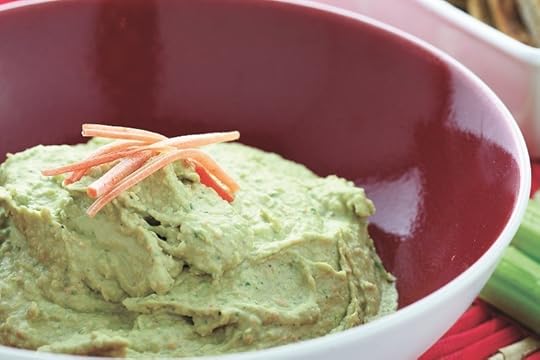
I love a good hummus, and find it goes well with all kinds of foods such as burgers, chicken, vegetables, simple pasta recipes, salads, and bread.
The problem with many store-bought options, however, is they’re usually so damn high in fat (making it less attractive for proper meal planning).
Well, you can use this recipe from my cookbook Eat Green Get Lean to make your own fresh, delicious, and relatively low-calorie hummus. Enjoy!
Servings
12
Calories Per Serving
79
Protein Per Serving
2 grams
Carbohydrates Per Serving
9 grams
Fat Per Serving
2 grams
Ingredients
1/3 cup carrots, shredded
1/3 cup fresh parsley
1/4 cup scallions, sliced
1 1/2 cups cooked chickpeas (if canned, drained)
1/4 cup tahini
3 tablespoons lemon juice
2 tablespoons extra-virgin olive oil
2 cloves garlic, minced
1/4 teaspoon salt
1/8 teaspoon ground black pepper
Instructions
In a food processor or blender, add the carrots, parsley, and scallions and process until finely chopped.
Add the remaining ingredients and process until smooth, or desired consistency
What You Get to Eat
What did you think of this week’s recipe? Let me know in the comments below!
Want more delicious, easy-to-make recipes like this?If you like this recipe, then you’ll love the bestselling cookbook it came from: my own Eat Green Get Lean! It contains 100 vegetarian and vegan recipes specifically designed for high-protein, healthy dieting.
And even if you’re not a vegetarian or vegan eater, you will find plenty of delicious “add-on” dishes, as well as breakfast, lunch, and dinner recipes that you can easily add meat or other forms of protein to.
Buy this book now to forever escape the dreadful experience of “dieting” and learn how to cook nutritious, delicious vegetarian and vegan meals that make building muscle and burning fat easy and enjoyable!
Buy now
AmazonAmazon UKAmazon AUAmazon CABNiBooksKoboGoogle Play
You might also like my other bestselling cookbook, The Shredded Chef.
In this book you’ll find 120 healthy, flavorful recipes specifically designed for athletes that want to build muscle or lose fat. Regardless of your fitness goals, this book has got you covered.
Buy now
AmazonAmazon UKAmazon AUAmazon CABNiBooksKoboGoogle Play

January 24, 2014
Cool Stuff of the Week: Gym Stereotypes, Garmin Vivofit, Atlas Shrugged, and More…
I’m not ashamed to admit that I’m kind of a sucker for cool stuff. I like nifty gadgets, quirky decoration pieces, nice clothes (and shoes!), good books, and fun games.
In this series of weekly posts, I share whatever currently has my fancy. Maybe some of it will catch yours as well!
VIDEO OF THE WEEK:
GYM STEREOTYPES
There has been a lot of these gym stereotype videos recently but this one is definitely one of the best. The Naked Old Guys get me every time… I have a strict “eyes-straight-ahead” policy when I’m in the locker room…
HAROW BLACK SKULL CHAIR


Now this is a chair.
If you want to feel like an awesome supervillain,this is for you. Designed by Harold Sangouard for Harow, each piece is limited and the price is only available upon request, which means it probably costs six figures and a few baby souls.
GARMIN VIVOFIT
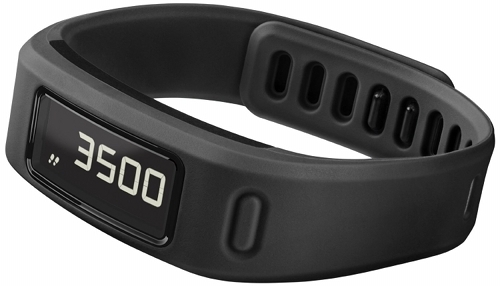
Wrist-worn fitness trackers are really hot right now, and Garmin has thrown their hat into the fray.
The Vivofit comes with the standard features you’d expect from such a device, like…
Daily activity recommendations based on fitness goals.
Movement tracking that allows for the display of steps taken, calories burned, distance traveled, and so forth.
Sleep monitoring with reports of total sleep hours as well as periods of movement and restful sleep.
Wireless syncing with Garmin Connect, an online platform for viewing your data and community for meeting other Garmin-using, fitness-minded people, competing with friends, and more..
Water resistant
One feature that is unique is the user-replaceable battery that lasts for up to a year. That means no annoying recharging every few days.
Buy now
Amazon
IFIXIT PRO TECH TOOLKIT

iFixit is known for taking apart all kinds of cool gadgets, and this requires a pretty diverse set of tools.
Well, they’ve packaged them all into this awesome toolkit, which contains 70 tools to help you fix and hack all kinds of electronics. It includes things like…
A 54-bit driver kit
Tools for opening electronics
Various knives, rulers, tweezers, and spudgers
Anti-static wrist strap
And more…
MAKERBOT REPLICATOR 2

3D printing is awesome, and really is the way of the future, but it’s been completely inaccessible to us consumers. 3D printers are just too damn expensive, hard to use, and large to keep at home. Not to mention that the raw materials needed are hard to come by.
Well, MakerBot is changing all that, making 3D printing at home a reality. Sure, their devices are still expensive, but if you have the money or the desire, you can start printing all kinds of cool stuff at home with the Replicator 2.
It features a user-friendly interface, wireless connectivity, a digital store for buying designs, and touch-and-print capability, making it easier than ever to prototype at home.
Buy now
Amazon
BOOK OF THE WEEK:
ATLAS SHRUGGED
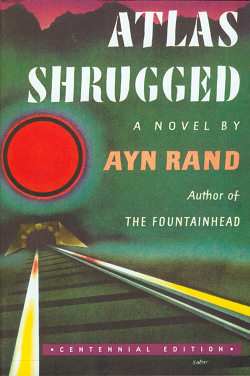
Yes it’s too long, yes it belabors its arguments, yes the philosophy is heavy-handed, yes the characters are cardboard…but there’s a reason Atlas Shrugged is widely considered one of the best novels of all time. Despite being more or less ignored by the media and academia, it continues to sell hundreds of thousands of copies every year.
The story takes place in what seems to be the 1950s, and in a time of political and economic turmoil. There’s a recession that’s worsening, the ineffectual bureaucrats have no idea how to solve the nation’s woes, and men and women of great industry–the people providing tens of thousands of jobs and the economic backbone of the society–are disappearing at an alarming rate.
Enter Dagny Taggart, the protagonist of sorts. She’s capable and intelligent, serves as the VP of Operations of the largest railroad left in the world, and will do whatever it takes to keep the company alive. And while the story piles on the complications, making it harder and harder for her to fulfill her mission, that’s not really what it’s about.
This book is an elegant exposition of Rand’s philosophies about individualism vs. collectivism, and whether you agree or not, it will make you think (and will probably give you some pause regarding what is going on in today’s political and economic climate). It’s an exploration of human psychology–of our motives, ideals, and standards of morality and ethics.
While I don’t fully agree with all of Rand’s beliefs, I’m fully behind her fundamental critiques of collectivism, and loved the messages in Francisco’s speech on money, Galt’s (admittedly long-winded) final radio transmission, Dagny’s stubborn optimism, and the parasitic nature of government and ineffectual whiners.
I truly think this is a book everyone should read and reflect on. Whether you agree with Rand’s core tenets or not, this book will change the way you view the world.
Buy now
Amazon
What do you think of this week’s picks? Have anything you’d like to share? Let me know in the comments below!
January 23, 2014
5 Healthy Whole-Food Pre-Workout Snacks
While a pre-workout protein shake is easy, and there may be particular benefits to pre-workout whey protein, sometimes it’s nice to mix it up and eat something delicious instead.
In this article, I share with you 5 recipes for healthy, whole-food pre-workout snacks that I’ve really liked. Enjoy!
Eggs in a Basket

Picture courtesy of Food.com
Without the sides of hash potatoes and sausage, this brunch classic makes a healthy and delicious snack.
Directions
Use a round cookie cutter (or the rim of a cup) to cut out the middles of two slices of sprouted wheat bread (my favorite is Ezekiel bread).
Heat a skillet over medium heat, add 1/2 tsp. of butter, and add bread.
In the holes in the bread slices, add 1/2 tsp. butter and melt. Crack one large egg in the center of each slice. Sprinkle with salt and pepper.When the egg white is set, carefully flip over the bread so as to keep the yolk inside.
Toast the two extra bread rounds. Serve warm.
Nutrition Facts
Calories: 373 calories
Protein: 23 grams
Carbs: 35 grams
Fat: 16 grams
Peanut Butter & Banana Parfait
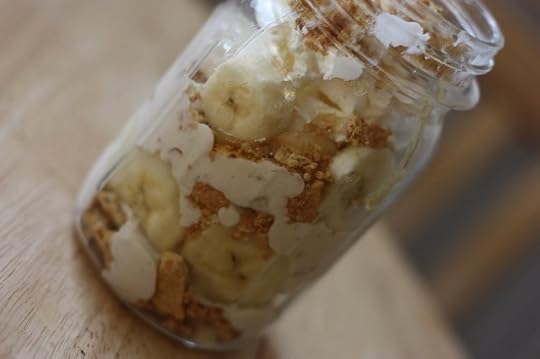
Picture courtesy of The Smart Kitchen
This simple snack is popular with the knee-high crowd, but it’s also a great way to fill up without feeling overly full.
Directions
One large banana and a tablespoon of chunky peanut butter equal 215 calories, but for a more substantial snack, they can be turned into a decadent yogurt parfait.
Swirl the peanut butter into 6 oz. non-fat Greek yogurt. Layer the bananas and yogurt in a bowl with 2 Tbsp. old-fashioned rolled oats. Top with a dash of cinnamon.
Nutrition Facts
Calories: 361 calories
Protein: 25 grams
Carbs: 50 grams
Fat: 10 grams
Brown Rice Protein Pudding
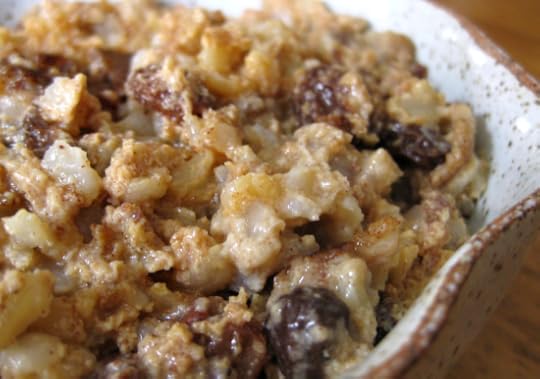
Picture courtesy of Lilyella
Rice pudding is a delicious, healthy dessert, but this naturally sweetened version is an excellent pre-workout snack too. It takes a while to make, but this recipe makes six servings and will be just as tasty cold as it is warm.
Directions
In a medium saucepan, bring 1 cup brown rice and 4 1/2 cups unsweetened vanilla almond milk to a boil. Simmer over medium-low heat until the rice has absorbed the liquid, about 45 minutes. Stir regularly.
Then to make a natural syrup, soak 2 cups pitted dates in 1/2 cup boiling water for 15 minutes. Blend or puree until the mixture becomes smooth.
Once rice is ready, add 2 scoops unflavored whey protein powder, date syrup, 1 cup toasted slivered almonds, 1/2 cup golden raisins, 1 tsp. vanilla extract, 1/2 tsp. almond extract, and 1/4 tsp. cinnamon. Makes 8 servings.
Nutrition Facts (Per Serving)
Calories: 350 calories
Protein: 13 grams
Carbs: 51 grams
Fat: 12 grams
Egg White Whipped Oatmeal
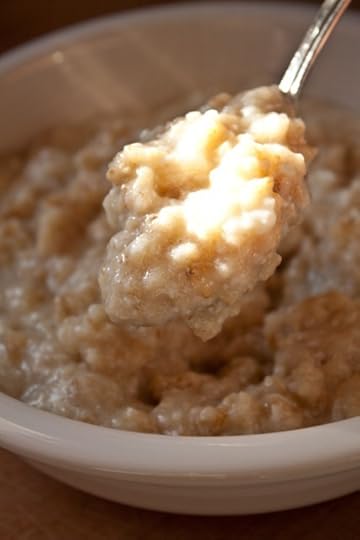
Picture courtesy of Can You Say For Dinner?
Early to bed, early to rise? If you need a hearty breakfast before a morning workout, or before commuting on two wheels to work, this bowl of healthy oatmeal will do the trick. And there’s no added sugar!
Directions
Over medium-high heat, simmer add 2/3 cup old-fashioned rolled oats and 1 1/3 cups water, about four minutes. Reduce heat to medium-low and cook for about 5 more minutes, stirring often.
In a small bowl, whip 4 egg whites and 1/2 tsp. pure vanilla extract until frothy. Once the oats have absorbed most of the liquid, add egg mixture and whip with a heavy spoon.
Bring heat back up to medium, and add 1/2 tablespoon of salted butter. Keep on heat at a simmer for another 4 minutes, until creamy, and then cover the pot to let oats finish cooking for 5 minutes. Serve hot.
Nutrition Facts
Calories: 374 calories
Protein: 24 grams
Carbs: 44 grams
Fat: 11 grams
Sweet Potato Matchsticks & Beef Jerky
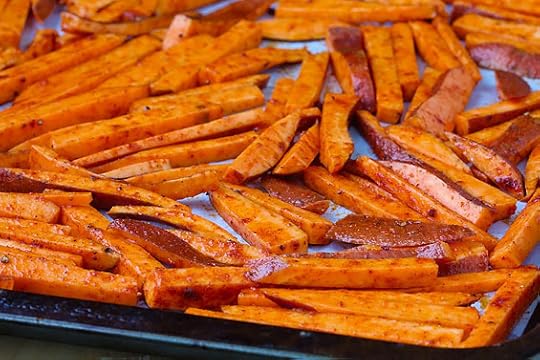
Picture courtesy of Gimme Some Oven
These thin fries are a great way to get some healthy carbs before you exercise. Pop them in a tall cup, and you can snack on these fresh-from-the-oven sweet potato matchsticks as you drive to the gym. Pair with a couple ounces of organic beef jerky for a salty snack that’ll prepare you for a serious workout.
Directions
Preheat the oven to 450°F, and cut a medium sweet potato in half lengthwise. Cut both pieces into 1/4-inch thick strips, and on a large baking sheet roll the matchsticks in 1/2 tablespoon olive oil.
Spread out thin sweet potato strips in a single layer, and sprinkle with 1/4 teaspoon salt. Bake for a half hour, or until crispy. Season with sumac or paprika.
Nutrition Facts
Calories: 313 calories
Protein: 26 grams
Carbs: 36 grams
Fats: 9 grams
What did you think of these healthy pre-workout snacks? Have anything else to share? Let me know in the comments below!
Want more delicious, easy-to-make recipes like these?If you like these recipes, then you’ll love my bestselling cookbook The Shredded Chef!
In this book you’ll find 120 healthy, flavorful recipes specifically designed for athletes that want to build muscle or lose fat. Regardless of your fitness goals, this book has got you covered.
Buy this book now to forever escape the dreadful experience of “dieting” and learn how to cook nutritious, delicious meals that make building muscle and burning fat easy and enjoyable!
Buy now
AmazonAmazon UKAmazon AUAmazon CABNiBooksKoboGoogle Play
Vegan and vegetarian dishes are great sources of micronutrients, and even if you’re a meat eater, they’re great for changing things up in your meal plan.
And in my cookbook, Eat Green Get Lean, you’ll find 100 of my favorite vegetarian and vegan dishes, carefully balanced for our high-protein, healthy needs!
Buy this book now to forever escape the dreadful experience of “dieting” and learn how to cook nutritious, delicious vegetarian and vegan meals that make building muscle and burning fat easy and enjoyable!
Buy now
AmazonAmazon UKAmazon AUAmazon CABNiBooksKoboGoogle Play
January 22, 2014
The Definitive Guide to Whey Protein
Whey protein is a staple in most athletes’ diets for a good reason: it’s digested quickly, absorbed efficiently, and easy on the taste buds.
Prices are all over the place, however, ranging from less than $10 per pound, to over $20 per pound, and marketing claims used to justify various price points range from sensible to ludicrous.
So what gives? Well, let’s lift the veil of mystery on whey so you can make an informed choice, and get the right product for the right price.
What is Whey Protein, Anyway, and What is the Big Deal?
Whey is a byproduct of cheese production. It’s a relatively clear liquid left over after milk has been curdled and strained and it used to be disposed of as waste.
It was later discovered that it contains an impressive array of complete proteins necessary for protein synthesis and hypertrophy, and thus, the whey protein supplement was born.
But why is whey so big in the health and fitness world? Does it warrant all the attention and use?
Well, whey is especially popular with athletes and bodybuilders because of its amino profile, which is high in leucine. Leucine is an essential amino acid that plays a key role in initiating protein synthesis.
Whey is particularly effective when eaten after training, due to its rapid digestion and abundance of leucine. Simply put, the faster protein is digested and the more leucine it has, the more muscle growth it stimulates. This is why research has proven that whey is a highly effective form of post-workout protein.
So yes, there’s a good reason why most protein supplements sold are whey. But not all whey powders are equal.
Whey Concentrates, Isolates, Hydrolysates, Oh My!
The three forms of whey protein sold are whey concentrate, isolate, and hydrolysate.
Whey concentrate is the least processed form and cheapest to manufacture, and it contains some fat and lactose. Whey concentrates range from 35 – 80% protein by weight, depending on quality.
Whey isolate is a form of whey protein processed to remove the fat and lactose. Isolates are 90%+ protein by weight, and as they’re more expensive to manufacture than whey concentrate, they’re more expensive for consumers too.
Whey hydrolysate is a predigested form of whey protein that’s very easily absorbed by the body and free of allergenic substances found in milk products. Research also indicates that the hydrolysis process improves solubility and digestibility. Whey hydrolysate is the most expensive of the three options.
So which should you buy? Well, when choosing a whey, you have a few things to consider.
While isolates and hydrolysates are pushed as superior to concentrates due to purity and higher protein concentrations per scoop, there’s insufficient evidence to support claims that they are superior to concentrates when used as a part of a mixed diet.
That said, choosing the cheapest whey you can find, which will always be a concentrate, isn’t always a good idea, either. A quality whey concentrate is somewhere around 80% protein by weight, but inferior concentrates can have as little as 30% protein by weight.
If a low-quality whey concentrate is only 30% protein by weight, what else is in there? Well, unfortunately we can only wonder, as adulteration (the addition of fillers like maltodextrin and flour) is startlingly rampant in this industry.
Another significant benefit of a pure whey isolate is the removal of the lactose, which means better digestibility and less upset stomachs. (I hear this quite often from customers of mine that like my 100% whey protein isolate product.)
The general rule with whey protein is you’ll get what you pay for–if the product costs a lot less than the going rate for whey, it’s probably because it’s made with inferior ingredients. (And I can tell you firsthand that producing a high-quality whey protein isn’t cheap!)
High prices aren’t always indicative of high-quality, either. Disreputable supplement companies pull other tricks, such as starting with a low-quality concentrate, adding small amounts of isolate and hydrolysate to create a “blend,” and then calling attention to the isolate and hydrolysate in their marketing and packaging.
To protect yourself as a consumer, always check ingredient lists and serving sizes and amounts of protein per serving before buying protein powder.
Specifically, you’re going to want to look at the order in which the ingredients are listed (ingredients are listed in descending order according to predominance by weight), and the amount of protein per scoop relative to the scoop size.
For instance…
If a product has maltodextrin (a filler), or any other ingredient, listed before the protein powder, don’t buy it. That means there’s more maltodextrin, creatine, or other fillers in it than protein powder.
If a scoop is 40 grams but there is only 22 grams of protein per serving, don’t buy it unless you know that the other 18 grams are made up of stuff you want. Weight gainers have quite a few carbs per scoop, for instance.
A high-quality whey protein is easy to spot:
Whey concentrate, isolate, or hydrolysate listed as the first ingredients
A scoop size relatively close to the amount of actual protein per scoop (it’ll never match because there is at least sweetener and flavoring along with the protein powder in every serving)
Whey Protein Processing and Denaturing
A very common method of processing whey protein is using a machine called an “ion exchange.” Whey concentrate is run through this device to create an “ion exchange whey isolate,” and this is often marketed like it’s something good or special.
While this sounds fancy, it actually has significant drawbacks.
Whey protein is a complex molecule made up of many smaller molecules called subfractions, such as beta-lactoglobulin,immuno-globulins, lactoferrin, lactoperoxidases, lysozyme, and others. Each of these subfractions has its own unique properties and functions in the body.
The ion exchange process selectively depletes many of these subfractions, thereby reducing the overall health value of the protein. This is known as “denaturing” the protein.
Superior (more expensive) processing methods utilize technologies known as “cold-filtration” and “micro-filtration” to produce the protein powder while still maintaining the original undenatured state of the protein.
How to Use Whey Protein
The ideal ratio between whole food and supplement protein is still an area of scientific ambiguity, but anecdotal evidence has led to the general advice of getting at least 50% of your daily protein from whole food sources.
Remember, protein supplements are meant to be just that–supplements–and not primary sources of daily protein.
Now, as you know, whey protein is a particularly good source of post-workout protein. How much should we have after a workout, though?
Well, according to one study, 20 grams of whey protein eaten as a post-workout meal stimulates maximum muscle protein synthesis. That is, eating more than 20 grams of whey protein after a workout will not increase muscle growth.
While that sounds neat and simple, it doesn’t apply to everyone equally. Protein metabolism and needs are affected by several things:
How much muscle you have.
The more muscular you are, the more protein your body needs to maintain its lean mass, and the larger the “reservoir” it has for storing surplus amino acids.
How physically active you are.
The more you exercise, the more protein your body needs.
Your age.
As our bodies age, they need more protein to maintain lean mass. For example, research has shown that, in the elderly, 35 – 40 grams of post-workout protein stimulates more protein synthesis than 20 grams.
Your hormonal profile.
Anabolic hormones like testosterone, growth hormone, and insulin-like growth factor 1 (IGF-1) stimulate muscle protein synthesis. If your body has high levels of these anabolic hormones, it will be able to make good use of higher amounts of protein than someone with lower levels.
On the other hand, elevated levels of cortisol reduces protein synthesis and accelerates the process whereby the body breaks down amino acids into glucose (gluconeogenesis), thereby reducing the amount available for tissue generation and repair. Some people have chronically elevated cortisol levels, and this impairs protein metabolism.
So, while 20 grams of protein might be enough to stimulate maximum protein synthesis under certain conditions, this won’t hold true for everyone.
Whey protein can also be used as an effective pre-workout supplement, as research has shown protein ingested 30 minutes prior to training can reduce muscle damage and soreness.
The Best Whey Protein Powder
I’ve always used 100% pure whey protein isolate products because concentrates can bother my stomach (research has shown that approximately 70% of the world’s population can’t properly digest lactose, and I guess I’m one of them). If dairy bothers your stomach at all or gives you any symptoms of indigestion, I recommend you stick with 100% whey protein isolate products too.
I’m also picky when it comes to artificial sweeteners and food dyes, MSG, and other chemicals commonly found in whey protein powders. I like my workout supplements naturally sweetened and as free of artificial additives as possible, and recommend the same for my readers.
These requirements have really limited me in the past, and the whey protein powders I used were particularly expensive (upwards of $25 – 30 per pound). Fortunately, I’ve been able to leverage my success as an author to launch my own line of naturally sweetened, filler-free workout supplements, and it includes a 100% whey protein isolate product.
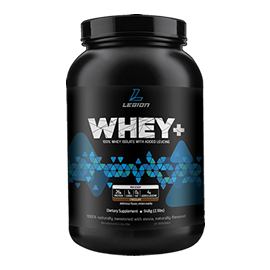
It’s called WHEY+, and it’s essentially the whey protein powder I’ve always wanted.
WHEY+ is 100% whey isolate protein, not a blend of isolate and cheaper forms of protein.
WHEY+ is made from milk that comes from hormone-free cows.
WHEY+ contains wholly intact, undenatured protein made with cold micro- and ultra-filtration technologies.
WHEY+ has 4 additional grams of leucine per serving to further stimulate muscle growth.
WHEY+ is naturally sweetened with stevia, and naturally flavored.
WHEY+ has no artificial junk like maltodextrin, MSG, or artificial food dyes.
Buy now
LEGION (SAVE 10%!)Amazon
What did you think of this definitive guide to whey protein powder? Have anything else to share? Let me know in the comments below!
January 21, 2014
Why “Good Enough” Isn’t Good Enough
Two words are the hallmark of mediocrity and laziness. They are…
“Good enough.”
This is the worst attitude to have in your work and indeed, your life. Settling for “good enough” is such a low standard. It means that you simply don’t care enough to be extraordinary. And the reality is, achieving any level of real success requires just that—extraordinary desires, efforts, and persistence.
This complacent attitude keeps us from doing our best work. It keeps us from making the money we want to make and from having the type of life we want. “Good enough” leads to divorce, poverty, and a legacy that reaches no further than the grave.
You want to know a funny, kind of counter-intuitive way to spot a professional? His craft kicks his ass sometimes. (Click here to tweet this!) He wants to rip his hair out in frustration because he just can’t put all the pieces together yet. He cares that much about his work.
The “good enough” type of person would never sweat it. He’d shrug, recite his mantra—“it’s good enough”—and blithely carry on with the next uninspired task. And life repays him in kind—with good enough pay, good enough recognition, good enough opportunities.
Don’t be that person.
It’s okay to be discontent with circumstances and strive for things uncomfortably larger. It’s okay to always want more. Don’t try to avoid dissatisfaction—use it to spur you on to greater things, because that’s where true satisfaction is. (Click here to tweet this!)
I’m talking about the attainment of BIG goals. The production of BIG effects. Why settle for anything less?
Don’t swing completely to the other end of this spectrum, though: The perfectionist that is never satisfied with anything, that can be pleased by nothing and no one, and that has a rapacious, insatiable drive. That’s no way to live, either.
There’s a balance that you have to strike. Any movement in the right direction should be celebrated, even if it’s just for a moment. Those little steps, when reinforced, can turn into leaping strides. The greatest geniuses in history had incredibly “unattainable” goals but, ironically, they were also incredibly patient.
While working on the lightbulb, Edison famously wrote, “I have not failed 10,000 times. I have successfully found 10,000 ways that will not work.”
Don’t let minor failures convince you to abandon your dreams and replace them with vague, colorless visions that are “good enough.” Always push back. Always figure out how to do it better. Never compromise with what you know you can accomplish.
You are important—maybe more than you know—and you can make a difference in the world. Take it upon yourself to become extraordinary. The world needs you.
As Paul Hawken said in his moving commencement address, “You are brilliant, and the earth is hiring.” Are you up for the job? (Click here to tweet this!)
What’s your take on the attitude of “good enough”? Have anything else you’d like to share? Let me know in the comments below!
January 20, 2014
The Ultimate Shoulder Workout: The Best Shoulder Exercises for Big Delts
When it comes to upper body training, the shoulders are often undertrained. They naturally tend to lag behind arm and chest development, and can remain very stubborn, refusing to change at all.
I know because I used to have this problem. But I don’t anymore, and in this article, I’m going to share with you how I finally grew some shoulders I could be proud of.
If you follow my advice in this article, and eat properly, your shoulders will grow in both size and strength.
So, let’s first take a quick look at the anatomy of the shoulders so we understand what we’re trying to achieve in our shoulder workouts.
Growing the Shoulder Muscles
Your shoulders are comprised of three major muscles known as deltoids, and here’s how they look:
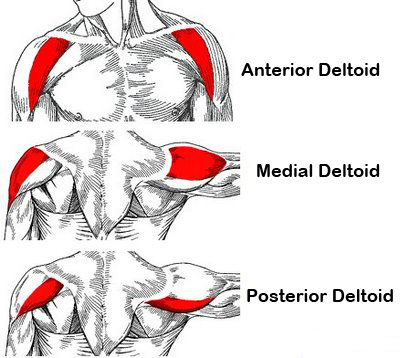
It’s very important to develop all three heads of this muscle group, because if one is lagging, it will be painfully obvious.
In most cases, the medial and posterior deltoids need the most work because the anterior deltoids do get trained to some degree in a good chest workout. The other two heads don’t, however.
Let’s use my own physique as an example. First, check out the following picture taken about 4 years ago:
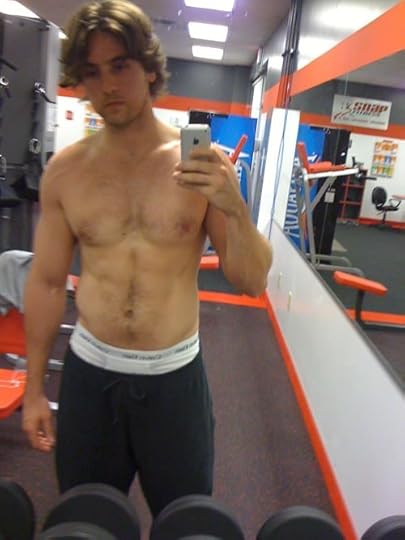
I didn’t look horrible, but take a look at my left shoulder and how small it looks compared to the middle of my arm (the middle of my bicep and triceps). Here’s another shot from the same time period that shows it even more:
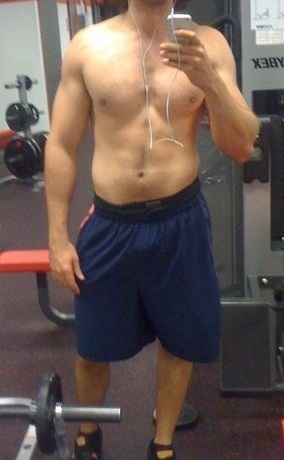
As you can see, my arm and chest completely overpowered my shoulder. Keep in mind that I was training shoulders at that time–I was doing a lot of sets as a part of a traditional bodybuilder routine (a lot of isolation work, 10 – 12+ reps, Drop Sets, Super Sets, etc.).
Soon after I took these pictures, I began changing the way I trained and ate, and after about a year of this new style of eating and training, I looked like this:
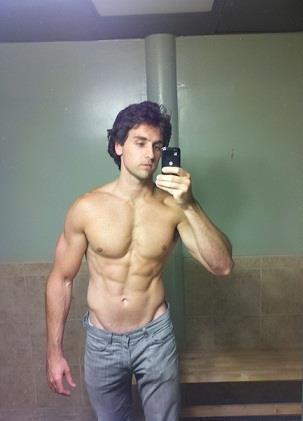
Quite an improvement, of course (I was thrilled), but let’s focus again on that left shoulder because it’s still lagging. The medial head in particular lacked size–it didn’t protrude enough to balance the size of my triceps.
I kept working at it, however, and here’s a shot of me taken a few months ago:

I still think my shoulders need a bit more work, but I think you’ll agree they have greatly improved and are fairly proportional to my arms, chest, and back.
The progress you’re seeing in the above pictures was achieved with the exact training advice that I’m going to share with you in this article.
So let’s get to how to best workout your shoulders…
Shoulder Training 101
The two biggest mistakes most people make in their shoulder workouts are:
1. Focusing on the wrong shoulder exercises.
Many people focus too much on machine and isolation exercises, which are not the key to building big, round delts.
2. Focusing on high-rep training.
This mistake will stunt the growth of any major muscle group in the body, but it’s particularly detrimental when it comes to shoulder development.
These two points go against what a lot of people hear and assume about shoulder training. Namely the assumption that because the deltoids are smaller muscles, they respond better to high-rep training. This is false, and I explain why in my article on muscle hypertrophy (muscle growth).
Many people also focus on the wrong shoulder exercises–usually isolation exercises that don’t permit enough progressive overload without risking injury. Well, like all major muscle groups in the body, the reality is shoulders respond best to heavy, compound weightlifting.
“But wait a minute,” you might be thinking. “INSERT SHREDDED FITNESS MODEL HERE does a lot of high-rep isolation shoulder exercises in his shoulder workouts, and he has amazing boulder shoulders… What gives?”
The answer is steroids. I know, that might sound cynical, but it’s true.
When someone is on enough drugs, achieving muscle growth is mind-numbingly simple: he sits in the gym for a few hours every day doing rep after rep after rep, exercise after exercise, and his muscles get bigger and bigger. In this case, focusing on high-rep training is actually a good thing.
Furthermore, the shoulders (along with the upper arms, traps, and upper chest) are quite dense in androgen receptors, which are special types of proteins in cells that respond to certain hormones in the blood (including anabolic hormones like testosterone). That’s why these parts of the body–the shoulders, upper arms, traps, and upper chest–grow very quickly when guys get on steroids, and can reach freaky levels of size.
That said, you can still build a great set of delts without drugs. It just takes time, and it takes the right approach to shoulder training. And the right approach as a natural weightlifter is very simple:
1. Focus on lifting heavy weights in your shoulder workouts.
If you want your shoulders to get big and strong, you’ll want to focus on the 4 – 6 or 5 – 7 rep range.
2. Focus on the shoulder exercises that safely allow for sufficient progressive overload.
We’ll talk more about this in a minute, but these are exercises like the Military Press, various types of Dumbbell presses, the Dumbbell Side Lateral Raise, and more.
Training volume and frequency is also important. Like “ideal” rep ranges, optimal training frequency is a hotly debated subject. The bottom line is it boils down to workout intensity and volume.
The lighter the weights and fewer the sets per workout, the more often you can train the muscle group. And, as a corollary, the heavier the weights and greater the sets per workout, the less often you can train the muscle group.
I’ve tried many different splits and frequency schemes, and what I’ve found works best is in line with an extensive review on the subject conducted by researchers at Goteborg University:
When training with the proper intensity (focusing on lifting heavy weights), optimal frequency seems to be about 60 – 70 reps performed every 5 – 7 days.
This not only applies to the shoulders but to every other major muscle group as well. If you’re an advanced weightlifter (3+ years of proper training under your belt), you can probably push this up to the 70 – 80 rep range, but any more than that and you will be risking overtraining.
Alright, let’s now look at the best shoulder exercises for muscle growth.
The Best Shoulder Exercises
My list of favorite shoulder exercises is pretty short and simple. These are the exercises I’ve used to dramatically improve my own shoulders, and that will do the same for yours.
1. Seated or Standing Military Press
Barbell pressing is the most effective way to build your shoulders because although it focuses on the anterior head, it also involves the other two, and it allows you to push heavy weight without risking injury.
I prefer the Seated Military Press because the standing variation requires quite a bit of balance and lower back stability to perform, and as I squat and deadlift heavy every week, I don’t feel I need any more lower back training.
Here’s how to properly do the Seated Military Press:
The key point here is I’m bringing the weight down to my chest in a controlled manner. Don’t stop at 90 degrees for fear of your shoulders–so long as you keep your elbows under the bar and resist the urge to flare them out, you’ll be fine.
Here’s how to do the Standing Military Press correctly:
2. Seated Dumbbell Press
The dumbbell variant of the press is also a great exercise for building overall strength and size. Here’s how it’s done:
3. Arnold Press
The Arnold Press is a variation of the traditional Dumbbell Press, and uses an increased range of motion to further overload the anterior deltoid. Here’s how to do it:
4. Dumbbell Front Raise
The Dumbbell Front Raise is an effective exercise for targeting the anterior deltoid. Between this and the presses, you don’t need anything else for this front head of the muscle group. Here’s how to do it:
5. Side Lateral Dumbbell Raise
The Side Lateral Dumbbell Raise is the most effective exercise for building the medial (middle) deltoid. This head is usually underdeveloped when compared to the anterior because people tend to focus on chest and shoulder pressing.
Here’s how to do it:
As your shoulders get stronger, you’ll find it harder to maintain proper form when trying to lift both dumbbells simultaneously. An effective way to get around this without cheating is to do a hanging variant of the exercise:
6. Rear Dumbbell Raise
The posterior (rear) deltoid is the smallest and weakest of the three heads, but still needs some love if you want to have a “three-dimensional” shoulder that doesn’t fall flat in the back.
The Rear Dumbbell Raise is a simple and effective exercise for building this posterior head. Here’s how to do it:
You can also do a standing variation of this exercise:
7. Rear Lateral Barbell Row
The Rear Delt Barbell Row is another great exercise for targeting the posterior deltoids. Here’s how to do it:
Remember–Progression is the Key to Muscle Growth
That’s it on the exercises.
The key, however, isn’t just doing the above exercises. It’s progressing on them. That is, increasing the amount of weight you can push over time.
If you don’t get stronger, you won’t get bigger. But if you do work on building your strength on these exercises, and you eat enough food to grow, your shoulders will get bigger and stronger.
The Ultimate Shoulder Workout
A good shoulder workout trains all three heads of the muscle, and focuses on heavy weights. Just like any other muscle group, shoulders can benefit from higher rep work, but you have to emphasize the heavy weightlifting if you want them to grow.
While I go over everything you need to program your own shoulder workouts in Bigger Leaner Stronger (and provide you with an entire year’s worth of workouts that can, when combined with proper nutrition, help you put on 20 – 25 pounds of muscle in your first year of weightlifting), I want to leave you with a shoulders workout that will prove the effectiveness of what I’ve discussed in this article.
What I want you to do over the next 8 weeks is perform the following shoulder workout once every 5 – 7 days:
Seated or Standing Military Press: Warm up and 3 sets of 4 – 6 reps
Dumbbell Side Lateral : 3 sets of 4 – 6 reps or 6 – 8 reps if you can’t maintain proper form with 4 – 6
Rear Dumbbell Raise: 3 sets of 4 – 6 reps or 6 – 8 reps if you can’t maintain proper form with 4 – 6
Optional (if you feel like you have some juice left): Dumbbell Front Raise: 3 sets of 4 – 6 reps or 6 – 8 reps if you can’t maintain proper form with 4 – 6
That’s it–just 9 – 12 heavy sets for your entire workout. If you’re an advanced lifter, or you feel you have more in you at the end of the workout, you can do the final 3 sets, but don’t do more than that or you will likely wind up overtrained at some point.
Once you hit the top of your rep range for one set, you move up in weight. For instance, if push out 6 reps on your first set of the Military Press, you add 5 pounds to each side of the bar for your next set and work with that weight until you can press it for 6 reps, and so forth.
Rest 2 – 3 minutes in between each set. This will give your muscles enough time to fully recoup their strength so you can give maximum effort each set.
I guarantee you that if you combine that shoulder workout with a proper nutrition plan, you will be very happy with how your shoulders respond.
This type of training is the core of my Bigger Leaner Stronger program, and I’ve had hundreds and hundreds of guys email me, ecstatic that they were finally breaking through 1+ year plateaus with ease, gaining strength and size every week.
What’s your take on this type of shoulder workout? Have anything else you’d like to share? Let me know in the comments below!
How to get lean and build serious muscle and strength, faster than you ever thought possible…
Depending on how you eat, train, and rest, building muscle and losing fat can be incredibly easy or incredibly hard. Unfortunately, most people make many different mistakes that leave them stuck in a rut.
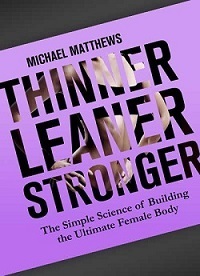
And that’s why I wrote Bigger Leaner Stronger for men, and Thinner Leaner Stronger for women: they lay out EVERYTHING you need to know about diet and training to build muscle and lose fat effectively…
Buy now
AmazonAmazon UKAmazon AUAmazon CAAudible AudiobookBNiBooksiBooks AudiobookKobo
Buy now
AmazonAmazon UKAmazon AUAmazon CAAudible AudiobookBNiBooksiBooks AudiobookKobo
January 19, 2014
How to Develop True Grit
The last 3 books I’ve read have been about 3 of the greatest leaders in history: Napoleon Bonaparte, Robert E. Lee, and Theodore Roosevelt. Each of them are great reads illustrating how men from a much different time than we’re in today rose to great heights, accomplishing incredible feats.
I’ve read other books about other great men as well. Be they great military leaders or warriors, business tycoons, or religious figureheads, and throughout each story there exists common characteristics. The characteristics that come to mind are a fearlessness aided by an incredible audacity and ambition. Of said shared qualities, however, grit is a constant characteristic, and one that’s disappearing in the modern man.
What is Grit?
Grit is perseverance and persistence. It’s an unwillingness to wilt, complain, or cry about one’s current state. It’s the ability to accept your reality and make the best of it, never wishing you were somewhere else, or in someone else’s shoes.
Life is as it is, all you can do is make the best of your situation.
Grit is toughness. It’s resilience. To be a man of true grit means you can’t be a quitter, you can’t be weak, and you can’t run from your fears.
If you’re going to accomplish anything of value in life, grit is a prerequisite. Without it, you surely won’t finish the long journey of greatness in any field.
Where Has Grit Gone?
Grit was once needed not only to thrive, but to survive. Before technology brought almost everything to our phone, home, and laptop, we had to travel to talk to someone, we had to kill our own food, harvest our own crops, and take care of our own land.
Our survival was dependent on, at least, some degree of grit. Today, you still need grit, but we’re not developing it like we once did.
Social Media: The Killer of Grit
Much of the sadness in our own lives can be attributed to our constant desire to compare ourselves, and our lives, to those of other people. We’re constantly comparing, and it ain’t healthy. No happiness can exist if it’s contingent on the lack of happiness of another when compared with our own.
The same is true when it comes to vanity and grit, the two can’t coexist. They oppose one another, and vanity has never been more prevalent in our society, especially with the addition of social media, where our lives are more about images than substance.
We can create entirely fictional identities on Facebook, for example. We can selectively choose what images we show, and which we don’t. We keep in touch with friends on Facebook, removing the need to bare our souls in one-on-one interaction. And the images we do post are chosen because of what others will think about us and the lives we lead.
You see more pics of beach views than you do of desks, which isn’t good either. Ease is king on social media. We want people to see the wonderful life we’re leading, foregoing the work needed to attain said ease – unless of course your Daddy can foot the bill.
Social media is compounding vanity, making it worse, and more widespread. A man can’t live a vain existence whilst also being a gritty, strong, tough man.
The Fix:
Post pics on social media, by all means, but forget about this “persona” you’re trying to create. Post pics of trips and stuff like that, but don’t constantly feel the need to check how many likes you’ve received. Your self-worth isn’t dependant on a number of likes. And what others think of the life you’re leading is of no consequence, especially if you’re actually living it, and not portraying it on social media.
Be on the Facebooks of the world, but don’t live on them.
Ease: Grit’s Greatest Enemy
A life of ease is what most of us want, but it isn’t what’s good for us as humans. For our own personal development, nor for society on the whole and our contribution to the rest of humanity. The strenuous life is good for us. It makes us tougher and better equipped to withstand the peaks and valleys that we’ll inevitably go through in life.
Ease doesn’t develop grit, hard work and persistence does. Ease makes you weak, hard work makes you tough. There isn’t a simpler way to put it.
So what do you do? Are you supposed to never rest? Hell no! Rest, by all means. Enjoy life, but enjoy your work as well, and when you set out to achieve something, don’t quit until you’ve done what you set out to do.
On a daily basis, fight the good fight. Work hard and persist, you’ll be better for it. Hardship is good. Place it upon yourself, don’t merely wait for it to pop its head into your life. The gym is one place you can do this.
Using the Gym to Develop Grit
The gym is more than a place to forge a stronger, better-looking and performing body. It’s a place to develop mental toughness as well. Use it as such.
“Training”, or working out, first started to train warriors. The Romans did it, as did the Greeks and Spartans. But it wasn’t merely used to build stronger, more skilled warriors, but prepare them for the horrors of war, to give them the ability to withstand the pain and fear they were going to face in battle.
Training hasn’t changed, even though people have.
It’s up to you what you use the gym for. You can use it to merely build bigger, leaner muscles, or you can use to help you forge a stronger will. Every time you resist that voice telling you to quit one rep earlier, or that you’ve “done enough” for the day when there’s still more to be done, you’re becoming tougher.
Every time you win the little battles that occur in the gym you’re not only building stronger muscles, but a stronger will. You’re developing grit.
Grit was once forged daily. We had to wake up early to tend to the farm, feed the animals and such, as a means for our survival. Today we can get by without doing the work that once needed to be done. Most of what we need can be earned or purchased from our arses.
But life hasn’t become any easier. And though ease is everywhere, character is still what makes great men great, and a lack of character still keeps weak men living small, insignificant lives filled with envy, a feeling of self-entitlement, and laziness.
Where you end up in life is up to you. Take that responsibility and run with it. Make your life the stuff of legend, become grittier, tougher, and self-reliant.
You, as well as the rest of humanity, will be better of for it, and the gym can be the beginning of this character that will help you through the highest of highs, and the deepest depths that life will inevitably throw your way if you take any kind of risk, and attempt any audacious feat.
I’d like to end this article with short video I put together on the subject at hand:
What’s your take on grit? Have anything else you’d like to share? Let me know in the comments below!
Chad is a former 9-5er turned entrepreneur, a former scrawny amateur boxer turned muscular published fitness author. He’ll give you the kick in the ass needed to help you live the big, ambitious life you should be living, and you can find him on Facebook and Twitter.
As a gift, check out this free report on how to naturally enhance your testosterone levels.Click Here for the Free Report.

January 18, 2014
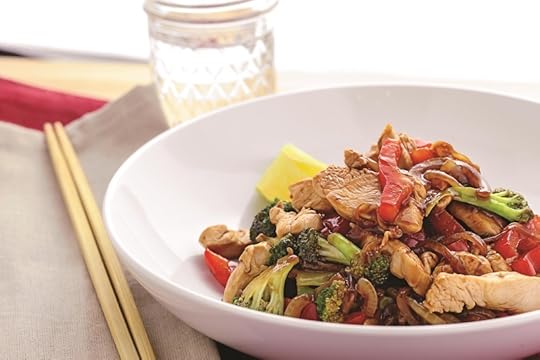
Recipe of the Week: Classic Chicken & Vegetable Stir Fry
Chicken and vegetable dishes are a staple of the fitness world. They’re high-protein, low-fat, and if you use the right recipes, they can be really tasty.
This stir fry recipe is from my bestselling cooking The Shredded Chef, and it’s one of my go-to “quick & easy” meals. Hope you enjoy!
Servings
4
Calories Per Serving
200
Protein Per Serving
42 grams
Carbohydrates Per Serving
6 grams
Fat Per Serving
2 grams
Ingredients
4 boneless, skinless chicken breasts (6 ounces each), rinsed, dried, trimmed of fat, cut into thin strips
2 tablespoons red wine
1 tablespoon low-sodium soy sauce
1/2 teaspoon cornstarch
1 teaspoon stevia or other sugar alternative
1 teaspoon salt
2 cups broccoli florets
1 red bell pepper, seeded and chopped
1/2 cup yellow onion, sliced
Instructions
In a small mixing bowl, combine the red wine, soy sauce, cornstarch, stevia, and salt. Mix well to dissolve the cornstarch.
Coat a 12-inch skillet in cooking spray and place over medium-high heat. Add the broccoli, bell pepper, and onion. Sauté until the vegetables are tender and onions are browned. Add the chicken and stir-fry for 2 – 3 more minutes, until chicken is browned.
Pour the sauce over the chicken and vegetables and continue to stir-fry until sauce is thickened and chicken is cooked through, about 2 – 4 minutes
What You Get to Eat
What did you think of this week’s recipe? Let me know in the comments below!
Want more delicious, easy-to-make recipes like this?If you like this recipe, then you’ll love the bestselling cookbook it came from! My own The Shredded Chef!
In this book you’ll find 120 healthy, flavorful recipes specifically designed for athletes that want to build muscle or lose fat. Regardless of your fitness goals, this book has got you covered.
Buy this book now to forever escape the dreadful experience of “dieting” and learn how to cook nutritious, delicious meals that make building muscle and burning fat easy and enjoyable!
Buy now
AmazonAmazon UKAmazon AUAmazon CABNiBooksKoboGoogle Play
Vegan and vegetarian dishes are great sources of micronutrients, and even if you’re a meat eater, they’re great for changing things up in your meal plan.
And in my cookbook, Eat Green Get Lean, you’ll find 100 of my favorite vegetarian and vegan dishes, carefully balanced for our high-protein, healthy needs!
Buy this book now to forever escape the dreadful experience of “dieting” and learn how to cook nutritious, delicious vegetarian and vegan meals that make building muscle and burning fat easy and enjoyable!
Buy now
AmazonAmazon UKAmazon AUAmazon CABNiBooksKoboGoogle Play
January 17, 2014
Cool Stuff of the Week: Hublot Big Bang Unico, Samsung Galaxy Gear Watch, Sony 4K, and More…
I’m not ashamed to admit that I’m kind of a sucker for cool stuff. I like nifty gadgets, quirky decoration pieces, nice clothes (and shoes!), good books, and fun games.
In this series of weekly posts, I share whatever currently has my fancy. Maybe some of it will catch yours as well!
VIDEO OF THE WEEK:
NEWS BLOOPERS 2013
A really solid collection of cringe-worthy news moments…
HUBLOT BIG BANG UNICO
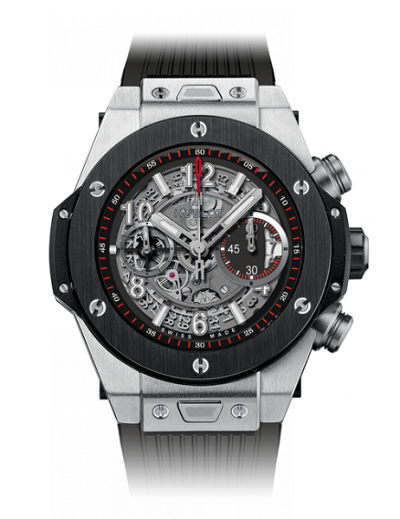
If you have $16,000 to drop on a watch, then you might want to consider this black-strapped little beauty from Hublot.
I love the sporty take on their classic design elements: it features a matte-black, skeletonized dial, three sword-shaped, luminescent hour, minute, and seconds hands, and luminescent index and Arabian hour markers, and it’s mounted on thick, black rubber straps with a heavy-duty clasp.
Something to add to the “if I’m ever a millionaire” list! 
POLAROID SOCIALMATIC CAMERA

If most of your pictures end up on a social network like Instagram, Facebook, or Twitter, then you’ll like the Polaroid Socialmatic.
It comes with WiFi connectivity, Android installed, and a 4.5-inch touchscreen, so you can load it up with all your favorite apps for photo sharing. It also features a built-in printer that prints two- by three-inch snaps to distribute by hand.
Buy now
Polaroid
SAMSUNG GALAXY GEAR SMARTWATCH

Before I even talk about the watch, I have to share with you what is probably the worst commercial I’ve ever seen. Kudos, Samsung:
I actually have to wonder if this was intentional to create viral trolling, or if someone at Samsung actually thought it would sell the watch?
Well, either way, the watch is actually pretty cool.
It can pair with any Samsung Galaxy device, and then do various cool things like…
Discreetly notify you of incoming text messages, emails, Facebook activity, etc., and then let you preview their contents and open them on your larger device
Interact with music, letting you browse, pause, play, skip, or adjust volume
Place and receive calls using the built-in microphone
Give your Samsung device voice command like “Call so-and-so,” “What’s the weather like?”, and “When’s my next appointment?”
Take pictures with the built-in 1.9 megapixel camera
And more
SONY FDR-AX100 4K CAMCORDER

If you haven’t seen a 4K TV yet displaying 4K video, you’re going to be blown away when you do. The picture is so vibrant and crisp that it’s like you’re looking through a window at the actual thing.
The problem with these TVs at the moment, however, is the lack of content to take advantage of it. Well, with the Sony FDR-AX100, you can just make your own.
This remarkable little video camera is capable of capturing ultra HD, 4K video with a 14 megapixel sensor, a Carl Zeiss lens, and a BIONZ X processor. It also has built-in WiFi and NFC (near field communication) connectivity, so you can pair it with your phone, which can then be used as a remote control.
Buy now
AmazonAmazon UK
BOOK OF THE WEEK:
ROGUE WARRIOR
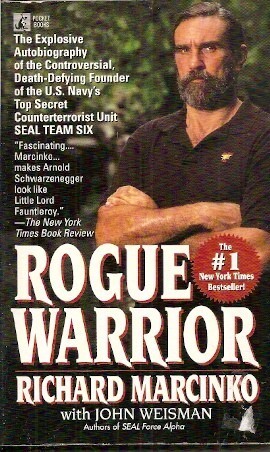
I saw Lone Survivor last weekend (PLEASE EXPLAIN WHY THEY DIDN’T JUST HAVE THE GOAT HERDERS MARCH WITH THEM UNTIL THEY MADE CONTACT WITH THEIR BASE?) and it reminded me of this book, and how enthralled I was with Richard Marcinko’s crazy antics as a SEAL.
This book chronicles Marcinko’s harrowing missions across Vietnam and other theaters of war, as well as his prodigious rise through the Navy ranks. This is the guy that created and ran both SEAL Team SIX and Red Cell, so you know he has some stories to tell.
My favorite part of the book was definitely his account of Vietnam, where he and his merry band of marauders cheated death so many times that Marcinko finally concluded that he must just be unkillable. This, then, inspired him to take on riskier and riskier missions, and his devastating success in these missions eventually convinced the Viet Cong to place a bounty on his head.
If you like tales of superhuman toughness and resolve, you’ll like Rogue Warrior.
Buy now
AmazonAmazon UK
What do you think of this week’s picks? Have anything you’d like to share? Let me know in the comments below!


