Michael Matthews's Blog, page 130
February 19, 2014
11 Scientifically Proven Ways to Increase Your Bench Press
Like it or not, the Bench Press is one of the primary lifts on which your strength is judged. Nothing turns heads faster in the gym than an impressive Bench Press, and it’s the first (and often only) lift people want to know your numbers on.
There’s a good reason for this beyond ego, though.
The Bench Press is one of the best upper body exercises you can do because, when performed properly, it trains not just the pectorals but the lats, shoulders, triceps, and even the legs (through a proper leg drive, as discussed later in this article). Every chest workout or push workout should include at least a few sets of the Bench Press.
That said, like the other big compound lifts (Deadlift, Squat, and Military Press), the Bench Press is actually quite technical. If you don’t know what you’re doing, you’ll quickly hit a plateau, which is not only frustrating, but can set you up for injury as you try to break through it by compromising form.
So, in this article, we’re going to look at 11 safe, scientifically proven ways to increase your bench press and, in some cases, also reduce the risk of injury.
Tip #1 to Increase Your Bench Press:
Pump Yourself Up
If you an experienced weightlifter, you know the importance of being mentally prepared for heavy lifts. You can psych yourself out or up and hit or miss a lift accordingly.
You’ve undoubtedly seen powerlifters go through what sometimes looks like a ridiculous, satanic ritual before attempting a lift, but did you know that pumping yourself up like that has been scientifically proven to work?
A study conducted by researchers at AUT University with elite rugby players found that when they pumped themselves up for a Bench Press set, force production increased by 8%. Researchers also found that distraction significantly decreased force production–there was a 12% difference in force production between the pumped-up and distracted lifters.
The takeaway here is pump yourself up your for heavy lifts and concentrate on each rep as your perform it–no talking, being talked to, or mental wandering.
I don’t stomp around the gym like a madman to get pumped up. I find that the right workout songs helps dramatically for getting pumped up, and before I grab the bar, I like to take 10 to 15 seconds to focus on the lift I’m about to perform and visualize myself performing it successfully. Sounds silly? Research has shown that visualizing a successful lift before performing it can increase strength.
Tip #2 to Increase Your Bench Press:
Mix Up Your Rep Range
The subject of “ideal” rep ranges is complex, so I won’t dive into it in this article. (I do talk a bit about it on my article on hypertrophy, though.)
Instead, I’ll keep this short and sweet:
If you’re new to weightlifting (you’ve been lifting for less than a year), this tip doesn’t apply to you. You should stick to the advice give in my article on the ultimate chest workout.
If you’re an experienced weightlifter, however, you can benefit from working in different rep ranges, or periodizing your training, as it’s known.
I will be discussing periodization in more detail in my next book, and will be sharing a full periodized program for advanced lifters, but here’s a periodized chest workout that you can use to help increase your bench press:
Flat Bench Press: Warm up and 2 sets of 2 to 3 reps ( ~90% of 1RM)
Incline Bench Press: 3 sets of 4 to 6 reps (~80% of 1 RM)
Flat Dumbbell Press: 3 sets of 4 to 6 reps
Flat Bench Press: 2 sets of 8 to 10 reps (~70% of 1RM)
The 2 to 3 rep work provides maximal overload, which is crucial to building muscle and strength; the 4 to 6 rep work is the “sweet spot” for myofibrillar muscle growth; and the focus of the 8 to 10 rep sets is cellular fatigue, which also stimulates muscle growth.
Tip #3 to Increase Your Bench Press:
Lift Explosively
While many people believe that slowing the weight down improves performance, research says otherwise.
This study demonstrated that, when bench pressing, lowering the bar quickly (1 second) and, without pause, then exploding it upward results in greater power gains than a slow descent followed by a pause and explosive ascent.
That said, don’t bounce the bar off your chest at the bottom of the rep. This isn’t only cheating, it can hurt quite a bit as the weights get heavier. Don’t simply “drop” the weight toward your body, either–you want to feel as if you are pulling the bar toward your chest, which is something we’ll be talking more about soon.
Tip #4 to Increase Your Bench Press:
Give the Bench Press Priority in Your Workout
You might be surprised how many guys write me concerned about their Bench Press being stuck, but who are performing as the last exercise in their workouts. They usually start with dumbbell work, then maybe move on to Dips, and finally come around to the Bench Press for their final few sets.
Well, studies such as this and this have shown that the order in which you do your exercises has a significant impact on your strength and overall performance capacity on each.
This is why my Bigger Leaner Stronger and Thinner Leaner Stronger workouts always begin with big, compound lifts like the Bench Press, Deadlift, Military Press, and Squat, and then move on to more isolation-type exercises like Dips, Dumbbell Rows, Side Lateral Raises, and Lunges.
Start your chest workouts with the Bench Press and you’ll be most likely to make progress.
Tip #5 to Increase Your Bench Press:
Make Sure You’re Not Under- or Over-Training
Like “ideal” rep ranges, optimal training frequency is a hotly debated subject. The bottom line is it boils down to workout intensity and volume.
The lighter the weights and fewer the sets per workout, the more often you can train the muscle group. And, as a corollary, the heavier the weights and greater the sets per workout, the less often you can train the muscle group.
I’ve tried many different splits and frequency schemes, and what I’ve found works best is in line with an extensive review on the subject conducted by researchers at Goteborg University:
When training with the proper intensity (focusing on lifting heavy weights), optimal frequency seems to be about 40 – 60 reps performed every 5 – 7 days.
While training each muscle group 2 to 3 times per week is trendy right now, and while it’s workable (if volume is programmed correctly), it’s not necessarily more effective than training each muscle group once per 5 to 7 days, at the right volume.
The bottom line is when it comes to muscle and strength gains, research shows that proper workout volume appears to be more important than frequency. If you do less than the optimal volume, as given above, you will be leaving some gains on the table. If you do more, you’ll probably end up overtraining.
Tip #6 to Increase Your Bench Press:
Work On Your “Upper Chest”
Yes, there is a muscle that forms what we call the “upper chest.” It’s known as the clavicular pectoralis. Here’s what it looks like:
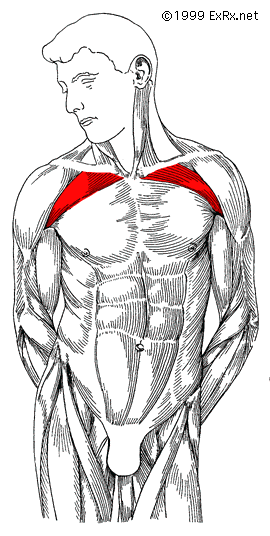
An underdeveloped upper chest not only looks bad, it compromises your overall Bench Press performance. Avoid this by always including incline pressing in your chest workouts, which has been proven to be particularly effective for building all of the muscles involved in the flat Bench Press.
Tip #7 to Increase Your Bench Press:
Vary Your Grip Width
Powerlifters have been using different grip widths for many years and studies back this up as an effective method for increasing bench press strength.
Research has shown that a wide grip (several inches wider than shoulder-width) emphasizes the larger, prime mover muscles (the pectorals), whereas a narrow grip (right at shoulder-width, or slightly narrower) emphasizes the smaller muscles involved, such as the arms and shoulders.
By varying your grip widths, you’re able to focus on each of these muscle groups and strengthen each, which can help you break through sticking points. A good way to do this is to include 1 to 2 wide-grip sets in your chest workouts, and close-grip sets in your arms workouts.
Tip #8 to Increase Your Bench Press:
Keep Your Elbows Tucked and Protect Your Shoulders
The Bench Press gets a bad rap for ruining shoulders, but that’s not the whole story. It’s bad for the shoulders when performed incorrectly, and the biggest mistake people make is flaring their elbows out as they ascend.
Research has shown that keeping your arms at about a 45-degree angle relative to your torso, and using a medium grip, is the best way to protect your shoulders.
(And don’t worry, including some wider- and narrower-grip work isn’t going to get you hurt. Just ensure the majority of your bench pressing is done with a normal, slightly wider than shoulder width grip.)
Tip #9 to Increase Your Bench Press:
Stay Off the Smith Machine
It’s been proven time and time again: if you want to get strong on the Bench Press (and Squat), stay off the Smith machine.
The reason why is simple: the Smith machine simply activates less muscle fibers than the free weight Bench Press.
If your gym doesn’t have a free weight Bench Press station, change gyms. If you can’t, then you can begrudgingly use the Smith machine (it’s better than no bench pressing at all).
Tip #10 to Increase Your Bench Press:
Try to Pull the Bar Apart
This is another old-school powerlifting tip that has been scientifically validated.
The idea is simple: As you descend, pull the shoulder blades together and try to actually bend the bar in half or “pull it apart,” and maintain this position and tension as you ascend. You should feel like you’re pulling the bar down toward your chest, and doing this not only increases shoulder stability, it also accounts for a fair portion of the upward force.
This, by the way, helps explain why you can’t dumbbell press as much weight as you can bench press. More stabilization is required with dumbbells, but more importantly, you can’t generate this lateral force as it would cause the dumbbells to move away from each other.
Tip #11 to Increase Your Bench Press:
Set Up Properly and Maintain It Through the Lift
An improper setup can bleed a surprising amount of force on the bench press, and this is why powerlifters are very deliberate with their positioning under the bar. The major points are these:
“Screw” your shoulder blades into the bench by setting up onto your upper back, with a lower back arch big enough to fit a fist in between it and the bench.
Don’t lose this position when you lift the bar off the rack and maintain it throughout each rep.
Create a stable lower body base by placing your feet directly beneath your knees and forcing your knees out, which will tighten your quads and activate your glutes.
This allows you to push through your heels as you ascend, creating the “leg drive” that you’ve probably heard of.
Grip the bar as hard as you possibly can.
What do you think about these tips on how to increase your bench press? Have anything else to share? Let me know in the comments below!


February 18, 2014
Can You Carry a Message to Garcia?
How often do you hear sympathies these days for the “downtrodden, exploited, and underpaid” common folk, along with harsh, condemning words for those people with any measure of financial success?
Well, it’s very true that there are criminals operating in the largest corporations, the highest levels of Wall Street, and our government that make the robber barons of the past look like noble saviors, and I hope to see them put in prison one day, where they belong. Crony capitalism is a travesty of free market capitalism and is to blame for much of the inequity we see in today’s society.
That said, that condemnation doesn’t apply to the average rich person, who is simply a small business owner that worked his or her ass off to build a team of people that sell and deliver valuable products and services that others need and want. Only a small fraction of the “1%” are the problem.
Many of the “downtrodden” avoid this reality and instead try to place the responsibility of their failures at the feet of the generalized “rich,” but there’s a cold, hard fact they don’t want to face:
They are unsuccessful because they can’t carry a message to Garcia.
What the hell am I talking about? I’m talking about Elbert Hubbard’s famous short story, A Message to Garcia—a story that contains one of the most fundamental principles of success that I know.
People who can carry a message to Garcia are a special breed. They’re invaluable not only as workers, but as friends and, indeed, members of society. I guarantee you this: If you can simply carry a message to Garcia, you will always make money, always accomplish goals, and always be in demand.
Think I’m overstating the issue? Click the link below to read the short story for yourself, and let me know what you think.
Click here to download A Message to Garcia
It’s short but powerful. Enjoy.
What do you think of A Message to Garcia? Have anything else to add? Let me know in the comments below!
If you liked this article, then you’ll love this book…If you’d like to know what some of history’s greatest thinkers and achievers can teach you about awakening your inner genius, and how to find, follow, and fulfill your journey to greatness, then you want to read this book today.
(I wrote this book under a pen name simply because I want to keep it, and future books of mine that will have nothing to do with health and fitness, completely separate from my main line of work. But I can still promote it! )
Read this book today and discover what it really takes to find and follow your bliss, and how to use the lessons passed down to us by some of history’s greatest geniuses to systematically rise to top of your fields, activities, and endeavors.
Buy now
AmazonAmazon UKAmazon AUAmazon CAAudible AudiobookBNiBooksiBooks AudiobookKoboGoogle Play

February 17, 2014
The Best Forearm Workouts to Increase Grip Strength
When it comes to getting strong, grip strength is rarely thought about. But it actually plays a large role in your overall progress.
If your grip strength is lacking, you’ll not only have a lot of trouble with your back workouts (deadlifts, especially) and arm workouts, you’ll probably struggle with less-than-impressive looking forearms. (I know because I used to have all three of these problems.)
Furthermore, by increasing your grip strength, you can progress faster in your chest workouts and shoulder workouts. How? It’s simple: by engaging your wrist and forearm muscles, like you will in the forearm workouts in this article, you’ll also engage all the other muscles in your arms, including your shoulders. (A simple way to feel this is to hold your arm out in front of you and squeeze your hand into a fist as hard as you can. See how everything in your arm tightens?)
The bottom line is the better your grip strength, the better you’ll do in your weightlifting and the better your arms will look. So in this article, I’m going to share with you the best forearm workouts for building Popeye-level grip strength.
The Best Forearm Workouts for Increasing Grip Strength
While your grip strength will naturally improve through a proper weightlifting program, there are quite a few grip exercises that you can do to speed up the process.
Below we’ll look at my favorite types of forearm workouts and how to put them together into an overall forearm training routine.
Hand Exercisers
One of the most effective ways to increase grip strength is to to train your “crush grip,” which is simply the action of closing your hand around an object and squeezing. By training your crush grip, you build the strength and density of the bones and muscles of the hands, fingers, wrists, and forearms.
A hand exerciser is a great way to improve your crush grip. But not just any hand exerciser–you want one with enough resistance to be effective, but not so much that you can’t use a full range of motion (you should be able to fully squeeze the hand exerciser, not only partially close it).
Here are the two hand exercisers that I like and recommend:
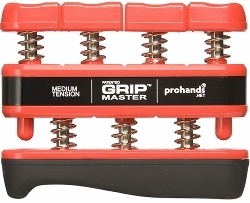
Gripmaster Hand Exerciser
The Gripmaster is a good place to start training your crush grip. I also like that it allows you to train each finger independently, which comes in handy for strengthening the weaker links like the pinky and ring fingers.
I recommend starting with the medium tension (red), and once that’s easy, move up to the heavy (black).
IronMind “Captains of Crush” Hand Exerciser
Once you’ve defeated the black Gripmaster, you’re ready for a “big boy” hand exerciser.
The “Captains of Crush” hand exercisers are great products. They’ve been on the market for about 15 years now and are quite popular in bodybuilding, powerlifting, and strongman circles.
You have 11 strength options to choose from, ranging from 60 lbs to an incredible 365 lbs. Most people find they need to start with the Guide or Sport models (60 and 80 lbs of strength required to squeeze, respectively), but if you’re an experienced weightlifter that can deadlift over 300 pounds for reps without straps, you can probably start with the Trainer model (100 lbs) and be fine.

Buy now
AmazonAmazon UK
How to Use the Hand Exerciser
Alright, so you have your hand exerciser. What now? First, let’s see how to properly set it into your hand for use:
Use the following tips to get the most out of it:
1. Start with 2 to 3 hand exerciser forearm workouts per week.
While the forearm muscles are very resilient, training them too frequently is detrimental. This is especially true if you’re also weightlifting.
So start with 2 to 3 forearm workouts per week and, over time, you should be able to work this up to 4 to 5.
2. Structure your hand exerciser forearm workouts correctly.
Start your hand exerciser forearm workouts with a few warm-up sets (I like to do these sets with the Gripmaster or even a cheap, lower-strength hand exerciser, like this), and then move on to your “heavy sets.”
After you’ve warmed up, you will do 5 to 6 sets of squeezes, with 8 to 10 squeezes per set. Rest 1 to 2 minutes in between each set. Once you can do 5 to 6 sets of 8 to 10 squeezes, you’re ready to move up to the next level of resistance.
As a note, a “special” type of squeeze that helps build strength is the “squeeze-and-hold” rep. This is where you fully squeeze the hand exerciser and hold it closed for 10 to 20 seconds (start with 10 and work up from there). I will often finish my sets with squeeze-and-hold reps.
3. Keep your form strict.
Like with any exercise, form is very important. And that means full squeezes (don’t start too heavy or you won’t be able to even get one full squeeze), and no twisting your arm or body to get additional leverage. Treat it like a proper weightlifting exercise.
Barbell Holds
The Barbell Hold is a great way to increase grip strength and it can be done at the end of any workout. It’s very simple:
I like to use a Power Rack and an Olympic bar, and make sure to use a double-overhand grip.
Go for 10 to 20 seconds of hold time per set and adjust your weight accordingly. Once you can hold a given weight for 20 seconds, add 10 pounds to the bar and work with that new weight until you can hold it for 20 seconds, and so forth.
The end of a back workout or arms workout is a good place to insert 1 to 3 sets of Barbell Holds.
Plate Pinches
Like the Barbell Hold, the Plate Pinch gives a great forearm workout and you don’t need anything special to do it. Here’s how it works:
Like the Barbell Hold, you’re going for about 20 seconds of hold time, and once you hit it, you increase the difficulty by adding another plate to pinch (3 instead of 2, and then 4, after which point I would go back to 2 plates of next higher denomination).
And again, like the Barbell Hold, 1 to 3 sets of Plate Pinches after your back or arms workouts is plenty. (You could do Barbell Holds after your back workouts and Plate Pinches after your arms workouts, for instance.)
Oversized Grips
Oversized grips are thick rubber grips that fit over barbells and dumbbells, and they’re an incredibly cost-effective way to improve your grip strength.
I like to use them on my big push exercises (Barbell Bench Press and Military Press, mainly), but not my pull exercises as they greatly limit the amount of weight you can pull (some people use them on warm-up sets only).
Here are the products I use and like:
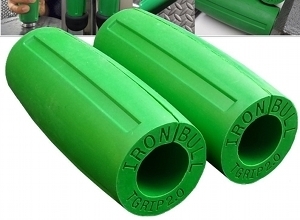
Iron Bull T-Grip 2.0
The Iron Bull T-Grip 2.0 is comfortable and extremely durable and stays locked in place. You can’t go wrong here.
Buy now
AmazonAmazon UK
Fat Gripz
Fat Gripz are also popular and effective oversized grips.
I wouldn’t say either the T-Grip or Fat Gripz are better than the other–it’s just a matter of preference. Some people (like me) like the slight bulge in the middle of the T-Grip, whereas others don’t; and some people prefer the rougher texture of the Fat Gripz, whereas I don’t care either way.

Buy now
AmazonAmazon UK
Dumbbell Farmer Walks
The Dumbbell Farmer Walk is a tried-and-true grip strength builder. Here’s how it works:
Easy enough. Shoot for 30 to 40 feet walked per “set,” and once you’re able to move a given weight for that distance, move up.
Like Barbell Holds and Plate Pinches, Dumbbell Farmer Walks are great for ending a back or arms workout.
Weightlifting Straps
Purists shun straps as blasphemous and while I don’t disagree with that mentality, straps can be useful for improving grip strength if used properly.
The key is to not strap on your first set. Instead, work without straps until your grip is too fatigued to allow for a proper set, and then use straps.
Don’t go with just any straps, either–bad straps are more of a liability than a help. They can be overly tricky to wrap tightly, they can fail to hold their grip while you’re lifting, and they can seriously cut into your wrists.
Here are the straps I use and like:
Harbinger Big Grip “No-Slip” Lifting Straps

These straps rock. They have a padded wrist strap with a sturdy velcro clasp, so no awkward looping of the strap to get it to hold (this is the type that will shred your wrists), and they have two thin rubber tracks running down the inside of the strap, which grip the metal tightly.
Buy now
AmazonAmazon UKBodybuilding.com
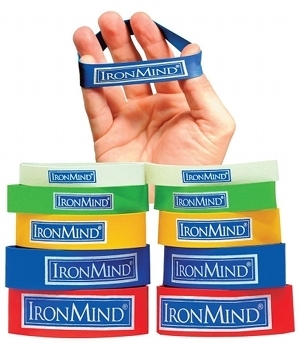
Band Extensions
Last but not least on the list of forearm workouts are the deceptively hard Band Extensions.
This isn’t a grip exercise like the crush and hold exercises given above, but it helps prevent injuries and strengthen your overall grip by training your forearm extensor muscles.
You do Band Extensions by placing a band around several or all of your fingers and opening your hand and holding for 5 to 10 seconds (that’s one rep). You can finish each hand exerciser forearm workout with 1 to 3 sets of Band Extensions.
You can use a thick rubber band for this or can get bands especially made for it, like these:
Buy now
Amazon
The Ultimate Forearm Workout Routine
Alright, now that we’ve gone over a variety of grip exercises, let’s turn them into something of a routine. Here’s what I recommend:
Use straps on in back workouts if necessary, as described above
End your back workouts with 2 to 3 sets of Barbell Holds or Dumbbell Farmer Walks (you can alternate between these each week)
Use oversized grips on your push exercises
End your arms workouts with 2 to 3 sets of Plate Pinches
Do 1 to 2 hand exerciser forearm workouts per week, and include Band Extensions for bonus points, and as your grip gets stronger, you can increase this to 3 to 4 hand exerciser forearm workouts per week
If you do this routine, you will rapidly increase your grip strength, and will immediately notice the benefits in your bigger lifts. Happy forearm training!
What do you think of this forearm workout routine? Have anything else to add? Let me know in the comments below!
How to get lean and build serious muscle and strength, faster than you ever thought possible…
Depending on how you eat, train, and rest, building muscle and losing fat can be incredibly easy or incredibly hard. Unfortunately, most people make many different mistakes that leave them stuck in a rut.
And that’s why I wrote Bigger Leaner Stronger for men, and Thinner Leaner Stronger for women: they lay out EVERYTHING you need to know about diet and training to build muscle and lose fat effectively…
Buy now
AmazonAmazon UKAmazon AUAmazon CAAudible AudiobookBNiBooksiBooks AudiobookKoboGoogle Play
Buy now
AmazonAmazon UKAmazon AUAmazon CAAudible AudiobookBNiBooksiBooks AudiobookKoboGoogle Play
February 15, 2014
Recipe of the Week: Indian Curry Chicken
There’s a reason why this is one of the most popular recipes from my cookbook The Shredded Chef: it’s really, really good.
Even if you’re not big on curry, you should give this dish a go. I get emails every week from people that don’t usually like curry but love this recipe. And look at those macros!  Enjoy!
Servings
4
Calories Per Serving
247
Protein Per Serving
46 grams
Carbohydrates Per Serving
9 grams
Fat Per Serving
3 grams
Ingredients
4 boneless, skinless chicken breasts (6 ounces each), rinsed, dried, trimmed of fat, cut into 1-inch cubes
1 small onion, chopped
1 clove garlic, minced
3 tablespoons curry powder
1 teaspoon paprika
1 bay leaf
1 teaspoon ground cinnamon
1/2 teaspoon fresh ginger root, grated
salt and ground black pepper, to taste
1 tablespoon tomato paste
1 cup fat-free plain Greek yogurt
1/2 cup water
1/2 lemon, juiced
1/2 teaspoon Indian chili powder
Instructions
Coat a 12-inch skillet with cooking spray and place over medium heat. Sauté the onion until translucent, then stir in the garlic, curry powder, paprika, bay leaf, cinnamon, ginger, salt, and pepper.
Continue stirring for 2 minutes, then add in the chicken, tomato paste, yogurt, and water. Bring to a boil, then reduce heat and simmer for 10 minutes. Remove the bay leaf, stir in the lemon juice and chili powder. Simmer 5 more minutes, or until chicken is cooked through
What You Get to Eat
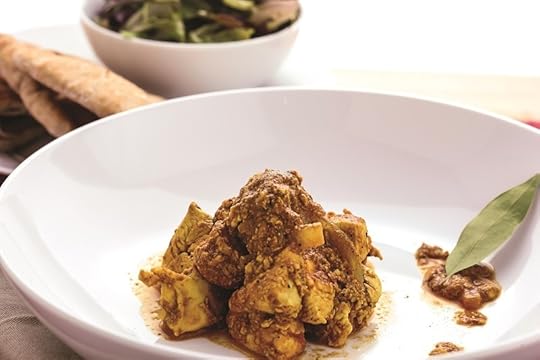
What did you think of this week’s recipe? Let me know in the comments below!
Want more delicious, easy-to-make recipes like this?If you like this recipe, then you’ll love the bestselling cookbook it came from! My own The Shredded Chef!
In this book you’ll find 120 healthy, flavorful recipes specifically designed for athletes that want to build muscle or lose fat. Regardless of your fitness goals, this book has got you covered.
Buy this book now to forever escape the dreadful experience of “dieting” and learn how to cook nutritious, delicious meals that make building muscle and burning fat easy and enjoyable!
Buy now
AmazonAmazon UKAmazon AUAmazon CABNiBooksKoboGoogle Play
Vegan and vegetarian dishes are great sources of micronutrients, and even if you’re a meat eater, they’re great for changing things up in your meal plan.
And in my cookbook, Eat Green Get Lean, you’ll find 100 of my favorite vegetarian and vegan dishes, carefully balanced for our high-protein, healthy needs!
Buy this book now to forever escape the dreadful experience of “dieting” and learn how to cook nutritious, delicious vegetarian and vegan meals that make building muscle and burning fat easy and enjoyable!
Buy now
AmazonAmazon UKAmazon AUAmazon CABNiBooksKoboGoogle Play
February 14, 2014
Cool Stuff of the Week: Ferrari Cali T, Settlers of Catan, American Psycho, and More…
I’m not ashamed to admit that I’m kind of a sucker for cool stuff. I like nifty gadgets, quirky decoration pieces, nice clothes (and shoes!), good books, and fun games.
In this series of weekly posts, I share whatever currently has my fancy. Maybe some of it will catch yours as well!
VIDEO OF THE WEEK:
SONNY THE 70 YEAR-OLD BODYBUILDER
Holy S&*T, now THIS is inspiring. Not just his physique but his outlook on life and aging. I want to be this guy when I grow up!
FERRARI CALIFORNIA T

I’m not even a Ferrari lover, but I think the Ferrari California T is a truly beautiful blend of retro lines with a modern, exotic touch.
It’s Ferrari’s first turbo-powered car in nearly three decades with nearly 570 horsepower, and its retractable hardtop lets you convert it from coupe to convertible and back with the touch of a button.
REPORTER

Nicholas Felton is a unique, incredibly talented guy. He rose to fame with his stunning Annual Reports, which detail each year of his life in a staggeringly thorough and beautiful manner. Oh, and he’s also the guy that built the Facebook Timeline.
Well, Reporter is his new iPhone app that uses your phone’s sensors and a few short daily surveys to capture information about your daily routines, including where you’ve been, how active you’ve been, who you’ve been with, and so forth. All that data is then used to compile elegant reports, giving you a gorgeous birds-eye-view of your life.
KRUPS ELECTRIC KETTLE WITH TEA INFUSER
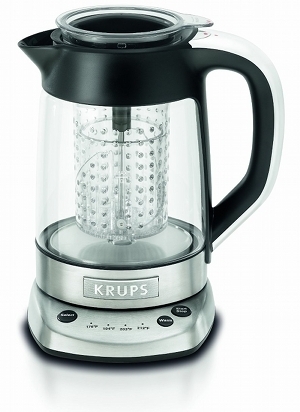
If you’re like me and you drink a lot of tea, you should consider getting a proper tea maker like this Krups electric kettle. Here are the key features:
Four programmable water temperature settings (176f, 194f, 203f amd 212f).
As you probably know, water temperature is a very important part of extracting enough flavor from the leaves to brew a perfect cup of tea.
A BPA-free plastic double infuser.
This is a basket-within-a-basket setup that lets you place shorter brew time ingredients in the inner basket and longer brew time ingredients in the outer basket.
A fine mesh screen to help keep sediment out of your cup.
Excessive tea debris is annoying and a mesh screen behind the spout keeps it out.
Although I prefer my Breville One-Touch, this Krups kettle is a great alternative for half the price.
Buy now
Amazon
SETTLERS OF CATAN

I’m a bit of a board game geek, and Settlers of Catan is one of my favorites.
The game is for 3 to 4 players (but you can bring more players in using expansion packs) and it involves collecting resources and using them to build roads, settlements and cities, for which you gain Victory Points. The first player to collect 10 Victory Points wins.
What makes it great is its blend of strategy, luck, and player interaction. It’s easy enough to learn that you can enjoy it from the get-go, but sophisticated enough that you can devise and test strategies to your heart’s content. The trading and bartering system between players also adds a fun, challenging dimension and element of unpredictability.
I also love the replay value of this game. You can vary the board setup every game, which puts you into different starting positions every time, requiring you to adapt your strategies accordingly.
BOOK OF THE WEEK:
AMERICAN PSYCHO

“My name is Patrick Bateman. I am twenty-six years old. I live in the American Garden Buildings on West Eighty-First Street, on the eleventh floor. Tom Cruise lives in the penthouse.
“I believe in taking care of myself, in a balanced diet, in a rigorous exercise routine. In the morning, if my face is a little puffy, I’ll put on an ice pack while doing my stomach crunches. I can do a thousand now.”
That’s your first introduction to Ellis’ protagonist, and you immediately know what type of person this is. In his world, you are what you wear, own, and drive. Your life is defined by where you eat, shop, and party. Your values are an ever-shifting, amorphous blob of social responses designed to impress and belittle others.
In this book, Ellis gives a haunting look into the world of the Manhattan uber-Yuppies, where materialism and physical beauty is admired over all. Bateman has gone to great pains to appear as perfect as possible: he’s obsessed with taking care of his body and looks like a GQ model, he wears nothing but the finest designers, he lives in an upper-class condo in the trendy Upper West Side, he makes six figures working for his father’s Wall Street firm, and he dines at the most exclusive restaurants in New York City, and parties in the most exclusive clubs. Bateman loves nobody, regards his fiance, friends, and co-workers with disgust, and feels nothing but a cold, bitter hatred of the world and its inhabitants.
The only thrill Bateman can experience is brutally torturing and murdering people, particularly young women. His violent outbreaks are rarely pre-meditated. If he’s on a date with a girl, he may or may not take her home to chop her head off. If someone mentions how the Japanese are buying up all of New York City, he may order Chinese take-out to an abandoned building (mistakenly thinking it as Japanese food) and stab the delivery boy to death. If a bum asks him for money, he may toss him a few bucks with disdain, or strangle him to death.
That’s just how his world moves, as he says.
I won’t lie–for the first half of this book, I was pretty hooked. Bateman and his soulless comrades do and say some of the most outrageous stuff, and I just wanted to know what Ellis’ twisted mind would think up next. I appreciated the shock value of the story and situations, but by 2/3 through the book, the gimmick felt repetitive. I kept reading simply because I don’t like to quit books.
My experience could be summed up as 5 stars for the first half, 3 stars for the middle, and 2 stars for the final 1/3. I think it’s worth reading for the first half alone, and while it goes downhill from there, there are a few later sequences that will still get a rise out of you.
MOVIE OF THE WEEK:
PIRATES OF THE CARIBBEAN: THE CURSE OF THE BLACK PEARL

This is one of the greatest action/adventure films in the last decade. You know, the type that you can watch for the seventh time and still enjoy. Up there with the original Indiana Jones movies, in my opinion.
Depp is at his comedic best and really steals the show despite a strong supporting cast of memorable characters. Rush couldn’t have played the villain better and struck a perfect balance of despicable evil and comedic charm. He was one of those bad guys that you love to hate. Bloom and Knightley don’t shine like Depp and Rush, but they fill their roles more than adequately and definitely contribute to the flick and help carry the story along.
I’m not sure if you could structure a story better than this. It holds your attention from beginning until end, tension builds and releases in a perfect rhythm, stakes build with every scene, and the film has the perfect blend of action, drama, romance, and comedy. It’s just darn fun to watch.
If you haven’t seen this movie yet, treat yourself to it–it’s one of those rare movies that isn’t just fun to watch, but completely enchanting.
Watch now
Amazon Instant Video
What do you think of this week’s picks? Have anything you’d like to share? Let me know in the comments below!
February 13, 2014
MFL Podcast #7: Interview with JC Deen: Building a great body and building a great life
In this podcast, I interview JC Deen from JCD Fitness, and we talk about…
How the quest to build a great body also helps you in the quest to build a great life.
Why maintaining perspective and mental balance is crucical to the “inner game” of fitness.
How working out helps you feel in control of your life and maintain a positive, causative outlook.
Why spending more and more time in the gym and eating less and less food to get lean is a recipe for disaster.
What “nutrient partioning” is and why it’s important.
Why chasing the “end all be all” method of building muscle and getting lean is futile, and what you should actually be looking for.
What metabolic speed has to do with your ability to lose fat, and especially to getting really lean.
And more…
You can also find this podcast in iTunes and the Windows Phone Podcasts Store:


What did you think of the podcast? Have any requests or suggestions? Let me know in the comments below!
February 12, 2014
5 “Diet” Foods That Don’t Help You Lose Weight
Weight loss is a $61 billion market, and when people are spending that much money, you’d better believe that there are companies willing to do or say anything to get a piece.
“Diet” foods are an example of this and are pushed in mainstream weight loss advice as a healthy, easy way to lose weight. Many people believe that weight loss even requires the consumption of diet foods.
Well, I have good news: you don’t have to eat diet foods to lose weight. All you have to do is ensure your metabolism is healthy and burn more energy than you consume, and you will lose weight. If you really want to do it right, you will include resistance training in your routine, like weightlifting, to preserve (or even build) muscle and thus maximizing fat loss.
So, in this article, I want to discuss 5 popular diet foods that you should stay away from whether you’re trying to lose weight or not, and what you should choose instead.
Why Agave Syrup Doesn’t Help You Lose Weight
You can find more than 300 species of agave plants growing in Mexico, the southern United States, and northern areas of South America. The nectar extracted from the core of this plant has long been used for medicinal and intoxication purposes (you get tequila when you ferment it), and more recently, as a natural sweetener.
Most of the agave syrup you find in stores comes from the “blue agave” species of plant, and although it’s marketed as a healthier alternative to sugar and high-fructose corn syrup, it’s not.
You see, both sucrose (table sugar) and high-fructose corn syrup are comprised of about 50% glucose and 50% fructose, whereas agave nectar can be anywhere from 55% to as high as 90% fructose. Why does this matter?
Well, more and more research is emerging that increasing fructose intake increases the risk of developing the risk factors for cardiovascular disease and metabolic syndrome. (And in case you’re wondering, the fructose found naturally in fruit is fine, but the fructose artificially added to foods to sweeten them is not.)
So, if you’re looking for a healthy, natural sweetener, stay away from agave and choose a zero-calorie, fructose-free alternative like stevia or xylitol.
Why Fruit Juice Doesn’t Help You Lose Weight
Many people perceive fruit juice to be healthy because they assume it comes from fruit. Well, in many cases it’s little more than flavored sugar water. No fruit, just chemicals that taste like it.
Even if you choose 100% fruit juice, it’s still not a great choice of beverage for a few reasons:
1. Drinking calories never a good idea when you’re trying to lose weight.
Weight loss requires that you restrict your calories, and if you want to avoid hunger issues, you need to get as much satiation from those calories as possible. And drinking calories simply doesn’t make you feel full.
Instead, you want to be eating plenty of protein, low-gyclemic carbohydrates, and fibrous foods, all of which keep you satiated and less likely to overeat.
2. The natural sugars found in fruit are different than those found in the juice.
This is because the sugars in whole fruit are bound to the fibrous flesh, which fills you up and slows down their absorption in the body. The bottom line is the sugars in fruit don’t pose a problem unless you’re eating ridiculous amounts of fruit every day.
Fruit juice is different, though–it allows you to consume much larger quantities of sugar, and it lacks the fibrous matter to slow down the absorption. For example, one cup of orange juice contains the sugar content of about two whole oranges, or a can of Coke, with none of the fiber mass.
So, enjoy a few servings of fruit every day, but stay away from fruit juice.
Why Diet Soda Doesn’t Help You Lose Weight
An easy way for many people to reduce caloric intake is to simply switch from sugar-sweetened beverages to artificially sweetened ones, like diet soda. While this is an effective way to reduce the amount of sugar and calories one eats, it can cause other problems.
Namely, research has shown that artificial sweeteners can stimulate the appetite as well as sugar cravings, causing you to overeat in general and thus sabotaging your weight loss efforts.
The last thing we need when we’re dieting to lose weight is an appetite stimulant, so leave the diet soda out. Instead, stick to water and if you have a sweet tooth, indulge it my favorite choice: naturally sweetened green tea.
Why Gluten-Free Junk Food Doesn’t Help You Lose Weight
Gluten-free dieting is hugely popular these days and big food manufacturers have jumped all over it, bringing all kinds of crappy gluten-free products to the marketplace.
Well, remember that cheap gluten-free muffins, breads, cereals, and other highly processed, low-quality carbohydrates are no better than their gluten-containing counterparts.
All are devoid of nutrition and high on the glycemic index, which can contribute to vitamin and mineral deficiencies as well as increase the risk factors for cardiovascular disease, diabetes, and even certain types of cancers. Furthermore, research has shown that high-glycemic carbohydrates can be less filling than lower-glycemic options, which increases the likelihood of overeating.
If you’d like to reduce your gluten intake, stick to naturally gluten-free foods like meats, nuts, fruits, and vegetables, not processed gluten-free junk sitting on the supermarket shelves.
Why Margarine and Fake Butters Don’t Help You Lose Weight
While the anti-fat crusade has died down and given way to the now-trendy anti-carb hysteria, people continue to buy margarine and other butter alternatives.
Well, while butter is healthy, margarine isn’t. There are two main problems with margarine:
1. Many margarine products still contain trans fats.
Trans fat is a highly processed form of unsaturated fat that has been associated with increased risk for a whole host of health problems, including heart disease, Alzheimer’s, breast cancer, depression, and more.
Furthermore, and directly relevant to weight loss, research has shown that regular consumption of trans fats may induce insulin resistance, which in turn impairs your body’s ability to burn fat.
2. All margarine products contain high levels of omega-6 fatty acids.
An omega-6 fatty acid is a type of fat molecule that is found in quite a few foods prevalent in Western diets such as pultry, eggs, vegetable oils, whole grain breads, and nuts.
While omega-6 fatty acids aren’t inherently harmful, if you eat too much of them and too little omega-3 fatty acids (which are comparatively scarce in the common Western diet), the risk of developing many types of disease (cardiovascular disease, cancer, and inflammatory and autoimmune diseases, depression, and more) is dramatically increased.
The bottom line is us Westerners are already generally eating too much omega-6 fats and too little omega-3 fats, so throwing margarine into the mix will only make the problem worse.
Instead of turning to margarine or other similar products, you’re much better off sticking with the real deal and just using it sparingly, as a part of a proper meal plan.
What do you think about these diet foods? Have anything else to share? Let me know in the comments below!
How to get lean and build serious muscle and strength, faster than you ever thought possible…
Depending on how you eat, train, and rest, building muscle and losing fat can be incredibly easy or incredibly hard. Unfortunately, most people make many different mistakes that leave them stuck in a rut.
And that’s why I wrote Bigger Leaner Stronger for men, and Thinner Leaner Stronger for women: they lay out EVERYTHING you need to know about diet and training to build muscle and lose fat effectively…
Buy now
AmazonAmazon UKAmazon AUAmazon CAAudible AudiobookBNiBooksiBooks AudiobookKoboGoogle Play
Buy now
AmazonAmazon UKAmazon AUAmazon CAAudible AudiobookBNiBooksiBooks AudiobookKoboGoogle Play
February 11, 2014
10 Characteristics of Highly Successful Entrepreneurs
There are countless problems and opportunities in the world today, and the human race relies on entrepreneurs for solutions and growth in every facet of life. We rely on them to give us smart phones, electric cars, social networking sites, world-class food, Oscar-winning movies, and, indeed, much of the very fabric of our culture.
I’ve always liked to read about world-class entrepreneurs, and I’ve found that the most successful ones in history shared at least ten traits in common.
Whether you currently possess these traits or not doesn’t matter. Anyone can develop them if they want to, regardless of education, experience, or accomplishments.
The fact is the world can always use more highly successful entrepreneurs that have the courage to steadfastly work toward greatness. Are you willing to become one?
Highly successful entrepreneurs do what they love.
What you ultimately get out of your business in the way of personal satisfaction and fulfillment, financial gain, and an enduring mark on society will be the sum of what you put into your business.
Entrepreneurs that don’t truly enjoy their work will rarely, if ever, achieve any real level of success. Highly successful entrepreneurs, one for one, are in love with their work not because it makes them rich or famous, but for its own sake. (Click here to tweet this!) They couldn’t imagine themselves doing anything else.
Highly successful entrepreneurs possess burning passion for their work—one that they can tap into when times get rough, when distractions beckon, and when naysayers detract.
Highly successful entrepreneurs wholeheartedly believe in what they do.
This naturally stems from the first trait.
Highly successful entrepreneurs are crystal clear on why their work is supremely valuable and helpful to others. (Click here to tweet this!) They don’t toil away for a paycheck but for the chance to change people’s lives, no matter how insignificant it might seem to others.
Look at movie producers, for example. Some people could view their work like this: They work tirelessly for many months to produce a product that, if done well, entertains people for an hour and half or so, who then go on with their lives. Big deal, right?
Well, that’s not how a great producer would explain it. He would say that he works tirelessly for many months to produce a product that, if done well, will not only entertain, excite, and move millions of people, but will get them to view life a bit differently—to not take the small things for granted, or to stay true to their goals, or to treat their fellows with compassion and understanding, or to face evil courageously.
The great producer would say that he works tirelessly to steer our culture toward a bright future, and to reveal to people the essences of life.
Highly successful entrepreneurs feel just as strongly about their businesses, regardless of how mundane or trivial the industries might seem to you or me.
Highly successful entrepreneurs plan everything.
Highly successful entrepreneurs know that if the many aspects of a business endeavor aren’t meticulously planned, they will never be done properly, in the right sequence, and on time. Thus, they analyze situations, research and compile data, and make decisions and thorough plans based on a full understanding of what is, what is to be, and how to get there.
To some, all this work seems distasteful or unnecessary. It takes quite a bit of thought and analysis. It feels easier and more gratifying to just get into action on something—anything—than break it all down in advance. Those that skip planning in business rarely succeed, however.
No, things never go exactly as planned, and the ability to adapt to circumstances is just as vital as planning. Winning a war requires both brilliant strategy (planning) and tactics (adaption to actual conditions), and business is no different. You have to first clarify exactly what your objective is, and exactly how you will get there, with forethought as to potential obstacles and curve balls, and then you have to execute that plan and adapt as it unfolds.
Highly successful entrepreneurs always take the time to chart their course in detail before embarking. (Click here to tweet this!)
Highly successful entrepreneurs are good money managers.
Your business’ lifeblood is its cash flow. Without enough cash available, you can’t buy materials or products, you can’t pay for services, you can’t market your products and services, you can’t repair or replace work materiel, and you can’t pay yourself or others sufficient wages.
Highly successful entrepreneurs are very wise money managers. They ensure the money earned is properly accounted for and budgeted, but more importantly, they ensure that cash keeps flowing in by focusing their and others’ efforts on the activities that make the company money (even if they don’t “like” it).
Highly successful entrepreneurs can sell others on their products, services, and ideas.
Having great marketing and great things for sale doesn’t necessarily mean you’ll make any money. Here’s a business truism: to make money, you need to know how to get people to buy your stuff.
Not just tell you that you do great work. Not just say that they loved your ad. No—you need them to fork over the cash. And there’s a lot more to that than just being enthusiastic and having a pretty website.
Highly successful entrepreneurs are invariably great salespeople and can not only get people to buy their products and services, but can get people to buy into their ideas and thus recruit great employees, raise money, get publicity, and so on.
Highly successful entrepreneurs never forget that they serve the customer—not vice versa.
Highly successful entrepreneurs know that their business is not about their beautiful products or world-class services. They know it’s not about their competitors and how to out-maneuver them. They know it’s not about how many people they know in the industry.
Highly successful entrepreneurs know that their business is all about the customers. Period. They know that they serve their customers, and that their success is solely reliant on retaining the privilege to serve these people. (Click here to tweet this!)
Thus, highly successful entrepreneurs are constantly focused on improving their customers’ experiences. They creates company policies, warranties, payment options, operating hours, presentations, marketing campaigns, etc. to try to make the customers happier.
Highly successful entrepreneurs are supported by a top-flight team.
Highly successful entrepreneurs know that no one person can build a great business alone.
It requires a team just as dedicated as they are, and they seek to surround themselves not with people that just want to work for a paycheck, but that believe in their vision and purpose.
Highly successful entrepreneurs aren’t scared to promote themselves.
If you build a better mousetrap, the world will probably NOT beat a path to your door.
Highly successful entrepreneurs know that stellar abilities, products, and services are rarely discovered and embraced by a marketplace without being consistently and actively promoted.
Thus, highly successful entrepreneurs promote their businesses, products, and service rigorously and force their markets to notice them.
Highly successful entrepreneurs invest in themselves.
Everything in business is constantly evolving. Industries shift. What worked last year may not work this year.
Highly successful entrepreneurs read voraciously to stay on the crest of the business wave. They read business and marketing books, magazines, reports, journals, newsletters, blogs, and industry publications. They join associations and clubs, network with their peers, attend seminars and workshops, and take training courses. They spend a considerable amount of time and money on these things because that’s the first step of improving understanding and skills (actually applying what is learned is the second).
Highly successful entrepreneurs do this even if they feel they’ve mastered some aspect or aspects of business. They are always looking for newer, better ways to do things. They never stop investing in their most powerful, successful, and dependable tool for business success—themselves.
Highly successful entrepreneurs take a breather.
For most entrepreneurs, there’s a never-ending list of tasks and projects to get done. The temptation to bury ourselves in work and never come up for air is very real and alluring.
Highly successful entrepreneurs always include time in their busy schedule to “unplug” and reflect on what they’re doing, where they’re headed, and how it’s going. (Click here to tweet this!)
On top of that, they also take time to fully take their minds off work and have some fun, which is incredibly refreshing and helps them jump back into their work with verve.
What do you think of these characteristics of highly successful entrepreneurs? Have anything else to add? Let me know in the comments below!
February 10, 2014
How to Boost Your Immune System and Beat Sickness Bugs
Every year, sickness bugs sweep across nations like locusts, piercing our body’s natural defenses and leaving us with runny noses, sore throats, fevers, and many other debilitating symptoms.
And while everyone hates getting sick, it’s especially aggravating for us fitness folk. It not only knocks us out of our routines for days or even weeks, once we’re better, it takes just about as long to get back to where we left off in terms of performance.
That’s why I utilize the various strategies given in this article to boost my immune system and beat sickness bugs, and while I still get a cold once or twice per year, they’re very mild and last only a few days.
So, let’s start with discussing what the immune system is and how it works, and then we’ll get to how to strengthen it and prevent and quickly overcome sickness.
How the Immune System Works
The immune system is an amazingly complex network of cells, tissues, and organs that defend the body against “attacks” by outside invaders. Most of these invaders are tiny organisms like bacteria, parasites, and infection-causing fungi, and viruses, all of which are able to flourish in the human body.
The types of invaders out there number in the millions, and the immune system’s job is to recognize and keep them out. Some inevitably sneak by the body’s defenses, though, and the immune system hunts them down and wipes them out with special types of fluids and cells.
For example, take a look at the following image:
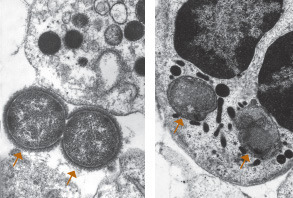
In the image on the left, you can see two large bacteria that cause gonorrhea, side by side. In the image on the right, you can see these bacteria “swallowed up” by a large immune cell known as a neutrophil, which engulfs and kills the invading bacteria.
The healthier your immune system is, the faster and more powerfully it can defeat invaders, thus preventing sickness in many cases, and reducing severity and duration in others.
Exercise and the Immune System
Considering the fact that regular exercise improves just about every aspect of our health, it’s no surprise that it directly improves immune function.
It is, however, possible to have too much of a good thing: too much exercise can actually impair the immune system, which is one of the symptoms of overtraining. Ultimately what is “too much exercise” varies from body to body, but my experience working with thousands of people has taught me this:
It’s harder to overwhelm the immune system with exercise than you might think. And that’s especially true when you’re eating plenty of healthy foods and getting enough rest and recovery. That said, I generally recommend that people limit their total weekly exercise to 8 hours or less, and that they include one day of no exercise whatsoever each week.
Exercising When Sick
I totally understand the desire to exercise when sick. Once you’ve established a good exercise routine, you really don’t like messing with it.
The reality is intense exercise is only going to make the sickness worse, though. Why? Because intense exercise temporarily depresses immune function, which gives the invaders more time to wreak havoc in your body.
That said, animal research has shown that light exercise (20 to 30 minutes of light jogging on a treadmill) performed while infected with the influenza virus boosts immune function and speeds recovery.
Similar effects have been seen in human studies as well, which is why I recommend no more than 3 sessions of 20 to 30 minutes of light cardio when sick (you should never get too winded to speak).
Smoking and the Immune System
Smoking is up there with alcoholism as one of the most unhealthy habits you can develop, and among its many liabilities is the suppression of the immune system.
Research has shown that smokers generally get sick more often than non-smokers and that smokers are much more likely to contract respiratory diseases than non-smokers. Furthermore, cold and flu viruses make smokers sicker than non-smokers.
The answer, of course, is to quit smoking, and while I’ve never smoked, I would definitely use this book to quit if I did–it’s a time-proven, incredibly effectively tool for quitting easily and permanently.
Body Weight and the Immune System
There are bigger problems with being overweight or obese than how you look: it’s incredibly unhealthy, increasing the risk for all kinds of disease including type 2 diabetes, cancer, reproductive problems, heart disease, and more.
Research has shown that one of the reasons for this is the chronic systemic inflammation that comes with being overweight or obese, which impairs immune function, thus increasing the likelihood of infection and the duration of sickness.
The solution is obvious, and while many people are made to believe that losing fat and building muscle is incredibly hard or complicated, it’s not. It doesn’t require that you live in the gym…. It doesn’t require that you follow strange, overly restrictive diets… and it doesn’t require that starve yourself or even battle with hunger.
All healthy weight loss requires is sensible meal planning that includes plenty of tasty, nutritious foods, and a proper exercise program that uses moderate amounts of weightlifting and cardiovascular exercise to burn calories, build muscle, and maintain health.
Nutrition and the Immune System
The foods you eat have a major impact on the competence of your immune system. Micronutrients such as zinc, selenium, iron, copper, beta-carotene, vitamins A, D, C, and E all play important roles in keeping your immune system strong.
The less healthy, micronutrient-dense foods you eat, the more likely you are to develop deficiencies in the many vitamins and minerals your body needs to maintain optimal health and immune function. This, in turn, impairs immune function.
Ideally, we’d get all of the vitamins and minerals we need from the food we eat, but this is easier said than done.
First there’s the issue of the ever-declining quality of soil and food (even in the world of organic), which is making it harder to get adequate nutrition from our diets.
Then there’s the fact that maintaining optimal levels of vitamin and mineral intake requires a bit of planned dietary diversity, which can be done, but can also be time consuming.
Personally, I prefer a simpler approach. I make sure the majority of my calories come from nutrient-dense foods, like the following:
Avocados
Greens (chard, collard greens, kale, mustard greens, spinach)
Bell peppers
Brussels sprouts
Mushrooms
Baked potatoes
Sweet potatoes
Berries
Low-fat yogurt
Eggs
Seeds (flax, pumpkin, sesame, and sunflower)
Beans (garbanzo, kidney, navy, pinto)
Lentils, peas
Almonds, cashews, peanuts
Barley, oats, quinoa, brown rice
Salmon, halibut, cod, scallops, shrimp, tuna
Lean beef, lamb, venison
Chicken, turkey
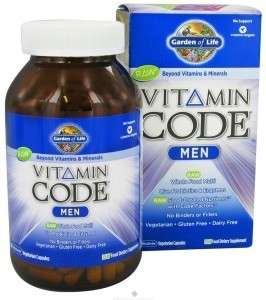
And I take a high-quality multivitamin supplement daily to ensure I don’t become deficient in anything important. Here’s what I’m currently using and liking:
Buy now
AmazonAmazon UKBodybuilding.com
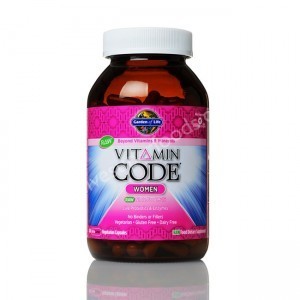
And here’s the women’s version of the same product:
Buy now
AmazonAmazon UKBodybuilding.com
Lifestyle and the Immune System
While exercise falls under the banner of lifestyle, it deserved its own section. In this section, I want to discuss a few other lifestyle-related factors of immunity.
Chronic Stress Increases Risk of Sickness
Research has shown that while acute stress enhances immune function (the good old “fight or flight” mechanism working for us), chronic stress suppresses it.
So, try not to sweat the little annoyances so much, stay away from negative people that try to keep you down, avoid overtraining in the gym, take some time for yourself every day to chill out, and avoid conflicts by trying to treat others the way you’d like to be treated, and you’ll not only be happier in life, but you’ll get sick less often.
Inadequate Sleep Increases Risk of Sickness
For generations, mothers have been telling their children to get enough sleep or they’ll get sick…and it turns out there’s some truth in it.
Research has demonstrated that acute sleep deprivation acutely suppresses immune function, and the longer sleep is restricted, the more likely you are to get sick. And not only cold and flu sick, but heart disease and diabetes sick as well.
The bottom line is, like smoking and over-consumption of alcohol, regularly not getting enough sleep is incredibly unhealthy and, over time, can contribute to all kinds of disease and dysfunction. What is adequate sleep varies from person to person, though. Check out my article on how to sleep better for more information.
Have More Sex to Boost Your Immune System
You probably don’t need much convincing to have more sex, but here’s another reason:
Research has shown that regular sex boosts immune function, and thus helps your body fight off sickness bugs like the flu and other bacteria and viruses.
Specifically, the study found that college-aged people having sex once or twice per week had higher levels of immunoglobulin A (IgA), the body’s first line of defense against cold viruses, than people having sex less or more (bummer) frequently. Furthermore, the study also found that higher levels of satisfaction and duration in relationships were associated with higher levels of IgA.
So, have more sex, enjoy your relationship, and stay healthy.
Supplements That Boost the Immune System
Vitamin C
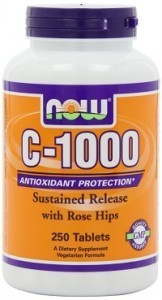
Vitamin C is found in high concentrations in immune cells and is quickly consumed during infections.
Research has shown that regular intake of vitamin C up to about 1 gram per day helps reduce symptoms and shorten the duration of respiratory tract infections like the common cold. Supplementation with vitamin C also helps reduce systemic inflammation and cortisol levels, which can further boost immune strength.
This is why I supplement with 1 gram per day, and here’s the product I take:
Buy now
AmazonAmazon UK
Fish Oil
Thanks to its high amounts of omega-3 fatty acids, fish oil has a long list of health benefits, and a recently published study has uncovered yet another:
Fish oil, which was once believed to suppressed immune function, actually enhances it by improving the function of B cells, a type of cell vital to the immune system’s defenses.
Not all fish oils are equal, however. The cheaper options contain an inferior, processed form of the oil (ethyl ester), which is much more resistant to the enzymatic process by which the body breaks the oil down for use. Not only that, but the cheaper oils also have low levels of omega-3 fatty acids, requiring that you take a few handful of pills every day to reach the recommended 3.5 to 4.5 grams of omega-3 fatty acids per day.
Instead, you want the natural trigclyeride form of fish oil, which is better absorbed by the body, and which has higher concentrations of omega-3 fatty acids. And that’s why I buy and use this product:
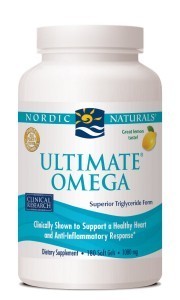
Nordic Naturals is one of the most respected brands of fish oil on the market, and this specific product is a “double strength” EPA/DHA formula, with 650mg of EPA and 450 mg of DHA in each serving. Most other fish oils contain half of that per serving.
Buy now
AmazonAmazon UKBodybuilding.com
Vitamin D
Vitamin D deficiency has been associated with an increased risk of developing a wide variety of diseases, such as osteoporosis, heart disease, stroke, some cancers, type 1 diabetes, and multiple sclerosis, tuberculosis and even the flu.
Furthermore, according to research published by the Center for Disease Control in 2011, 8% of Americans are vitamin D deficient, and 25% are considered “at risk” of a deficiency. Other research published in 2010 showed that nearly 70% of breast-fed babies were vitamin D deficient at one month, which can be particularly harmful considering how important this vitamin is in overall health and development.
And while we can get vitamin D by going in the sun for about 15 to 25 minutes per day, few are able to regularly do that. Instead, we can just take a daily supplement. How much should we be taking, though?
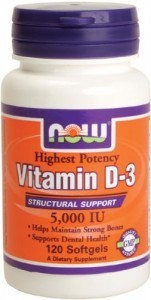
A committee of the U.S. Endocrine Society recently convened to review the evidence, and concluded that 600-1,000 IU per day is adequate for ages 1-18, and 1,500-2,000 IU per day is adequate for ages 19+.
Here’s the product I use:
Buy now
AmazonAmazon UK
Echinacea
Echinacea is a type of flowering plant in the daisy family, and it has long been used as an herbal product to help fight colds and other common sicknesses.
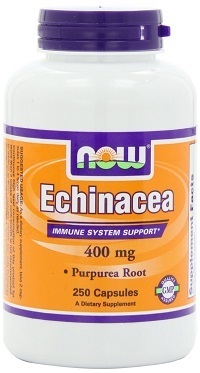
Echinacea’s use as an immune booster has been controversial in scientific circles. There is research showing it to be effective in both reducing the likelihood of getting sick and the duration of sickness, and there is research demonstrating no such benefits. That said, several clinical trials that have failed to demonstrate immune benefits have been criticized for using inferior forms of echinacea extracts and for using dosages too small to do anything.
While I don’t take echinacea year-round, I do take about 3 grams per day if I’m sick or in close contact with sick people (office or family). Here’s what I take:
Buy now
AmazonAmazon UK
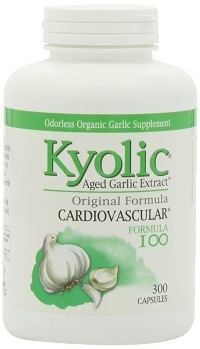
Aged Garlic Extract
Like echinacea, garlic has a long history of use for fighting infections, and modern science has confirmed its effectiveness.
Aged garlic extract is particularly effective: research has shown that it reduces the severity and amount of symptoms experienced while sick with a cold or the flu.
Like echinacea, I don’t take aged garlic extract unless I’m sick or around sick people, and when I do, I take about 1 gram per day. Here’s what I use:
Buy now
AmazonAmazon UK
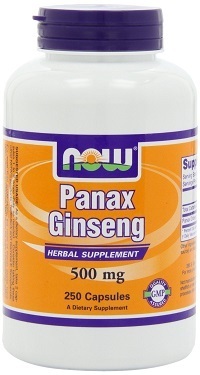
Ginseng
Ginseng is one of the most well-known oriental medicinal herbs, and has long been used to treat a variety of disorders. Its role as an immune modulator is widely known in scientific circles, and research has shown that regular supplementation boosts immune function.
It’s generally recommended that you take ginseng supplements for less than 3 months at a time, so I include it in my supplementation regimen when I’m sick or around sick people, and when I do, I take about 2 grams per day. You want the Asian (panax) form, and here’s what I take:
Buy now
AmazonAmazon UK
Probiotics
Probiotics are good bacteria in your digestive tract, and research has shown that certain types not only help in digesting your food, they also build up the immune system.
There’s a problem, though, as reported by the American Academy of Microbiology: many of the probiotic products on the market are crap. In many cases, the bacteria are dead, and thus the products are worthless. This is especially true in the case of products that include probiotics as a “bonus” (the processing of such products kills the bacteria), as well as cheap products that don’t need to be refrigerated.
That’s why I stick with NOW Foods, a highly respected brand that has undergone quite a bit of scrutiny over the years in the way of third party testing and come out unscathed. Here’s the product I use, and I take one capsule per day during flu season or when I’m sick or around sick people:
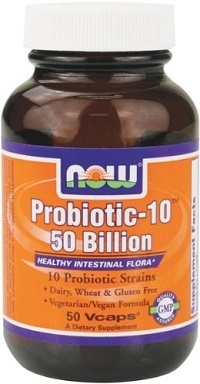
Keep this in the fridge to keep the bacteria alive.
Buy now
AmazonAmazon UK
What do you think of these strategies for boosting the immune system? Have anything else to add? Let me know in the comments below!
February 9, 2014
7 Deliciously Healthy Soup Recipes You’ll Absolutely Love
Check out the labels on cans of soup at the grocery store, and it won’t take more than a few minutes to realize they all have one thing in common: protein deficiency! Even the chicken noodle and beef potato soups are high in salt and preservatives and low in actual meaty deliciousness.
But that doesn’t have to be the case when you make soup from scratch. Here are 7 soups with 15 to 50 grams of protein per serving with moderate amounts of carbohydrate and fat as well, and all of which require less than 30 minutes of time in the kitchen.
Salmon Chowder

Picture courtesy of CHOW
For a satisfying lunch or a rich starter course, perk up bland corn chowder with flaky salmon.
Directions
Start by melting 3 Tbsp. butter in a large stockpot, and sauté 1/2 cup chopped celery, 1/2 cup chopped onion, and 1/2 cup diced green bell pepper for about 5 minutes, until tender.
Add in 1 can (about 2 cups) chicken broth, 1 cup diced potatoes, 1 cup shredded carrots, 1 1/2 tsp. sea salt, 1/2 tsp. freshly ground pepper, and generous 1/2 tsp. fresh dill. Reduce heat once the mixture begins to boil, cover the pot, and simmer for 40 minutes.
Stir in 1 can creamed corn, 2 cups half and half (or low-fat milk), and 16 oz. cooked salmon. Heat together for about 15 minutes before serving.
Serves 8
Nutrition Facts (Per Serving)
Calories: 273
Protein: 16 grams
Carbs: 20 grams
Fat: 16 grams
Carrot Ginger Lentil Soup
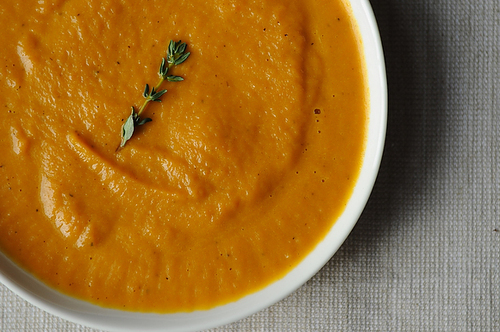
Picture courtesy of Food52
This flavorful soup is vegan, yet the lentils provide a good amount of protein. It’s a good option whether you need a pre-workout snack, light lunch, or side for a cut of meat.
Directions
The night before cooking, soak 1 1/2 cups of yellow split lentils in 2 cups water.
More than 8 hours later, prepare the soup by heating 2 tsp. coconut oil in a large soup pot over medium heat. Sauté 1 large onion and 6 large carrots, diced, for about 5 minutes.
Continue cooking for a couple minutes with 1 Tbsp. fresh ginger, 2 cloves minced garlic, and 1 tsp. cinnamon. Then add the lentils and soaking liquid, 1/8 cup maple syrup, 4 cups vegetable stock (or beef stock), a bay leaf, salt, and pepper.
Bring to a boil, reduce heat, and simmer for a half hour or more. Puree mixture, minus the bay leaf, in a blender or with a hand blender.
Serves 6
Nutrition Facts (Per Serving)
Calories: 267
Protein: 17 grams
Carbs: 44 grams
Fat: 3 grams
Bacon Cheeseburger Soup
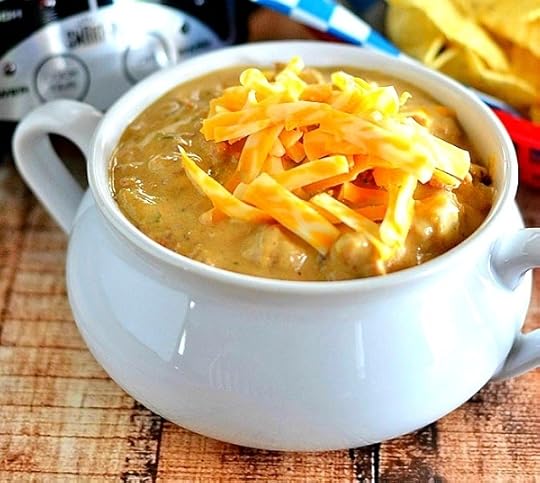
Picture courtesy of Kitchen Meets Girl
All the flavor of a bacon cheeseburger in a nutritionally balanced soup, and it comes together in a slow cooker? Making soup at home doesn’t get better than that.
Directions
First, cook a mirepoix – 3 minced garlic cloves, 1 chopped onion, and 3 chopped celery stalk – in 1 Tbsp. olive oil in a skillet over medium-high. Once the onions are translucent, add the mixture to the slow cooker.
In the hot pan, brown one pound of lean ground beef (or turkey, for less fat), drain, and transfer to the slow cooker. Then cook 4 strips of thick-cut bacon, crumble over a paper towel, and add in with the veggies and browned beef.
Whisk together in a small bowl 1/2 cup chicken broth with 2 Tbsp. whole wheat flour. Once lump-free, pour the mixture into the warm skillet, and add 2 1/2 cups more broth. Stirring constantly, bring the mixture to a boil, and once thickened, add it into the slow cooker.
Add 12 oz. low-fat evaporated milk, 1/2 tsp. paprika, 1/2 tsp. garlic powder, 1 1/2 Tbsp. Worcestershire sauce, 1 Tbsp. mustard, 1/4 tsp. salt, 1/8 tsp. freshly ground pepper, and 8 oz. low-fat extra sharp cheddar cheese. Stir well, and cook for 2 hours on low.
Serves 6
Nutrition Facts (Per Serving)
Calories: 378
Protein: 42 grams
Carbs: 11 grams
Fat: 17 grams
Thai Pork Stew with Parsnips

Picture courtesy of Hungry in Bangkok
This hearty stew is comfort food even though the flavors are far from home.
Directions
Blend together 2 tsp. fresh ginger, 6 garlic cloves, 4 chopped cilantro stalks (stems and all), 4 sliced green onions, and 2 seeded, diced hot peppers in a food processor until the mix turns into a paste. Add in 1 Tbsp. ground coriander, 1 tsp. white pepper, 1 tsp. ground cumin, and a pinch of cloves.
In a large Dutch oven, heat 1 Tbsp. peanut oil over medium-high heat. Brown 3 lb. cubed pork shoulder in three or four batches, and once finished, toss all in the pan with the paste, stirring regularly for 4 minutes.
Stir in 5 sliced parsnips, 1/3 cup fish sauce, 1/3 cup packed brown sugar, and 2 cups water. After bringing to a boil, reduce heat and cover; simmer for at least a half hour, or until pork is tender.
To thicken the stew, prepare a mix of 2 tsp. cornstarch and 1 Tbsp. water in a little dish. Over medium-high heat, remove the cover from the pot and add the cornstarch mixture. Boil for 1 minutes. Spoon stew into bowls, and garnish with 1/4 cup fresh chopped mint leaves.
Serves 6
Nutrition Facts
Calories: 522
Protein: 50 grams
Carbs: 38 grams
Fat: 18 grams
Khoreshe Behh (Persian Beef Stew with Quince)

Picture courtesy of In Erika’s Kitchen
A versatile dish bursting with Persian flavors, this can be served with or without rice, and it can be made simmering in either a slow cooker or a big pot on the stove.
Directions
Begin by browning 2 lbs. of cubed stew beef (or lamb) in a large pot in 3 Tbsp. of olive oil. Once seared, remove the meat, and add 2 finely chopped onions to the pan to cook for 6–8 minutes, until light brown.
Move the meat and its juices back to the pot. Add 1/2 tsp. turmeric, 1/4 tsp. cinnamon, 2–3 Tbsp. tomato paste, 1/4 cup lemon juice, salt, pepper, and water to halfway cover the beef. Stir to combine, and keep over medium heat until simmering.
Just as it caramelizes, add 2 cored and cubed quinces, a handful of prunes, and 3 Tbsp. honey, stirring well. Cover the pot, and let simmer slowly over low heat for three hours. Check from time to time, an add water if needed.
Serves 6
Nutrition Facts (Per Serving)
Calories: 469
Protein: 47 grams
Carbs: 28 grams
Fat: 19 grams
Halibut Stew with Fresh Herbs

Picture courtesy of Our Lady of Second Helpings
This is a lean, quick-to-prepare meal that’s suitable for almost any diet. There’s no excuse not to eat well when it’s this easy and delicious.
Directions
First, sauté 1 diced medium onion in a large pan with 1 Tbsp. olive oil. After about 3 minutes, before the onions brown, add 1/2 cup white wine, and scrape the bottom of the pan with a wooden spoon. Add 1 can diced tomatoes (or 6 Roma tomatoes), along with a pinch of white pepper, and bring to a simmer.
Cook for a few minutes, then add 2 cups vegetable broth, 1/3 cup ground onions, and 2 cups chopped bok choy. Stir occasionally for a couple more minutes, and once the leaves begin to wilt, add 12 oz. of cubed halibut filets. Cook for 4–5 minutes, until the fish is opaque.
Serves 4
Nutrition Facts (Per Serving)
Calories: 235
Protein: 27 grams
Carbs: 11 grams
Fat: 10 grams
White Bean & Ham Soup

Picture courtesy of CHOW
This is a standby soup that’s cheap yet satisfying, and it’s a great way to use up leftover ham.
Directions
The night before, cover 1 lb. dried cannellini beans with at least 3” of water to soak for at least 8 hours. Drain before preparing soup.
In a large Dutch oven or heavy-bottomed pot, pour in 3 1/2 quarts (14 cups) of water, and place 1 lb. ham hocks (or smoked ham bone) to begin to a boil. Simmer uncovered for an hour over medium heat.
Add soaked beans and 3 fresh thyme sprigs, and continue simmering, stirring occasionally until beans are tender but not soft in the center. It will take about an hour.
Dice 2 carrots, 2 celery stalks, and 1 yellow onion. Add to the pot on the stove, and sprinkle in about 1 tsp. salt. Continue cooking for about 40 minutes.
Turn off the heat, and transfer ham hocks to a cutting board to remove the meat. Lightly mash the beans and vegetables, keeping some intact, and add back in the sliced ham meat along with 8 oz. fully cooked smoked ham. Season to taste with salt and freshly ground pepper, and serve.
Serves 8
Nutrition Facts (Per Serving)
Calories: 391
Protein: 35 grams
Carbs: 38 grams
Fat: 11 grams
What did you think of these healthy soup recipes? Have anything else to share? Let me know in the comments below!
Want more delicious, easy-to-make recipes like these?If you like these recipes, then you’ll love my bestselling cookbook The Shredded Chef!
In this book you’ll find 120 healthy, flavorful recipes specifically designed for athletes that want to build muscle or lose fat. Regardless of your fitness goals, this book has got you covered.
Buy this book now to forever escape the dreadful experience of “dieting” and learn how to cook nutritious, delicious meals that make building muscle and burning fat easy and enjoyable!
Buy now
AmazonAmazon UKAmazon AUAmazon CABNiBooksKoboGoogle Play
Vegan and vegetarian dishes are great sources of micronutrients, and even if you’re a meat eater, they’re great for changing things up in your meal plan.
And in my cookbook, Eat Green Get Lean, you’ll find 100 of my favorite vegetarian and vegan dishes, carefully balanced for our high-protein, healthy needs!
Buy this book now to forever escape the dreadful experience of “dieting” and learn how to cook nutritious, delicious vegetarian and vegan meals that make building muscle and burning fat easy and enjoyable!
Buy now
AmazonAmazon UKAmazon AUAmazon CABNiBooksKoboGoogle Play