Nicholas Fox Weber's Blog, page 5
January 20, 2015



January 15, 2015
January 9, 2015
Paul Klee, Man-Fish-Man-Eater, 1920
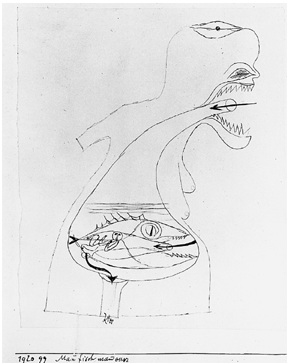 Paul Klee, Man-Fish-Man-Eater, 1920. Klee’s vivid imagination was grounded in natural elements, however startling the results.
IN SEVERAL LECTURES, Klee talked about, and illustrated, the intake and outgo of food. The year he arrived at the Bauhaus, he had sketched a “man-fish-man-eater.”153 This amazing image is evidence that, in his art as in his cooking, there was little that Klee considered off limits. But he evoked his unusual visions in such a naturally competent way that they are not terribly startling. To consider his “man-fish-man-eater” grotesque imposes a judgment on it that is alien to Klee’s way of thinking. The creature’s greed and barbarity are depicted so as to appear as natural as the rivers and blood flow he examined in his lectures. To Klee, the creature’s actions were simply part of the cosmos. The truncated “man-fish-man-eater” has a large boxlike head and is entirely bald. His wide open mouth is marked by upper and lower teeth that are as jagged and brutal as saw teeth; these lethal chompers anticipate by nearly two decades the brutal imagery in Picasso’s Guérnica. He also has on top of his flat pate a form that could be read either as a large eye or as a pair of lips with a black dot at their center. A bold arrow penetrates the gulletlike opening at the top of the free-form vessel that rises through the man-fish-man-eater’s throat and opens in the middle of his mouth. The route of his comestibles could not be clearer. Toward the base of that vessel, a few horizontal lines suggest water, beneath the surface of which are abstracted fish—jagged fins and all—as well as a tiny, embryonic humanoid. They are still waiting to be digested, and a second bold arrow suggests what will happen after they have been: they will be small enough to go through a little hole and then down into a discharge pipe. At the exit from that pipe is written the name “Klee.”
Nicholas Fox Weber, The Bauhaus Group
The post Paul Klee, Man-Fish-Man-Eater, 1920 appeared first on www.nicholasfoxweber.com.
January 8, 2015
Bird Pep, Paul Klee, 1925
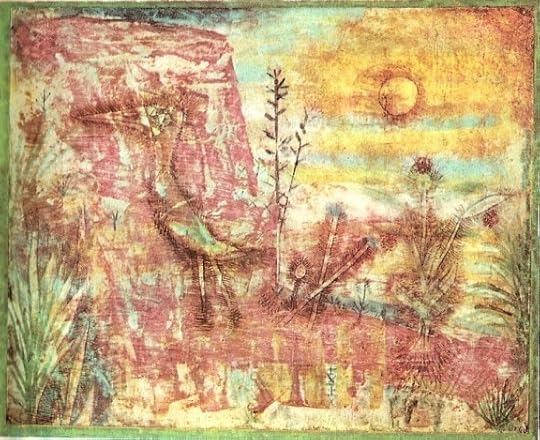 In his 1925 Bird Pep, for example, Klee had anticipated the revelations of the Egyptian desert. In this marvelous painting, the cactus on the horizon seems to have just burst into life, as if it were born in a nanosecond. The plant is like a dancer who was not there a moment ago and now has leapt onto the stage as a mature and developed being. We feel its growth and development as if we can see its stems lengthening, its leaves gaining their span, and its red flowers assuming their color. In this as in so much of Klee’s work, the history of the universe seems to have occurred simultaneously in a fraction of a minute and over countless millennia. The sun that Klee painted with a core like a fertile egg yolk, and with a red aura around it, is the sun of all times. Conveying its past, present, and future, it has irrefutable power.
The bird that is the central figure of this oil and watercolor on paper has legs like those Klee drew for his students when he was depicting human development. They are signs for the limbs of a competent walker, not a realistic rendering. The bird is comic, its head and beak practically equal in size to the rest of its body. Its entire outline—of head, chest, tail, legs—is covered with fine follicles, copious and long, with many of them jutting out straight. A lot of the plants also have these follicles that look like antennae. Projecting into the atmosphere, reaching toward the future, all these little hairs evoke the miraculousness of living organisms. Three years later, Klee would be conscious that the birds he saw in Egyptian statuary were comparable: timeless and universal creatures endowed with spiritual power. ��
The colors of this 1925 painting are an amazing, almost lurid mix of desert rose, bilious yellow, and lime green. We are in a warm and exotic place here—certainly not Weimar or Dessau. This could be a vision of the ancient primordial past; it could be a view out the window today. Or maybe it is the future, when strange and fantastic creatures will have taken over the earth. In Egypt, he would discover its companions.
— Nicholas Fox Weber, The Bauhaus Group
The post Bird Pep, Paul Klee, 1925 appeared first on www.nicholasfoxweber.com.
December 16, 2014
Small Worlds IV, WASSILY KANDINSKY, 1922
 WASSILY KANDINSKY, Small Worlds IV, I922. Shortly after arriving at the Weimar Bauhaus, Kandinsky produced a series of prints in various media that remain to this day among his best-known work.
–The Bauhaus Group Six Masters of Modernism
The post Small Worlds IV, WASSILY KANDINSKY, 1922 appeared first on www.nicholasfoxweber.com.
Kandinsky’s Birthday, 1926
 HERBERT BAYER
Poster For Kandinsky’s 60th birthday exhibition in Dessau, 1926.
Bayer’s design announced one of Kandinsky’s most important exhibitions
ever, a great event for everyone at the Bauhaus Dessau.
–The Bauhaus Group Six Masters of Modernism
The post Kandinsky’s Birthday, 1926 appeared first on www.nicholasfoxweber.com.