
Nicholas Fox Weber's Blog, page 30
March 5, 2013
Wassily Kandinsky’s creative journey from figurative realism to abstract painting
[image error]Shortly after the Bauhaus moved to Dessau, Wassily Kandinsky wrote a letter
to Lily Klee. This was in the period when Lily preferred to remain in the pleasant
apartment in Weimar rather than move to temporary digs near the school’s
new location.
Lily had given Kandinsky some polenta. Addressing her with a Russianized
version of her name, he wrote,
Dear Elisaveta Ludwigovna,
For years I have wanted to eat polenta — so you will easily understand what pleasure you have given me. My
heartfelt thanks. For me polenta is a synaesthetic delight, for in some strange way, it stimulates three senses perfectly
harmoniously: first the eye perceives that wonderful yellow, then the nose savors an aroma that definitely includes the
yellow within itself, at last the palate relishes a flavor which unites the color and the aroma. Then there are further
“associations” — for the fingers (mental fingers) polenta has a deep softness (there are also things which have a shallow
softness!) and finally for the ear — the middle range of the flute. A gentle sound, subdued but energetic …
And the polenta which you served me had pink tones in its yellow color … definitely flute!
Kind regards to you, dear Pavel Ivanovitch, and dear Felix Pavlovitch, with best wishes for you all,
Yours,
Kandinsky
Read more here.….…Kandinsky


March 2, 2013
George Grey Barnard
 George Grey Barnard was a carver of marble figures of muscular Michaelangelesque
nude men who was totally destitute until Arthur (Corning Clark) turned his life around
by making him what others would call his “kept boy”. Thanks largely to Alfred’s
beneficience, not only would Barnard have a successful career and help create
New York’s wonderful Cloisters Museum, but he would also guide both Sterling and
Stephen Clark, in the brief period of their adult lives when they were still friendly with
one another, to discover the wonders of European art and begin collecting it.
The Two Natures of Man
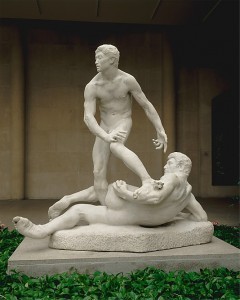
The Struggle of the Two Natures of Man, George Grey Barnard, marble, final version, 1891–94
The Two Natures of Man can also be read as a
parable of victory and defeat. In either instance
the theme was close to Alfred Corning Clark’s
heart. George Barnard wrote, “I shall try and
bring all the anguish that what we call a victor
is susceptible to–that is the higher one gets the
more delicate he is strung.”
March 1, 2013
February 28, 2013
The Art of Babar

The Art of Babar
Babar the elephant led the jungle and entered Western civilization
in 1931 in a book published in Paris. Since then he has fought enemies
and aided friends, sailed to exotic islands, flown to distant planets,
toured America, solved mysteries, and encountered the supernatural
in a series of adventures chronicled in thirty-seven volumes to date.
His story has been translated into seventeen languages, recorded on
tape, animated, and set to music.
Read More about The Art of Babar

Interaction of Color

Interaction of Color
“This is the same color, in the grid, exactly the same ink.
Hard to believe but because of the neighboring colors,
the background, it looks different and Josef would apply
this perception to his observations of people. He might say,
I look one way on my own but with my family members you
would see me differently – either like them or unlike them but
we always see things in relation to something else.”
Watch Video
Nicholas Fox Weber, Josef Albers in America Works on Paper lecture, The Morgan Library and Museum,
September 21, 2012




![[image error]](http://www.nicholasfoxweber.com/wp-content/uploads/2013/03/Kandinsky.publication-huge.jpg)