Hugh Thomson's Blog, page 8
May 23, 2013
Paul Fussell: An Anniversary Tribute

Lt. Paul Fussell in Paris, France, May 1945
I was in Philadelphia recently and thought of Paul Fussell, who lived there before his death this time last year and whom I knew: one of the finest writers about 20th-century war, both because he wrote about the subject as a cultural critic more than military historian and because having fought in WW2 both in Europe and the Pacific, he knew what he was talking about. The Great War And Modern Memory is his most famous book – but I have only just read one of his very last books, The Boys’ Crusade. Subtitled ‘American GIs In Europe: Chaos And Fear In World War II’, it highlights some familiar Fussell themes: how many American soldiers were teenagers, how little about war they knew before they went, and how many cock-ups there were.
Like all of his books – and like his conversation – it is candid and clear-sighted, just like the Augustan prose he so admired (he was a professor of 18th-century English Literature). Unlike most books on WW2, it is also elegantly short.
But if his other achievements were not enough, he also helped in the revival of interest in travel writing, for which I am more directly grateful to him. His book, Abroad: British Literary Travelling between the Wars, championed travel writers of the 1930s like Robert Byron who had largely been forgotten at the time.
I was once with him when a BBC executive (I was trying to get the BBC to make a programme about and with Paul) asked him if he had ever met any Germans. Fussell gave him a stare: ‘Any Germans I met during the war, I killed.’ The executive blanched.
see my review of Panther Soup, by John Gimlette: ‘It was Paul Fussell in his magisterial Wartime who picked out the pivotal moment when the American authorities realised what they were dealing with in the Second World War. They issued an edict that servicemen should no longer be issued with white underpants. The war in all its messy, scrappy detail – sniping and scuffling in the vegetable gardens of Western Europe by ordinary soldiers – has always been more difficult to convey than the grand strategies of the generals who sent them there…’


March 11, 2013
Panspermia
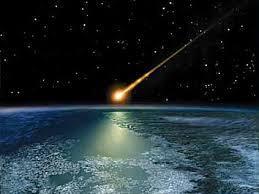 I’ve always been fascinated by the idea of panspermia: the theory that Fred Hoyle and others put forward almost 30 years ago that – very broadly put – life was distributed across the universe by meteorites.
It’s often been ridiculed by other astronomers and physicists – let alone biologists – for being simplistic, but that surely is part of the charm: we should look for an elegant simplicity in our scientific solutions.
So the news that scientists, including a former colleague of Fred Hoyle’s, have identified biological matter in the heart of a meteorite that recently landed in Sri Lanka, in December, should have attracted much greater attention than it has.
This judicious and weighted article in the August M.I.T Technology Review puts the case.
My more frivolous case for panspermia is below:are
The first Big Bang:
panspermia flood
through space, lactating
fireworks against the black;
meteorites cross-pollinate
.
between planets,
extremophile bacteria
clinging to the rocks
like a rodeo:
‘yi-haaaaaah!’
.
The Earth got lucky –
we were fertilised.
But what I want
to ask the Universe
is this:
.
‘How was it for you?’
February 4, 2013
An outrageous plan to build a new airport for Cusco on the beautiful highlands above Chincheros
Interesting piece in this week’s Economist which confirms what I was suggesting in a From Our Own Correspondent report for the BBC last year, that Peru is booming away at a phenomenal rate of between 7% and 9% this year, figures that those of us experiencing double or treble dip recessions can only dream of.
The boom has been helped by strong minerals, cautious banks (you have to be a cautious bank if you’re operating in Latin America!) and an emerging middle class. It’s seen the dollar fall against the local currency, the Peruvian sol, by some 25% over five years – not such good news if you’re planning to travel there, although compensated for by rapidly improving infrastructure: over the last decade, the number of roads in Peru has doubled, an extraordinary statistic for this huge country that is five times the size of the UK.
But with wealth comes responsibility – and in particular, responsibility for the environment, not something that has always been Peru’s strong suit (remember the riots about introducing gas pipelines to the Amazon, when local indigenous tribes confronted the army and police).
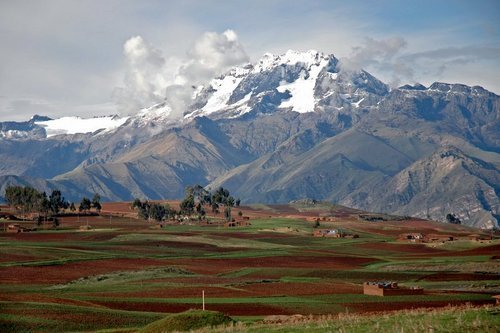
Now there is an outrageous plan to build a new airport on the beautiful highlands above Chincheros, some thousand feet above Cusco, which is the city that it would serve.
The old airport in Cusco is deemed to have run its purpose – mainly because it can’t take international flights, and also because developers are eyeing up what has become a valuable inner-city resource for housing, having started off as a few fields on the outskirts of town when I first went there in the early 1980s.
There are some doubt as to whether a new airport would really do much better for international flights – and no doubt at all that it would be a huge eyesore on one of the most beautiful areas close to Cusco and one which many tourists see as they travel over towards Machu Picchu.
My old mate Nick Asheshov has written astutely about this in his column for the Peruvian magazine Caretas.
The idea has been ticking over for years and no one really thought the authorities would quite bring themselves to do it. Tragically, it now sounds as it is a done deal, as large amounts of money have been handed out to the local communities already as recompense.
The view over the Chincheros plain to Mount Verónica, past lakes and fields of growing quinoa, is one I have always cherished and I for one will be very sad if it now becomes a sprawl of not only the airport but all the ancillary hotels and mess that an airport inevitably brings.
January 10, 2013
following Edward Thomas and his ‘map of the soul’
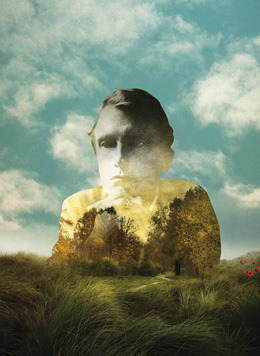 Blown away by the quite phenomenal Nick Dear play The Dark Earth and The Light Sky about Edward Thomas, now showing at the Almeida Theatre on its first run.
I wrote about Thomas in The Green Road into the Trees – indeed in some ways the book was a centenary version of his own book, The Icknield Way, when he took the same route in 1912. Nick Dear has a fine phrase for Thomas’s travel books which he describes as ‘maps of his soul’, rather than more conventional guides, and as a result did not sell.
Dear does a few things exceptionally well: he doesn’t sentimentalise Thomas at all – he often comes across as a monster in the way he treats his wife Helen in particular; the play does not climax with Thomas’s tragic death in the First World War which often over-colours accounts of his life – this is the chronicle of a death foretold; he shows how the friendship between Thomas and Robert Frost was pivotal for both men’s poetry – Thomas started publishing and Frost got recognition.
But above all it focuses on Helen, who for me had always been a shadowy presence. She comes across as a tragic figure, quite beautifully played by Hattie Morahan, dealing with her husband’s depression and death wish with alternate light and sadness.
In The Green Road into the Trees, I quoted the lines of Thomas that haunted me from his own account of my journey: ‘I could not find a beginning or an ending to the Icknield Way. It is thus a symbol of mortal things with their beginnings and ends always in immortal darkness.’
December 21, 2012
Well at least it gets you out and about early
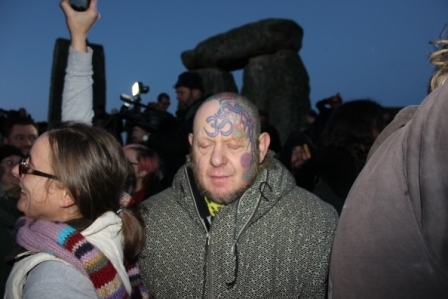
all photos (c) Hugh Thomson
.
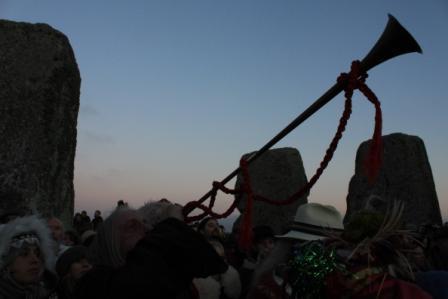
Having complained in an earlier column that most people celebrate the wrong solstice at Stonehenge – i.e. the summer one – when archaeologists think that it was built for the winter solstice, seemed only fair to go along today and see what might be happening. Even if it meant getting up at four in the morning to drive there.
.
.
.
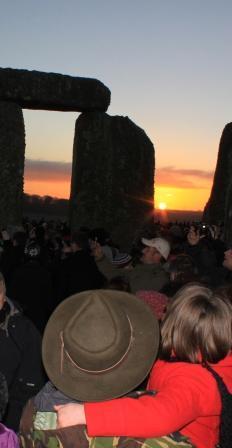
The Druids were out in force and drumming up a storm. So were about 1000 more people, but nothing compared to the summer when you can easily get 30,000. Fewer people come in the winter because usually there’s no sun – but today, despite the recent rains, it dawned beautifully clear.
.
One celebrant who came every year told me it was the first time she’d ever seen the sun for the solstice dawn.
Made for a great atmosphere. Chief druid Rollo Maughling (Panama hat, below right) led some ecumenical prayers in which Gaia got the odd mention, as did the war in Syria and – an unexpected left field one – the centenary of the US membership of the IMF (I’m taking him on trust on this one).
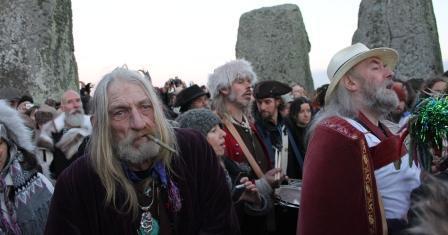
The odd friendly heckle from the crowd added suggestions for the service – like a spontaneous cheer in the honour of the late Sir Patrick Moore. Or a cry that went up at one point – ‘give him some room, druid coming through’ – when one berobed and bearded sage arrived late after trouble parking on the A344.
.
More by accident than design I found myself right by the drummers as they got going and almost got speared in the face by a stray dear’s antler on the back of someone’s mask.
.
But the moment the sun came up was a moment to melt the ice splinter in any sceptic’s heart: the stones warmed by the dawn, the music and the celebration. As the self-styled King Arthur Pendragon, who has spent a lifetime campaigning for more open access to the stones and is now in his 60s, said to the assembled media, ‘one can see the divine in the spirit of the place.’
.
more pictures
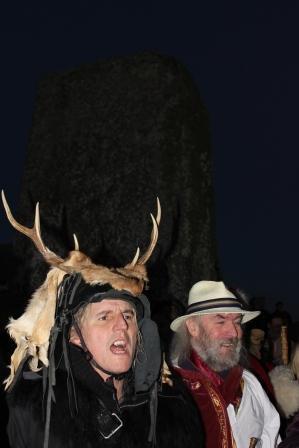
the antlers that almost got me
.
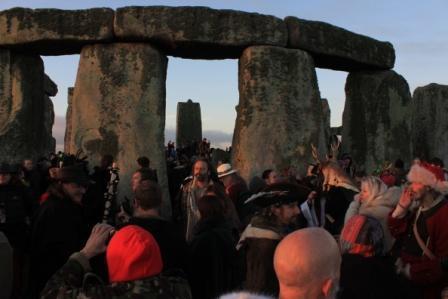
wonderful to see the stones open to all, as they always should be
.
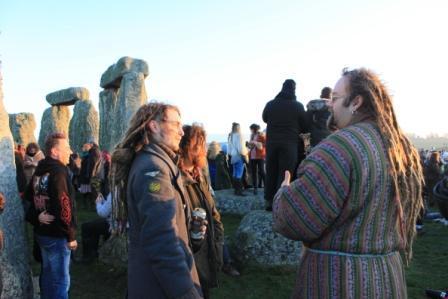
he ain’t heavy he’s my brother
November 20, 2012
Getting Through Customs
Regular readers will remember my review of Howard Marks’s book about his adventures and high times in the drugs trade, which I suggested signalled a new form of travel book – the ‘how am I going to get through customs’ genre. Another remarkable example of this was Marching Powder, ghost-written by Rusty Young about the hair-raising experiences of a drug dealer in a Bolivian jail and set to be a major motion picture, with Brad Pitt’s involvement.
[image error]
Now comes Mark Dempster’s Nothing To Declare, ably ghostwritten by Matthew Huggins, which is considerably grittier than either of the above. Dempster does slightly less glamorous travel – though there is a funny bit where he tries to cross the Himalayas to a Nepalese village when stoned which is clearly not recommended in the manual – and is more Sweeney than Miami Vice.
Connoisseurs of the genre will still notice one or two similarities: there is always a moment when, just like the hero of Goodfellas, paranoia overtakes the life of Riley and the helicopters start circling overhead.
Dempster also does the ‘it’s just become a day job shtick’ well, when he describes ‘the same daily routine, the same grind: up at eight, drink, stock up on Crucial Brew, deal, opium, drink, deal, smoke hash, deal, line of coke, deal, line of coke, Brian [his main supplier], bottle of wine, Sprog [bodyguard and drinking mate, trouble], fight, opium, drink, sex with girlfriend Lesley, drink, drink, drink, drink – pass out. That was it – days into weeks into months until a whole year had vanished.’
Thinking of doing a hard-core writers book which would describe my day, which also begins at eight but otherwise has few similarities: cup of tea, watch a rerun of Frazier on Channel 4, bacon sandwich, few e-mails, cup of coffee, write as much as I can before I get bored, phone girlfriend, pop over to deli across the road for a chat, have a Scotch egg or pork pie for lunch if I’m feeling like something extreme, salad if I’m feeling healthy and trying to go clean, do some more writing, do some more e-mails, uh, take some exercise, and let’s face it no one has got this far in the paragraph because it’s so dull….
This book reminds me a bit of those Alcoholics Anonymous meetings where every speaker tries to outbid the last one by declaring that ‘you think that guy did bad stuff – wait until you hear what I did!’
Dempster is quite remarkably candid – and often funny – about his lowlife, which does hit some truly frightening lows by the end. It never quite addresses the mystery of why some people feel the need to get so wasted – ‘an addictive personality’ is a very loose concept. But it certainly describes the consequences well.
October 10, 2012
What Laser Scans have revealed at Stonehenge
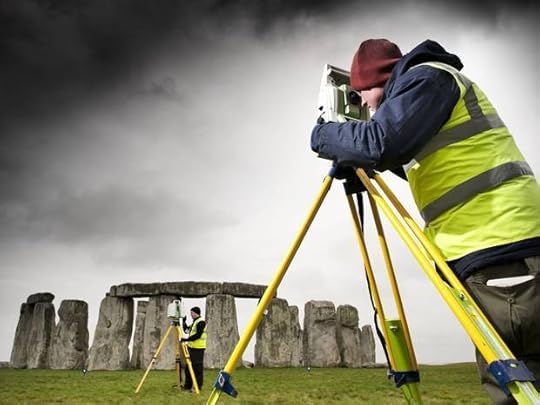
Revelations about Stonehenge continue apace, with the news that laser scans have revealed 72 previously unknown Early Bronze Age carvings chipped into five of the giant stones.
Moreover many of these carvings are of Bronze Age axes. The initial response – by among others The Independent, who covered the story – was that ‘the axe-heads – the vast majority of the images – may have been engraved as votive offerings to placate a storm deity and thus protect crops.’
As always, whenever anyone reaches for a ‘ceremonial’ or ritual explanation in archaeology it is wise to be careful.
One should remember that bronzes axes were neither purely functional or military, let alone ceremonial, in Bronze Age culture; they were often used as currency, to be bartered for other goods. There are many reasons why the symbol of the axe may have had such a great attraction for the builders of Stonehenge: as a symbol of wealth, or of the great clearance of the forests which they were embarking on; or simply as a potent icon, in the same way that they celebrated horses on their coins and at the White Horse of Uffington.
Very few such Bronze Age depictions of axes have been uncovered elsewhere in Britain; those few that have were often associated with funerary monuments, which would match with the recent work done on the sacred landscape that surrounds Stonehenge by Mike Pearson Smith (who uncovered a henge at the river Avon nearby).
These are not the first axes to be noticed at Stonehenge. A few can still be made out on the surface without the need for a laser scan, and were listed in the 1950s. But in the past they have always been considered a rather marginal aspect of the site. This new discovery, showing them there in such quantities, puts them more centre stage.
Those who wish to go straight to source on this fascinating story should read the full report which very helpfully has been put online by English Heritage: among other details, it also confirms the long-held suspicion that many of the stones have been removed over the years. Rather than being an unfinished site – as many have suggested since the very first investigations of the 18th century – it is a vandalised site.
Those who think the only good thing ever to happen to Stonehenge was to be in Spinal Tap might instead enjoy the Daily Mash’s Experts close to discovering secret pointlessness of Stonehenge.
October 2, 2012
The Real Enemy of the Coral Reef
 An excellent piece in the Independent shows how the true enemy of the coral reef is not climate change – although of course this is a contributory factor – but a particular coral eating starfish.
I had a wonderful time a couple of years ago snorkelling off the Belize coral reef, the longest in the Western Hemisphere and one of the most unspoilt in the world; Charles Darwin described it as ‘the most remarkable reef in the West Indies’.
I had snorkelled before, off Bonaire in the Dutch Antilles which has some of the best walk-in snorkelling in the world. But this was altogether more satisfying, slipping from the side of a sailing boat into some nameless section of the reef, and seeing one’s fellow passengers transformed into weightless and floating mer-folk swimming with the fishes.

And what fishes: large shoals of blue tang floating over and around the elkhorn coral; yellow snapper and the striped school-master fish; Nassau groupers and the odd pork fish as loners within the group; a peacock flounder near the bottom. And then the sting rays, swimming in majesty and leisure, or burrowing down into the sand, the best possible reason never to rest your flipper on the seabed if you could possibly help it.
At one point I felt someone swimming along beside me and turned to see which member of the group it might be, only to find a spotted eagle ray calmly keeping pace at almost arms length, the largest of the stingrays after the manta.
Much of the reef was still healthy compared to some of the deterioration that coral had experienced worldwide as sea temperatures rose. But there was still a sense of elegy, a feeling that if I returned in ten, twenty, let alone another thirty years time I might not be able to see delicate blue damselfish nibbling around the polyps, the fan coral waving in the current or the squiggles of brain coral clustered on the bottom.
September 21, 2012
Machu Picchu in the clouds
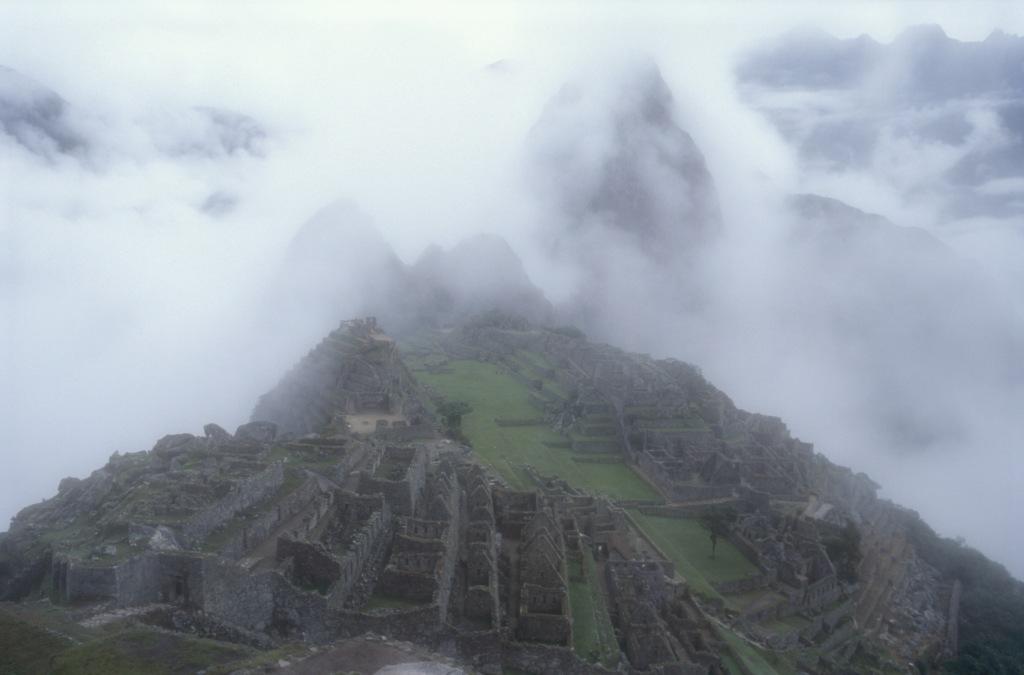
There is a good interesting roundup of current theories about Machu Picchu in the Peruvian Times in which the author, Rick Vecchio, sensibly doesn’t commit himself too far in any particular direction…
…Unlike many of the guides at Machu Picchu who are still perfectly capable of telling you that this was where the Inca emperor hid his Virgins Of The Sun and that stone over there was where they sacrificed the black llamas.
.
For my own brief introduction to the interpretation of the ruins, take a look at the short film I did for CNN last year: See Hugh’s cut-out-and-keep 5 minute guide to Machu Picchu for CNN.
.
Then you’ll understand why I prefer to use this picture of my own in which Machu Picchu is covered by cloud, rather than the usual sunlit panorama. It’s a place we still don’t fully understand although we have recently gained some useful pointers.