Hugh Thomson's Blog, page 6
March 1, 2015
All The Young Dudes: Ryan Adams
 To see Ryan Adams at the Hammersmith Apollo, scene of many a great concert in the past when it was the Odeon. When I first went in 1974 (the year Adams was born), there was a new support band called Queen who no one had ever heard of and we thought a bit much, while we waited for the main band – Mott the Hoople… Years later I interviewed Mick Ronson there just before he died, for my Dancing in the Street series, and he reminisced about Bowie’s ‘Ziggy retirement concert’, and played solo for us.
Ryan Adams has turned into a singer of real stature (although not in actual height – he looks like a shaggier version of Frodo) – after many a wayward twist and turn since the days of Gold and ‘New York, New York’ which first brought him fame. His new album, just called Ryan Adams, although about his 14th (give or take a record company reject), feels like he’s found his voice – and guitar – again.
In the past, his very facility for writing songs – he turns the heckles of one punter into an instant song, a neat party trick I’ve heard him play before but one that exemplifies this weakness – means that he produces too much; but these song feel heartfelt. I suspect he’s this generation’s Neil Young – prolific, occasionally brilliant, sometimes infuriating and veering between acoustic and electric to great effect.
He’s joined by his support act Natalie Prass for a couple of well matched duets, including a showstopping ‘Oh My Sweet Carolina’, and gets even the most jaded of London’s spoilt-for-choice rock audience singing along to ‘When the Stars Go Blue’. Oh, and he keeps talking about ‘dudes’ on stage. Which no one else has done since Ian Hunter.
NB – The footage of Mick Ronson playing solo for us in the stalls at Hammersmith Odeon was played back at the memorial concert held at the Odeon for him when he died in 1993, shortly after the interview was recorded: a strange and ghostly moment. Ronson was a charming and honest man, and still undervalued. Quite apart from his transformative work with Bowie and Lou Reed, he had also just reinvigorated Morrissey’s career with the excellent Your Arsenal album that for the first time made the petulant one a star in the States.


February 12, 2015
Paris after Charlie Hebdo
 Struck on a visit to Paris by the changes that have taken place in recent years – and also going in the shadow of the recent Charlie Hebdo tragedy which has had the effect – a little like the July bombings in London did a decade ago – of reminding citizens what a multicultural city they now find themselves in.
Also struck by the wealth of modern art – the shows at the Musée d’Art Moderne de la Ville de Paris (a museum often ignored in favour of the more grandstanding Pompidou Centre) are superb – retrospectives of veteran Sonia Delaunay, whose work spanned the 20th century, and of Canadian newcomer David Altmejd, whose fecund world of fur and crystal covered giants, and Perspex mazes, was new to me but endlessly exciting.
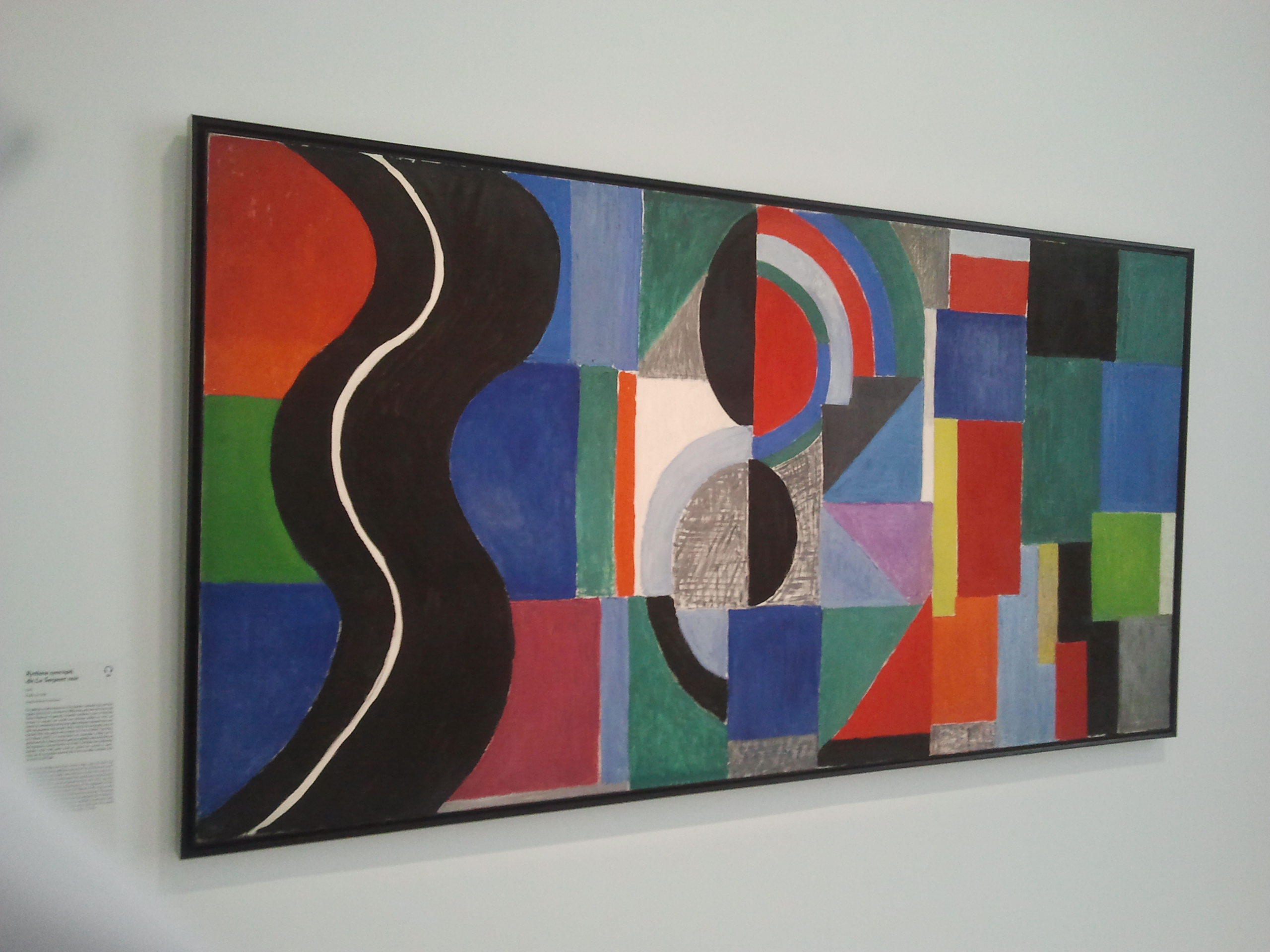
Sonia Delaunay
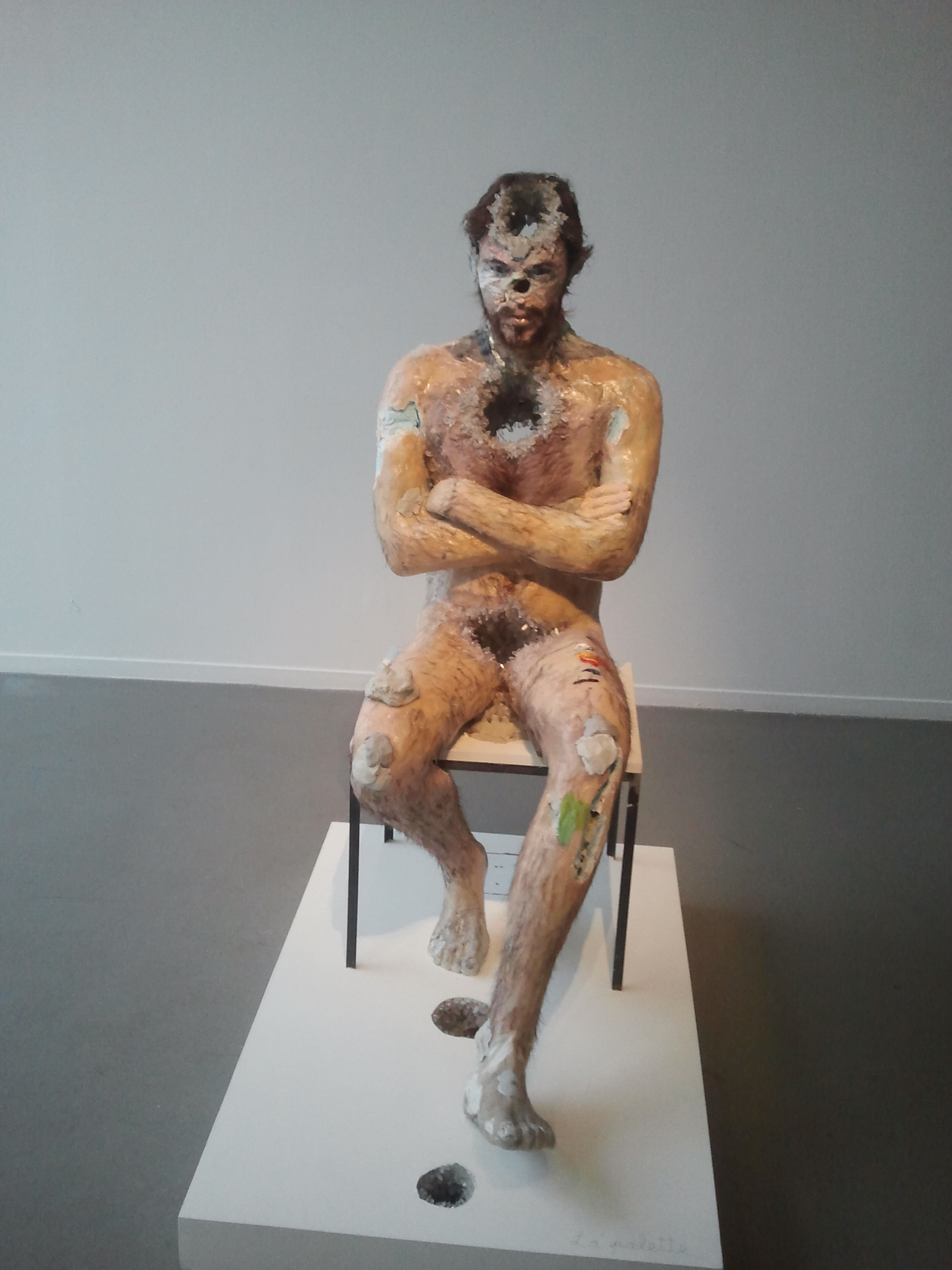
David Altmejd
December 31, 2014
Seeing the best out of 2014
At the end of a year with even more travel than usual – Hawaii to Tahiti, out down the mouth of the Amazon, round the Mediterranean with my son Leo, and films on India and Pakistan in the autumn, let alone a great deal of time spent in Glasgow and Scotland – good to catch up on myself and the best things I came across that sustained me on the journeys:
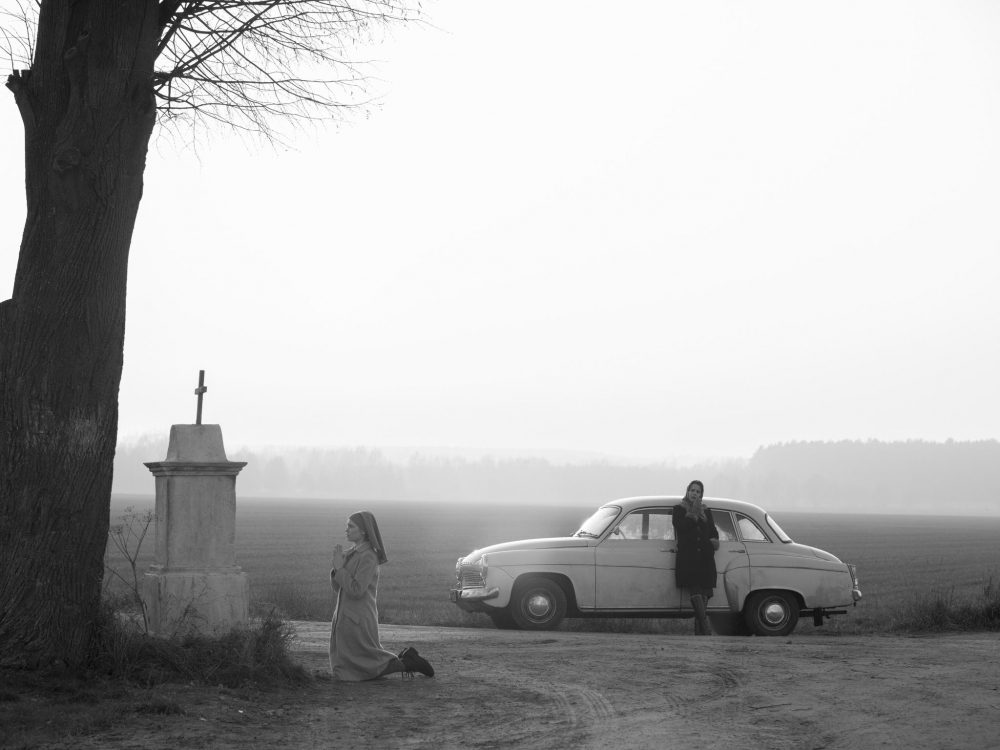 Best films: In June, I stumbled into a small art-house cinema in New England on the off chance and saw the only movie that looked promising, although I’d never heard of it – Ida, by some way my film of the year for its unflinching honesty, beauty and rigour, despite what seems the unpromising scenario: Polish girl in a 1950s convent has to decide whether she stays or she goes, not necessarily helped by her hard-drinking, hard-living aunt. A luminous film in the spirit of Bresson, and the first Paweł Pawlikowski has made in Poland rather than Britain.
It’s been a great year for strong female performances. The best things about Mr Turner and The Theory Of Everything were not the technically accomplished portraits of their heroes by Timothy Spall and Eddie Redmayne, but the life given to the films by their screen wives, Marion Welsh and Felicity Jones, who were both superb. Likewise, Scarlett Johansson pulled off some bold strokes in first the very enjoyable and slightly bonkers Lucy, and then the less enjoyable, but equally bonkers Under The Skin, ludicrously overrated by the Guardian as their #1 film of the year.
Both Wes Anderson and Christopher Nolan produced fine films in The Grand Budapest Hotel and Interstellar, even if neither was their best, and the less said about the execrable Wolf on Wall Street the better – Scorsese been running on empty so long, the car should surely just be left in the garage.
But along with Ida, the other knockout film of the year was Boyhood, for letting us feel the director’s surprise at how lives unfold and people age.
Best books were Arundhati Roy’s rage against caste, The Doctor And The Saint; Adam Nicolson’s passionate advocacy of Homer and the Bronze Age in The Mighty Dead; and two work of popular history told with verve and flair – Charles Spencer on how The Killers Of The King (Charles I) were hunted down after the Restoration, and Boris Johnson on The Churchill Factor without the boring 3-volume life bits or indeed bothering with much chronology at all.
In my own field of travel books, amongst some increasingly austere and dull nature writing, one book shone out for its unaffected simplicity and grace: Meadowland: The Private Life Of An English Field by John Lewis-Stempel.
Best exhibitions: the British Museum’s ‘Mummy: The Inside Story’, where they revealed the faces of those inside the mummies by using CT Scans; ‘Matisse: The Cut-Outs’ at the Tate which proved that a big blockbuster show can still be thoughtful.
Best albums were the eponymous Ryan Adams, his best for many years and all the better for being guitar driven; and Mark Kozalek’s remarkable Benji, in which his talent for long narrative songs about the American mid-west made him a sort of aural equivalent of Boyhood. Kozalek (aka ‘Sun Kil Moon’) also gave the most audacious concert I saw in which he had to hire a drummer from the audience as his own had failed to turn up (and paid the replacement in cash on stage), and then asked if any women in the audience would come up and sing a duet with him on ‘I’ve Got You Babe’, at which the audience collectively sucked in their teeth at the humiliation to come, but Joanne from Glasgow gave a knockout performance.
December 3, 2014
The Riches Of The European Bronze Age
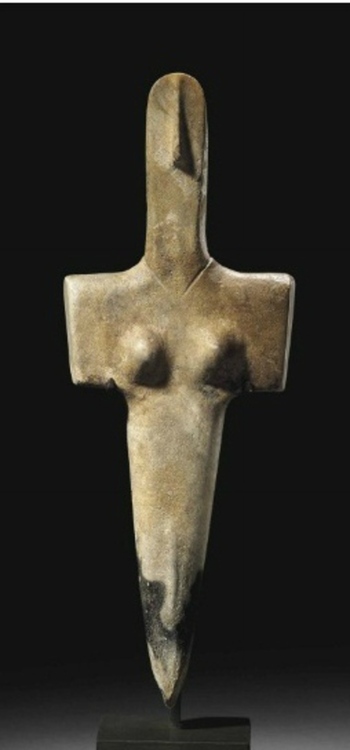 Another reminder this year of the riches of the European Bronze Age which we still underestimate so much – this time in the form of an artefact allegedly looted from Sardinia and now up for sale in New York, magnificent in its stark simplicity.
Adam Nicolson’s superb study of Homer and the Bronze Age, The Mighty Dead, and my own travels through Bronze Age Britain in The Green Road into the Trees have whetted my appetite for more. And a chance to go to Athens recently and see some of Schliemann’s findings from Mycenae, like the so-called Mask of Agememnon, in the flesh – or rather metal – only confirmed that.
A chance to see something closer to home is at the British Museum: The Mold Gold Cape, discovered in Wales and the most spectacular of British Bronze Age findings, which should have crowds diverting from the Egyptian rooms, but few know about.
November 25, 2014
Arundhati Roy’s essay ‘The Doctor and the Saint’
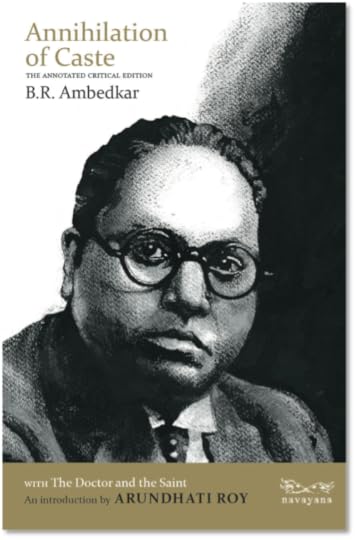
If you read one book this year, it should be not even the book itself, but the introduction to the book: Arundhati Roy’s essay ‘The Doctor and the Saint’, attached to the reissue of a lost classic, Annihilation of Caste by B.R Ambedkar, the leader of the Untouchables at the time of Indian Independence.
In cool and merciless prose, Roy blows away the cobwebs that obfuscate all discussion of this most shameful aspect of Indian life. There are still around 100 million Untouchables, or Dalits as they are now more commonly known – and , as I saw when interviewing her some 15 years ago in Kerala, it is a prejudice that is practised in India by Christian and Muslim communities as well as Hindu ones.
You can watch The Exotic Marigold Hotel or The Darjeeling Limited and be blithely unaware of the realities of caste as a system that still preordains life for so many and so narrowly.
As she asks: ‘Other contemporary abominations like apartheid, racism, sexism, economic imperialism and religious fundamentalism have been politically and intellectual challenged at international forums. How is it that the practice of caste in India – one of the most brutal modes of hierarchical social organisation that human society has known – has managed to escape similar scrutiny and censure? Perhaps because it has come to be so fused with Hinduism, and by extension with so much that is seen to be kind and good – mysticism, spiritualism, non-violence, tolerance, vegetarianism, Gandhi, yoga, backpackers, the Beatles – that, at least to outsiders, it seems impossible to pry it loose and try to understand it.’
The introduction, at 125 pages, is longer than the book it presents. In any other writer this might be presumption; with Arundhati Roy every last word is justified. She has already proved herself a formidable polemicist, but this may have been her most important contribution to the debate about India’s future – and one which has already stirred up a great deal of controversy, both because she attacks Gandhi and because some Dalit radicals have complained – unfairly in my view – that she has tried to appropriate their voice.
‘The Doctor and the Saint’, as an introduction to Annihilation of Caste by B.R Ambedkar, has just been published by Verso in the UK.
The Indian edition by Navayana has the best cover – as here – and has been carefully priced to make it accessible to a wide readership, although there have been problems finding distributors for it in some states due to its controversial nature. I bought it on my last day in Delhi and read it in the next 24 hours as I travelled back to the UK, learning more about India than I had in the previous two weeks in the country.
October 26, 2014
The Buddhist Heartland of Gandhara
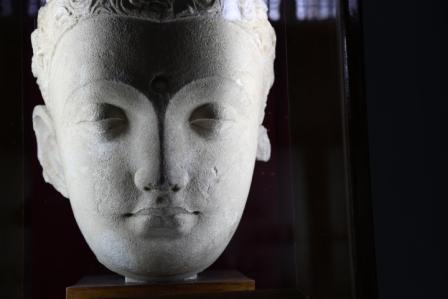
Seven years ago I visited the Buddhist heartland of Gandhara on my way to Afghanistan and determined I would come back one day to this part of Pakistan – and now I’ve been making a film there (one reason for the radio silence over the last couple of months as it’s been a very intensive operation and fraught with security issues).
The quality of the sculpture produced by the Indo Greek kingdoms that followed Alexander the Great’s incursions here in 326 BC is phenomenal – like this Buddhist head that I photographed in Taxila – with its mixture of classical, Persian and Indian influence.
Some of the Buddhist sculptures have been vandalised in situ and now need to be protected from Islamic extremists – or just as sadly some heads have to be removed from their torsos and taken to museums for safety, as it is usually the head that is vandalised.
We had problems filming here because some of the sites are close to nuclear and military installations so the ISI sent a heavy to follow us ‘for our own protection’.
But as a chance to spend some time around the old monasteries and stupas, it was memorable and a reminder which the world occasionally forgets that the old Indo Greek kingdoms in what is now modern Pakistan were responsible for exporting Buddhism to Tibet, China and the Far East.
June 24, 2014
One of the Last Few Polymaths
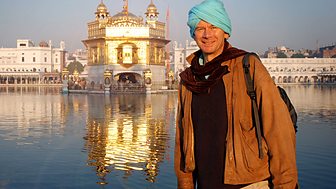 Reading Michael Wood’s excellent A South Indian Journey (first published as The Smile of Murugan) and as ever by Michael’s work, impressed. He really is one of the last few polymaths, equally at ease writing about South American conquistadors or Anglo-Saxon chronicles. And filming them as well – ‘The Story of India’ for the BBC a few years ago was a tremendous achievement; and now he’s taking on China for a 2-year film project! Respect…
June 15, 2014
Homage to the World Cup
 .
.
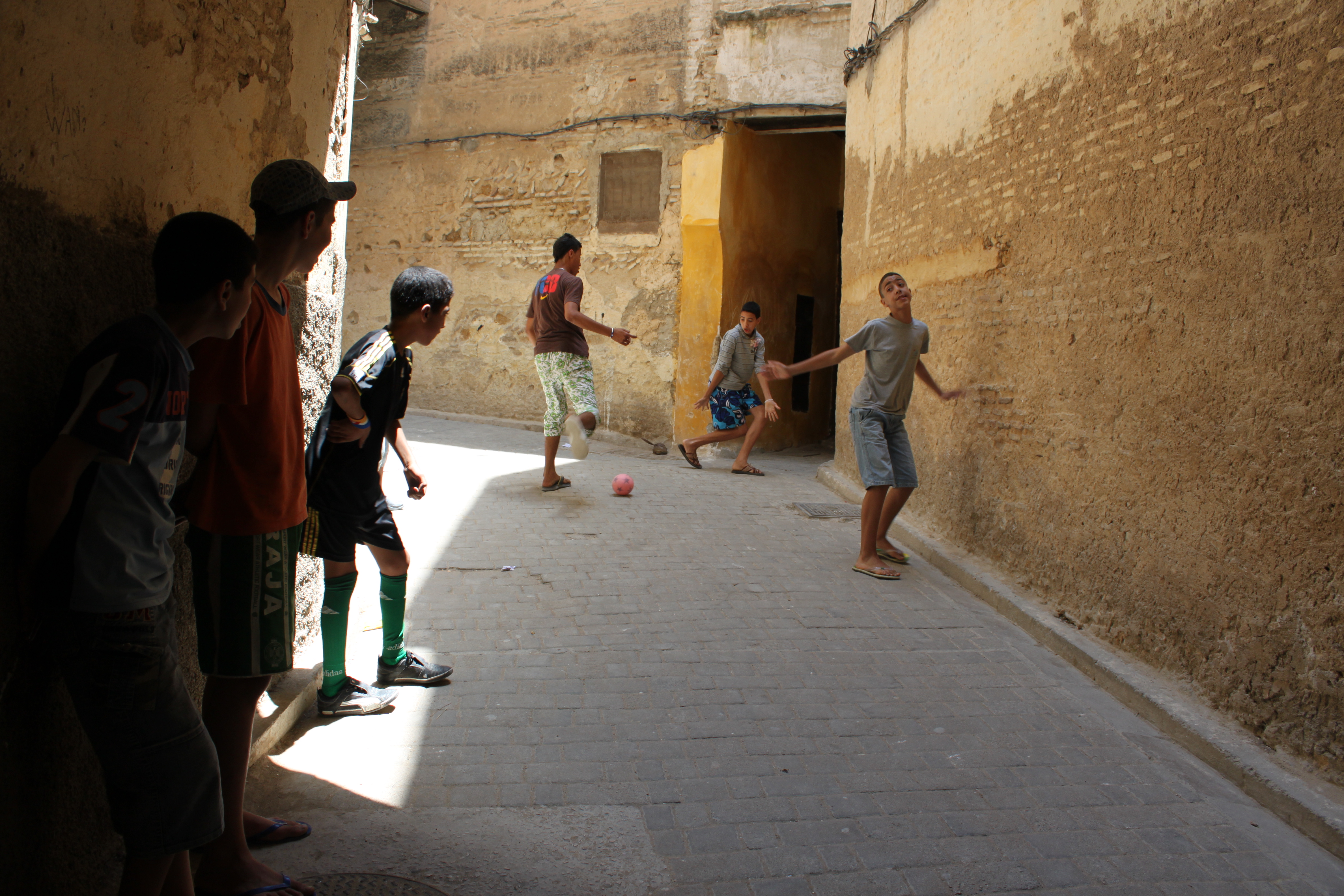
My small homage to the World Cup – and tribute to Cartier Bresson who took a series of similar pictures – is this shot I took in Fez a few years ago, and my accompanying piece for Conde Nast Traveller on ‘how to get lost there’ – always a perennial concern of mine, as anyone who has read Tequila Oil: Getting Lost in Mexico knows…..
May 1, 2014
Oxford Mayday
 .
.
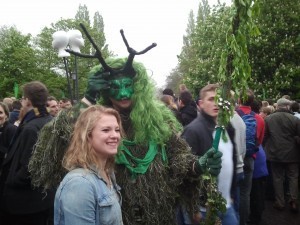
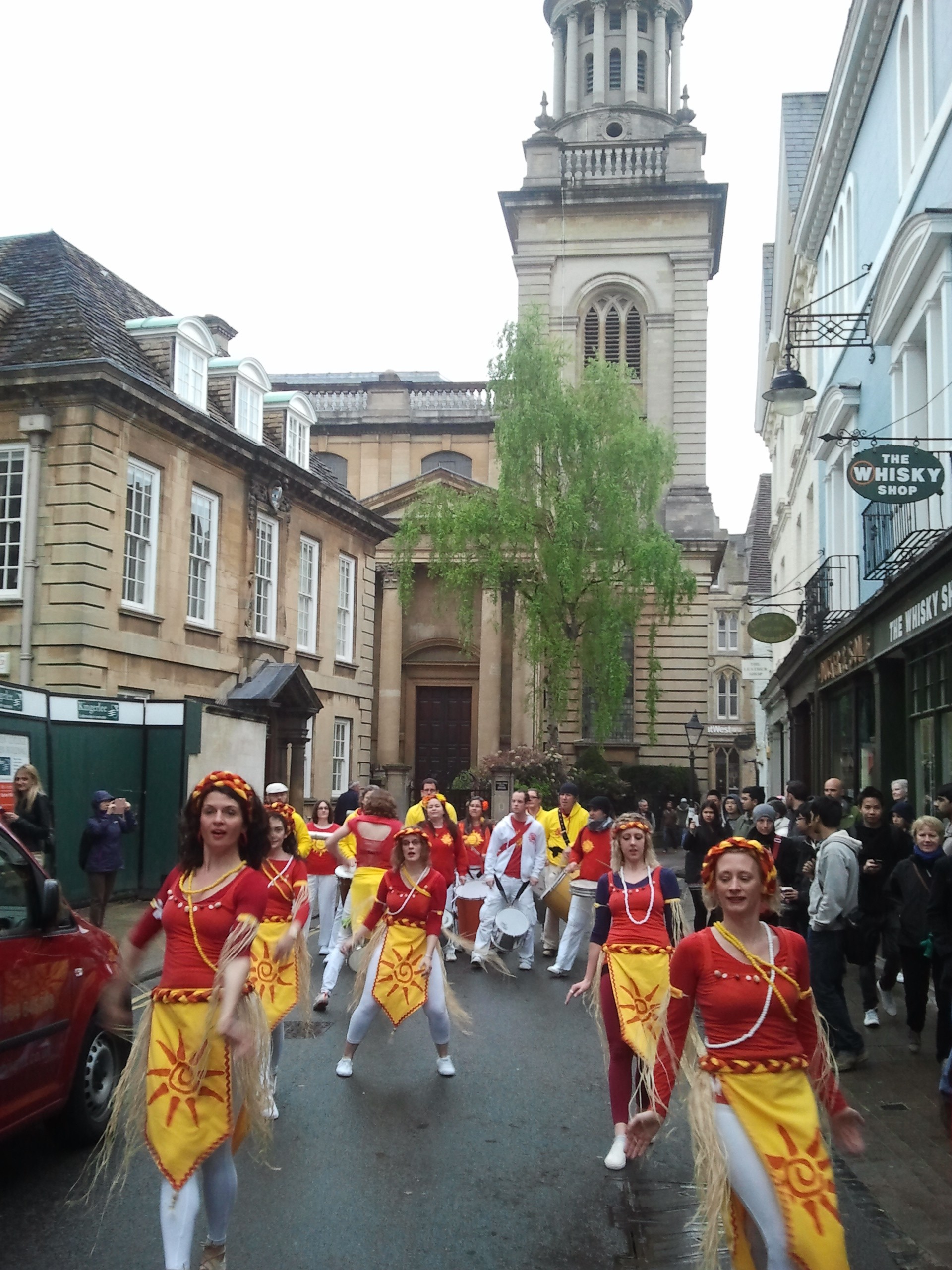
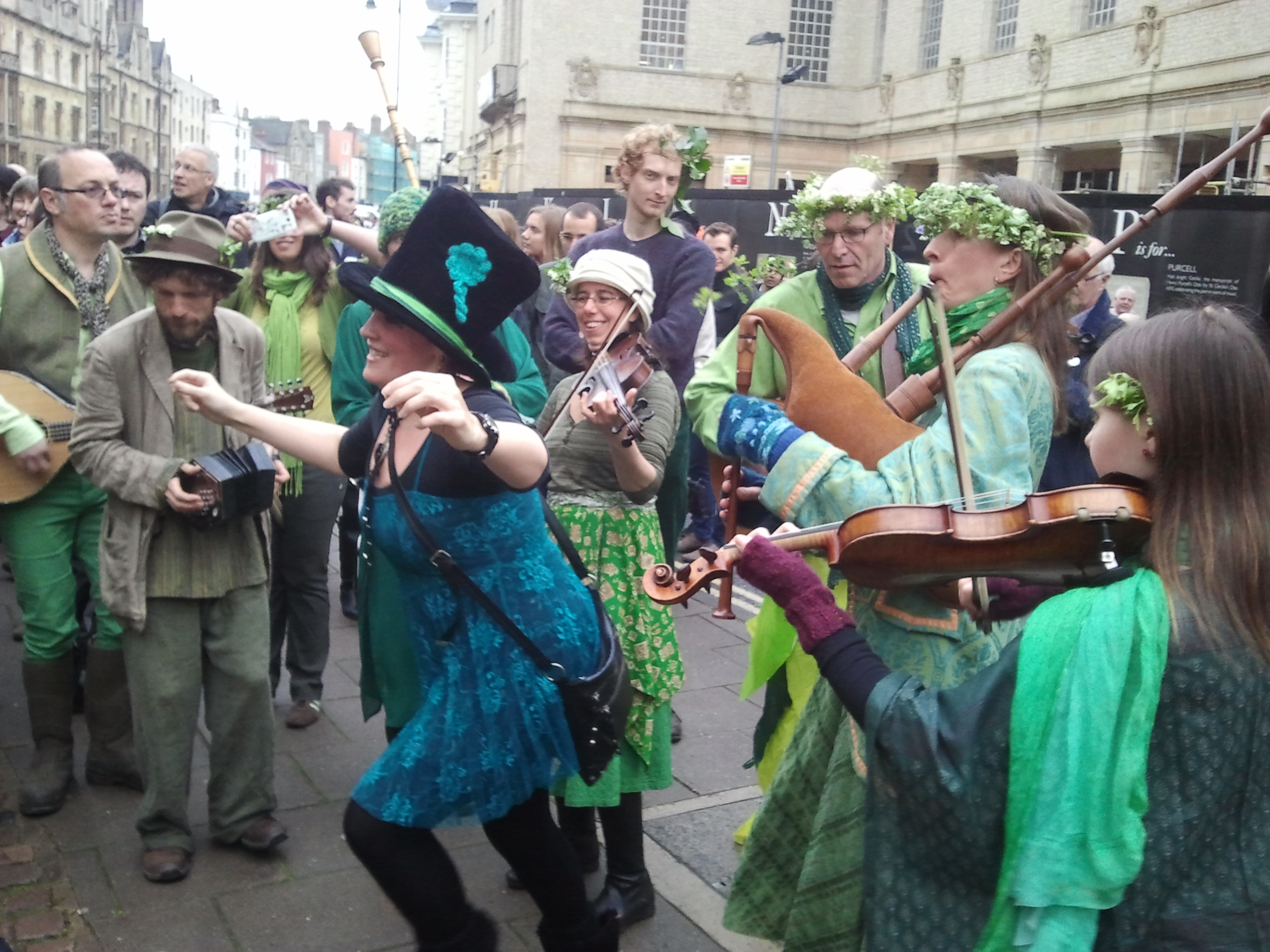
As part of an occasional series – where I get up early so you don’t have to, as in previous posts on Stonehenge solstice etc. – a frontline report from Oxford Mayday, which by comparison was a relatively genteel affair – the only rasta locks I saw were on a security guard, one of many stopping anyone from jumping into the river off Magdalene Bridge.
.
But from the moment the choir started singing from the top of the tower at 6.00 am, this had a magical quality: green men parading, a terrific samba band up the High St and Oxford buildings looking at their most dreamy in the morning mist. A lot of very hungover and loved up students emerged from clubs and pubs: a strange mixture of disco shorts and dishevelled black tie. And in the middle of it all, a talented band playing mournful latin music in front of the Havana cigar shop…… what a way to wake up to spring.
http://www.thewhiterock.co.uk/wp-content/uploads/2014/05/video-2014-05-01-06-42-00.mp4
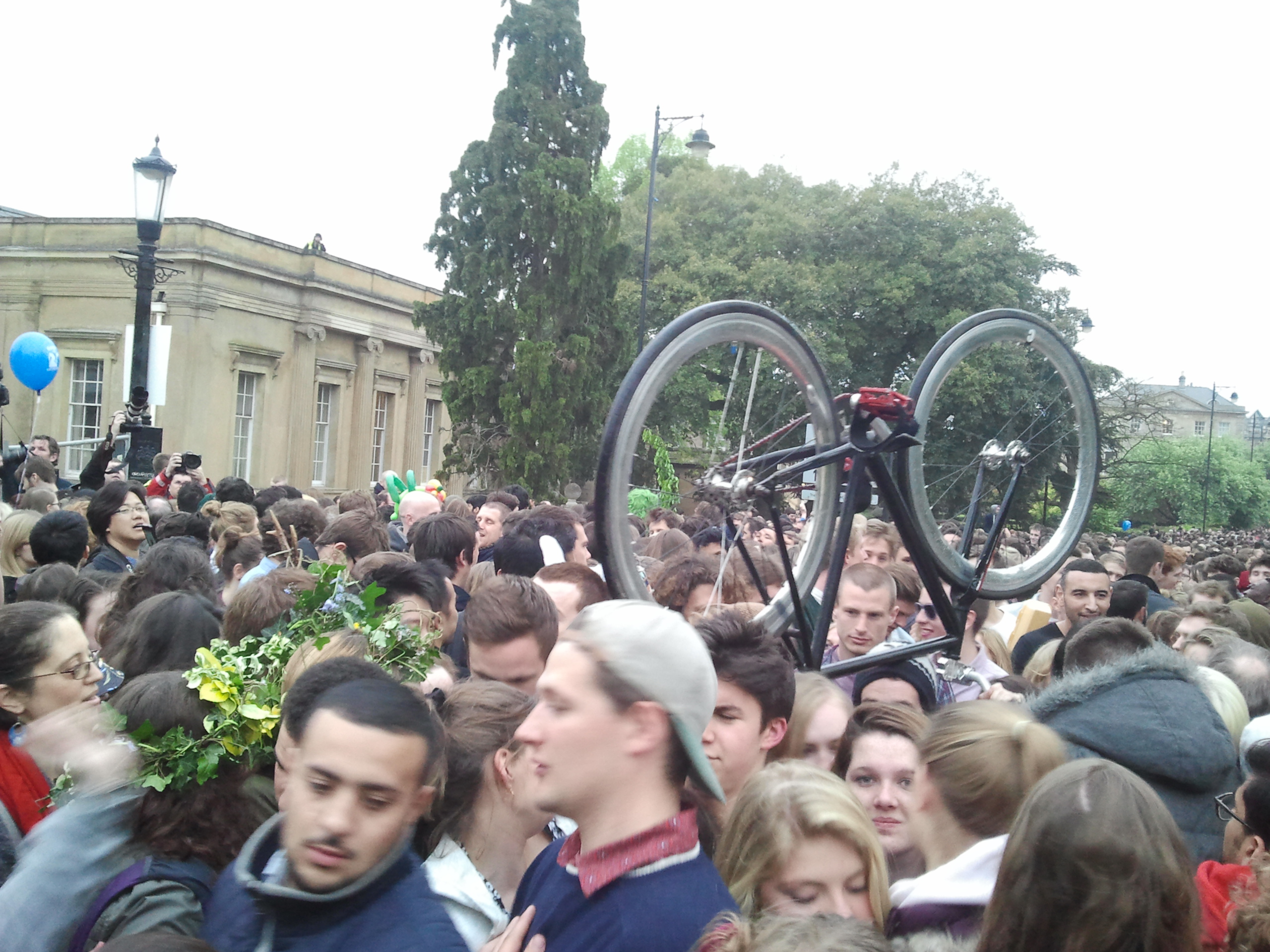
for those who always have to have a bike with them in Oxford
April 23, 2014
Spring: The Blue Road into the Trees
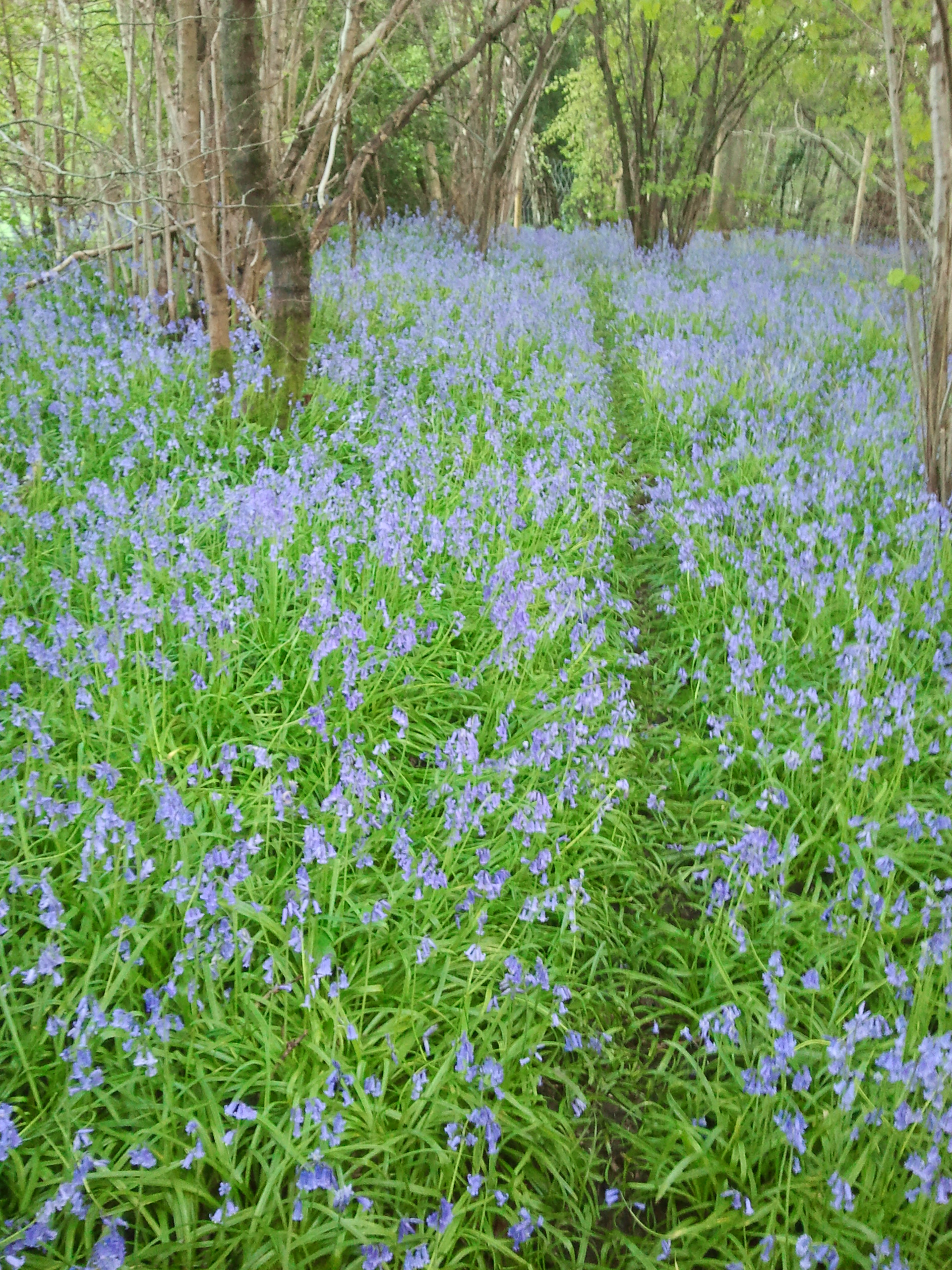
bluebell woods (c) Hugh Thomson
“The bluebells in the beech woods that surrounded and disguised the embankment came as a shock. I had forgotten that they would be there, a soft purple rather than blue, as I came in from the bright sunshine of the fields and saw waves and islands of them spreading below the trees, not so much lighting up the forest as glowing within it: purple shadows.
They spread across the ridge. A heavy-seeded plant, bluebells travel slowly across the ground: it had taken many, many generations for them to cover such distance. The carpet of blue flowers managed to be a celebration both of the transience of spring and of the permanence of the English landscape.
I followed a path that was covered with beech-mast and threaded through with white wood anemones. Looking down through the trees at the wheat fields to either side, with the young wheat still tight in bud, the stalks shimmered blue under the green of their tops, so that when viewed from certain angles they looked like water, an effect exaggerated when the wind blew across the fronds and sent a ripple of green-yellow across the underlying blue.”
a seasonal extract from The Green Road into the Trees: An Exploration of England, which has just won the first Wainwright Prize for Nature & Travel Writing