Paul David Adkin's Blog, page 43
October 1, 2014
THE MEANING OF THE UNIVERSE IS THE MEANING OF LIFE

For a scientific understanding of life on Earth (or all life as we know it) we need only study its double helix, DNA. The DNA is an archive, a library and an operating system. Life, as such, is dependent on information that is stored, read and followed. The individual is subject to the complexity and limitations of this information. What’s more, it is this double helix which also determines our individuality as much as our similarities. We are biological computers based on a binary system of base pairs: a combination of adenine and cytosine; cytosine and guanine; guanine and thymine; thymine and cytosine, etcetera … This is our four element, binary combination language – the language of life.
But the question why does life exist is a profound one, as is the question of why does anything exist. Fundamental questions that the scientific understanding of life can only satisfy up to a point. In order to find deep answers to the deepest questions we need to go beyond fact to reasons and purpose; we have to bring science back into the fold of philosophical speculation from which science originated from sometime around the 5th century BCE.
This is not to say by any means that we should abolish or even diminish the science, but, on the contrary allow speculation to fuel a science-based philosophy concerned with meaning that will pull science back into the realm of metaphysics. A future science with pre-Socratic intentions if you like.

Nothing can come from nothing, says reason, but science demonstrates that a particle can emerge from the void and vanish again. From nothing you came and to nothing you will return. The will to have what we lack. Nothing lacks everything, but let’s start with something. From the void there came a particle. That was enough. A thing, generated by lack of everything and motivated by a possibility of anything, aggregated into a singular complexity of that everything that needed to explode and allow such potential to become forms, perhaps even become everything in an infinite, multi-dimensional way. An everything that needs time and space in order to understand it. But within that time and space it also needs something capable of perceiving it. It needs an objective observer, something fashioned with sensors. Of course if everything exists there will not only be an abundance of these organisms, and an abundance of intelligent forms of these creatures, but also, an absolute lack of them … but that doesn’t make sense, does it? Or perhaps it does …
In order for everything and nothing to exist, time and space must exist, for it is time and space which provides the separation allowing for diversity to be possible. Everything is One thing, a mass that needs to be broken apart in order to be able to perceive the real potential of everything, but included in the One is also an Absolute Zero as well as a never truly achieved Infinity. This breaking apart of the Infinite singularity is managed through the manifestation of time and space.
But what has this got to do with the meaning of life?…
Life: a double-helix DNA executive commanding its single-strand RNA clerk. Our primary communication, which is at the same time the executive communication. Constant, but silent and secretive. The secret Genetic Code. A linear codex as of the steps of a ladder. Letters in a sentence, a punctuated sentence. Life is a language, dictated by DNA. We are built on carbon foundations building other complex language systems on silicon foundations.
The goal of evolution is to produce the perfect brain that will be able to achieve the most complex understanding of the world and the universe it is a tiny part of. The universe is a universe of information transmitted through language but mainly devoid of objects capable of understanding that language and acting accordingly. But by analysing the physical form of the universe it becomes clear that it has an aim. Time and space and DNA exist because the principal aim of the universe is to understand itself; to be able to exist in a conscious and self-conscious, self-fulfilled way. This can only take place through the agent of intelligent life.


September 28, 2014
Where are we now? and What’s to be done?

We live in a two dimensional society: there is length and width but no height or depth. Our world is a flat plane, a cartoon reality replete with caricatures. Lacking is the third dimension that will pull us out of the flatness and allow us to properly see things for what they are, by allowing us to perceive things from all angles. The artist knows that depth is achieved by adding perspective, by understanding illumination and being able to master the shadows cast by the impenetrable and opaque. Depth is added by knowing and only by mastering shadow and perspective can liberation from the monotonous flatness of our two-dimensionality begin. Only when we have depth because we have been able to pull the flatness up will we know what to do.
The tautological knowledge creates knowing is profound. Knowing is a continual process of becoming, it is the process of unveiling, which in turn is a process of pulling forth, lifting up, stretching out, moving around, flying over and crawling under … All the things which we cannot do on the flat plane unless we know how to manipulate the art of generating perspective.
This is not a concern confined to the present: historical and futurological perspectives must also be deepened. Objectification is also required: an artist’s ability to step outside of the paradigm that is being described and lived – to stand at a point outside of the space, and outside of time, in order to perceive everything that has been hidden and understand real necessity. Objectification is needed to be able to stand over the current of the river of time in order to understand where the continuum has been flowing from. In order to perceive the reasons and mistakes that have determined certain courses of history; in order to redirect rivers, ensuring cleaner, more transparent waters that are capable of irrigating the possibilities of our optimistic futurologies. Muddy rivers will only give us a muddy, carp-full ocean of little future hope.
And so we have two tasks to concentrate on: a) the act of discovering perspective and uncovering depth, and b) that of eradicating the factors that cloud our rivers and have been pushing the historical continuum to a false inevitability for centuries.
The answer to the question must ultimately lie between what ought to be done and what has seduced our attention away from the goal. The utopia is No-Place because we are not going there. We will never get to Timbuktu if we are walking across the Americas, but that does not mean that Timbuktu cannot be reached. Maps must be drawn so that we can see why we are trapped in the maze, but in order to draw such maps we must achieve altitude and be able to stand over the labyrinth. It is a contradiction that turns the path back in on itself and to understand the labyrinthine nature of the system we must reveal the tremendous contradictions which work in its favour.


September 26, 2014
Melancholia – Lars von Triers’ depression

What could be sadder than the idea that the only life in the universe is about to be extinguished? Or perhaps not. But then, what kind of heart could not be saddened by this idea?
Lars von Triers spreads the idea out before us in his film Melancholia: should we feel sad? There is no chance for deliverance in Melancholia, the Earth’s destruction is a purely cosmological matter, a question of physics. It is beyond our control and because of that it does not matter. But still the dilemma stays with the spectators – should we be sad?
The fact is the film is certainly not a tear-jerker, despite the powerful feelings generated by Tristan and Isolde’s tragic love theme, pounding us incessantly with the gut wrenching chords of Wagner’s emotional masterpiece. But it is not a tear-jerker because the characters are hardly endearing and this removes most of us from any audience-character empathy at the moment of the final tragedy. Also the perspective is insular, the characters themselves are isolated individuals which cuts us off completely in any emotional sense from the rest of the world that perishes with them. And this is the brilliant thing in the film’s art – we are alienated from any deep involvement in the tragedy and left with the debate. Should we feel sad? Or, perhaps even – what is the difference between sadness and melancholy? Between sadness and depression?
Von Trier’s film is about depression, with a narrative and composition that is rich in symbolism. Depression itself could be seen as a rejection of the outward experiences with the world as something pointless and absurd. The depressive’s journey is an escape to the world within and von Trier’s is right in suggesting that it is not a fear of an antagonistic world – as is the idea of the naked man alone in nature – but of the absurd human creation we are immersed in that torments the depressive. It is the human specular existence that the depressive flees from not the cold laws of nature.
Von Trier’s film is the tragedy of all tragedies and we are told by the protagonist that it is this tragedy of tragedies which is going to be the great liberator from the evil of life on earth. But through alienation techniques the film is also testimony to the great absurdity of our specular human reality, a tremendous eschatological paradox that tells us that it is impossible to escape from the horror we have created except via our absolute annihilation.
Despite attempts to find religious significance in the film it is deeply nihilistic (but then again all religions are also deeply nihilistic). The depressive’s antagonism to the absurd and pointless must succumb to the absurdity of salvation. If all endeavour is rendered pointless by an Apocalypse, why go on? Why go forward? The only escape from the ridiculous is an autistic regression, an instinctive sinking back into the Uroboric, prenatal state of a pure self-satisfied existence, without will.


September 6, 2014
THE EVOLUTION OF THE STATE THROUGH SCIENCE

We know from biology that states do not evolve into a better form either consciously or through an internal logic, but that natural selection is determined by exterior, environmental needs. If there is no environmental need to evolve, there is no need for natural selection. If the species’ existence is not threatened there is no need for it to change in any radical way, let alone improve itself. So, evolution is a question of need.
We think this same observation can be applied to social change. It is the environmental crisis which will necessitate a social evolution that will pull us away from the militaristic industrial and theological society we are dominated by now toward a kind of society that is equipped to deal with the current ecological crisis that threatens us with extinction.
If society is to evolve toward something that can adapt to ecological imperatives without regressing culturally and technologically, that evolution has to be led by a force that understands the imperatives we are adapting to. And what force is that? Science, of course.
The ecological nature of the crisis implies a revolution towards the moral authority of science. The moral authority of science? What is that? Doesn’t experience tell us that the “truth” of science is easily manipulated? We have seen how easy it is to make scientific arguments pale into the white background of relativity when economic or political motives need to be sceptical about certain scientific information. For a scientific morality to exist it must be equally vigilant of its own truths as it is of its grasp of the laws of the universe.
Science has always been a driving force behind all intellectual revolutions and only through its absence and/or manipulation have regimes been able to perpetuate their horrendous crimes and anti-humanitarian practices. Sure science is used by the military to advance their weaponry and authority. Likewise it has been used to exterminate the enemies of intransigent regimes and to spy on and control the citizens of those regimes. Any revolution through science, therefore, would have to be an un-anchoring of science from the military and industrial-theological powers that those militaries protect.
But, how could that be? To imagine a military without technology is absurd. Why would power give up what it needs to protect itself? So, we reason, if we are going to achieve this un-anchoring, we have to take it by force –and so the perverse cycle seems to be maintained. The only way to dislodge power is by force, creating a military substitute for the industrial-theological-military regime that we had. Naturally, this cannot be a solution.
The only way we can imagine an evolution to take place, rather than a violent revolution which would basically be a conservative return to the same, will be through a morally maturing process of the scientists themselves. Only when scientists have become a moral class will science be able to evolve the state, society, and hence, humanity.


August 18, 2014
THE CHEATING GAME

It is obvious that the triumph of Western liberal democracy and its subsequent process of Globalisation has done very little toward bringing humanity more closely together. Quite the opposite is true: we all seem to be drifting further and further apart. But, if it has failed with humanity, what has two centuries of liberal democracy achieved with the individual? How successful has it been in its attempts to forge a society of strong-selves? If we have failed with the whole, then surely we must have succeeded with the individuals who are the antithesis of the whole?
But again it is obvious that we haven’t? In Nietzsche’s terms, we have achieved neither the Human nor the Superman, just the Last Man. The pathetic Last Man, bumbling through a cheating-game world of relativity and conspiracy theories. Conspiracy theories because, whether we accept them or not, they point an accusing finger at the basic fabric of the system, undermining all responsibilities and moralities with scepticism. How can one be morally responsible in a system which is inherently corrupt? The individual, rather than standing strong and finding a good position in the competitive world, finds him or herself immersed in a society of cheats. The system has now become a cheating-game and the strong-self has to be identified in such an environment as a morally irresponsible subject.
One can only be a strong, successful player in the cheating-game by being a good cheat. This of course makes all success seem suspicious. Eventually decisions need to be made in which “honesty” is needed, but… who can we trust anymore? A strong leader is obviously a good liar and a very good cheat. This kind of leader is useful at convincing us that we are happy in a world that in reality offers us very little… Useful that is until we start to understand the truth. And the simple truth is that we are being cheated.
The first great lie is freedom as individuality and its idea of the unfettered individual along with the creation of a passion for strong individuals. Freedom is now a term used to propagate the unfettering of power: freedom to dominate; freedom to manipulate. The second great lie is democracy itself. The lie of free choice. The lie of majority rule. The lie of the individual’s capacity for achievement in the system.
The only way to combat the lie is by establishing positive, human objectives. We must look beyond the individual and the tyranny of egos in order to establish goals that are out of the cheating game. Goals without any other reward except progress towards human fulfilment. Goals that would pull us out of the cheating-game into another game with real rules that we know will really protect us and protect the world we depend on for our survival. All the rest is petty bickering, which is inevitable when you’re playing the cheating-game.


August 16, 2014
OUR CRIME AND PUNISHMENT

Bad-conscience, Superego, Freedom: how much are these three things intertwined? Our Superego gives us a bad conscience, a sense of what should be done that we are not doing – it inspires an action. Freedom is to be moved to act – either because we want to or because we need to – and in the choice of either consummating or not that act. Only if we are inspired to act can we be free, and we will only ever be inspired to act if we have a sense of an action that needs to be carried out, of something that has not yet been started or finished. And this sense of duty is mainly generated by our bad conscience or our Superego.
When will humanity start to see itself as humanity? When will we start to judge the value of our lives according to what humanity has done? Not as a race, or nation; not as a competing thing – and all nations, classes, religions are competing things – but as Humanity.
When humanity does do this, if it ever can, it will have to fall into a depression caused by the guilt of a terrible conscience. That guilt which will be the realisation of how much has been wasted; how much history of non-progress, of movement away from the humanity that has never ever been realised. Humanity is that which we are but have never been. Humanity: our great family that we have always been avoiding; that we have never been able to embrace.
If we look at history, the creation of the polis and its politics, the creation of the Nation State, and the empires of trade and religions, we must see a steady process of division rather than any unification. This should weigh on our consciences. What kind of guilt gnaws at us for that loss, not of innocence, but of unity and the potential civilisation that could have been born out of that unity? What kind of guilt for all our crimes against those of our own species? What kind of perverse diversion from reality made human beings the objects of fear and hate and the exploitation of one another?
![Raskolnikov[2]](https://pauladkin.files.wordpress.com/2014/08/raskolnikov2.jpg)
But is this guilt, this bad-conscience for doing so badly at fulfilling our true human potential a bad thing? Doesn’t the guilt not remind us of a duty? Does it not evoke a direction for all of us? Knowing what one’s duty is liberates one from having to search for it. Duty anchors and liberates at the same time. Anchored we become free to float without fear of being carried away into waters we cannot possibly get back from.
Has there ever been a more depressing age than our own nihilistic one? What is worse, nihilism has submerged guilt to far deeper subconscious levels than the religions ever did. Guilt and duty can only be positive forces if they are conscious ones. In Dostoevsky’s Crime and Punishment Marmeladov is healthier than Raskolnikov, but only because he is aware of a duty, albeit a phantasmagorical one. Both Raskolnikov and Marmeladov are disillusioned by the duties they think they must follow, because both of them ignore their most real duty, which is the duty towards humanity. Both become afflicted by the fantasy of sin, and become incapable of comprehending the real humanity they are told they should love. They are incapable of finding love for humanity because it is overshadowed by a love of the fantasy figure of the monotheistic God. Raskolnikov’s guilt is tripled by turning his back on Christianity to embrace nihilism, which unsatisfactorily maintains him and he finds himself struggling for the anchor of guilt. A guilt which is of such a nature that punishment cannot absolve him from it. The nature of guilt is in the non-fulfilment or in the losing of one’s way. It seems it can only be remedied by putting one on the tracks toward a real purpose and aim.
And the only real aim for humanity can be the aim to be human and to recognise all other humans as human beings the same as we are. The only real aim can be the non-competitive aims of creativity and invention, not for personal gain, but for the satisfaction for having contributed in the furthering of human fulfilment as a knowing creature, as Sapiens.


August 15, 2014
IF YOU’RE HUMAN AND YOU KNOW IT, USE YOUR MIND
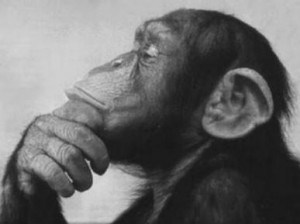 Nietzsche called consciousness our most fallible organ, yet despite its inaccuracies it is really the defining element in what it is to be human, and in its constant dialogue with the unconscious and its struggle to be conscious of the non-perceivable, consciousness embodies the amazing complexity of the condition of being human. Despite Nietzsche’s remark, we have no more prized possession and once it has been taught to work well and learned how to maintain itself in proper working order, there should be nothing more dear to us. It is the defining feature of the Homo Sapiens – I am because I know and I know because I’m consciousness – and yet, perhaps Nietzsche was right, as far as humanity as a whole goes, it is in a sad state of neglect, misused, often quite blatantly abused and fragrantly uncared for by most people.
For humanity to be honest with itself it must protect this human-defining power. Humanity needs to see itself more clearly for what it is – and we are essentially “Sapiens” the animal that knows. Sapiens needs to impose itself, above the term “humanity” itself, not as a new species but as a fulfilment of the potential it has always had, or, better said, as a commitment – perhaps for the first time really – toward fulfilling that potential of being truly conscious of the Universe.


May 27, 2014
Nietzschean Influences in Isadora Duncan’s Dance Philosophy
 Originally posted on A R T L▼R K:
On the 27th of May 1877, the great American dancer, considered the creator of modern dance, Isadora Duncan, was born in San Francisco, California. Her whole life was devoted to dance, it represented an extension through which she connected with the outer world, a channel for expressing her innermost yearnings, emotions and passions. She revolutionised dance by seeking, as she stated herself, “the divine expression of the human spirit through the body’s movement,” which meant allowing the body to ‘tell’ a story dictated by personal mood, music and the general ambience created by minimalistic sets and lighting. This does not mean, however, that Duncan was a mere “dancer to the music”, as is often suggested in related literature. In fact, Duncan’s choreography was very complex, inspired by the classical Greek arts (hence all of her costumes were variations of the ancient Greek tunic), folk and social dances, taking inspiration…
View original 711 more words


May 23, 2014
NIETZSCHE’S LEGACY (the danger of scepticism)

Forget the Übermensch, the Last Man and the Eternal Return, if Nietzsche really did have a determining influence on 20th century intellectual thought it was through his idea of the historical reinterpretation of reality:
“There is no set of maxims more important for an historian than this: that the actual causes of a thing’s origin and its eventual uses, the manner of its incorporation into a system of purposes, are worlds apart; that everything that exists, no matter what its origin, is periodically reinterpreted by those in power in terms of fresh intentions; that all processes in the organic world are processes of outstripping and overcoming; and that, in turn, all outstripping and overcoming means reinterpretation, rearrangement, in the course of which the earlier meaning and purpose are necessarily either obscured or lost. No matter how well we understand the utility of a certain physiological organ (or a legal institution, a custom, a political convention, an artistic genre, a cultic trait) we do not thereby understand anything of its origin.”[1]
Suddenly everything we know becomes suspicious. The accounts we have been given are no longer reliable, in fact they are almost certainly smoke-screens erected to hide the truth. And then comes the realisation that – if everything we know has come from distractions, deliberate lies even, then what do we know? Here we see the best of Nietzsche’s scepticism and cynicism. Like Diogenes, some two thousand years before him, he was looking at the Emperor, saw that he was naked and proclaimed the truth.
From Nietzsche onwards history “becomes a continuous chain of reinterpretations and rearrangements, which need not be casually connected among themselves.”[2] Evolution “is a sequence of more or less profound, more or less independent processes of appropriation… as well as the results of successful counterattacks.”[3]
The observations are brilliant, but Nietzsche himself does not conclude a subsequent need to discover and unveil the truth from this constant chain of falsities and falsifications, rather he applauds the falsifications as necessary (without using the actual term) and imagines his Will to Power exploiting this condition in which progress “is measured by all that must be sacrificed for its sake”[4], coming to the proto-fascist conclusion that: “To sacrifice humanity as mass to the welfare of a single strong human species would indeed constitute progress…”[5] Unfortunately, there could not be a more perfect Nazi slogan.
Nietzsche, who saw the great dangers of nihilism and was terrified by them, just as he was terrified by the negating process of scepticism, needed an anchor for his thought, an anti-nihilistic grounding, for he knew that without one humanity was doomed. The will to power was one of those anchors, as was the Eternal Return. While the latter was indefinite, fantastical and weak, the former was perverse, only succeeding in dragging his most brilliant sun-scorched illuminations into the cool shade of the status quo. His idea of power as freedom would prove to be deeply reactionary and after Nietzsche the 20th century produced a succession of power/freedom regimes that have made humanity more insipid and ignoble than ever before. We now have a power/freedom aristocracy that is driving humanity to the brink of destruction and Nietzsche’s dreams of sacrifice for the good of the single strong species seem hardly any different to Christian fantasies of the Apocalypse.
[1] Friedrich Nietzsche, THE GENEALOGY OF MORALS, 2nd Essay, XII
[2] Ibid.
[3] Ibid
[4] Ibid
[5] Ibid


May 22, 2014
NIETZSCHE’S ASSAYING ANIMAL

In his Genealogy of Morals, Nietzsche, searching for the essence of the human condition, uncovered the “assaying animal” the one that quantifies and qualifies. He observed that mankind is the species that sees itself as “the being that measures values”[1] and linked this self-perception to human pride and acuteness. Mankind is the assaying animal of the market place and “mankind soon reached the grand generalisation that everything has its price, everything can be paid for”[2]. But was Nietzsche here really associating the essence of the human with the Homo-economicus? It is certainly a very neo-liberal notion that we are, and that Nietzsche did… but how true is this assumption?
The assaying animal is a competitive animal, but is this a truly logical assumption? Assaying is not just a process of quantification: we don’t just compare things according to size or volume, but according to quality. In fact we could say that quality is considered uppermost over quantity, in almost all human assaying, in all fields of human activity except: (a) the economy and (b) the game. In these two areas quantity is the important thing. The economy is a mathematical reality in which pride can be measured according to the more zeroes one has following a figure that is not zero. Likewise, the game is usually devised as an accumulation of points. Sure, there is the idea of sportsmanship and cheating is frowned upon, but in the long run what matters, in the game and the economy, is that one has more points than one’s opponent.
Games and economies are abstract inventions, but in the real, beyond these abstractions, what is essentially important is quality rather than quantity. If one is ill, one doesn’t need any overdose of alimentation, what one needs is the right kind of diet to make one well. Offer a banquet to a starving man and you may kill him. The buffet bars that offer as much as you can eat, and the publicity campaigns that imply the same, are as damaging to public health as any drugs. When the assaying is quantitative the spirit cannot be an essential quality of our nature. There can be no real fulfilment in having more. The fulfilment comes qualitatively, by having what is better.
Human measuring, however, whether through quantity or quality, is inherent in the concept of freedom-granting power. It has always been in the interests of Power to determine quality by quantity and reduce reality to mathematical abstraction. Only when we can see all the perverse side-effects stemming from the subjection of the qualitative by the quantitative will Sapiens[3] be able to release itself from the cruelty inherent in the sadistic, aristocratic desires for the freedom of power.
All economic injustices are a direct result of aristocratic fantasies for the freedom of power. Fantasies which can only be conquered by a stronger desire – that which is inherent in Sapiens – the lust for knowledge, and the revaluation of all concepts via understanding and knowledge.
For example, only when democracy is understood as a universal granting of access to knowledge will the status quo of power elites be finally undermined. Power is knowledge and if the civilising trend is to be a democratic one then it must be understood that the universal access, distribution and sharing of knowledge is democracy; any secrecy is undemocratic; is anti-civilisation and barbaric. And knowledge cannot be measured quantitatively but qualitatively. A Sapiens measuring will be predominantly a qualitative one. Poverty will no longer be measured according to the amount of money one has, but according to the amount of fulfilment one has. Fulfilment for Sapiens will be a knowledge-based satisfaction. We are talking about an empire of Wisdom that is shared democratically and used for sensible, practical necessities primarily and for personal pleasure secondly. Dignity through a fulfilment of what is necessity. Pleasure through the quality of the life experience in the world. This is the Sapiens future.
[1] Friedrich Nietzsche, THE GENEALOGY OF MORALS, Second Essay, VIII.
[2] Ibid
[3] For more on Sapiens see my post “Where are we?” http://pauladkin.wordpress.com/2013/08/02/where-are-we/