
Elizabeth Spann Craig's Blog, page 142
February 1, 2014
Twitterific Writing Links
by Elizabeth S. Craig, @elizabethscraig
Twitterific links are fed into the Writer’s Knowledge Base search engine(developed by writer and software engineer Mike Fleming) which has over 23,000 free articles on writing related topics. It’s the search engine for writers.
Have a great week!
Using Amazon KDP’s New Cover Creator http://t.co/wqrhRrB0xN @nickdaws
7 Essential Questions of Plot— Do You Ask Them? http://t.co/MauI0e3OXf @JennyHansenCA
Getting Physical: Ways to Make Your Characters Come Alive: http://t.co/6qkI5L9NoX @RMFWriters
7 Lessons Learned from Half a Year of Writing Every Day: http://t.co/grXieJRZwJ @jamietr
Myst. Lov. Kitchen: Super Bowl Recipe for a Crowd! http://t.co/pBTaQ30I8M @CleoCoyle
Writer of a Certain Age: http://t.co/ENbgBQUySV @fay_weldon @NYTimes
How to Write: A Year in Advice from Franzen, King, Hosseini, and More: http://t.co/FLrngrtL4p @JoeFassler @TheAtlantic
Top Social Media Mistakes Authors Make: http://t.co/R1jrZCk2y6 @ediemelson
4 Things You Must Know About Reaching Your Writing Goals: http://t.co/APL0yz3bVw @carol_brill @womenwriters
3 Ways Authors Write in Excess (And How To Cut Back): http://t.co/D8pDM0ZfX7 @vgrefer
10 Ways to Introduce Conflict in Dialogue: http://t.co/CjDObGaPOa @amandaonwriting @writers_write Why are there so many trilogies? http://t.co/PP877igURk @jdiddyesquire @tordotcom
The importance of being able to focus solely on our writing: http://t.co/iCKsi4GbMz @flawritersconf @joannetlewis
7 Key Trends Of 2014 That Independent Filmmakers & Screenwriters Embrace: http://t.co/OXlZLGtcnp @raindance
The Magnificence of Middle Grade: http://t.co/NZY0hqY71F @kellybarnhill
Will tracking reader data make for better books? http://t.co/lpQO7lPiCN @nytimesbits @DavidStreitfeld
Using Story Beats To Increase Writing Speed: http://t.co/D0vKtZpJhU @DavidGaughran
A look at happy story endings http://t.co/ZWXWMqez5o @jamigold
Best of Both Worlds: Hybrid Authors Up Close: http://t.co/WPueUR1Twq @chuckwendig
How to Use Profanity And Other Raw Talk In Your Fiction: http://t.co/fIRKWRd4r2 @ESimsAuthor @writersdigest
My Tax Time Income Revelations and…Is Writing is the Career We Can’t Retire From? http://t.co/2MLGL8kstQ
10 Tricks For Writing Great Fight Scenes: http://t.co/KkJk4VRNUx @raynehall
Crime fiction–instances where sleuths have passed the torch to the next generation: http://t.co/4GCZ7BrQif @mkinberg
Remember to back up blogs, too: http://t.co/ZfwmbX1Dz9 @womenonwriting
Keeping it Real – Female Protagonists in YA Lit http://t.co/Zjh3ZPwxQz @JennWalkup
Crafting an Effective Beginning: Opening Image or Paragraph: http://t.co/442tsEI7zo @camillelaguire
3 Steps to Reading Harder, Better, Faster, Stronger: http://t.co/03LtP0dRJf @PeterDamien
Why Evil Overlords Need to be Competent http://t.co/jAKp8HfcVL @mharoldpage
Myst. Lov. Kitchen: Potato Casserole Revisited http://t.co/RbKOoAtUto @CleoCoyle
Audio Books First – A New Publishing Movement: http://t.co/3WrmGEsBnw @Goodereader
10 Reasons Our Hero Needs Flaws http://t.co/1Hm750ZFlu @angelaackerman
Publishing: Between Revolution and Revolt: http://t.co/v3qQUxphJt @HughHowey @Porter_Anderson @rebecsmart
How 1 writer sold his book through serialization: http://t.co/4qxjnm2sbv @rchazzchute
What makes a book a classic? http://t.co/A56KCZfWT8 @magiciansbook @salon
How to Write a Novel Based on Your Life Story–10 Tips: http://t.co/zHpC9SJGqj @helenahalme
What it Takes to Be an Author http://t.co/Y2QfacUNCM @KristenEckstein
A Characterization Case Study: Jean Valjean and Javert from “Les Misérables”: http://t.co/T79fnGaRyY @vgrefer
The most prolific author you’ve never heard of: http://t.co/ffiiTHIOuc @melvillehouse
5 Ways to Use Dramatic Irony in Your Writing http://t.co/KsQzNEsboc @JulieEshbaugh
How Can Bookstores Survive? | Savvy Writers & e-Books online: http://t.co/jgZI2wDzaw
Connecting Subplots with Each Other and the Main Story Arc: http://t.co/1cv4BpfGVl @vgrefer
A free directory of cover designers, formatters, freelance editors, and more: http://t.co/E2upLeKgPR
How 1 Famous Author Tricks Herself Into Writing Wonderful Stories http://t.co/ir9tdaIdaQ @thewritelife
Why 1 Writer No Longer Uses Profanity in His Books: http://t.co/GXi2N2t2gu @rchazzchute
An Important Tool to Make You a More Productive Writer: http://t.co/yJsw2NS4KD @DIYMFA
Evaluating Whether You’re Really Ready to Self-Publish http://t.co/HMC96qE50X @JordanMcCollum
Guidelines of Good Online Behavior: http://t.co/5P9uBbSTYR @EdieMelson
But Can’t I Send My Best Pages? http://t.co/knb3N5eAnD @ava_jae
7 Things You Can Do to Promote Your Book As Soon As You Finish the First Draft: http://t.co/lwl9C7rXk7 @sandrabeckwith
Does digital publishing mean the death of the author? http://t.co/J5XvHqbUVf @guardianbooks @richardlea
Are You Creating Your Own Personal Cliches? http://t.co/LzgPW0yl8t @KMWeiland
How To Turn Real Life Into Bestselling Fiction: http://t.co/sNfbuESSoA @RuthHarrisBooks @RomanceUniv
Myst. Lov. Kitchen: The ‘Lucy Burdette’ Daiquiri, Courtesy of @SusanMacNeal http://t.co/RJYkmRC9CJ @CleoCoyle
What Works, What Doesn’t In Book Marketing: http://t.co/1vt8iOp5t0 @badredheadmedia
6 Degrees of Agent Evolution | http://t.co/M2itUdGmKT @digibookworld
Horror–Screenwriting: How Found Footage was Murdered : http://t.co/MYRnosRWec @yomyomf
The Great Free Book Debate: Authors Weigh In: http://t.co/fclbaqc0KX @libraryoferana @mythicscribes
How a love of tabletop D&D helps video game designers tell their stories: http://t.co/CaVHJceMv0 @ColinCampbellx @Polygon
Small presses growing translated fiction’s readership: http://t.co/ggiKbprzwu @badaude @guardianbooks
3 Questions Your Professional Writing Bio Must Answer http://t.co/sJH1CtGRzh @writersrelief
Myth: to be good, writing must be hard | http://t.co/1u3BCch2Pn @deanwesleysmith
Leaving a Literary Legacy: Who Will Watch Over Your Work? http://t.co/NfKBUWFIId @annbauerwriter
5 Things Readers Want from Novelists on Social Media: http://t.co/tpeLtwBTvh @kcraftwriter
Tips for writing better endings: http://t.co/4Jv7MbzqTY @io9
How to Use Coincidence in Stories: http://t.co/2kNSWgGoyy @shalvatzis
Tips for new writers on getting started writing a book: http://t.co/VrQ1wgT3A5
Crime Fiction: A Modern-Day Look at ‘The Hound of the Baskervilles’: http://t.co/pKsyMwp5nV @kbowenwriter
Guide to Targeting an Audience http://t.co/D2ynOvjMvQ @mariamurnane
An agent on authors who worry their ideas will be stolen: http://t.co/tfv8bNNel7 @Janet_Reid
Questions to answer when creating a mythology for your world: http://t.co/gEM5iCjsp1 @rfwriters
Myst. Lov. Kitchen: Maple Cheese Scones http://t.co/T3DJcyd397 @CleoCoyle
Tools for Writing More http://t.co/Nd8VsB1R72 @SusanKayeQuinn
Creating Fully Developed Characters–writers weigh in: http://t.co/aIswHDEexB @WriterDiaries
How to Sell More of Your Fiction Without Selling Your Soul: http://t.co/pjeTG1z3V5 @storyrally
Writers Unplugged: Going Underground, for Productivity’s Sake http://t.co/RBvUcQ3fZK @GlimmerGuy 5 SF Convention Misconceptions: http://t.co/Syx9JmDIQj @petersnede
5 tips for a good narrative essay: http://t.co/8wLVhjZhWR @busyguru
5 Lies That Keep Us from Becoming Great Writers: http://t.co/o5UPf3OQMc @JoelRunyon
3 Things Authors Should Do Before Attending a Book Fair or Writers Conference: http://t.co/VyMQeaNZfO @Coach2Publish
Write First. Edit Later: http://t.co/TdVcEwgn6s @ErinMFeldman
Contract Basics: Subsidiary Rights http://t.co/dheznen44o @AriaGlazki
5 Tips for World Building in Speculative Flash Fiction: http://t.co/B5XcWMuGy2 @EDFsChronicles
Write What You DonÂ’t Know: http://t.co/HIdAHZtZuQ @litreactor
The Future of Publishing–Profit-Sharing Authors?: http://t.co/ruXYSTaDZ0 @IanKEllard @Porter_Anderson
5 Screenwriters That Ended Up Hating Their Own Movies http://t.co/ty21sEOU78 @WritingLeeman
12 Resolutions for a Writer: http://t.co/O6iqDCxkjX @LitRejections
Querying a book that already has interest from a publisher http://t.co/8KfSArBQ5i @Janet_Reid
12 Tips to Inspire Your Writing http://t.co/nRuWUKBJ3f @BlaskovicWriter
Why 1 Writer Has Failed To Write a Word in 2014: http://t.co/3M7efFM5Tp @aaronmritchey @RMFWriters How Journalism Created a Writer: http://t.co/N3Vnfgnlw7 @johnweeast
What’s hard about self-pub? Authors weigh in: http://t.co/jZO35j1hvb @thecreativepenn @Porter_Anderson @ByRozMorris @MirabilisDave
Myst. Lov. Kitchen: Frito Shepherd’s Pie and Super Bowl Boulevard from Cleo Coyle #glutenfree recipe http://t.co/xumBQsyx1I @CleoCoyle
The 15 Best Twitter Lists for Writers http://t.co/Fn7Y6yWvRK @thewritelife
How Art Can Save Your Soul | fcmalby http://t.co/GbnScMllCB @FCMalby
13 Secrets for Sizzling Dialogue http://t.co/2flwghiH61 @RayneHall
Tips for Holding a Writing Workshop http://t.co/hfQVbr92pb @emilyjeanroche
Plotting v. Pantsing: Is One Superior Over the Other? http://t.co/GObOo1Us2V @jeanniecampbell
Persistence, And The Long Con Of Being A Successful Writer « terribleminds: chuck wendig http://t.co/KnHTPy2Bwl @KameronHurley
A Self-Pub Journey: Sales and Marketing Break Down http://t.co/icitqGxiXT @Aimeelsalter
8 Ways to Handle Rejection. http://t.co/PGf9GOK3Jt @WritersBistro
Authors deserve better : http://t.co/MS0lTtPGSV @barryeisler
A Prediction on Book Visibility in 2014 | Savvy Writers & e-Books online http://t.co/YrdAjsWmky @JAKonrath
Stress less and daydream more: a writer’s resolution http://t.co/Z7Nzcfiaja @jodimeadows
How Much Do Writers Earn? Less Than You Think: http://t.co/P7myVB9l7y @pubperspectives
Narrative Setting: How To Build A World http://t.co/xBJKXV8oQm @woodwardkaren
1 Writer’s Process for Approaching Large Revisions: http://t.co/xb9OboeMQw
Understanding Patterns of Change in Fiction and Memoir: http://t.co/wphruFMr4O @writeabook {corr’d link}
6 Of The Best Pieces of Advice From Successful Writers: http://t.co/gHUPajrQQ5 @BelleBethCooper
JA Konrath responds to industry expert Mike Shatzkin’s recent analysis on the future of publishing: http://t.co/jgWPZI6M64 @MikeShatzkin
Realistic fictional settings in crime fiction: http://t.co/fxhsGqZGLQ @mkinberg
Why Don’t More People Buy Your Book? http://t.co/X3Syb3LLa1 @LyndaRYoung
The Art of Writing Copy http://t.co/IpxOoUdFDP @sjaejones
Myst. Lov. Kitchen: Orange Chicken http://t.co/LYOBPnO0Ey @CleoCoyle
A writer’s concerns about using 99 Designs: http://t.co/wNqKwzmP1T @lkblackburne
9 Keys to Creating an Effective Writing Accountability Group http://t.co/XkRRl875FQ @bigstatebiglife
Hard truths about self-publishing: http://t.co/zaPA3KBQyB @NazareaAndrews
Why authors and trad pub don’t reveal authors’ earnings http://t.co/N1TtVbDLwM @LexiRevellian
NA Alley: 5 Tips for Writing Love Scenes http://t.co/6iBM0d0aW2
Twitter Rewards Spamming Indie Authors with Trending Terms http://t.co/mgbucVrlB3 @Goodereadermike @Goodereader
10 Writing Tips From Ernest Hemingway: http://t.co/s3EtGSsSaw @boyinthehat
How to get your indie-book in book stores: http://t.co/zHDYeCnDSZ @tamzwrite
Can men write good heroines? http://t.co/yzEmZ7dKYw @SamanthaEllis27 @guardianbooks
Another Twist on Marketing your Book http://t.co/Xx36foo9xM @CarsonCanada
3 tips for writing watertight fantasy, science fiction and time travel stories: http://t.co/Ls3vwIrMC4 @nailyournovel
S Africans slow to adopt e-books: http://t.co/Gmobbnz1DH @techcentral
All the links I shared last week: http://t.co/lKuTGh1jo6 . All the links I’ve ever shared (searchable): http://t.co/tjn3OfwnLH .
Writing Filters to Use: The Finer Details Filters: http://t.co/7HTZnZyxFd @Awesome_Dawn
How to Decide Which Story to Write First: http://t.co/n0xbkau3kC @cantrelljason
50 Attributes of a Great Copywriter: http://t.co/duVpiLaRkl @jeffbullas
Myst. Lov. Kitchen: Steamed Comfort Eggs from Ovidia Yu http://t.co/ZhyuwLpPsY @CleoCoyle
The Formative Event Technique Raises Your Story’s Stakes: http://t.co/XSQu9DKJUE @marilynhorowitz
On Becoming a (Self) Publisher: (Lessons Learned): http://t.co/elceTiIugI @NickRuffilo @pubperspectives
Yes, Shakespeare used flashbacks and multiple storylines: http://t.co/1LYrIak8ya @AronsonLinda
Roadblocks and Why 1 Writer Prefers Blogging to Writing Her Book: http://t.co/AV925M9ICD
Make Your Story Richer with In-depth Knowledge of Your Characters: http://ow.ly/sXQhv @ReeseRyanWrites
7 Things 1 Writer Has Given Up To Write and Read More: http://ow.ly/sXQ0U @jamietr
Why 1 Writer Won’t Read ‘How To’ Screenwriting Articles Anymore: http://ow.ly/sXPS4 @clivefrayne @scriptmag
Reviewing Your Year’s Writing Goals Encourages Your Creative Spirit http://ow.ly/sXQsF @writeabook
To Outline or Not to Outline? A New Way of Looking at the Debate: http://ow.ly/sXQbZ @jessicastrawser @writersdigest
Killing the Top Ten Sacred Cows of Publishing: Killing a Career | http://ow.ly/sXQ6k @deanwesleysmith
The Top 5 Things 1 Writer Learned from an Editor: http://ow.ly/sXQlp @DonnaGalanti
10 Things 1 Writer Has Learned 4 Months After Publishing Her 1st Novel http://ow.ly/sXPKy @womenonwriting
A Writer Considers the Future of Self-Pub: http://ow.ly/sXQ9H @BlakeBooks
How to Set Up Google Authorship (and Why You Really Should) http://ow.ly/sXQ4o @nickdaws
6 Ways Micro-Publishing Strengthens Your Career: http://ow.ly/sXQA3 @writermama
45 ways to avoid using the word ‘very’: http://ow.ly/sXQDl @writers_write
5 Mistakes Killing Self-Published Authors: http://ow.ly/sXQdS @kristenlambtx
It’s Not Just One Book. Your Rights And How To Exploit Them: http://ow.ly/sZ91I @thecreativepenn
How To Make Life Easy For Librarians So Your Book Gets In Libraries http://ow.ly/sZ9hZ @uriel1998
Cleaning Up Your Manuscript Can Save You Money http://ow.ly/sZ9wU @CKmacleodwriter
How to Feel Confident Sharing Your Creative Work In Public http://ow.ly/sYSUa @LeRegalla
The Secret To Succeeding As A Writer: Having A Criterion For Success http://ow.ly/sYSeW @woodwardkaren
Top Tips to Make Best Use of A Blog Tour: http://ow.ly/sZa7w @cupgrease
Is There a Right Age to Read a Book? http://ow.ly/sYSNQ @tordotcom
In Britain and especially abroad, ebooks are booming: http://ow.ly/sYSun @guardianbooks
The post Twitterific Writing Links appeared first on Elizabeth Spann Craig.


January 30, 2014
Tax Time Revelations and…Is Writing is the Career We Can’t Retire From?
By Elizabeth S. Craig, @elizabethscraig
I had my appointment with my CPA on Wednesday. The appointment was in the middle of the Southern snowstorm aftermath, actually—there’s nothing like adding to the misery of taxes with a minor natural disaster, you know. I hired a CPA last year when I continued waking up in cold sweats in the middle of the night, worrying that I was doing my taxes wrong. I didn’t think I’d fit in well in tax jail. I decided I didn’t mind paying for peace of mind.
She had me painstakingly pick through my bank account and pull out every deposit from all sources…self-publishing and traditional publishing…for 2013. This was nightmarish and took the better part of an hour. But I didn’t have the 1099 from Amazon yet and she wanted to double-check all my income sources anyway, so I combed through the statements. The entries I was looking for were direct deposits and checks from Penguin (via my agent), Llewellyn (my agent doesn’t represent me with this publisher), Amazon, ACX, Smashwords, Apple, CreateSpace, and Barnes & Noble.
The amazing revelation I made was that my total income for 2013 was 68% self-publishing income. That’s with a total of 8 traditionally published books and 5 self-published books currently on the shelves (1 trad. published book is in production and 1 self-published book is in production).
Overall profits increased by 66.6% for 2013. I tried to figure out what I was doing right so that I could replicate it. But all I’ve done online is what I’ve been doing for ages…I blog here. I tweet. I Google Plus. I sometimes Facebook. I rarely pitch my books. What had changed in 2013: all my self-published books released in print. All my self-published books released in audio. I had three traditionally-published releases (although, as I mentioned, the traditionally-published income was a small fraction of my total) and one self-published release. I did a couple of Goodreads giveaways.
My accountant asked about my advertising expenses for my small business, since I wrote off $100 in 2012 for print copies of my traditionally published books for giveaways, conferences, charity basket auctions, that kind of thing. No–I spent $0 for advertising in 2013. I blushed a little when she asked me that question. What kind of a small business owner am I? But I seem to make more when I just focus on the writing stuff.
One big thing help was that foreign sales picked up dramatically last year. My foreign sales figures had been lackluster for over a year and a half. From 2011 until early last year, I never even clicked on foreign sales on the KDP page. In 2013, I saw a dramatic upswing…mainly in the UK, but also Denmark and Australia (other foreign sales were just odds and ends here and there). I did nothing to make those sales happen. I guess my visibility increased on Amazon US to the point where it just trickled through to the other markets. I really have no explanation for it.
Actually, I do have one explanation for it. I’m starting to saturate my corner of the market a little bit. I’ve given my content more reach by putting it in more formats. And I’m writing 3-4 books a year. I think I’ve got readers engaged with me—an amazing feat, considering I don’t actually interact with readers on any of my social media platforms…well, with the exception of my Riley Adams Facebook page. I’m getting many more emails and Facebook direct messages from readers than I ever received in the past.
What engages my readers are my books. And that’s the way I want it. They’re not very interested in me. A good thing, because I’m not particularly interesting. My sister joked with me one day and asked if readers were calling themselves “my number one fan.” (Stephen King reference there.) And I told her, no, not at all. Although several have written to me saying they’re Myrtle Clover’s #1 fan (protagonist in one series). And that’s exactly the way I want it.
But to sustain this book-centric reader engagement, I have to keep writing books. Which brings me to my next point—is writing a career that’s difficult to retire from? To keep our income stream constant, is the necessary visibility and discoverability dependent on regular book publication?
I think it might be. And right now, that’s absolutely fine with me. I love writing books. I’m all about books. But people I know frequently ask me if I might burn out at the pace I’m going. I say no—but there are days when I’ve got to recharge. Fortunately, there are enough writing-related tasks to switch to something else productive and allow myself to recharge a little. So I’ll contact my book cover designer or I’ll edit my outline or I’ll write a blog post or schedule updates on Twitter.
But…sure. When I think of keeping this career going and keeping my readers engaged and I think of the decades in the future—it can be overwhelming. In some ways, though, it’s a relief to me to think that my platform, which is a writer-centric platform, isn’t what’s connecting me to readers. I’m sure it’s not. My blog and Twitter and Google + have given me a higher visibility among writers, but readers aren’t finding me that way. They’re finding me through my books.
When I think of all my favorite authors…many of them (aside from some of the now-deceased Golden Age mystery writers) continue to be favorites because they regularly publish. That’s how they stay on my radar. Each year there’s an Elizabeth George book out or a Louise Penny book out or an M.C. Beaton. That’s what’s keeping me hooked… regularly released solid reads.
So those are my thoughts, just from my own data. What do you think, though? How do you feel readers are discovering your books, or how do you discover books as a reader? What keeps your favorite writers on your radar, as a reader? How can writers sustain visibility and income levels, moving forward?
Image: MorgueFile: Cohdra
The post Tax Time Revelations and…Is Writing is the Career We Can’t Retire From? appeared first on Elizabeth Spann Craig.
January 28, 2014
A Modern-Day Look at “The Hound of the Baskervilles”
by Kathy Owen, @kbowenwriter
Elizabeth invited me to share with you one of my favorite classic detective novels, Sir Arthur Conan Doyle’s The Hound of the Baskervilles. I love talking about the classics with fellow mystery lovers!
The Hound of the Baskervilles (1901-02) has been regarded by current and contemporary Sherlockians as the best of the four novels. Since its publication, it has been adapted dozens of times for radio, film, and television.
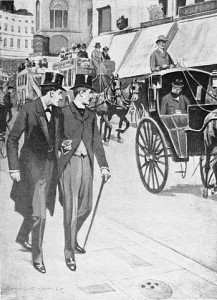
Holmes and Watson. Artist Sidney Paget, 1901. Wikimedia Commons.
Hound beginnings:
The year 1901 marked the death of Queen Victoria and saw Doyle well-established in his career: he had achieved many of his personal goals, and was considered a serious writer and popular public speaker. That year, Doyle went on a golfing holiday in Norfolk with his friend Fletcher Robinson. On a dreary, rainy day, when golfing was out of the question, Robinson passed the time by recounting to Doyle the West Country legend of a spectral hound, which gave Doyle the idea for his story. Blogger and writer Gene Lempp wrote a fascinating post on the Legend of Black Shuck which gives more detail.
Doyle subsequently traveled to the Dartmoor area to get local color for the story, which was originally not intended to feature Holmes (he had already killed off Holmes in “The Final Problem” – pitching him over the Reichenbach Falls with Professor Moriarty). According to Doyle, Holmes sort of worked his way into the story; so, rather than resurrect Holmes (although he did later, in 1903), Doyle made the story a reminiscence by Watson of an earlier undocumented case.
The Hound of the Baskervilles was serialized in The Strand Magazine (where most of the stories were serialized) over a nine-month period, from August 1901 to April 1902. It was eagerly received, and long lines formed at the publisher’s office when the next installment was due out.
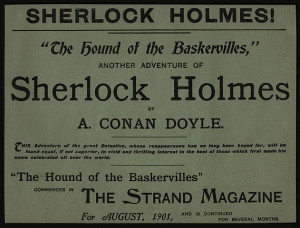
Broadsheet advertisement for The Hound of the Baskervilles, 1901. Wikimedia Commons.
There’s a lot to admire about the novel, but I’ll keep to a few interesting aspects.
Narrative strategies in Hound:
Doyle was master of the cliff-hanger. He knew how to break up the segments to keep the readers hooked. The first magazine installment, for example, ends with Watson’s sleep being disturbed by: “the sob of a woman, the muffled, strangling gasp of one who is torn by uncontrollable sorrow.” Other cliff-hangers involve a dead body, a stealthy stranger, and mysterious noises in the night.
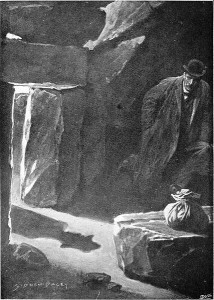
Watson lying in wait for the mysterious stranger. Artist Sidney Paget, 1901. Wikimedia Commons.
In Hound, Doyle was able to resolve the narrative difficulty he’d had in two earlier full-length Holmes novels: how to explain the complex and lengthy series of events that lead up to a crime without the use of long flashbacks or tedious explanations that interrupt the story. Instead, Doyle used different narrative voices: those of the client, a 17th century manuscript, Watson, and Holmes, who later relays his own account of the time when he and Watson are working the case separately.
The separation of the Holmes/Watson team is unusual as well. Without Holmes on the scene to guide him, Watson has his chance in the limelight as a detective. It is a role that weighs heavily on him, however. The reader shares the feeling of vulnerability in Holmes’s absence.
Gothic elements:
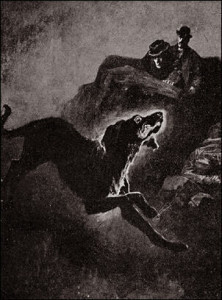
Artist Sidney Paget’s otherworldly hound. Image via wikimedia commons.
The novel’s Gothic horror story trappings make it an unusual setting for a detective story: a family curse, a dark, primitive moor, a seemingly-supernatural hound, a black-hearted villain. There are lots of “thrills and chills.” But it’s a detective story through and through, because the Gothic is not its solution. There is a rational explanation for everything. Some scholars posit this is why Doyle instinctively felt that Holmes belonged in the story.
Psychoanalytic facets of the novel:
During the time that Doyle was writing the Holmes stories, Freud was developing his theories of the unconscious mind and repression. Writers such as Conrad, Stevenson and James wrote symbolic stories in which the source of evil existed within the mad soul and had to be restrained by the intellect. The Hound of the Baskervilles treats the problem of human evil from a psychological perspective rather than a metaphysical/ supernatural one. Scholars like to read the wild, lonely, treacherous moors as symbolic of the repressed unknown unconscious mind, uncivilized and barbaric. Using this interpretation, the moor would act in conjunction with characters in the story (including the neolithic savages, the original inhabitants of the moor) to depict the unconscious, dark side of the human soul, or the primitive part of man existing beneath the civilized veneer, if you will.
There’s more I could say about this (we haven’t even touched Jungian theory), but we want stuff to discuss in the comments section! I hope you’ll give The Hound of the Baskervilles a second (or first) look.
Bio:

K.B. Owen taught college English at universities in Connecticut and Washington, DC and holds a doctorate in 19th century British literature. A long-time mystery lover, she drew upon her teaching experiences in creating the Professor Concordia Wells mystery series. The first book, Dangerous and Unseemly, was published in early 2013.
The second book, Unseemly Pursuits: A Concordia Wells Mystery, has just been released:
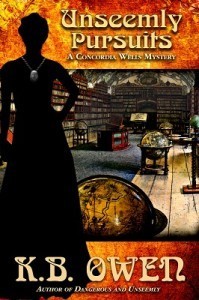
A deadly secret that won’t stay buried…
It is the fall of 1896, and Miss Concordia Wells is hip-deep in the usual tumult of a lady professor’s life: classes, clubs, student pranks, and the unending drama generated by the girls she lives with on campus. Complicating this normality is the new Lady Principal, whom the students have nicknamed “the Ogre.” The woman seems bent on making Concordia’s life miserable.
And then there’s the exotic spirit medium, Madame Durand, who has befriended Concordia’s mother and has started a “Spirit Club” on campus. Madame’s prognostications of doom are at first only mildly irritating – until events take a sobering turn. An ancient Egyptian amulet donated to the college mysteriously disappears, the donor is found murdered, and his daughter – Concordia’s best friend – confesses to killing him.
Desperate for answers, Concordia unravels a 20-year-old secret, closely guarded by men now dead. But such secrets can be dangerous for the daughters left behind, including Concordia herself. Can she make sense of the mystery that has bound together their fates, before it’s too late?
Unseemly Pursuits is available through these venues:
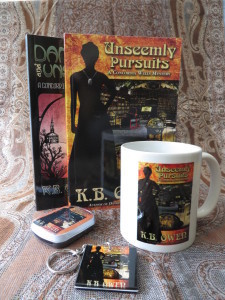
Kathy’s also hosting a giveaway! A randomly-selected winner from the comments section of each guest post on her blog tour (comments up through March 6, 2014) will receive a free e-copy of Unseemly Pursuits. One grand-prize winner from all of the ebook winners will receive an Unseemly Pursuits swag kit! This includes a mug, JellyBelly tin, keychain, and two signed paperbacks: her first novel in the series, Dangerous and Unseemly, along with Unseemly Pursuits. (If the grand-prize winner lives outside the U.S., she or he will receive a $50 Amazon gift card instead, because of the cost of shipping).
The post A Modern-Day Look at “The Hound of the Baskervilles” appeared first on Elizabeth Spann Craig.
January 26, 2014
My Process for Approaching Large Revisions
By Elizabeth S. Craig, @elizabethscraig
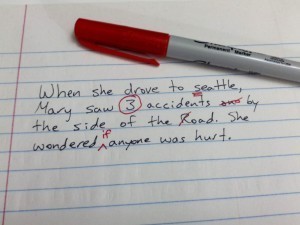 I received an email last week from a writer who is feeling a little overwhelmed by the revision process and asked if I’d written any posts that helped to sort of sort through revision in an organized way.
And my first reaction was, besides completely understanding why anyone would feel overwhelmed, was: “Oh sure, I’ve got gobs of blog posts like that.” But…no. Although I talk a lot about my need for revision and stuff I’ve had to fix in the past, and the fact that I don’t edit while I draft–I had no posts at all about how I organize and approach revision. So I’ll correct that now. And, looking at my process below, I’m thinking that one reason I might not have outlined this before is because it so closely resembles my process for writing a book that maybe I thought I’d repeat myself.
This is a process for someone who really, really needs a process or has become frozen because there is so much to do and she doesn’t know where to start. It could work for someone with really limited time and a demanding day job. Or someone who has tried other methods without success.
First off:
Brainstorm a list for your revision.
This may be a humdinger of a list, but work on it a little every day. Maybe you already have a list of notes to yourself about manuscript problems…this is a good time to organize the bits into a master list.
Everything goes on the list. The stuff you worried about in your book. The feedback you got from your editor/beta reader/critique group. It’s a master list.
Brainstorm all the global problems you recognize in your book. You might know immediately what these are. If you can’t put your finger on them, think about lack of conflict, whether the protagonist is taking charge or observing, character development, character growth, flat dialogue, and character goals/motivation.
Brainstorm all the smaller mistakes you want to watch for. Be thinking about things like: repeated words (echoes), continuity errors (character’s hair color/outfit changes in same scene), POV problems, pacing (some scenes too rushed? some scenes too slow?) too many adjectives or adverbs, dialogue tag issues, varied sentence structure, bumpy scene transitions, etc. Weak word choice–sometimes I’ll double-check that I’ve used words like felt, very, look, started to, think, really, put in a smart way.
Brainstorm all the additions you want to make to the manuscript. These might be chapter breaks, descriptions, setting description, added scenes that add conflict or develop character, etc.
Brainstorm all the deletions you know you want to make to the manuscript. These might be instances of backstory, dull dialogue, or meandering scenes that don’t further the story.
Then: break headings on your list into smaller tasks of things to do/address. See how many tasks you can break each area down into. So maybe you received some beta reader/editor/crit group feedback: Help make main character more sympathetic and likeable. You could change that to add in a pet-the-dog/save the cat moment near book’s beginning.
Martin seems too flat as a character could have a few to-dos: Brainstorm Martin’s backstory and what he fears most/wants most. List why Martin is important to the protagonist and ways to make him more so. How does Martin grow during the story?
Some of these things are going to take only a few minutes (word searches for frequently repeated words or potential problem words). Some will take longer (continuity errors, POV, etc.). If you’ve broken down some of your bigger tasks into much smaller, manageable to-dos, though, you’ll have bits you can accomplish even in small amounts of time.
After you finish with your list, work on it as you have time. If you’re forgetful like I am, carefully mark off each item when you’ve finished. Mark on your document where you left off, if you’re working on a read-through. I use Word’s Track Changes or Comments feature.
Continuity errors seem to take the longest amount of time for me to catch because I usually have to jot down notes about what day of the week the story is on, a character’s eye color (can prevent this if I make a style sheet as I write the book!), etc. Read through the book for continuity errors (notepad beside us), POV, and transition problems.
If you come across additional problems as you go, add them to your to-do list, also breaking them down into smaller tasks.
Double-check yourself. Check your list again.
Do a final read-through to make sure all your deletions, additions, and word changes make sense.
Call yourself done and reward yourself somehow. Maybe by starting on that next book that was tempting you the whole time you were plodding through your revision?
I’ll add here that now, although I still do need a list to help me keep track of changes I need to make, I don’t *have* to make one as extensive as the one above…now it’s more rote because I’ve done it so many times. This is more if you have a heckuva revision on your hands, feel overwhelmed, or need to apply some real organization to your project to help stay on track and motivated.
There are so many ways to approach a big revision. What are some of your tips?
Image: MorgueFile: jppi
The post My Process for Approaching Large Revisions appeared first on Elizabeth Spann Craig.
January 25, 2014
Twitterific Writing Links
by Elizabeth S. Craig, @elizabethscraig
Twitterific links are fed into the Writer’s Knowledge Base search engine(developed by writer and software engineer Mike Fleming) which has over 23,000 free articles on writing related topics. It’s the search engine for writers.
Have a great week!
The Two Main Characters – A Writer’s Worksheet: http://dld.bz/dfKNE @amandaonwriting
5 Ways Authors Can Recycle Their Discarded Material: http://ow.ly/sJaFZ @vgrefer
Sing with Your Inner Voice (& Write It All Down). ~ Caroline Brown http://ow.ly/sJaYV @elephantjournal
Fiction writing: When you might want to use passive construction | Into Another World http://ow.ly/sJb3d
Sarcasm in narration: http://dld.bz/dfKK5 @rfwriters
7 Ways to Overcome Writer’s Block: http://dld.bz/dfQta @KenneyMyers
First Be a Storyteller: http://dld.bz/dfKN3 @jamesscottbell
Writers Are People That Stop And Start: http://ow.ly/sJbe6 @thoughtcatalog
Blood-Red Pencil: Audio Editing http://ow.ly/sJbh7 @authorterryo
Foundations of fantasy–Beowulf: http://dld.bz/dfKK9 @RyanHowse
To kickstart inspiration: a plot bank with over 2300 entries: http://dld.bz/dfKKu
Tips for Better Blog Posts for Writers: http://ow.ly/sJbjX @CaballoFrances
When studying your character, don’t think about heroism or gender…think about fear: http://dld.bz/dfKNk @bang2write
Tips for better dialogue: http://dld.bz/dfKMP @rfwriters
Finding your readers online: Award-winning authors speak up: http://dld.bz/dfKJ4 @jimhbs
Writers, we are doing it backwards: http://dld.bz/df8EZ @speechwriterguy
Inspiration and motivation from a slaughterhouse: http://dld.bz/dfV85 @Screenwriter12
Self-Published Authors should always own their own set of ISBNs: http://ow.ly/sL8DA @oceanviewpress
Launch etiquette–must you buy the book? http://dld.bz/dfTUS @KerryGans
Free Research and Development for Authors http://ow.ly/sJbnz @byondpapr
Getting published–a flowchart: http://dld.bz/dfTVb @rfwriters
How Much Can Hybrid Authors Make? http://bit.ly/1eJ1JPJ @steenaholmes
Historical fiction: 10 Rules for Rewriting History http://ow.ly/sJbIw @writerunboxed
An ergonomic tip for writers: http://dld.bz/dfQtt @MartinaABoone
How to use lists to write: http://ow.ly/sJbQc @MSaintGermain
Fantasy Flash Fiction–5 Common Mistakes : http://ow.ly/sJc9c @FaithBoughan
12 Tips To Improve Your Writing In A Hurry: http://ow.ly/sJcfe @AnneWayman
How to Successfully Kill a Character: The Checklist: http://dld.bz/dfTVq @KMWeiland
The Power of Polarizing Through Your Writing: http://dld.bz/dfV8c @menwithpens
Combat in fantasy–10 tips: http://dld.bz/de75M @fantasy_faction
Don’t Start Something New in 2014 (Finish Something Old): http://dld.bz/dfTWC @Jordanrosenfeld
10 tips for writing romance: http://dld.bz/dfTUX @amberrisme
10 Authors Who Wrote for the Silver Screen: http://ow.ly/sJcAk @pastemagazine
18 Signs You’re A Writer At Heart: http://ow.ly/sJcnQ @thoughtcatalog
Should you self-publish? 6 key questions: http://ow.ly/sJcCh @MSaintGermain
Tips on How to Read Your Novel: http://ow.ly/sJcEa @MSaintGermain
5 Things Writing Has Taught 1 Writer About Love: http://ow.ly/sJcki @AlwaysIncluded
How 1 Writer Plans to Write His Best Screenplay Ever: Make His 1st Feature Film: http://ow.ly/sL6Ut @bartondeepwood @nofilmschool
How 1 Writer Plans to Write His Best Screenplay Ever: Make His 1st Feature Film: http://ow.ly/sL6Ut @bartondeepwood @nofilmschool
How 1 Writer Plans to Write His Best Screenplay Ever: Make His 1st Feature Film: http://ow.ly/sL6Ut @bartondeepwood @nofilmschool
Characteristics of the ‘Bad Guy’ Antagonist: http://dld.bz/df8De @rfwriters
How authors can reclaim the rights to their back catalog titles http://ow.ly/sJvOs @Bookbaby
5 Things YA Parents Say (But 1 Writer’s Parents Never Did): http://dld.bz/dfKNv @EmilyCaseysMuse
How to speak publisher: F is for Foreign rights: http://dld.bz/df2dM @annerooney
I have sucked. I currently suck. I will suck. (Or the life of a writer): http://dld.bz/df2d2 @rebeccaberto
Goodreads’ live or die decision to be purchased by Amazon: http://ow.ly/sJw0V @michaelwhite1
Tips for writing something you’ve never experienced: http://dld.bz/df8At @rfwriters
Self editing basics: http://dld.bz/dfDmb @rebeccatdickson
Twitter etiquette: http://bit.ly/1eUlVQZ @jemifraser
Overused Words To Avoid: http://dld.bz/df8AZ @thewritermama
Vulnerable Characters: http://dld.bz/dfG7v @JeanOram
Finding New Readers with a Multi-Author Ebook Bundle: http://bit.ly/1diyxfZ @goblinwriter
The awkward art of book trailers: http://nyr.kr/J8FxEy @rachelarons @pageturner
Plot structure–wow moments: http://bit.ly/1bgfTt1 @camillelaguire
Old methods of reader discoverability–and why they no longer work: http://bit.ly/1mmauVA @kristinerusch
A Beat Sheet For Scrivener: http://bit.ly/1dGCr6V @woodwardkaren
Why Everyone Should Read More Science Fiction: http://huff.to/1bt4Ye3 @huffpost
Putting the Weird in Weird Western: http://dld.bz/dfV8u @gemmafiles @qqwill
Stop being embarrassed about fan fiction: http://bit.ly/1fJRH6d @dailydot
8 tips for better keynote addresses: http://bit.ly/1ceR9Te @paulsloane
How to set writing goals for 2014: http://bit.ly/1gYaVVp @LeahMcClellan
The 10 Biggest Mistakes People Make in Setting Goals: http://bit.ly/1e6pkK1 @michaelhyatt
How to develop your writer’s voice: http://bit.ly/1afAE9Z @writeabook
An agent’s opinion of self-publishing: http://bit.ly/1azH3u4 @Janet_Reid
Thoughts on pacing stories: http://bit.ly/1afBi7p @TiffanyReisz
How to make your romance novel feel real: http://dld.bz/dfDmA @nownovel
Why 1 Writer is Shutting Down His Facebook Page: http://bit.ly/1fJWMve @RobBiesenbach
Learning to Write – a writer’s journey in How To books: http://ow.ly/sL6tS @candygourlay
How to Outwit Second Novel Syndrome: http://dld.bz/df8Fx @Lisa_Alber
5 Ways to Untangle Plot : http://ow.ly/sN69X @Awesome_Dawn
Character Secrets and Contradictions: http://nyti.ms/1azcTnS @nytimes
How To Become A Master Of Creativity – Attitude: http://linkd.in/1dKfAH4 @ConsumGoodsClub
5 Easy Ways To Make Writing A Habit: http://dld.bz/dfDmf @losapala
How Much Does Author Platform Impact Sales? http://bit.ly/1chcM5z @janefriedman
Using Index Cards To Outline A Novel: http://dld.bz/dfDmz @woodwardkaren
Traveling To Research Historical Novels: http://dld.bz/dfDnf @WriteHistNovels
Do Authors Need Publishers? http://bit.ly/1cG1dze @LynneCantwell
Jane Austen on Creative Integrity: http://bit.ly/1dmaZHD @brainpicker
Crowdfunded Anthologies: Concerns For Writers: http://dld.bz/dfG73 @victoriastrauss
Self-Pubbed Books vs. Literary Awards: A Logistical Problem? http://bit.ly/1fJW80H @shaunduke
A play by play of 1 author’s free ebook giveaway: http://bit.ly/19D3CQx @SPressfield
Comparing a scene as written and as shot: http://dld.bz/dfDmt @johnaugust
5 Ways to be a Smart, Gutsy Writer - http://ow.ly/sKTLh @ainegreaney @womenwriters
Do Novelists Need A Book Proposal? http://bit.ly/1jeIW1N @terrywhalin @flawritersconf
Understanding Tolkien: Why His Landscapes Work: http://dld.bz/dfDkW @mharoldpage
Screenwriting site–Loglines R Us: http://bit.ly/1azbI7J @DouglasKing4 @scriptmag
Elements of a good scene–a checklist: http://dld.bz/dfG7j @Writers_Write
8 Screenwriting Clichés to Avoid: http://dld.bz/df9s4 @screencrafting
6 Ways To debunk The Talent Myth: http://ow.ly/sKUl6 @raindance
Creating Active Characters: http://ow.ly/sL8NB @WritersRumpus
Book Pricing (Discoverability) http://ow.ly/sJaAV @kristinerusch
4 Reasons Why Our Entertainment Is Getting More and More Sex Soaked: http://ow.ly/sKYk3 @passivevoiceblg
3 tools that’ll make the submissions process easier for writers: http://dld.bz/dfA97 @chrisrobley
Writers reviewing writers: http://ow.ly/sL98j @hutchingsjulie
How to Kill Your Main Character http://ow.ly/sLbCR @RhiannonPaille @mythicscribes
Is one good Amazon review worse than no reviews? http://ow.ly/sL9xe
7 Mistakes Indie Authors Make with Their Covers: http://ow.ly/sLbCZ @GabrielleSaraP
Will Traditional Publishing Ever Become Author-Focused? | Eric Lorenzen http://ow.ly/sLbD8
Novel endings–don’t rush: http://bit.ly/KgHj7y @lindasclare
Beta readers–the magic elves of the publishing world: http://ow.ly/sLbDc @nzstelter
Lit Fic Mags for Spec Fic Writers: 5 Markets to Consider : http://dld.bz/dfV8g @sfwa
Discoverability–what works: http://ow.ly/sLbDg @alexjcavanaugh
Is the midlist, ‘publishing’s experimental laboratory,’ disappearing? http://ow.ly/sL90K @ZeljkaMarosevic
Why 1 writer is crowdfunding his book: http://dld.bz/dfDmG @johnbiggs
Murder 101: 7 Reasons to Kill your Characters | http://ow.ly/sL9QR @robsmedley86 @fuelyourwriting
Where to Find Beta Readers: http://ow.ly/sLbDq @jamigold
Roadblocks and Why 1 Writer Prefers Blogging to Writing Her Book: http://ow.ly/sLbDt
Yes, Shakespeare used flashbacks and multiple storylines: http://ow.ly/sLbDx @AronsonLinda
On Becoming a (Self) Publisher: (Lessons Learned): http://ow.ly/sKU95 @NickRuffilo @pubperspectives
The Formative Event Technique Raises Your Story’s Stakes: http://bit.ly/1cEIhBh @marilynhorowitz
50 Attributes of a Great Copywriter: http://bit.ly/18C0UtS @jeffbullas
How to Decide Which Story to Write First: http://ow.ly/sN4oW @cantrelljason
Writing Filters to Use: The Finer Details Filters: http://ow.ly/sN3JS @Awesome_Dawn
S Africans slow to adopt e-books: http://ow.ly/sN3Dc @techcentral
3 tips for writing watertight fantasy, science fiction and time travel stories: http://ow.ly/sN3XF @nailyournovel
Another Twist on Marketing your Book http://ow.ly/sN4Yw @CarsonCanada
Can men write good heroines? http://ow.ly/sN4Pt @SamanthaEllis27 @guardianbooks
How to get your indie-book in book stores: http://ow.ly/sN3PY @tamzwrite
A writer’s concerns about using 99 Designs: http://dld.bz/dfDm7 @lkblackburne
10 Writing Tips From Ernest Hemingway: http://ow.ly/sN43z @boyinthehat
Twitter Rewards Spamming Indie Authors with Trending Terms http://ow.ly/sN48o @Goodereadermike @Goodereader
NA Alley: 5 Tips for Writing Love Scenes http://ow.ly/sN3Vy
Why authors and trad pub don’t reveal authors’ earnings http://ow.ly/sN5ar @LexiRevellian
Hard truths about self-publishing: http://ow.ly/sN4w9 @NazareaAndrews
9 Keys to Creating an Effective Writing Accountability Group http://ow.ly/sN4E4 @bigstatebiglife
1 writer’s close-call with a disastrous cover: http://dld.bz/dfKJm @nailyournovel
3 reasons writers should be happy about rejection: http://dld.bz/dfDhF @bookbaby
Avoiding Repetition in Stories: http://dld.bz/dfKJC @shalvatzis
Screenwriters | 10 Ways To Make A Good Impression As A Writer http://ow.ly/sJauP @bang2write
Real Life Diagnostics: Will This Opening Draw in the Reader? http://dld.bz/dfQtg @Janice_hardy
“12 Fundamentals Of Writing The Other”" (And The Self): http://ow.ly/sJajn @djolder”"”
8 Formatting Tips and Shortcuts For Writers: http://dld.bz/dfG7R @joebunting
Online traps for unwary writers and illustrators: http://dld.bz/dfhu9 @nicolamorgan
The Most Likely Person to Read a Book? A College-Educated Black Woman http://ow.ly/sJa4o @pbump
More Americans read books than you think: http://ow.ly/sJa6C @mims
Best practices for social media posting: http://dld.bz/dfrfj @GuyKawasaki
10 Ways to Create Gut-Gnawing Suspense: http://dld.bz/dfG7W @niniehammon
How to Beat the Self-Pub Stigma and Gain New Readers: http://ow.ly/sJacV @Wiseink
Banning the Negative Book Review: http://dld.bz/deY7C & @nytimes
5 Writers Who Took Romantic Revenge in Print | Mental Floss http://ow.ly/sJa07
Can you use social media to increase reader loyalty? http://dld.bz/dfKJb @SMisDynamite
How 1 Writer Plans to Write His Best Screenplay Ever: Make His 1st Feature Film: http://ow.ly/sL6Ut @bartondeepwood @nofilmschool
Can Subscription Services Work for Ebooks? http://ow.ly/sJ9TI @LJSellers
How to improve your writing–subplots and subtext: http://dld.bz/dfhuu @storyfix @writersdigest
All about reader conferences for writers: http://dld.bz/dfG7F @authorterryo
How 1 Writer Plans to Write His Best Screenplay Ever: Make His 1st Feature Film: http://ow.ly/sL6Ut @bartondeepwood @nofilmschool
16 Reasons Why Screenwriters and Film-makers Fail: http://dld.bz/dfG7B @raindance
What’s the Future of Bookstores? 25 Influential Authors Weigh In http://ow.ly/sJ9IF @CarmenConnects
Tips for writing the perfect logline and why it’s as important as your screenplay (or book): http://dld.bz/dfkJs @noamkroll
7 things every writer should be able to do in their sleep. http://ow.ly/sJ9DY @MasqCrew
Is good characterization really about change? http://dld.bz/deY6f @bang2write
Creating Friction With Clashing Personalities: http://dld.bz/dfkKq @thecreativepenn @angelaackerman
The joy of literary destruction: Writers who broke all the rules: http://ow.ly/ @salon
When Reviews Are Negative (Or Worse) http://ow.ly/sJ9uS @rsguthrie
9 Tips on Pinterest for Writers: http://ow.ly/sJ9qF @LPOBryan
More Americans read books than you think: http://ow.ly/sJa6C @mims
Why Writers Should Embrace Household Chores | http://ow.ly/sJ9ku @Writethismoment
Writing novice? 6 best pieces of advice from successful authors: http://ow.ly/sJ96l
More Americans read books than you think: http://ow.ly/sJa6C @mims
5 Writers Who Took Romantic Revenge in Print | Mental Floss http://ow.ly/sJa07
The bad side of Goodreads’ Reading Challenge | Books | theguardian.com http://ow.ly/sJ912 @guardianbooks
5 Writers Who Took Romantic Revenge in Print | Mental Floss http://ow.ly/sJa07
Why Writers Should Embrace Household Chores | http://ow.ly/sJ9ku @Writethismoment
How to Build a Writing Group by Nathaniel Kressen http://ow.ly/sJ8S5 @Janefriedman
Why Writers Should Embrace Household Chores | http://ow.ly/sJ9ku @Writethismoment
Can’t Take a Research Trip? No Problem: http://dld.bz/cUPSz @carrieturansky
How To Make Your Own Free Book Cover In MS Word: http://dld.bz/cU24H @thecreativepenn
How To Fix A Plot That Feels Lightweight Or Predictable: http://dld.bz/cU24U @raindance
The post Twitterific Writing Links appeared first on Elizabeth Spann Craig.
January 23, 2014
Does Mind Mapping Hurt?
by Delia Brendan, @deliabrendan
 Years ago, I went to a plotting workshop. The workshop leader described a process involving white poster board and multi-colored sticky notes. She described how each sticky note color corresponded to various plot elements. At the end of the exercise, she showed the group a completed plot map and explained how this process could help you from getting bogged down during drafting.
As a visual person, I loved the concept of working from a map. So, I dutifully went out and bought white poster board and enough sticky notes to outfit a corporation. As an organizationally-challenged over thinker, I was soon mired down in details. Was Dr. Venom’s mother from Siberia a blue sticky note because she was related to a bad guy or a green sticky note because she befriends the heroine? No surprise, I never wound up with a plot map and I’m still pulling sticky notes out of sock drawers and couch cushions.
If I could get my information organized in virtual notebooks, was a free tool that would help me organize my plot too much to hope for?
It turns out it’s not. Now, when I say “mind mapping,” I need you to take a deep breath. It’s a terrible name as it conjures images of being strapped in a chair as electrodes are attached to your temples. It’s not something that one might think would help creativity, but it is invaluable.
“Mind mapping” is not new. It’s just a description of how to organize your thoughts. In terms of the software, a map is nothing more than that huge piece of white poster board we lugged home from the office supply store. Topics and subtopics are the sticky notes.
Let’s look at this in action with the story of Sleeping Beauty. As you dig back in your Disney brain, recall that the story opens with the birth of the King and Queen’s daughter. An evil fairy casts a spell on the child that when a spindle pricks her she’ll die. A good fairy can’t remove the curse, but she alters it. Instead of dying, the princess will fall into a 100-year sleep and be awoken by the kiss of a prince. Fifteen years later, the princess accidentally triggers the curse.
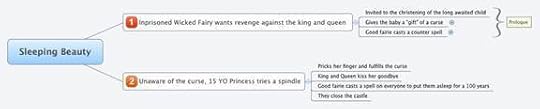
The name of the story is our starting points, my first two topics are the key events: the curse and triggering the curse.
The activities that follow each of those events are subtopics. There’s no right or wrong way to create a map. You start from the point that makes sense to you.
Depending on the software, you can customize the map. If you enjoyed the sticky notes colors, rest assured you can color your topics. Even better, you can change Dr. Venom’s mother from a blue to a green without having to find where you put the green sticky notes. Topics can be rearranged by clicking and dragging. You can also order items across branches with markers or create relationships as you build a chapter structure.
When I was writing the first Matchmaker Pearl romantic mystery, Undercover (2013), I appreciated the ability to open and close branches on the map until I needed them. It helped avoid being overwhelmed by an intricate and complex plot structure.
So, what application should you use? The answer is the one you like. What makes complete sense for me may not for you. You’ll need to try a couple to find the best fit.
Here are a few products to get you started:
XMind—(Windows/Mac) Xmind is very popular. I was amazed at how came in the free version. It’s an application, so you need to spend a few minutes to understand how it works. It is very right-click oriented as you add topics and subtopics.
MindJet Maps—(Windows/Mac/iPad) MindJet is aimed at a professional audience and the computer version price reflects that. However, I discovered that the iPad version is free. That is great news because the iPad app is terrific. It has a streamlined interface, easy to understand, and the tutorial is very helpful without being invasive. You can either save maps to defined storage areas, like Dropbox or Box.com, or email them as PDFs or mind map files.
Coogle—(Web) Coogle is a basic free web application. You can sign in with either Google or Facebook credentials. It has a very clean web interface and can handle basic mapping. This is may be a good place to start, but I’m concerned that this product may be too limited if you have a complex plot.
Before diving in, I have two pieces of advice. First, whenever you’re downloading software make sure to take a few minutes and look at the licensing agreement. It’s not breathtaking reading, but it’s important to understand the parameters and what they do with your data. Second, spend a few minutes with the tutorials. Each product has it’s own nuances and this will save you time.
 Delia Brendan was born and raised in Washington state. She graduated from the University of Southern Mississippi with the kind of doctorate that you don’t want when you’re bleeding or trying to determine if that lump “means something.” Her careers have always involved writing, be it technical writing, legal writing, or just your average system down messages.
A chance meeting of Pearl Waterman in 2012 brought a desire to share her adventures and explain what really happens in Dandelion. She is married to writer Sean Brendan Brown and they live in Olympia with a very gray, fat little beagle named Katie.
The post Does Mind Mapping Hurt? appeared first on Elizabeth Spann Craig.
January 21, 2014
Reasons and Methods of Killing Characters—And One Reason Not To
By Elizabeth S. Craig, @elizabethscraig
There’s an interesting phenomenon when you comb through your RSS reader—even if you have a large number of blogs that you’re following. Sometimes it’s as if everyone got an idea for a particular blog post at the same time. This is natural when you’re talking about posts on a topical issue (publishing news) but a little eerie when it happens spontaneously, with nothing prompting it.
So I recently came across and shared or scheduled for sharing, four different posts in a week’s time, that either linked to material on the same topic, or posted on that topic. So we’ve got “400+ Ways to Kill a Character” from Clever Girl Helps, “How to Successfully Kill a Character—the Checklist” from K.M. Weiland, “How to Kill Your Main Character” from Rhiannon Paille, and “Murder 101—7 Reasons to Kill Your Character” from Robert Smedley.
I was blinking from all the killing, and I’m a murder mystery writer.
All of the posts had excellent points, which is why I shared them. K.M. Weiland also delves into reasons why you shouldn’t kill a character:
Shocking readers just for the sake of shocking them. (Shock value isn’t without its, well, value, but not every author is Alfred Hitchcock and not every story is Psycho.)
Making readers sad just for the sake of making them sad. (An old saw says, “If they cry, they buy.” But readers never appreciate being tortured without good reason.)
Removing an extraneous character. (I know, I know. I just said that was a good reason. But you have to double-check this one. If the character is extraneous, then you better verify he really belongs in this story in the first place.)
Naturally, as a mystery writer, I kill characters all the time. I’ve done the math. At a rate of two bodies a book and I’m on my fourteenth book…that’s 28 bodies I’ve got littered out there. But my readers expect bodies in these books. They even enjoy trying to figure out who body number two is (body number one is always disclosed on the back cover). I write a gentler subgenre, so my victims are usually the result of blunt force trauma, falls, or barely-described poisonings, knifings, or gunshot wounds. Although the 400+ ways of killing characters post was fascinating to me.
But what series readers don’t usually expect is for main characters in the series to die. They’ve developed relationships with the recurring cast members and I haven’t broken that covenant with them…yet. Although our discussion the other day of dark story arcs for series made me mull this over a bit.
But there is one element I think we have to consider—what have we either invested in this character in the past or what potential does this character have to be a good investment for our series? Basically: does this character have star quality?
I have an example, actually. I’ve mentioned before that I have an editor who likes outlines and I turn in an outline for each book in the series before writing it. I’d submitted this particular outline (this was probably 3 years or so ago) and she said she loved it—but she really wanted to keep Miss Sissy. In fact she’d particularly liked Miss Sissy the best among the supporting characters.
Miss Sissy, of course, died in the book’s second act—in the outline. But that’s the nice thing about outlines…they can be changed. So I brought Miss Sissy back from the dead and picked another victim. And the editor made a great call—Miss Sissy ended up being the character I hear most about when I get reader emails for that series.
So, my basic point is—if you’ve got a character with potential for reader popularity, you might want to back off from killing that one. If it’s a series. Just saying. It’s hard enough to create new, lifelike characters for a series…why put in all that labor, create a solid, winning character, and then kill her off for the sake of a minor plot twist? Then we’re back at the drawing board for the next book in the series, trying to create another well-rounded, lifelike character that readers relate to. Now obviously, if a major plot point or story arc depends on the death of a character…this is just something we have to go through with, regardless.
How can we know which characters instantly resonate with readers? If you don’t have an editor…it may help to get one (I maintain a free database that has many freelance editors listed). Otherwise, beta readers are also very helpful—good betas are discerning and honest readers who can provide you with constructive feedback. There have also, in another feat of synchronicity, been a couple of solid recent posts on betas: “Beta Readers: The Magic Elves of the Publishing World” by Nillu Nasser Stelter and “Where to Find Beta Readers” by Jami Gold.
Have you ever killed a main character? How and why did you do it? When might you avoid killing off one?
Image: MorgueFile: Penywise
The post Reasons and Methods of Killing Characters—And One Reason Not To appeared first on Elizabeth Spann Craig.
January 19, 2014
3 Common Reasons We May Not Feel Motivated to Write
by Bridget McNulty , @nownovel
 No matter how badly you want to write, you may find yourself feeling unmotivated. However, by figuring out why you are unmotivated, you can overcome that inertia and get back to putting words down on paper regularly.
One of the most common reasons you may be unmotivated is due to fear. Fear might be telling you that your writing will never be good enough. Fear might be suggesting that you compare your first drafts to the published output of longtime professional writers and wonder why you are not magically producing work that is just as good on the first try. There are a few ways to manage this fear. One way is simply to realize that most first drafts are not very good and that no one starts out as a brilliant writer. One psychological trick involves giving your worries and negative thoughts space and a time limit. Five minutes to vent about all your worst fears may be all that is needed. Finally, keep in mind that most writers are not fearless either, but they keep writing in the face of that fear.
Being too busy can leave you unmotivated as well, and many people do have genuinely busy lives between jobs, volunteer work and taking care of family. If you find that having too much to do is leaving you unmotivated to write, you have a few options. Can you cut any activities from your schedule? Perhaps you can get take-out a couple of nights per week or persuade a family member to take over cooking duties. Another option is to get up half an hour earlier or stay up half an hour later at night. Early mornings before anyone else is awake can be best. Finally, you can look for spaces in the day where you might have time to write including breaks at work, lunch breaks, commutes or even while waiting in line.
Unfortunately, being busy can also mean being tired, and this can be another impediment to writing motivation. It’s hard to be creative when you are exhausted. As with being too busy, try to cut out an activity. If this isn’t possible, look at your nutrition and even your exercise. Eating better and getting a little exercise can give you the energy boost you need.
What are some things that interfere with your writing motivation, and how do you defeat them in order to get that motivation back?

Bridget McNulty is the founder of Now Novel. Now Novel is an easy to use online novel writing course with a helpful creative writing blog .You can find Now Novel on Twitter @nownovel
The post 3 Common Reasons We May Not Feel Motivated to Write appeared first on Elizabeth Spann Craig.
January 18, 2014
Twitterific Writing Links
by Elizabeth S. Craig, @elizabethscraig
Twitterific links are fed into the Writer’s Knowledge Base search engine(developed by writer and software engineer Mike Fleming) which has over 23,000 free articles on writing related topics. It’s the search engine for writers.
Have a great week!
A free directory of cover designers, formatters, freelance editors, and more: http://bit.ly/nolbXq
How Morals and Basic Needs Influence a Character’s Positive Traits: http://dld.bz/dfFAQ @BeccaPuglisi
Tips for querying a self-pubbed novel: http://dld.bz/dftSX @Janet_Reid
99 clichés in epic fantasy: http://dld.bz/dftTx
3 Ways to Write Great Supporting Characters: http://dld.bz/dftTW
Do writers need a website? http://dld.bz/dfwKA
How Much Money Is In the Self-Publishing Game? http://dld.bz/dfwKM @jamesscottbell
7 Steps To Road Testing Your Concept: http://dld.bz/dfwKV @bang2write
The 10 Rules of Surveillance Dystopia Stories: http://dld.bz/dfwKY @io9
Teaching writing: shared writing: http://dld.bz/dfwNU @BethMooreTCRWP
A Look at Pacing and Tension on the Opening Page: http://dld.bz/dfwPb @Janice_Hardy
Building a Multi-Layer Table of Contents in MS Word: http://dld.bz/dfwPq
Freelancers–How to Boost Your Sagging Motivation for Writing: http://dld.bz/dfxuT @ticewrites
When Writers Receive Conflicting Advice: http://dld.bz/dfx3v
Rewriting–a checklist for authors: http://dld.bz/dfx5n @Writers_Write
World building–maps: http://dld.bz/dfx5C @rfwriters
A secret to writing the dreaded synopsis: http://dld.bz/dfx5W @annerallen
Tips for Writing Your Novel Like a Song: http://dld.bz/df2da @jawardwrites
I have sucked. I currently suck. I will suck. (Or the life of a writer): http://dld.bz/df2d2 @rebeccaberto
16 ways to get jazzed up about writing again: http://dld.bz/df2d4 @LauraPepWu
Burn Bright and Be Patient: http://dld.bz/df2dF @susankayequinn
How to speak publisher: F is for Foreign rights: http://dld.bz/df2dM @annerooney
10 tips to grow your email list: http://dld.bz/df2eb @jeffbullas
Screenwriting: Classic 80s Movie: “Working Girl”: http://dld.bz/df2eh @gointothestory
The Dutch-Elm Disease of Creative Minds: http://dld.bz/df4ZC @mrkocnnll
The Main Character in Their Own Lives: Does Diversity Make YA SF/F Better? http://dld.bz/df5ah @tansyrr @tordotcom
Does a Blog With Multiple Contributing Authors Dilute Your “Brand?” http://dld.bz/df5a5 @Jenpens2
The Duality of Character Traits–Why We Need the Good, the Bad and Even the Ugly: http://dld.bz/df5a7 @kristenlambtx @BeccaPuglisi
How to make action sequences pop: http://dld.bz/df5aY
Your story’s hero needs to take action: http://dld.bz/df5bm @storyfix
Break the Rules for Style: http://dld.bz/df5bs @Jen_328 @WriteDivas
7 things most writers fear: http://dld.bz/df5bB @SylviaNey
A mantra for writers–do the work: http://dld.bz/df8Ag @NinaBadzin
Tips for writing something you’ve never experienced: http://dld.bz/df8At @rfwriters
Don’t Be Too Quick To Shut Down That Author Blog: http://dld.bz/df8A2 @indieauthor
How to write faster: http://dld.bz/df8AM @goodinaroom
Overused Words To Avoid: http://dld.bz/df8AZ @thewritermama
The Beginner’s Guide to Planning and Writing a Memoir: http://dld.bz/df8Bj @thewritelife
20 + Free Resources to Create a Simple Ebook: http://dld.bz/de3y5 @lifehackorg
Characteristics of the “Bad Guy” Antagonist: http://dld.bz/df8De @rfwriters
Will Your Novel Be a Best Seller? Ask An Algorithm: http://dld.bz/df8DM @gizmodo
7 Simple Edits That Make Your Writing More Powerful: http://dld.bz/df8DX @jonmorrow
Writers, we are doing it backwards: http://dld.bz/df8EZ @speechwriterguy
A trad.published author’s apology to self-pubbed authors: http://dld.bz/df8Fq @nataliewhipple
How to Outwit Second Novel Syndrome: http://dld.bz/df8Fx @Lisa_Alber
Who cares what others will think? Write the story you want to write: http://dld.bz/df8F6 @BadRedheadMedia
35 Perfect Examples of the Art of the Short Story: http://dld.bz/df8F7 @flavorwire
14 Great Books About To Become Movies: http://dld.bz/df8FA @cinemablend
Creativity In The Face Of Depression: http://dld.bz/df8Gr @HutchingsJulie
50 better ways to say “looks/seems like”: http://dld.bz/df8G5
Smashwords’ Mark Coker: Authors Should Focus on Quality Writing: http://dld.bz/df9mU @STTBooks
How to Save Local Bookstores in 2 Easy Steps: http://dld.bz/df9mW @SnarkyNomad
Why Writers Write About Writing: http://dld.bz/df9na @briaeliza
10 Tips on Self-Publishing: http://dld.bz/df9nf
20 Accounts All Screenwriters Should Follow on Instagram: http://dld.bz/df9qB @screencrafting
How Readers Can Find Your Book: http://dld.bz/df9qX @111publishing
Cash vs. Cache: Why Self-Publishing Pays Better: http://dld.bz/df9rh @contently
6 Best WordPress Plugins for Amazon Associates: http://dld.bz/df9rq
Tips for publishing and marketing your ebook on Amazon: http://dld.bz/df9ry @ProLifeMastery
Writers and rum: http://dld.bz/df9rz @NewYorker @adamgopnik
2014: Increased Competition Between Traditional Publishers and Indie Authors: http://dld.bz/df9rC @passivevoiceblg
1 midlist writer’s 2013 income: http://dld.bz/df9rH @jimchines
Option clauses in book contracts: http://dld.bz/df9rS @busyguru
4 things a good query does: http://dld.bz/df9sb @KourHei
8 Screenwriting Clichés to Avoid: http://dld.bz/df9s4 @screencrafting
The Role of the Rights Department in Publishing: http://dld.bz/df9sE @tordotcom
The Long Tradition of Hating Your Own Work: http://dld.bz/dfA9p @99u
Where Do Character Strengths Come From? http://dld.bz/dfA9t @beccapuglisi
Lessons in character development: parental influences: http://dld.bz/dfA9w @onewildword
The Amateur’s Guide to a Professional Book Package: http://dld.bz/dfA92 @diymfa @melindavan
3 tools that’ll make the submissions process easier for writers: http://dld.bz/dfA97 @chrisrobley
Lit Fic Mags for Spec Fic Writers: Is it Literary? http://dld.bz/dfA9B @sfwa @spitkitten
How to Make a Fantasy World Map: http://dld.bz/dfAAr @tordotcom
Script To Screen: “Wag the Dog”: http://dld.bz/dfABT @gointothestory
Tips for writing your novel faster: http://dld.bz/dfABV @EmilyBenet
Editors Respond Far Better to Positive: http://dld.bz/dfACa @behlerpublish
12 Ways To Be More Focused And Get More Things Done Quickly: http://dld.bz/dfACd @Higher_Boy
On Letting Your Characters Go: http://dld.bz/dfACe @ava_jae
3 Ways the Magic of Dr. Seuss Can Help You Create Unforgettable Copy: http://dld.bz/dfACn @copyblogger
5 writing and reading myths debunked (sort of): http://dld.bz/dfACK @BookPassTime
How to write your book’s first draft like a professional: http://dld.bz/dfDgU @bookbaby
Special Needs in Strange Worlds: Quick Fixes Usually Aren’t: http://dld.bz/dfDha @sfsignal
10 Authors and Publishers to Follow on Instagram: http://dld.bz/dfDhf @heidenkind @bookriot
It’s OK to hate your book: http://dld.bz/dfDhg @johnhartness
Writing vs. publishing (or: “No more half-measures, Walter”): http://dld.bz/dfDhC @chuckwendig
3 reasons writers should be happy about rejection: http://dld.bz/dfDhF @bookbaby
Understanding Tolkien: Why His Landscapes Work: http://dld.bz/dfDkW @mharoldpage
Self editing basics: http://dld.bz/dfDmb @rebeccatdickson
5 Easy Ways To Make Writing A Habit: http://dld.bz/dfDmf @losapala
Comparing a scene as written and as shot: http://dld.bz/dfDmt @johnaugust
Using Index Cards To Outline A Novel: http://dld.bz/dfDmz @woodwardkaren
A writer’s concerns about using 99 Designs: http://dld.bz/dfDm7 @lkblackburne
How Morals and Basic Needs Influence a Character’s Positive Traits: http://dld.bz/dfFAQ @BeccaPuglisi
Book Contests for Indie Authors: http://dld.bz/dfGGJ @JodieRennerEd
Plans to improve the BEA con: http://dld.bz/dfWCf @Porter_Anderson @StevenRosato ##BEA14
The post Twitterific Writing Links appeared first on Elizabeth Spann Craig.
January 16, 2014
Writing Books Faster—Without Compromising Quality
By Elizabeth S. Craig, @elizabethscraig
These days, it seems as though everyone is talking about writing faster. And there’s definitely a link between the number of books we have available for sale and sales rank…if our books are good.
But that’s the problem. How do we ensure quality while turning out books as fast as we can?
I could write more or faster than I do now. But I don’t want to risk compromising my writing.
Instead, I’ve worked on ways to streamline and fine-tune my process to make the most of the writing time I have. And I’ve become more organized to provide more opportunities to write.
Here are the four big ways I’ve gotten more done with the time that I’ve got (and added a few more minutes, to boot):
1: By using a mini-outline. A mini-outline, as I’ve mentioned before, is useful for a couple of different reasons. One, it keeps me from having to re-read what I wrote the day before, which is time-consuming—I always end writing sessions with a short sentences explaining where I left off. For another, they succinctly tell me what I plan to write that day so I’m not trying to figure out the direction of my story. I keep these brief and specific and designed for that day’s writing.
2: Thinking about my story before opening up the laptop (priming the pump). I write first thing in the morning, so I start thinking about my writing plan as I’m getting up, pouring my coffee, and letting the dog out. It prevents those minutes of staring blankly at a computer screen and helps me get my thoughts in order and get in the writing mode.
3: Outlining the next story in a series when finishing up a book in the same series (described in this post). This is for everyone who writes multiple series…it’s a real time saver. Outline the next story in the series as soon as you finish a book in the series and before making the leap to writing a different series.
4: Making my non-writing life more streamlined. Finding other ways to cut corners during my day. Hello, crockpot. (A few recipes that are pretty steadily in my rotation with the slow cooker: potato soup, hamburgers, creamy chicken, and easy shredded chicken). Instead of having to run last minute errands, I put everything I need to do each day on my Google calendar—and set Google to email me each morning at 5 a.m. with a daily agenda. Using a free timer to help me keep track of the time I spend online checking email or Twitter.
5: Making the most of spare time by using it to write. Even the unexpected bits of small time that accumulate in a day. I use lists to help me make progress on my manuscript when I get an extra 5-15 minutes. I upload my manuscript to Google Drive or SkyDrive to make sure I have my book with me at all times (this also functions well as a backup, since it’s on a cloud).
Are you trying to increase output without sacrificing quality? How are you going about it?
The post Writing Books Faster—Without Compromising Quality appeared first on Elizabeth Spann Craig.


