
Michael Formichelli's Blog: Nero's Niche, page 16
March 1, 2013
Sci-Fantasy & Sci-Fiction
What is Science Fantasy and What is Science Fiction?
One of the things I had to learn years ago if for no other reason than to save pointless arguing with friends, was the difference between Science Fantasy and Science Fiction. It's helpful to know if you're going to write it, and definitely helpful to know if you are the type, like me, whose opinion of a work sort of depends on what you were expecting when you went into the movie/started reading/etc.
Science Fantasy:
I define it as any story that takes place in a science-fiction type setting (space, advanced civilizations, etc) but whose central themes or technology deal with things that are thought to be scientifically improbable, if not impossible, by today's scientific understanding.
The most famous science fantasy story of all time is Star Wars.
(Trailer courtesy YouTube, LEGO, LucasFilm, and Disney)
Why is it science fantasy and not science fiction?
-Is it because it has faster-than-light travel?
No. There are FTL systems that are theoretically possible, like wormholes (e.g. Stargate SG-1 and possibly Battlestar Galactica depending on how "jump drive" actually works), and even warp drive (see Alcubierre Drive a version of which was recently taken up by NASA as a realistic means of reaching another star within one's lifetime.) Even Star Wars' own version of FTL transportation, "Hyperdrive" may be theoretically possible. (If you're a big nerd like me, you've read the additional materials that explain "hyperspace" in the SW universe is an alternate dimension that ships jump into to travel faster than light. Some versions of String Theory predict multiple dimensions, so I'm gonna say we can't rule this one out).
-Is it because there are cyborgs (Darth Vader)?
No. Cybernetics is a growing reality. (See my previous posts on this topic)
What makes Star Wars Science Fantasy? Here's a short list:
>The Force: "The Force is an energy field created by all living things, it surrounds us, penetrates us, it binds the galaxy together" -Obi'Wan Kenobi (No such energy field has been proven to exist)
>Space ships that fly through space as though it's air (again, if you're a mega-nerd you know this is because they use "dimensional rudders" that somehow enable this... Still, that's fantasy by our current understanding).
>Lightsabers (much to my sadness)
You get the picture, right?
Other examples of Science Fantasy include:
>Doctor Who (backward time travel seems improbable unless the theory about wormholes stretching through time turns out to be correct -doesn't look like it will-, but also there is a lot of silliness when it comes to scientific plausibility in the series; but who cares? It's fun!)
>Star Trek (although many real world ideas for actual tech have come from ST cough: Cell phones! :cough! a lot of it is just fantastical imaginings based on science. I draw your attention to the original series... Pretty much pick an episode, any episode...)
>Farscape (one of my favorites, but don't get me started... There's just so much not right about it- but in a good way)
So what is Science Fiction?
Science Fiction, or sci-fi, is fiction set in the plausible future. Be it post-apocalyptic, high tech, or near-future, a piece of speculative fiction is sci-fi if things go a certain way in the real world, the setting and/or events could actually occur. The category also includes things like alternate futures/time-lines and alternate Earths as long as the "rules" (laws of physics) are obeyed according to what science things is possible (but not necessarily what exists now. I refer you to the aforementioned Alcubierre Drive).
A special note has to be placed here, since there are a few things considered non-plausible that are included in this category anyway for reasons of tradition. Mainly, telepathy/psychic powers, which although science holds that there is no widely accepted evidence for, are included anyway because, well, they've just always been in the genre.
So, what qualifies as "Science Fiction"?
In my opinion, one of the best works that defines sci-fi is Babylon 5.
Why do I think it exemplifies the genre? Here's another short list:
>The space ships appear to follow the laws of physics- mostly (e.g. the fighters use strategically placed thrusters to turn around)
>Takes place in a high-tech, far future setting which is meant to be our own future
>FTL system is a wormhole drive variant (possible!)
>Largely sticks to what is plausible (with the aforementioned special exception of psychic powers)
It's also a damn good story (at least Seasons 1-4, I highly recommend it if you haven't seen it yet) which isn't necessary to be sci-fi, but I really just had to mention it. Seriously, go watch it!
Other examples include:
>Battlestar Galactica (the 2004 version, also be sure to check out the 2012 "Blood and Chrome" story)
>Stargate SG-1 (as far as I can tell, it stays within the plausible, or mostly within it but I haven't seen every episode) & spin-offs (SGU, Atlantis)
>Continuum (a recent favorite- but wait! It has time travel which you said is improbable, right? Well, maybe. Watch the series, they do it in a more plausible way than straight-out backward time travel).
So that's it for this week.
Did I miss something you really think belongs in this discussion? Let me know in the comments!


February 22, 2013
Women in the Geek World
This week I have an important topic to write about. It's not in my usual vein, but it has to do with the culture I choose to live in; "geek" culture. I write both as a geek and for geeks, and I happen to think that nerdy/geeky people can be some of the coolest, most creative people on the planet. It saddens me greatly when I hear about or experience something that shows we can be just as petty and awful as everyone else, perhaps even more so.
I've been out of the gaming loop for a long time. World of Warcraft lost its charm for me a few years ago, and I'm sad to say I didn't stick with The Old Republic very long, either. I've never been a FPS (First Person Shooter) player, since I get motion sick, so I haven't really been directly involved in or observed much online gaming abuse aside from being the target of a small amount of it in Starcraft 2 battles, but when I read "Gaming While Female" by Dr. Nerdlove I was compelled to write something about it.
The article explains and comments on the gender bias in gaming and geek culture against women. Women, it explains, face harassment, negative comments, and even outright verbal attacks just for being women. It sights a study done by Ohio University where women were called all manner of awful things just for saying hello in voice-chat on Halo 3. Female accounts, the study found, drew three times more negative comments than the male accounts, including things like "Shut up, whore" after one female gamer said hello to everyone. This kind of horrid treatment, it explains, has driven nearly half of the women who would like to game from doing so, and caused a significant number of those who remain to take steps to conceal their gender.
As someone who has felt inspired by video games, and who loves strong female characters regardless of the media in which they appear, this type of behavior coming from my gender strikes me as not just offensive, but bizarre as well. I say that, not because it is unexpected (sad though that is), but because I can only imagine these idiots who are making the gaming and geek environment so hostile to women are doing so because their foolish egos do not realize there is no difference between being bested by a man or a woman. You've still lost, and hopefully, you'll learn something from it.
From what I've been able to gather, between 30%-64% of gamers are female—no one seems to agree on a figure, and I suspect it has to do with the types of games that "count" in such surveys. It's completely nonsensical to drive half of a population out of a culture for any reason. This is particularly true in video games, and dare I say the entire set of geek genres from games to movies to books, since aside from the moral implications, doing so reduces revenues which reduces the amount of quality content available. Moreover, women think in different ways than men do, and bring something distinct to the table. Their presence, if given its equal weight, makes for a more meaningful experience overall.
Clearly, attitudes towards women in geek culture have to change. As the article points out, there is no magic solution to accomplish this, but perhaps by presenting an increasing number of good female characters in lead roles, we can move those slow to grasp gender equality towards a greater respect, not just for female characters, but for real life women as well. As strange as it may sound, I hope to see the day when a lead female character isn't something rare or special, because that would mean the mold which our culture says women should fit will have finally been broken for good.
I could go on, but I'll stop it here and add that I hope, I really hope, that my fellow male geeks wake up, cut the crap, and start treating women as one should treat anyone—on merit. I hope that the industry continues to produce more and more female characters in leading roles to set the example, and I hope male geeks realize our lives—including our gaming lives—are much better with women taking an active, meaningful role.
Without that, we're all just getting half the experience.
February 15, 2013
A Near Miss and a Small Hit
Today was fairly momentous in terms of astronomical happenings.
We had the closest meteor-visitor in my lifetime, 2012 DA 14 that passed within 17,000 miles of Earth (the moon is about 220,000 miles from Earth), and a meteor smashed into Earth's atmosphere traveling at 33,000 mph, broke apart and wound up injuring over 500 people in Russia (but killing 0).
 Photo courtesy NASAThe two events were reported as unrelated on account of the Russian meteor strike being on a different trajectory than 2012 DA 14, though it is a very strange coincidence.
Unfortunately, I was working when 2012 DA 14 passed by, so I missed the show, but below is a series of shots by NASA showing our rocky visitor passing by.
 Courtesy NASAWhat if 2012 DA 14 had struck Earth?
I read earlier today that DA 14 had about the same mass as the meteor that caused the Tunguska air-blast of 1908 that leveled an area with a 50 mile radius—about equal to a hydrogen bomb. So it would have been bad news for anyone underneath it, but DA 14 was not even close to being on the scale of the meteor that killed the dinosaurs, or even Apophis—the meteor predicted to have a small chance of striking Earth in 2036 which is massive enough to cause global temperatures to fall and block out some of the sun's light. (And yes, Apophis is named after the Stargate SG-1 character, its discoverers are SG-1 fans).
Fortunately, we have 20 years to prepare for Apophis, and its orbit is well known. Some scientists predict that if it is determined to be a real threat to Earth, we could do something about it in time—so don't worry just yet (and if you're in the USA, tell Congress to fund NASA!)
February 9, 2013
Rex and the Future of Cybernetics
I didn't mean to keep going with the concept of humans merging with machines from last week, but I happened across this video yesterday and I think it's worth a look by all.
The video features Rex, a human-style framework on which is pinned, functionally, almost every piece of artificial structure we can put in a human body at this time. An artificial heart, artificial blood, artificial limbs controlled by brain signals, and even an artificial pancreas are all represented. Rex's purpose is simply to display what we can do at this time. What's truly mind-blowing about the video, though, is what is attached to the arm of one of Rex's developers, Bertholt Meyer—a fully functional cybernetic prosthesis for a limb he was born without controlled by his brain waves.
Mr. Meyer makes a very interesting point about the future of cybernetic prosthetics, that they will not try to hide their nature (not only because it diminishes their functionality but because it looks awkward), but instead will be designed to draw attention to the fact that the limb in question is artificial. I have to say, after watching the video, I think he's right. This generation of cybernetic limbs looks pretty slick.
Check the video out, it runs about 7 minutes.
Mr. Meyer's point about the ethics of cybernetic replacements is also quite interesting. Will we, in the future, allow people to elect to replace healthy limbs with mechanical ones that are superior? If we make such voluntary replacement illegal, will there be a rash of people injuring themselves in order to get access to this new technology?
Would seeing something like "Prosthesis" as featured by this Gajitz article make someone want to hack their arm off to get one?
To read more about Rex and see a diagram of his systems check out this Daily Mail article.
February 1, 2013
Is the Singularity Really Happening? & Prototype the Movie
Below is the trailer for a movie coming out later this year called Prototype. From what I can tell, it deals with the concept of the next step in evolution for us homo sapiens—merging with our machines in an event commonly referred to as the Singularity.
(Video Courtesy YouTube)
Having not seen the movie, it's hard to tell if it will follow the likely path of this event, but I'm definitely going to have to see it.
Wikipedia defines the Singularity as the point at which super-intelligence is achieved "through technological means." Put another way, it's the point at which we take the biological brain capacity for parallel processing (a fancy way of saying imagination) and merge them with the mathematical and speed of thought abilities of a computer—probably by means of putting computer hardware inside our bodies.
Many believe this process is inevitable, the set course of human evolution over the next thirty to fifty years (yes, that soon). There are numerous papers and books written about the subject, including one on my "to read" list called The Singularity is Near by Ray Kurzweil. There's even a Singularity Institute dedicated to research and advancement of the Singularity and AI in general.
So are there signs that this is actually happening?
There certainly are. The miniaturization of technology has led to many things being possible now that we could not have imagined even ten years ago. Think about how powerful a smartphone is compared to, say, a computer from the 1980's, but don't stop there. Look at some of the innovations that are just on our horizon, like Google's Augmented Reality Glasses:
(Video courtesy YouTube & Google)
—And it doesn't stop with glasses. There is research being done right now to put something like Google's ARG's into contact lenses for use by both the military and civilian worlds. There are even brain-controlled prosthetic (cybernetic limbs) being tested right now.
The signs are indeed there.
Is this a good thing? Scary? Exciting? Only you can be the judge of that. Some believe that this is the only way humans will be able to compete with artificial intelligence—another technological innovation that many say is inevitable—and that may be true. It is certain that when the Singularity does happen, it will have profound affects on civilization as we know it.
Though no one can predict what form the Singularity will take, exactly, one thing is certain—the future will be a very interesting place to live.
Side note for the tech-detail mided: For more on the augmented reality contact lenses, read here (detailed description of development at University of Washington).
January 27, 2013
Towerfall Announced!
I'm very excited to announce a new story set in the same universe as Blood Siren!
Towerfall stars Cygni Lau-Aragón, a reporter assigned to investigate the death of a popular baron in the Confederation, and signals the launch of a new story arc that will be featured in future stories.
 Towerfall Cover Art by Michael Lam, ©2012
The cover art is by the talented Michael Lam. I promise a visit to his site will not be wasted!
Here's what it's all about:
Cygni Aragón is an investigative reporter for the Confederation's leading multi-species news outlet, the Spur Herald. Little does she realize what she's getting involved in when she sneaks into the crime scene below the Intelligent Systems Tower and discovers the broken body of a popular Confederate baron.
Was it suicide or murder?
Cygni's quest to find out will lead her down the rabbit hole into a world of barons, cyborgs, and a conspiracy that could bring down the entire Confederate government.
A new story set in the Blood Siren universe, Towerfall introduces us to a new character in the epic space adventure!
Towerfall will be released soon, I'll keep you updated here and on Twitter and my Facebook page, but look for it sometime towards the end of February!
January 12, 2013
Is it life, Jim?
I recently read an article in the Daily Galaxy about how astrobiologists are anticipating finding non-carbon based life forms. The article explores the possibility of non-traditional life forms, and makes many claims—among them that life could theoretically be found in gas clouds in space, plasma in stars, and in neutron stars. All of these are the stuff of extreme science fiction, but could such "life" really exist?
In order to answer that we have to define what something is when it is alive. After consulting Webster's New World Dictionary and Dictionary.com, it seems the simplest definition is something that has a metabolism, engages in growth, reproduction, and adaptation to its environment. In order for something to metabolize, grow, reproduce, and adapt it has to have some kind of structure.
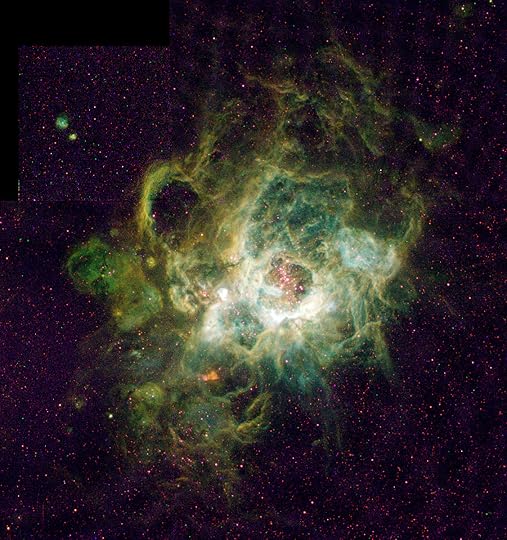 NGC-604 Stellar Nursery
Photo courtesy NASA via Wikimedia CommonsThis rules out even the bizarre so-called life forms such as those proposed by the article which sited three possible extreme environments that its author was hopeful to find new forms of life—gas clouds, inside stars, and on neutron stars. Gas clouds in space show some electrical activity, but nothing that is actually reproducing, metabolizing, etc. Hot stars are made of plasma, and plasma is a form of matter where the electrons are dissociated from their atoms, meaning the atoms can't really do much in the way of chemistry required to meet any of the definitions of life. Neutron stars are in an even greater state of dissociation, the gravity is so intense that the atoms have broken up into electron layers, neutron layers (hence the name), etc. No bio-chemistry at all is possible here. At best I think we might find something analogous to a virus in such extreme environments, but I doubt it since even viruses (which are not alive, as they do not metabolize or grow) require more structure than these environments provide. But what about the alternate structured life forms the article suggests?
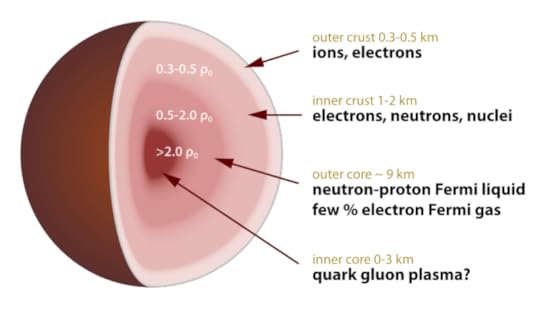 Neutron Star Structure
Courtesy Robert Schulze
Wikimedia Commons
Life here on Earth is carbon-based, meaning that the basic element that comprises most of life's basic structure is carbon. Without carbon there could be no DNA, no cells, no food, no proteins��—you get the picture. I'm sure you've heard the term "organic" in reference to things that are natural or having to do with living things, and with good reason. In chemistry, "organic" means "containing carbon atoms."
But why carbon? Without getting too much into the details, carbon is 1) abundant since even smaller stars can make it, and 2) it forms stable, complex bonds with other elements. Taken together, both reasons make carbon an extremely likely choice for life everywhere in the universe. Even silicon, which is often sited as an alternative element to carbon in possible extra-terrestrial life, does not form nearly the number of stable bonds that carbon does, and research into the possibility of silicon-based life has shown that the element, for all its similarities to carbon, can't naturally form the complex structures required for a self-replicating system (like DNA), making it an unlikely candidate to replace carbon in alien biochemistry. I invite you to read NASA's research summary on the topic.
But what about alternative structures that still use carbon? Ah! Here is a much more likely area for life not as we know it to exist.
 Mono Lake, CA, USA-Photo courtesy Michael Gäbler via Wikimedia Commons
In recent years there was some excitement about the possibility that this wasn't entirely true. In 2010 a microbe called GFAJ-1 in California's Mono Lake was found to be thriving in an environment that consisted primarily of arsenic. The scientists who discovered this thought that GFAJ-1 might be using arsenic instead of phosphorus in its DNA (phosphorus is important for the backbone that supports the ladder-like structure), since arsenic and phosphorus are chemically similar. If this were to be true, it would mean that life could exist in much more extreme environments than we thought possible (and carbon based life already exists in some very extreme environments in the form of a group of organisms called Extremophiles). Unfortunately, it was later found that GFAJ-1 has a strong preference for phosphorus over arsenic, and the substitution was likely an adaptation to its arsenic-concentrated environment.
 Snottites in Cueva de Villa Luz in Southern Mexico
Photo Courtesy NASA & Wikimedia CommonsGFAJ-1 (along with my personal favorite, snottites that live in acid-rich environments) illustrates the point that life can exist in some pretty weird places. With new planets being discovered all the time, and with more and more of them being analyzed as Earth-like, I am quite hopeful that we will find life on other planets. I would even go so far as to say it is inevitable. What has really got me excited, is that since it is very likely such life will be carbon-based, there is the possibility that if such life proves to be sentient like we are, there is an increased chance that we will be able to understand each other. We'll certainly have more in common with another carbon-based life form than we would with anything else.
In order to answer that we have to define what something is when it is alive. After consulting Webster's New World Dictionary and Dictionary.com, it seems the simplest definition is something that has a metabolism, engages in growth, reproduction, and adaptation to its environment. In order for something to metabolize, grow, reproduce, and adapt it has to have some kind of structure.
 NGC-604 Stellar Nursery
Photo courtesy NASA via Wikimedia CommonsThis rules out even the bizarre so-called life forms such as those proposed by the article which sited three possible extreme environments that its author was hopeful to find new forms of life—gas clouds, inside stars, and on neutron stars. Gas clouds in space show some electrical activity, but nothing that is actually reproducing, metabolizing, etc. Hot stars are made of plasma, and plasma is a form of matter where the electrons are dissociated from their atoms, meaning the atoms can't really do much in the way of chemistry required to meet any of the definitions of life. Neutron stars are in an even greater state of dissociation, the gravity is so intense that the atoms have broken up into electron layers, neutron layers (hence the name), etc. No bio-chemistry at all is possible here. At best I think we might find something analogous to a virus in such extreme environments, but I doubt it since even viruses (which are not alive, as they do not metabolize or grow) require more structure than these environments provide. But what about the alternate structured life forms the article suggests?
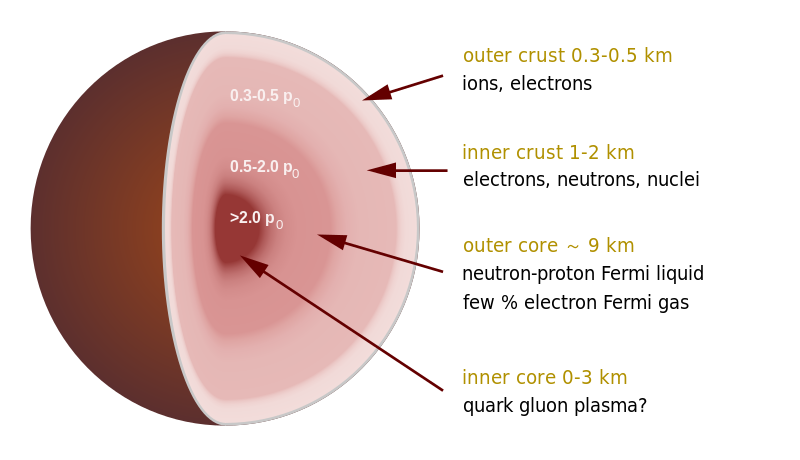 Neutron Star Structure
Courtesy Robert Schulze
Wikimedia Commons
Life here on Earth is carbon-based, meaning that the basic element that comprises most of life's basic structure is carbon. Without carbon there could be no DNA, no cells, no food, no proteins��—you get the picture. I'm sure you've heard the term "organic" in reference to things that are natural or having to do with living things, and with good reason. In chemistry, "organic" means "containing carbon atoms."
But why carbon? Without getting too much into the details, carbon is 1) abundant since even smaller stars can make it, and 2) it forms stable, complex bonds with other elements. Taken together, both reasons make carbon an extremely likely choice for life everywhere in the universe. Even silicon, which is often sited as an alternative element to carbon in possible extra-terrestrial life, does not form nearly the number of stable bonds that carbon does, and research into the possibility of silicon-based life has shown that the element, for all its similarities to carbon, can't naturally form the complex structures required for a self-replicating system (like DNA), making it an unlikely candidate to replace carbon in alien biochemistry. I invite you to read NASA's research summary on the topic.
But what about alternative structures that still use carbon? Ah! Here is a much more likely area for life not as we know it to exist.
 Mono Lake, CA, USA-Photo courtesy Michael Gäbler via Wikimedia Commons
In recent years there was some excitement about the possibility that this wasn't entirely true. In 2010 a microbe called GFAJ-1 in California's Mono Lake was found to be thriving in an environment that consisted primarily of arsenic. The scientists who discovered this thought that GFAJ-1 might be using arsenic instead of phosphorus in its DNA (phosphorus is important for the backbone that supports the ladder-like structure), since arsenic and phosphorus are chemically similar. If this were to be true, it would mean that life could exist in much more extreme environments than we thought possible (and carbon based life already exists in some very extreme environments in the form of a group of organisms called Extremophiles). Unfortunately, it was later found that GFAJ-1 has a strong preference for phosphorus over arsenic, and the substitution was likely an adaptation to its arsenic-concentrated environment.
 Snottites in Cueva de Villa Luz in Southern Mexico
Photo Courtesy NASA & Wikimedia CommonsGFAJ-1 (along with my personal favorite, snottites that live in acid-rich environments) illustrates the point that life can exist in some pretty weird places. With new planets being discovered all the time, and with more and more of them being analyzed as Earth-like, I am quite hopeful that we will find life on other planets. I would even go so far as to say it is inevitable. What has really got me excited, is that since it is very likely such life will be carbon-based, there is the possibility that if such life proves to be sentient like we are, there is an increased chance that we will be able to understand each other. We'll certainly have more in common with another carbon-based life form than we would with anything else.
January 5, 2013
Scifi Picks for 2013 Part 2: Movies
2013 is going to be a great year for spec-fic fans.
There are a slew of speculative fiction movies coming out over the next 12 months. Speculative fiction will be represented in everything from mega-blockbusters to small releases. Below are some of the up and coming films that are just a sample of what's ahead.
Elysium
Staring: Matt Damon, Jodie Foster
Intrigued? I am. Although the trailer doesn't really do more than set up the environment, a trip over to the movie's IMDB page reveals Elysium is about the fight for equality at the end of the 21st century where the elite live in a space station above a ruined Earth (where the rest of us are forced to scrape out an existence.) Has the plot been done before? Sure, but the world looks interesting, and I'm amused by the Armadyne website. If the movie itself shows at least the same level of creativity, we're in for a good one.
Man of SteelStaring: Henry Cavill, Russel Crowe, Amy Adams
Yup, it's Superman again. This take on the 80 year old superhero is being done by director Zack Snyder, the same man who directed 300, Watchmen, and Sucker Punch. At the very least this movie is going to be visually stunning. It's not that I didn't like 300 or Watchmen—I loved Watchmen—but I'm wary of yet another Superman movie that's taking us in a new direction. On top of that, it is yet another reboot (I'm getting tired of reboots). This one is supposed to be a bit of a darker spin on the story, which I'm looking forward to, but I am not 100% sure it's actually going to be a good movie. Hopefully, this won't be the case.
Pacific RimStarring: Idris Elba, Charlie Hunnam, Rinko Kikuchi
I'll be honest with you. I hate giant robot movies (I don't even like the Transformers; I know, I know, blasphemy!) despite loving robots. My brain just doesn't accept them—they'd be too heavy to move, the power required for such things is absurd, how the hell would we build something that big?—you get the picture. It's a shame, too, since I am a big fan of Idris Elba (Prometheus, Luther), and this movie not only looks pretty (as expected from director Guillermo Del Toro) but I really want to see the combat training sequences (I'm a sucker for martial arts). I just don't think I can bring myself to watch a movie where giant robots fight giant alien monsters from a rift in space time under the ocean... Maybe I'll catch it on Netflix in a year, but I don't think I'm going to shell out for this one in the movie theater. Still, if giant robots and monsters are your thing, you'll probably love this movie.
Oz the Great and Powerful
Staring: James Franco, Michelle Williams, Rachel Weisz, Mila Kunis
I grew up watching the Wizard of Oz reruns every year around Thanksgiving time on TV, and I'm very much looking forward to this new take/back-story. From the looks of things it's going to be a combination of nods to the original story and a modern interpretation of Oz itself. I'm a fan of James Franco and Rachel Weisz, which only adds to the excitement for me. I've really got my fingers crossed that Oz the Great and Powerful will deliver.
Iron Man 3
Starring: Robert Downey Jr., Guy Pierce, Ben Kingsley
I was pleasantly surprised by the first Robert Downey Jr. Iron Man, and haven't really been disappointed at all as his appearances in Iron Man 2 and the Avengers have rolled out. The trailer has me a bit iffy about 3, however. These "hero gets brought low, then rebuilds himself" movies are so common that I almost feel like they're becoming a bit worn, but if done right it can still make for good entertainment. Hopefully, it will.
Star Trek Into Darkness
Staring: Chris Pine, Zachary Quinto, Zoe Saldana, Simon Pegg, Karl Urban, John Cho, Anton Yelchin
If I only get to see one movie this year, this is going to be it. JJ Abrams' take on Star Trek is one of my favorite movies of the last decade, and I can't tell you how much I'm looking forward to the next installment. He's also done a masterful job of building the suspense for who the villain, played by Benedict Cumberbatch, will be. Is it Khan? Is he new? Time will tell, but I'm chomping at the bit to see how this all plays out!
December 29, 2012
Sci-Fi Picks for 2013- Part1: Games
The end of 2012 approaches, and since we didn't die in a rain of fire on the 22nd, it's about that time when everyone starts coming out with lists.
The last few weeks have been busy ones for me. I've been working on getting a cover for the upcoming short stories set in the Blood Siren universe, as well as lining up one for the sequel, "Keltan's Gambit."
I've also been working on some new chapters, and adding elements to streamline the new additions into the universe as a whole.
Part of what I do to keep myself in the mindframe of a future world when not writing, is to watch trailers for the latest sci-fi media. 2013 promises to be a good year for sci-fi, and today I'd like to share what I've been looking at with you, starting with my 5 picks for sci-fi related video games in 2013.
5. Fuse- or, the game formerly known as Overstrike
I'm a little conflicted about this. Fuse was originally called "Overstrike" and was initially marketed as a quirky shooter that looked like a ton of fun. Apparently, EA has repackaged the game, now called "Fuse," as a darker and more standard-looking 3rd person shooter. Quite frankly, it looks like a lot less fun to me, but hopefully I'm wrong. Below is the Fuse trailer, followed by the original Overstrike trailer.
4. Metal Gear Rising Revengeance and Metal Gear Solid Grounds Zero
Two Metal Gear installments are up for release in 2013. The first in January, Metal Gear Rising Reveangeance, focuses on Raiden—a sword-wielding cyborg warrior introduced in Metal Gear Solid 2: Sons of Liberty. Despite its seeming cheese-factor, I'm a bit of a sucker for high-tech sword fighting (swords turn up in my writing all the time), and it looks like it might be fun to get some serious cyborg-slashing action that this game promises.
Metal Gear Solid: Grounds Zero is due out late next year (rumored to be September 2013), and features the hero of the series, Solid Snake. I'm not sure I buy the "guy hunched over from age but still kicking ass" thing, and I wasn't so hot on the last Metal Gear Solid installment, but as with every MGS game it has the potential to be something very cool. The first MGS game remains one of my all-time favorites—ever.
The trailer is 10 minutes long, so rather than feature it here, you can click on this link to see it.
3. Tomb Raider: Survivor
I was never big into Tomb Raider back in the day, but this reboot has me interested. Unlike the lonely romps through forgotten caverns that the first of the series had, Survivor looks to be an Uncharted style romp through a trap and treasure-hunter infested wilderness. Making this a reboot with an unexperienced Lara Croft may have been a stroke of genius, or it may wind up falling flat. Time will tell.
2. The Last of Us
In my humble opinion this was one of the most interesting trailers from 2012's E3. This game, made by the same folks that brought you Uncharted, takes place in a post-apocalyptic world where you not only have to figure out how to survive, but must also defend your young, female companion. With good graphics and a story that sounds compelling, I'm looking forward to playing this one next year.
1. Beyond Two Souls
This is one I'm definitely looking forward to. Besides being a sucker for swordplay, I'm a huge sucker for psychic powers, secret organizations, and all out mind-versus-gun fights. This game has it all. I'm chomping at the bit to get at this one in 2013!
-And that's my top 5 for games. Next post I'll write about the promising sci-fi movies of 2013. Be sure to check it out!
December 9, 2012
Auroratrek - An original sci-fi movie worth your time!
While scanning Youtube for sci-fi clips I came across this gem.
It's a story set in the Star Trek universe made by Auroratrek. Instead of focusing on Starfleet, it follows the exploits of an independent merchant, Kara Carpenter, and her vulcan first mate, T'Ling. The story is first rate, and quite touching as well. Although a little slow at first, it is absolutely worth an hour of your time. Below you'll find the movie in its entirety, but Youtube has it broken into episodes if you just want a sample first.
Here's the synopsis from the website (auroratrek.com)
"Star Trek: Aurora follows the exploits of captain Kara Carpenter and her new (and only) Vulcan first mate T'Ling on their tiny merchanter cargo ship Aurora. This fully CG-animated movie is set just after the original Star Trek series in a lawless sector of space, where Kara and T'Ling engage in their marginal venture while trying to both turn a profit and stay out of trouble, but even in the vastness of space, trouble is never far away...and sometimes the past is never far enough behind."
-Excerpt from http://www.auroratrek.com/about2.html
If you'd rather watch the movie on the website, you can find it here.

Nero's Niche
Blogging about the things that inspire my writing: science, science fiction, fantasy, and the universe around us!
- Michael Formichelli's profile
- 23 followers


