
Michael Formichelli's Blog: Nero's Niche, page 15
May 11, 2013
Alien Communication
Something I've been thinking about a lot recently is how we might communicate with an intelligent alien species once we encounter them. What will first contact really be like in this regard? Scientific speculation on the matter is quite varied, and some think that it may not be possible at all. However, there are a few general assumptions about life on other worlds, and the requirements for a species to reach technological complexity, that seem to lend hope.
First, we need to look at evolution and natural selection as the current dominating theory of how life changes through time. Here on Earth, the general direction of Evolution has been towards greater complexity. From early, single-celled organisms to humans, life has gotten increasingly complicated since it first started struggling to survive. We expect that this process will be the same no matter where we go in the universe. It is hard to imagine how else life might arise from stardust (basic elements) as it has, and this is a good thing where communication is concerned.
 Image Credit: Falense
Via Wikimedia Commons
All complex life on Earth has the same basic needs because we all have the same struggle to survive and pass on our genes to the next generation. We all need energy (food), a means to secure our resources (claws, fangs, venom, swords, guns, etc.) since all life is in competition with all other life for energy, and a way to make a next generation. The reasons why we do are dictated by the laws of physics and chemistry that we think are universal, so unless physics is different in different parts of the universe, it's safe to assume that life in all parts of the universe will have the same basic needs. This means that an alien language will probably have "words" for activities and things associated with satisfying basic needs, e.g. food, weapon, reproduction, etc.
So that covers the basics, but how do we go from that to skyscrapers, philosophy, and space ships?
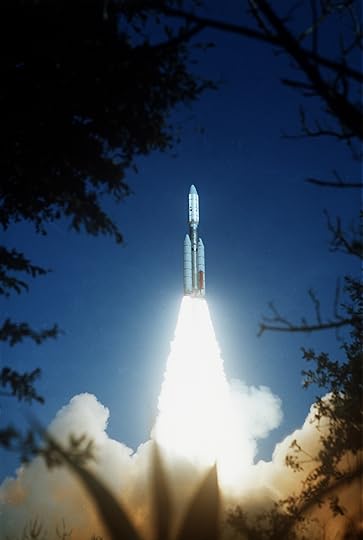 Voyager 2 Launch 1977
Image Credit: NASA/JPL
This requires a wholly different level of life—a form of life that can process complex and abstract concepts like the laws of physics, mathematics, etc. This is more good news in terms of communication between advanced species, since it means we will probably share these complex concepts between us (which again, arise out of the laws of physics). This has been the prevailing thought since the 19th century when people thought that intelligent life might exist on the moon and mars, and were already thinking about how to contact that life.
The German mathematician and physicist Carl Friedrich Gauss thought that we might be able to communicate with life on other worlds, like Mars or Venus, by building huge geometric shapes in the Siberian tundra. The Austrian astronomer Joseph Johann Littrow felt we could do the same by digging long trenches in the Sahara Desert and lighting them on fire with Kerosene. In modern times the theories of shared mathematical understanding have evolved. Since an advanced civilization like ours today requires advanced mathematics, more recent attempts to come up with exolinguistic systems (Exolinguistics is the hypothetical study of alien languages) have focused on communicating with abstract mathematical concepts.
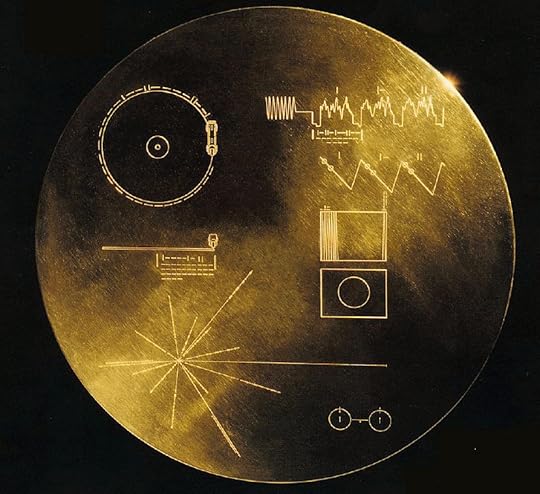 The Golden Record on Voyager 1
Image Credit: JPL, NASA
Astraglossa, Lincos, and a system using prime numbers invented by Carl Sagan all represent these modern attempts at building a cross-species language based on mathematical concepts using simple symbols.
A more ambitious attempt at alien communication was made by Dr. Carl Sagan, with the Voyager project's inclusion of the "Golden Record" on both Voyager spacecraft.
"The contents of the record were selected for NASA by a committee chaired by Carl Sagan of Cornell University, et. al. Dr. Sagan and his associates assembled 115 images and a variety of natural sounds, such as those made by surf, wind and thunder, birds, whales, and other animals. To this they added musical selections from different cultures and eras, and spoken greetings from Earth-people in fifty-five languages, and printed messages from President Carter and U.N. Secretary General Waldheim. Each record is encased in a protective aluminum jacket, together with a cartridge and a needle. Instructions, in symbolic language, explain the origin of the spacecraft and indicate how the record is to be played. The 115 images are encoded in analog form. The remainder of the record is in audio, designed to be played at 16-2/3 revolutions per minute. It contains the spoken greetings, beginning with Akkadian, which was spoken in Sumer about six thousand years ago, and ending with Wu, a modern Chinese dialect. Following the section on the sounds of Earth, there is an eclectic 90-minute selection of music, including both Eastern and Western classics and a variety of ethnic music. Once the Voyager spacecraft leave the solar system (by 1990, both will be beyond the orbit of Pluto), they will find themselves in empty space. It will be forty thousand years before they make a close approach to any other planetary system. As Carl Sagan has noted, "The spacecraft will be encountered and the record played only if there are advanced spacefaring civilizations in interstellar space. But the launching of this bottle into the cosmic ocean says something very hopeful about life on this planet."
-Quoted from : Voyager The Interstellar Mission, The Golden Record page (http://voyager.jpl.nasa.gov/spacecraft/goldenrec.html)
Although it is unlikely that any civilization except our own will pick up the Voyager spacecraft (if it's going to take 40,000 years to reach the next star system, I'd like to think we'd have some kind of star drive well before then), the attempt at communication with an alien civilization made by these craft was still a worthwhile one. Given the number of stars in the galaxy, and our recent discovery that planet formation, and even Earth-like planet formation is relatively common, building a system of cross-alien-species communication is going to be an important part of our future.
Who knows? Maybe one day there will be a Rosetta Stone software program for Kepler-62 aliens.
First, we need to look at evolution and natural selection as the current dominating theory of how life changes through time. Here on Earth, the general direction of Evolution has been towards greater complexity. From early, single-celled organisms to humans, life has gotten increasingly complicated since it first started struggling to survive. We expect that this process will be the same no matter where we go in the universe. It is hard to imagine how else life might arise from stardust (basic elements) as it has, and this is a good thing where communication is concerned.
 Image Credit: Falense
Via Wikimedia Commons
All complex life on Earth has the same basic needs because we all have the same struggle to survive and pass on our genes to the next generation. We all need energy (food), a means to secure our resources (claws, fangs, venom, swords, guns, etc.) since all life is in competition with all other life for energy, and a way to make a next generation. The reasons why we do are dictated by the laws of physics and chemistry that we think are universal, so unless physics is different in different parts of the universe, it's safe to assume that life in all parts of the universe will have the same basic needs. This means that an alien language will probably have "words" for activities and things associated with satisfying basic needs, e.g. food, weapon, reproduction, etc.
So that covers the basics, but how do we go from that to skyscrapers, philosophy, and space ships?
 Voyager 2 Launch 1977
Image Credit: NASA/JPL
This requires a wholly different level of life—a form of life that can process complex and abstract concepts like the laws of physics, mathematics, etc. This is more good news in terms of communication between advanced species, since it means we will probably share these complex concepts between us (which again, arise out of the laws of physics). This has been the prevailing thought since the 19th century when people thought that intelligent life might exist on the moon and mars, and were already thinking about how to contact that life.
The German mathematician and physicist Carl Friedrich Gauss thought that we might be able to communicate with life on other worlds, like Mars or Venus, by building huge geometric shapes in the Siberian tundra. The Austrian astronomer Joseph Johann Littrow felt we could do the same by digging long trenches in the Sahara Desert and lighting them on fire with Kerosene. In modern times the theories of shared mathematical understanding have evolved. Since an advanced civilization like ours today requires advanced mathematics, more recent attempts to come up with exolinguistic systems (Exolinguistics is the hypothetical study of alien languages) have focused on communicating with abstract mathematical concepts.
 The Golden Record on Voyager 1
Image Credit: JPL, NASA
Astraglossa, Lincos, and a system using prime numbers invented by Carl Sagan all represent these modern attempts at building a cross-species language based on mathematical concepts using simple symbols.
A more ambitious attempt at alien communication was made by Dr. Carl Sagan, with the Voyager project's inclusion of the "Golden Record" on both Voyager spacecraft.
"The contents of the record were selected for NASA by a committee chaired by Carl Sagan of Cornell University, et. al. Dr. Sagan and his associates assembled 115 images and a variety of natural sounds, such as those made by surf, wind and thunder, birds, whales, and other animals. To this they added musical selections from different cultures and eras, and spoken greetings from Earth-people in fifty-five languages, and printed messages from President Carter and U.N. Secretary General Waldheim. Each record is encased in a protective aluminum jacket, together with a cartridge and a needle. Instructions, in symbolic language, explain the origin of the spacecraft and indicate how the record is to be played. The 115 images are encoded in analog form. The remainder of the record is in audio, designed to be played at 16-2/3 revolutions per minute. It contains the spoken greetings, beginning with Akkadian, which was spoken in Sumer about six thousand years ago, and ending with Wu, a modern Chinese dialect. Following the section on the sounds of Earth, there is an eclectic 90-minute selection of music, including both Eastern and Western classics and a variety of ethnic music. Once the Voyager spacecraft leave the solar system (by 1990, both will be beyond the orbit of Pluto), they will find themselves in empty space. It will be forty thousand years before they make a close approach to any other planetary system. As Carl Sagan has noted, "The spacecraft will be encountered and the record played only if there are advanced spacefaring civilizations in interstellar space. But the launching of this bottle into the cosmic ocean says something very hopeful about life on this planet."
-Quoted from : Voyager The Interstellar Mission, The Golden Record page (http://voyager.jpl.nasa.gov/spacecraft/goldenrec.html)
Although it is unlikely that any civilization except our own will pick up the Voyager spacecraft (if it's going to take 40,000 years to reach the next star system, I'd like to think we'd have some kind of star drive well before then), the attempt at communication with an alien civilization made by these craft was still a worthwhile one. Given the number of stars in the galaxy, and our recent discovery that planet formation, and even Earth-like planet formation is relatively common, building a system of cross-alien-species communication is going to be an important part of our future.
Who knows? Maybe one day there will be a Rosetta Stone software program for Kepler-62 aliens.


May 4, 2013
Sample of the Golden Mean
As part of the release this week of my new ebook short story, The Golden Mean, below is a short sample from that story. I hope you all enjoy it!
 Cover Art by Michael Lam 2013
From the Golden Mean by Michael Formichelli:
The lift struck the floor hard enough to send a jolt through Merte's body. The sound made her jump inside, though it was worse in the old days when there were nothing but tunnels and mining equipment on this level. They were gone now, along with long hours in the dark and the stink of sweaty miners and ozone from the machines. Merte's revolution banished such things to the realm of stories a long time ago. The construction on this level was all new. The gray halls were well lit and the apartments all had modern, iris style doors. It was all thanks to a deal Ram worked out with a Confederate trader ten years ago that included, along with modern doors and lights, getting proper radiation shielding for the colony. Merte didn't need to know the details of how he pulled that off with their limited funds. She knew that not asking questions of Ram or most of their visitors was the path to happiness. New Bimini was on the edge of the Confederation. The system was located along the shared border with the Orgnan Empire and the only thing scarier than their interstellar slave economy—the Revok Domain. Far from of the center of Confederate life on Kosfanter, most of their visitors were Orgnan, Revok, or Confederate citizens looking to do things out of the Confederate Space Authority's sight. The population of New Bimini was a mixed group, mostly human since the ETMC was a Terran corporate barony, but there were also high numbers of Galaeneans, and Volgoth thanks to the illegal slave trading the ETMC conducted in the old days. Members of all groups waved cheerfully to her as Merte headed for Oroth's, the restaurant that old timers like herself favored. "What's this all about, Merte?" Das'Voq stood in front of a pair of glass doors interrupting the regularity of the corridor—the entrance to Oroth's.He masticated a length of blasting cable in the fleshy beak of his mouth. It was a habit of his from the old days before the revolution, and for a moment the excitement of that time rushed through her like a rogue wave. She couldn't help a smile from creeping onto her face. His mottled brown-and-blue skin matched the loose tunic and pants he wore on his well-muscled frame. Das'Voq was a surly Galaenean with hot, purple eyes above a modest, single cheekbone that stretched from one side of his face to the other. Although Galaeneans were gender-shifters similar to amphibious creatures on Earth, Das'Voq had spent decades in his male form due to their shared condition, and Merte often attributed his ornery disposition to it even though she knew she shouldn't. He was willful even when she first met him all those years ago in his female mode. "You'll find out on the inside, Das, like everyone else." "Even I have to wait?" He spat the cable out with a sound that was something between a pop and a bark. "So being your mate gets me nothing, huh?" Merte shook her head, bent down, and picked up the ten centimeter length of cable. "It gets you out of consequences for this." Merte held up the cable. "If you were anyone else I'd fine you for littering." "Me? It is a cold female that fines her life-mate, Merte." His mouth dropped open and his tongue lolled to the side, but she knew his ire was faked. His mottled skin would dull if Das'Voq was really upset. "Watch it or I'll have you locked up as well," she said. "That has possibilities.""Shut up and get in the restaurant." Merte rolled her eyes.
The Golden Mean is available for Kindle for $0.99!
 Cover Art by Michael Lam 2013
From the Golden Mean by Michael Formichelli:
The lift struck the floor hard enough to send a jolt through Merte's body. The sound made her jump inside, though it was worse in the old days when there were nothing but tunnels and mining equipment on this level. They were gone now, along with long hours in the dark and the stink of sweaty miners and ozone from the machines. Merte's revolution banished such things to the realm of stories a long time ago. The construction on this level was all new. The gray halls were well lit and the apartments all had modern, iris style doors. It was all thanks to a deal Ram worked out with a Confederate trader ten years ago that included, along with modern doors and lights, getting proper radiation shielding for the colony. Merte didn't need to know the details of how he pulled that off with their limited funds. She knew that not asking questions of Ram or most of their visitors was the path to happiness. New Bimini was on the edge of the Confederation. The system was located along the shared border with the Orgnan Empire and the only thing scarier than their interstellar slave economy—the Revok Domain. Far from of the center of Confederate life on Kosfanter, most of their visitors were Orgnan, Revok, or Confederate citizens looking to do things out of the Confederate Space Authority's sight. The population of New Bimini was a mixed group, mostly human since the ETMC was a Terran corporate barony, but there were also high numbers of Galaeneans, and Volgoth thanks to the illegal slave trading the ETMC conducted in the old days. Members of all groups waved cheerfully to her as Merte headed for Oroth's, the restaurant that old timers like herself favored. "What's this all about, Merte?" Das'Voq stood in front of a pair of glass doors interrupting the regularity of the corridor—the entrance to Oroth's.He masticated a length of blasting cable in the fleshy beak of his mouth. It was a habit of his from the old days before the revolution, and for a moment the excitement of that time rushed through her like a rogue wave. She couldn't help a smile from creeping onto her face. His mottled brown-and-blue skin matched the loose tunic and pants he wore on his well-muscled frame. Das'Voq was a surly Galaenean with hot, purple eyes above a modest, single cheekbone that stretched from one side of his face to the other. Although Galaeneans were gender-shifters similar to amphibious creatures on Earth, Das'Voq had spent decades in his male form due to their shared condition, and Merte often attributed his ornery disposition to it even though she knew she shouldn't. He was willful even when she first met him all those years ago in his female mode. "You'll find out on the inside, Das, like everyone else." "Even I have to wait?" He spat the cable out with a sound that was something between a pop and a bark. "So being your mate gets me nothing, huh?" Merte shook her head, bent down, and picked up the ten centimeter length of cable. "It gets you out of consequences for this." Merte held up the cable. "If you were anyone else I'd fine you for littering." "Me? It is a cold female that fines her life-mate, Merte." His mouth dropped open and his tongue lolled to the side, but she knew his ire was faked. His mottled skin would dull if Das'Voq was really upset. "Watch it or I'll have you locked up as well," she said. "That has possibilities.""Shut up and get in the restaurant." Merte rolled her eyes.
The Golden Mean is available for Kindle for $0.99!
April 26, 2013
Astronauts and Bears
I recently read a European Space Agency article about the bed rest studies they are conducting to simulate the effects of weightlessness on the body. What's a bed rest study, you ask? It's one where volunteers are placed in hospital beds that have the head end tilted below the feet, and are told to remain there 24 hours a day for periods as long as 60 days.
You read that right. Participants eat, shower, read, surf the internet, exercise, etc. all without leaving their beds. The extended periods spent in bed cause the body to undergo the same degradation as astronauts experience in weightless environments. Bone and muscle loss, as well as metabolic changes, occur in a similar fashion in free fall as they do in bed. This research allows doctors and other scientists to study the effects of low and micro-gravity environments on people without having to spend the resources to get them into space.
Are these studies important?
As we reach for the stars with ever growing ambition mission times are increasing. Right now, astronauts spend long periods of time—up to six months—on the International Space Station, and with missions to Mars on the agenda, they will spend even longer living in micro-gravity. These studies will help scientists understand and prepare for the medical effects of such long missions. On the Earth-bound side of things, this research will help bedridden patients avoid debilitating effects.
One possible solution for long-term missions in space (and long-term stays in the hospital) comes from an unlikely source with a transhuman angle: bears.
 Image Courtesy Wikipedia Commons
By User: SimmEveryone knows that bears hibernate during the winter months to conserve energy. What might amaze you is that they don't lose muscle or bone mass while they do. Recent studies have shown that a hibernating bear is somehow able to regulate its metabolism so that its body does not go through the normal atrophy process (read an article about it here). The mechanisms of this amazing ability, it is thought, can be transferred to humans (we're both mammals, after all). Although still poorly understood, one day it might be possible to have astronauts hibernate their way from Earth to Mars or beyond and wake up just as fit as they were when they left Earth.
It also might be possible for people who are bedridden to receive similar benefits from this research. If you've ever had a broken bone you know that the immobilized limbs are atrophied when the cast comes off. Similar atrophy occurs for patients who are unable to move for extended periods of time. Learning the mechanisms bears use to avoid this fate may be adaptable to hospital patients, rendering physical therapy and rehabilitation a thing of the past. This could take the form of an injectable medicine, or perhaps, might be a gene, or set of genes, that can be transplanted into the human genome (which itself raises more issues around ethics).
Previous posts in this blog have opened discussions on cybernetic implants and genetic engineering. I'm ending this one with this thought:
If you could receive some kind of gene therapy to give you the power to hibernate or at least not experience muscle atrophy, would you take it?
April 20, 2013
New Earth-Like Planets, Plans to Discover Alien Life, and an Announcement!
I've got two things to share with you this week. First, there was big news this week in the hunt for Earth-like planets outside our solar system.
Kelper, the NASA space observatory, has discovered two Earth-like planets around a system named Kepler-62. Both planets appear to be "rocky" (as opposed to being gas giants) and have water on their surfaces. They are both within the habitable zone of their star as well, meaning that liquid water can be found on their surfaces making them strong candidates for finding life outside of Earth.
 Image Credit: NASA Ames/JPL-Caltech
Astronomers think that Kepler 62f is mostly, if not entirely, dominated by a massive ocean which may or may not be frozen like Jupiter's moon Europa (thought to be a ball of ice around a liquid water center, and a place we might find life outside of Earth in our own solar system). The reason for the uncertainty is our inability, at present, to detect the composition of its atmosphere. Given its distance from its sun, the atmosphere will play a key role in what kind of planet Kepler 62f is.
Kepler 62e, being closer to the orange-golden star, is more likely to have liquid oceans on its surface. There are plans in the works to launch a new orbital observatory, NASA's Transiting Exoplanet Survey Satellite (TESS), that will be able to see the chemical composition of the atmospheres of these worlds and others like them in 2017.
The TESS will be our first true window into determining if there is life as we know it on other planets outside the solar system by detecting what gasses are present on them. If we find the atmospheres have an Earth-like composition it makes the possibility for life as we understand it very high. If the TESS finds complex artificial molecules in the atmosphere of another world, like Freon, then we will finally have the answer to the question of whether or not we are alone in the galaxy.
Given that there have been nearly 3,000 Earth-like planets discovered so far, and the estimate of how many worlds in the galaxy are like our own stands at around 4.5 billion, I'd say it's only a matter of time before we discover another civilization like ours. Then the question will be, are they friendly, hostile, or indifferent?
And now for the second thing:
I've got a new short eBook story coming out this May called, The Golden Mean.

Will Paradise be Lost?
Beyond the edge of civilized space, Merte Algol has led the people of New Bimini from destitution under the thumb of the Extraterrestrial Mining Corporation to wealth and prosperity. When a message from the Confederation reveals that not only have they not been forgotten, but that they will be receiving a visitor from the most powerful being in human space, it puts everything they have achieved in jeopardy.
Can Merte save the colony? Or is their fragile paradise coming to an end?
Find out in The Golden Mean!Coming in May of 2013!
April 12, 2013
NASA's Plan to Capture a Wild Asteroid
I'm not sure how I missed this up until now, but included in NASA's 2014 budget is a plan to develop a robot space craft to locate, capture, and return with an entire asteroid which will then be placed in a stable orbit around the "Earth-Moon System" which I take to mean the orbit will be beyond that of our moon—I'm guessing for safety reasons since it would be a bit of a problem if NASA caused an asteroid to crash in a populated area.
My first reaction to hearing the news was, "wow, that's crazy," but the more I read about it the more I realized how wrong that reaction was. The mission will involve several new technologies, and is being used as both a precursor to our plan to put humans on Mars by the 2030's and as an opportunity to study an asteroid up close. Previous asteroid studies have been done by probes, but this one will involve humans riding up in the new Orion space capsule and studying the asteroid first-hand.
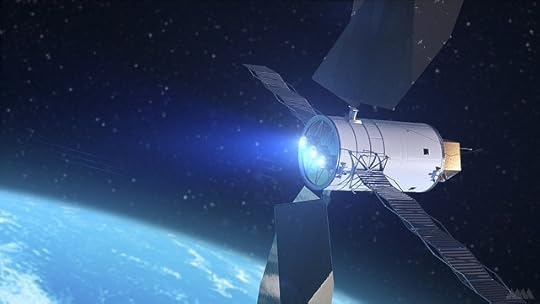 Artist's concept of the Solar-Electric Propulsion System
Photo by NASA HQ PHOTO'S PHOTOSTREAMThe asteroid capture mission a.k.a. the "Asteroid Initiative" will use a robotic probe at first, utilizing the new solar-electric propulsion system to grab the asteroid and place it in the desired orbit. Once that is accomplished, astronauts will utilize the Space Launch System NASA has developed and travel to the asteroid to perform tests and take samples.
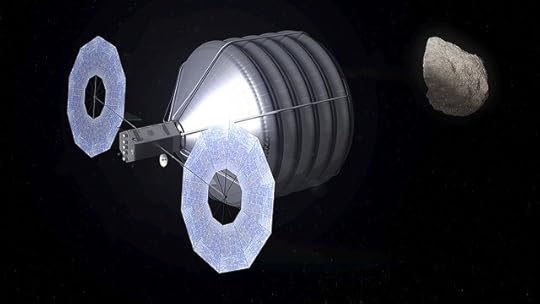 Artist's concept of the asteroid capture in progress
Photo by NASA HQ PHOTO'S PHOTOSTREAM
The new orbit of the asteroid will make it readily available for future missions to visit, and the use of all of the technologies involved serves as an early field test for our missions to Mars, as well as the technology needed to protect the Earth from asteroid impacts.
As amazing as all of this is, the mission's existence has become controversial since it displaced plans for a NASA led return to the moon. Under President Obama's direction, the asteroid capture mission has become the priority, despite objections from certain members of congress. Representative Bill Posey of Florida has introduced legislation which would direct NASA to return to the moon by 2022, however, this puts him at odds with both the President of the United States and NASA Administrator Charles Bolden, who stated "NASA will not take the lead on a human lunar mission." He also said that if another nation mounts a lunar mission NASA will be happy to be a part of it, but that it had no actual plans of its own to return to the moon within Mr. Bolden's lifetime. Which side of the debate will win out is anyone's guess.
If you'd like to learn more about the asteroid capture mission I invite you to follow these links and watch the animated video below:
http://www.nasa.gov/mission_pages/asteroids/news/asteroid_initiative.html
http://news.yahoo.com/nasa-proposal-reignites-asteroid-vs-return-moon-controversy-170800279.html
(Video by NASA via YouTube)
My first reaction to hearing the news was, "wow, that's crazy," but the more I read about it the more I realized how wrong that reaction was. The mission will involve several new technologies, and is being used as both a precursor to our plan to put humans on Mars by the 2030's and as an opportunity to study an asteroid up close. Previous asteroid studies have been done by probes, but this one will involve humans riding up in the new Orion space capsule and studying the asteroid first-hand.
 Artist's concept of the Solar-Electric Propulsion System
Photo by NASA HQ PHOTO'S PHOTOSTREAMThe asteroid capture mission a.k.a. the "Asteroid Initiative" will use a robotic probe at first, utilizing the new solar-electric propulsion system to grab the asteroid and place it in the desired orbit. Once that is accomplished, astronauts will utilize the Space Launch System NASA has developed and travel to the asteroid to perform tests and take samples.
 Artist's concept of the asteroid capture in progress
Photo by NASA HQ PHOTO'S PHOTOSTREAM
The new orbit of the asteroid will make it readily available for future missions to visit, and the use of all of the technologies involved serves as an early field test for our missions to Mars, as well as the technology needed to protect the Earth from asteroid impacts.
As amazing as all of this is, the mission's existence has become controversial since it displaced plans for a NASA led return to the moon. Under President Obama's direction, the asteroid capture mission has become the priority, despite objections from certain members of congress. Representative Bill Posey of Florida has introduced legislation which would direct NASA to return to the moon by 2022, however, this puts him at odds with both the President of the United States and NASA Administrator Charles Bolden, who stated "NASA will not take the lead on a human lunar mission." He also said that if another nation mounts a lunar mission NASA will be happy to be a part of it, but that it had no actual plans of its own to return to the moon within Mr. Bolden's lifetime. Which side of the debate will win out is anyone's guess.
If you'd like to learn more about the asteroid capture mission I invite you to follow these links and watch the animated video below:
http://www.nasa.gov/mission_pages/asteroids/news/asteroid_initiative.html
http://news.yahoo.com/nasa-proposal-reignites-asteroid-vs-return-moon-controversy-170800279.html
(Video by NASA via YouTube)
April 6, 2013
The Future of Human Space Exploration
"To be perfectly honest I think it would be sad for anybody not to want to go to space..."
-Richard Branson, Founder and Chairman of Virgin
I admit it, when President Obama opened space exploration to privatization in 2010 I was more than skeptical—I was disheartened. In my view at the time, I felt this would take space from the realm of everyone, a place of human destiny, to a profit-driven realm of the privileged few. That remains something of a concern for me, since space exploration is in everyone's self-interest.
As Carl Sagan once said, "...in the long run, every planetary civilization will be endangered by impacts from space, every surviving civilization is obliged to become spacefaring—not because of exploratory or romantic zeal, but for the most practical reason imaginable: staying alive..."
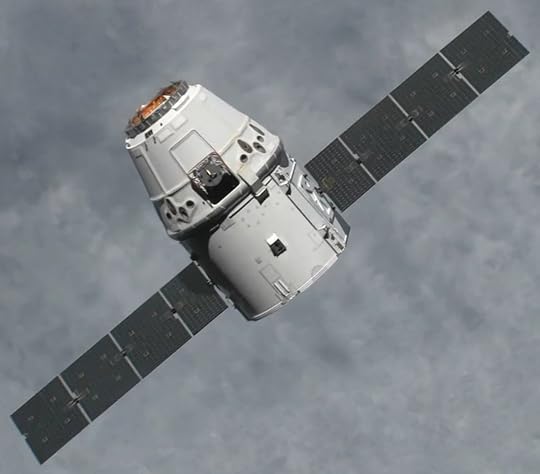 The Dragon Capsule in Earth Orbit
Photo by NASA via Wikimedia Commons
Although it remains to be seen what this new corporate space exploration will become, there are some rays of hope coming from those directly involved in it. NASA has not been sidelined, but has assumed a new role as a partner and funding source in this new arena. SpaceX's Dragon Capsule has shown that automated trans-atmospheric delivery vehicles can and do work quite well, paving the way for a more economic path to building the infrastructure we will need to ultimately shed our planetary bonds. Its success is leading the way for the crewed version, the Dragon Rider, to come into operation at 1/3 the per seat cost as the current Russian Soyuz craft. Not only that, but plans for the Red Dragon and Mars One Dragon craft have been drafted and will be proposed for funding to NASA later this year. Both vehicles will explore and pave the way for the targeted human presence on Mars in 2023.
Another source of hope in the private-space arena is Virgin Galactic. The child of Virgin founder Richard Branson, it aims to bring passengers and tourists into space. The Virgin system will be something of a revolution, as it abandons launch-pad systems for in-flight launches from a specialized airplane (currently, White Knight 2). This system has some advantages over pad launches as the starting point, being further away from the Earth's center of gravity, will require less energy expenditure on the part of the actual space-module (Space Ship 2) to reach the boundary of space than its terrestrial counterparts, but its main advantage lies in its purpose. I have great hope that the expanded access—making space more accessible to people—will create more of a sense that space really is for all of us, which in turn will lead to greater public interest around the world and by extension, greater funding for more ambitious missions. If this is successful, then the privatization of space will indeed have been a very good thing and an important step in bringing our future, our destiny as a species, to fruition.
Below is a video I watched on Space.com by Virgin Galactic and Richard Branson. In it you will see the White Knight 2 and Space Ship 2 in operation. Sir Branson's words were inspiring, and I hope this kind of attitude pervades the future of space exploration and colonization.
-Richard Branson, Founder and Chairman of Virgin
I admit it, when President Obama opened space exploration to privatization in 2010 I was more than skeptical—I was disheartened. In my view at the time, I felt this would take space from the realm of everyone, a place of human destiny, to a profit-driven realm of the privileged few. That remains something of a concern for me, since space exploration is in everyone's self-interest.
As Carl Sagan once said, "...in the long run, every planetary civilization will be endangered by impacts from space, every surviving civilization is obliged to become spacefaring—not because of exploratory or romantic zeal, but for the most practical reason imaginable: staying alive..."
 The Dragon Capsule in Earth Orbit
Photo by NASA via Wikimedia Commons
Although it remains to be seen what this new corporate space exploration will become, there are some rays of hope coming from those directly involved in it. NASA has not been sidelined, but has assumed a new role as a partner and funding source in this new arena. SpaceX's Dragon Capsule has shown that automated trans-atmospheric delivery vehicles can and do work quite well, paving the way for a more economic path to building the infrastructure we will need to ultimately shed our planetary bonds. Its success is leading the way for the crewed version, the Dragon Rider, to come into operation at 1/3 the per seat cost as the current Russian Soyuz craft. Not only that, but plans for the Red Dragon and Mars One Dragon craft have been drafted and will be proposed for funding to NASA later this year. Both vehicles will explore and pave the way for the targeted human presence on Mars in 2023.
Another source of hope in the private-space arena is Virgin Galactic. The child of Virgin founder Richard Branson, it aims to bring passengers and tourists into space. The Virgin system will be something of a revolution, as it abandons launch-pad systems for in-flight launches from a specialized airplane (currently, White Knight 2). This system has some advantages over pad launches as the starting point, being further away from the Earth's center of gravity, will require less energy expenditure on the part of the actual space-module (Space Ship 2) to reach the boundary of space than its terrestrial counterparts, but its main advantage lies in its purpose. I have great hope that the expanded access—making space more accessible to people—will create more of a sense that space really is for all of us, which in turn will lead to greater public interest around the world and by extension, greater funding for more ambitious missions. If this is successful, then the privatization of space will indeed have been a very good thing and an important step in bringing our future, our destiny as a species, to fruition.
Below is a video I watched on Space.com by Virgin Galactic and Richard Branson. In it you will see the White Knight 2 and Space Ship 2 in operation. Sir Branson's words were inspiring, and I hope this kind of attitude pervades the future of space exploration and colonization.
March 29, 2013
Thoughts on Genetic Engineering
 Double-Helix
Image from Wikipedia
by Brian0918Genetic engineering is a hot topic these days. As the human species gains the knowledge to alter the "source-code" of life with ever increasing accuracy, the ethical and medical issues surrounding such advances multiply with equal speed. Everything with DNA (or RNA) can be altered to become something else, from warm-weather plants modified to grow in the Canadian climate to animals that produce spider silk, and even human beings. Genetic engineering has also been a staple of a lot of speculative fiction for decades, and though much of what we see in fiction seems impossible, genetic scientists seem to move the line further out with every discovery.
The most commonly supported form of genetic engineering in humans is its use to cure diseases like diabetes, cystic fibrosis, and the like. Most often, this form of genetic engineering is used to justify the technology. With the power to end the massive suffering caused by genetic diseases, and gene-related diseases like cancer, there is a strong argument that it is our moral duty to explore this area of science and use it. If this were the only use of genetic engineering, there probably wouldn't be as much of an argument beyond the question of whether or not humans should change the basic code of life, but it is not the only way genetic engineering can, or is used.
 Image by PaleWhaleGail at en.wikipedia Right now, the most common forms of genetic engineering (at least that I know of) are used to give an organism, such as a plant or animal, the ability to do something it couldn't before by taking the genes for that ability from another organism. When I worked in a lab during the 1990's we used the technique to transfer whale myoglobin (a protein like hemoglobin that makes meat red in all mammals, and is part of the reason whales can hold their breath for so long) into bacteria, who would then produce the myoglobin in massive amounts. This served as a near limitless supply of myoglobin, and spared the lab from having to draw blood from actual whales every time they needed more for study. This is the same type of technique used to produce goats that make spider silk. The goats can make way more silk than an equivalent number of spiders, so they serve as a better resource for research of the silk.
 Image by Spedona via
Wikimedia CommonsThis type of engineering is also used to modify plants in our food supply to do things like resist pests better, or to grow in places they wouldn't be able to before. Corn, being a major cereal grain, is a common target of modification (along with rice), and have been altered with genes from various organisms, including bacteria, to do things like tolerate drought conditions better. This sounds like a great idea, until one considers that unintended consequences can result. A classic case of this, though created from intentional cross-breeding instead of genetic modification, is the Lenape potato.
Created in the 1960's by a popular snack company, the Lenape potato produced perfect potato chips. They were crispy, and tasted good. The only drawback was that they were also highly toxic. By cross-breeding two different types of potatoes, the company had accidentally created one that produced many times the natural defensive chemicals that potatoes create to ward off pests. People who ate the new potato chips got sick. Although this was a case of cross-breeding the traditional way that farmers have been doing for centuries, it is also a cautionary tale of unintended consequences which can and do occur in genetic engineering.
(By the way, don't eat green potatoes, they contain high amounts of the same defensive chemical.)
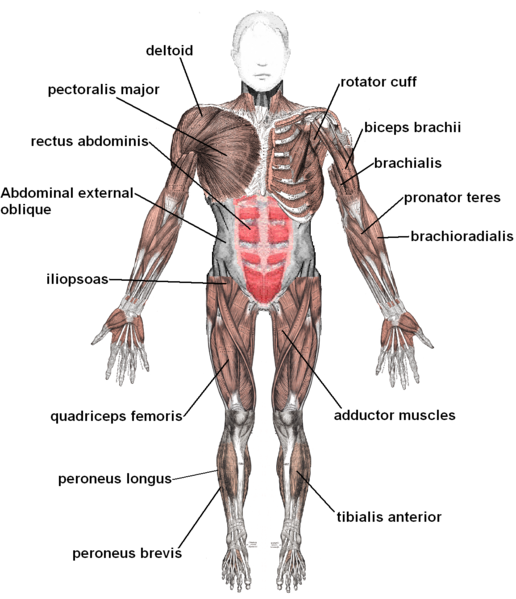 Image via Wikimedia Commons
From Gray's Anatomy, 1918 EditionThe most controversial type of genetic engineering is the modification of humans not intended to cure a painful or fatal disease. Several groups have stated their intentions to accomplish this in the near future around the world, though I don't know of any such research or active procedures that do this right now. The temptation, however, is quite intense. Imagine being able to get a shot at a doctor and, maybe days later, be able to see in the dark or run 20 miles per hour. What about hyper-intelligence? Ultrasonic hearing? Sonar? The ability to regenerate organs and limbs? Super strength, or perhaps you would like the ability to produce electricity like an electric eel? In theory, all of these things are possible by transplanting existing genes (or making new ones) from other organisms. Of course, the possibility is what has people so worried.
Who would control such technology? Who would benefit from it? Would it be restricted, by price, to the rich? Would everyone have access? Could companies require their employees to, say, acquire a gene that makes them need sleep less so they can work more hours? Is it even ethical to explore this possibility? These questions and many more will need to be answered by populations and governments as we move forward into the future.
Do the benefits outweigh the other issues?
March 22, 2013
March of the Clones
Recently scientists associated with the "Lazarus Project" out of the University of New South Wales in Sydney, Australia, successfully cloned an extinct variety of frog (Rheobatrachus silus a.k.a. Gastric Brooding Frog), bringing the species back to life, albeit only in embryo form. Although this seems like we'll be getting a Jurassic Park in a few years, the Lazarus Project has already said they have no intention of bringing dinosaurs back (on an NPR broadcast, I"ll link once it's up on the web), as the project's goal is to restore species that have gone extinct due to human activity.
Reading about Rheobatrachus silus, which is worth the read—it's a bizarre animal—got me wondering what the state of cloning is today. We might remember Dolly, the cloned sheep from the 1990's that made headlines, and who holds the title of the first mammal cloned from an adult cell (it was a mammary gland cell, hence the name "Dolly" —after Dolly Parton). I remember hearing news at the time that stated cloning Dolly was an arduous and expensive process, so I was curious about what advances have been made in the nearly two decades since.
According to this Wikipedia entry, there have been at least 22 cloned animals since Dolly including species as large as a horse and as small as a fruit fly. Apparently, the process has gotten easier, and it seems we're figuring out how to do better all the time.
The funny thing about cloning, is that people (at least here in the USA) tend to be very nervous about it. I'm sad to say this is probably the fault of my favorite genre—science fiction—filling everyone's head with the notion that "cloning" means making a complete copy of someone right down to their thoughts and past experiences and done all within a few minutes, hours, or days.
 Photo courtesy WikipediaNothing could be further from the truth. Cloning takes just as long to make an adult thing (be it animal, plant, etc) as natural reproduction. If someone were to take your DNA and clone a whole you, it would take however many years to reach your age of maturity as you did. Further, it would have none of your knowledge or skills since it would be growing up under different circumstances, taught by different people, in a different world than you did (temporally speaking)—though your clone may have your same liking for certain foods, etc. Other than being a mode of reproduction, there really is no point in cloning a whole person—and if that doesn't set your mind at ease, there is a chance you already know one since identical twins are naturally occurring clones.
There's far more use in cloning individual organs or other body parts than whole people. In fact, this research is going on right now, though it is slow for people due to the restrictive laws concerning using human stem cells and DNA in experiments. There has already been work done in this area on animals, however. Perhaps one day it will be possible to eliminate the need for organ donor and replace a failing heart or liver with a new one which is every bit as "you" as the rest of you.
Time will tell.
Reading about Rheobatrachus silus, which is worth the read—it's a bizarre animal—got me wondering what the state of cloning is today. We might remember Dolly, the cloned sheep from the 1990's that made headlines, and who holds the title of the first mammal cloned from an adult cell (it was a mammary gland cell, hence the name "Dolly" —after Dolly Parton). I remember hearing news at the time that stated cloning Dolly was an arduous and expensive process, so I was curious about what advances have been made in the nearly two decades since.
According to this Wikipedia entry, there have been at least 22 cloned animals since Dolly including species as large as a horse and as small as a fruit fly. Apparently, the process has gotten easier, and it seems we're figuring out how to do better all the time.
The funny thing about cloning, is that people (at least here in the USA) tend to be very nervous about it. I'm sad to say this is probably the fault of my favorite genre—science fiction—filling everyone's head with the notion that "cloning" means making a complete copy of someone right down to their thoughts and past experiences and done all within a few minutes, hours, or days.
 Photo courtesy WikipediaNothing could be further from the truth. Cloning takes just as long to make an adult thing (be it animal, plant, etc) as natural reproduction. If someone were to take your DNA and clone a whole you, it would take however many years to reach your age of maturity as you did. Further, it would have none of your knowledge or skills since it would be growing up under different circumstances, taught by different people, in a different world than you did (temporally speaking)—though your clone may have your same liking for certain foods, etc. Other than being a mode of reproduction, there really is no point in cloning a whole person—and if that doesn't set your mind at ease, there is a chance you already know one since identical twins are naturally occurring clones.
 There's far more use in cloning individual organs or other body parts than whole people. In fact, this research is going on right now, though it is slow for people due to the restrictive laws concerning using human stem cells and DNA in experiments. There has already been work done in this area on animals, however. Perhaps one day it will be possible to eliminate the need for organ donor and replace a failing heart or liver with a new one which is every bit as "you" as the rest of you.
Time will tell.
March 16, 2013
DIY Cybernetics
DIY Cybernetics is already a reality.
This week's post was inspired by a Slate.com article titled "Choose Your Own Sixth Sense" about how people, right now, are doing what amounts to do-it-yourself-cybernetic surgery to give themselves abilities one normally associates with science fiction.
The article covers people referred to as "Bio-Hackers" and "Grinders," both somewhat new terms to me, who take items like magnetic sensors, and RFID chips and put them in their bodies themselves using everyday household items like knives, and even—shudder—a vegetable peeler as a surgical instrument. One man put a magnetic sensor in his finger so he could detect things like the battery dying in his friend's laptop, while a woman in Scottland (the one with the vegetable peeler) has installed an RFID chip, a temperature sensor, and a magnetic sensor all in the comfort of her own home.
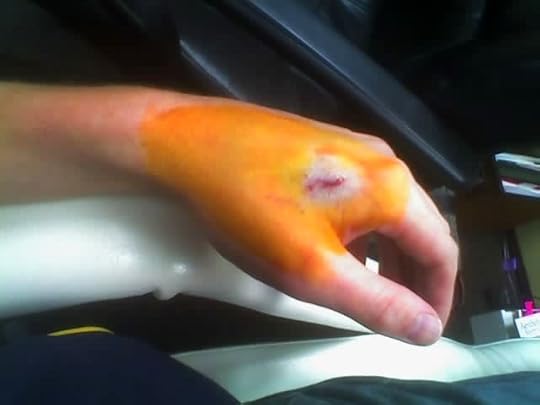 RFID chip freshly implanted
Photo by Amal Graafstra
Via Wikimedia Commons
Whereas the idea of using a kitchen utensil to put electronics into my body isn't exactly the most appealing thing I can think of, I do have to admit that if the opportunity came up for some kind of professional implant I would probably be game to try it. Right now, as far as I know, such experimental cybernetic surgeries are still restricted to the realm of research like that sited in this Project Cyborg article where a man was implanted with an electronic network that allowed him to remotely control a robotic arm and a wheelchair. I have to think after reading the Slate.com article, however, that such oddly invasive yet empowering implant options aren't that far away from being on the market.
Imagine walking into the Apple store or Best Buy and coming out with an iPhone beneath the skin of your forearm, or the ability to see in the dark via infrared retinal implants. Is this something the next generation will regard as commonplace? Is this type of opt-in surgery something we'll see more of in the coming decade? I'm willing to bet it is.
This week's post was inspired by a Slate.com article titled "Choose Your Own Sixth Sense" about how people, right now, are doing what amounts to do-it-yourself-cybernetic surgery to give themselves abilities one normally associates with science fiction.
The article covers people referred to as "Bio-Hackers" and "Grinders," both somewhat new terms to me, who take items like magnetic sensors, and RFID chips and put them in their bodies themselves using everyday household items like knives, and even—shudder—a vegetable peeler as a surgical instrument. One man put a magnetic sensor in his finger so he could detect things like the battery dying in his friend's laptop, while a woman in Scottland (the one with the vegetable peeler) has installed an RFID chip, a temperature sensor, and a magnetic sensor all in the comfort of her own home.
 RFID chip freshly implanted
Photo by Amal Graafstra
Via Wikimedia Commons
Whereas the idea of using a kitchen utensil to put electronics into my body isn't exactly the most appealing thing I can think of, I do have to admit that if the opportunity came up for some kind of professional implant I would probably be game to try it. Right now, as far as I know, such experimental cybernetic surgeries are still restricted to the realm of research like that sited in this Project Cyborg article where a man was implanted with an electronic network that allowed him to remotely control a robotic arm and a wheelchair. I have to think after reading the Slate.com article, however, that such oddly invasive yet empowering implant options aren't that far away from being on the market.
Imagine walking into the Apple store or Best Buy and coming out with an iPhone beneath the skin of your forearm, or the ability to see in the dark via infrared retinal implants. Is this something the next generation will regard as commonplace? Is this type of opt-in surgery something we'll see more of in the coming decade? I'm willing to bet it is.
March 8, 2013
Real Freaky Science to Inspire
Real life science often serves as an inspiration for some of the most out-there stories, and it definitely influences the fiction I come up with. This week I thought to share five examples of the freaky, wild, wonderful things that science has revealed which inspire me.
5. Black Holes
Video courtesy NASA
Black holes are some of the strangest, scariest, most awesome things in the universe. Once, only theoretical, we now have observed black holes through telescopes (or more accurately, the accretion discs around them) and have a working understanding of how they function largely due to Stephen Hawking.
4. Exoplanets
Video Courtesy NASA
The more we discover, the weirder we realize the universe around us is. I'm thrilled by the prospect of what, and who, we'll find one day.
3. Chemotrophs and Deep Ocean Vents
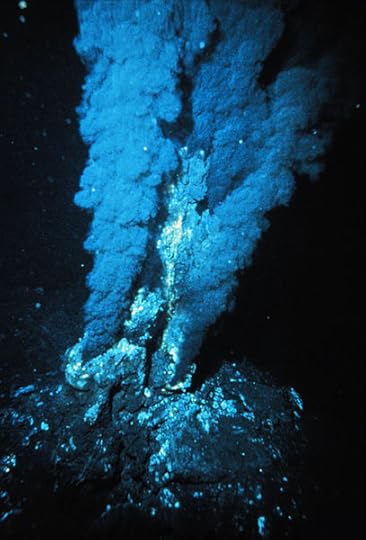 Photo © P. Rona
Courtesy NOAA via Wikipedia Commons
Deep ocean vents are spouts of volcanic activity on the ocean floor where chemotrophs—creatures that use the heat and chemical reactions to make energy (as opposed to relying on sunlight like plants do)—gather and thrive. The discovery of ecosystems independent of sunlight fired the imaginations of astrobiologists (and authors). Their existence means that we might find life on planets we would have considered either hostile, or lethal, to life as we knew it before.
2. Strange Plants and Animals
There are many living things on planet Earth which almost seem to defy the normal rules of biology. They can be some of the most inspiring things for me to get writing ideas from—particularly for alien species or cool genetic modifications for my protagonists. Among my favorites are things like predatory plants, most famously the Venus Flytrap, but also Drosera capensis (Cape Sundew)—a South African plant that actually grabs its prey in a sticky leaves.
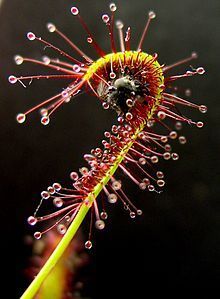 Drosera capensis Photo © Noah Elhardt
Via Wikipedia CommonsAmong the coolest animals on earth is the sea slug Elysia chlorotica from New England and Canada. Why is it so cool? Because this animal is a natural genetic engineer, stealing the genes to make chloroplasts (the photosynthetic part of plants and algae) from the algae it eats and incorporating them into its own genome to produce its own chloroplasts.
 Elysia chlorotica
Photo © EOL Learning Education Group
Via Wikipedia CommonsIf creatures like this exist on this planet, imagine what we may one day find out among the stars?
1. Cordyceps
One of the freakiest things on planet earth, this genus of fungus invades its host, quite literally taking over its mind, forcing it to move to a place where conditions are ideal for the fungus, before replacing its internal tissues with its own.
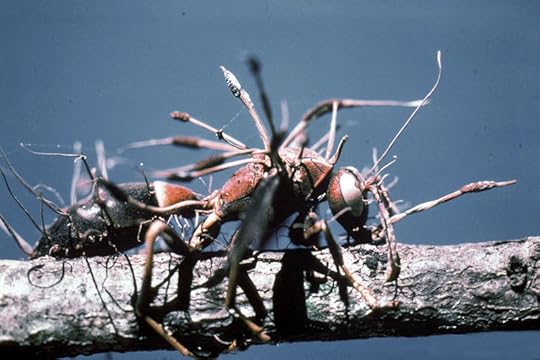 Photo © Erich G. Vallery, USDA Forest Service - SRS-4552, Bugwood.org
Via Wikipedia Commons
Who knew zombification was real? I've had a great deal of scary fun dreaming up what such a fungi could do if it could invade something, like, say, a human...
For more on Cordyceps, and the utterly freaky and frightening things it can do, check out this clip from the BBC's Planet Earth.
5. Black Holes
Video courtesy NASA
Black holes are some of the strangest, scariest, most awesome things in the universe. Once, only theoretical, we now have observed black holes through telescopes (or more accurately, the accretion discs around them) and have a working understanding of how they function largely due to Stephen Hawking.
4. Exoplanets
Video Courtesy NASA
The more we discover, the weirder we realize the universe around us is. I'm thrilled by the prospect of what, and who, we'll find one day.
3. Chemotrophs and Deep Ocean Vents
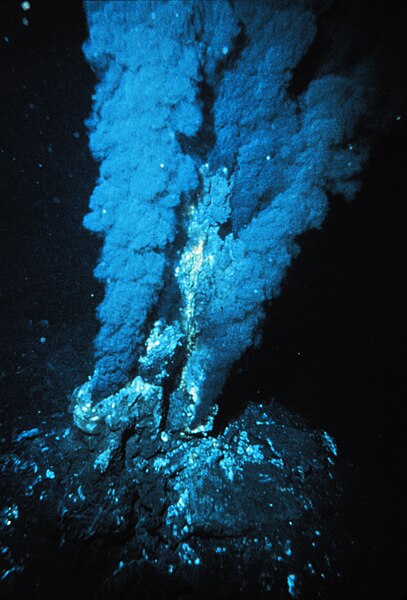 Photo © P. Rona
Courtesy NOAA via Wikipedia Commons
Deep ocean vents are spouts of volcanic activity on the ocean floor where chemotrophs—creatures that use the heat and chemical reactions to make energy (as opposed to relying on sunlight like plants do)—gather and thrive. The discovery of ecosystems independent of sunlight fired the imaginations of astrobiologists (and authors). Their existence means that we might find life on planets we would have considered either hostile, or lethal, to life as we knew it before.
2. Strange Plants and Animals
There are many living things on planet Earth which almost seem to defy the normal rules of biology. They can be some of the most inspiring things for me to get writing ideas from—particularly for alien species or cool genetic modifications for my protagonists. Among my favorites are things like predatory plants, most famously the Venus Flytrap, but also Drosera capensis (Cape Sundew)—a South African plant that actually grabs its prey in a sticky leaves.
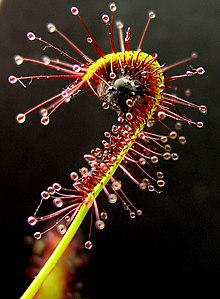 Drosera capensis Photo © Noah Elhardt
Via Wikipedia CommonsAmong the coolest animals on earth is the sea slug Elysia chlorotica from New England and Canada. Why is it so cool? Because this animal is a natural genetic engineer, stealing the genes to make chloroplasts (the photosynthetic part of plants and algae) from the algae it eats and incorporating them into its own genome to produce its own chloroplasts.
.jpg) Elysia chlorotica
Elysia chloroticaPhoto © EOL Learning Education Group
Via Wikipedia CommonsIf creatures like this exist on this planet, imagine what we may one day find out among the stars?
1. Cordyceps
One of the freakiest things on planet earth, this genus of fungus invades its host, quite literally taking over its mind, forcing it to move to a place where conditions are ideal for the fungus, before replacing its internal tissues with its own.
 Photo © Erich G. Vallery, USDA Forest Service - SRS-4552, Bugwood.org
Via Wikipedia Commons
Who knew zombification was real? I've had a great deal of scary fun dreaming up what such a fungi could do if it could invade something, like, say, a human...
For more on Cordyceps, and the utterly freaky and frightening things it can do, check out this clip from the BBC's Planet Earth.
Nero's Niche
Blogging about the things that inspire my writing: science, science fiction, fantasy, and the universe around us!
- Michael Formichelli's profile
- 23 followers

