
Michael Formichelli's Blog: Nero's Niche, page 13
April 19, 2014
Women and Sexuality in Spec-Fic
This week I found myself confronted, again, by the battle over how to properly portray women in speculative fiction. A while back I did a post about Women in Gaming, discussing a lot of the unnecessary and terrible treatment that male gamers throw at female gamers. This week's post is on the related topic of sexuality in spec-fic and geek culture (games, movies, novels, etc.)
What is the best way to portray a sexual yet empowered character?
I've asked myself this question many times over the years since I started writing seriously. How sexual can one make a character without crossing that line between empowered and objectified? There is no easy answer.
I'm going to concentrate on women for this post, not that male characters can't be sexualized or objectified, but because when they are it tends not to evoke the same emotional response—and rightly so. Men, after all, are the current gender of privilege in the world (sorry guys, but when is the last time you got paid less or skipped over because of your gender?) When we encounter a sexualized male character, even a hyper-sexual one, our reaction as a whole usually does not entail thoughts like, "oh he's such a slut" or "what a whore that guy is." Right? And even when it does, there just isn't the same level of nastiness about it. In fact, many hyper-sexual males are celebrated instead of denigrated like their female counterparts. Do we view Heracles and Hank Moody the same way we do women who behave the same way (like the woman in the bathroom at the end of the movie Choke)? It is easier for society to accept a sexualized man as being empowered than it is for the same to be true of a sexualized woman, even though on an objective level, there is no reason for the imbalance.
So, as a woman, is simply being sexual empowering in itself?
I've heard women say yes, that taking control of their sexuality is one of the more empowering things they've done, and I've heard women say that no, that it detracts from getting men to focus on more important things like their intelligence and contributions to society.
Tara Babcock (who works for, among others, Zoomin.TV Games) did a post titled "Feel Free to Fap!" on her VLog recently about how she appreciates the focus on her body since she chose a career that was about her looks. She goes on to say "where people go wrong is assuming someone is a certain way by their looks." She goes on to provide examples of compliments that are acceptable, and ones that cross the line, and then (at about the 1:50 mark or so) she starts to talk about how women take body compliments the wrong way. Check out the VLog and see if you agree. Is she being too broad in her statements? If a woman chooses to be sexual, is she choosing to degrade herself or is she choosing to take possession of the power her sexuality can bring? Does context matter?
As it relates to sexual female characters, does the way in which they are portrayed change the light in which we see them? I'd argue that yes, it does. There is a difference between a character who is sexual, and that's all we really see of her, and one that is sexual but we know she's also intelligent, witty, and cunning.
In the original version of Blood Siren I wrote but never published, I had a character who I wanted to portray as being empowered by her sexuality (something I personally find very attractive). I wrote her as being out-loud about it in a "this is who I am and deal with it" kind of way. I also gave her a troubled but heroic past (her birthright had been taken from her and she'd learned to survive and conquer adversity through it), and showed her solving many of the problems around her with her wits and experience. I thought I'd made a well rounded character who women and men could both get behind, then I showed the work to my wife and my sister-in-law.
To my surprise, I got very different reactions. My wife had no problem with the character, but my sister-in-law found her to be very uncomfortable and perhaps unrealistic. My wife knew what I was trying to do with the character, but my sister-in-law hadn't heard anything I'd said about her until she read the piece. Could that account for the difference? Had I failed to do what I set out to or was this a case of individual comfort level?
Of course, people are different and how you view a character is going to be colored by who you are. Sexuality is part of being human, and part of what makes speculative fiction so great is that by placing characters in strange worlds that might be, it highlights what the word "humanity" can really mean. It follows, for me, that sexuality needs to be in that portrayal for that general portrayal (or at least any expansive portrayal like a book series) to be complete. Off the top of my head, I think the series "Saga" by Brian K. Vaughan does this very well, but I'm hard-pressed to be confident about recommending many others.
The challenge, is providing that without lapsing into an unrealistic and offensive world. Can it be done? Of course, the number of positive, empowered, and sexual women in the media is on the rise. The more examples we have the better off we will all be. Personally, I'd like to see more men and women getting together behind these fully-realized, fully-rounded female characters. It can be tough to write them simply because there are so few examples right now in the general cultural mind to follow, but it's well worth the effort. I'd like to think there will be a day where the truly despicable levels this debate reaches becomes a thing of the past, but until this is accomplished, until producers of media and the general public both make it the norm, this problem will continue.


April 5, 2014
Alien Love in a Future World Part 4: Finale
Thank you all for following the Alien Love in a Future World series here on Nero's Niche.
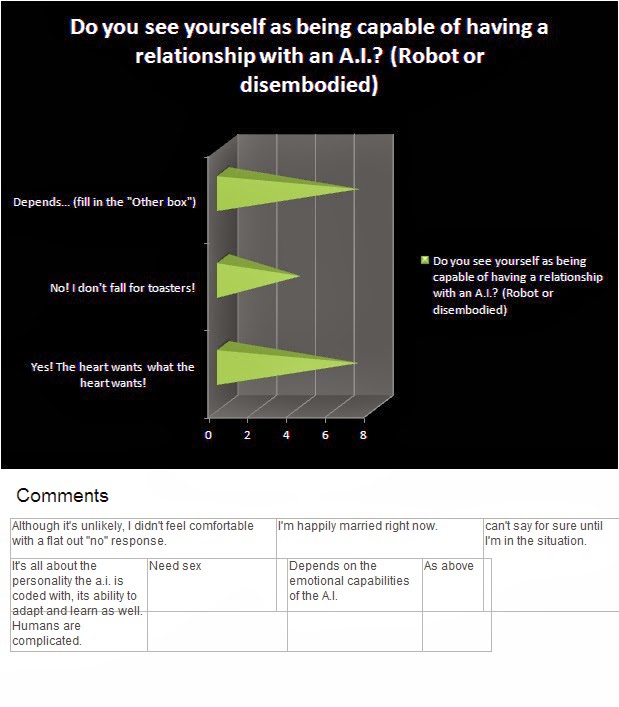
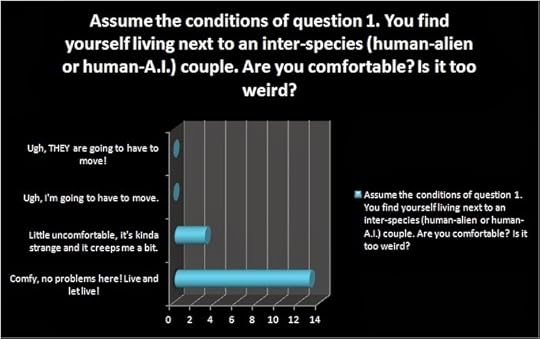
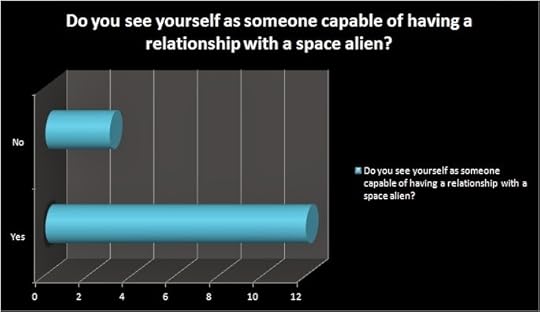
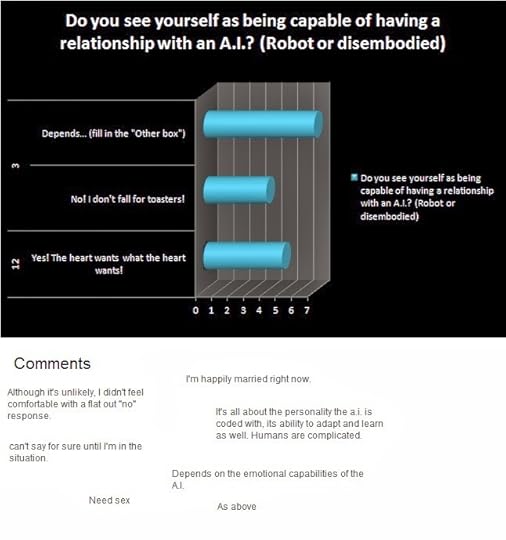
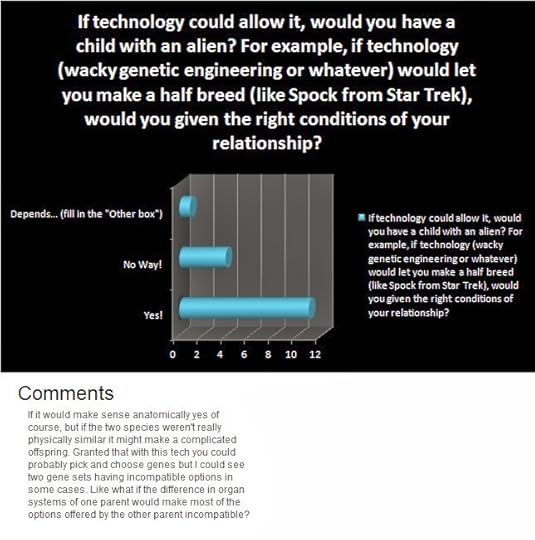
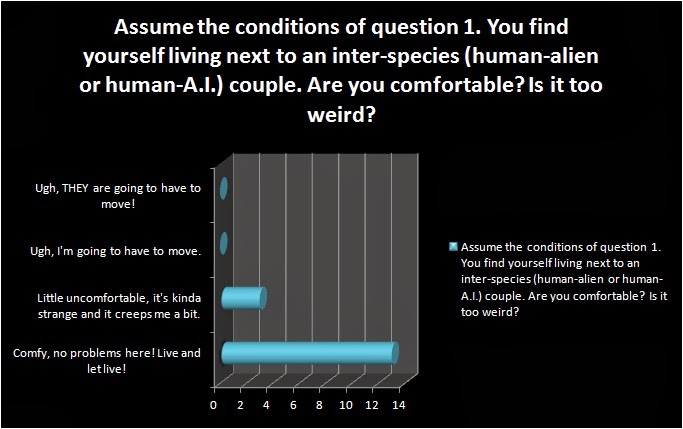
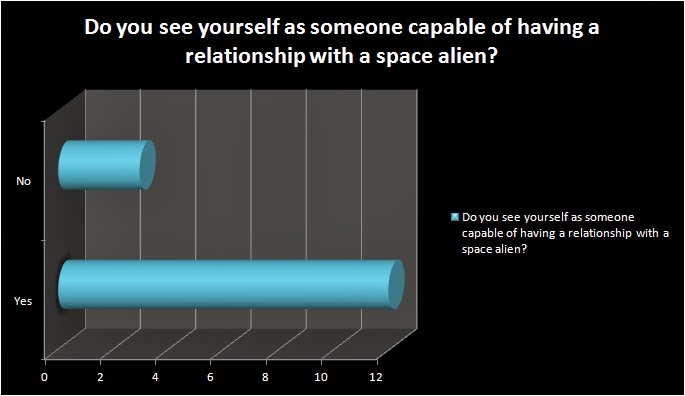
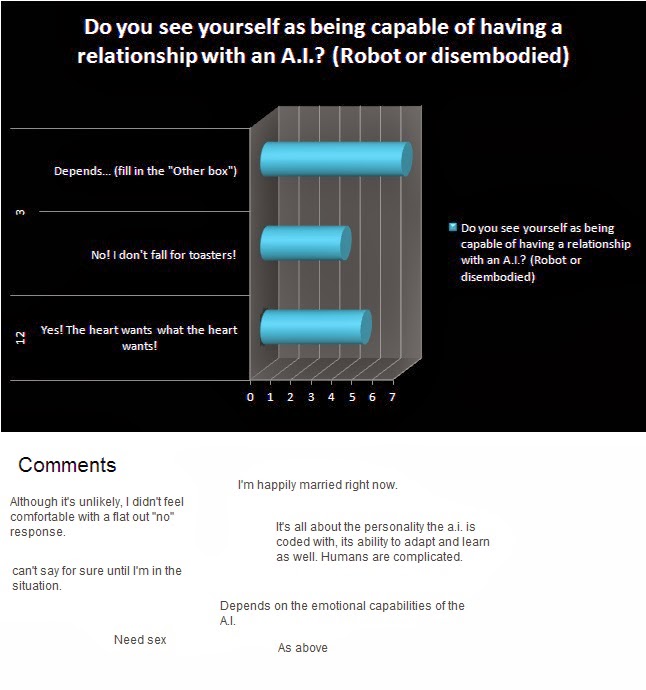
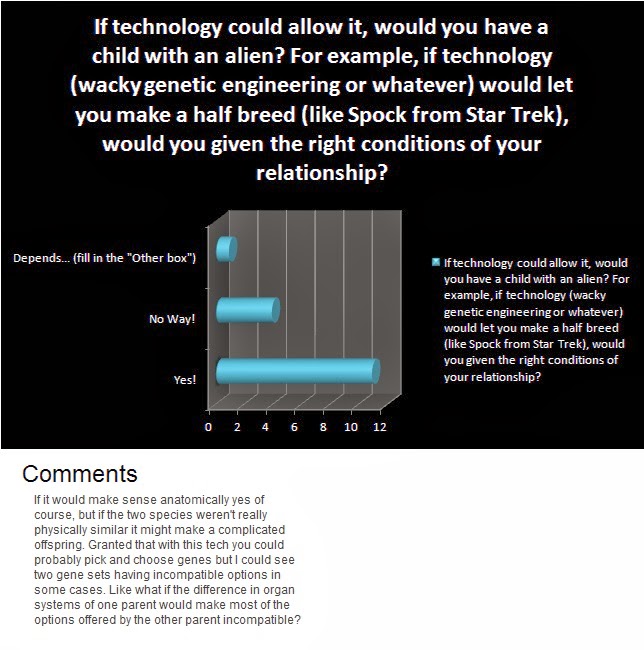
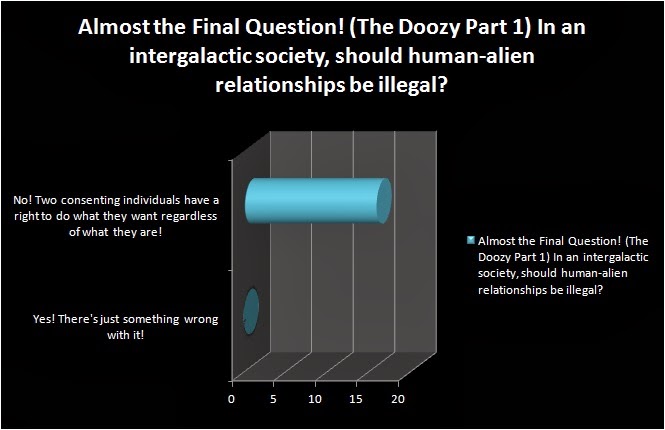
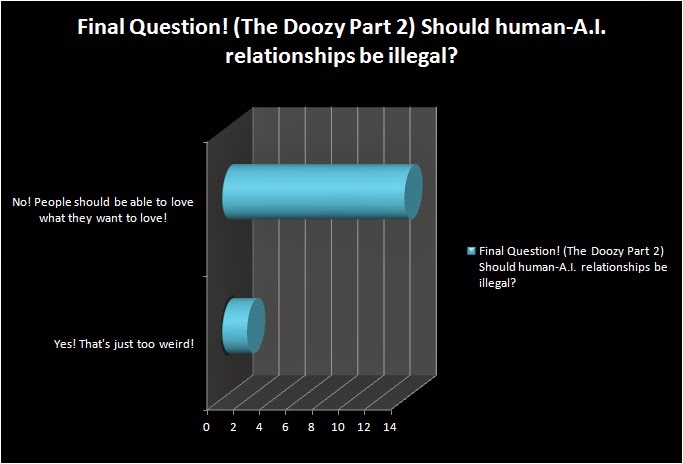
It seems this week was a slow week for the survey so the results from the last post still stand.
Overall, I'm happy to see that most of the responses were positive in terms of being open to the possibilities that the future may bring to people. Often in science fiction, inter-species relationships are used to illustrate the inter-racial and inter-cultural relationships that occur right now here on Earth. That my survey got any negative results at all was a bit of a surprise in this regard.
One of the classic roles of science fiction is to illustrate what might be and to serve as a mirror for society. As a genre science fiction, and speculative fiction as a whole, show us that no matter the time or place people are people. It's an important message, and one that illustrates we are connected to both the people who have come before us and those who are yet to be born. On an even broader scale, romantic elements and themes in science fiction are even more important. That we can imagine being in love with a space alien, or even a digital intelligence, shows that there is a possibility of love, at least on some level, is a universal capacity.
One day we may (probably) meet intelligences other than those born here on Earth, and we will definitely live among those not born but made by our own hands in the near future. People often say that when we do live among those so different from us, we will have problems getting along due to the basic "alienness" between us. I can't deny there will be issues, but at least where space aliens are concerned we will have some common ground. All living things need food, shelter, and some means of reproduction. Complex, self-aware living things will need a means of getting along—an ability to serve mutual interest—to carry out that reproduction and to have an advanced society at all. It gives me hope to think that when we reach the point where we do need to learn to live among them, the capacity for love and romance could serve as a basis for common ground.
Below are the final results of the survey, reproduced for your convenience.




March 28, 2014
Alien Love in a Future World Part 3
Welcome back for Part 3 of the series on aliens, A.I., and romance in science fiction. These pieces are from two of my good friends Judy Kirby and Rachelle Mandik. The latest survey results will be posted after their work. Don't forget to take the survey if you haven't already so your opinions will count in the last installment coming next week! The survey is found in part 1 of this series.
And now:
Author & Avid Sci-Fi Lover Judy Kirby:
When Mike asked me to write a blog post about inter-alien species relationships I will confess my mind
was racing off into a thousand directions. There is a lot to cover so I am going to pick out just a few
points of interest. Relationships, alien biology, and us.
I think the biggest and most important word here is relationships. When you watch sci-fi shows that cover
these types of relationships, it is nice to see that a lot of the emotions that are running throughout the
episodes are brought to bare for the public to see. If memory serves there was an episode of Star Trek:
TNG about a child who was half Klingon and half human. It dealt with how he fit into the world around
him. And although it is an obvious parallel to human race relations today it does bring about questions
for writers to toy with when creating worlds where alien races intermingle. Is a whole new race
created? How do those around them react? How are they viewed by other races on other worlds? Are
there family issues? And how are those cultures going to be affected by similarities and differences? Do
they have similar emotions or not? I personally would like to see more sci-fi TV shows and movies deal
with these questions.
Of course there are biological issues that aliens who live and work together have to deal with. Some
writers use breathing apparatus for certain species of aliens so that they can share the same
space. When you see this type of adjustment for a race in a book, is that something that seems
appropriate or is an overused plot device at this point? I mean, let’s take the Vorlons from Babylon 5 as
an example. The audience is told in the beginning that Vorlons need these suits to be able to breath in
human air. If you haven’t watched the show then I won’t spoil it for you, but they need the suits for
other reasons I will not go into here. But let’s say that a writer has some serious differences in biology
for their alien races that have to interact,? How are they handled? Is it physically possible or not to
share the same room? If so, are they biologically compatible? And are there any side health issues for
the offspring of these compatible races? Do they live longer or shorter lives? There are a whole host of
questions about anatomy that come into play here.
And last but not least, us. How do we as an audience member feel about the characters and their
situations? Can we relate to them enough to care? Do they have enough human qualities to keep us
interested in them for the rest of the plot? I feel that is something that has to be considered even more so
in books then on the screen. It may not translate as well when describing the interactions in a book for
your main character to constantly show that they do not care about the other characters around them. In
a movie, there may be more room for that, e.g. the Riddick movies. But it would be interesting to know
what your thoughts are.
I’m certain there is a plethora of books/movies out there that demonstrate how the relationships between
aliens can happen. Can you think of any you have read recently? If so, what are they?
Loving the Alien by Rachelle Mandik
The miraculous thing is that it’s possible for a human to love something other than himself. The biological specifics concerning the object of that love are tangential to this first, awful, truth. Freud might argue that it’s actually not possible. That what we call love is a recognition of ourselves in the Other. That we name it love when a certain threshold of sameness is perceived. But mostly the pleasant sameness. If the Other is too much like ourselves, or not at all, we call it hate because we can either see more of our own horribleness laid bare or nothing with which to identify.
The fact is, all Others are aliens. It doesn’t matter one jot the physical distance from one’s own home to the home of one’s beloved. It can be measured in feet or in parsecs. But the same principle applies. Anyone who is not you is an alien. But if there is sentience, if there is the capacity for consciousness and self-awareness and other-awareness, if interpersonal communication can be facilitated, then recognition of oneself is possible and therefore love is possible.
In my view, human-alien love, as depicted in science fiction, seems expressly designed to serve as an analogue for human-to-human relationships. An inherently political analogue, at that. Sci-fi romance of this type began to truly blossom in an era of political isolationism, of human-to-human xenophobia. That is, the Cold War. When we were struggling to parse the meanings of race, of class, of nationality, of culture, of ideology in new ways, science-fiction writers began to extrapolate these questions and take them to their logical conclusions. Are there laws against miscegenation? Well, let’s imagine humans marrying space aliens! In danger of losing your nationality if you travel to a forbidden country? Let’s have our protagonist abandon the motherfucking Earth, forever, to be with his alien bride. You can’t go home again. No, really. You can’t.
Part of the “normalization” of aliens in sci-fi is the confounding fact that there are comparatively few depictions of alien life that is not humanoid. Bipedal. Oxygen-breathing. Gendered. Or for that matter, genitally endowed and able to produce offspring. A human-Vulcan pairing resulted in Mr. Spock, who is treated more like a biracial character than a bispecial character. Because what are Vulcans except humans with strange ears, larger brains, and colder hearts? Aliens that are not humanoid are almost always irretrievably “Other” and therefore not candidates for romantic love. Human relations to these creatures generally rests somewhere along the avoidance/indifference-to-hate spectrum.
The one exception to this rubric, of course, is love between a human and an alien AI or love between a human and an alien embodied AI (aka robot). And even with the latter, the robots, to a man/woman are made in the humanoid mold and should probably not be considered exceptions at all. The fact that a human can “love” a disembodied intelligence speaks less to his or her romantic capacity than his or her religious instinct. For what is a disembodied AI but a god? If we can love it, then it is made in our image. An image of ourselves, looking at ourselves. The recursion of Narcissus. Endlessly transgressing, endlessly forgiving. Love distilled.
Rachelle Mandik is a professional book copyeditor and writer living in the Jersey suburbs.
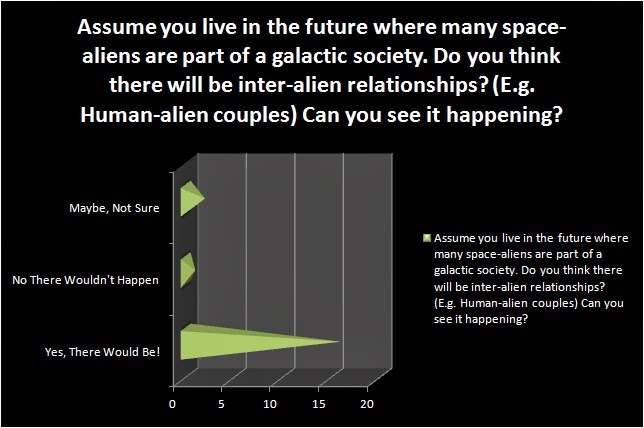
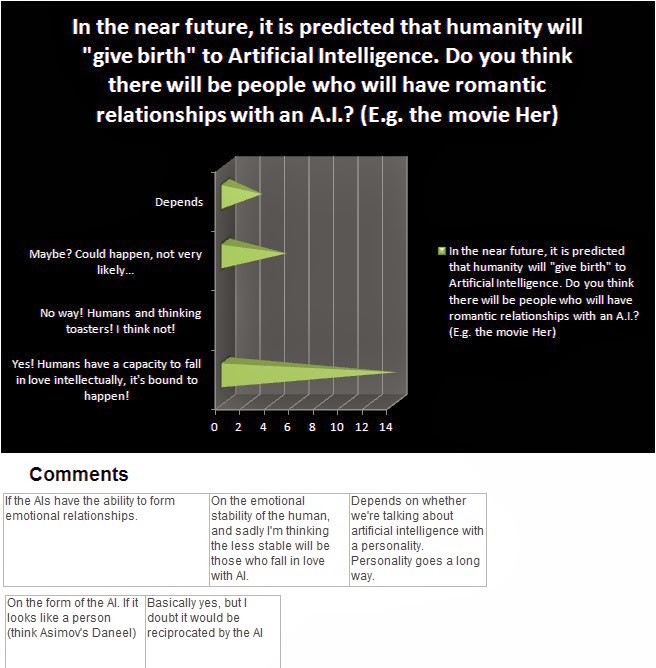
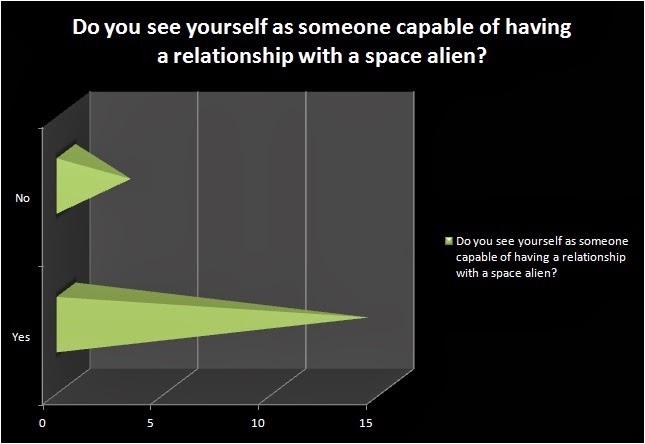
Survey Results to Date:

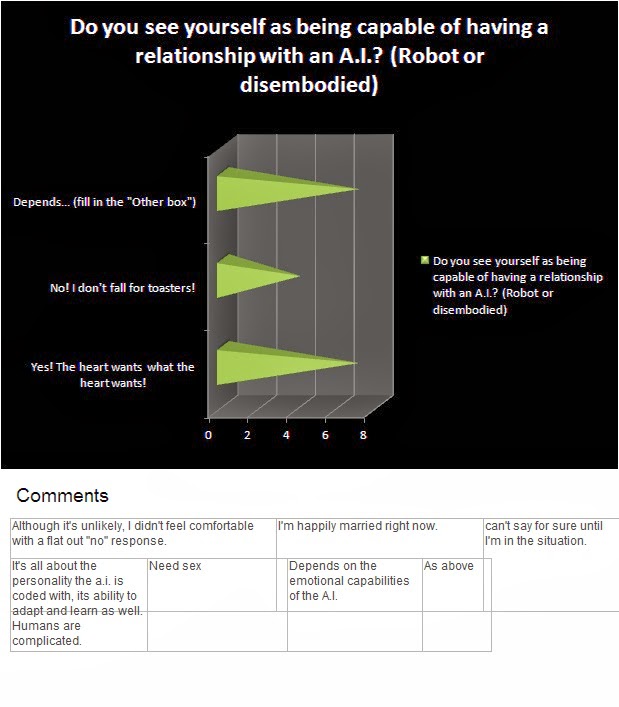

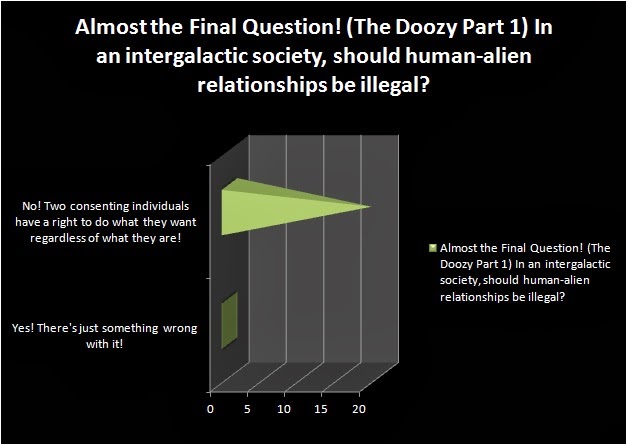

March 21, 2014
Alien Love in a Future World Part 2
Welcome to part 2 of the series.
This week we hear from Sci-Fi author Alia Gee, (The Red Button Press) , and Sci-Fi Romance author Pippa Jay (Adventures in Sci-Fi). Also, don't forget to check the updated survey stats at the end of this post!
If you missed it, you can take the survey here in Part 1!
And now, Science-Fiction Author Alia Gee on Alien Relationships...
Dear Mike,You asked me to write about human-alien relationships.Also, here be spoilers. Sorry.
Here is my first thought:
I’m vaguely suspicious of human-alien relationships.
One reason is my brain parses it as “interspecies” and that invokes sheep. No one wants to go there. (Except the lonely shepherd. Ha ha ha.)
But seriously, when I think about this topic in relation to SF my first thought is 1950s B movies, and how it’s always this super-powerful Other (Kong, Big Green Men) who latch onto some not-that-interested human female. I suspect there are stories where it’s a strong alien female who kidnaps the male… but I’m pretty sure in the end the guy(s) are the ones who get the ultimate power, be it vis a vis the relationship or the laser guns. So the historically gendered power imbalance thing is a big turn-off for me.
And that’s key: it really comes down to sex/sexual attraction, doesn’t it? Long distance relationships are hard enough to maintain, if the relationship is interstellar there needs to be something intimate and purely, deeply human for the consumer of fiction to relate to. Lois McMaster Bujold, in the SF novella Labyrinth, explains why better than I can. Just go, read the story. Love Taura. Then come back here…
I think the physical compatibility issue is a big one that needs to be addressed by any author who thinks alien love would be delightful. Mercedes Lackey blatantly lampshades it in The Eagle and the Nightingales, part of her Bardic Voices mostly-fantasy series. I’m not sure it’s even possible to be subtle about alien plumbing. And I do like my subtlety.
Another issue is that to believe in the relationship, I need to believe in its future. And the future belongs to children.
The whole point about other species/races/aliens is that we might be attracted to their tentacles or silver fur, but we can’t have babies with them. Otherwise, they’re just long-lost kissing cousins (See the Jaran series by Kate Elliott). Kurt Vonnegut even makes a compelling argument in Cat’s Cradle that the potential to create life is a crucial part of the excitement of sex.
However, I’m not saying it’s all about the bayb3333s. Couples who don’t have children are still couples, in fact and fiction. Anne McCaffrey’s Freedom series has a strong alpha couple who totally save the universe and totally can’t have genetically shared kids with each other and the author makes this both an issue for the characters and, frequently, a plot point. No one questions their bona fides as a couple, though.But again, it’s a thing that a thoughtful reader wants to have dealt with, and a good author has to do the heavy lifting around it.
So if it’s so hard to make an interspecies relationship believable, why do it?
Writers, whether they write pure SF or dabble in all sorts of places, are all about making the familiar alien, and the alien… human. Falling in love with the other makes them less other, makes their differences compelling and delightful.
If you can get your reader to fall in love with the alien story, so much the better.
So that’s what I think about that.Cheers,Alia
Science Fiction Romance Author, Pippa Jay:
Love conquers all?
Hi, I’m Pippa Jay, a girl who writes scifi and the supernatural with a romantic soul. Whovian, Scaper and Sith-in-Training. Double SFR Galaxy Award winner, and mum to three little redhaired monsters.
Do I believe that humans could fall in love and/or have a romantic relationship with an alien? In theory, yes. Last year I wrote my first human/alien romance—Imprint—which became part of the Tales from the SFR Brigade anthology. I’ve got to admit, I was probably more nervous about it that either of my characters ended up being, though I used that as part of the story. I wanted to keep the relationship realistic without being too weird or icky, but marking the differences. Sweet rather than brutally explicit, going for the emotional connection rather than the sex itself. But the whole point of the story was the fact that my male MC Tevik wasn’t human, so I had to put some detail into it. My main issue was not making him so alien that it would freak out either my female MC or my readers, or just coming up with something that would simply wouldn’t fit, work or would end gruesomely like Species. I think the part that probably bothered me the most was comparing an aspect of his anatomy to *cough* an elephant’s trunk (I’ve fed them at our local zoo and that’s an amazing experience), but my editor did end up commenting that she’d never look at an elephant the same way again! (And you’ll have to read the story to find out the details about that).
Writing an AI male was a breeze by comparison. Created to be exactly like a human, but with advantages in strength, speed, and full control of every part of his body, my sub-avatar Soren could be considered the perfect man. Except in the eyes of the law, he isn’t a man at all. Tied to the space station that maintains him, Soren isn’t free to do much more than choose which of the station’s visitors he’d like to spend his time with. Loaded up with his original human persona, he’s more than capable of behaving and feeling like the person he once was, even though he’s designated as a machine. Not everyone can accept him as anything more though.
In reality the likelihood is that any alien races we encounter will not be biologically and/or physically compatible in any way. In Imprint, I put forward the theory that in fact all the humanoid races in existence came from one common ancestor that another race had spread throughout the habitable worlds in the galaxy. Otherwise, at best we might only have diplomatic or political relationships with another race, possibly a marriage or partnership born from a meeting of minds, but unlikely to be anything more on the physical side. With AIs, we could create any kind of physical form for them to occupy, but would we choose to make them anything like human? Would it be necessary to do so? It seems the only reason we would do this is either to make interactions with them more comfortable in a psychological sense, or perhaps because we hope to interact with them on a more personal level. Would that lead to romance of any kind? We can only imagine…
So in my fictional universe, aliens and AIs are capable and willing to form relationships with humans. And why not? Is it really such a huge leap compared to our ability to love someone despite cultural, religious, and even physical differences? Love conquers all, as they say.
~Pippa Jay
Thank you to both Alia and Pippa for your contributions!
Next week the series continues in Part 3 with Authors Judy Kirby and Author/Professional Book Copyeditor Rachelle Mandik!
Survey Results to date:
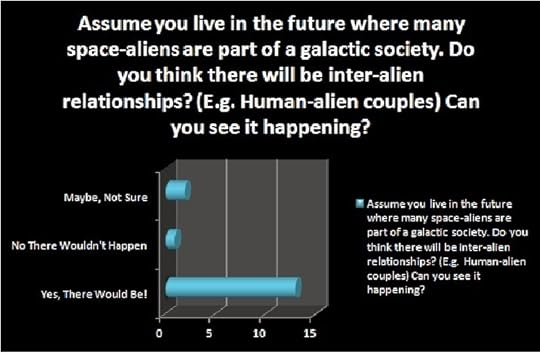
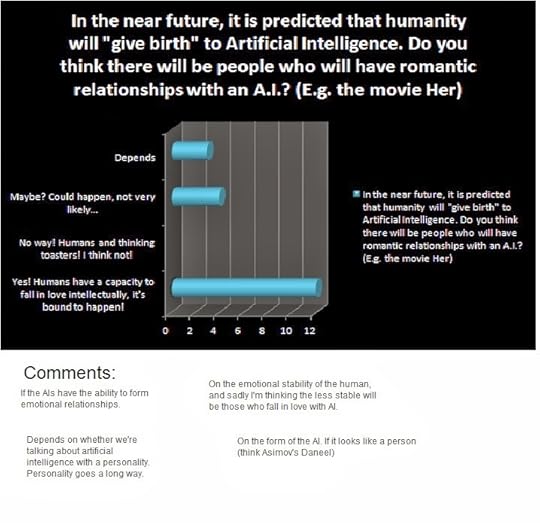
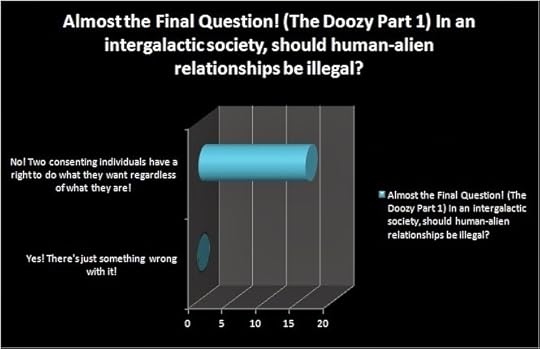
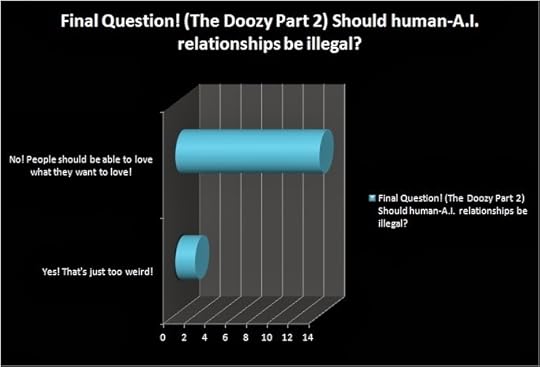
This week we hear from Sci-Fi author Alia Gee, (The Red Button Press) , and Sci-Fi Romance author Pippa Jay (Adventures in Sci-Fi). Also, don't forget to check the updated survey stats at the end of this post!
If you missed it, you can take the survey here in Part 1!
And now, Science-Fiction Author Alia Gee on Alien Relationships...
Dear Mike,You asked me to write about human-alien relationships.Also, here be spoilers. Sorry.
Here is my first thought:
I’m vaguely suspicious of human-alien relationships.
One reason is my brain parses it as “interspecies” and that invokes sheep. No one wants to go there. (Except the lonely shepherd. Ha ha ha.)
But seriously, when I think about this topic in relation to SF my first thought is 1950s B movies, and how it’s always this super-powerful Other (Kong, Big Green Men) who latch onto some not-that-interested human female. I suspect there are stories where it’s a strong alien female who kidnaps the male… but I’m pretty sure in the end the guy(s) are the ones who get the ultimate power, be it vis a vis the relationship or the laser guns. So the historically gendered power imbalance thing is a big turn-off for me.
And that’s key: it really comes down to sex/sexual attraction, doesn’t it? Long distance relationships are hard enough to maintain, if the relationship is interstellar there needs to be something intimate and purely, deeply human for the consumer of fiction to relate to. Lois McMaster Bujold, in the SF novella Labyrinth, explains why better than I can. Just go, read the story. Love Taura. Then come back here…
I think the physical compatibility issue is a big one that needs to be addressed by any author who thinks alien love would be delightful. Mercedes Lackey blatantly lampshades it in The Eagle and the Nightingales, part of her Bardic Voices mostly-fantasy series. I’m not sure it’s even possible to be subtle about alien plumbing. And I do like my subtlety.
Another issue is that to believe in the relationship, I need to believe in its future. And the future belongs to children.
The whole point about other species/races/aliens is that we might be attracted to their tentacles or silver fur, but we can’t have babies with them. Otherwise, they’re just long-lost kissing cousins (See the Jaran series by Kate Elliott). Kurt Vonnegut even makes a compelling argument in Cat’s Cradle that the potential to create life is a crucial part of the excitement of sex.
However, I’m not saying it’s all about the bayb3333s. Couples who don’t have children are still couples, in fact and fiction. Anne McCaffrey’s Freedom series has a strong alpha couple who totally save the universe and totally can’t have genetically shared kids with each other and the author makes this both an issue for the characters and, frequently, a plot point. No one questions their bona fides as a couple, though.But again, it’s a thing that a thoughtful reader wants to have dealt with, and a good author has to do the heavy lifting around it.
So if it’s so hard to make an interspecies relationship believable, why do it?
Writers, whether they write pure SF or dabble in all sorts of places, are all about making the familiar alien, and the alien… human. Falling in love with the other makes them less other, makes their differences compelling and delightful.
If you can get your reader to fall in love with the alien story, so much the better.
So that’s what I think about that.Cheers,Alia
Science Fiction Romance Author, Pippa Jay:
Love conquers all?
Hi, I’m Pippa Jay, a girl who writes scifi and the supernatural with a romantic soul. Whovian, Scaper and Sith-in-Training. Double SFR Galaxy Award winner, and mum to three little redhaired monsters.
Do I believe that humans could fall in love and/or have a romantic relationship with an alien? In theory, yes. Last year I wrote my first human/alien romance—Imprint—which became part of the Tales from the SFR Brigade anthology. I’ve got to admit, I was probably more nervous about it that either of my characters ended up being, though I used that as part of the story. I wanted to keep the relationship realistic without being too weird or icky, but marking the differences. Sweet rather than brutally explicit, going for the emotional connection rather than the sex itself. But the whole point of the story was the fact that my male MC Tevik wasn’t human, so I had to put some detail into it. My main issue was not making him so alien that it would freak out either my female MC or my readers, or just coming up with something that would simply wouldn’t fit, work or would end gruesomely like Species. I think the part that probably bothered me the most was comparing an aspect of his anatomy to *cough* an elephant’s trunk (I’ve fed them at our local zoo and that’s an amazing experience), but my editor did end up commenting that she’d never look at an elephant the same way again! (And you’ll have to read the story to find out the details about that).
Writing an AI male was a breeze by comparison. Created to be exactly like a human, but with advantages in strength, speed, and full control of every part of his body, my sub-avatar Soren could be considered the perfect man. Except in the eyes of the law, he isn’t a man at all. Tied to the space station that maintains him, Soren isn’t free to do much more than choose which of the station’s visitors he’d like to spend his time with. Loaded up with his original human persona, he’s more than capable of behaving and feeling like the person he once was, even though he’s designated as a machine. Not everyone can accept him as anything more though.
In reality the likelihood is that any alien races we encounter will not be biologically and/or physically compatible in any way. In Imprint, I put forward the theory that in fact all the humanoid races in existence came from one common ancestor that another race had spread throughout the habitable worlds in the galaxy. Otherwise, at best we might only have diplomatic or political relationships with another race, possibly a marriage or partnership born from a meeting of minds, but unlikely to be anything more on the physical side. With AIs, we could create any kind of physical form for them to occupy, but would we choose to make them anything like human? Would it be necessary to do so? It seems the only reason we would do this is either to make interactions with them more comfortable in a psychological sense, or perhaps because we hope to interact with them on a more personal level. Would that lead to romance of any kind? We can only imagine…
So in my fictional universe, aliens and AIs are capable and willing to form relationships with humans. And why not? Is it really such a huge leap compared to our ability to love someone despite cultural, religious, and even physical differences? Love conquers all, as they say.
~Pippa Jay
Thank you to both Alia and Pippa for your contributions!
Next week the series continues in Part 3 with Authors Judy Kirby and Author/Professional Book Copyeditor Rachelle Mandik!
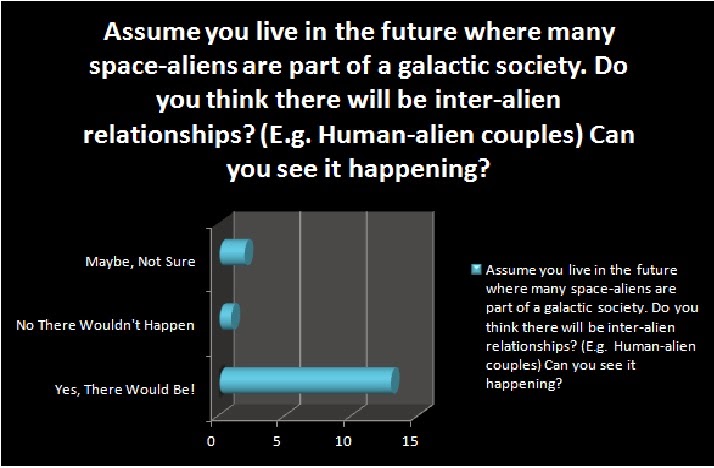
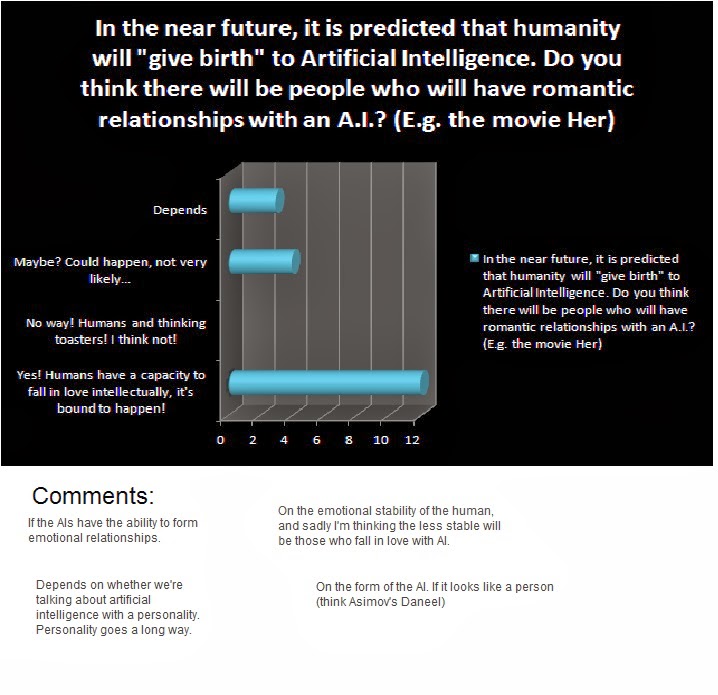
Survey Results to date:
March 14, 2014
Alien Love in a Future World (Part 1)
This week I'm beginning a series on romantic relationships in sci-fi, specifically those between species and/or kinds (e.g. space aliens and humans, and aliens and aliens of different types, and aliens and AI). I write a lot about this kind of relationship in my own stories, but the universality of romance is a common theme in popular science fiction as well.
Star Trek made extensive use of this type of romance in its series (TNG, Voyager, DS9, Enterprise), though the most famous of inter-species pairs was Spock's parents Sarek (Vulcan) and Amanda Greyson (Human).
Other examples in popular science fiction include:
Delenn (Minbari) and John Sheridan (Human) on Babylon 5
Alana (of Landfall) and Marko (of Wreath) from Saga (Image Comics)
Gaius Baltar (Human) and Number Six (Cylon/A.I.) on Battlestar Galactica
John Crichton (Human) and Aeryn Sun (Peacekeeper) & Chianna (Nebari) and Ka D'Argo (Luxan) of Farscape
—and the list goes on and on.
To start exploring this topic, I queried several authors about their opinions, and set up a survey via SurveyMonkey to find out what opinions of these types of relationships were out there. We'll hear from the authors later in the series.
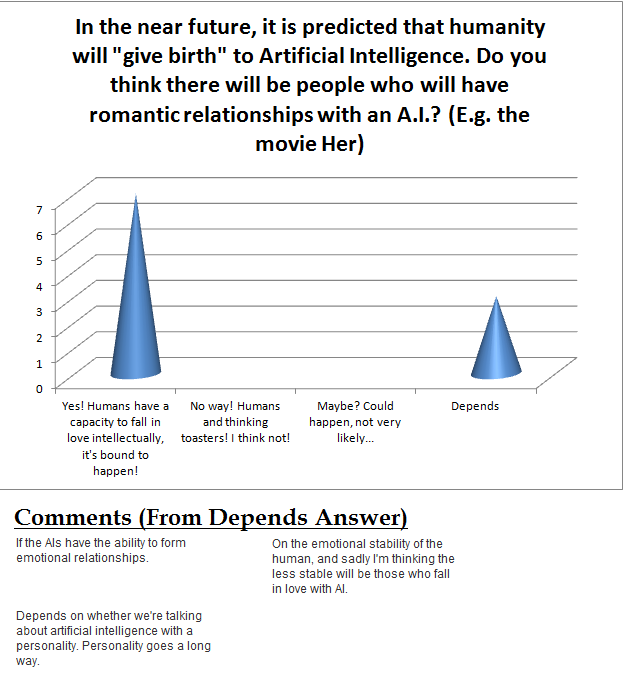
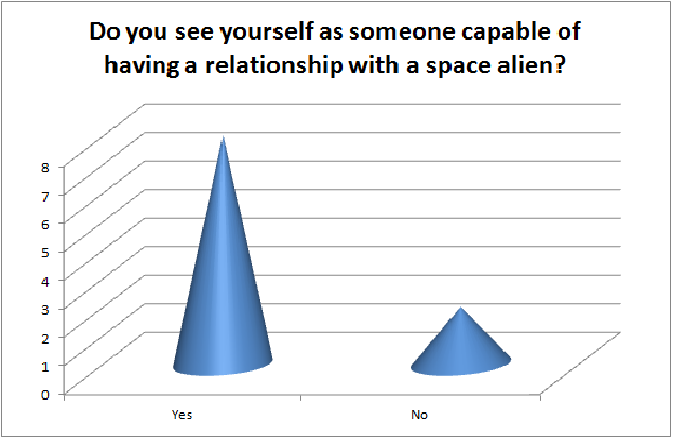
Below are the current results (the survey will continue throughout this series and I'll update the numbers) along with my 8 question survey.
Create your free online surveys with SurveyMonkey , the world's leading questionnaire tool.
Survey Results:


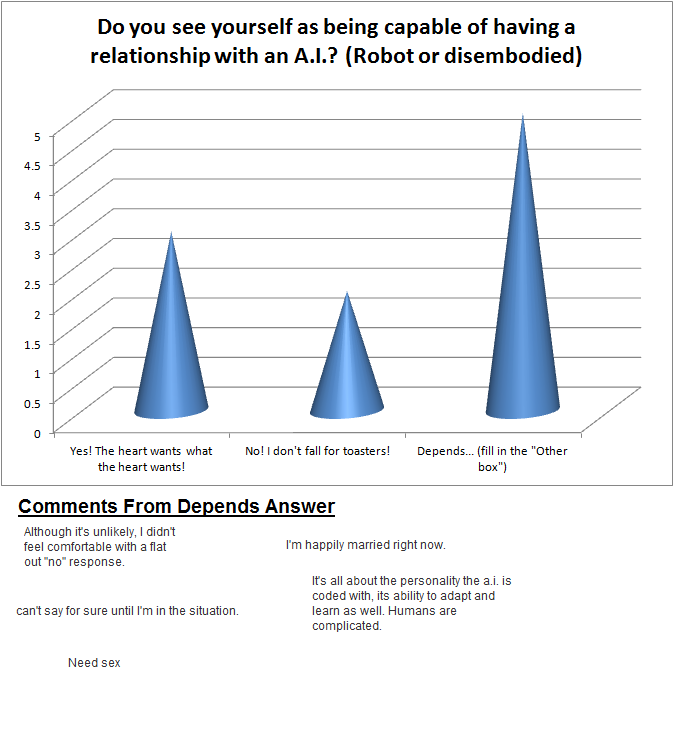
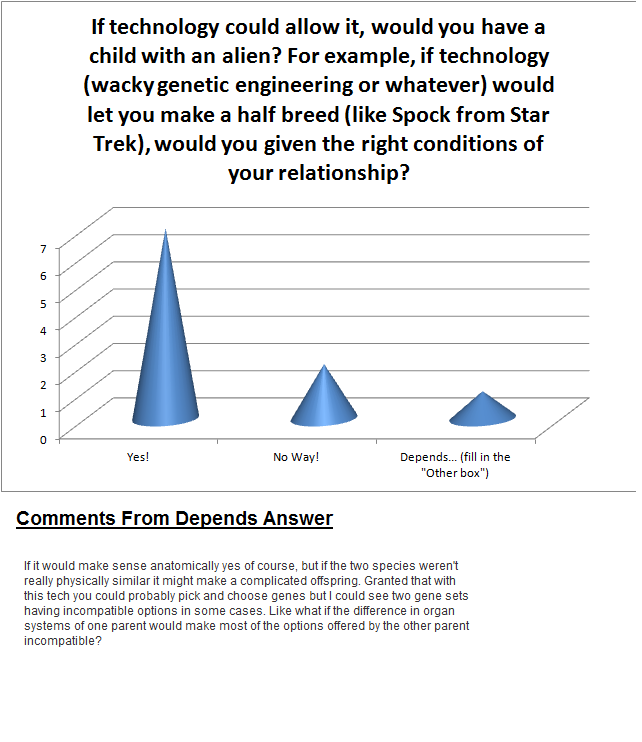

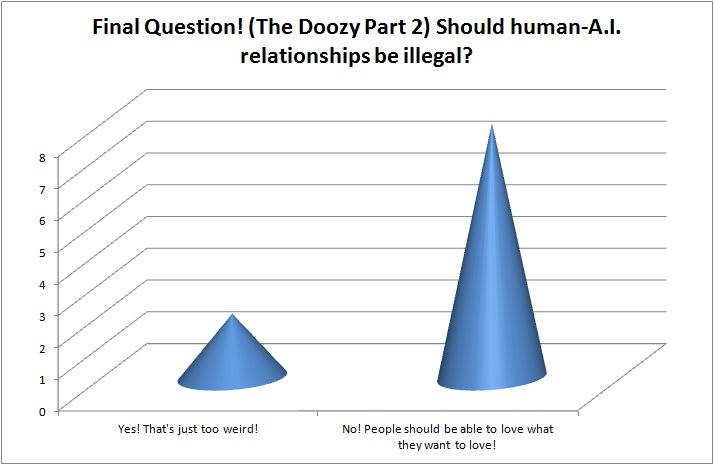
Stay tuned for Parts 2 and 3 of the series where we hear from the authors Alia Gee, Judy Kirby, Rachelle Mandik and Pippa Jay!
February 28, 2014
The Universe is a Pretty Cool Place...
I found myself watching some of Brian Cox's Wonders of the Solar System today, and much to my surprise I found it to be greatly moving—yes, I said it, moving.
Above is the BBC trailer for the series that showed in the US on the Science Channel. It covered a wide array of solar phenomena, including the birth of our solar system, what's special about each planet (in some cases, besides the obvious), and how the eight planets are interconnected despite the distances between them. Some of the things that really blew my mind were:
> Ice volcanoes (a.k.a. Cryovolcanoes) on Enceladus: I had no idea they existed (missed it somehow). They must look really amazing up close, like a snow-geyser!
 False-color Image of Enceladus' Cryovolcanoes
via Cassini spacecraft; Image Credit: NASA
>That if not for Saturn, Jupiter, and Neptune, there would probably be no life on Earth (it has to do with the gas giants causing the comet-bombardment of the inner planets that formed our oceans).
>The sun puts out 1 kilowatt of energy per square meter of the Earth's surface every second... (think of how many kilowatts you use in your house in an hour to get an idea of how much energy this really is).
>Not to harp on Saturn, but I learned that the rings of the planet are a microcosm of the early solar system, and that you can actually see its moons' gravity disrupt the rings as they pass by, making wakes in them like you would if you stroked the top of a pond.
>The sun's direct gravitational influence goes out to about 50,000 AU (50k times the distance between the Earth and the sun or about 3/4 of a light-year), and it hauls around a sphere of icy proto-comets with it as it hurtles through the galaxy (the Oort Cloud). [Note, technically the gravity of every piece of matter is infinite, but the father away things are the less an influence it has, but I'm talking about the Sun's effective influence here.]
There was a lot more, but I'll stop myself here. I guess it all just got to me and I had a moment where I just got choked up at the beauty of it all. It's incredible that out of the chaos such a clockwork-like order can arise, but thanks to thermodynamics and gravity, it did. More amazing, it didn't happen just once. Recently the Kepler team announced the discovery of over 700 new exoplanets (100 of them are Earth-sized!). I can only imagine what the future will bring when we finally get out there to see what we can. If only I had a time machine to jump forward a hundred years or so...
Some people say that science takes the wonder out of life, but I very much disagree. A lot of the time the answers, not the quick ones but the ones that respond to "Why? But why is that? And why is that?", often inspire in me a sense of amazement about the universe. I feel more connected to it, and more in awe the more I know about it. I guess you could say, for me science—and by that I mean the testable knowledge it brings—doesn't take the wonder out of the universe, but instead it makes the universe wonderful.
February 21, 2014
The Future of the Space Suit
Often in science fiction we see sleek, body-hugging attire that probably looks like it was designed more for style and "sex appeal" than any practical reason, however, it looks like those curve-hugging designs are coming about to be a reality in the near future. More surprising, they will have invaluable medical and practical applications as humanity begins to jump forward up into the stars.
 Skinsuit, Image Credit: NASA-Waldie
The European Space Agency has developed something they call a "Skinsuit" which will be worn while inside a space craft or space station. The purpose of the suit is to squeeze the body and provide support that will lessen the muscle and bone loss that occurs in low and zero gravity environments. This is expected to help astronauts avoid the difficult transition, and in some cases surgery, required when transiting back to normal gravity conditions.
 Skinsuit, Image Credit: ESA
It does this using a tailored weave in the material that provides a pressure on the body from the shoulders and feet that simulates that experienced on Earth due to gravity. This not only "tricks" the body into thinking it's in a gravitational field, it helps prevent slipped discs and spinal injuries that can occur due to the decompression the spine experiences in space.
Even more innovative designs are in the works. MIT graduate and current professor, Dava Newman, has invented a skin-tight space suit using nickel-titanium wires called "muscle wires" to provide the needed pressure for the occupant. These suits are designed specifically with Mars missions in mind, and will be used to walk around and perform activities in the open Martian atmosphere. The suit has a bubble-like helmet with a streamlined design, and a body-glove like cover that, like the ESA's Skinsuit, presses against the body. She calls this type of space suit a "Bio-suit," and in a recent TED-Women talk referred to it as "the world's smallest space craft." (I highly recommend following the link, close-up views of the Bio-suit are available there along with the original article).
 Bio-Suit & Traditional Style Suit, Image Credit: NASA
This NASA image shows the Bio-suit beside a more traditional space suit. (Go to the TED site for images of the helmet attachment).
—And speaking of a more traditional suit, NASA also has something called a Z1 Space Suit in development. The Z1 is meant to be a quick-entry space suit whose back attaches to an airlock. To put it on, an astronaut need only slip in through the hatch in the back and bam! They're ready to go out on a leisurely (or not) stroll around the space station.
 The Z1 suit, Image Credit: NASA
This quicker suit will save vital time that is now spent putting on the older, bulkier, and multi-part space suits. In an emergency, one can easily imagine the benefits of this design.
Although I don't have access to release/use dates, one can expect these new designs to be in use within the next 10-20 years (hopefully shorter). Moving forward it looks they will make space a sleeker and safer place to be!
February 13, 2014
RoboCop 2014 Review
Robocop Trailer via Youtube
Why is America so Robophobic?
In some ways this is the central question of the 2014 remake of Robocop, but the meaning of the film goes much deeper. In keeping with the 1987 classic directed by Paul Verhoeven, Robocop is about a cop placed inside the body of a robot to become a cybernetic crime-fighting organism, but it's also about a vision of a society so dominated by corporations that it allows ownership of its citizens as embodied in the person of RoboCop himself.
The 1987 film illustrated this theme by showing both the corporate attitude towards Detective Alex Murphy (RoboCop), as well as interspersing cheesy commercials throughout the film for ridiculous products ("I'd buy that for a dollar!"). This 2014 remake handles the illustration a bit differently, and much more poignantly. We are shown the effects of hyper-consumerism and corporate imperialism through scenes of drones filling the streets of the middle east and killing people, and through the personal story of Alex Murphy himself. Whereas the 1987 film focused on the action and often cheesy humor, this one focuses on his personal story and the impact that Omnicorp, the company that made RoboCop (OCP in the original which is the parent company in this one), has on his family and friends.
As much as this movie remains an action film (there's plenty of action for the shoot'em up crowd), I found myself getting choked up several times (my wife said she could hear me snuffling). Gary Oldman gives an amazing performance with great emotional nuance, and speaking of nuances, there are several subtle clues about how things are happening throughout the film that you might miss if you don't pay attention. They give the film a nice touch, little flavors here and there that make the whole an even bigger joy to watch. Although the movie plays homage to the original, this is a different story with some substantive changes (e.g. Lewis is now a man played by Michael K Williams of Boardwalk Empire fame), so don't expect a carbon copy. The end was a little weak for me, but overall the movie was fantastic and I'm definitely going to be adding it to my budding Blue-Ray collection when it comes out.
January 31, 2014
An Interview with Suncatcher Author Alia Gee
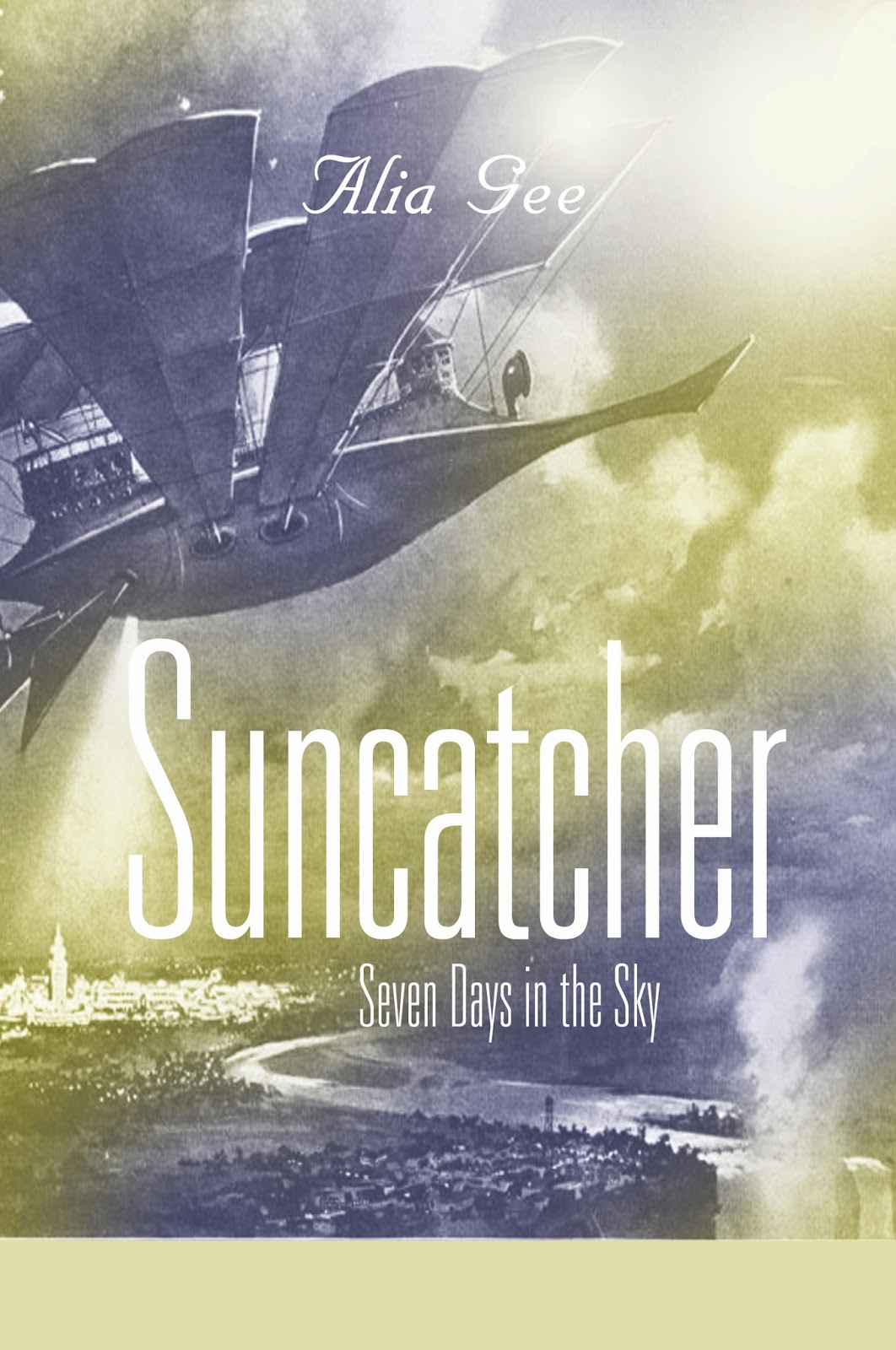
It’s 2075 in a post-climate change, post-pandemic, post-peak oil world. Professor Radicand Jones has earned a nice quiet sabbatical on her sister’s solar powered airship, floating serenely above it all. Instead, Radicand finds herself:
Defending the airship flockagainst pirates with nothing but her rifle and her wits.
Risking her mind every time she goes deeper into the enhanced virtual reality of the aether—just like her father before her.
Helping her best friend escapefrom bounty hunters determined to keep her genetic property under corporate control.
Falling in love with a killer.He has a heart of gold. It might belong to someone else.
Happy endings may look easy in the sky, but can Radicand Jones save everyone else’s hearts and minds without losing her own?
__________
Alia is a self published author, and a fellow Oberlin College graduate. She and I started chatting recently when I took note of her book on the web and reached out to ask her about. I'm happy and honored that she agreed to do this interview which follows her bio below.
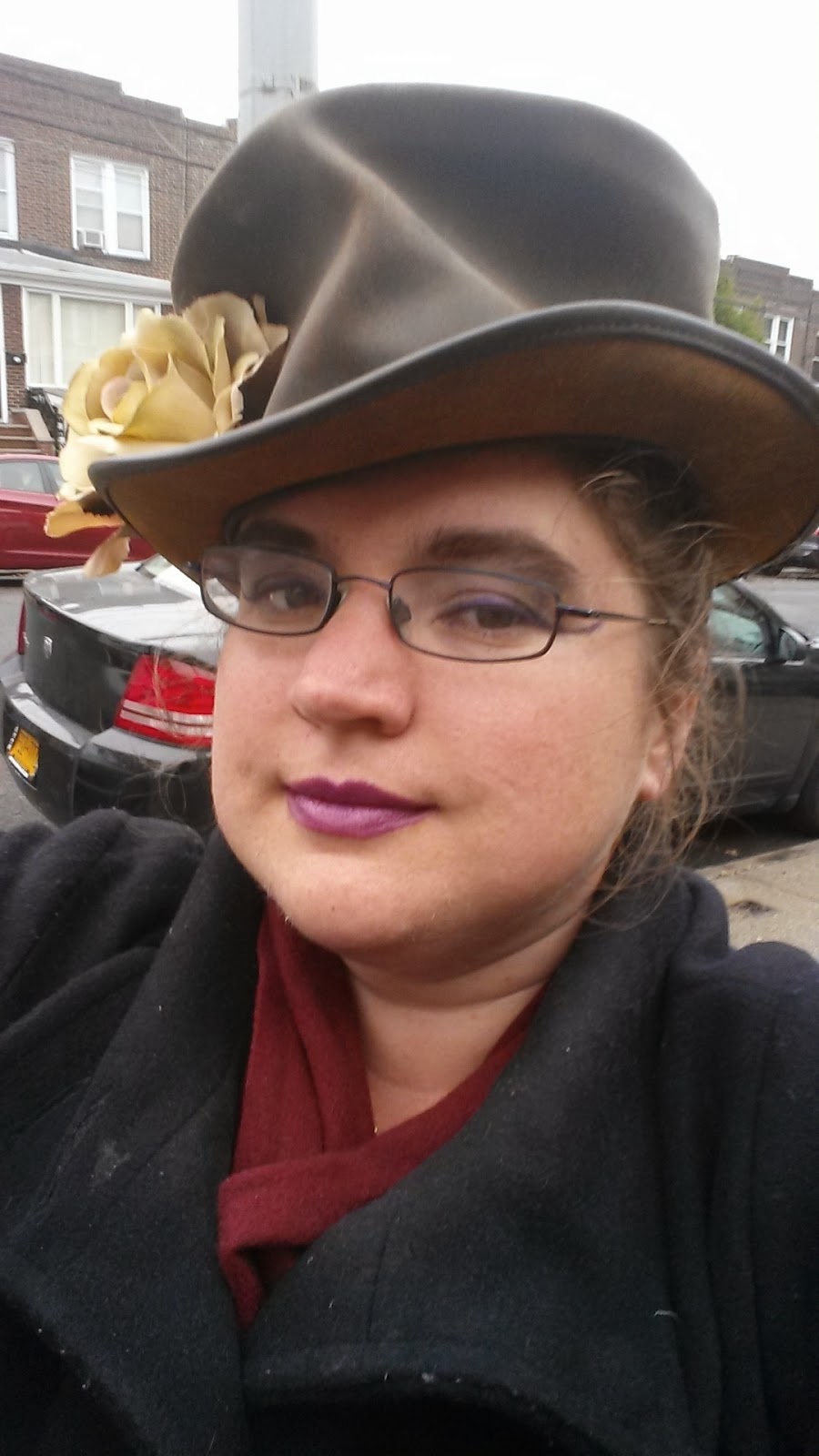
Alia Gee was raised on a steady diet of science fiction and the kindness of strangers. She is grateful for both.Alia has loved Rumi, solar power, and her husband for a very long time. She recently fell in love with Occupy Wall Street. Now she lives and loves in New York City raising her eyebrows at her children and her glass to art and her voice in the streets.Her poetry has been published in The Omnibus of Doctor Bill Shakes and the Magnificent Ionic Pentatetrameter and the forthcoming Poetry for the 99%.
Suncatcher is her first novel.
1. Let's start with the basics. How long have you been interested in science fiction?
Since my parents told me that I was named after a science fiction character.
They explained that they were young and stupid (they really said this. At least they were honest) and named me after this great character, a saint, no less! … but then a couple of years after I was named the second book in the series came out and little Alia goes crazy and kills herself. Apparently they wrote Frank Herbert and explained the situation and he wrote them a lovely letter back saying that it was ok, it was a real name before he used it and told them it meant “exalted one” in Arabic, don’t panic.
As far as I know, though, they were young and stupid AND LOST THE LETTER. One of those things I may never be able to forgive them for… sigh.
I remember the first SF book I read was The Menace from Earth when I was 9, and I devoured all the Heinlein juveniles my dad had. Then all the ones the library had. I read Asimov and Arthur C. Clarke and all those Adventure-type stories with the rocket ship on the spine. My mom tried to steer me towards Ursula K. LeGuin but I wasn’t ready for her yet. (I could wax poetic about Always Coming Home, the best book I’ve never finished, for hours.)
Round about the same time I really started to accept that I was not being taken seriously by my science teachers (“but you’re going to be an English major, so I won’t sign the form that will let you take Chemistry even though you have the second highest grade in the class” “next year you’ll discover boys, so I won’t sign the form that will let you take physics even though you have the highest grade in the class”, I realized that Heinlein and the other Adventure SF writers didn’t really take English majors seriously, either, and I drifted away from hard SF for a long time.
I didn’t really get back into it again until I discovered Lois McMaster Bujold. She’s my current favorite SF author—though I think The Curse of Chalion and Paladin of Souls are her best work and they are pure fantasy. Nobody’s perfect. ;)
I’ve also become quite fond of John Scalzi, mainly because of his blog but his books are fun, too.
2. Are you influenced by other types of speculative fiction, or other types of writing in general?
Anything Bujold writes, see above. ;) Also, anything that Terry Pratchett writes even when he forgets to be funny and lapses into poignancy. Damnit, Pratchett, stop making me cry.
I was really influenced by web comics, when I was writing this book. I had a newborn, and that made reading books difficult, but I had a long list of webcomics that I could squeeze in between nursing and changing diapers and wiping noses. That pacing and emphasis on punchy dialogue really affected the way I wrote this novel. (I did write a different book as my “first first novel” and it was excellent practice and no I’m not planning on publishing it any time soon because it has no drama.)
3. When did you get the idea for Suncatcher? Was there a particular moment, or did it evolve over time?
You know how they talk about rock bands that suddenly get discovered, but actually they’ve been working for years in their Mom’s basement? That. But here’s the overnight success version, because that is pretty long just by itself…
I was reading a blog, http://silver-goggles.blogspot.com/, which is not updated often enough and takes a dim view of steampunk that whitewashes alternate history.
Jha Goh, the blogger, was interviewing an author (much like our situation here) who claimed to have written a Third Wave Feminist Steampunk Adventure and I almost fainted from trying to hit the buy button on Amazon too hard. This, this was what I wanted to read! Pretty dresses and adventure with female protagonists but alive to intersectionality and nuance and stuff!
Only it didn’t. It was so so so disappointing I spent a very long Facebook status detailing just how terrible it was—it was literally Mary Sue Saves The Brown People, but it’s alright because even though she’s been raised white and privileged her *mother* was (albino) but Brown! So it’s ok! …oh, and she had phenomenal cosmic powers and there was a weird love triangle between her and a white guy and a brown guy, and she loved them equally so she wasn’t racist. And both guys loved her, but then the brown guy sacrificed himself/their love by staying behind to save His People, so she ends up with the white guy. But it wasn’t racist. Oh, no… and then there was the part where she “taught” the brown people to garden, and they planted PEAS NEXT TO THE PUMPKINS. (That’s a cool weather crop next to a hot weather crop. Even with cosmic powers, THAT JUST DOESN’T sdgebyx cmyoi suy YT…
You can see I *still* feel strongly about this, eh?
So anyway, I’m ranting and ranting and my friend commented, “So why don’t you write a feminist steampunk adventure, then?”
And I did. Or at least, I tried to.
It turns out I can’t write alternate history because I’m enough of a history buff that I can’t forget what I know and pretend it didn’t happen, so pure steampunk was out. But I started out with the Bechdel test— hey, random, did you know she went to Oberlin, too? We Obies get everywhere!—two women talking about something besides a guy. Two women…. Sisters! Right, so I needed to have two women talking, and I was thinking about steampunk, and so what’s more steampunk than pirates?
I hammered out a 2000ish word scene about two sisters on an airship discussing the imminent approach of pirates and posted it on Facebook. And that’s when things got interesting—several people commented, “That was great… but then what happened?”
6 months and 456 pages later, I can honestly say quite a lot. (And then I edited it and edited it and edited it some more…)
4. Is your book a single-person perspective, or do you have a wide cast of characters that the "camera" follows like Game of Thrones?
I was learning about the world as I wrote it, so it definitely follows the perspective of the protagonist, Radicand Jones. However, I found that extra stuff kept appearing, emails and restaurant menus and inter departmental memos, and I really enjoyed incorporating them into the story. Later they began to tell their own story in counterpoint to Radicand’s lived experience, and I hope they flesh things out that the reader would otherwise have to take on faith.
5. Tell us a bit about the world your story takes place in. (When does it take place, what's the "mood" of the setting(s))
It’s a cheerful dystopia! …an early reader called it that, and I love that description. It’s specifically set above and within Miami in June, 2075. But this is a world that has been changed by peak oil, pandemic, and climate change. For instance, Miami (and New York City, too) are walled cities surrounded by shallow sea water.
It’s pretty terrible—but when I was writing it swine flu had just sent half a nearby school home sick, the gulf oil spill and Katrina were freaking me out and I was reading a lot of doomer blogs just as Lehman Brothers imploded and it seemed like corporations were taking over everything and the world was a few breaths away from neo fascism forever and ever and everything owned by Monsanto.
The future was holding my babies hostage, and I had to do something about that.
So I had to create, almost for my own sanity, this world where all the scary things had happened, but my grandchildren could still grow and laugh and have meaningful lives.
6. Many characters in stories are based on people the author actually knows in real life. Are there any like that in your story?
They are all me, especially the bad guys.
7. As many of my blog followers may know, having reasonably accurate science in science fiction is very important to me. How much of the science in your book is real, based on known science, or a projection of what current science thinks might be possible?
Heh. Well, in the 4.5 years from when I first started it the “goggles” that I thought were super-cool and bleeding edge are just another form factor of what apple is doing. (Damnit, apple!)I spent a lot of time with websites that predicted rates of sea level rising, on best to worst case scenarios, and talked to my friend the meteorologist about what climate changed storms would look like. (“That’s a good question, I should pose it to my students on their next paper,” was his first response.)
I researched airships and worked out a rough idea of how my flock of airships worked engineering-wise (hard envelopes, rather than the soft blimps we’re more familiar with) so that I wouldn’t screw up—and even then we almost made design choices that would have sent them nose first into the ocean.
The tech I took the most liberties with is something I called the “aether”… and this started out as a nod to steampunk but it became integral to a lot of things that were important to me and to the story. The aether is a “metaphor based virtual reality” and it was my way of making room for English majors in science fiction.
The seed of it came from a friend, who wanted to develop a hardware interface so that grade school children could “dance math”… He’s a bit of a mad professor, and I don’t know how far he got on that project, but his love of math and this idea that you could move your body to manipulate data meshed with my desire for beauty in my science fiction… So yeah. The aether is pretty out there, but it’s also very pretty.
8. What themes or storylines in your story do you hold to be the most important to you?
Community. Connections. Loyalty. Love. My editor thought that human identity and ownership were key, too. But honestly I think the story has enough complexity that you see the themes you want to see.
9. Do you think this book is geared for a specific demographic? Is it accessible to a broad range of readers?
I really don’t know. I want it to be. People who want to be entertained and are willing to trust me for a couple of hours. Anyone in that demographic should love it!
10. Describe what your method is. Do you sit down and write the book all the way though and then edit? Edit as you go? Do you have a particular ritual you do to get into the "writing groove?"
During the baby’s afternoon nap I’d sketch out ideas and what-ifs and future scenes I wanted to allude to or get to. In the evening after the kids were in bed and I was back at my laptop I would read the last scene and maybe check my outline to see where I was and where I was planning on going. Then with the afternoon’s notes on hand I would write out the dialogue, as fast as it came, often without tags or “she saids” just bam bam bam. Then I’d go back and write the in-between bits, the action, the description, the internal monologues.
Best advice I got was not to end my writing at the end of a chapter, but to write the first sentence or two of the next scene and then end so that when I came back to it the next day I could just keep going, rather than try and recreate the energy I was riding the day before.
I did a lot of light editing as I went, as things became more or less important—whole airship crews got deleted from earlier scenes because they just weren’t important to the plot.
11. What was your motivation for self publishing? What were the challenges you faced with moving forward on it? What triumphs did you achieve?
Well, Tor declined to publish it and Baen never got back to me. Those are the only SF publishers who will accept unsolicited manuscripts without an agent. Neil Gaiman’s agent did ask for the full manuscript, and I almost cried when I got that letter—but ultimately she wasn’t excited enough by it to take me on as a client.
All the other agents who take SF authors sent very polite rejection letters with my first query. That was a brutal 12 months of rejection. Later, a friend told me that she had drinks with a friend of a friend who was an agent, and mentioned my book to her, and apparently the agent wrinkled her nose and said, “A book about a middle aged Pakistani-American? Who would want to read that?”So whether or not I wanted to go the traditional publishing route, traditional publishing did not want me.
I think the Suncatcher-verse is rich with potential (and I have a couple more books stuck in my head) …but they are very stuck. I thought that if I could get this first book out of my head and unable to be edited any longer (just one more edit, I can quit any time!) I could focus my energy on writing new material.
I decided to self-publish over a year ago, but then the problem was finding an editor. I knew I had taken it as far as I could, but the story deserved proper editing. It was really hard finding someone who would take my money but not give me BS about “show don’t tell” … that is the worst feedback ever, because believe me if I knew what it meant I would do it.
So yeah, finding an editor was really hard. In the end it was word of mouth and grabbing someone who wasn’t professionally trained but had experience helping another author shape her work. His feedback really helped me understand the villain and the villain’s story better, and I hope that will make the next book easier to write.
My most glorious moment so far was when I was freaking out about cover art, and a friend (also from Oberlin. Ha!) found the perfect image. It was black and white, though—but then an online community she belongs to sort of adopted the project and added color to the imageI got tears in my eyes, and it really made me believe in this project, the first time I saw that airship sail through a blue sky into a yellow sun.
12. And where can we get Suncatcher?
Suncatcher, is available from these sellers:
Booklocker(where the first 9 chapters are free to read online)
Amazon
Barnes and Noble
—and your local bookstore can order it for you, too!
Read global, shop local. ;)
__________
A big thank you goes out to Alia for this interview. On a final, happy note:
Alia Gee can be found at:
http://www.theredbuttonpress.com/
and
http://alia-gee.blogspot.com/
January 24, 2014
I'm Stargazing
As you may have figured out, I like to involve a lot of real science, or at least real science theory, in my writing. Sometimes it's meant many hours spent on the NASA website playing with imaginary thrusters using the real equations, but recently my ventures into space, without leaving the Earth, have taken a much more visual and visceral turn. One of the big items I got at the end of 2013, from my wife (Love you baby!) is a Celestron Powerseeker 127EQ. It hasn't even been a month and already, like the dork that I am, I run out with it on my shoulder every clear night.
 Celestron Powerseeker 127EQ
Photo by Michael Formichelli 2014
These first couple of weeks have been "getting to know you" time between me and the scope, but the last time I was out I felt confident enough to try and snap a few pictures through the eyepiece.
I don't have the right type of camera yet, so for the time being my iPhone and my old Sony Cybershot will have to do. It's harder than one might think (at least, than I thought) to get them lined up with the eyepiece lens, but for a first timer, hopefully, I didn't do too bad.
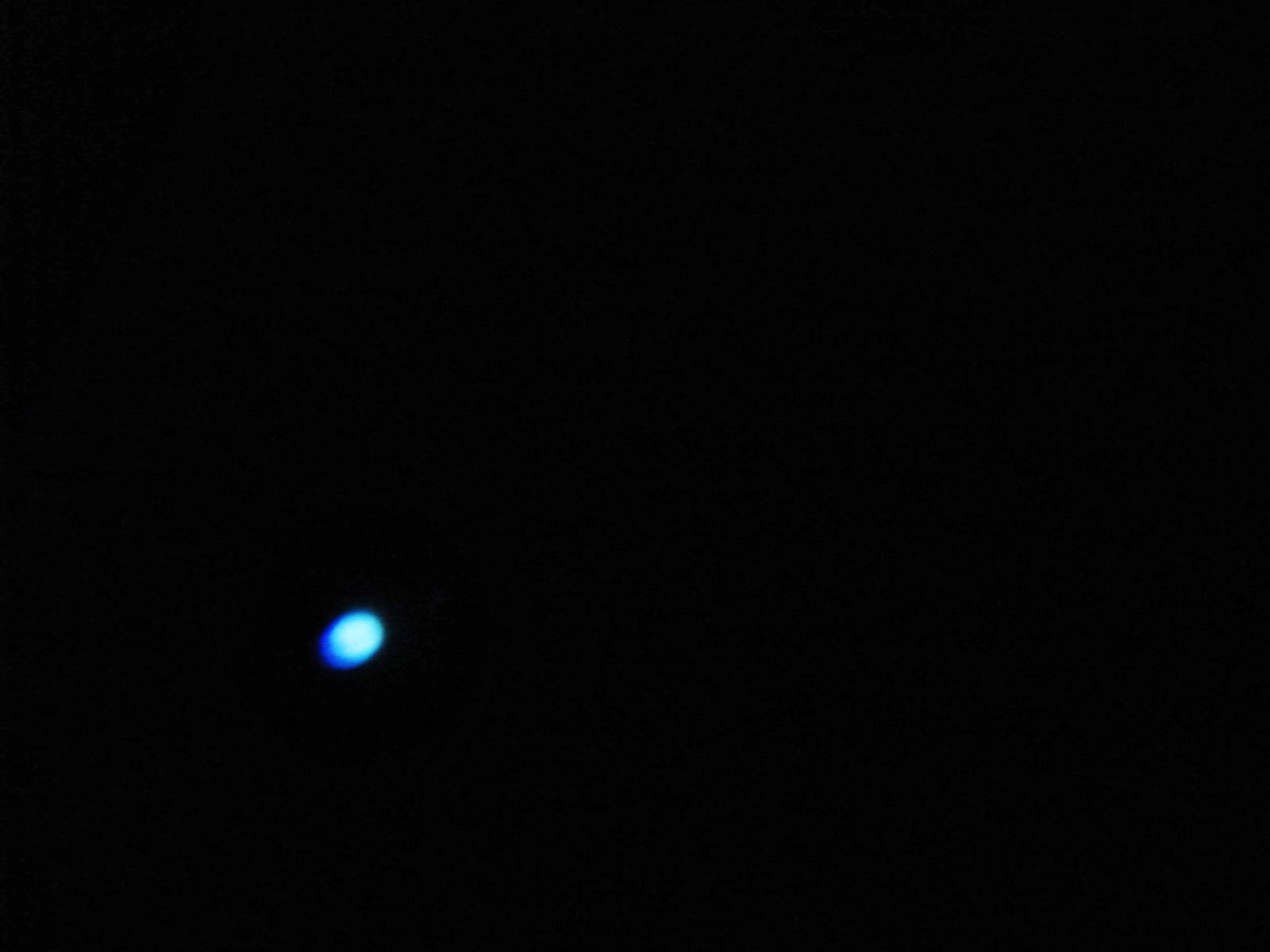 Jupiter- Blue Filter - 250x
Michael Formichelli 2014
Jupiter was a bit evasive that night, but I think I know what I did wrong (I forgot the Barlow lens- it magnifies the magnifier) and I was shaking a bit so I couldn't get a clear shot. Also, without the proper mount, I can't leave the camera on long enough to get all the light and hence, the 4 moons that were visible around it (shout out to Galileo!) Maybe next time around I'll do better.
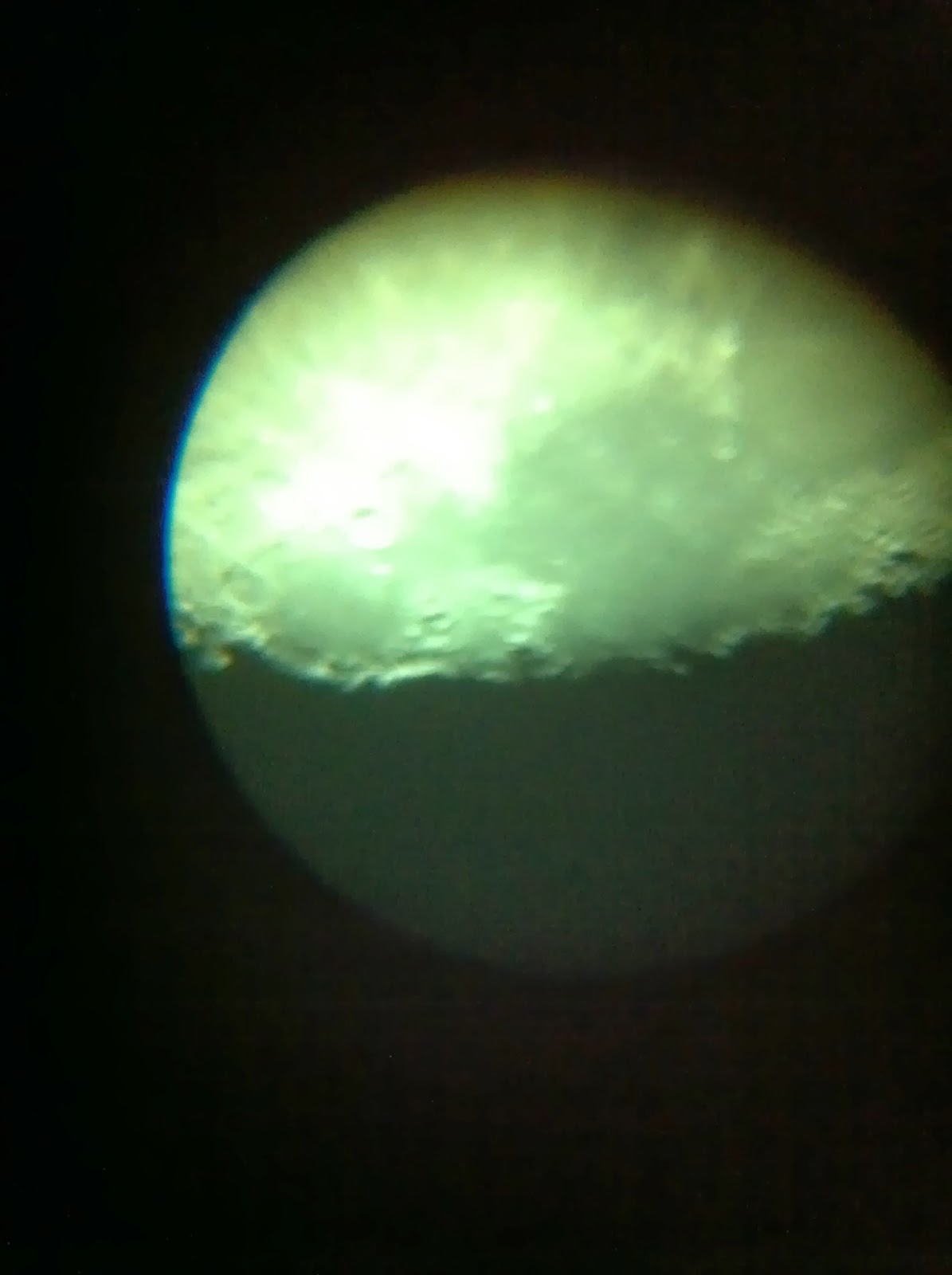
The Moon, however, was very obliging and I got several good ones. This one here was taken with a "Moon Filter" in the eyepiece lens. Basically what it does is cut down the glare so you can see details. If you get close in on this shot you can see the craters framed against the darkness of space (which is caused by the moon being so bright in comparison to the starlight behind it. Remember, space isn't black, per se, it's really full of stars. I mention it here because the blackness around Earth and The Moon in pictures is cited by conspiracy theorists for all kinds of crazy statements. Also the blacker darkness around the image is the telescope).
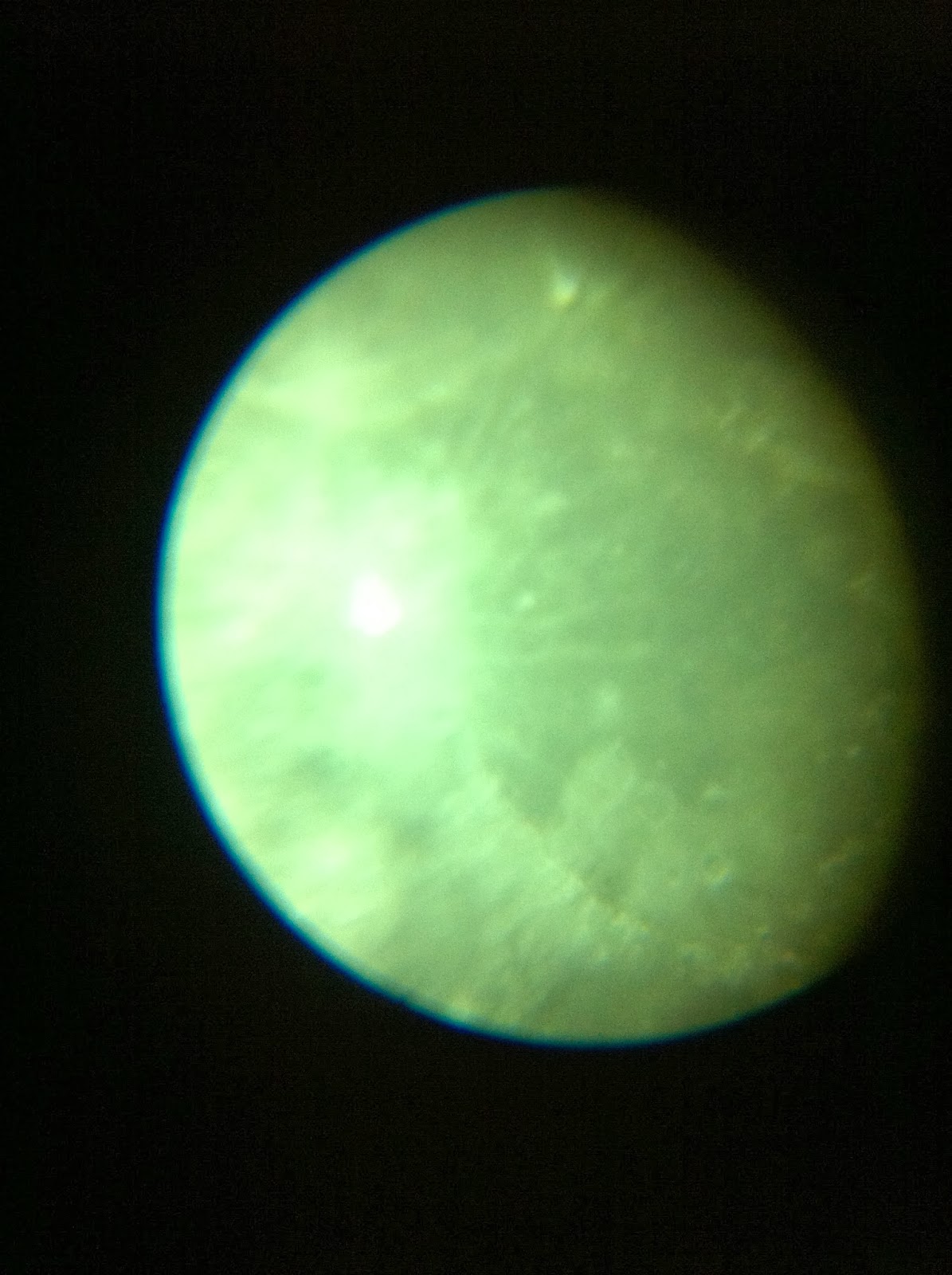 The Moon - Moon Filter- 250x
Michael Formichelli 2014
Here's the lunar surface with the Moon Filter up. The level of detail is pretty astounding through the telescope. It's amazing how much you don't see looking up at night without one. (The pictures don't do it justice.)
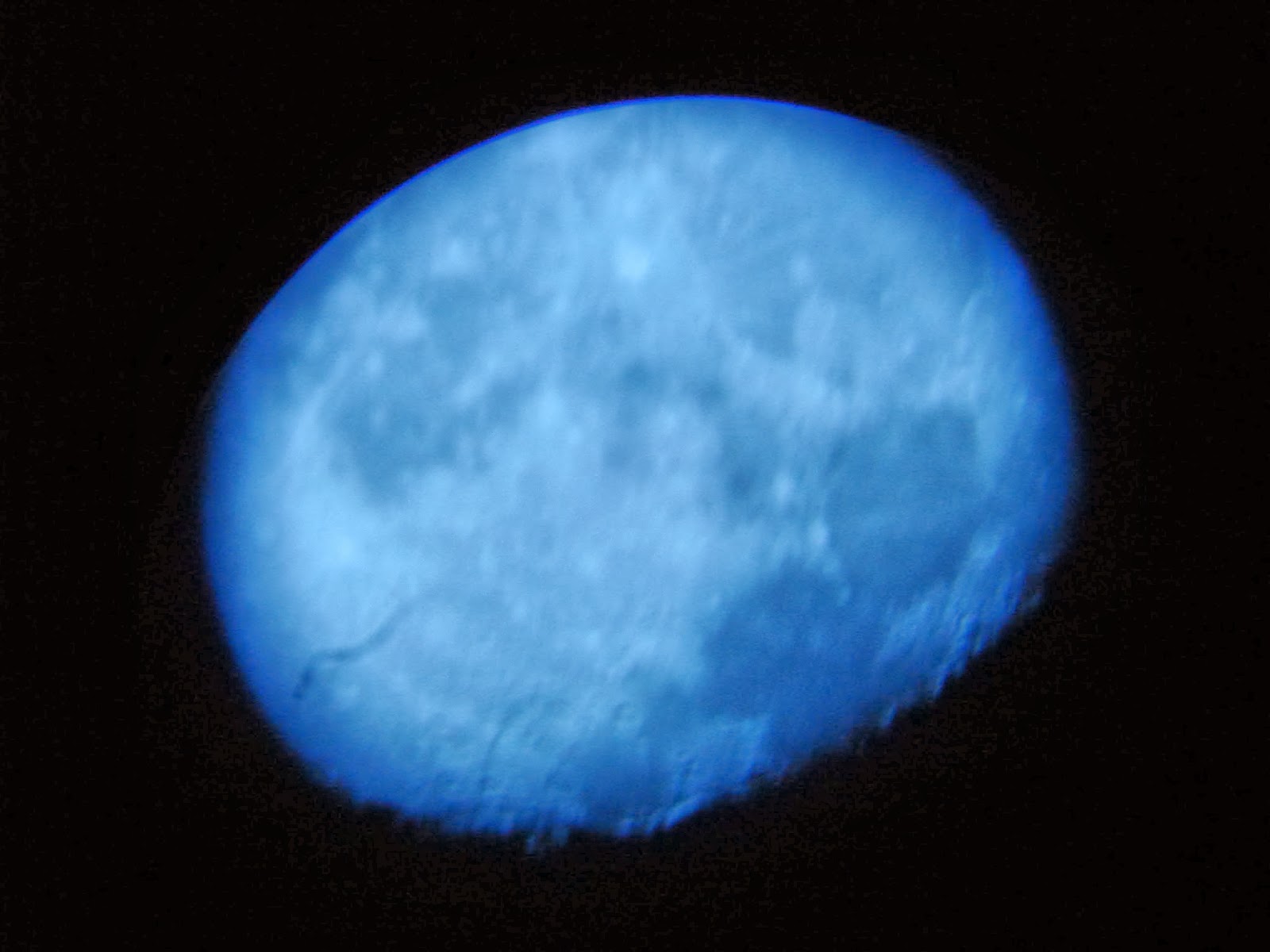 The Moon - Blue Filter - 250x
Michael Formichelli 2014
And finally I'll end here, on the blue moon... Just kidding, it's a filter effect again. I'd put it on to see if I could bring out the contrast in Jupiter's bands (failure this time) and just left it in the lens after turning the telescope on good old Luna here.
That's all for now. I'll post more photos as I get more interesting things on digital record (I miss saying film).
And just in case you're wondering, or are a mega-layman when it comes to telescopes like me, the Celestron I have is a Newtonian telescope—yes, the style was actually invented by Isaac Newton—which means it uses mirrors instead of lenses to capture the image (the only lenses are in the eyepiece, not the telescope body). It is one of three major styles, Refractor (the best known type, think giant pirate telescope), Newtonian, and Cassegrain (which is like a mix of the two).
You can look at the whole line of Celestron telescopes on Amazon.com or at http://www.celestron.com/.
AND be sure to come back around next week for my interview with my fellow science fiction author, Alia Gee!
Suncatcher, a new science fiction novel by Alia Gee!
Airships. Pirates. Gene kidnappers. Just another week in thesky!
Nero's Niche
Blogging about the things that inspire my writing: science, science fiction, fantasy, and the universe around us!
- Michael Formichelli's profile
- 23 followers

