Heather Holleman's Blog, page 159
August 30, 2019
Cultivating an Awareness of God’s Presence
Today for the Friday “The Verb” podcast (Listen here), I talk about worshiping God as our “full time occupation” (Tozer). Wherever you find yourself today, you can stop and cultivate an awareness of God’s presence by thanking Him for three things: His provision, His providential care for you, and the eternal perspective this situation brings you.


August 29, 2019
The Verb that Describes What You Do Best
As a professional development exercise, I ask students to choose a few verbs to describe what they do best.
I love what I hear around the room: inspire, rehabilitate, invigorate, adapt, synthesize, comfort, and design. I think of myself as encouraging and teaching or even enlivening.
It’s a fun activity!
August 28, 2019
Write the Book Only You Can Write
Today I woke up thinking that I have to write the book only I can write, not the book someone else would write.
I know that sounds obvious, but when you want to write your book—whatever your topic is—you’ll immediately think it should be more of this or that. More research! More literary devices! More paragraphs that sound like that other best-selling writer! You’ll start to sound like another writer.
Oh, it’s a struggle.
But only you can write the book you’re writing. If someone else can write it, let them write it, but that’s not the book you’re writing. You’re writing your book, your way, in your voice, with your authoritative experience and genius insight. And we need that kind of book.
I think writer’s block, shame, or any of the insecure feelings we might have come from trying to write someone else’s book. We’re performing the role of some writer when, really, the real, authentic writer was always there in you.
Write the book only you can write.
Only you can write the book you're #writing. If someone else can write it, let them write it, but that's not the book you're writing. You're writing your book, your way, in your voice. And we need this book. #amwriting
Click To Tweet
August 27, 2019
Return to the Gratitude List
If you feel out of sorts, remember the gratitude list that helps boost your mood and reminds you of all your blessings large and small. As a mental health practice, the gratitude list adds to your toolbox of daily rituals. Try just 5-10. This morning, I note how good the new coffee tastes (West African with frothy creamer). I’m thankful for rainy weather that will make my classroom feel so cozy as I teach for the first time this semester. I’m thankful for perfume that I just love to wear (anything with notes of vanilla). I love the Psalms and how they encourage me every morning and connect me to God’s great love. I am thankful for my growing children and how they provide opportunities to pray and just God more and more for their lives.
On and on into gratitude!
August 26, 2019
Forward Movement
A wise friend of mine who once wrote about horses shares with me a paraphrase of a quote she once discovered about horses that speaks to life:
“A stumbling horse finds his footing by continuing to gallop on his course.”
When stumbling around as we write, we just keep going. We’ll find our footing eventually. I find this works in so many areas of my life when I feel like I’m failing or confused about something. It’s just stumbling for a moment; as I continue to gallop on my course, I’ll find my sure footing soon.
What matters is continual forward movement–with horses and in life.
(The actual quote comes from Anthony Trollope–the Victorian English novelist. He wrote, “A stumbling horse regains his footing by persevering in his onward course.” Wonderful!)
August 25, 2019
Better Late Than Never
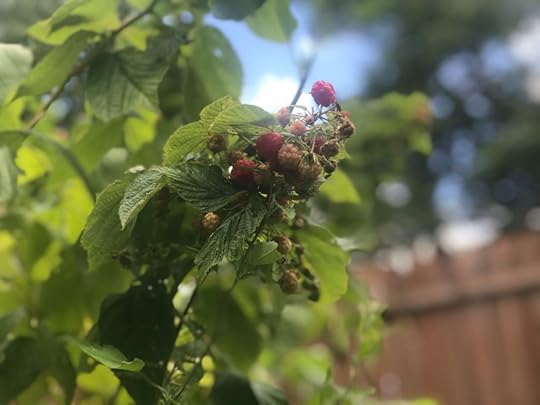
I love the late August harvest of berries that somehow always seems late. I remember that in every season of life, I’ll find unexpected fruit.
August 24, 2019
Catch Yourself
Today I met a woman named Helga who talked about doing certain things to “catch yourself” when you fall back into old habits or even ways of thinking. The phrase made me picture myself free-falling out of the sky and somehow also down below to “catch myself.” And it was a comforting thought.
It’s a supremely confident thought. When you travel too far down a path you’re not to take, you’ll catch yourself. You’ll eventually redirect, reposition, and rework.
Then, I learned about having little “rest stops” during the day to take stock of the day so you’re never just living on autopilot. You sit down in the middle of the day—or maybe earlier like after breakfast—and you create a little rest stop for yourself.
And maybe it’s in the rest stops that you catch yourself.
August 23, 2019
What Changes When You Enter a Room?
I’m loving this new professional development question that helps build self-awareness, confidence, and even conviction in students: What changes when you enter a room?
Some people know that they suck the energy out of a room by negativity, complaining, or attention seeking. Others know they offer little because they refuse to engage or let themselves be known. Others think they bring a judgmental attitude or dogmatic speech.
Do you know people who, when they walk in the room, everyone feels inspired to love more, be more creativity, and even become their true selves? Do you know people who bring energy, insight, or some kind of adventure with them?
I think I bring a bit of lively energy when I enter a room. But sometimes I don’t. I want to attune my heart to what happens when I’m in any environment and whether I add value or harm the community.
I told my teen daughters what I think changes when they enter a room: One brings laughter and sees the humor in anything. Another brings a weighty and much needed focus on important conversations happening in the world. I love the variety!
Good professional development question: What changes when you enter a room?
Click To Tweet
August 22, 2019
Not Knowing How You Feel
Today I talked with several women about growing older and how–at least in our stages of life–our days feel like an emotional upheaval. During certain times of life ranging from adolescence to any kind of transition, I’ve often taken great comfort in knowing exactly how I feel and why. I take comfort in being predictably happy or at least knowing why I’m not. But these days? I don’t know anything. It’s not just me; my teens don’t know how they feel or why. My friends don’t often know why they feel certain ways. Certain years just feel unstable and like an estrangement from self. My aging friends at work say it’s a New Normal of growing older.
Our emotions and thoughts that once kept us tethered tightly to purpose now fail us. Our steady sense of knowing with certainty what we’re doing and why fades. It’s not bad. It’s just growing up. I tell my teens and I tell myself.
The Italian Mama says to “sit tight” through emotional transitions. It will get better. It’s like the ebb and flow I thought about yesterday. In the meantime, though, I trust in God, not my emotions or even my ability to think clearly as I age. I’m not the same as I was at 20, 30, or 40. A new me emerges during each decade. A new you emerges. We wait. We trust. And we realize that our emotions will change and we won’t often feel like ourselves. But one day, we will.
August 21, 2019
Ebb and Flow
This morning I read an update from a friend about her life’s ebb and flow. As a girl who grew up–and ordered her young life–alongside the tidal patterns of Little Hunting Creek at the mouth of the Potomac River, the expression resonated with me.
But what is an ebb and flow? It’s “a recurrent or rhythmical pattern of coming and going or decline and regrowth.” Tidal bodies of water ebb and flow, as if God wanted to make sure we didn’t miss this metaphor for living.
When life ebbs, it recedes. Things seem dry and empty. God lays bare the matters of the heart like all things exposed at low tide. But here, the ebb fosters adaptation and strength. The ebbing tide pulls away toxins and pollutants.
When life flows again, the sense of flourishing returns. The tide flows back, and with it, new nutrients circulate.
As a girl, I learned to find the beauty in low tide. It kept me on the shore. My canoe couldn’t go anywhere. I learned patience. I learned to enjoy the growth I could now see that was once hidden underwater. I could track the footprints of foxes, raccoons, deer, and birds that walked the creek bed. You learn a different kind of seeing at low tide. You’re waiting, yes, but you’re also enjoying what you can only see in emptiness: turtle eggs, the beaver’s home, and the particular treasures of the creek bottom–like the fishing pole you lost at high tide.
But at high tide, I let myself loose. I paddled down unexplored paths, cutting into hydrilla and lily pads to find turtles and fat catfish. I fished and netted and went anywhere I pleased. But soon, the tide forced me home to avoid my green canoe sinking into the muck of Little Hunting Creek. More than once my father had to drag my sister and me back to shore when we stayed out too long.
Both the ebb and the flow: that’s a beautiful life.