Azly Rahman's Blog, page 10
January 2, 2019
PHILOSOPHY: Thinking about Thinking in the Age of “Post-truths”: Reading our personal book of signs, seeking out the history of questions
PHILOSPHICAL ESSAY
Thinking about Thinking in the Age of “Post-truths”:Reading our personal book of signs, seeking out the history of questions
A Presentation by Azly Rahman
in OviSymposium (Finland & Greece)

There is an overdose of talk these days on the word “post-truth” and “fake news” and the way the corporate media especially is trying to make the discourse of relativism par excellence go viral true to its ethos of profiting from reporting about conflicts. From “all the news that’s fit to print” we now have “all the views that count as equal truths.” Anything goes as well as long as they sell, in an age of the globalization of packaged and branded nothingness. Daily, especially when one is living in America and chose to be watched and washed by television, consume the news, get amused by the programs, entertained by Hollywood, transformed into televisual and online consumers, get informed by newscasters and talk show hosts in parallel-talks arguing at each other, or even simply be made to doze off by the hundreds of cable and non-cable channels, one is confronted with cruel choice of accepting “truths”.
We continue to live in a world deeply mediated by the corporate media that is now mutating in all forms: from those emanating from the regular TV broadcasts to the self-aggrandizing personal podcasts others create in the age of post-humanism and intelligent machines. The media and the way truth is “epistemologized” or how they are produced – through sound bites, click streams, fake-reproductions, or even sensationalized and viralized -- is mediating and, in fact, creating us in ways we still do not know how and to what effect.
Herein lies the complexity of the world we live in. Herein lie the need, I feel, for introspection and the occasionally to “leave our mediated self,” or the Platonic Allegorical cave we are forced into en masse. Now is the time look at what we have been made to become by the words, thoughts, concepts, and definitions we consume. This is a complex task understandably: a paradox of absurd proportions. How do we get out of the “Reality-defining language” we are in – this “prison-house” and look critically at the crystal-ball that is “us” or “we” or “I” and find out the process of how we become “constructed”? In other words, how do we “step out of ourselves” and see who we are or what we have become and then, ask the question, “what then must we do”?
Absurd.
That is the word to describe my proposition above. But engage in a phenomenological inquiry on the nature of cognition we must. Below are my thoughts on the phenomenology and the dialogics and dialectics of “truth production” I propose we need to look at in order to at least question what we know or made to know. I shall draw examples from the culture I grew up in as well as examples of how concepts become ideologies and installations shaping institutions in Malaysia. My interest is in the process of truth-construction and how they define social-relations of production.
The self as a text, hypertextualized: a book of signs
We are a book of signs. We are also living in a book of signs. We must learn how to read it.
"Read, in the name of thy Lord who created thee, from a clot (of Blood)."
This foundational and genealogic Quranic verse suggests the importance of reading. We can interpret this as reading being more than an act of understanding; that reading is an act of knowing, naming, de-constructing, and reconstructing the world.
What are we to read in our lifetime? How are we to live a life that has been pre-determined by the ideological framework that awaits us at the point of departure from that clot of blood?
"Man, in a word, has no nature . . . what he has is history," said the Spanish thinker Ortega y Gassett.
" Cogito ergo sum (I think; therefore, I exist)," said the French mathematician Rene Descartes.
The Western tradition suggests that circumstances and historical-materialism create the conditions of human existence. This seems to suggest to the idea that we must use our mental capacities to master our environment and the possibilities that await us, provided that we recognize the structures of oppression we are in.
This seems to further suggest that to exist, as a "free human being" one must first be aware of the visible and invisible systems created by other human beings. One must be aware in order for his/her existence to be one of "being and becoming" and in order for the human self to live with its own "global positioning system". These sayings suggest the idea of "reading" the signs and symbols of the world we inhabit. They ask us to understand the significance of language we use, the culture we inhabit, the ideologies our consciousness are shaped by, and the way we as human beings are "produced and reproduced" by those in control of the historical march of "progress".
But how are we to read, what is the history of our existence, and how is the human self-degenerating?
Many have labored on with this issue - philosophers of the Eastern and Western worlds, from ancient times to the frontier thinkers of the post-modern tradition.
Socrates taught people to ask questions so that they may be free from the state and from the gods created by the Athenians, Plato suggested the principles of ethics, metaphysics, poetics, and through 'The Republic', wrote what utopia is.
Modern philosophers of the Western tradition - Nietzsche, Locke, Hobbes, Mann, Rousseau, Hegel, Marx, Heidegger, Santayana, Habermas, Sartre, Foucault, Lacan and Derrida - continued the legacy of defining what free human beings ought to be.
The texts of the Judeo-Christian traditions, of Chinese and Hindu philosophies, and of other grand and subaltern voices have spoken on the need for the human self to be recognized as the highest form of existence. These texts have also explained the relationship between the human being and the universe he/she inhabits.
How might human beings be totally free in the entire scheme of human control?
Foundations of a dialogical self
I think we now ought to understand what the foundations of civilization are and understand the complexities of the structures of human control. If we understand what the creative, critical, and ethical foundations are, we might be able to read the society we live in better.
We might even have to labor less on the question of for example, "how to reduce corruption in society" or "how to make politics more ethical" or "how to educate citizens to become more obedient to the dictates of the state".
These questions have their own unique history. We must learn to ask the right questions.
From our understanding of the foundations of civilization, we can then comfortably explore what it means to be free and to be liberated from the prison of structures that have been erected by those who own the means of economic and intellectual production.
We can then understand how language can free or shackle us by the very nature of language as part of the system of signs and symbols. We can then understand the maxim “language is power" and whoever owns the language owns the knowledge to control others, or that whoever is in power can further produce systems of control through the use of specialized knowledge.
From our understanding of the foundations of knowledge and the tools to explore issues of power/knowledge/control, we may begin to examine the structures that oppress us and others and learn to be critically aware of unique spaces of power and knowledge we inhabit or to understand the "cartography of our existence", so that we can then fully appreciate the thoughts we possess as a human being who is born free.
We therefore must first learn to "read", in order to be free.
Dialogical thinking, as the Russian philosopher and linguistic theorist Mikhail Bakhtin might agree, will prepare us with the foundations of building new ideas and breaking new frontiers in the way we conceive what life might possibly be.
Dialogical thinking can help us examine the way we think what history can alternatively be, as in the manner many counter-factual historians might think.
Many of us have the urge to learn how to demystify age-old dogma, recognize faulty styles of thinking, and analyze flawed systems of perceptions. The urge to de-construct can be turned into a set of principles we can adopt on our road towards becoming a thinking being and on our road towards "illuminations".
The phenomena of globalization, the repudiation of technology, the control of resources in the hands of the global few, the increasing fragmentation of nations and the rise of "post-modern post-industrial tribes" is making this world an increasingly complex place.
Signs and symbols
We were born into pre-designed economic conditions and systems. In traditional societies, we were born as agricultural beings. In modern societies, we were born into structures defined as "modern".
In this age, we are born into Homo Cyberneticus (Cybernetic Beings), especially when we declared ourselves inhabitants of a Malaysian Multimedia Super Corridor living in the intelligent cities of Cyberjaya and Putrajaya.
In Malaysia for example, the economic design is one of an amalgamation of post-colonialism and Oriental Despotism, a legacy of nationalism and laissez faire economic structure and superstructure. We inherit these structures from the historical march of dominant economic ideologies chosen out of political preferences.
The knowledge we acquire is dependent upon/tied to the economic condition. The more sophisticated the ideology, the more hegemonic would be its impact on the way we acquire knowledge. We define our existence from this ideological point of view.
Following Rousseau, we were already born in chains; chained by the ideology of the political and the economic condition. The spiritual belief system is also of our own construction; based on packaged knowledge of myth and magic and manifestations of the nature of economic practices transplanted from faraway lands. This manifestation becomes culture.
The synthesis and interplay of narratives, myth, and political-economic structures become culture; as we see in the culture of the nomads of the Bedouin desert as well as the "post-industrial" nomads of Silicon Valley, California.
The structure of the development of the historical-materialism of things can be read from the nature of the development of culture and its interplay with technology and the development of human consciousness. Culture may become belief systems. Belief systems in turn become neutralized through the installation of ideologies based on dominant inscriptions.
We consume whatever that is termed as history; memories based on recollections of human experiences, archived by human beings and written by those "who know how to write" and "those who own the pen."
We are taught packaged knowledge, through the process of education as social reproduction and the process of schooling as a deliberate attempt to indoctrinate and tame the mind, so that these minds will not rebel against the structures they are born into.
Creatures of perception
Let us now look at some examples in Malaysian history of how institutions and ideologies shape the human self. I shall draw examples of how we have become creatures of perception, constructed by signs and symbols of the institutions that reproduced us.
During the early days of the elitist and British-modeled Malaysian school Malay College Kuala Kangsar, for example, children were taught packaged knowledge based on what was then the beginning of Eton-styled education system. That was the dominant installation of the British ideology.
Later in the 1970s, the Maktab Rendah Sains Mara system installed an educational ideology based, among others, on the model of the Bronx School for the Gifted in Science using an American-styled curriculum.
There were also models of indoctrination using Islamic-based principles of teaching and learning. One can go farther back in history and analyses how Christian missionary schools were built to have the minds reproduced according to the designs of the producers.
Another example will be the development of vernacular schools and ideologies based on race and ethnicity dictates the development of the self.
In the heyday of the "Islamization process" in Malaysian politics, then minister of education prepackaged an "Islamic" version of knowledge and called it The (Malaysian) Integrated Curriculum or Kurikulum Bersepadu to indoctrinate children into believing what political reality is about and to ensure his truth and the aligned truth of a prevailing doctrine be broadly disseminated.
Much later, in the heyday of Malaysia's conversion into an "Information Age" society, educationalist pre-packaged knowledge by introducing other means of disseminating truths and educating by designing Smart Schools (aligned with the demands of the Information Age).
In the Muslim-dominated states of Kelantan and Terengganu and in other similar Malay-Malay economic belts, other forms of schooling and indoctrination rule. Those in power and in their capacity to design systems of control install stronger structures of control; control of the minds of children who possess the ability to become frontier thinkers.
Human creativity is curbed to ensure that dogma will reign. Regimented truths are systematically forced into the curious young minds. These truths are borrowed from faraway lands and disseminated through specialized language.
Such are regimes of truth we have created out of our political-economic conditions. We must learn to read the meaning of how our learning institutions have produced us, as well as the power structures that produce such regimes of truth.
In all these examples of the social and ideological construction of reality, where would be the source of knowledge that? Where is locus of control of the production of “truth” oftentimes crafted as Official Knowledge and force-fed into human consciousness through schooling, training, and indoctrination?
We ought to be more interested in the history of questions rather that their utility primarily. In the following paragraphs with further reference to the case of hypermodern Malaysia, I expand this notion of genealogy over structurality. However, I can only provide more questions.
Seeking out the history of questions
We live in interesting times with questions concerning our existence.
How are human beings controlled by those who own the means of intellectual and economic production? How does power, in its raw and refined form, operate in our society? How is it dispersed? How is power sustained? How is truth produced? How is truth multiplied?
Still more questions plague me.
How is the self constructed? How are we alienated? What is inscribed onto the body and into the mind, in the process of schooling? How is human imagination confined and how might it be released? How is the mind enslaved by the politics of knowledge? How is historical knowledge packaged? How do we define our existence in this Age of Information?
Still more questions:
Who decides what is important in history? What is an ideal multi-cultural society? How has our ideas of multi-culturalism influence the way we live our lives? What historical knowledge is of importance? What tools do we need to create our own history?
And as I grow older, there are even more questions:
How is the individual more powerful than the state? How is a philosopher-king created? How is justice possible? Who should rule and why? How are we to teach about justice?
And finally, how might we realize a democratic-republic of virtue - one that is based on a form of democracy that is meaningful and personal?
Inadequate answers
Throughout the course of my study on the origin and fate of this society, I have learned how much the work of these people have contributed to the social construction of the Malaysian self and the democratic ideals that this nation aspires to realize.
I have learnt what the early philosophical journeys of the Malays look like, what kind of statecraft was practiced what the metaphysical system of this group constitutes, what form of social-humanism is to be fought for, what a Malaysian social justice may mean, what a multi-cultural Malaysian might look like, and finally, what brand of nationalism must be embraced in an age wherein "the Centre cannot hold".
I want to explore the history of the questions asked and to find out how we arrive at this or that historical juncture. I believe these questions will help us go back to the origin of things and in the process, to understand the world in which we live.
I believe that these questions can help one way for human beings to go back to the Centre and its Primordial Nature, through what Rousseau calls "sentimental education" or, to explore, as the Indonesian poet W S Rendra once said in his play 'The Struggle of the Naga Tribe', the "world within and the world without".
Through these questions, I believe one can break free from the shackles of domination and release the imagination. And as Rousseau continues: "Man is born free... and everywhere He is in chains", and that the first language he needs is the cry of Nature.
Transcultural flow of ideas
Based on a thesis I produced on the origin of Malaysia’s new city of Cyberjaya, I am currently further developing a "social theory of how nations develop and hypermodern as a result of transcultural flow of ideas and in the process of developing, how the human being loses its essence, gets alienated, and become conditioned by the system of signs and symbols; by its genealogy, anatomy, chemistry, and its cybernetic properties".
Ideas dance and do the hip hop and flow gracefully from one nation to another; from the mind of one group of people to another, from a nation at the Centre to the peripheries and the hinterlands. But in their dance, there is always the beauty and the deadly persuasion.
It is believed that in this age, we are born into a matrix of complexities, and we will spend our lifetime understanding it, possibly escaping it, and consequently constructing an understanding of our Existential self.
We are born to be makers of our own history. In this world without borders, are all essentially, transcultural citizens differentiated only by our national identity cards and our passports.
What comes after “Post-truth”?
In today’s world of multiple truths of knowing as well as the speed of technological diffusion of “truths” we ought to increase our effort in developing the human mind and in the teaching multiple perspectives of knowing not only to learn more but to critically examine further claims and assumptions bombarded onto us.
At the end of our writings, I hope we can name the inherent contradictions between our existentialism and the world of cybernetics we inhabit.
Still, my question is: What’s after “post-truth” then and how do we live an intelligible life without starving for knowledge yet drowning in information that keeps growing out of the womb of “Post-Truism?
Thinking about Thinking in the Age of “Post-truths”:Reading our personal book of signs, seeking out the history of questions
A Presentation by Azly Rahman
in OviSymposium (Finland & Greece)
There is an overdose of talk these days on the word “post-truth” and “fake news” and the way the corporate media especially is trying to make the discourse of relativism par excellence go viral true to its ethos of profiting from reporting about conflicts. From “all the news that’s fit to print” we now have “all the views that count as equal truths.” Anything goes as well as long as they sell, in an age of the globalization of packaged and branded nothingness. Daily, especially when one is living in America and chose to be watched and washed by television, consume the news, get amused by the programs, entertained by Hollywood, transformed into televisual and online consumers, get informed by newscasters and talk show hosts in parallel-talks arguing at each other, or even simply be made to doze off by the hundreds of cable and non-cable channels, one is confronted with cruel choice of accepting “truths”.
We continue to live in a world deeply mediated by the corporate media that is now mutating in all forms: from those emanating from the regular TV broadcasts to the self-aggrandizing personal podcasts others create in the age of post-humanism and intelligent machines. The media and the way truth is “epistemologized” or how they are produced – through sound bites, click streams, fake-reproductions, or even sensationalized and viralized -- is mediating and, in fact, creating us in ways we still do not know how and to what effect.
Herein lies the complexity of the world we live in. Herein lie the need, I feel, for introspection and the occasionally to “leave our mediated self,” or the Platonic Allegorical cave we are forced into en masse. Now is the time look at what we have been made to become by the words, thoughts, concepts, and definitions we consume. This is a complex task understandably: a paradox of absurd proportions. How do we get out of the “Reality-defining language” we are in – this “prison-house” and look critically at the crystal-ball that is “us” or “we” or “I” and find out the process of how we become “constructed”? In other words, how do we “step out of ourselves” and see who we are or what we have become and then, ask the question, “what then must we do”?
Absurd.
That is the word to describe my proposition above. But engage in a phenomenological inquiry on the nature of cognition we must. Below are my thoughts on the phenomenology and the dialogics and dialectics of “truth production” I propose we need to look at in order to at least question what we know or made to know. I shall draw examples from the culture I grew up in as well as examples of how concepts become ideologies and installations shaping institutions in Malaysia. My interest is in the process of truth-construction and how they define social-relations of production.
The self as a text, hypertextualized: a book of signs
We are a book of signs. We are also living in a book of signs. We must learn how to read it.
"Read, in the name of thy Lord who created thee, from a clot (of Blood)."
This foundational and genealogic Quranic verse suggests the importance of reading. We can interpret this as reading being more than an act of understanding; that reading is an act of knowing, naming, de-constructing, and reconstructing the world.
What are we to read in our lifetime? How are we to live a life that has been pre-determined by the ideological framework that awaits us at the point of departure from that clot of blood?
"Man, in a word, has no nature . . . what he has is history," said the Spanish thinker Ortega y Gassett.
" Cogito ergo sum (I think; therefore, I exist)," said the French mathematician Rene Descartes.
The Western tradition suggests that circumstances and historical-materialism create the conditions of human existence. This seems to suggest to the idea that we must use our mental capacities to master our environment and the possibilities that await us, provided that we recognize the structures of oppression we are in.
This seems to further suggest that to exist, as a "free human being" one must first be aware of the visible and invisible systems created by other human beings. One must be aware in order for his/her existence to be one of "being and becoming" and in order for the human self to live with its own "global positioning system". These sayings suggest the idea of "reading" the signs and symbols of the world we inhabit. They ask us to understand the significance of language we use, the culture we inhabit, the ideologies our consciousness are shaped by, and the way we as human beings are "produced and reproduced" by those in control of the historical march of "progress".
But how are we to read, what is the history of our existence, and how is the human self-degenerating?
Many have labored on with this issue - philosophers of the Eastern and Western worlds, from ancient times to the frontier thinkers of the post-modern tradition.
Socrates taught people to ask questions so that they may be free from the state and from the gods created by the Athenians, Plato suggested the principles of ethics, metaphysics, poetics, and through 'The Republic', wrote what utopia is.
Modern philosophers of the Western tradition - Nietzsche, Locke, Hobbes, Mann, Rousseau, Hegel, Marx, Heidegger, Santayana, Habermas, Sartre, Foucault, Lacan and Derrida - continued the legacy of defining what free human beings ought to be.
The texts of the Judeo-Christian traditions, of Chinese and Hindu philosophies, and of other grand and subaltern voices have spoken on the need for the human self to be recognized as the highest form of existence. These texts have also explained the relationship between the human being and the universe he/she inhabits.
How might human beings be totally free in the entire scheme of human control?
Foundations of a dialogical self
I think we now ought to understand what the foundations of civilization are and understand the complexities of the structures of human control. If we understand what the creative, critical, and ethical foundations are, we might be able to read the society we live in better.
We might even have to labor less on the question of for example, "how to reduce corruption in society" or "how to make politics more ethical" or "how to educate citizens to become more obedient to the dictates of the state".
These questions have their own unique history. We must learn to ask the right questions.
From our understanding of the foundations of civilization, we can then comfortably explore what it means to be free and to be liberated from the prison of structures that have been erected by those who own the means of economic and intellectual production.
We can then understand how language can free or shackle us by the very nature of language as part of the system of signs and symbols. We can then understand the maxim “language is power" and whoever owns the language owns the knowledge to control others, or that whoever is in power can further produce systems of control through the use of specialized knowledge.
From our understanding of the foundations of knowledge and the tools to explore issues of power/knowledge/control, we may begin to examine the structures that oppress us and others and learn to be critically aware of unique spaces of power and knowledge we inhabit or to understand the "cartography of our existence", so that we can then fully appreciate the thoughts we possess as a human being who is born free.
We therefore must first learn to "read", in order to be free.
Dialogical thinking, as the Russian philosopher and linguistic theorist Mikhail Bakhtin might agree, will prepare us with the foundations of building new ideas and breaking new frontiers in the way we conceive what life might possibly be.
Dialogical thinking can help us examine the way we think what history can alternatively be, as in the manner many counter-factual historians might think.
Many of us have the urge to learn how to demystify age-old dogma, recognize faulty styles of thinking, and analyze flawed systems of perceptions. The urge to de-construct can be turned into a set of principles we can adopt on our road towards becoming a thinking being and on our road towards "illuminations".
The phenomena of globalization, the repudiation of technology, the control of resources in the hands of the global few, the increasing fragmentation of nations and the rise of "post-modern post-industrial tribes" is making this world an increasingly complex place.
Signs and symbols
We were born into pre-designed economic conditions and systems. In traditional societies, we were born as agricultural beings. In modern societies, we were born into structures defined as "modern".
In this age, we are born into Homo Cyberneticus (Cybernetic Beings), especially when we declared ourselves inhabitants of a Malaysian Multimedia Super Corridor living in the intelligent cities of Cyberjaya and Putrajaya.
In Malaysia for example, the economic design is one of an amalgamation of post-colonialism and Oriental Despotism, a legacy of nationalism and laissez faire economic structure and superstructure. We inherit these structures from the historical march of dominant economic ideologies chosen out of political preferences.
The knowledge we acquire is dependent upon/tied to the economic condition. The more sophisticated the ideology, the more hegemonic would be its impact on the way we acquire knowledge. We define our existence from this ideological point of view.
Following Rousseau, we were already born in chains; chained by the ideology of the political and the economic condition. The spiritual belief system is also of our own construction; based on packaged knowledge of myth and magic and manifestations of the nature of economic practices transplanted from faraway lands. This manifestation becomes culture.
The synthesis and interplay of narratives, myth, and political-economic structures become culture; as we see in the culture of the nomads of the Bedouin desert as well as the "post-industrial" nomads of Silicon Valley, California.
The structure of the development of the historical-materialism of things can be read from the nature of the development of culture and its interplay with technology and the development of human consciousness. Culture may become belief systems. Belief systems in turn become neutralized through the installation of ideologies based on dominant inscriptions.
We consume whatever that is termed as history; memories based on recollections of human experiences, archived by human beings and written by those "who know how to write" and "those who own the pen."
We are taught packaged knowledge, through the process of education as social reproduction and the process of schooling as a deliberate attempt to indoctrinate and tame the mind, so that these minds will not rebel against the structures they are born into.
Creatures of perception
Let us now look at some examples in Malaysian history of how institutions and ideologies shape the human self. I shall draw examples of how we have become creatures of perception, constructed by signs and symbols of the institutions that reproduced us.
During the early days of the elitist and British-modeled Malaysian school Malay College Kuala Kangsar, for example, children were taught packaged knowledge based on what was then the beginning of Eton-styled education system. That was the dominant installation of the British ideology.
Later in the 1970s, the Maktab Rendah Sains Mara system installed an educational ideology based, among others, on the model of the Bronx School for the Gifted in Science using an American-styled curriculum.
There were also models of indoctrination using Islamic-based principles of teaching and learning. One can go farther back in history and analyses how Christian missionary schools were built to have the minds reproduced according to the designs of the producers.
Another example will be the development of vernacular schools and ideologies based on race and ethnicity dictates the development of the self.
In the heyday of the "Islamization process" in Malaysian politics, then minister of education prepackaged an "Islamic" version of knowledge and called it The (Malaysian) Integrated Curriculum or Kurikulum Bersepadu to indoctrinate children into believing what political reality is about and to ensure his truth and the aligned truth of a prevailing doctrine be broadly disseminated.
Much later, in the heyday of Malaysia's conversion into an "Information Age" society, educationalist pre-packaged knowledge by introducing other means of disseminating truths and educating by designing Smart Schools (aligned with the demands of the Information Age).
In the Muslim-dominated states of Kelantan and Terengganu and in other similar Malay-Malay economic belts, other forms of schooling and indoctrination rule. Those in power and in their capacity to design systems of control install stronger structures of control; control of the minds of children who possess the ability to become frontier thinkers.
Human creativity is curbed to ensure that dogma will reign. Regimented truths are systematically forced into the curious young minds. These truths are borrowed from faraway lands and disseminated through specialized language.
Such are regimes of truth we have created out of our political-economic conditions. We must learn to read the meaning of how our learning institutions have produced us, as well as the power structures that produce such regimes of truth.
In all these examples of the social and ideological construction of reality, where would be the source of knowledge that? Where is locus of control of the production of “truth” oftentimes crafted as Official Knowledge and force-fed into human consciousness through schooling, training, and indoctrination?
We ought to be more interested in the history of questions rather that their utility primarily. In the following paragraphs with further reference to the case of hypermodern Malaysia, I expand this notion of genealogy over structurality. However, I can only provide more questions.
Seeking out the history of questions
We live in interesting times with questions concerning our existence.
How are human beings controlled by those who own the means of intellectual and economic production? How does power, in its raw and refined form, operate in our society? How is it dispersed? How is power sustained? How is truth produced? How is truth multiplied?
Still more questions plague me.
How is the self constructed? How are we alienated? What is inscribed onto the body and into the mind, in the process of schooling? How is human imagination confined and how might it be released? How is the mind enslaved by the politics of knowledge? How is historical knowledge packaged? How do we define our existence in this Age of Information?
Still more questions:
Who decides what is important in history? What is an ideal multi-cultural society? How has our ideas of multi-culturalism influence the way we live our lives? What historical knowledge is of importance? What tools do we need to create our own history?
And as I grow older, there are even more questions:
How is the individual more powerful than the state? How is a philosopher-king created? How is justice possible? Who should rule and why? How are we to teach about justice?
And finally, how might we realize a democratic-republic of virtue - one that is based on a form of democracy that is meaningful and personal?
Inadequate answers
Throughout the course of my study on the origin and fate of this society, I have learned how much the work of these people have contributed to the social construction of the Malaysian self and the democratic ideals that this nation aspires to realize.
I have learnt what the early philosophical journeys of the Malays look like, what kind of statecraft was practiced what the metaphysical system of this group constitutes, what form of social-humanism is to be fought for, what a Malaysian social justice may mean, what a multi-cultural Malaysian might look like, and finally, what brand of nationalism must be embraced in an age wherein "the Centre cannot hold".
I want to explore the history of the questions asked and to find out how we arrive at this or that historical juncture. I believe these questions will help us go back to the origin of things and in the process, to understand the world in which we live.
I believe that these questions can help one way for human beings to go back to the Centre and its Primordial Nature, through what Rousseau calls "sentimental education" or, to explore, as the Indonesian poet W S Rendra once said in his play 'The Struggle of the Naga Tribe', the "world within and the world without".
Through these questions, I believe one can break free from the shackles of domination and release the imagination. And as Rousseau continues: "Man is born free... and everywhere He is in chains", and that the first language he needs is the cry of Nature.
Transcultural flow of ideas
Based on a thesis I produced on the origin of Malaysia’s new city of Cyberjaya, I am currently further developing a "social theory of how nations develop and hypermodern as a result of transcultural flow of ideas and in the process of developing, how the human being loses its essence, gets alienated, and become conditioned by the system of signs and symbols; by its genealogy, anatomy, chemistry, and its cybernetic properties".
Ideas dance and do the hip hop and flow gracefully from one nation to another; from the mind of one group of people to another, from a nation at the Centre to the peripheries and the hinterlands. But in their dance, there is always the beauty and the deadly persuasion.
It is believed that in this age, we are born into a matrix of complexities, and we will spend our lifetime understanding it, possibly escaping it, and consequently constructing an understanding of our Existential self.
We are born to be makers of our own history. In this world without borders, are all essentially, transcultural citizens differentiated only by our national identity cards and our passports.
What comes after “Post-truth”?
In today’s world of multiple truths of knowing as well as the speed of technological diffusion of “truths” we ought to increase our effort in developing the human mind and in the teaching multiple perspectives of knowing not only to learn more but to critically examine further claims and assumptions bombarded onto us.
At the end of our writings, I hope we can name the inherent contradictions between our existentialism and the world of cybernetics we inhabit.
Still, my question is: What’s after “post-truth” then and how do we live an intelligible life without starving for knowledge yet drowning in information that keeps growing out of the womb of “Post-Truism?


#12: People voted for a newer Malaysia, not a newer Umno
People voted for a newer Malaysia, not a newer UmnoOpinion |
Azly Rahman
Published: 29 Oct 2018, 12:05 am | Modified: 29 Oct 2018, 12:05 am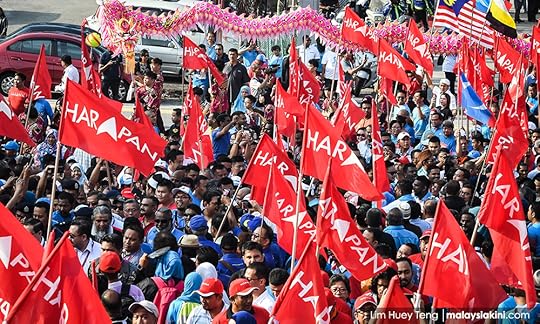 A+ A- COMMENT | As we read about the “Operasi Lalang 2.0” or “Weed-Out-the-Corrupt Campaign of the New Regime” at play and in full throttle as in the McCarthyism of our cultural sensibility, as we see more leaders hauled up to be tried for grand theft, money-laundering and for bankrupting and corroding society, we ask: what next in this metamorphosis and game of political karma we are to see?All these against the backdrop of talks of the third car project, crooked bridge, political-party border-crossings, renewed demands to strengthen Malay rights, postponed promises, and to rebrand fundamentalist Islamic identity in preparation for the challenges posed by the super liberals and the LGBT. What will the new coalition transform into in a country whose political parties are addicted to a race-based ideology?Then, there is the crucial issue of a newer Umno and newer BN emerging, with talk of 40 Umno MPs crossing over to Bersatu. There was also the latest statement by a minister that Ketuanan Melayu will end soon, replaced by the idea of making every Malaysian prosperous. Then the idea was immediately repudiated by another minister, a former deputy prime minister in the regime of the Najib Abdul Razak.
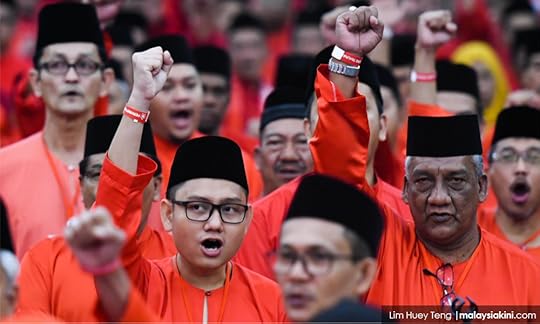 I have a sense that the latest developments in the continuing chaos produced in PKR, the seemingly silent DAP in addressing the issues the party once opposed, the talk of a new Indian party, and, of course, the strengthening and enlarging of Bersatu – all this points not only to the emergence of a BN reloaded, a 2.0 version of Malaysia’s race-based politics.I might be wrong. We shall observe the developments. We may even see more “Kajang Moves”, cross-overs, and more intense struggle for power within and amongst the coalition parties.The voters in GE14 voted for a new Malaysia. Equal opportunity in education, lessening of race-based politics, abolishing of tolls and whatever that was promised by the then opposition, the “Coalition of Hope” of the Mahathir-led campaign against kleptocracy and the materially, morally and ideologically corrupt regime of Najib.At least that was the promise which then turned into a primarily false one, leaving the voters feeling lied to and short-changed.The hope for the non-Malays, non-bumiputera to stop being treated as second-class citizens in the land called Malaysia they and their parents and grandparents, too, toiled for will not be realised after all. The rhetoric of today’s new Malaysia is the same old rhetoric of keeping the status quo alive.
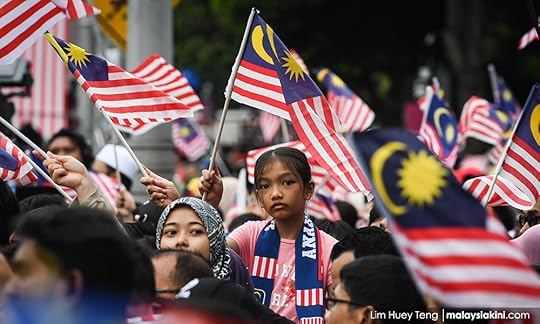 This means that there will be no push for the idea of “Malaysian Malaysia” and equal opportunities in education, especially for all non-Malays. Hope buried. When the new coalition has transformed into a newer version of the old politics, the non-Malays can expect another five decades of racialised politics affecting the future of their children.This is not a grim view of what I see developing. I am sure some of my esteemed readers, too, share a similar perspective of a hope for the triumph of multiculturalism dashing. Unless the Harapan government can, in unison, with consistency and as a policy, state its commitment to make Malaysia a place in which no Malaysian will be left behind.Where are we heading?Back to Umno and its sudden death. The talk about more Umno MPs leaving for Bersatu is of concern for those who voted for hope and for real change.But what will replace Umno in this time of a “new Malaysia” in which race and religion continues to be the strongest force for the current regime as well, to continue policies inspired by her own apartheid system of divide and conquer with wealth, power, hegemony, and ideology as the hybrid of authoritarianism, continue to glue the still-cognitively unliberated society?The question remains: what kind of Malaysian Malaysia do we wish to see? How will a rebranded Umno be an obstacle to this?
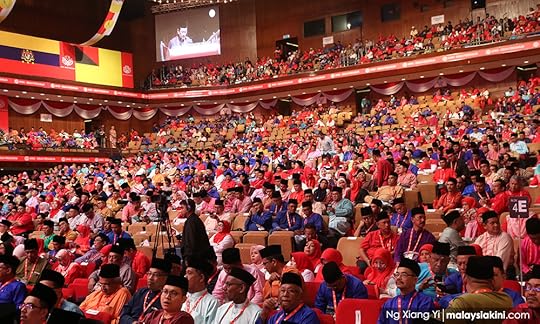 The key to dealing with any rot from happening is to educate for change. If the change we wish to see is for a Malaysia for all Malaysians, education, as the only means for a sustainable cognitive, cultural, personal and social progress should be the one taking lead.When politics continues to travel the trajectory of ethnocentrism and only pays lip-service to multi-culturalism and the restructuring of society through a philosophy of education based on a truly Malaysian reconstructionism, we will fail as a people.Education needs to step in and correct the political conveyor belt, changing course. As it is now, we are not seeing the Ministry of Education committed to producing such a change to reverse the major aspects of discrimination in the various levels of schooling. The issues of class, caste, race, religion and privilege is not addressed systemically.Like many, I am concerned with the disjuncture between politics, education, economy, and national unity. There is an unhealthy development in the way party-politics is moving.Our concerns may turn into fear of yet another wave of chaos as parties and followers and consumers of ideology and real and fake news alike prepare for another general election that will only bring stagnancy, not change.Where are we heading? What then must we do to drum into the new regime that race-based politics should no longer be allowed to rear its ugly head?AZLY RAHMAN is an educator, academic, international columnist, and author of seven books available
here
. He grew up in Johor Bahru and holds a Columbia University doctorate in international education development and Master’s degrees in six areas: education, international affairs, peace studies communication, fiction and non-fiction writing. Twitter @azlyrahman. More writings
here
.
The key to dealing with any rot from happening is to educate for change. If the change we wish to see is for a Malaysia for all Malaysians, education, as the only means for a sustainable cognitive, cultural, personal and social progress should be the one taking lead.When politics continues to travel the trajectory of ethnocentrism and only pays lip-service to multi-culturalism and the restructuring of society through a philosophy of education based on a truly Malaysian reconstructionism, we will fail as a people.Education needs to step in and correct the political conveyor belt, changing course. As it is now, we are not seeing the Ministry of Education committed to producing such a change to reverse the major aspects of discrimination in the various levels of schooling. The issues of class, caste, race, religion and privilege is not addressed systemically.Like many, I am concerned with the disjuncture between politics, education, economy, and national unity. There is an unhealthy development in the way party-politics is moving.Our concerns may turn into fear of yet another wave of chaos as parties and followers and consumers of ideology and real and fake news alike prepare for another general election that will only bring stagnancy, not change.Where are we heading? What then must we do to drum into the new regime that race-based politics should no longer be allowed to rear its ugly head?AZLY RAHMAN is an educator, academic, international columnist, and author of seven books available
here
. He grew up in Johor Bahru and holds a Columbia University doctorate in international education development and Master’s degrees in six areas: education, international affairs, peace studies communication, fiction and non-fiction writing. Twitter @azlyrahman. More writings
here
.
A+ A- COMMENT | As we read about the “Operasi Lalang 2.0” or “Weed-Out-the-Corrupt Campaign of the New Regime” at play and in full throttle as in the McCarthyism of our cultural sensibility, as we see more leaders hauled up to be tried for grand theft, money-laundering and for bankrupting and corroding society, we ask: what next in this metamorphosis and game of political karma we are to see?All these against the backdrop of talks of the third car project, crooked bridge, political-party border-crossings, renewed demands to strengthen Malay rights, postponed promises, and to rebrand fundamentalist Islamic identity in preparation for the challenges posed by the super liberals and the LGBT. What will the new coalition transform into in a country whose political parties are addicted to a race-based ideology?Then, there is the crucial issue of a newer Umno and newer BN emerging, with talk of 40 Umno MPs crossing over to Bersatu. There was also the latest statement by a minister that Ketuanan Melayu will end soon, replaced by the idea of making every Malaysian prosperous. Then the idea was immediately repudiated by another minister, a former deputy prime minister in the regime of the Najib Abdul Razak.I have a sense that the latest developments in the continuing chaos produced in PKR, the seemingly silent DAP in addressing the issues the party once opposed, the talk of a new Indian party, and, of course, the strengthening and enlarging of Bersatu – all this points not only to the emergence of a BN reloaded, a 2.0 version of Malaysia’s race-based politics.I might be wrong. We shall observe the developments. We may even see more “Kajang Moves”, cross-overs, and more intense struggle for power within and amongst the coalition parties.The voters in GE14 voted for a new Malaysia. Equal opportunity in education, lessening of race-based politics, abolishing of tolls and whatever that was promised by the then opposition, the “Coalition of Hope” of the Mahathir-led campaign against kleptocracy and the materially, morally and ideologically corrupt regime of Najib.At least that was the promise which then turned into a primarily false one, leaving the voters feeling lied to and short-changed.The hope for the non-Malays, non-bumiputera to stop being treated as second-class citizens in the land called Malaysia they and their parents and grandparents, too, toiled for will not be realised after all. The rhetoric of today’s new Malaysia is the same old rhetoric of keeping the status quo alive.This means that there will be no push for the idea of “Malaysian Malaysia” and equal opportunities in education, especially for all non-Malays. Hope buried. When the new coalition has transformed into a newer version of the old politics, the non-Malays can expect another five decades of racialised politics affecting the future of their children.This is not a grim view of what I see developing. I am sure some of my esteemed readers, too, share a similar perspective of a hope for the triumph of multiculturalism dashing. Unless the Harapan government can, in unison, with consistency and as a policy, state its commitment to make Malaysia a place in which no Malaysian will be left behind.Where are we heading?Back to Umno and its sudden death. The talk about more Umno MPs leaving for Bersatu is of concern for those who voted for hope and for real change.But what will replace Umno in this time of a “new Malaysia” in which race and religion continues to be the strongest force for the current regime as well, to continue policies inspired by her own apartheid system of divide and conquer with wealth, power, hegemony, and ideology as the hybrid of authoritarianism, continue to glue the still-cognitively unliberated society?The question remains: what kind of Malaysian Malaysia do we wish to see? How will a rebranded Umno be an obstacle to this?The key to dealing with any rot from happening is to educate for change. If the change we wish to see is for a Malaysia for all Malaysians, education, as the only means for a sustainable cognitive, cultural, personal and social progress should be the one taking lead.When politics continues to travel the trajectory of ethnocentrism and only pays lip-service to multi-culturalism and the restructuring of society through a philosophy of education based on a truly Malaysian reconstructionism, we will fail as a people.Education needs to step in and correct the political conveyor belt, changing course. As it is now, we are not seeing the Ministry of Education committed to producing such a change to reverse the major aspects of discrimination in the various levels of schooling. The issues of class, caste, race, religion and privilege is not addressed systemically.Like many, I am concerned with the disjuncture between politics, education, economy, and national unity. There is an unhealthy development in the way party-politics is moving.Our concerns may turn into fear of yet another wave of chaos as parties and followers and consumers of ideology and real and fake news alike prepare for another general election that will only bring stagnancy, not change.Where are we heading? What then must we do to drum into the new regime that race-based politics should no longer be allowed to rear its ugly head?AZLY RAHMAN is an educator, academic, international columnist, and author of seven books available
here
. He grew up in Johor Bahru and holds a Columbia University doctorate in international education development and Master’s degrees in six areas: education, international affairs, peace studies communication, fiction and non-fiction writing. Twitter @azlyrahman. More writings
here
.#11: Revisiting our 'rempitised' education system
Revisiting our 'rempitised' education systemOpinion |
Azly Rahman
Published: 7 Oct 2018, 4:23 am | Modified: 7 Oct 2018, 4:23 am A+ A- COMMENT | Our schools are at risk. Is it now governed by the ideology of 'rempitism'? What is this ideology? How do we prevent it from destroying the country? What are our educational leaders doing about it? I proposed some remedies based on the relationship between education, economy, and technopoly, but this ideology is of pressing concern.The Malaysian phenomenon of youths racing illegally on public roads on customised motorbikes after midnight to that rob peaceful citizens of their restful sleep is a phenomenon akin to a capitalist economy of a struggling showcasing Third Word nation, that hypermodernises beyond the ability of its people to cope with its sensationalised designs of 'economic miracles'.Both phenomena rest upon idiotic pride and arrogance that endanger a peaceful, ethical and sustainable future. Both present clear and present danger on the equally dangerous highway of globalisation. A 'rempitised' economic and education system 'rams' human beings into different 'pits' of the conveyer belt of the capitalist production system; creating what looks like a natural progression of meritocracy in education and social evolution. The foundation of this system is neocolonialism, structural violence and the alienation of labour (like participants in the global rat race, mat rempit always want to finish first in the deadly race and be the first to do a wheelie for the world to see).Is our public education system failing? Is it producing more and more mat rempit, anak Abu, bohsia, bohjan, and alienated youth put at risk by our education system?Are we creating class systems in education the way we have created varying types of classrooms that correspond to different classes in society? Why are we seeing the tuition industry becoming a billion-ringgit business, helping our children memorising more and more but understanding less and less of what they learn?
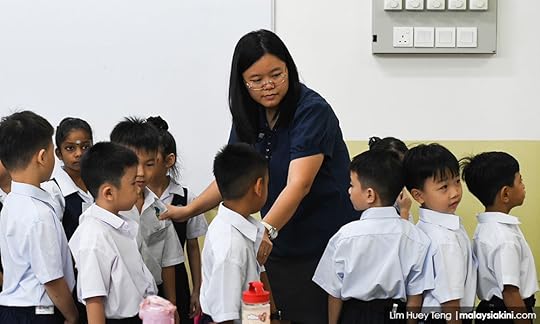 Do we have people in the education ministry well-versed enough in analysing the phenomenon of our rempitised economy (speeding it up illegally) and how this is directly related to how we are 'schooling' our society?What is our national agenda in education, not only to ensure no child of any race or religion be left behind but seeing through that they will love learning as a lifelong pursuit? How much planning, scenario-building, analysing, big data-gathering, futuristics-thinking, and innovative strategizing is the Education Ministry doing to address this issue of alienation in schools?Do we now have an entire system of higher education inheriting the children of our rempitised economy and contributing to the low quality of graduates – who cannot think critically and are always subjected to the whims and fancies of a totalitarian regime only interested in tightening the stranglehold on our universities?British and American scholars like Paul Willis, Henry Levin, Peter McLaren and Martin Carnoy who studied the phenomena of schooling in capitalist societies observed the nature of the learning process in countries in which the rapid and unreflective industrialisation and post-industrialisation process have created one-dimensional citizens out of youth.Schooling teaches these children to become good and obedient workers in an economic system that reduces the larger population into labour, while enriching the upper class into people and property-owners in a rempitised economy.What's lacking in teachersIs our education ministry training teachers well in urban education and in the schooling of our at-risk youth? Will it study enough of the issue of class and social reproduction in order to shift the way we think about student success, learning engagement, and closing the achievement gap between the rich and the poor?Do we actually know the root cause of rempitism and gangsterism in schools, and are we able to design better learning systems for those who are already marginalised and left behind by our rempitised economy? How many schools are today classified as troubled, especially in the infiltration of drugs and drug traffickers in schools?
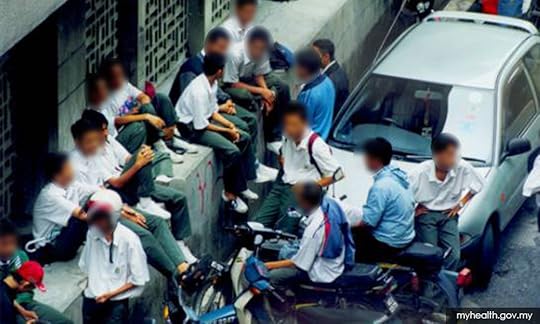 I have a sense that the cases of gangsterism and bullying of teachers will continue to increase. More private schools will be built and Malaysians will lose confidence in their public schools. More private schools mean more divisions in society. The rich will produce better schools and the poor will be left behind in this rempitised system we have all created in the name of newer versions of the New Economic Policy.Teachers do not have the necessary concepts and skills to deal not only with millennial children (high-tech, high gadgetry, low attention span, low school-tolerance), but also the rempitised children who have low skills of reading, writing and computing.Children left behind will be those who become mat and minah rempit and even those alienated at a very young age, in estates and city slums. They will be destructive to the classroom process and will translate their social anger into counter-productive and destructive activities.These are the ones who will be made criminals as a result of an uncaring education system that criminalises the human mind by placing unmotivated, uncreative and unprepared teachers to develop the untapped geniuses in our classrooms.Criminals are made, not born. Each child is a gift. It’s how we design the system of equitability, peace, and justice in schooling that will determine the nature of 'social conveyer belt' we are using.Should we rename the mat and minah rempit as mat cemerlang (excellent ones) as suggested by an Umno Youth leader some time ago? Should we build a racing circuit for them to continue drag racing in places such as Johor Bahru and Kuala Terengganu?I do not think we should. I think those who propose such names and measures of glorification need radical counselling on the meaning of education. I think it shows a clear lack of understanding of the root of the problem. Wrong diagnosis of a social ill.Rehabilitation programmeI think we should beef up the highway police force and stop illegal drag racing, round up the mat rempit and send them for six-month rehabilitation in rempit camps near Perlis, guarded by graduates of the once glorified National Service.We should build a safe motorcross clearing/ zones and let them drag-race happily in these areas until they are exhausted.In between these sessions, we ought to give them a good and safe motorcycle education so that they will understand what it means to ride safely and not endanger the life of others.We can have the National Civics Bureau write the module so that good indoctrination programmes will be used more on these rempitised youth instead of those who do not need to be indoctrinated into any form of totalitarianism.Peace-loving, rest-needing, night-sleeping citizens affected by the activities of rempitism will appreciate this radical programme of reconfiguring the mind of the rempitised youth.De-rempitising our schoolsIn the meantime, how do we deal with the leadership of the public education system? We need to start by selecting only those who are well-versed in the entire spectrum of education.
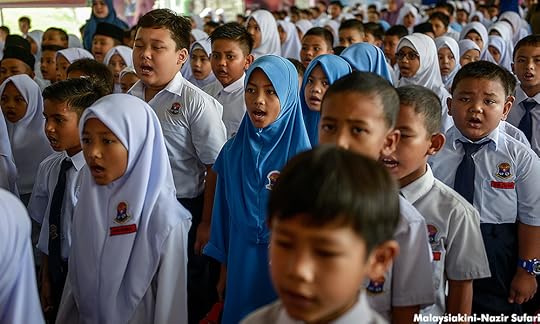 We have ministers, educational experts, specialists and educational representatives who either have minimal classroom experience or none at all – let alone have much-needed knowledge in the history, theory, post-structurality and possibilities of education.We place them in this ministry based on political considerations. They mess things up and show their inability to understand where our youth are heading, or how to design an education system good enough to reflect the dream we have – a dream of a just, equitable, environmentally sustainable, intellectual and ethical society. Regardless of race and ethnicity.We need the English language, the lingua franca, as the main medium of instruction if we are to succeed in the globalising world.We are more concerned with having our students and teachers pledge blind loyalty to the signs and symbols of power; one-dimensional thinking; and politically correct behaviour instead of developing, celebrating and further grooming good teachers who can radicalise the minds of the youth of tomorrow.We force our university students to ceremoniously recite loyalty pledges, and round on those who protest against corruption and social injustice. We have failed to teach them citizenship skills and show them what a good political culture which honours the separation of powers and put the constitution as the most supreme law of the land looks like.We train the mind to be absurdly obedient, against the backdrop of our speeded-up, hypermodernised economy – one we rempitised in the name of any rebranded New Economic Policy.The question for us now is: how do we de-rempitise our society?What kind of educational leadership do we need to address this issue?AZLY RAHMAN is an educator, academic, international columnist, and author of seven books available
here
. He grew up in Johor Bahru, and holds a Columbia University doctorate in international education development and Master’s degrees in six areas: education, international affairs, peace studies communication, fiction and non-fiction writing. Twitter @azlyrahman. More writings here.
We have ministers, educational experts, specialists and educational representatives who either have minimal classroom experience or none at all – let alone have much-needed knowledge in the history, theory, post-structurality and possibilities of education.We place them in this ministry based on political considerations. They mess things up and show their inability to understand where our youth are heading, or how to design an education system good enough to reflect the dream we have – a dream of a just, equitable, environmentally sustainable, intellectual and ethical society. Regardless of race and ethnicity.We need the English language, the lingua franca, as the main medium of instruction if we are to succeed in the globalising world.We are more concerned with having our students and teachers pledge blind loyalty to the signs and symbols of power; one-dimensional thinking; and politically correct behaviour instead of developing, celebrating and further grooming good teachers who can radicalise the minds of the youth of tomorrow.We force our university students to ceremoniously recite loyalty pledges, and round on those who protest against corruption and social injustice. We have failed to teach them citizenship skills and show them what a good political culture which honours the separation of powers and put the constitution as the most supreme law of the land looks like.We train the mind to be absurdly obedient, against the backdrop of our speeded-up, hypermodernised economy – one we rempitised in the name of any rebranded New Economic Policy.The question for us now is: how do we de-rempitise our society?What kind of educational leadership do we need to address this issue?AZLY RAHMAN is an educator, academic, international columnist, and author of seven books available
here
. He grew up in Johor Bahru, and holds a Columbia University doctorate in international education development and Master’s degrees in six areas: education, international affairs, peace studies communication, fiction and non-fiction writing. Twitter @azlyrahman. More writings here.
A+ A- COMMENT | Our schools are at risk. Is it now governed by the ideology of 'rempitism'? What is this ideology? How do we prevent it from destroying the country? What are our educational leaders doing about it? I proposed some remedies based on the relationship between education, economy, and technopoly, but this ideology is of pressing concern.The Malaysian phenomenon of youths racing illegally on public roads on customised motorbikes after midnight to that rob peaceful citizens of their restful sleep is a phenomenon akin to a capitalist economy of a struggling showcasing Third Word nation, that hypermodernises beyond the ability of its people to cope with its sensationalised designs of 'economic miracles'.Both phenomena rest upon idiotic pride and arrogance that endanger a peaceful, ethical and sustainable future. Both present clear and present danger on the equally dangerous highway of globalisation. A 'rempitised' economic and education system 'rams' human beings into different 'pits' of the conveyer belt of the capitalist production system; creating what looks like a natural progression of meritocracy in education and social evolution. The foundation of this system is neocolonialism, structural violence and the alienation of labour (like participants in the global rat race, mat rempit always want to finish first in the deadly race and be the first to do a wheelie for the world to see).Is our public education system failing? Is it producing more and more mat rempit, anak Abu, bohsia, bohjan, and alienated youth put at risk by our education system?Are we creating class systems in education the way we have created varying types of classrooms that correspond to different classes in society? Why are we seeing the tuition industry becoming a billion-ringgit business, helping our children memorising more and more but understanding less and less of what they learn?Do we have people in the education ministry well-versed enough in analysing the phenomenon of our rempitised economy (speeding it up illegally) and how this is directly related to how we are 'schooling' our society?What is our national agenda in education, not only to ensure no child of any race or religion be left behind but seeing through that they will love learning as a lifelong pursuit? How much planning, scenario-building, analysing, big data-gathering, futuristics-thinking, and innovative strategizing is the Education Ministry doing to address this issue of alienation in schools?Do we now have an entire system of higher education inheriting the children of our rempitised economy and contributing to the low quality of graduates – who cannot think critically and are always subjected to the whims and fancies of a totalitarian regime only interested in tightening the stranglehold on our universities?British and American scholars like Paul Willis, Henry Levin, Peter McLaren and Martin Carnoy who studied the phenomena of schooling in capitalist societies observed the nature of the learning process in countries in which the rapid and unreflective industrialisation and post-industrialisation process have created one-dimensional citizens out of youth.Schooling teaches these children to become good and obedient workers in an economic system that reduces the larger population into labour, while enriching the upper class into people and property-owners in a rempitised economy.What's lacking in teachersIs our education ministry training teachers well in urban education and in the schooling of our at-risk youth? Will it study enough of the issue of class and social reproduction in order to shift the way we think about student success, learning engagement, and closing the achievement gap between the rich and the poor?Do we actually know the root cause of rempitism and gangsterism in schools, and are we able to design better learning systems for those who are already marginalised and left behind by our rempitised economy? How many schools are today classified as troubled, especially in the infiltration of drugs and drug traffickers in schools?I have a sense that the cases of gangsterism and bullying of teachers will continue to increase. More private schools will be built and Malaysians will lose confidence in their public schools. More private schools mean more divisions in society. The rich will produce better schools and the poor will be left behind in this rempitised system we have all created in the name of newer versions of the New Economic Policy.Teachers do not have the necessary concepts and skills to deal not only with millennial children (high-tech, high gadgetry, low attention span, low school-tolerance), but also the rempitised children who have low skills of reading, writing and computing.Children left behind will be those who become mat and minah rempit and even those alienated at a very young age, in estates and city slums. They will be destructive to the classroom process and will translate their social anger into counter-productive and destructive activities.These are the ones who will be made criminals as a result of an uncaring education system that criminalises the human mind by placing unmotivated, uncreative and unprepared teachers to develop the untapped geniuses in our classrooms.Criminals are made, not born. Each child is a gift. It’s how we design the system of equitability, peace, and justice in schooling that will determine the nature of 'social conveyer belt' we are using.Should we rename the mat and minah rempit as mat cemerlang (excellent ones) as suggested by an Umno Youth leader some time ago? Should we build a racing circuit for them to continue drag racing in places such as Johor Bahru and Kuala Terengganu?I do not think we should. I think those who propose such names and measures of glorification need radical counselling on the meaning of education. I think it shows a clear lack of understanding of the root of the problem. Wrong diagnosis of a social ill.Rehabilitation programmeI think we should beef up the highway police force and stop illegal drag racing, round up the mat rempit and send them for six-month rehabilitation in rempit camps near Perlis, guarded by graduates of the once glorified National Service.We should build a safe motorcross clearing/ zones and let them drag-race happily in these areas until they are exhausted.In between these sessions, we ought to give them a good and safe motorcycle education so that they will understand what it means to ride safely and not endanger the life of others.We can have the National Civics Bureau write the module so that good indoctrination programmes will be used more on these rempitised youth instead of those who do not need to be indoctrinated into any form of totalitarianism.Peace-loving, rest-needing, night-sleeping citizens affected by the activities of rempitism will appreciate this radical programme of reconfiguring the mind of the rempitised youth.De-rempitising our schoolsIn the meantime, how do we deal with the leadership of the public education system? We need to start by selecting only those who are well-versed in the entire spectrum of education.We have ministers, educational experts, specialists and educational representatives who either have minimal classroom experience or none at all – let alone have much-needed knowledge in the history, theory, post-structurality and possibilities of education.We place them in this ministry based on political considerations. They mess things up and show their inability to understand where our youth are heading, or how to design an education system good enough to reflect the dream we have – a dream of a just, equitable, environmentally sustainable, intellectual and ethical society. Regardless of race and ethnicity.We need the English language, the lingua franca, as the main medium of instruction if we are to succeed in the globalising world.We are more concerned with having our students and teachers pledge blind loyalty to the signs and symbols of power; one-dimensional thinking; and politically correct behaviour instead of developing, celebrating and further grooming good teachers who can radicalise the minds of the youth of tomorrow.We force our university students to ceremoniously recite loyalty pledges, and round on those who protest against corruption and social injustice. We have failed to teach them citizenship skills and show them what a good political culture which honours the separation of powers and put the constitution as the most supreme law of the land looks like.We train the mind to be absurdly obedient, against the backdrop of our speeded-up, hypermodernised economy – one we rempitised in the name of any rebranded New Economic Policy.The question for us now is: how do we de-rempitise our society?What kind of educational leadership do we need to address this issue?AZLY RAHMAN is an educator, academic, international columnist, and author of seven books available
here
. He grew up in Johor Bahru, and holds a Columbia University doctorate in international education development and Master’s degrees in six areas: education, international affairs, peace studies communication, fiction and non-fiction writing. Twitter @azlyrahman. More writings here.# 10: A Merdeka message for the next prime minister
A Merdeka message for the next prime ministerOpinion |
Azly Rahman
Published: 23 Aug 2017, 11:17 pm | Modified: 23 Aug 2017, 11:17 pm
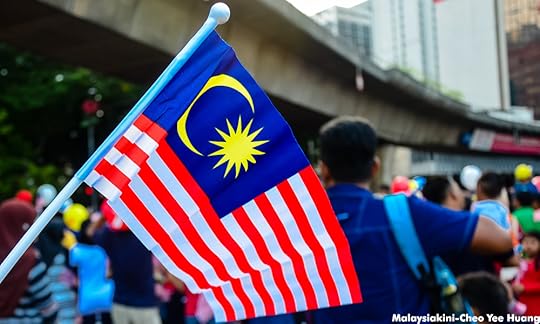
A+ A- COMMENT | In conjunction with Merdeka Day, I have these brief messages of peace to both the next leader and the people led. We cannot know who will be the next prime minister, and which coalition or party will help us through this mess, but I hope this message is clear and simple: we hope for an election as clean as a sarong pelikat washed with Clorox.Mr or Ms prime minister (who doesn’t have to be a Malay-Muslim, only a good man or woman), help all Malaysians, not just Malays or your own people, if you and your coalition are going to redesign strategies for peace, equality, and social justice.We are all bumiputeras now; today’s generation of Malaysians, be they from Chinese, Indian, Malay, Kadazan-Dusun, Iban, Orang Asal, ‘orang hybrid’ or this or that heritage. Those have been here long enough to no longer call this land Tanah Melayu, but Bumi Bangsa Malaysia. We have toiled for the soil.And you must remind yourself that you are prime minister for all. Not just for you, your family, and members of your family.Poverty now cuts across racial lines, with an increasing number of those in the middle class now falling into the trap. Even the middle class are struggling to put food on their table.There is no strong rationale anymore, after 60 years of independence and being a country called Malaysia, to continue policies based on racial lines. Continuing these policies will guarantee another 50 years of race and class antagonism.In the field of education especially, scholarships need to be given based on merit, talent, and needs, not because one is a bumiputera or a Malay, or because of birthright. If you are a Malaysian citizen, you ought to be enjoying the rights and privileges as well as the responsibilities that come with being a citizen. It’s that simple.Let us not continue our policy of educational apartheid, Mr or Ms prime minister, if you and your party are to enjoy the support of all Malaysians. One crucial aspect of change is to dismantle the all-Malay, all-bumiputera, all-privileged school, and use its philosophy, paradigm, and pedagogical process to democratise education for all races.Many of those in the elite and privileged boarding or residential schools, such as in Maktab Rendah Sains Mara (MRSM), are not from families that cannot afford a good education. Many are from wealthy families.There are deserving children from all races that must be given every opportunity to excel, just like abject poor Malays were given the chance to back in the early 1970s, when the MRSM system was first introduced.Mr or Ms prime minister, you must be fair and just to people of all races.For example, open up privileged schools such as MRSM to children of all races. Open all monocultural educational institutions, such as Universiti Teknologi Mara, to Malaysians of all races. It will be better for the nation.Look at the plight of other Malaysians. Promising billions of ringgit in educational, entrepreneurial, and economic aid to only one race defined by a one-dimensional construct is a political act with ill intent. Be wise in the political time you and your party have been given.Again, reverse the apartheidisation trend in education – for the sake of our children’s future. Education is one of the best means of social reproduction to ensure the evolution of a just and progressive nation.The New Economic Policy has been replaced with the New Economic Agenda, which promises fairness for all, not just for Malays and bumiputeras. Honour that.In concluding this part of my plea I say this: in our country, there is enough to go around for everybody, not just to feed the greed of the few.To the ultrasI also have a message for the ultra-Malays misrepresenting their race, showing the world that Malays are amok-loving and buffoonish, allergic to reason and good dialogue, always ready to wield the parang and keris even if not challenged, and love to perform theatrics in public to scare the hell out of other races and even their own race. And most of the time, for lousy reasons.Leave this drama. Malays are not like that. We have more class than Hang Tuah or Hang Jebat, the two historical fools we read about in textbooks – fools who served the sex-crazed, women-snatching, human-trafficking, drunkard sultan who thought he owned the world with control over a river only big enough for Donald Trump’s yacht.To the red shirts, who do not represent the Malays, here is my message:I can understand what has happened and how this is an unhealthy development that goes against the hopes and aspirations of a nation wishing to move forward. But here is my advice, especially to those who have children.It is better to focus on raising your children well to adjust to an ever-changing and increasingly globalised and diversified society. Raising your children to be good citizens able to realise their limitless potential in a multicultural and liberal world. There is so much to gain from networking with others.Teach them to understand others, improve their English, steady their moral compass, encourage them to think well of and befriend those of other races and religions, and be grateful that schools offer a great opportunity to love and respect friends and teachers of different races.Teach them of the dangers of generalising, stereotyping, and projecting hate that leads to mass deception, encourage them to learn about other cultures and religions, and teach them that all of us in Malaysia are now Malaysians, not this or that group of immigrants.Teach them that we all are migrants in time and space and in history, and all humans with emotions, struggles, challenges, histories of joy and despair, memories of pain and pleasure.Teach them that all of us merely differ in skin tone, born to speak different languages, believe in different things about salvation, all of us travellers in this life.This is what we are, and have no need for moments of history where hate is cultivated, for there is a bigger picture of oppression that we may not understand. We may all be mere pawns in this great political game of big-time plunderers and multiethnic robber barons skilled at mass deception and distraction.We should be grateful that we are still alive, and we must think of ourselves as Malaysians for each and every one of us to prosper in peace.Come back to our senses. Our strength as Malaysians will still come from diversity and the cultivation of talent. On Merdeka Day, we should rejoice and celebrate the achievements of this nation for that beautiful concept of unity in diversity, not rally to spew hatred and invoke the horrors of May 13.Let us design a safer journey towards a more progressive and harmonious Malaysia, beyond this red-shirted river of blood that marches through the city because of some mangled, manufactured propaganda of ‘Malay dignity’.What laaahhh you, Malay dignity gang
Malu lah kita majoriti orang Melayu
Kita tarak macam tu lor
Lu, gua, kita semua sama, tapi manyak lain-lain lor
Kita manyak hormat sama semua-semua bangsa lor
Seriously folks, chill, we are a great nation of different peoples, unity in diversity
Our strength is drawn from the creativity of manyLet’s have a party
Not just a party but a nasi lemak and teh tarik kaw kaw party
A truly Malaysian party
Muhibbah late night party
Because we love our country
We just don’t want it to turn into a Zimbab-wee!
But first, dismantle all race-based and racist parties, can we?
Now that rhymes, wouldn’t you agree?
A+ A- COMMENT | In conjunction with Merdeka Day, I have these brief messages of peace to both the next leader and the people led. We cannot know who will be the next prime minister, and which coalition or party will help us through this mess, but I hope this message is clear and simple: we hope for an election as clean as a sarong pelikat washed with Clorox.Mr or Ms prime minister (who doesn’t have to be a Malay-Muslim, only a good man or woman), help all Malaysians, not just Malays or your own people, if you and your coalition are going to redesign strategies for peace, equality, and social justice.We are all bumiputeras now; today’s generation of Malaysians, be they from Chinese, Indian, Malay, Kadazan-Dusun, Iban, Orang Asal, ‘orang hybrid’ or this or that heritage. Those have been here long enough to no longer call this land Tanah Melayu, but Bumi Bangsa Malaysia. We have toiled for the soil.And you must remind yourself that you are prime minister for all. Not just for you, your family, and members of your family.Poverty now cuts across racial lines, with an increasing number of those in the middle class now falling into the trap. Even the middle class are struggling to put food on their table.There is no strong rationale anymore, after 60 years of independence and being a country called Malaysia, to continue policies based on racial lines. Continuing these policies will guarantee another 50 years of race and class antagonism.In the field of education especially, scholarships need to be given based on merit, talent, and needs, not because one is a bumiputera or a Malay, or because of birthright. If you are a Malaysian citizen, you ought to be enjoying the rights and privileges as well as the responsibilities that come with being a citizen. It’s that simple.Let us not continue our policy of educational apartheid, Mr or Ms prime minister, if you and your party are to enjoy the support of all Malaysians. One crucial aspect of change is to dismantle the all-Malay, all-bumiputera, all-privileged school, and use its philosophy, paradigm, and pedagogical process to democratise education for all races.Many of those in the elite and privileged boarding or residential schools, such as in Maktab Rendah Sains Mara (MRSM), are not from families that cannot afford a good education. Many are from wealthy families.There are deserving children from all races that must be given every opportunity to excel, just like abject poor Malays were given the chance to back in the early 1970s, when the MRSM system was first introduced.Mr or Ms prime minister, you must be fair and just to people of all races.For example, open up privileged schools such as MRSM to children of all races. Open all monocultural educational institutions, such as Universiti Teknologi Mara, to Malaysians of all races. It will be better for the nation.Look at the plight of other Malaysians. Promising billions of ringgit in educational, entrepreneurial, and economic aid to only one race defined by a one-dimensional construct is a political act with ill intent. Be wise in the political time you and your party have been given.Again, reverse the apartheidisation trend in education – for the sake of our children’s future. Education is one of the best means of social reproduction to ensure the evolution of a just and progressive nation.The New Economic Policy has been replaced with the New Economic Agenda, which promises fairness for all, not just for Malays and bumiputeras. Honour that.In concluding this part of my plea I say this: in our country, there is enough to go around for everybody, not just to feed the greed of the few.To the ultrasI also have a message for the ultra-Malays misrepresenting their race, showing the world that Malays are amok-loving and buffoonish, allergic to reason and good dialogue, always ready to wield the parang and keris even if not challenged, and love to perform theatrics in public to scare the hell out of other races and even their own race. And most of the time, for lousy reasons.Leave this drama. Malays are not like that. We have more class than Hang Tuah or Hang Jebat, the two historical fools we read about in textbooks – fools who served the sex-crazed, women-snatching, human-trafficking, drunkard sultan who thought he owned the world with control over a river only big enough for Donald Trump’s yacht.To the red shirts, who do not represent the Malays, here is my message:I can understand what has happened and how this is an unhealthy development that goes against the hopes and aspirations of a nation wishing to move forward. But here is my advice, especially to those who have children.It is better to focus on raising your children well to adjust to an ever-changing and increasingly globalised and diversified society. Raising your children to be good citizens able to realise their limitless potential in a multicultural and liberal world. There is so much to gain from networking with others.Teach them to understand others, improve their English, steady their moral compass, encourage them to think well of and befriend those of other races and religions, and be grateful that schools offer a great opportunity to love and respect friends and teachers of different races.Teach them of the dangers of generalising, stereotyping, and projecting hate that leads to mass deception, encourage them to learn about other cultures and religions, and teach them that all of us in Malaysia are now Malaysians, not this or that group of immigrants.Teach them that we all are migrants in time and space and in history, and all humans with emotions, struggles, challenges, histories of joy and despair, memories of pain and pleasure.Teach them that all of us merely differ in skin tone, born to speak different languages, believe in different things about salvation, all of us travellers in this life.This is what we are, and have no need for moments of history where hate is cultivated, for there is a bigger picture of oppression that we may not understand. We may all be mere pawns in this great political game of big-time plunderers and multiethnic robber barons skilled at mass deception and distraction.We should be grateful that we are still alive, and we must think of ourselves as Malaysians for each and every one of us to prosper in peace.Come back to our senses. Our strength as Malaysians will still come from diversity and the cultivation of talent. On Merdeka Day, we should rejoice and celebrate the achievements of this nation for that beautiful concept of unity in diversity, not rally to spew hatred and invoke the horrors of May 13.Let us design a safer journey towards a more progressive and harmonious Malaysia, beyond this red-shirted river of blood that marches through the city because of some mangled, manufactured propaganda of ‘Malay dignity’.What laaahhh you, Malay dignity gang
Malu lah kita majoriti orang Melayu
Kita tarak macam tu lor
Lu, gua, kita semua sama, tapi manyak lain-lain lor
Kita manyak hormat sama semua-semua bangsa lor
Seriously folks, chill, we are a great nation of different peoples, unity in diversity
Our strength is drawn from the creativity of manyLet’s have a party
Not just a party but a nasi lemak and teh tarik kaw kaw party
A truly Malaysian party
Muhibbah late night party
Because we love our country
We just don’t want it to turn into a Zimbab-wee!
But first, dismantle all race-based and racist parties, can we?
Now that rhymes, wouldn’t you agree?
#9: Memo to the new education minister, pt 2
Memo to the new education minister, pt 2Opinion |
Azly Rahman
Published: 17 May 2018, 9:27 pm | Modified: 17 May 2018, 9:27 pm

A+ A- COMMENT | I have a suggestion for Malaysia to consider, as a continuation of my previous memo .Today’s schools need to be cognitively architectured and grown anew, and made to start at year zero of a new education revolution. This revolution should rest on of the idea of singularity and complexity, and the multiplicity of knowledge that is fluid and evolving organically.This philosophy of education is yet to be conceived and crafted, even as the nature of the human self and the mind is being reconstructed, leaving behind the legacy of the paradigms of industrialism, post-industrialism, and quantum physics.Schools will one day respond to these mega changes and cease to exist in its current shape, form and purpose.They will one day replace institutions of power and knowledge controlled form above, such as ashrams, madrasah, abbots, convents, and kibbutzim. These are prison-houses of mass indoctrination, of monocultural cognitive linearism for the state to mould children into citizens obedient enough to be slaves to the power elite, new global imperialists and newer mandarins.Essentially, in this post-industrial social design called ‘instrumental education’, today’s schools are mere factories producing an unthinking citizenry living in a matrix of absurdities.But what would be among the most compelling transformational uses of technology seen in schools of today, given that we are living in a deeply mediated technological world?It would be an entire school using the philosophy of project-based learning – students beginning their day with ‘playlists’ as learning objectives, going to their collaborative stations; teachers as tech-gurus and chief researchers, utilising only primary sources; in a research-driven and stress-free school which is aimed at using technologies of the future purposefully, and to nurture scientific, artistic, philosophical, and global thinking.It is a redesign of instruction that Socrates would have insisted upon and Elon Musk has shown, but informed by the wisdom of Howard Gardner. That would be my idea of a democratic academy, one that Henry David Thoreau would approve of.Using technology to transformI saw this idea of a digitally-driven, project-based learning concept in schools in New Jersey and in New York, through the School of One initiative.National education leaders and ministers – once they become skilled in conceiving the relationship between human beings, technology, culture, and schooling – should explore cutting-edge ideas for using technology in more transformational ways.This includes writing, reading, thinking, and creating. Virtual reality, big data historicising tools, GPS-type systems, and 3D printing technologies are emerging as potentially transformational tools of collaborative learning.I grew up in a village in Johor Bahru, like Mowgli in The Jungle Book. I saw the first computer – perhaps an IBM 036 – in an office which 12 human beings had to share. That was in the early 1970s.I have used technologies of learning such as the ‘tablet’ (a green alphabet and numbers writing pad used with chalk), learned to use the ancient typewriter, then the need-to-boot floppy-disc computer, and other tools to work and learn with the progress of technology.Today, I am fortunate to be able to even design an entire Master’s curriculum using collaborative technologies and smart tools. I know I will continue to evolve carefully with technologies, without the fear of being turned into a robot and thinking like one.Technological advancesThere are advances in technology I foresee in the near future. I see virtual and augmented reality as technologies of the future that will redesign schooling altogether, only if these are to be used purposefully and democratically, and made available to children in impoverished countries.The underlying principle of learning is not to showcase gadgets and turn children into techno-zombies, but to develop minds to be more humane and emphatic – more human – and to understand and manage an increasingly complex world in which information has become a commodity, and where knowledge and understanding, let alone wisdom is absent.We are at a critical juncture of perhaps a third digital revolution, after the computer and the internet. We are moving into a phase of transhumanism, with its attendant dangers and inherent contradictions.I see global education, learning, and cross-cultural perspectives in urban-international education as the new frontiers for any education consulting company to be venturing into.‘Summerhill’ of loveMy passion about education could be traced as early as I started thinking what my ‘existence in school’ means. I wanted to know more about how my teachers and my principles thought. I read book on educational philosophy, at quite an early age.One book that had a profound effect on the way I think about the world and my place in it was AS Neil’s Summerhill: A Radical Approach to Child Rearing, published in the ‘hippie’ 1960s.I read the entire book in 1975 when I was 14, in an ‘experimental American high school’ in Kuantan. I was chosen to be sent to the school based on my academic achievements and my parent’s poverty level.Its model was based partly on the Bronx High School of Science in New York, as I found out while preparing my PhD proposal for the Stanford Graduate School of Education.The Bronx High School of Science produced eight Nobel laureates in science and six Pulitzer Prize winners, two of the world’s most prestigious awards in those fields.So, in that boarding school, I was bored. I read many things. Neil’s book was in my school library – meant for my teachers, I suppose.I love the way the children were treated in the titular boarding school, Summerhill, in Neil’s book. They could come to school whenever they liked. Learning in that one-house school happened as democratically as it should be in the ‘Summer of Love’ sixties.The best thing is that, according to Neill, the school’s founder, the children did not turn out to be criminals.Maybe deep inside I was trying to understand why I was put in that boarding school in Kuantan, sent there at 13, hundreds of miles away from my village, and missing my mother every day.It was an experimental American high school, and I was there as the government’s guinea pig, as we were constantly told, happily, by our teachers. I am writing my memoir on those days of schooling.But back to my memo.I want to suggest the new education minister read up on essential works by major authors on school reform, so that he/she could do the best job producing the best and brightest of our nation.I recommend works both of the traditional and modern authors: Socrates, Gardner, Jean-Jacques Rousseau, Maria Montessori, John Dewey, Paulo Freire, Peter McLaren, Carl Perkins, and even sci-fi writers talking about scenarios in education.Let us help the Education Ministry conduct a total revamp: from philosophy to paradigm to practice and people, as well as products.We have a set of pillars of a major shift to erect. It is a new beginning requiring careful and intelligent steps, in a world of alienation, unemployment, technological determinism, underrepresentation, and increasingly violent racism and religious intolerance – the excesses of predatory local, national and global capitalism.But most of all, we must move forward gracefully, for the future of all the Malaysian children, hungry for knowledge, understanding and wisdom, to function as good and thinking citizens in a truly multicultural society.Memo to the new education minister, pt 1AZLY RAHMAN is an educator, academic, international columnist, and author of seven books. He grew up in Johor Bahru, and holds a Columbia University doctorate in international education development and Master’s degrees in five areas: education, international affairs, peace studies communication, and creative writing.The views expressed here are those of the author/contributor and do not necessarily represent the views of Malaysiakini.
A+ A- COMMENT | I have a suggestion for Malaysia to consider, as a continuation of my previous memo .Today’s schools need to be cognitively architectured and grown anew, and made to start at year zero of a new education revolution. This revolution should rest on of the idea of singularity and complexity, and the multiplicity of knowledge that is fluid and evolving organically.This philosophy of education is yet to be conceived and crafted, even as the nature of the human self and the mind is being reconstructed, leaving behind the legacy of the paradigms of industrialism, post-industrialism, and quantum physics.Schools will one day respond to these mega changes and cease to exist in its current shape, form and purpose.They will one day replace institutions of power and knowledge controlled form above, such as ashrams, madrasah, abbots, convents, and kibbutzim. These are prison-houses of mass indoctrination, of monocultural cognitive linearism for the state to mould children into citizens obedient enough to be slaves to the power elite, new global imperialists and newer mandarins.Essentially, in this post-industrial social design called ‘instrumental education’, today’s schools are mere factories producing an unthinking citizenry living in a matrix of absurdities.But what would be among the most compelling transformational uses of technology seen in schools of today, given that we are living in a deeply mediated technological world?It would be an entire school using the philosophy of project-based learning – students beginning their day with ‘playlists’ as learning objectives, going to their collaborative stations; teachers as tech-gurus and chief researchers, utilising only primary sources; in a research-driven and stress-free school which is aimed at using technologies of the future purposefully, and to nurture scientific, artistic, philosophical, and global thinking.It is a redesign of instruction that Socrates would have insisted upon and Elon Musk has shown, but informed by the wisdom of Howard Gardner. That would be my idea of a democratic academy, one that Henry David Thoreau would approve of.Using technology to transformI saw this idea of a digitally-driven, project-based learning concept in schools in New Jersey and in New York, through the School of One initiative.National education leaders and ministers – once they become skilled in conceiving the relationship between human beings, technology, culture, and schooling – should explore cutting-edge ideas for using technology in more transformational ways.This includes writing, reading, thinking, and creating. Virtual reality, big data historicising tools, GPS-type systems, and 3D printing technologies are emerging as potentially transformational tools of collaborative learning.I grew up in a village in Johor Bahru, like Mowgli in The Jungle Book. I saw the first computer – perhaps an IBM 036 – in an office which 12 human beings had to share. That was in the early 1970s.I have used technologies of learning such as the ‘tablet’ (a green alphabet and numbers writing pad used with chalk), learned to use the ancient typewriter, then the need-to-boot floppy-disc computer, and other tools to work and learn with the progress of technology.Today, I am fortunate to be able to even design an entire Master’s curriculum using collaborative technologies and smart tools. I know I will continue to evolve carefully with technologies, without the fear of being turned into a robot and thinking like one.Technological advancesThere are advances in technology I foresee in the near future. I see virtual and augmented reality as technologies of the future that will redesign schooling altogether, only if these are to be used purposefully and democratically, and made available to children in impoverished countries.The underlying principle of learning is not to showcase gadgets and turn children into techno-zombies, but to develop minds to be more humane and emphatic – more human – and to understand and manage an increasingly complex world in which information has become a commodity, and where knowledge and understanding, let alone wisdom is absent.We are at a critical juncture of perhaps a third digital revolution, after the computer and the internet. We are moving into a phase of transhumanism, with its attendant dangers and inherent contradictions.I see global education, learning, and cross-cultural perspectives in urban-international education as the new frontiers for any education consulting company to be venturing into.‘Summerhill’ of loveMy passion about education could be traced as early as I started thinking what my ‘existence in school’ means. I wanted to know more about how my teachers and my principles thought. I read book on educational philosophy, at quite an early age.One book that had a profound effect on the way I think about the world and my place in it was AS Neil’s Summerhill: A Radical Approach to Child Rearing, published in the ‘hippie’ 1960s.I read the entire book in 1975 when I was 14, in an ‘experimental American high school’ in Kuantan. I was chosen to be sent to the school based on my academic achievements and my parent’s poverty level.Its model was based partly on the Bronx High School of Science in New York, as I found out while preparing my PhD proposal for the Stanford Graduate School of Education.The Bronx High School of Science produced eight Nobel laureates in science and six Pulitzer Prize winners, two of the world’s most prestigious awards in those fields.So, in that boarding school, I was bored. I read many things. Neil’s book was in my school library – meant for my teachers, I suppose.I love the way the children were treated in the titular boarding school, Summerhill, in Neil’s book. They could come to school whenever they liked. Learning in that one-house school happened as democratically as it should be in the ‘Summer of Love’ sixties.The best thing is that, according to Neill, the school’s founder, the children did not turn out to be criminals.Maybe deep inside I was trying to understand why I was put in that boarding school in Kuantan, sent there at 13, hundreds of miles away from my village, and missing my mother every day.It was an experimental American high school, and I was there as the government’s guinea pig, as we were constantly told, happily, by our teachers. I am writing my memoir on those days of schooling.But back to my memo.I want to suggest the new education minister read up on essential works by major authors on school reform, so that he/she could do the best job producing the best and brightest of our nation.I recommend works both of the traditional and modern authors: Socrates, Gardner, Jean-Jacques Rousseau, Maria Montessori, John Dewey, Paulo Freire, Peter McLaren, Carl Perkins, and even sci-fi writers talking about scenarios in education.Let us help the Education Ministry conduct a total revamp: from philosophy to paradigm to practice and people, as well as products.We have a set of pillars of a major shift to erect. It is a new beginning requiring careful and intelligent steps, in a world of alienation, unemployment, technological determinism, underrepresentation, and increasingly violent racism and religious intolerance – the excesses of predatory local, national and global capitalism.But most of all, we must move forward gracefully, for the future of all the Malaysian children, hungry for knowledge, understanding and wisdom, to function as good and thinking citizens in a truly multicultural society.Memo to the new education minister, pt 1AZLY RAHMAN is an educator, academic, international columnist, and author of seven books. He grew up in Johor Bahru, and holds a Columbia University doctorate in international education development and Master’s degrees in five areas: education, international affairs, peace studies communication, and creative writing.The views expressed here are those of the author/contributor and do not necessarily represent the views of Malaysiakini.
#8: Memo to the new education minister, pt 1
Memo to the new education minister, pt 1Opinion |
Azly Rahman
Published: 16 May 2018, 4:52 am | Modified: 16 May 2018, 4:52 am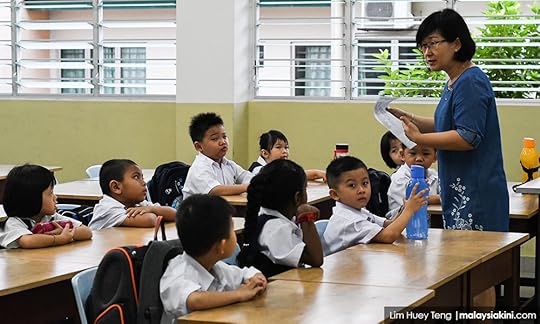 A+ A- COMMENT | Now that we have a new government serious in implementing change, with an inclusionist policy, I’d like to share my view of what the children of all Malaysians deserve.We saw, especially in the era of the previous regime, our educational system plagued with themes of racial discrimination, student indiscipline, gangs in schools and the growing numbers of young people more interested in bike-racing past midnight in cities such as Johor Bahru.Why this malaise in the most important sector of society: education? How do we bring back the joy of learning and the importance of education to the young? Herein lies the need to reconceptualise the way we build our schools in our hope to prepare the younger members of our society to participate in Malaysia’s democratic lives.Each child has the right to be intelligent. This is a view of education the new regime needs to work on. I begin with talking about what an “ideal school” should look like as we keep afloat in this predatory “Blue Ocean” of globalisation, as we try to sustain ourselves economically, culturally, and cognitively.The future is here. A long time ago, in fact. Schools need to change, the way they are defined and built. What kind of school would best fit the needs of Malaysia’s intelligent child?It would be a “Transhumanistic -Renaissance school” Deweyian-Freirian-Monstessorian-Gandhian in nature, in which the child is a living, thinking, breathing and artefact-creating being growing up not only useful for himself/herself in society but also a culturally-responsive global citizen able to use technology for peaceful purposes. The school, therefore, must be created, philosophically, artistically, architecturally, and responsively to nurture this new human being.The principle of singularity-multiplicity will be applied, thinking without borders and knowledge framed constructively, and artefacts created for social use be produced altruistically. The students will be in a space of knowledge production, construction, and deconstruction without walls, with Nature or a simulacrum of it adorning the surrounding with the technology used purposefully and sustainably and the “teachers”, are merely guides on the side and not sages on stage.It’s a “Google Scholar-meets-Facebook-meets Elon Musk-meets-a Summerhill-tribal-green” type of school. Here are my thoughts on education, an excerpt from an article I once wrote in an online journal called Eurasia Review, based in Oregon, USA:“ … what is our problem with this gentle profession and enterprise called “education”? How must we act and feel as teachers — those “transmitters of culture and Grand Narratives” and at the same time “subverts of the human mind and promoters of Constructivism in thinking? How do we mediate these two roles; of the managers of virtue and cultivators of critical thinking?
 Having been immersed in this “passion” called the “teaching profession” for more than 25 years now, teaching in the two cultures “East and West”. i.e. in Malaysia and in the US in both the secondary and at the tertiary levels both ways, I have this to say about what teachers ought to become and how the “Socratic ethos” need to be in synchrony with the mind of the millennial child that resides in the 21st Century.The noble profession of teaching should only be reserved for the best and the brightest in society: the Socrates amongst us. It should be reserved for those who have the passion, dedication, and discipline to turn children into radical thinkers who will question everything and anything and who will create useful artefacts for society and dedicate one’s life to the improvements of the mind, body, and soul of fellow beings.This is necessary so that society can constantly be renewed, refreshed and be brought to reach the height of periods of evolving renaissance. This will be our Socratic process of bringing humanity from darkness to light as in the Sanskrit term “guru”.Having said this, many of those teaching in our classrooms today ought to leave the profession for many are there whose unintended goal is to destroy the minds of an entire generation.A good teacher is one who is skilled in the art and science of planting doubts in the curious young minds and good at training minds to be scientists and philosophers. A Socratic teacher as such will leave each lesson with more questions than answers, to respect each and every child as if each one of them is a teacher one can learn from, and to shower each child with questions that will make him/her shake the foundation of the self, invigorate the critical sensibility in the self. This is done so that the child will grow up thinking as freely as how he/she ought to live and die and free as Nature wishes human beings to be.Such notion of freedom is the creed of a free society, one that is free from the dictates of dogma and dictatorship of the few; those powerful few who themselves were trained to think as free as how oppressors and immoral aristocrats ought to be. “Man is born free and everywhere he is in chains, as the enlightenment thinker Jean Jacques-Rousseau said and we do not have anything to lose except of chains, the economic historian Karl Marx concluded.Dare we build this new school order?In the next part of this memo, I shall speak of how technology is changing schooling and how our educational system, in need of major overhaul, can best respond to the needs of our global village's major and rapidised technological shifts.Our children deserve better schools. Re-imagine education. Make radical changes. The world is changing fast. Very fast.Memo to the new education minister, pt 2AZLY RAHMAN is an educator, academic, international columnist, and author of seven books. He grew up in Johor Bahru and holds a Columbia University doctorate in International Education Development and Master’s degrees in five areas: Education, International Affairs, Peace Studies Communication, and Creative Writing.The views expressed here are those of the author/contributor and do not necessarily represent the views of Malaysiakini.
A+ A- COMMENT | Now that we have a new government serious in implementing change, with an inclusionist policy, I’d like to share my view of what the children of all Malaysians deserve.We saw, especially in the era of the previous regime, our educational system plagued with themes of racial discrimination, student indiscipline, gangs in schools and the growing numbers of young people more interested in bike-racing past midnight in cities such as Johor Bahru.Why this malaise in the most important sector of society: education? How do we bring back the joy of learning and the importance of education to the young? Herein lies the need to reconceptualise the way we build our schools in our hope to prepare the younger members of our society to participate in Malaysia’s democratic lives.Each child has the right to be intelligent. This is a view of education the new regime needs to work on. I begin with talking about what an “ideal school” should look like as we keep afloat in this predatory “Blue Ocean” of globalisation, as we try to sustain ourselves economically, culturally, and cognitively.The future is here. A long time ago, in fact. Schools need to change, the way they are defined and built. What kind of school would best fit the needs of Malaysia’s intelligent child?It would be a “Transhumanistic -Renaissance school” Deweyian-Freirian-Monstessorian-Gandhian in nature, in which the child is a living, thinking, breathing and artefact-creating being growing up not only useful for himself/herself in society but also a culturally-responsive global citizen able to use technology for peaceful purposes. The school, therefore, must be created, philosophically, artistically, architecturally, and responsively to nurture this new human being.The principle of singularity-multiplicity will be applied, thinking without borders and knowledge framed constructively, and artefacts created for social use be produced altruistically. The students will be in a space of knowledge production, construction, and deconstruction without walls, with Nature or a simulacrum of it adorning the surrounding with the technology used purposefully and sustainably and the “teachers”, are merely guides on the side and not sages on stage.It’s a “Google Scholar-meets-Facebook-meets Elon Musk-meets-a Summerhill-tribal-green” type of school. Here are my thoughts on education, an excerpt from an article I once wrote in an online journal called Eurasia Review, based in Oregon, USA:“ … what is our problem with this gentle profession and enterprise called “education”? How must we act and feel as teachers — those “transmitters of culture and Grand Narratives” and at the same time “subverts of the human mind and promoters of Constructivism in thinking? How do we mediate these two roles; of the managers of virtue and cultivators of critical thinking?Having been immersed in this “passion” called the “teaching profession” for more than 25 years now, teaching in the two cultures “East and West”. i.e. in Malaysia and in the US in both the secondary and at the tertiary levels both ways, I have this to say about what teachers ought to become and how the “Socratic ethos” need to be in synchrony with the mind of the millennial child that resides in the 21st Century.The noble profession of teaching should only be reserved for the best and the brightest in society: the Socrates amongst us. It should be reserved for those who have the passion, dedication, and discipline to turn children into radical thinkers who will question everything and anything and who will create useful artefacts for society and dedicate one’s life to the improvements of the mind, body, and soul of fellow beings.This is necessary so that society can constantly be renewed, refreshed and be brought to reach the height of periods of evolving renaissance. This will be our Socratic process of bringing humanity from darkness to light as in the Sanskrit term “guru”.Having said this, many of those teaching in our classrooms today ought to leave the profession for many are there whose unintended goal is to destroy the minds of an entire generation.A good teacher is one who is skilled in the art and science of planting doubts in the curious young minds and good at training minds to be scientists and philosophers. A Socratic teacher as such will leave each lesson with more questions than answers, to respect each and every child as if each one of them is a teacher one can learn from, and to shower each child with questions that will make him/her shake the foundation of the self, invigorate the critical sensibility in the self. This is done so that the child will grow up thinking as freely as how he/she ought to live and die and free as Nature wishes human beings to be.Such notion of freedom is the creed of a free society, one that is free from the dictates of dogma and dictatorship of the few; those powerful few who themselves were trained to think as free as how oppressors and immoral aristocrats ought to be. “Man is born free and everywhere he is in chains, as the enlightenment thinker Jean Jacques-Rousseau said and we do not have anything to lose except of chains, the economic historian Karl Marx concluded.Dare we build this new school order?In the next part of this memo, I shall speak of how technology is changing schooling and how our educational system, in need of major overhaul, can best respond to the needs of our global village's major and rapidised technological shifts.Our children deserve better schools. Re-imagine education. Make radical changes. The world is changing fast. Very fast.Memo to the new education minister, pt 2AZLY RAHMAN is an educator, academic, international columnist, and author of seven books. He grew up in Johor Bahru and holds a Columbia University doctorate in International Education Development and Master’s degrees in five areas: Education, International Affairs, Peace Studies Communication, and Creative Writing.The views expressed here are those of the author/contributor and do not necessarily represent the views of Malaysiakini.#7 The missing agenda in Malaysian education
The missing agenda in Malaysian educationOpinion |
Azly Rahman
Published: 10 Nov 2018, 6:39 pm | Modified: 10 Nov 2018, 6:39 pm A+ A- COMMENT | After 60 years, what kind of society has our education system produced? What kind of people do we have now in wealth and in power? Where are we going next? What is our agenda for a new Malaysia?Is our education system geared towards social justice, multiculturalism, and preparing children for the future of post-industrialism?Is this being done through a rigorous curriculum that enhances mental capacity, multilingual mastery, and above all, a culture of teaching and learning using appropriate tools and available technology to affect the way we see and approach schooling in a uniquely diverse country such as Malaysia?The missing agenda is the inability to grasp the meaning of the higher-order systemic change vis-à-vis the role of the individual versus the state, and the differences between education, schooling, and indoctrination.In the last 13 years as a commentator, I have written about this repeatedly, most recently in a
two-part piece
on
Malaysia's educational direction
after the recent general election.No new directionMy comments below are based on my observations as one who has been in the profession for more than 30 years, and blessed with the experience teaching in a variety of contexts both in Malaysia and the United States, and having studied comparative education systems as well as trends in international education.The problem is what is being considered as a 'new direction' seems to look like a list of initiatives that have been done in the past, devoid of radical innovations, new ideas of social imagination and implementation.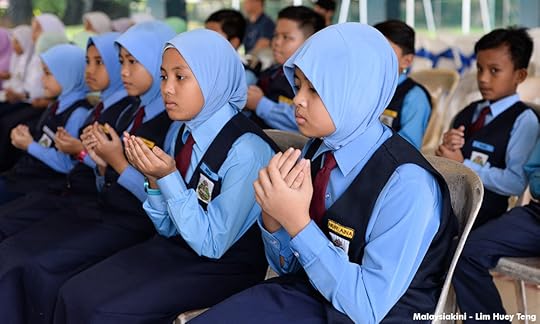 Yet the country's leaders want to venture into becoming spearheads in ‘innovative’ ventures – from a third national car produced by outsiders, to the best durians cloned to perfection.Worse, our educational leaders are still trapped in the straitjacket of our own apartheid system, still clinging on to the idea that only Malays-bumiputera have special rights.Billions of ringgit continue to be poured into ensuring that only this group will advance socio-economically, so that the ethnic hegemony and false sense of superiority can continue. This is Malaysia’s human resource tragedy.Yet we wish to emulate Japan, Korea, Finland and other advanced countries, though we cannot tell the difference between apples and oranges (or durians and melons in this case).Essentially, we cannot distinguish between a homogenous and heterogeneous society in our planning for educational success, through eliminating racial discrimination and promoting inclusivity and diversity.We continue to fail, philosophically. We have to get out of this quagmire. For the sake of our children and the future of the nation.Reading about the ‘major initiatives’ taken by the Pakatan Harapan government to radically alter the course of the education system – breakfast programmes, mastery of three languages, black shoes, black socks, improving the status of Bahasa Malaysia, having a school manual for moral values, reduced workload for teachers, increased funding for tahfiz and Malay elite schools – lead me to ask one question.
 Where is the innovation to alter the landscape of our children's imagination, make schools more inclusive, create happy thinkers and movers and shakers, and most importantly, dismantle the apartheid altogether?Or in other words, where is the right stuff that will make our society great? Where is the agenda that ensures no child will be left behind in the Malaysian Malaysia Malaysians voted for?Borrow wiselyIn countries that excel in education, diversity and free thought are not only values that are appreciated, but tenets of human rights that have been transformed into policies.Strong liberalism, in the absence of the spectre of bigotry and extremism, drives these societies into a future characterised by respect for the rights and dignity of all races, and the constant attempt de facto and de jure to maintain peace, justice, and security through the measurable goal of sustainability.Hence the models of successful social democratic countries such as Finland, Norway, Switzerland, Denmark, Iceland, Ireland, Luxembourg, and Sweden. Compare these to the dynamics of failed nation-states such as South Sudan, Somalia, Yemen, Syria, Central African Republic, DR Congo, Sudan, and Afghanistan – countries with dead serious problems of race and religion, and of course, political economy.
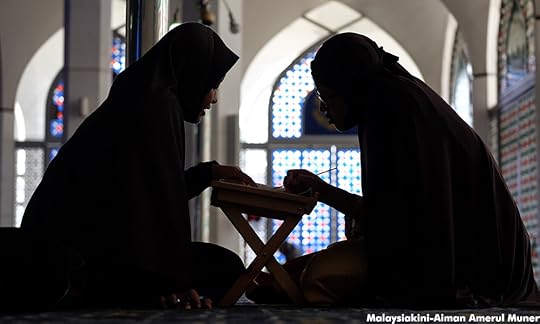 In fact, by the measurement and standards of what constitutes a truly Islamic country, the nation of ‘kafir’ that is Ireland stands up as a model. Not Saudi Arabia, Iran, Yemen, Pakistan, or indeed, Malaysia.The idea that Islam teaches cleanliness and any Muslim country ought to have citizens that value such a virtue is not evident in many of the so-called Islamic countries. One has to look for this Islamic virtue in a country like Japan – one founded upon Shintoism, known for its radical ideas of cleanliness and being one with the spirit of nature.What we have instead is more funding for more Malay-Muslim educational institutions. More delays with recognising the United Examination Certificate (as if we need rocket scientists to solve the simple issue of an entry-level examination). More emphasis on Islamisation with more funding for tahfiz schools (even if we’re unsure if they are registered with the Education Ministry).More money for MRSM schools – a breeding ground for an elite class who have been propping up race-based political parties in the school system’s 40-year history.These are amongst other ‘new directions’ that will not, in all honesty, work towards building a Malaysian culture based on the principle of national unity. These initiatives are useful for the purpose of divide and rule.So, how do we address the missing agenda in Malaysian education, so that rhetoric can match with reality and be translated into action plans that will benefit every Malaysian child and adult?Instead of constantly looking outwards for models of educational sustainability, constantly falling into the trap of failed ventures because borrowed models are not understood clearly, why not look inside of our national psyche and craft our own educational praxis based on a sound multicultural philosophy?In the end, will it be another generation of wasted development, because we do not have the right direction?What then must be done?AZLY RAHMAN is an educator, academic, international columnist, and author of seven books available here. He grew up in Johor Bahru and holds a Columbia University doctorate in international education development and Master’s degrees in six areas: education, international affairs, peace studies communication, fiction and non-fiction writing. Twitter
@azlyrahman
. More writings
here
.
In fact, by the measurement and standards of what constitutes a truly Islamic country, the nation of ‘kafir’ that is Ireland stands up as a model. Not Saudi Arabia, Iran, Yemen, Pakistan, or indeed, Malaysia.The idea that Islam teaches cleanliness and any Muslim country ought to have citizens that value such a virtue is not evident in many of the so-called Islamic countries. One has to look for this Islamic virtue in a country like Japan – one founded upon Shintoism, known for its radical ideas of cleanliness and being one with the spirit of nature.What we have instead is more funding for more Malay-Muslim educational institutions. More delays with recognising the United Examination Certificate (as if we need rocket scientists to solve the simple issue of an entry-level examination). More emphasis on Islamisation with more funding for tahfiz schools (even if we’re unsure if they are registered with the Education Ministry).More money for MRSM schools – a breeding ground for an elite class who have been propping up race-based political parties in the school system’s 40-year history.These are amongst other ‘new directions’ that will not, in all honesty, work towards building a Malaysian culture based on the principle of national unity. These initiatives are useful for the purpose of divide and rule.So, how do we address the missing agenda in Malaysian education, so that rhetoric can match with reality and be translated into action plans that will benefit every Malaysian child and adult?Instead of constantly looking outwards for models of educational sustainability, constantly falling into the trap of failed ventures because borrowed models are not understood clearly, why not look inside of our national psyche and craft our own educational praxis based on a sound multicultural philosophy?In the end, will it be another generation of wasted development, because we do not have the right direction?What then must be done?AZLY RAHMAN is an educator, academic, international columnist, and author of seven books available here. He grew up in Johor Bahru and holds a Columbia University doctorate in international education development and Master’s degrees in six areas: education, international affairs, peace studies communication, fiction and non-fiction writing. Twitter
@azlyrahman
. More writings
here
.
A+ A- COMMENT | After 60 years, what kind of society has our education system produced? What kind of people do we have now in wealth and in power? Where are we going next? What is our agenda for a new Malaysia?Is our education system geared towards social justice, multiculturalism, and preparing children for the future of post-industrialism?Is this being done through a rigorous curriculum that enhances mental capacity, multilingual mastery, and above all, a culture of teaching and learning using appropriate tools and available technology to affect the way we see and approach schooling in a uniquely diverse country such as Malaysia?The missing agenda is the inability to grasp the meaning of the higher-order systemic change vis-à-vis the role of the individual versus the state, and the differences between education, schooling, and indoctrination.In the last 13 years as a commentator, I have written about this repeatedly, most recently in a
two-part piece
on
Malaysia's educational direction
after the recent general election.No new directionMy comments below are based on my observations as one who has been in the profession for more than 30 years, and blessed with the experience teaching in a variety of contexts both in Malaysia and the United States, and having studied comparative education systems as well as trends in international education.The problem is what is being considered as a 'new direction' seems to look like a list of initiatives that have been done in the past, devoid of radical innovations, new ideas of social imagination and implementation.Yet the country's leaders want to venture into becoming spearheads in ‘innovative’ ventures – from a third national car produced by outsiders, to the best durians cloned to perfection.Worse, our educational leaders are still trapped in the straitjacket of our own apartheid system, still clinging on to the idea that only Malays-bumiputera have special rights.Billions of ringgit continue to be poured into ensuring that only this group will advance socio-economically, so that the ethnic hegemony and false sense of superiority can continue. This is Malaysia’s human resource tragedy.Yet we wish to emulate Japan, Korea, Finland and other advanced countries, though we cannot tell the difference between apples and oranges (or durians and melons in this case).Essentially, we cannot distinguish between a homogenous and heterogeneous society in our planning for educational success, through eliminating racial discrimination and promoting inclusivity and diversity.We continue to fail, philosophically. We have to get out of this quagmire. For the sake of our children and the future of the nation.Reading about the ‘major initiatives’ taken by the Pakatan Harapan government to radically alter the course of the education system – breakfast programmes, mastery of three languages, black shoes, black socks, improving the status of Bahasa Malaysia, having a school manual for moral values, reduced workload for teachers, increased funding for tahfiz and Malay elite schools – lead me to ask one question.Where is the innovation to alter the landscape of our children's imagination, make schools more inclusive, create happy thinkers and movers and shakers, and most importantly, dismantle the apartheid altogether?Or in other words, where is the right stuff that will make our society great? Where is the agenda that ensures no child will be left behind in the Malaysian Malaysia Malaysians voted for?Borrow wiselyIn countries that excel in education, diversity and free thought are not only values that are appreciated, but tenets of human rights that have been transformed into policies.Strong liberalism, in the absence of the spectre of bigotry and extremism, drives these societies into a future characterised by respect for the rights and dignity of all races, and the constant attempt de facto and de jure to maintain peace, justice, and security through the measurable goal of sustainability.Hence the models of successful social democratic countries such as Finland, Norway, Switzerland, Denmark, Iceland, Ireland, Luxembourg, and Sweden. Compare these to the dynamics of failed nation-states such as South Sudan, Somalia, Yemen, Syria, Central African Republic, DR Congo, Sudan, and Afghanistan – countries with dead serious problems of race and religion, and of course, political economy.In fact, by the measurement and standards of what constitutes a truly Islamic country, the nation of ‘kafir’ that is Ireland stands up as a model. Not Saudi Arabia, Iran, Yemen, Pakistan, or indeed, Malaysia.The idea that Islam teaches cleanliness and any Muslim country ought to have citizens that value such a virtue is not evident in many of the so-called Islamic countries. One has to look for this Islamic virtue in a country like Japan – one founded upon Shintoism, known for its radical ideas of cleanliness and being one with the spirit of nature.What we have instead is more funding for more Malay-Muslim educational institutions. More delays with recognising the United Examination Certificate (as if we need rocket scientists to solve the simple issue of an entry-level examination). More emphasis on Islamisation with more funding for tahfiz schools (even if we’re unsure if they are registered with the Education Ministry).More money for MRSM schools – a breeding ground for an elite class who have been propping up race-based political parties in the school system’s 40-year history.These are amongst other ‘new directions’ that will not, in all honesty, work towards building a Malaysian culture based on the principle of national unity. These initiatives are useful for the purpose of divide and rule.So, how do we address the missing agenda in Malaysian education, so that rhetoric can match with reality and be translated into action plans that will benefit every Malaysian child and adult?Instead of constantly looking outwards for models of educational sustainability, constantly falling into the trap of failed ventures because borrowed models are not understood clearly, why not look inside of our national psyche and craft our own educational praxis based on a sound multicultural philosophy?In the end, will it be another generation of wasted development, because we do not have the right direction?What then must be done?AZLY RAHMAN is an educator, academic, international columnist, and author of seven books available here. He grew up in Johor Bahru and holds a Columbia University doctorate in international education development and Master’s degrees in six areas: education, international affairs, peace studies communication, fiction and non-fiction writing. Twitter
@azlyrahman
. More writings
here
.#6 Thinking beyond Harapan’s disruptive politics
Thinking beyond Harapan’s disruptive politicsOpinion |
Azly Rahman
Published: 15 Dec 2018, 6:28 pm | Modified: 15 Dec 2018, 6:28 pm
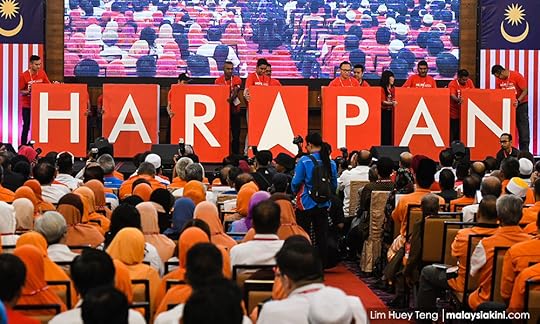
A+ A- COMMENT | Like many Malaysians, left simultaneously bedazzled and fuming by desperate politicians jumping ship and welcomed aboard by those on the sinking 'Bahtera Merdeka', I was angry. I still am.I wrote a series of social media posts to register my disgust towards the nature of Pakatan Harapan’s politics, and how this is going to lead the coalition and the country towards disruption. The years leading to the next general election will see politicians busy focusing on how to kill each other politically, if not sending each other to jail, rather than helping communities. Time and resources to do good, whether utilitarian or ontological, will be wasted.What exactly should be our agenda? What do the people want from those elected into office and paid handsomely to talk and argue in Parliament? What was the promise and how do we reclaim the agenda?But first, some of my notes of disgust:Disruptive politics at its disruptive best – this is what Pakatan Harapan is offering its voters who are now devastated.Politics based on lifelines and the avoidance of life in prison is politics not alive. Dead as deadwood.Just when Malaysians are about to learn what hope for reform means, we have the gates open for pirates who abandoned the mothership.How nervous will leaders of Harapan component parties be now about the future of their jobs, as well as when the rebranded Umno emerges?The question is: can a fragile democracy such as Malaysia afford a zero-opposition policy? That would be crazy.Let the corrupt leave their caves, but close the gates of the sanctuary. Let a strong opposition grow from the ruins of the old.Other parties must preserve integrity at a time when it is for sale. Time to review the coalition.People were angry there were groups that spoiled the votes, like #UndiRosak. Now, are we seeing a damaged government evolving? What then is the difference between the old and the new regime, if the old crooks are invited back, in the name of a two-thirds majority? Our first moveWhere do we go from here – from the premise of change and the reality of disruption to a properly framed course of action? What ideas do we need to push in order for our nation to progress along the path of our common dream?
This is what we need to see evolving: brand-new political will, radical political change, an overhaul of the system and a fresh new mandate. We need a prison complex big enough to incarcerate the long corrupt; a plan to redistribute wealth, dismantle educational apartheid, rewrite Malay and Malaysian history, and rethread the moral fibre of security personnel. We need the widespread arrest of political tyrants, a restructuring of the casino capitalist economy, the restructuring of local government, and a clampdown on racist hate groups. We need a return to the rule of law, to an agricultural society, to a cooperative system, as well as experiment with a radically new form of communal living. We must dismantle systems that allow corporate giants to continue to prey upon the weak, strengthen labour, re-educate political officials on management, ethics, and political philosophy, and punish polluters and the destroyers of forests.We need to separate religion and state, do away with useless cultural and religious rituals, and restructure society based on the principles of radical multiculturalism and the celebration of transcultural philosophies. We need to cut down on TV time and introduce the reading of the great works of arts, humanities, literature, and philosophy, as well as curb rhetoric on Islamic or any religious state.We need all these and more to turn the system on its ugly head.
 As revered founding father Tunku Abdul Rahman – himself a victim of a political coup by racialised politicians – said in 1957 when he proclaimed the country’s independence:”…But while we think of the past, we look forward in faith and hope to the future; from henceforth we are masters of our destiny, and the welfare of this beloved land is our own responsibility."Let no one think we have reached the end of the road: Independence is indeed a milestone, but it is only the threshold to high endeavour – the creation of a new and sovereign state.“At this solemn moment, therefore I call upon you all to dedicate yourselves to the service of the new Malaya: to work and strive with hand and brain to create a new nation, inspired by the ideals of justice and liberty – a beacon of light in a disturbed and distracted world."Indeed, when people believe in the future of their nation, it will be strong. That belief in Malaysia must be rekindled and recreated.The next agendaThe agenda for true reform must be honoured by the present regime, provided that the component parties come together, study Tunku's vision, recall what they themselves promised, remove the ills plaguing communitarian and sectarian politics, and the mad spy-versus-spy world in which we scheme against one another and build personal and family empires.As it is, the scenario does not look good, because we are moving towards yet another form of authoritarianism, don’t-care-for-the-people-ism, plus a whole set of 'isms' that are disruptive to what we wish for as an independent nation: sustainability, peace, and social justice.It is a complex issue for a complex plural nation with complex needs, governed by complex people and a regime not willing to use political will to address such complexities.Whereas life is quite simple. We feed our needs first, rather than our greed.Honour your promises, Harapan!AZLY RAHMAN is an educator, academic, international columnist, and author of seven books available here. He grew up in Johor Bahru and holds a Columbia University doctorate in international education development and Master’s degrees in six areas: education, international affairs, peace studies communication, fiction and non-fiction writing. Twitter @azlyrahman. More writings here.The views expressed here are those of the author/contributor and do not necessarily represent the views of Malaysiakini.
A+ A- COMMENT | Like many Malaysians, left simultaneously bedazzled and fuming by desperate politicians jumping ship and welcomed aboard by those on the sinking 'Bahtera Merdeka', I was angry. I still am.I wrote a series of social media posts to register my disgust towards the nature of Pakatan Harapan’s politics, and how this is going to lead the coalition and the country towards disruption. The years leading to the next general election will see politicians busy focusing on how to kill each other politically, if not sending each other to jail, rather than helping communities. Time and resources to do good, whether utilitarian or ontological, will be wasted.What exactly should be our agenda? What do the people want from those elected into office and paid handsomely to talk and argue in Parliament? What was the promise and how do we reclaim the agenda?But first, some of my notes of disgust:Disruptive politics at its disruptive best – this is what Pakatan Harapan is offering its voters who are now devastated.Politics based on lifelines and the avoidance of life in prison is politics not alive. Dead as deadwood.Just when Malaysians are about to learn what hope for reform means, we have the gates open for pirates who abandoned the mothership.How nervous will leaders of Harapan component parties be now about the future of their jobs, as well as when the rebranded Umno emerges?The question is: can a fragile democracy such as Malaysia afford a zero-opposition policy? That would be crazy.Let the corrupt leave their caves, but close the gates of the sanctuary. Let a strong opposition grow from the ruins of the old.Other parties must preserve integrity at a time when it is for sale. Time to review the coalition.People were angry there were groups that spoiled the votes, like #UndiRosak. Now, are we seeing a damaged government evolving? What then is the difference between the old and the new regime, if the old crooks are invited back, in the name of a two-thirds majority? Our first moveWhere do we go from here – from the premise of change and the reality of disruption to a properly framed course of action? What ideas do we need to push in order for our nation to progress along the path of our common dream?
This is what we need to see evolving: brand-new political will, radical political change, an overhaul of the system and a fresh new mandate. We need a prison complex big enough to incarcerate the long corrupt; a plan to redistribute wealth, dismantle educational apartheid, rewrite Malay and Malaysian history, and rethread the moral fibre of security personnel. We need the widespread arrest of political tyrants, a restructuring of the casino capitalist economy, the restructuring of local government, and a clampdown on racist hate groups. We need a return to the rule of law, to an agricultural society, to a cooperative system, as well as experiment with a radically new form of communal living. We must dismantle systems that allow corporate giants to continue to prey upon the weak, strengthen labour, re-educate political officials on management, ethics, and political philosophy, and punish polluters and the destroyers of forests.We need to separate religion and state, do away with useless cultural and religious rituals, and restructure society based on the principles of radical multiculturalism and the celebration of transcultural philosophies. We need to cut down on TV time and introduce the reading of the great works of arts, humanities, literature, and philosophy, as well as curb rhetoric on Islamic or any religious state.We need all these and more to turn the system on its ugly head. As revered founding father Tunku Abdul Rahman – himself a victim of a political coup by racialised politicians – said in 1957 when he proclaimed the country’s independence:”…But while we think of the past, we look forward in faith and hope to the future; from henceforth we are masters of our destiny, and the welfare of this beloved land is our own responsibility."Let no one think we have reached the end of the road: Independence is indeed a milestone, but it is only the threshold to high endeavour – the creation of a new and sovereign state.“At this solemn moment, therefore I call upon you all to dedicate yourselves to the service of the new Malaya: to work and strive with hand and brain to create a new nation, inspired by the ideals of justice and liberty – a beacon of light in a disturbed and distracted world."Indeed, when people believe in the future of their nation, it will be strong. That belief in Malaysia must be rekindled and recreated.The next agendaThe agenda for true reform must be honoured by the present regime, provided that the component parties come together, study Tunku's vision, recall what they themselves promised, remove the ills plaguing communitarian and sectarian politics, and the mad spy-versus-spy world in which we scheme against one another and build personal and family empires.As it is, the scenario does not look good, because we are moving towards yet another form of authoritarianism, don’t-care-for-the-people-ism, plus a whole set of 'isms' that are disruptive to what we wish for as an independent nation: sustainability, peace, and social justice.It is a complex issue for a complex plural nation with complex needs, governed by complex people and a regime not willing to use political will to address such complexities.Whereas life is quite simple. We feed our needs first, rather than our greed.Honour your promises, Harapan!AZLY RAHMAN is an educator, academic, international columnist, and author of seven books available here. He grew up in Johor Bahru and holds a Columbia University doctorate in international education development and Master’s degrees in six areas: education, international affairs, peace studies communication, fiction and non-fiction writing. Twitter @azlyrahman. More writings here.The views expressed here are those of the author/contributor and do not necessarily represent the views of Malaysiakini.January 1, 2019
#5: Proposing a dream school for Malaysians
Proposing a dream school for MalaysiansOpinion |
Azly Rahman
Published: 17 Nov 2018, 6:25 pm | Modified: 17 Nov 2018, 6:25 pm
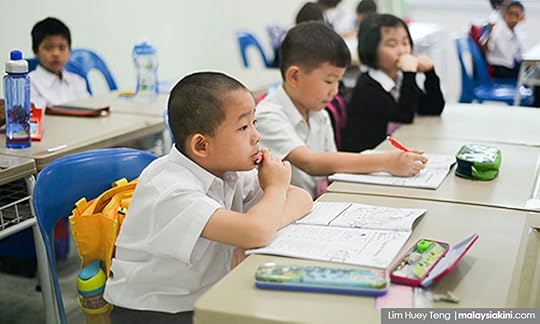
A+ A- COMMENT | Our schools are in trouble. Our society is in crisis. Our nation is at risk. Our children are in need of the right to be intelligent.Hence, talks about a revamped curriculum is good. Contrary to what has been imagined, it is not a monumental task.Some would give the excuse that Rome was not built in a day. But we have a system in place. We have many blueprints. Yet we are producing more and more disenfranchised youth, especially in the urban areas.Drug abuse, drag racing past midnight, dread in our children’s minds, and devastation of the political, ecological and cultural spheres continue to plague our nation – these are consequences of a school system that do not retain student attendance, and spark imaginations and propel new creations.I write based on my 30 years of experience as an educator and studying best practices in other countries. I wish to see the best happening in ours.Below are thoughts of a dream school for Malaysians that I hope people in power are interested in - to help nurture the multiple intelligences of the powerless. To help our nation move out of this quagmire.What does a new breed of school with a totally revamped curriculum look like? Of schools that will ignite the genius in each child? Of one in which together as Malaysians, we eliminate racism and apartheid in the system, according to the principles proposed by the United Nations (Icerd).In short, how do we initiate a renaissance of the Malaysian mind, through a renewed philosophy, paradigm, process, pedagogy, and through a culture that leaves no child behind?The proposalI have a modest proposal of a re-imagined school for Malaysia redesigned and recast as a model “Malaysian Malaysia” (minus the political undertones and sloganising).A nation that belongs to the bright, young, and innovative minds of all races, not just the ones claiming superiority and reproducing bigotry.
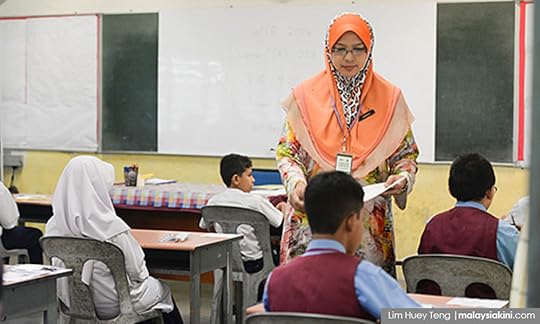 For too long, we have created a schooling system that acts as a conveyer belt for racial and religious discrimination. We can no longer be that nation, as we talk about looking East, looking at Japan, or becoming a sustainable society.I hope the Pakatan Harapan government will take up the idea of this new brand of schooling to propel the country into a new era of educational reform as we approach 2020, the metaphorical vision of a developed country.The initiative should showcase what the BN regime was unable to do in meeting the schooling and human capital needs of the 21st century, as well as for national unity.I have been writing about this model for years and have even proposed to educational leaders from both governmental camps. I call this initiative Akademie Renaissance (AR) Schools and would like to see it come to fruition in my lifetime.This initiative will propel us into a major phase of educational reform to showcase the nation and other countries a model of a truly global school that harmonises technology, culture, and total human development from the level of kindergarten to graduate school.Mission and visionIts mission will be to prepare children to become global citizens and experts in the fields of study they will choose as a career, through a systematic process of schooling of the highest standards, from kindergarten to high/secondary schools.The educational objective is to create ‘academies’ that will become ‘feeder schools of choice’ (specialised) to prepare students for entry into top Asian, American, British, and other international universities of high standing where English is the medium of instruction.
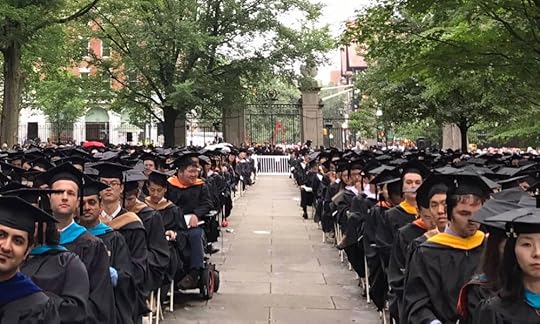 The initial project will be the building of secondary/high schools. It will help local universities receive top minds from our very own secondary schools – young minds that are ready to learn and innovate.These schools will be modelled after the most innovative of educational philosophies with the vision of creating thinkers, innovators, and life-long learners who will be successful at all phases of learning and will contribute to the betterment of society and to Malaysia in general.This will be based on a curriculum that is distinct from the governmental school, focusing on the English Language as a lingua franca as the medium of instruction so that the students will be prepared for entry into the world’s top-ranking colleges/universities whose language of instruction is English. A high level of proficiency in this language is therefore necessary to master skills.The teaching staff will consist of those from diverse local and international backgrounds, skilled in the art and science of teaching and committed to the principles of highest academic excellence and global education, and student emotional and cultural growth.They will be the premier college-preparation schools which will give admission priority to the best and the brightest of children of the poor of all races in Malaysia.
 The aim is to provide the best quality education to children who come from families who are in the worst economic conditions and to give them all the opportunity they will need to be successful enough to give back to their families and community.A criterion is also to give priority admission to those whose parents have never had a college/university education and to orphans of all ethnic background.Alleviation of poverty The vision of this new genre of schools is to have a population that reflects the true composition of multi-ethnic Malaysia who will further demonstrate that they will still continue to succeed against all odds and be leaders with a conscience clear enough to contribute to one of independent Malaysia’s noble goal of development - the alleviation of poverty regardless of race, colour and religion.The schools will not only be internationally linked as ‘university-college-lab-schools of global-experiential learning’ in which the curriculum is based on cutting-edge 21st century informational-society driven paradigm of learning and teaching and expected outcomes but will also be architecturally innovative; one that will harmonise not only the elements of living much needed in the 21st century but also be culturally-intellectually responsive.
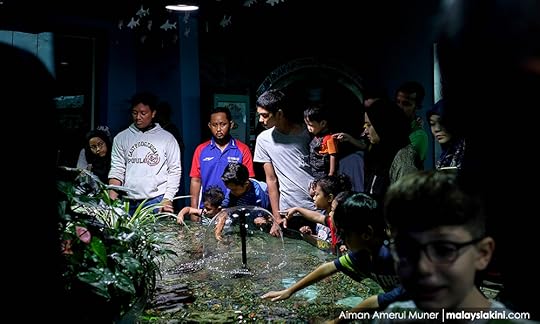 Appreciation and celebration of each other’s difference will be the cultural foundation of the school system so that we will create world-wise citizens.A truly Malaysian design. In other words, these schools in all states across Malaysia will have a unique design that will harmonise tradition and modernity, and make each child think Malaysian first and act like a global citizen, without weakening his or her roots.These experimental schools will also be an educational facility for community education and entrepreneurial activities linking local production of cottage-industrial artefacts to the global market, utilising advanced digital, cybernetic, and virtual communication technologies for students to help the local community to participate in the global business.In the area of community education, it will also house specialised galleries showcasing historical artifacts comprising local-historical materials collected and curated by students, with the help of teachers.They will essentially be ‘research-driven college/trade/apprenticeship prep schools’ in which at every level of learning, students will primarily be employing scientific thinking as a means to acquire and produce knowledge and to further create artefacts useful both for the advancement of theoretical knowledge as well as those practically useful for society.More science and humanismLess of religion and the supernatural, more of science and the ideas of humanism. More time engaging in Socratic and Einsteinian dialogues in the classroom, to create new ideas and products, rather than being lectured endlessly about heaven and hell or to prepare to racialise and proselytise each other.
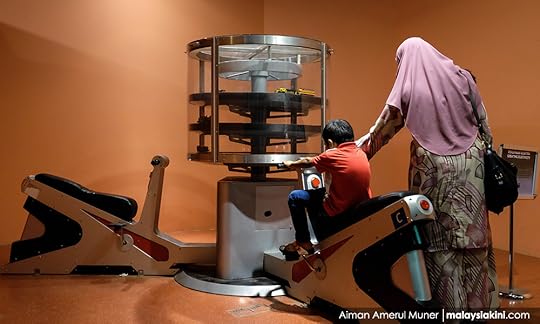 In essence, Akademie Renaissance (AR) will be 21st-century schools showcasing best practices in global education, in which our children are masters of their own learning, creators of their own destiny in a country taking pride in racial harmony.I hope there will be an interest in experimenting with this radical-humanistic change. I hope it will come from the Harapan government if it wishes to show commitment to meaningful reform. Before the people who voted lose hope for the future of their children.A future free from our Malaysian apartheid. A future that celebrates differences, not use them for racial and religious violence. A future in which each child is a winner.Because education is a peaceful and gentle profession that promotes peace, advance personal and professional goals, and most importantly creates good citizens, workers, and social and spiritual beings.Yes, Rome wasn’t built in a day. But Malaysia is not Rome. We just need to remove rhetoric and get down to our post-industrial brutal reality.AZLY RAHMAN is an educator, academic, international columnist, and author of seven books available here. He grew up in Johor Bahru and holds a Columbia University doctorate in international education development and Master’s degrees in six areas: education, international affairs, peace studies communication, fiction and non-fiction writing. Twitter
@azlyrahman
. More writings
here
.The views expressed here are those of the author/contributor and do not necessarily represent the views of Malaysiakini.
In essence, Akademie Renaissance (AR) will be 21st-century schools showcasing best practices in global education, in which our children are masters of their own learning, creators of their own destiny in a country taking pride in racial harmony.I hope there will be an interest in experimenting with this radical-humanistic change. I hope it will come from the Harapan government if it wishes to show commitment to meaningful reform. Before the people who voted lose hope for the future of their children.A future free from our Malaysian apartheid. A future that celebrates differences, not use them for racial and religious violence. A future in which each child is a winner.Because education is a peaceful and gentle profession that promotes peace, advance personal and professional goals, and most importantly creates good citizens, workers, and social and spiritual beings.Yes, Rome wasn’t built in a day. But Malaysia is not Rome. We just need to remove rhetoric and get down to our post-industrial brutal reality.AZLY RAHMAN is an educator, academic, international columnist, and author of seven books available here. He grew up in Johor Bahru and holds a Columbia University doctorate in international education development and Master’s degrees in six areas: education, international affairs, peace studies communication, fiction and non-fiction writing. Twitter
@azlyrahman
. More writings
here
.The views expressed here are those of the author/contributor and do not necessarily represent the views of Malaysiakini.
A+ A- COMMENT | Our schools are in trouble. Our society is in crisis. Our nation is at risk. Our children are in need of the right to be intelligent.Hence, talks about a revamped curriculum is good. Contrary to what has been imagined, it is not a monumental task.Some would give the excuse that Rome was not built in a day. But we have a system in place. We have many blueprints. Yet we are producing more and more disenfranchised youth, especially in the urban areas.Drug abuse, drag racing past midnight, dread in our children’s minds, and devastation of the political, ecological and cultural spheres continue to plague our nation – these are consequences of a school system that do not retain student attendance, and spark imaginations and propel new creations.I write based on my 30 years of experience as an educator and studying best practices in other countries. I wish to see the best happening in ours.Below are thoughts of a dream school for Malaysians that I hope people in power are interested in - to help nurture the multiple intelligences of the powerless. To help our nation move out of this quagmire.What does a new breed of school with a totally revamped curriculum look like? Of schools that will ignite the genius in each child? Of one in which together as Malaysians, we eliminate racism and apartheid in the system, according to the principles proposed by the United Nations (Icerd).In short, how do we initiate a renaissance of the Malaysian mind, through a renewed philosophy, paradigm, process, pedagogy, and through a culture that leaves no child behind?The proposalI have a modest proposal of a re-imagined school for Malaysia redesigned and recast as a model “Malaysian Malaysia” (minus the political undertones and sloganising).A nation that belongs to the bright, young, and innovative minds of all races, not just the ones claiming superiority and reproducing bigotry.
For too long, we have created a schooling system that acts as a conveyer belt for racial and religious discrimination. We can no longer be that nation, as we talk about looking East, looking at Japan, or becoming a sustainable society.I hope the Pakatan Harapan government will take up the idea of this new brand of schooling to propel the country into a new era of educational reform as we approach 2020, the metaphorical vision of a developed country.The initiative should showcase what the BN regime was unable to do in meeting the schooling and human capital needs of the 21st century, as well as for national unity.I have been writing about this model for years and have even proposed to educational leaders from both governmental camps. I call this initiative Akademie Renaissance (AR) Schools and would like to see it come to fruition in my lifetime.This initiative will propel us into a major phase of educational reform to showcase the nation and other countries a model of a truly global school that harmonises technology, culture, and total human development from the level of kindergarten to graduate school.Mission and visionIts mission will be to prepare children to become global citizens and experts in the fields of study they will choose as a career, through a systematic process of schooling of the highest standards, from kindergarten to high/secondary schools.The educational objective is to create ‘academies’ that will become ‘feeder schools of choice’ (specialised) to prepare students for entry into top Asian, American, British, and other international universities of high standing where English is the medium of instruction.The initial project will be the building of secondary/high schools. It will help local universities receive top minds from our very own secondary schools – young minds that are ready to learn and innovate.These schools will be modelled after the most innovative of educational philosophies with the vision of creating thinkers, innovators, and life-long learners who will be successful at all phases of learning and will contribute to the betterment of society and to Malaysia in general.This will be based on a curriculum that is distinct from the governmental school, focusing on the English Language as a lingua franca as the medium of instruction so that the students will be prepared for entry into the world’s top-ranking colleges/universities whose language of instruction is English. A high level of proficiency in this language is therefore necessary to master skills.The teaching staff will consist of those from diverse local and international backgrounds, skilled in the art and science of teaching and committed to the principles of highest academic excellence and global education, and student emotional and cultural growth.They will be the premier college-preparation schools which will give admission priority to the best and the brightest of children of the poor of all races in Malaysia.The aim is to provide the best quality education to children who come from families who are in the worst economic conditions and to give them all the opportunity they will need to be successful enough to give back to their families and community.A criterion is also to give priority admission to those whose parents have never had a college/university education and to orphans of all ethnic background.Alleviation of poverty The vision of this new genre of schools is to have a population that reflects the true composition of multi-ethnic Malaysia who will further demonstrate that they will still continue to succeed against all odds and be leaders with a conscience clear enough to contribute to one of independent Malaysia’s noble goal of development - the alleviation of poverty regardless of race, colour and religion.The schools will not only be internationally linked as ‘university-college-lab-schools of global-experiential learning’ in which the curriculum is based on cutting-edge 21st century informational-society driven paradigm of learning and teaching and expected outcomes but will also be architecturally innovative; one that will harmonise not only the elements of living much needed in the 21st century but also be culturally-intellectually responsive.Appreciation and celebration of each other’s difference will be the cultural foundation of the school system so that we will create world-wise citizens.A truly Malaysian design. In other words, these schools in all states across Malaysia will have a unique design that will harmonise tradition and modernity, and make each child think Malaysian first and act like a global citizen, without weakening his or her roots.These experimental schools will also be an educational facility for community education and entrepreneurial activities linking local production of cottage-industrial artefacts to the global market, utilising advanced digital, cybernetic, and virtual communication technologies for students to help the local community to participate in the global business.In the area of community education, it will also house specialised galleries showcasing historical artifacts comprising local-historical materials collected and curated by students, with the help of teachers.They will essentially be ‘research-driven college/trade/apprenticeship prep schools’ in which at every level of learning, students will primarily be employing scientific thinking as a means to acquire and produce knowledge and to further create artefacts useful both for the advancement of theoretical knowledge as well as those practically useful for society.More science and humanismLess of religion and the supernatural, more of science and the ideas of humanism. More time engaging in Socratic and Einsteinian dialogues in the classroom, to create new ideas and products, rather than being lectured endlessly about heaven and hell or to prepare to racialise and proselytise each other.In essence, Akademie Renaissance (AR) will be 21st-century schools showcasing best practices in global education, in which our children are masters of their own learning, creators of their own destiny in a country taking pride in racial harmony.I hope there will be an interest in experimenting with this radical-humanistic change. I hope it will come from the Harapan government if it wishes to show commitment to meaningful reform. Before the people who voted lose hope for the future of their children.A future free from our Malaysian apartheid. A future that celebrates differences, not use them for racial and religious violence. A future in which each child is a winner.Because education is a peaceful and gentle profession that promotes peace, advance personal and professional goals, and most importantly creates good citizens, workers, and social and spiritual beings.Yes, Rome wasn’t built in a day. But Malaysia is not Rome. We just need to remove rhetoric and get down to our post-industrial brutal reality.AZLY RAHMAN is an educator, academic, international columnist, and author of seven books available here. He grew up in Johor Bahru and holds a Columbia University doctorate in international education development and Master’s degrees in six areas: education, international affairs, peace studies communication, fiction and non-fiction writing. Twitter
@azlyrahman
. More writings
here
.The views expressed here are those of the author/contributor and do not necessarily represent the views of Malaysiakini.#4: Of the temple attack, black shoes, iPads and the future of schooling in Malaysia
Of the temple attack, black shoes, iPads and the future of schoolingOpinion |
Azly Rahman
Published: 1 Dec 2018, 8:35 pm | Modified: 1 Dec 2018, 8:35 pm A+ A- COMMENT | I am both saddened and hopeful of the future of the Malaysian education system. Saddened by the fact that the incident of the fracas outside the Seafield Sri Maha Mariamman temple in Subang Jaya not only reflects the May 13, 1969 syndrome we are still in, but also the dangerous tipping points of race relations and religious complexity we are plagued with.The planned Dec 8 'victory rally' against the International Convention on the Elimination of All Forms of Racial Discrimination (Icerd) by the Umno-PAS coalition of desperation under the ill-defined umbrella of ummah is troubling, and symptomatic of the schools we have built.We hear of the Education Ministry planning this or that, sending circulars on
black shoes
, black socks, and using Islamic values as instructional strategies to be used on children and students of multi-religious backgrounds.And, in a show of symbolism and attunement to the digital age and the Internet of Things, all children are to be provided with iPads so that they can use digital books instead of carrying those heavy, printed ones.But we are not sure what the plan is to have teachers and students use digitally driven, constructivism-based, critical thinking and enhanced practices in teaching, thinking, and learning.Remember the 'smart schools' slogan of the 1990s? Remember the promise to turn each of the 10,000 schools into 'smart schools' under the Mahathir administration?In 1998, the Education Ministry stated that schools would also have Olympic-sized swimming pools. Schools then were supposed to prepare the young to be citizens of this utopia called the Multimedia Super Corridor.And today, we hear that iPads will be supplied (though we do not know who is the vendor) and that schools are to teach
swimming
, so that not only will children be digitally-enhanced and technologically-driven, but also be able to swim ashore when the tide of globalisation threatens to drown us.Now the news about the
Seafield temple riots
. Realistically, we need to critically examine why the riot occurred, and why it was seen as a prelude to a race riot, à la May 13.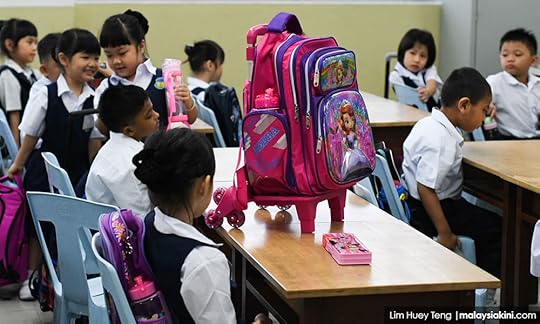 The point of this essay – written in anger – of why we are still a racist nation, and how we are to start thinking that nobody owns this land except Malaysians who are legal residents who toil for the nation, is to say that we are failing in this enterprise called “schooling.”We have created 10 types of schools that need to be restructured big time, in the name of sustainability, human rights, peace and justice.How is this so, and what does it say about the state of educational evolution and crisis of cultural degeneration Malaysia is in? For the world to understand how this hyper-modern society has evolved and how its people are schooled for social reproduction, one must understand the types of schools that have come into being.10 types of schoolsSince independence, and as a legacy of British colonialism of divide and conquer as well as following the mould of Americanism, Malaysia has developed 10 types of schools:Power schools. These are international schools meant for the rich and powerful who will compete and collaborate with children of expatriates and who will be academically better than the children of the poor and of the locals.Private schools. They are very expensive "breakaway schools" meant to save children from poor teaching and overcrowded classrooms.Privileged schools. These are well-funded boarding schools built to safeguard racial privileges and to instil a sense of Ketuanan Melayu in children who did well in their kampung schools, and to groom them so that they will become leaders who will protect the rights of their race.Parochial schools. These are schools that sustain the transmission of this or that culture based on the perceived superiority of this or that language, culture, and religion, so that the children will not be washed away by the tide of cultural change.Public schools. These are government schools that sustain the ideology of the ruling regime, and train the children to be nationalistic and patriotic. They are used as a training ground for children to participate in nation-building so that they will grow up as defenders of the state.'Proof-of-concept' schools. These are well-funded government schools that are seen as a showcase of innovations and good management, and authentic assessment and evaluation. This is to show that these selected schools can be saved from the failing public schools, and that a failing policy can be saved by a successful showcase of "smart ways to schooling."Pondok-preacher schools. These are tahfiz schools – registered and unregistered – that could be an easy channel of influence to reproduce extermists and religiously intolerant human beings, or worse, to become cadres and sympathisers of the Islamic State.Post-school schools. These are tuition centres in the billion-ringgit tuition industry.Pathetic schools. These are schools that have to beg for money from the government to even fix a roof or a toilet, and are meant for those children whose parents did not go to any of the above schools.Papa-mama-schools or homeschooling. These are managed by parents who do not have faith in any of the schools above, and do not wish their children to befriend bad boys and bad girls in schools.
 Which of those above do Malaysians wish their child to be schooled in? Herein lies my hope for a better way to chart our future before Malaysia becomes yet another failed state like Somalia, Syria, South Sudan, El Salvador, or any of those which started well but were later torn apart by race and religious extremism, class evolution, and modern imperialism.What next?We have yet to know how the Education Ministry proposes to create a truly Malaysian schooling system – from kindergartens to schools – that envisions a common destiny that is inclusive, creative, altruistic, futuristic and that will treat each and every Malaysian child, regardless of race and religion, as human beings.This is the challenge we face in yet another difficult period in which the spectre of May 13 are evoked to be used to destroy this beautiful country.The solution lies in schooling, the only means for a sustainable personal, social, cultural, and technological progress.Dare we create new schools to create a greater and more peaceful Malaysian society – beyond temple riots, black shoes and socks, and the promises of iPads and swimming pools?What must be our first step? And what do we really want from the current regime?AZLY RAHMAN is an educator, academic, international columnist, and author of seven books available here. He grew up in Johor Bahru and holds a Columbia University doctorate in international education development and Master’s degrees in six areas: education, international affairs, peace studies communication, fiction and non-fiction writing. Twitter
@azlyrahman
. More writings
here
.The views expressed here are those of the author/contributor and do not necessarily represent the views of Malaysiakini.
Which of those above do Malaysians wish their child to be schooled in? Herein lies my hope for a better way to chart our future before Malaysia becomes yet another failed state like Somalia, Syria, South Sudan, El Salvador, or any of those which started well but were later torn apart by race and religious extremism, class evolution, and modern imperialism.What next?We have yet to know how the Education Ministry proposes to create a truly Malaysian schooling system – from kindergartens to schools – that envisions a common destiny that is inclusive, creative, altruistic, futuristic and that will treat each and every Malaysian child, regardless of race and religion, as human beings.This is the challenge we face in yet another difficult period in which the spectre of May 13 are evoked to be used to destroy this beautiful country.The solution lies in schooling, the only means for a sustainable personal, social, cultural, and technological progress.Dare we create new schools to create a greater and more peaceful Malaysian society – beyond temple riots, black shoes and socks, and the promises of iPads and swimming pools?What must be our first step? And what do we really want from the current regime?AZLY RAHMAN is an educator, academic, international columnist, and author of seven books available here. He grew up in Johor Bahru and holds a Columbia University doctorate in international education development and Master’s degrees in six areas: education, international affairs, peace studies communication, fiction and non-fiction writing. Twitter
@azlyrahman
. More writings
here
.The views expressed here are those of the author/contributor and do not necessarily represent the views of Malaysiakini.
A+ A- COMMENT | I am both saddened and hopeful of the future of the Malaysian education system. Saddened by the fact that the incident of the fracas outside the Seafield Sri Maha Mariamman temple in Subang Jaya not only reflects the May 13, 1969 syndrome we are still in, but also the dangerous tipping points of race relations and religious complexity we are plagued with.The planned Dec 8 'victory rally' against the International Convention on the Elimination of All Forms of Racial Discrimination (Icerd) by the Umno-PAS coalition of desperation under the ill-defined umbrella of ummah is troubling, and symptomatic of the schools we have built.We hear of the Education Ministry planning this or that, sending circulars on
black shoes
, black socks, and using Islamic values as instructional strategies to be used on children and students of multi-religious backgrounds.And, in a show of symbolism and attunement to the digital age and the Internet of Things, all children are to be provided with iPads so that they can use digital books instead of carrying those heavy, printed ones.But we are not sure what the plan is to have teachers and students use digitally driven, constructivism-based, critical thinking and enhanced practices in teaching, thinking, and learning.Remember the 'smart schools' slogan of the 1990s? Remember the promise to turn each of the 10,000 schools into 'smart schools' under the Mahathir administration?In 1998, the Education Ministry stated that schools would also have Olympic-sized swimming pools. Schools then were supposed to prepare the young to be citizens of this utopia called the Multimedia Super Corridor.And today, we hear that iPads will be supplied (though we do not know who is the vendor) and that schools are to teach
swimming
, so that not only will children be digitally-enhanced and technologically-driven, but also be able to swim ashore when the tide of globalisation threatens to drown us.Now the news about the
Seafield temple riots
. Realistically, we need to critically examine why the riot occurred, and why it was seen as a prelude to a race riot, à la May 13.The point of this essay – written in anger – of why we are still a racist nation, and how we are to start thinking that nobody owns this land except Malaysians who are legal residents who toil for the nation, is to say that we are failing in this enterprise called “schooling.”We have created 10 types of schools that need to be restructured big time, in the name of sustainability, human rights, peace and justice.How is this so, and what does it say about the state of educational evolution and crisis of cultural degeneration Malaysia is in? For the world to understand how this hyper-modern society has evolved and how its people are schooled for social reproduction, one must understand the types of schools that have come into being.10 types of schoolsSince independence, and as a legacy of British colonialism of divide and conquer as well as following the mould of Americanism, Malaysia has developed 10 types of schools:Power schools. These are international schools meant for the rich and powerful who will compete and collaborate with children of expatriates and who will be academically better than the children of the poor and of the locals.Private schools. They are very expensive "breakaway schools" meant to save children from poor teaching and overcrowded classrooms.Privileged schools. These are well-funded boarding schools built to safeguard racial privileges and to instil a sense of Ketuanan Melayu in children who did well in their kampung schools, and to groom them so that they will become leaders who will protect the rights of their race.Parochial schools. These are schools that sustain the transmission of this or that culture based on the perceived superiority of this or that language, culture, and religion, so that the children will not be washed away by the tide of cultural change.Public schools. These are government schools that sustain the ideology of the ruling regime, and train the children to be nationalistic and patriotic. They are used as a training ground for children to participate in nation-building so that they will grow up as defenders of the state.'Proof-of-concept' schools. These are well-funded government schools that are seen as a showcase of innovations and good management, and authentic assessment and evaluation. This is to show that these selected schools can be saved from the failing public schools, and that a failing policy can be saved by a successful showcase of "smart ways to schooling."Pondok-preacher schools. These are tahfiz schools – registered and unregistered – that could be an easy channel of influence to reproduce extermists and religiously intolerant human beings, or worse, to become cadres and sympathisers of the Islamic State.Post-school schools. These are tuition centres in the billion-ringgit tuition industry.Pathetic schools. These are schools that have to beg for money from the government to even fix a roof or a toilet, and are meant for those children whose parents did not go to any of the above schools.Papa-mama-schools or homeschooling. These are managed by parents who do not have faith in any of the schools above, and do not wish their children to befriend bad boys and bad girls in schools.Which of those above do Malaysians wish their child to be schooled in? Herein lies my hope for a better way to chart our future before Malaysia becomes yet another failed state like Somalia, Syria, South Sudan, El Salvador, or any of those which started well but were later torn apart by race and religious extremism, class evolution, and modern imperialism.What next?We have yet to know how the Education Ministry proposes to create a truly Malaysian schooling system – from kindergartens to schools – that envisions a common destiny that is inclusive, creative, altruistic, futuristic and that will treat each and every Malaysian child, regardless of race and religion, as human beings.This is the challenge we face in yet another difficult period in which the spectre of May 13 are evoked to be used to destroy this beautiful country.The solution lies in schooling, the only means for a sustainable personal, social, cultural, and technological progress.Dare we create new schools to create a greater and more peaceful Malaysian society – beyond temple riots, black shoes and socks, and the promises of iPads and swimming pools?What must be our first step? And what do we really want from the current regime?AZLY RAHMAN is an educator, academic, international columnist, and author of seven books available here. He grew up in Johor Bahru and holds a Columbia University doctorate in international education development and Master’s degrees in six areas: education, international affairs, peace studies communication, fiction and non-fiction writing. Twitter
@azlyrahman
. More writings
here
.The views expressed here are those of the author/contributor and do not necessarily represent the views of Malaysiakini.