Annie Cardi's Blog, page 73
September 14, 2012
Friday Fifteen
Man, Friday could not come soon enough this week. So happy to be posting the Friday Fifteen!
 1. The Hunger Games by Suzanne Collins
This one sat on my bookshelf for a while; finally started it and was hooked.
2. Claiming Georgia Tate by Gigi Amateau
The sweetness and darkness of family are both very present here. Amateau doesn’t pull punches.
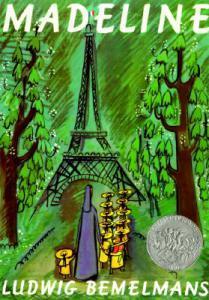
3. Madeline by Ludwig Bemelmans
A daring redhead who lives with her friends and has a cool scar? So awesome.
4. Othello by William Shakespeare
Not my favorite, but intriguing ideas about men and women. Also, I dig Emilia.
5. Stone Fox by John Reynolds Gardiner
This is what I think of when I see a samoyed.


September 13, 2012
Quote of the Day
In the great storytelling there is usually an indication of the resolution in the first sentence.–Madeleine L’Engle
I came across this quote in Madeleine L’Engle Herself: Reflections on A Writing Life. She goes on to talk about examples from Hemingway and Chekov, but even without knowledge of those stories, this quote is really intriguing. You don’t tend to think about the first line resolving anything. But I like the suggestion that the beginning of the story has to connect with the end of the story. The parts of a narrative don’t exist in a vacuum.
Definitely going back to my first sentence and thinking about how to reflects the rest of the story.


September 12, 2012
Integrated Parts of Story and Removing Stuff You Love
The Horn Book has a fantastic interview with Rebecca Stead about her latest book, Liar & Spy. One part I especially enjoyed:
“Roger: So many things worked well not only by being intrinsically interesting, like that taste test Georges’ science class does, which is just fun, but by being integrated parts of the story. Sometimes I’ll see authors throw in – I say throw in, which is disparaging; that’s how it feels to me – but it seems like someone has put his or her own little pet project or idea into a story but really hasn’t made it part of that story. Whereas I feel like you did.
Rebecca: I do believe there’s a great temptation to throw things in, as you put it, that you think are neat, or that you have a very clear, specific memory of and think you could do a good job writing about. What I find is that it’s like a seed you plant. You can try it, and if it will grow and connect with other ideas in the book, and you can see connections that you can actually realize on the page, then you’re allowed to leave it in. But if it just kind of lies there and doesn’t really add up to anything or there’s no chemistry with everything else going on in the book, then you have to take it out. I had a couple of things I tried to force into this book that just lay there.”
I think a lot of writers can related to this, especially at the first conception of a book vs. the final product. Trusted readers tell you that X just isn’t working or they’re not sure why it’s there. You argue. “No!” you say. “This is for real reasons!” But usually it’s just because you love the idea so much, and the story doesn’t really benefit from that extra page count.
The good news is that none of that X you loved needs to go away forever. Maybe it’s not right for this project, but keep it in your back pocket for something else.


September 11, 2012
Try to Praise the Mutilated World
I find it strange to talk about September 11th because, unlike so many people in New York or Washington or Pennsylvania, my life wasn’t dramatically affected that day. Whenever this day comes up, or the anniversary of any other tragic event, I turn to this poem by Adam Zagajewski:
Try to praise the mutilated world.
Remember June’s long days,
and wild strawberries, drops of wine, the dew.
The nettles that methodically overgrow
the abandoned homesteads of exiles.
You must praise the mutilated world.
You watched the stylish yachts and ships;
one of them had a long trip ahead of it,
while salty oblivion awaited others.
You’ve seen the refugees heading nowhere,
you’ve heard the executioners sing joyfully.
You should praise the mutilated world.
Remember the moments when we were together
in a white room and the curtain fluttered.
Return in thought to the concert where music flared.
You gathered acorns in the park in autumn
and leaves eddied over the earth’s scars.
Praise the mutilated world
and the gray feather a thrush lost,
and the gentle light that strays and vanishes
and returns.
—Adam Zagajewski
(Translated, from the Polish, by Clare Cavanagh.)
It was published in the September 42, 2001 issue of The New Yorker. Click through for more poetry in response to that day.


September 10, 2012
The Printz Award: What Does It Mean to Be Excellent in YA?
The Michael L. Printz Award for Excellence in Young Adult Literature (aka “the Printz”) is one of the top honors in the YA community. But what exactly is the Printz Award? How are books chosen and why? Who makes the decisions?
Someday My Printz Will Come, which takes a look at YA lit and the award throughout the year, has a great series going about what the award actually is. One of the big issues raised is “excellence” and what that actually means.
Another part I thought that interesting:
“No one on the committee is carried over from the previous year unless the AA goes on to become a committee member, which means that each committee operates in a vacuum. This in turn means that each committee must grapple with the hard questions anew. Which was, at times, incredibly annoying, but is also very freeing. It doesn’t matter what last year’s committee said about series titles, or how they felt, as an entity, about nonfiction. It only matters what you and the eight people on your committee think.”
So a book that could have dominated in one year could be completely left out the next. I think that ultimately levels the playing field (the award never goes to one kind of book), but I’m sure that’s frustrating when you consider that your book may have been nominated last year but not this year.
Make sure to check out both posts for a good insight into what makes the Printz happen.


September 7, 2012
Friday Fifteen
It’s finally Friday, which means it’s time for the Friday Fifteen. Here are this week’s fifteen-word reviews:
 Down Among the Women by Fay Weldon
Pretty sure I wrote a paper about this but can’t remember any details now.
The Dreamer’s Dictionary by Stearn Robinson and Tom Corbett
Had a few of these in my astrology phase. This one seemed pretty solid.
Super Sleepover Guide by Susan Saunders
Sleepover party themes include “makeover” and “Olympics.” Mine were usually “Dream Phone” themed.
Speak the Speech!: Shakespeare’s Monologues Illuminated by Rhona Silverbush and Sami Plotkin
I don’t think this was ever going to help my one-and-only Shakespeare audition go better.
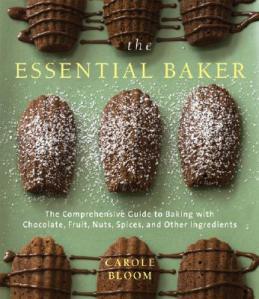
The Essential Baker: The Comprehensive Guide to Baking with Chocolate, Fruit, Nuts, Spices, and Other Ingredients by Carole Bloom
Probably my favorite cookbook. Organized well, with delicious recipes. Double fig tart, anyone?


When You Were Young: Author School Photos
It’s hard to imagine Margaret Atwood as Peggy, but her yearbook photo makes me think she must have been way cool to hang out with in high school:
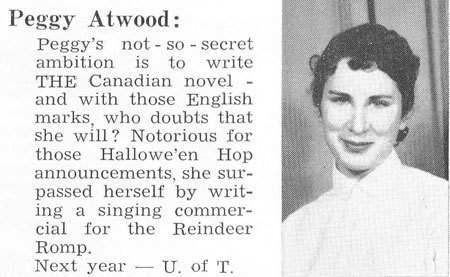
Lots of other author school photos (including ones of Lois Lowry and Madeleine L’Engle) through the link.
Sadly, no laser or space backdrops though.
(image via Flavorwire)


YA Lit Guy Crush List
Love this post at Book Riot about dreamy teen male characters. As a high schooler without anything resembling a romantic life, I lived vicariously through books. Jodi makes some awesome choices (Ponyboy!), but I thought it would be fun to add a couple of my own:
Phineas “Finny” from A Separate Peace by John Knowles
Charming, athletic, good-natured–it’s like Finny was made to be a preppy girl’s crush.
Dirk from Dangerous Angels by Francesca Lia Block
Lots of Block’s characters could have made this list, but Dirk has a special charm. He’s Weetzie’s best friend (and the best friend you want to have); he’s got major style; and his story in Baby Be-Bop is heartbreaking. The fact that he ends up with Duck (who’s just as great) makes him even cooler.
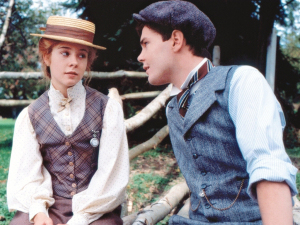 Gilbert Blyth from Anne of Green Gables by Lucy Maud Montgomery
Who didn’t love Gilbert? I love that he and Anne have a healthy sense of academic competition. (I was totally that girl in middle
school.) His friendship and eventual relationship with Anne feel very natural.
George Cooper from The Song of the Lioness by Tamora Pierce
Dude is the youngest King of the Rogue ever in Tortall. Charm? Heck yeah. And he appreciates a strong woman.
Sean Kendrick from The Scorpio Races by Maggie Stiefvater
Sean feels so real–he’s got a lot of sadness and anger, but it feels totally earned, and he’s not defined by those feelings. He’s compelling and talented and thoughtful. Plus, I loved the progression of Sean and Puck’s relationship.
Thinking about all these swoony guys, I think what I like most about them is that they’re their own characters. They don’t just exist to love the heroine. They have their own goals and fears and personalities. Something to keep in mind when we’re writing our own swoony characters.
Who would you add to the YA boy crush list?
(image: Anne of Green Gables Wiki)


September 6, 2012
Lip-Reading Twilight
Bella and Edward’s relationship is fraught with tension, especially when it’s presented in bad lip-reading form:

That cake’s my most bestest creation!


September 5, 2012
Links Galore
Lots of fun links for today:
So excited for Boston GLOW’s Fight Like a Girl! author panels. (H/T Lauren M. Barrett)
Yes, you can still write about vampires or dystopian societies. Story > trend.
Classic novels as teen movies. Lots of great flicks listed, and several I don’t know.
How to prepare for your book launch–and no, you don’t need a multi-million dollar budget.
Candlewick’s campaign in support of picture books warms my heart.
Also heart-warming: Daniel Radcliffe and JK Rowling talk about Harry Potter.