Melissa Wiley's Blog, page 73
August 26, 2013
Treasures
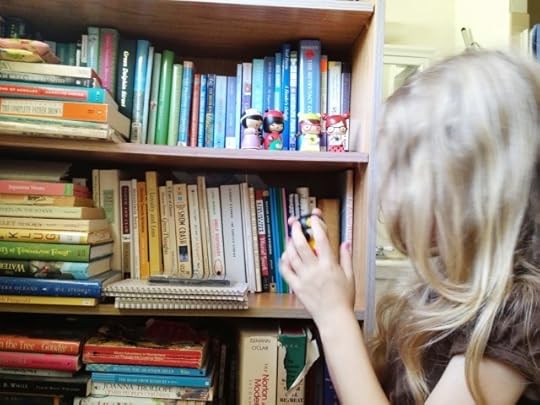
She’ll perch on a stool and play with the wooden dolls on my shelves by the hour. This is how Sunday afternoon unfolds: her soft doll-chatter murmuring beside me while I’m reading, studying, or (as was the case this weekend) cleaning out closets.
I see Joanna Trollope’s Other People’s Children peeking out from one of the stacks; I read it on (I think it was) Lesley’s recommendation and found it wholly absorbing, thoughtful, vivid, a bit sad. I liked it very much. Those shelves are a jumble of things I’m eager to read but haven’t had a chance yet (Green Dolphin Street, borrowed from my friend Carmen; The Light Between Oceans, a gift from my publisher last Christmas; Brideshead Revisited, because I still—still! still!!1!!—haven’t, among others) and books I love so much I need to keep them close. (A Far Cry From Kensington; One Man’s Meat; Dear Genius; etc. etc. etc.)
Notable picture-book reads of late: The Artist Who Painted a Blue Horse—a top-ten favorite of Rilla’s, and she’ll talk your ear off about the highlight colors in the paintings, if you like; Miss Suzy, back in frequent rotation; Open This Little Book, of which Huck cannot get enough; and to Huck for the very first time—oh! this particular milestone has been one of the most delightful I’ve experienced with each of the kids, one by one—Make Way for Ducklings. You can tell he’s the sixth child, not getting his full measure of McCloskey until the ancient age of four and a half. Scandal!








August 20, 2013
“Think of a book…”
“…any book. It’s hard to think of a really bad book this way, but think of a good book, one of your favorite books ever, as like a newborn child, a newborn child brought into the world. A book. Probably a lot more planning and thought and design and construction, at least intellectually, goes into that book than goes into most babies. Books have a cover. They have beginnings, middles and ends. They’re somebody’s dream, they’re somebody’s creation. They never satisfy—just like people—but they’re in some ways the greatest things we have, and sometimes it’s nice to remind ourselves of that, in the places where we take them most for granted.”



Round Buildings, Square Buildings, Buildings That Wiggle Like a Fish

Image source: Wikimedia Commons
I’ve written about this book before:
 “Round Buildings, Square Buildings, and Buildings that Wiggle Like a Fish
 by Philip M. Isaacson. Twelve years ago, this children’s book was my introduction to the study of architecture. I’ve never looked at buildings the same way since.
“Isaacson takes the reader on a leisurely, respectful tour of buildings around the world: churches, houses, museums, lighthouses, all kinds of structures, from the humble to the magnificent. In simple, straightforward prose he discusses various architectural concepts such as the impact of building materials, the interplay of light and color, and the significance of roof shape. His stunning photographs turn even the roughest earthen hut into a work of art. His lyrical text helps us see in the pictures what we might otherwise have missed:
‘These buildings are part of the Shaker Village at Sabbathday, Maine. On an afternoon in late winter they are warm and creamy, but in December, shadows thrown at them make them look haunted. A building only a few yards away fades into the land on a hazy morning.’”
—Originally posted March 11, 2006: “The Poetry of Walls.”
Round Buildings, Square Buildings was edited by my first boss in publishing, the great Stephanie Spinner. It was near completion by the time I came on board; I don’t think I did much more than look over galleys and jacket copy, and probably put through the request for Mr. Isaacson’s author copies. It’s one of those books I sat at my desk reading, unable to believe my good fortune: This is my job now; I’m getting paid to read.

Before Round Buildings I hadn’t done much real seeing of architecture. There were buildings I loved: the sandstone administration building (formerly a convent) of my first college, Loretto Heights, with its red tower soft-edged against a blue sky, and inside, a gorgeous mosaic floor—tiny tiles set into place by wagon-training nuns, so the story went. But even there, I was drawn more to story than to form. Most of the buildings that captured my imagination, pre-Isaacson, lived in books: Green Gables, the House o’ Dreams, Jane’s Lantern Hill house with its “lashings of magic.” The Muskoka cabin. (No one does houses better than Montgomery.) Plumfield. Juniper’s cottage. Miss Suzy’s tree-house with its acorn cups. Vicky Austin’s grandfather’s house-in-a-converted-stable with the stalls full of books. A great many English houses in a great many English novels.
But most of the time, my eye was drawn more to nature than to man’s edifices. I had next to no vocabulary for understanding architecture. Isaacson changed that in a paragraph with his description of the creamy walls of the Taj Mahal changing colors as the sun moved across them—the very passage I read with Beanie and Rose this morning. He writes about harmony and you find yourself looking for it everywhere you go. He made me see my world differently—just as John Stilgoe’s Outside Lies Magic changed how I looked at just about everything else: power lines, rain gutters, a sculpture garden, the line at the DMV. The way Betty Edwards’s Drawing on the Right Side of the Brain changed the way I see faces.

Clicking through these old posts, I see I’ve made a connection between these three books before. They’re transformative, all three.
Funny also to see in the old Stilgoe post I linked above, “Way Leads on to Way,” that I’d been reading Fifty Famous Stories Retold* to Beanie that year—in March, 2008, when she was seven years old. And now here’s Rilla seven, and I’m reading it to her. (Today’s tale: Androclus and the Lion. It drew cheers, and a narration with gusto. Because LION.) I have to laugh: way doesn’t just lead on to way; sometimes it leads right back full circle. I didn’t choose Round Buildings for the older girls and Fifty Famous Stories for the seven-year-old at the same time—again—on purpose; I guess it’s just that I’ve been doing this long enough now that I know what works for us, and these things have worked time and again. It did strike me this morning, reading the Isaacson, that the Stilgoe might be a satisfying read for Jane and Rose right about now.
**Also wonderful: Isaacson’s sequel, A Short Walk Around the Pyramids and Through the World of Art



August 19, 2013
The Prairie Thief in Paperback
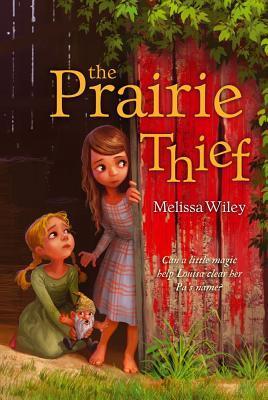
Hurrah! I love it when a book comes out in paperback. Such a thrill to know it will reach a new audience. 
Handy-dandy purchasing links for you, because I’m helpful like that:
Amazon • B&N • Indiebound
Do you know what I would love? If you happen to buy a copy (or if you have already purchased the hardcover) from your local indie, would you leave a comment to let me know the name of the bookstore? There are few things lovelier for a writer than knowing someone wandered into a bookshop and met your book on the shelf, and adopted it for keeps.
Here are some reviews:
“Wiley has created a charming, inventive tale that reads like a delightful mash-up of Little House on the Prairie and Tony DiTerlizzi’s ‘The Spiderwick Chronicles’ (S & S). Short chapters and the air of mystery and suspense keep the pages turning, and readers will be taken with Louisa, who is sweet and mild-mannered, yet has the strength to fight for what is right. The writing is breezy and lyrical…[a] top-notch story.” —School Library Journal
“Fans of the Little House books will recognize the setting and enjoy the fantastic twist. Stylized black-and-white illustrations capture key moments and add to the warm tone. The comedic, unexpected, satisfying conclusion hits just the right note. A pleasing folkloric/historical blend.” —Kirkus Reviews
“Wiley’s cleverly constructed story, which switches over to the circuit judge’s amusing perspective for a few chapters, is not only a fine tall tale but also gives some sense of nineteenth-century frontier life.” —Booklist
“Frontier fiction and folkloric fantasy are an unusual combination, but they actually blend remarkably well here, and Wiley does a fine job of staying true to the pioneer inflections of Louisa’s story while effectively integrating the magical brownie…The effective mashup of popular genres will make this a hit with a variety of readers, so try handing it to Little House fans and folktale-lovers alike.” —Bulletin of the Center for Children’s Books
“…a delight from start to finish.” —Jen Robinson’s Book Page
“Every now and then a book makes me miss having a class to read to. Some books absolutely beg to be read aloud. The Prairie Thief by Melissa Wiley is that kind of book….And then, the must of all musts for reading a story aloud… the language. The Prairie Thief is rich with gorgeous, evocative language that begs to be heard as well as read. We feel as though we’ve been transported back in time when we listen to expressions like, ‘He was wailing loud enough to curdle milk,’ or ‘Ye look like last year’s scarecrow.’ Even the simple ‘Balderdash!’ sounds better out loud. Wiley uses big words too—words that some kids will latch on to and roll around in their minds and mouths—like audacious, gesticulations, rapscallion, scrutinizing—they add to the mood and help us sink into this world.” —Writing on the Sidewalk
“Wholly delightful. I found it impossible to put down and read it in one great gulp. I don’t think I could have loved it more, had I read it as a child. The characters are lovely, each and all. The story, while never veering from the path to a happy ending, had plenty of dips and bobbles and surprises. I grinned my way through much of it, and am not ashamed to tell you my eyes filled with tears at the end. It’s wholesome without being smarmy, and fun without being arch.” —Salamander House
“…a mystical mystery not to be missed.” —the kids at Bookie Woogie
The Prairie Thief is a Junior Library Guild selection, an SCBWI Crystal Kite Member’s Choice Award nominee, and a Bravewriter Arrow selection. It is currently a nominee for New Hampshire’s Great Stone Face Children’s Choice Award. (Check out the rest of the books on that list, you guys—looks like some fun reading there.)



August 18, 2013
The Well-Appointed Medical Kit
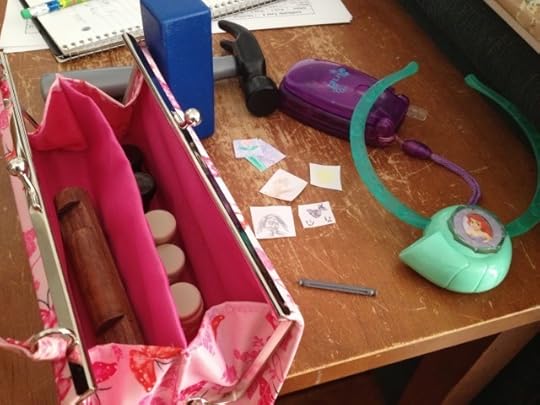
Medicine bottle, pills, otoscope, reflex hammer, cellphone, stethoscope, syringe, and of course stickers. What more does a good doctor need?



August 17, 2013
Heads up, Feedly’s being weird
If you’re a Feedly reader and my previous post seemed to end abruptly, it’s a glitch I can’t get to the bottom of…for no reason I can fathom, my blog is now appearing excerpt-only there. For some people. Not everyone. Until further notice, I recommend clicking through to see if there’s more to my posts than what appears in your reader. Sorry for the inconvenience!



August 16, 2013
Things We Did This Week
Only some of them, you understand. Most of the game-playing and show-watching and walk-taking happens during my work time.
Wonderboy started back to school on Tuesday. That kicked the rest of us into—perhaps not high tide, but the tide coming steadily in.
We watched the first twenty minutes of that Vermeer documentary I posted a link to the other day. It’s riveting so far. The only reason we didn’t view the whole thing in one gulp was because I didn’t want to overwhelm the kids (especially Rilla, who was entranced) with too much information. We’ll take our time with it…a sort of Slow Reading philosophy applied to YouTube.
(“Master of Light” indeed! I learned a lot in that first third of the video—learned to see some things I hadn’t known to look for.)
Earlier this summer, Jane asked Scott to give her a course in the history of rock and roll. So after our busybusy July was past, he put together a playlist for her and commenced the seminar this week. All three of our older girls showed up for class.
Rilla learned a little Latin (dry-erase markers and a whiteboard continue to be a sure-fire way to ensure enthusiastic vocab practice…ditto colored chalk and a little slate). And I love getting to dip back into the stories her sisters loved at this age. The Sword of Damocles went over like gangbusters. And the “Albion and Brutus” opening chapter of Our Island Story, which she’s heard before but likes because mermaids!
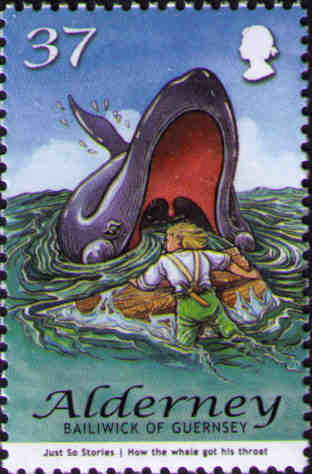 Which made it extra fun when “the white-cliffs-of-Albion” showed up in our Just So Stories pick today—”How the Whale Got His Throat.” I’d forgotten that bit, and my Mariner of infinite-resource-and-sagacity was an Irishman until he mentioned his natal-shore. Hasty accent-change required. At the end of the tale, Rilla peered closely at the grating the Mariner had lodged in the Whale’s throat (you didn’t forget about the suspenders, did you?) and commented: “So that’s why whales eat krill. They’re filter-feeders.” I’d been prepared to launch into an exploration of baleen, but I’m informed Octonauts beat me to it.
I was then required to read “Dingo! Yellow Dog Dingo!” (exclamation points very much a part of the title), which is how she refers to “The Sing-Song of Old Man Kangaroo.” Try as I might, I can’t make that inordinately proud creature sound remotely Australian. Gotta step up my game.
(Tangent: upon reflection, if I absolutely-please-don’t-make-me HAD to choose one single storybook for all future readalouds, I do believe I’d go with the Kipling. Playful language, magnificent vocabulary, surprising and amusing narratives, magnetic subject matter, sense of humor, discussion-fodder, colorful locales, magic, and crocodiles. You really can’t go wrong.)
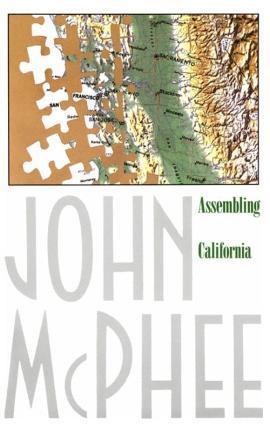 Let’s see, we also spent some time with this book: Assembling California by John McPhee, the fruit of my hunt for something to satisfy the local-geology itch created by our drive to Denver last Month.
First chapter quite promising. Begins at Mussel Rock off the shore of San Francisco, and dropped us right into the San Andreas Fault. Perfect. Then of course we wanted to see Mussel Rock for ourselves. YouTube obliged with this gem:
Those lingering shots on the uneven pavement of the parking lot, and later the cockeyed houses on a San Francisco street, really bring home the reality of shifting plates. And from McPhee we learned that the science of plate tectonics is quite new! Just barely older than I am.
Rilla is learning “The Walrus and the Carpenter” by heart. She had the first three stanzas down last spring but we forgot about it over the summer. She likes to practice when we’re walking around the corner to pick Wonderboy up from school.
There were other things…the visit to the Mammoth and Mastadon exhibit at the Museum of Natural History on Monday (and a carousel ride, mustn’t forget that), and the hopeful rescue of some withering veggies from our sunbaked garden. We relocated the cukes and canteloupe, and both tomato plants, and a poor, parched blueberry bush. Something’s quite different in that corner of the yard this year. Everything’s struggling. Or maybe it’s just that I’m off-season. I don’t usually do much out back during the late-summer months. January’s when my garden really perks up and starts producing.
We’ve got loads of monarch caterpillars, though. And goldfinches galore.
Rose got her ears pierced. Jane and Wonderboy and I cleaned out a Staples. Her college pile is growing.
Well, I can’t think what else. Oh: Huck’s picture-book picks were Open This Little Book and The Napping House. I finally read The One and Only Ivan, and cried and cried.




August 15, 2013
First Minnesota
 Image source: Wikimedia Commons.
Reading this story, my heart is in my throat.
The Battle of Gettysburg, Day 2, July 2nd, 1863.
“The scene is the center of the American line. Most of the attacks on the flanks have been repulsed by now, or nearly so, and the sun is near to setting. The American lines are now almost set into the famous ‘fish-hook’ formation that one can find on so many maps. But the operative word is ‘almost.’
“In the center, there is a gap…”
The writer is Lt. Col. Robert Bateman, and his recounting of the events in the weeks leading up to Gettysburg has had me enthralled for days. I’ve followed him from Fredericksburg, Virginia—the town, incidentally, where I graduated from college, and where I met Scott—north to Pennsylvania, his posts spanning the months of June and July, 1863, just over 150 years ago. I don’t particularly want to be in Gettysburg right now; my attention ought to be far to the south, in Alabama. But I can’t look away. Lt. Col. Bateman’s account is riveting.
“In the center, there is a gap because one American Corps commander took it upon himself to move well forward earlier in the fight. The rebels are now finishing crushing that Corps. But ever since that audacious Union Corps commander created that gap in the first place, a succession of recently arriving units have been fighting to keep the middle from collapsing. Now, as the sun sets over Seminary Ridge, the game is almost over. But there is a half-mile opening in the remaining American line, and two whole rebel brigades are headed straight to it.”
You’ll have to read the entire post to get the full thrust of what’s on the line in this moment—heck, you ought to read the whole series—but some of you will understand why this next passage made me gasp.
The American Corps commander now in charge of the section of the line closest to the hole, a fellow named Hancock, sees what is about to happen. The rebels are moments away from breaking the center of the Union line. His own Corps line ends several hundred yards to the north. The next American unit to the south is a quarter mile away. Hancock can see the reinforcements he has called for, as can others on the crest of the hill. Those troops are marching at full speed up the road. By later estimates, the relieving troops are a mere five minutes away from the ridgeline. But the Confederates are closer.
I talked about psychology yesterday. I wrote about how sometimes something that can only be described as moral ascendency (or perhaps morale ascendency) can make it possible for a smaller force to defeat a larger force — first emotionally, then physically. Rufus Dawes and his 6th Wisconsin Infantry pulled that off on the First Day, albeit at a horrendous cost. General Hancock understands in an instant the bigger picture. This is not some small slice of the field. He sees that if the rebels make it to the ridge, they might gain the psychological advantage over the whole Army of the Potomac, much of which is still arriving. So the rebels must be stopped. Now. Here.
And now, what I am about to describe to you transcends my own ability to explain. Hell, it is beyond my own understanding, and I have been a soldier for decades.
General Hancock sees a single American regiment available. But, though it is a “regiment,” this is in name only at this point. A “regiment,” at the beginning of the war, would be roughly 1,000 men. Before Hancock stand 262 men in American blue. Coming towards them, little more than 250 yards away now, are two entire brigades of rebels. Most directly, half of that force — probably about some 1,500 men from a rebel brigade — were coming dead at them. Perhaps a thousand more, at least two entire additional regiments, were on-line with that main attack, though probably unseen by Hancock. But what does that matter? The odds were, already, beyond comprehension.
“My God! All these all the men we have here…What regiment is this?” Hancock yelled.
“First Minnesota,” responded the colonel, a fellow named Colvill.
First Minnesota.
 That’s right, Lovelace readers. The very regiment Emily Webster’s grandfather fought in, the one Carney’s Uncle Aaron (her great-uncle, surely) died in—in that charge on the second day of the Battle of Gettysburg.
“When Colonel Colville told us to charge,” [Grandpa] said, nobody ran out on that field any faster than Aaron Sibley.”
“You ran fast enough to get a bullet through your arm.”
“Only winged, only winged,” he answered impatiently. “It might have been death for any one of us.”
It was for a good many of them, Emily remembered. She had heard her grandfather say many times that only forty-seven had come back out of two hundred and sixty-two who had made the gallant charge.
—from Emily of Deep Valley by Maud Hart Lovelace
Every single man of the 1st Minnesota,” writes Lt. Col. Bateman,
“placed as it was at the crest of the gentle slope, could see what was going on. All of them were veterans, having fought since the beginning of the war. Each of them understood the exact extent of what they were being asked to do by General Hancock. And, it would appear, that they all understood why.
“On this day, at the closing of the day, there was no illusion that they might win. There was not any thought that they could throw back a force more than seven or eight times their own size. Not a one of them could have entertained the idea that this could end well for them, personally.
“I suspect, though of course nobody can actually ‘know,’ that there was only a silent, and complete, understanding that this thing must be done. So that five minutes might be won for the line and the reinforcements and that their widows and children might grown up in a nation once more united, they would have to do this thing. Then, as men, the 262 men of the 1st Minnesota followed their colonel as he ordered the advance, leading them himself, from the front.
“They charged, with fixed bayonets, to win 300 seconds for the United States. Union and Confederate sources agree on this next point: There was no slacking, no hesitation, no faltering. The 1st Minnesota charged, en masse, at once alone and together. One hundred and fifty years later, those 300 seconds they then won for the United States have proven timeless. Because it worked. They threw a wrench into the rebel attack, stalling it, before the inevitable end.
“And, as Fox’s Compendium pointed out in cold, hard numbers, it only cost 82 percent of the men who stepped forward.”
Grandpa Webster and Aaron Sibley are fictional characters, but they are based on real people, just as Emily and Carney were. In the afterword to HarperPerennial’s 2010 edition of Emily of Deep Valley, Lovelace historian Julie A. Schrader tells us that Grandpa Cyrus Webster represented a man named John Quincy Adams Marsh, the grandfather of Maud’s classmate Marguerite Marsh, the “real” Emily. He was not, however, a Civil War veteran. Schrader writes,
“Maud appears to have based Grandpa Webster’s experiences on those of Captain Clark Keysor (Cap’ Klein)…. General James H. Baker, a veteran of the Dakota Conflict and the Civil War, was the basis for the character of Judge Hodges. In 1952 Maud wrote, ‘Old Cap’ Keysor and General Baker used to visit the various grades on Decoration Day to tell us about the Civil War…’”
Emily is, as I’ve often mentioned, not only my favorite Maud Hart Lovelace book, it’s one of my favorite novels period. Grandpa Webster is very real to me. I can’t describe my astonishment to find him there, suddenly, in Lt. Col. Bateman’s account, rushing unhesitatingly toward that gap in the line. 262 men made the charge. 47 survived. One of them was Cap’ Clark Keysor, who visited Maud’s school classrooms and told her stories she never forgot. Nor shall I.
***
For Lt. Col. Bateman’s entire Gettysburg series, click here.
For more background on the real people who inspired Maud Hart Lovelace’s characters, I highly recommend Julie Schrader’s book, Maud Hart Lovelace’s Deep Valley.
Related posts:
Why I love Carney
Why I love Emily
A Reader’s Guide to Betsy-Tacy



Here Comes High Tide
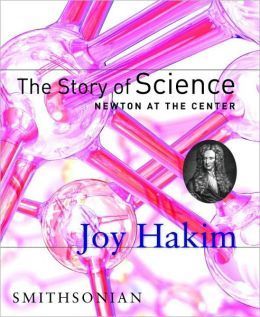 The Story of Science: Newton at the Center by Joy Hakim. Our history spine for the high-tide parts of our year. Yup, history: Hakim’s Story of Science series takes a historical-biographical approach to science, tracing the development of ideas in the context of the lives of the great thinkers and scientists, and the cultural and political events surrounding them. This is book two in the three-part series, beginning in the 1450s: the printing press, the fall of Constantinople. My heart goes all pitty-pat when I think about some of the books I can pull off the shelves this year to go along with this one: The Apprentice by Pilar Molina Llorente; The Second Mrs. Giaconda; Twain’s Joan of Arc; Diane Stanley’s
August 14, 2013
65 Minutes Left to Back Rachel and the Treeschoolers
UPDATE: The Kickstarter campaign is over and was a tremendous success. We’re looking forward to episodes 2-6!
***
My kids loved the first Treeschoolers episode. We’re thrilled the Kickstarter campaign has funded five more episodes, and we’re rooting for #7. Just a little over an hour left to back this delightful show from the makers of Signing Time! You know how I feel about Signing Time, don’t you?
(Remember this one? From a couple of years back, when Wonderboy and Rilla got new Signing Time videos for Christmas? I’m melting.)
Related:
• Signing with Babies, My Favorite Topic
• It Must Be a Sign
• Something Else to Buy Instead of Curriculum: Signing Time