Melissa Wiley's Blog, page 63
March 2, 2014
More MOOCs to explore

I’ve written before about our great experiences with various MOOCs one or more of us has taken via Coursera. Here’s another list of offerings, this time from FutureLearn.com. Courses that have caught my eye include:
• Moons— “Explore the many moons of our Solar System.” This has Beanie written all over it. Eight weeks, starts March 17. The Open University.
• Kitchen Chemistry— “Along the way you will use fruit tea to identify acids and alkalis, investigate chemicals that speed up reactions and experiment with electron transfer reactions. This should give you a feel for the world of molecules and an idea of some reactions. It should also introduce some methods to separate chemicals, to find out what chemicals are present in a mixture and ways to change chemicals from one form to another.” Six weeks, starts in April. University of East Anglia.
• England in the Time of Richard III! Exclamation point mine. “Explore 15th century England through archaeology, history and literature against the backdrop of the excavation of Richard III.” Yes, please. Methinks it’s time to introduce Rose and Beanie to Josephine Tey’s Daughter of Time—a compulsive reread for both Jane and me—as a backdrop to this course. Six weeks, starts mid-2014. University of Leicester.
Those plus the Courseras we’re already signed up for—including a History of Art for Artists, Animators, and Gamers via CalArts, which is just getting rolling—may tide us over until the next iteration of ModPo kicks off in September. Boy do I love sending my kids to college around the world in our own living room.








March 1, 2014
Painted with woad, and howling
Searches for this phrase (minus the comma) keep popping up in my stats. It’s a Downton Abbey quote, Violet mocking Isobel: “I wonder you don’t just set fire to the Abbey and dance ’round it, painted with woad and howling.” She didn’t pause for a comma, which has some folks confused. ‘Howling’ here is a verb.
Here is a person who is painted with woad, and is also howling.
 Maaaaaaaaatthew!
Woad is a blue dye extracted from a the plant Isatis tinctoria or “dyer’s woad.” Its flowers are yellow but you can get blue from its leaves. I learned a lot about it while researching my Martha books—woad would have been one of Auld Mary’s staples. Indeed, it was a staple in European textiles through the Middle Ages, until it was gradually replaced in commercial use by indigo.

You chop the leaves into a paste, let them dry, crumble them into powder, then sprinkle them with water and allow them to ferment, a process known as “couching.” Then you add a mordant, something to help fix the color into the cloth. In days of yore this was most commonly stale urine. (The ammonia in the urine serves as the fixative, as you probably learned from The Mammoth Hunters.) Fun fact: according to this dyeing site, the urine of male beer drinkers was most effective. The collection and sale of urine from certain cities was big business, at one time.
Urine from London was shipped up the coast to Yorkshire, where there was a big dyeing industry, and this is the origin of the phrase “taking the piss.”
Captains were unwilling to admit that they were carrying a cargo of urine and would say that the barrels contained wine.
“No – you’re taking the piss” was the usual rejoinder.
Who knew?
In ancient Scotland, so the story goes, the Picts liked to paint or tattoo themselves with woad, especially before going into battle. In fact, that’s how they came to be called Picts by the Romans, from the Latin word “pictus” or painted. Julius Caesar wrote in his The Conquest of Gaul, “All the Britons color themselves with glass, which produces a blue color.” Over time his word “vitro” (glass) came to be associated with woad, and the image of blue-painted Scottish warriors stuck. Some modern scholars dispute the association, saying Caesar meant something else entirely; it is widely accepted that the early Britons did engage in body art but the contemporary thinking, as far as I can tell, seems to be that the paint was probably not made from woad. However, other experts will point out that woad has antiseptic properties, which could well explain its use in painting the skin before or after armed conflicts. And so woad lives on in battles (of the scholarly sort) to this day.
Whatever the truth may be, the blue body paint is exactly what the Dowager Countess had in mind when she tossed her barb at Isobel. If I had any kind of Photoshop skills you would be looking at Maggie Smith’s face painted with woad (and howling) right now.
Here’s my recap of the Downton episode in question: Season 4, Episode 5 (UK/DVD 6)



February 28, 2014
It’s our first rainy Friday in the longest time
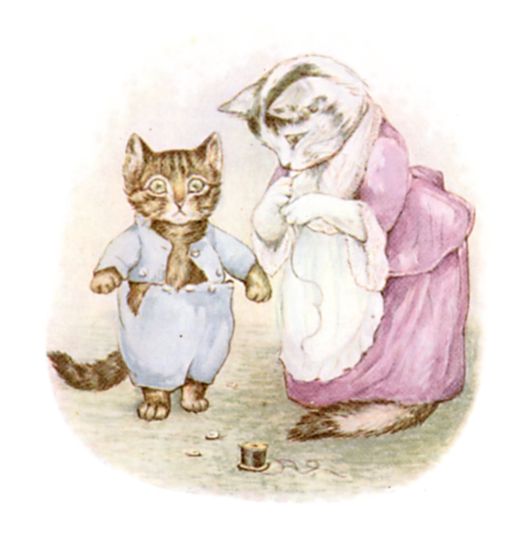 So this morning the littles and I stayed in and read. Mice, more mice, is what Rilla wants these days. Kittens and hedgehogs are an acceptable substitute. Any small creature that wears clothing, really.
So first it was The Story of Miss Moppet—four times! I ask you. They kept begging and begging.
Then The Tale of Tom Kitten, which is crammed with delicious language. All Beatrix Potter is, but this one especially tickles me.
“While they were in difficulties, there was a pit pat, paddle pat! and the three Puddle-ducks came along the hard high road…”
and
“‘My friends will arrive in a minute, and you are not fit to be seen; I am affronted,’ said Mrs. Tabitha Twitchit.”
That petulant “I am affronted” cracks me up every time. Mrs. Tabitha is the Mrs. Bennet of B. Potter characters.
And then finally we got to the necessary mice. Well, mouse, singular. We read about half of The Mouse of Amherst (speaking of delicious language). She didn’t remember it from three years ago, which made it all the more fun. Seven is the perfect age for this loveliest of little books.
I slept too late to get any Howards End in, but did grab a few minutes for …on the Landing. Now that I’ve determined I’m going to buy a copy, I may save the rest for later and turn to one of the other interlibrary loans I have piled up, as time is ticking and they can’t always be renewed. I have The Yellow-Lighted Bookshop and a couple of Gladys Taber’s Stillmeadow books, which were recommended to me in the memoir thread the other week. I also got hold of Helene Hanff’s Elizabeth I biography for children—she admired Elizabeth so, and it seemed a fun choice for a sampling of her children’s nonfiction.



February 27, 2014
Reading the 20th Century

Paperwhites by Rilla
Something Sherry mentioned in the comments reminded me of this post I’d left sitting in drafts all month. Instead of a booknote today (since all I’ve read is a chapter of Howards End), I’ll toss the draft up. I was saving it until I had time to say something intelligent about the three 1963 books, but now I can shove it into these quickie notes I’m doing and be excused from coming up with something insightful.
***
I read about the Century of Books project at Alex in Leeds—a reading project in which you endeavor to read a book written in every year of a particular century. Ideally you would assign yourself a time frame for completing the mission, but I’ve learned that deadlines are deadly to my recreational pursuits—too many deadlines swirling around my working life. I love, however, the idea of tracking the publication dates of my reading: another layer of interest to add to my favorite activity.
And so I borrowed Alex’s template and created a 20th-century list for myself, and plugged in last year’s titles. Right off the bat I discovered that my reading is skewed far more toward 21st-century titles than I might have guessed. (Over a third of my 2013 total.) I do read a lot of new books, I suppose, via NetGalley and other advance review copies. I just hadn’t thought about how that means new publications dominate my reading pile, elbowing older books to the lower, dustier shelves.
I logged fourteen 20th-century books in 2013 (well, counting this month*). Several were rereads—the children’s books especially, my read-alouds with Rilla. (I’m counting middle-grade and above, but not picture books. I can’t keep count of picture books. A dozen a week, at least.) Most surprising to me was the discovery that of those fourteen titles, three were published in the same year—1963.**
1) Mary McCarthy’s The Group, which caught my attention when Betty Draper read it in her bathtub. It was republished an as ebook by Open Road last year, and I snapped it up. (Set in the 30s.)
2) The Girls of Slender Means by Muriel Spark. (Set in 1945, with a 1963 framing story.)
3) The Scent of Water by Elizabeth Goudge. (Contemporary with its writing.)
All so striking, and so very different! All books that stick with you and affect how you think of other books, and the outside world. I will try to come back to this when I have more time and muster some actual analysis. There’s an essay in these three books rubbing shoulders, to be sure. I haven’t the brain for it now.
*”This month” was early January. Total in late February is twenty 20th-century books.
**And now there’s 1962′s Underfoot in Show Business right alongside these, capturing yet another vivid and totally distinctive world. (The striving of Broadway hopefuls in the 30s and 40s, mostly.)
***I made a 19th-Century page as well, but there’s nothing there yet. Not a single 19th-century book for 2013-present? Actually I do have a number of late 1800s titles I’ve used as reference for my current novel, but for some reason I never seem to include research books in my annual booklogs. That makes no sense at all. I’ve read them, haven’t I?
***
Oh, and I did read three picture books with the littles this morning. The Ultimate Book of Vehicles and two other interactive books from Chronicle, who have been spoiling me with review copies lately. Vehicles became Huck’s instant Favorite Thing Ever (it’s a giant pop-up with excavators scooping and crane operators climbing to the top, and he fell instantly in love, as Scott’s tweet attests.
Got a review copy of The Ultimate Book of Vehicles From Around the World. 5-year-old reacts as though he’s just seen the face of God.
— Scott Peterson (@petersonscott) February 27, 2014



February 26, 2014
Bookletter time
My Winter Bookletter is live! If you’re a subscriber, watch your inbox.  To subscribe to future issues, click here.
This time around, I share a new picture book the littles and I have fallen in love with and a surprisingly entertaining app for sentence diagramming. Plus news about my next Inch & Roly book!



“The exquisite touch, which renders ordinary commonplace things and characters interesting…is denied to me.”

These posts are going to get very short all of a sudden because Rose and Beanie have departed for a week with my parents. I’ll miss our daily Poetry 180 readings. To make up for it, I made sure to catch today’s Writer’s Almanac entry. “Yard Sale” by George Bilgere. And it seems it’s Christopher Marlowe’s birthday! He was only 29 when he died, can you believe it?
Early morning: Howards End.
After lunch: Howards End Is on the Landing. Standout bits: This quote from Sir Walter Scott:
Also read again, and for the third time at least, Miss Austen’s very finely written novel of Pride and Prejudice. That young lady had a talent for describing the involvements and feelings and characters of ordinary life, which is to me the most wonderful I ever met with. The Big Bow-wow strain I can do myself like any now going; but the exquisite touch, which renders ordinary commonplace things and characters interesting, from the truth of the description and the sentiment, is denied to me.
Oh how I love to hear writers talking about what other writers can pull off that they themselves can’t.
And just a note to myself to look up Penelope Fitzgerald’s The Blue Flower. Hill’s description certainly sells it. Also loved this line Hill quotes from a letter Fitzgerald wrote her, on the delights of being a grandmother:
It is such a joy to have someone who wishes to sit with you on a sofa and listen to a watch tick.



February 25, 2014
“What a thing it is to have an unruly family!”
I’m enjoying these daily booknotes even more than I expected to—it’s the least taxing writing I’ve done in a long time. I’ve said before I like talking about books more while I’m reading them than after I’ve finished, and doing it in these slapdash daily notes is less pressure than a monthly or weekly roundup. Also it makes me realize how much I actually read. Because sometimes weeks will pass without my finished a whole book, I’ve had a sense lately that my reading has dropped way off from where it used to be. But it hasn’t really, not when I’m counting (and why wouldn’t I? why haven’t I?) all the things I read to and with my kids in the course of a given day.
***
Early morning. Instead of turning to Middlemarch, I found myself sinking contentedly into Howards End instead. Gee, I wonder what put that particular book in my head? I love Forster—his prose at once crisp and dreamy, which is an impossible feat. I don’t know how he manages it. He’s a cipher. And a realist. Anyway, I got as far as the Beethoven concert, the goblins walking quietly over the universe from end to end. Bit wrenching to lay that aside and rise to the imperatives of contact lenses and lost Lego men.
***
Mid-morning, with the girls. Another small chunk of Wormwood Forest. The buried villages. Where are the poems? There must be reams of poetry about them. Probably in languages I can’t read.
This poem (it’ll be obvious by now that we’re reading through the Poetry 180 selections in order): Ron Koertge’s “Do You Have Any Advice For Those of Us Just Starting Out?” I’m trying not to talk about these too much, not unpack them, just let the girls sit with them. We’re doing so much heavy-duty analysis in our other poetry studies (Shakespeare’s sonnets at the moment), talking technique and all the rest of it. I don’t want to overwork poetry for them, to “tie the poem to a chair with rope /and torture a confession out of it” as Billy Collins describes in the very first poem of the 180 series.
They begin beating it with a hose
to find out what it really means.
I hope we haven’t beaten Shakespeare and Marlowe with a hose, but certainly we’ve poked and prodded them, ruffled their hair, measured the size of our hands against theirs. And so to balance it, we read these other poems, one a day, and I try very hard to sit there with my mouth shut.
***
After lunch: More Howards End Is on the Landing. I wonder if any of you laughed at me yesterday when I said I wasn’t going to make lists of the books she rhapsodizes about. Of course I’m going to make lists. Or else I’m just going buy this book, which I got through interlibrary loan. Of course I’m going to buy this book. I could blog my way through it, reading all the books she’s reading, like Julie and Julia only even more meta. And with less aspic.
I’m having an ongoing conversation with Susan Hill in my head. She shocks me sometimes. She mentions in passing a book “about Australian aborigines, in whom I had then, as now, little interest.” I gave her such a look! How can you not be interested in a group of people? How can you say such a thing, and mean it, and in print!
***
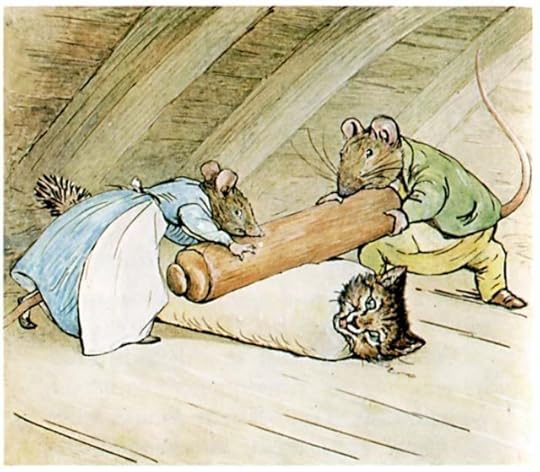
Early afternoon. Spent a long time poring over our Beatrix Potter treasury with Rilla. I much prefer the small single editions, the original miniature size that is so just right for stories about mice and rabbits. But this big battered old collection is wonderful too, and she wanted to page through it and talk over all the stories, the ones she remembered and the ones she didn’t—it’s been at least a year since it came off the shelf. Halfway through is Roly-Poly Pudding and, well, there’s no paging through that one, you have to stop and read it. The “unruly family” line I quoted above made her laugh so hard. Potter’s genius shines here—who else would enfold a naughty, sooty kitten in dough and have a couple of rats roll him with a rolling pin? I love how full of antiheroes her tales are, too. Practically no one behaves himself.
***
Will close with another quote from the Susan Hill book. (I found an excellent OCR app that can take a picture of print and turn it into editable text! You can paste it into Evernote or an email, straight from your phone.) Here Hill herself is quoting a 1904 Atlantic Monthly essay by Thomas Wentworth Higginson called “Books Unread”:
The only knowledge that involves no burden lies…in the books that are left unread. I mean, those which remain undisturbed, long and perhaps forever, on a student’s bookshelves; books for which he possibly economized and for which he went without his dinner; books on whose back his eyes have rested a thousand times, tenderly and almost lovingly, until he has perhaps forgotten the very language in which they are written. He has never read them, yet during these years there has never been a day when he would have sold them; they are a part of his youth, in dreams he turns to them…He awakens, and whole shelves of his library are, as it were, like fair maidens who smiled on him in their youth and then passed away. Under different circumstances, who knows but one of them might have been his? As it is, they have grown old apart from him; yet for him they retain their charms.



February 24, 2014
What I read today: the weekend and Monday
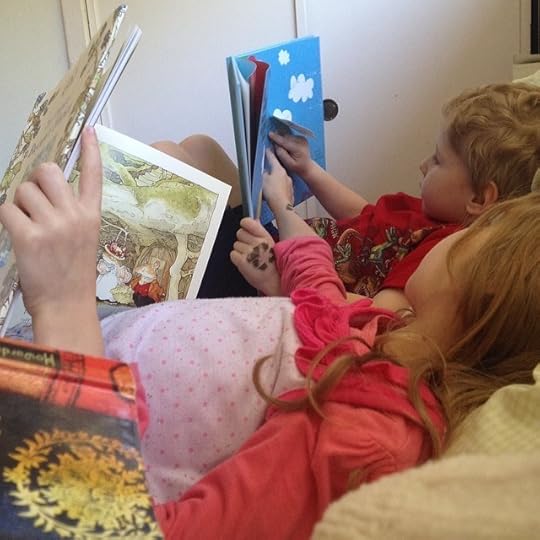
I lingered in bed yesterday morning—though linger is relative when the day begins around six, weekend or no—and the little ones saw me snuggled up, reading, and wanted in on the fun. I can’t say I got much of my own book read after that, but I have no regrets.
I’m moseying my way through Howards End Is on the Landing, enjoying it very much, the first chapter’s internet-grumping notwithstanding. It would be easy to come out of this book with another long list of books and authors to explore, and yet the author’s focus on spending a year reading only the books she already owns serves to discourage the impulse to start compiling. She keeps reminding me how much I have lying around the house already, or gobbling up the memory on my Kindle. I’m resisting the temptation to list. If any of her favorites stick with me after I’ve finished, I’ll hunt them up.
My favorite bits are the passages where she talks about encounters with other, older authors she admires. Susan Hill is in her early 70s, was first published at 18, has been part of England’s literary life since she was very young. She writes of one memorable encounter in a library while she was a student:
Not, though, as conscious as I was of the small man with thinning hair and a melancholy moustache who dropped a book on my foot in the Elizabethan Poetry section some weeks later. There was a small flurry of exclamations and apology and demur as I bent down, painful foot notwithstanding, picked up the book and handed it back to the elderly gentleman—and found myself looking into the watery eyes of E.M. Forster. How to explain the impact of that moment? How to stand and smile and say nothing, when through my head ran the opening lines of Howards End, ‘One may as well begin with Helen’s letters’, alongside vivid images from the Marabar Caves of A Passage to India? How to take in that here, in a small space among old volumes and a moment when time stood still, was a man who had been an intimate friend of Virginia Woolf? He wore a tweed jacket. He wore, I think, spectacles that had slipped down his nose. He seemed slightly stooping and wholly unmemorable and I have remembered everything about him for nearly fifty years.
I went back to the hostel and took out Where Angels Fear to Tread, read some pages, read the author biography, and had that sense of unreality that comes only a few times in one’s life. The wonder of the encounter has never faded. Nor, indeed, has the wonder of bumping into T.S. Eliot on the front doorstep of a house in Highgate, though, strangely, I cannot now remember whose house, but there was a literary party to which I had been invited by some kind patron of young writers. So there I stood, while Eliot rang the bell and gave me a rather owlish but kindly smile as we waited. Once the door was opened to us he was absorbed into the throng and I saw him no more—but I can certainly still hear the voice of someone saying, on seeing him, ‘Oh good, here’s Possum!’
I think my favorite quote so far comes from a conversation with her elderly friend, the poet Charles Causeley:
Shortly after receiving the Heywood Hill Prize, he was made a Companion of Literature by the Royal Society of Literature, a rare honour, and asked me, again, to accept on his behalf. ‘What would you like me to say?’ I asked.
The reply might well have been: ‘What an honour.’ Or perhaps, ‘What a surprise …’ But one of our greatest living poets, aged eighty-three, asked me to say, ‘My goodness, what an encouragement.’
***
I didn’t do so well with Middlemarch these past few days. The thing about reading something smart when I first wake up, while my brain is still wanting to drift back into whatever dream was dispelled by the sound of thumping boy-feet outside my door, is that I’m not always up to the intellectual effort required to stay attuned to the page. This morning I woke up twenty minutes after I started reading, with the phone gone black-screened in my hand. Lydgate something something promising young man something.
***
Things I read with kids today:
Landmark History of the American People, second half of the Eli Whitney chapter. I’ve read it before and forgotten it: the cotton gin sticks, obviously, but I’d lost the whole tale of how he invented mass production by transforming the process of how guns were made. Before Whitney, guns, like everything else, were made by specialist craftsmen, one at a time. In 1798 (I think—dates don’t stick to me) with Napoleon scaring the pants off everyone, a terrified young America was desperate for arms. Whitney’s cotton gin had transformed the entire economy of the South (for better or worse) and he was asked to turn his brilliant mechanical mind to the problem of how a country short on gunsmiths could generate vast quantities of guns. He reasoned that there were fifty parts to a musket, and if you could teach fifty men to make one part each—perfectly uniform, every time—you could assemble a great deal of guns in much less time that it takes one man to craft fifty separate parts by hand, over and over. Fast forward a few years through his creation of some molds, some part-making machinery, and there he is in a room with Pres. Adams, Vice Pres. Jefferson, and most of the Cabinet, with heaps of gun parts piled on a table. Go ahead, put some muskets together, he instructs them. Voila, mass production. (Now that I’ve narrated it, it oughta stick.)
Story of Science, finished the Keppler chapter. Watched a couple of Youtube videos afterward to help us grasp his Laws of Planetary Motion. Rose was most intrigued by the part about how DNA researchers in 1991 used clippings from Tycho Brahe’s mustache (!) to discover that he died of mercury poisoning.
Poem: “The Distances” by Henry Rago. “The house…billows with night” took my breath away. And the “rings and rings of stars” was a perfect and serendipitous cap to our Keppler conversation.
Also, these lines from Donne, quoted in the science book:
And new philosophy calls all in doubt,
The element of fire is quite put out,
The sun is lost, and th’earth, and no man’s wit
Can well direct him where to look for it.
(From “An Anatomy of the World,” although I could swear the Hakim book cited “The Anniversary” instead. Will check tomorrow if I remember.)



February 23, 2014
Downton Abbey Season 4, Episode 8: The London Season
My previous Downton Abbey recaps are here.
Cousin Oliver’s big day
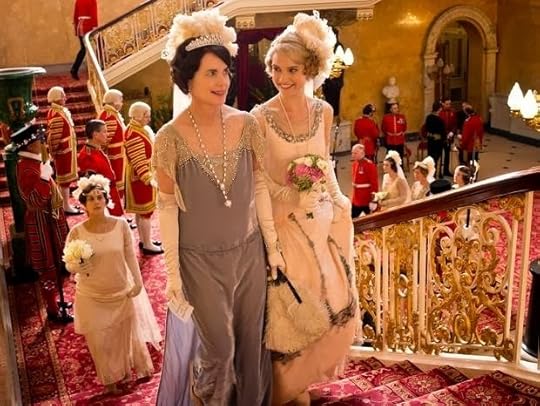
If I enjoyed screencapping more, I would turn this into a fashion blog and do nothing but rhapsodize about this week’s costumes. What an eyeful we got! Alas, I lack the vocabulary, not to mention the fortitude.
In lieu of gown-swooning, then, let’s talk plot. This is the supersized Christmas special, so there’s a lot of ground to cover. Here we are in June 1923, with the gang heading to London for Rose’s long-awaited presentation at Court. All season we’ve seen Rose chafing to be free to be out and about in London society—you know, as opposed to the dull life she’s been leading up till now, going to jazz clubs and sneaking off to float down rivers with her secret boyfriend—and all season Cora has chirped at her to be patient. Well, it looks like Rose has survived the wait without scandal, despite the way the season has pretended her reckless disregard for social norms was bound to lead to catastrophe. Not only do we have nary a whiff of scandal, there is absolutely no mention of her erstwhile fiancé, Jack Ross, nor the broken heart she might have been supposed to suffer when he, for her own good, broke off the brief engagement last episode.
Eight months have passed since the Jack Ross adventure, during which interval Edith and Rosamund disappeared to Geneva and Edith has “come back looking more tired than when she left,” in the kitchen staff’s opinion. Of course we know what the staff does not: Edith has had her baby and is now sadder than ever, wishing she could have kept her little girl. She is not exactly enthusiastic about the London trip, envying Tom who gets to stay behind for a couple of days—he has an estate to run. He’s expected to show up at Rose’s ball, though. I mean, someone has to bring Lord Grantham his dog.
The staff flap around in a frenzy of preparations. Mrs. Hughes is going up to London to run the house there, and Daisy will join Mrs. Patmore and Ivy, who went up early to prepare for the eleventy-thousand people they’ll be cooking for all week. This means Daisy has been left in charge of Downton meals for a few days already, a nicely subtle reminder of how competent she has become these past few years—skills that will take center stage later in the episode.
Nearly all our main belowstairs players will join us in London; only Thomas is left behind to boss the assorted unnamed housemaids and underservants. A bit boring for him, really; what’s a conniving villain to do without anyone to scheme about? He sends a not-very-cryptic and completely unnecessary message to Miss Baxter via Daisy (“Tell her I’m looking forward to her stories”), for which Daisy rewards him with her best are-you-daft look; and then I’m afraid it would have been a dull week for Thomas if he hadn’t suddenly remembered that he passionately hates Tom and resents his unwarranted rise to “Sir” status. WHEW. For a moment there I thought Thomas might actually have nothing to do but enjoy some down time. If an evil underbutler snarls in the forest where there’s no one to hear him, does he make a sound?
Daisy, a volcano of excitement about going to London: “I don’t care where I peel potatoes.”
Edith visits Violet, who attempts sympathy for Edith’s feelings, trying with what I thought was rather endearing forthrightness to talk about the baby. Edith snaps at her for saying “it,” not “she” and smacks her down for Violet’s feeble attempt at cheering her up. Edith, listen, I’ve been in your corner for a really long time, and your situation is genuinely tragic, but here’s the one person at Downton who knows why you’re in pain, and you’re biting her head off. She’s trying, which is more than you might have expected her to do.
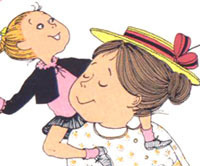 Meanwhile, the rest of the family is demonstrating equally charming manners. Robert whines about having to go to London; Mary sighs over the impending arrival of the “American contingent” (Cora’s like, Hey, that’s my mother you’re talking about); and then Cora completely loses her mind and suggests that Edith and Mary might have to share a room in London. Mary: “You’re joking. I’d rather sleep on the roof.” I’d give anything if only Cora could call in Mrs. Piggle-Wiggle at this point. Chapter 12, The Insufferable Sister Cure. “Oh, I know just the thing,” Mrs. Piggle-Wiggle said. “Take a blanket and pillow up to the roof, and make up a nice little bed for Mary and my pig, Lester. He has the loveliest manners.” After all, we know how inspired Mary is by Pigs.
Well, I’m with Cora. All this kerfuffle! Get out the door to London, already! They haven’t even made it to the car yet, and already Rose is pestering to go out to a club that night. “Your niece is a flapper. Accept it.” This from Mary, that famous progressive.
But at last, they’re off, and the stragglers can quiet down—except for Isobel, who is surprised by a visit from Lord Merton, hinting that he’d like to be her date to Rose’s ball. Isobel doesn’t plan to go—”not my natural habitat”—but we can make short work of this plotline. She’ll decide to go after all, because it’s tradition. Not her tradition, but the Downton Granthams are her people now, etc. I’m feeling a little sad about Isobel this season. She’s a wonderful character, somewhat wasted. All season we’ve seen a penduluming relationship between Isobel and Violet—they exasperate each other, but they look out for each other nonetheless; and since neither one of them seems inclined to be a hands-on grandmother, they’re left without much to do except keep each other’s blood pressure up. But since Violet’s other foil, Cora’s mother Martha, will promenade into the scene as soon as we hit London, Isobel becomes something of a shadow again. You’d think Martha—so loud! so vulgar! so American!—would make Violet appreciate Isobel’s merits, but we’re denied the fun of seeing a three-way snipe-fest between them.
LONDON AT LAST. The flappers head to the Embassy Club—Rose and her friend Madeleine Allsopp—and immediately bump into Madeleine’s father, an impoverished baron, hanging out with his good buddy the Prince of Wales. This is the future King Edward VIII (David to his family and friends), and he’s here at the club with his mistress, Mrs. Dudley Ward—Freda to her friends, and “My vewy vewy own precious darling beloved little Freddie” to the Prince. No, seriously. You see why it was so imperative that his letter not get into the wrong hands. Freda Dudley Ward and the Prince had an affair from 1918-1923 and remained close even after it ended, right up until he started seeing Wallis Simpson in 1934 (for whom he abdicated the throne in 1936).
Well, it turns out the Prince is fond of Rose’s father, good old Shrimpy, who hosted him in Bombay last year. Freda thanks Rose for perking up her grouchy date, and just like that Rose has some new friends.
BACK AT DOWNTON, Tom doesn’t want to make any trouble for the servants, which irritates Thomas no end. I mean, obviously, them’s fightin’ words. Gloves OFF. Or they would be, if Thomas wore gloves—what do you think he is, a footman? You want to be on his hit list, too?
Tom bumps into his new friend Sarah Bunting again, just in time to introduce her to Violet, whom I absolutely love to see peering from a car window. You can totally picture her peering from carriage windows with the same lofty distractedness, fifty years earlier. She takes little notice of Sarah and calls Tom “Branson” again by mistake, catching herself with an endearingly fluttery, “Oh, I mean Tom!” Sarah decides to take Tom up on his offer of dinner, and then all but goads him into giving her a tour of the house. Tom is terribly uncomfortable about it, feeling that it isn’t entirely appropriate, but he can’t take Sarah’s teasing. He does live in the house, after all; isn’t he allowed to have his friends over? HELLO, not when there’s an Evil Underbutler out to get you. Of course Sarah wants to see the view of the gallery from the top of the stairs—the bedroom stairs, Thomas will make a point of calling them to Lord Grantham later, when he rats Tom out.
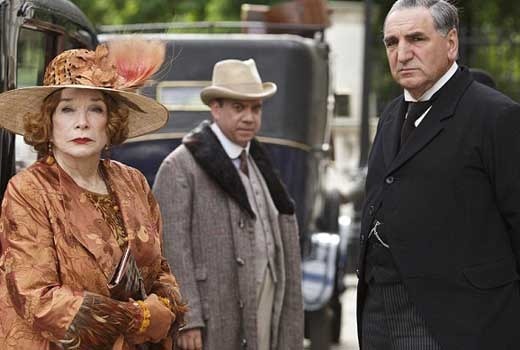
LONDON. Edith arrives at the same time as her grandmama and Uncle Harold. Uncle Harold is Paul Giamatti! This ensures I will love him even if he’s despicable. But it seems he is not despicable, that Teapot Dome business notwithstanding. “It should’ve worked.” Uncle Harold is cynical, picky about his food, wary of fathers on the prowl for rich sons-in-law, and inclined to take a dim view of his own charms. But he’s got a sweetly sad manner and is frank without being embarrassing (unlike his mother). Of course if Martha’s on screen, we hardly notice anyone else. It’s obvious Shirley MacLaine is having a blast with this role, and I’m glad, because playing it with that kind of over-the-top relish is the only way Martha’s character is made tolerable—otherwise she’d be such a cardboard stereotype of the Pushy American with Terrible Taste. MacLaine imbues her with a sense of humor and self-awareness: yes I know I’m ridiculous, I like it that way.
Uncle Harold has a chatty valet, Ethan Slade, whose American accent will make you wince. (It’s even worse than Jack Ross’s.) And boy howdy is he American! Pronto! You bet! He meets Daisy and is instantly smitten, for no reason at all. Well, he did mention that you have to have skin like a rhinoceros to work for the Levinsons. Daisy’s cold stare doesn’t faze him a bit. (“Are you excited?” “I’m never excited.”)
Carson has been charged with thinking up a nice outing to reward the harried staff at the end of their London stay. His ideas—visiting the “new science museum” or Madame Tussauds—exasperate Mrs. Hughes, because they’re apparently all boring from top to bottom. Rather than just come out and tell him what everyone will like (a visit to the seaside), she sticks a picture postcard at his eye-level and waits for him to be struck with the winning idea. After trotting out all sorts of eager suggestions to an unimpressed staff, he finally suggests the beach trip, at which point Mrs. Hughes jabs that it took him long enough to get there. Okay, this makes no sense at all. If it’s so important that he come up with the idea on his own (as suggested by her postcard ruse), why let him know she had something in mind all along? I love Mrs. Hughes, I really do, but this is not the first time this season her behavior has perplexed me.
And it happens again in the Bates plot. Anna donates Bates’s old coat to a cause Mrs. Hughes is collecting for. Mrs. H. finds an incriminating ticket stub in the pocket: York to London on the day Anna’s attacker, Mr. Green, was killed. EIGHT MONTHS AGO, remember. Let’s not linger too long on what it says about Bates that he has hung on to a damning piece of evidence all this time, like a trophy. He knows it was in the pocket because he’s very upset when he learns Anna gave the coat away without letting him go through the pockets first. He fixes his Sinister Gaze upon Mrs. Hughes, clearly suspecting that she suspects something. And here’s where Mrs. Hughes confounded me again: she shows the ticket to Mary, then gets very distressed when Mary contemplates turning Bates in. Then why tell her in the first place?
Robert’s all glum that Tom hasn’t arrived, and Cora coos because she thinks that’s sweet, and Robert’s baffled: “No, I mean he’s bringing Isis. I miss her.” HIS DOG. Best laugh of the night.
Another night at the Embassy Club. Rose is “tiddly,” to potentially disastrous effect: she blabs about a secret letter Freda has in her handbag, a tender missive from the Prince. Naturally the scoundrel Sampson (the card shark from earlier in the season) takes the opportunity to filch it. It’ll make him a tidy sum with the foreign press. When the news ripples back to the Grantham clan in the days following, they spring into action. Robert is a monarchist, for Pete’s sake! No relative of his shall be a party to bringing scandal upon the Royal Family! A very elaborate plan is hatched, involving a decoy poker game, a decoy theater outing, a forged letter (good old Bates!), and a secret search party in Sampson’s flat. Both of Mary’s fellas are in on the plot, and Charles is just so pleased that Mary reached out to him in a time of need.
Alas, the search is a bust: the letter isn’t in the flat. Back at the house, Bates puts two and two together and pickpockets the letter from Sampson’s coat right under everyone’s nose, because he is a master criminal. Brilliant forger (who sits brazenly in the servants’ hall doing the forgery he’s supposed to have contracted out to a friend), silken touch, can bump a man into traffic in front of hundreds of witnesses—is there nothing he can’t do? I’m starting to have second thoughts about Vera’s arsenic pie.
His pickpocketry saves his bacon, because Mary is so grateful for his loyalty to the family that she tosses the incriminating train ticket into the fire. All’s well that ends well.
In between the letter’s loss and its recovery, we had that tiny little diversion of Rose’s Presentation at Court. Gowns to die for. The King makes conversation with Rose—good old Shrimpy again—and Rose acquits herself admirably. But that is just a shadow compared to her success at her coming-out ball. With the dangerous letter safely back in Freda’s beaded purse, the Prince of Wales is in Rose’s debt. He crashes her ball and asks for the first dance. “If she’s not the belle of London society after this,” remarks Robert, it’s not his fault.
All week, Madeleine’s father has been pushing her at Uncle Harold, while daddy himself is making a play for Martha. Both Americans see right through the ploys and rebuff them with good humor. Harold actually winds up connecting with Madeleine, and they become friends of sorts. Meanwhile, Harold’s valet has made his own play for Daisy, offering her the chance to come to America and be Harold’s cook—after all, he adores her delicious fish mousse. Daisy declines, but is tickled by Slade’s interest. Ivy jumps at the opportunity since Daisy doesn’t want it, and everyone winds up happy. Daisy even smiles, which is how you can tell this is a season finale.
The season ends with a reason for Edith to smile, too. All along she’s been pushing back at Aunt Rosamund, regretting giving her baby away to that nice Swiss couple. And now that news has come at last of Michael—it seems he clashed with some Nazis in Munich (a “gang of toughs” who “wear brown shirts and go around preaching most horrible things”). We still don’t know if he’s dead or imprisoned. Edith has power of attorney over the magazine, and she may inherit his personal property as well. She feels very strongly that his daughter ought to have a share of that, and while the London crew is still recovering from the ball, she slips home to Downton and makes arrangements with Mr. Drew, the reliable farmer and new pig man. Drew agrees to raise the baby (her “friend’s” baby, but he susses out exactly what the situation is) as his own. Edith will get to watch her little girl grow up. This was the bit that made me feel most eager for next season.
I’m afraid Mary’s double romance, which is supposed to have been the dominant arc of this season—What Will Mary Do?—has left me rather flat. I like Tony, I like Charles, I don’t like watching Mary string them both along. I know she keeps trying to shoo them off, but never very convincingly. And now she’s got them fighting for her—”Let battle commence”—and, well, I keep thinking of the day one of my daughters complained about another: “Mom, she’s smugging again.”
What else is left to wrap up? Thomas bullies Baxter for more sssssecrets, but Baxter has drawn strength from Molesley’s kindness and decides to take her chances with whatever leverage Thomas has over her. Listen, look at Bates and Thomas—at this point a shady past is practically a requirement for new Downton hires.
And so the tide goes out on Season 4 at the seaside, with Carson and Mrs. Hughes holding hands and wading into uncertain waters. “We’re getting on, you and I,” she tells him companionably. “We can afford to live a little.”
The primary task of every character this season was to decide what world to live in: the old pre-War England, or the new. Robert has clung to the past like a toddler clutching his mother’s leg. Even Carson has accepted change with more dignity than his employer. Thomas, too, seems stuck in a past built on pecking order and rank. I wondered if his trip to America would open up new prospects for him, but it seems he came back more hidebound and bitter than ever. He wants esteem in the old order, and it’s fading away before he can climb to the top of his ladder. Cora seems to be fading away right along with it; she’s much less vital a person than she was during the war. Violet may not approve of all the ways in which society is changing, but she’s rolling with the change much more amiably than might have been expected, and I didn’t think Martha’s barbs about “your world is ending, mine is beginning” were entirely fair or accurate. Violet is accepting social change tolerably well; it’s Martha’s style she objects to, and her idiom. And her personality. And her face.
Mary has decided to orient herself toward the future for the sake of keeping Downton intact for her son—and that’s an interesting twist on progressivism. She’s open to new ideas only because she wants to maintain the status quo. It’s a nice little paradox and I’d like to see Mary grapple with that problem rather than her question of whom to marry whenever she feels like marrying again. But in the end, it’s the outliers I care about—Edith and Tom.
Season 4 • Episode 1 • 2 • 3 • 4 • 5 • 6 • 7



February 22, 2014
Quandary
Annie Dillard’s Pilgrim at Tinker Creek is on sale for Kindle today. This puts me in such a quandary.
1) Have never read it.
2) Have long intended to.
3) Bought a copy in 1993, have moved it 6 times.
4) See #1.
5) Am more likely to read it on Kindle, because eyes.
6) See #3.