Melissa Wiley's Blog, page 59
June 7, 2014
Online Foreign Language Resources #1: Memrise
Note: this is not a sponsored post and I’m not affiliated with Memrise in any way. It just turned out I had quite a lot to say about it!
To follow up on my post about memorizing monarchs and presidents, I thought I’d elaborate a bit further on how we’re using Memrise to learn languages, along with some other resources like Duolingo, iTalki, and Earworms, which I’ll talk about in subsequent posts. It’s kind of amazing how much you can do from your couch. 

MEMRISE. Free for computer, iOS, Android. Excellent for building vocabulary, not so much a grammar tool. (But read on.) You pick any of a multitude of courses in your target language. In small batches, words appear on your screen along with “mems,” mnemonic devices created by other users to help you remember the word. The best mems create some kind of visual image that helps fix the word in your mind, the way I was taught as a kid in the 80s to remember that Caspar Weinberger was Secretary of Defense by picturing Caspar the Unfriendly Ghost defending a bottle of wine and a hamburger. I don’t remember which teacher planted that image, but the picture is still vivid. That’s what the Memrise folks call a mem.
You can scroll through all the existing user-created mems for each word or phrase, and if you don’t like any of the choices you can create one of your own. The interface makes it easy to select a public-domain image, and then you add whatever text you want. Here’s a mem I made to help me identify Chad on a map of the Countries of Africa:
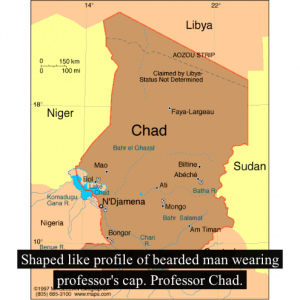
It’s corny but it works. Not all mems have an image attached; a good word-picture can help just as readily. I remember Ceuta on the map (a place I’d never heard of until taking this course, an autonomous Spanish city on the North African coast across the Strait of Gibraltar from Spain) by thinking of the Spanish pronunciation —thay-uta—and using the mem “they oota be in Europe but they’re in Africa instead.” Again, not exactly the height of cleverness but it was the hook I needed to remember how to spell the name of the city.
As this image suggests, and as I described the other day, you can use Memrise to learn a lot of things besides foreign languages. Other topics I’m studying include British and English Monarchs, U.S. Presidents, and the World’s Tallest Buildings. (What can I say, I’m a junkie.) But foreign language is where Memrise really shines. The selection of languages is breathtaking in its scope. Lingala, anyone?

Rose, whose favorite pastime, I kid you not, is learning the first chunk of a new language, has absorbed beginner vocab in Dutch, Welsh, Russian, Hungarian, Italian, and who knows what else, in between her longer-term progress through a 1000 Spanish Words course. I’m taking several different German courses simultaneously—you can move as quickly or as slowly as you want. I too have a “1000 Words” course I use as my primary focus to add vocabulary, but there’s a “German Conversation” course as well that has lots of useful longer phrases like “I couldn’t care less,” “I completely agree with you,” and “he’s so reliable you could build houses on him.” Then there’s the short course on prepositions I whisked through as a review, and a challenging one on verb conjugations that I like because it includes the preposition that goes along with each verb plus the case nouns take after the combo. And then—slowly, oh so slowly! probably only a hundred words over the course of a year!—I’m using the vast and comprehensive 5000 German words course which is packed with upper-level vocabulary.
But then, I thrive on variety. Other users might prefer to move steadily through one course at a time. There’s a fair amount of overlap in my assortment of courses, which helps cement things in my mind, but I can see that it might feel redundant or confusing to others.

Regarding mems for language, I’ve found that the best kind are those that help me work from the English to the German. I can usually remember the English meaning of a German word after a couple of repetitions, but it’s much harder for me to look at English and grope for its German counterpart. The majority of user-created mems seem to work the opposite direction—they’ll start with the German and use English puns to link the word to the English. For example, here’s a text-only mem I made for aufhören, German for “to stop doing something”:
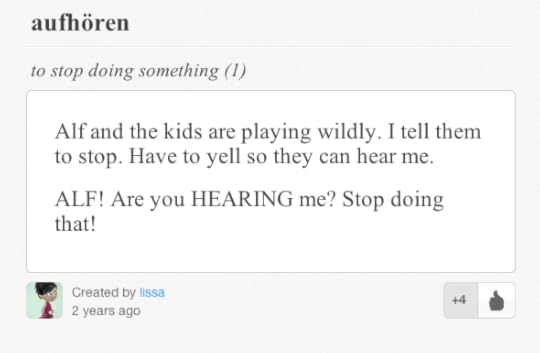
It didn’t really work for me, not after some weeks away from the program. I couldn’t look at the English definition and get to the German word. What I really needed was something that starts with “stop doing something” and gets to “aufhören.” In this case, I tried to enhance the mental picture that goes with the above mem: I picture a Stop sign with Alf the TV alien perched on top holding a phone—the phone because the “hören” part reminds me of Auf Wiederhören, “until I talk to you again,” which you say when getting off the phone. Now, this revised image is working pretty well for me—but it requires me to remember to use the “stop” in “stop doing something” as my jumping-off point for memory. Will I remember that if I come across the word in another context a year from now? I don’t know. I do know that a vivid and specific mental image makes a tremendous difference in my ability to connect words in two different languages, and that after some repetition, the word is transferred to my permanent memory and I don’t need to rely on the mnemonic device anymore.
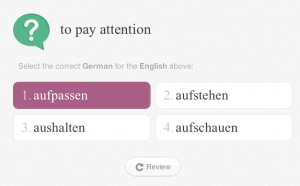
This repetition is part of what makes Memrise so successful: the program works by giving you the words at ever-increasing intervals as you demonstrate mastery. First you “plant” the words, a few at a time, and they give you a lot of interactions with it in different ways—English to German, German to English, multiple choice, type it in. This process only takes a few minutes for each new batch of words.
Here’s one example:
Here’s another:

Now the words are planted in your short-term memory. Memrise locks them for a few hours (sort of—you can override the lock by clicking “overwater” for extra practice). After that, they are ready for “watering”—you come back and review them again. If you get a word right on the first attempt, next time there will be a longer interval before it’s ready for watering. Eventually, as the words move from short-term to long-term memory, the intervals may be many days long.
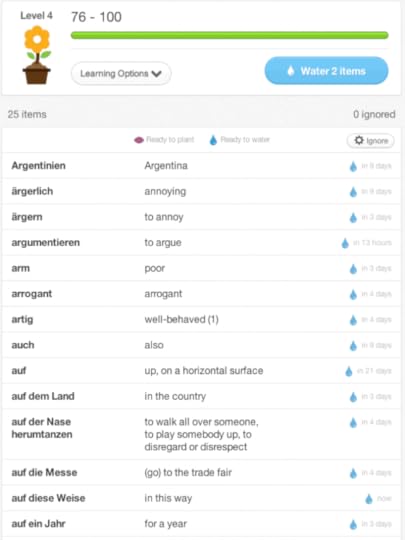
As you can see, most of the words in this lesson are in my long-term memory and don’t need “watering” (reviewing) for several days or even weeks. A phrase I missed yesterday, “auf diese Weise,” is ready for watering now. “Auf,” a common preposition I learned decades ago, is (obviously) in my long-term memory and only comes around every few weeks. If I wanted, I could tell Memrise to ignore it altogether—there’s a setting you can click that means I’ve got this one down and never need to review it again. I certainly don’t need “auch,” a word I learned on day one of German, popping up in my word list. I don’t always bother to mark words “ignore,” though, since it’s an extra step.
I mentioned above that what Memrise excels at is teaching you vocabulary, but it’s not as strong at conveying grammar. You won’t necessarily learn word order or grammatical cases from this program—for that we use other resources like Duolingo (about which, more in a future post). But what my kids and I have found is that Memrise is invaluable for building our vocabulary, and grammar is so much easier to nail down when you have a big word list to draw from. And when I was really struggling to keep straight which prepositions take which cases for object nouns, Memrise came to my rescue. I found a German course that focuses on that very thing—you have to enter +A or +D after each verb-preposition combo to indicate whether the noun will take accusative or dative. That’s the kind of drill I need to take me to the next level of fluency. I’ve been stuck in the middle of Level B1 (going by the Goethe Institute’s fluency scale) ever since college. My periodic reimmersions in German have prevented me from losing what skill I’d gained, but to move forward toward real fluency I need some more intensive drill. This course is helping shift my recall from groping to automatic.
How much time does Memrise take? It can be as little as five minutes a day, if you want—plant a couple of new words, maybe water some of your older ones. I tend to go in intense bursts of activity with long lulls between them—sometimes many weeks will pass without my checking in, and that’s fine. The whole point of the program is to plant the words in long-term memory. If I’ve forgotten them—the app can tell by how I answer—they get pushed back into a more active, frequent rotation in the list.
During my intense bursts, I add new words, level by level. Then, when my focus inevitably shifts elsewhere, I stop accruing new vocabulary but the program is there to help me maintain the vocab I’ve got. “Watering” your words can be really relaxing.
The iPhone app is pretty sharp. I like to check in last thing before I go to sleep and see if any of my words need watering. It’s a good waiting-room activity, too, since the courses I’m taking work fine with the sound turned off.
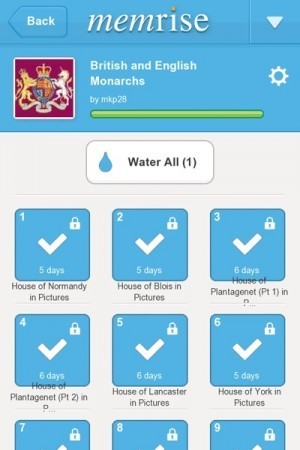
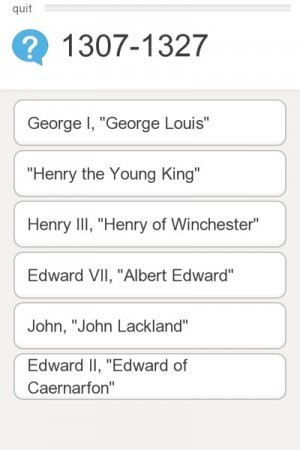
Now, I’ve talked a lot about how I use Memrise for my own learning. What about the kids?
My younger kids are very interested in it; Rilla begs to use it for French, but it’s a skitch above her level. Her spelling isn’t strong enough yet for her to be able to easily enter answers in English, let alone French. Also, and significantly, Memrise is designed for adults, and the mems are created by adult users, which means that occasionally you come across one that’s a bit off-color. For these reasons, I think it’s better saved for kids 13 and up, depending on your parental comfort level. For us, 12 or 13 is a good threshold.
For my younger set, we tend more toward apps specifically designed for children, like the ones I reviewed at GeekMom a while back.
Before heading off to college, Jane used Memrise to learn Japanese kanji. Rose, as I said, likes it best as a way to experience a wide variety of languages. She’s very interested in language and linguistics, and Memrise has allowed her easily to explore the rudiments of more tongues than I can keep track of. Meanwhile, she’s making steady progress through her Memrise Spanish course, which we supplement with a grammar workbook. (She’s not keen on Duolingo. Beanie and I love it.)
Beanie, like me, is into German. She does about 15 minutes of Memrise a day, 4-5 days a week. Her vocabulary is growing steadily and the program has the advantage of building excellent spelling skills as well.
There are also Memrise courses for the SAT and other college admissions tests, including SAT vocab builders. You can create brand new courses, too, and make them private or public as you choose. (Choose: wählen, she CHOOSES to wear a VEIL IN church. That’s someone else’s mem but it worked like a charm for me.) If I hadn’t found a course with the verb-preposition-case info I wanted, I was thinking about creating my own. I’m always happy, though, when someone else does the leg work.
Now if you’ll excuse me, I have 21 mems to water!








June 5, 2014
Learning notes, early June
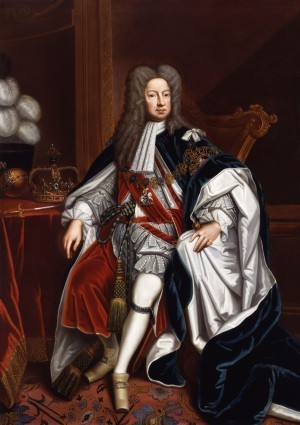 King George I by Sir Godfrey Keller. Image source: Wikimedia Commons.
The tide seems to be ebbing, as surely as tides do ebb. We’ve put away our science reading for the summer, leaving the world poised for dramatic change in the wake of Sir Isaac Newton. The history books aren’t yet officially shelved, but it’s a week or more since we picked one up. We got sidetracked by languages and kept conjugating the mornings away. Latin and German formally, the lot of us, and French informally via children’s songs (go ahead, ask us how many elephants can balance on a spiderweb), and Rose has me inching through Spanish grammar with her, and all of us have way too many plants to water daily on Memrise. And yet we keep planting more!
Ah, Memrise. Thanks to it, I can now list all the monarchs of England and Britain—with dates for all but a couple of sticky ones. Those two kings in the middle ages with interrupted reigns. One of the Henrys and one of the Edwards, I think. They’re still tripping me up—the specifics, I mean. I can wrangle them into their spots in the list. And I’m darn proud that I can keep all those Georges and Edwards and Henrys straight—even the one with long strings of names, since Memrise insists I use every doggone one of them. Edward VIII, Edward Albert Christian George Andrew Patrick David, even! (Edward Always Chases Girls And Parties Down—sorry, Ed, I know it isn’t very dignified but it works. Could be worse: think of poor Left-Leg Louie, aka King George I, George Louis. See him up there in the picture, with his left leg forward? The unfortunate nickname was someone else’s mem, and it worked.)
We’ve nailed the U.S. Presidents, too. We could sing them in order already—well, except for the bunch around Rutherford B. Hayes where we always got tripped up—thanks to an old (very old) Singin’ Smart cassette. (Cassette! That’s how old!) But now we’ve pegged them to dates. Ulysses S. Grant did not take the summer of ’69 for GRANTed. During James K. Polk’s term (1845-1849) the country POLKa’d its way to California just in time for the Gold Rush. The louder it makes you groan, the more likely you are to remember it.
Rose scoffs at mnemonics and just plain memorizes. Not I. I gotta have a hook. Richard I and Richard II both had reigns that closed out a century, did you know that? 1199 and 1399 respectively. Charles I (the Merry Monarch) and George III began their reigns in 1660 and 1760, and somehow that link makes them both easier for me to remember. William Henry Harrison died in office in 1841; James A. Garfield ditto in 1881. Another peg.
As always happens when you set “separate” chunks of history side by side, surprises hit you. I had never put it together that Teddy Roosevelt became President the year Queen Victoria died! His two terms align almost exactly with the reign of King Edward VII: you know, the Edwardian era. This is one of those connections I should have made earlier, and probably did make a time or two, glancingly, somewhere along the line, but I can’t say it really stuck. When I’m reading the Betsy-Tacy books (set during that very decade; Betsy graduates from high school in 1910, I think) I’m not thinking about who’s on the throne over in England. Nor, when watching Upstairs, Downstairs (in which, if I recall correctly, a whole episode revolved around the death of the King), was I picturing Theodore Roosevelt gallivanting around the U.S. creating National Parks. Connections are everything in education, and here’s one I hadn’t made until now. Teddy and Eddie. Got it.
***
I meant to make a list of all the books I’ve seen people reading, and books I’ve read aloud. Failed again. Missed some good ones, too! As for me, I read the first big chunk of The Goldfinch and found it so thoroughly harrowing I had to put it down for a little while. At this rate, it might take me the whole summer.
***
Literature of the English Country House has begun! I’m behind already! That’s quite all right!



May 30, 2014
How my daughters are furthering my education via Minecraft
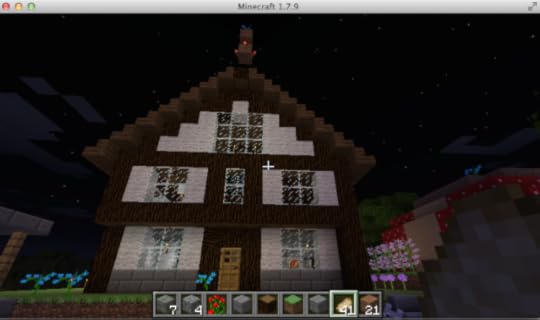
I mentioned that the kids and I share a Minecraft world. Its name is Calpurnia, after a favorite book. When I got a dog in the game, Rose offered to name it for me. The next time I logged in, “Darwin” was running around my attic—Darwin because of Calpurnia Tate, get it?
Then I wound up with a second dog. It ran around my house nameless for a day or two; then one day I returned home from a grueling shift at the ruined castle we’re building in the mushroom forest, and there, wagging its tail alongside Darwin, was “Newton,” newly monikered by Beanie. It seems I’m raising a bunch of scientist dogs, which is fine by me.
One day I accidentally fed both Darwin and Newton too many pork chops at the same time, and you know what that means: a puppy. I couldn’t wait for this new pooch to grow up, so I could see what name the girls would give it.
When I came home this afternoon, half dead after a skeleton ambush, the pup was waiting beside the front door, all grown up and sporting a new blue collar. Her name was Annie, the hover-text informed me. I was a little surprised that the girls hadn’t continued the scientist theme.
Shows what I know.
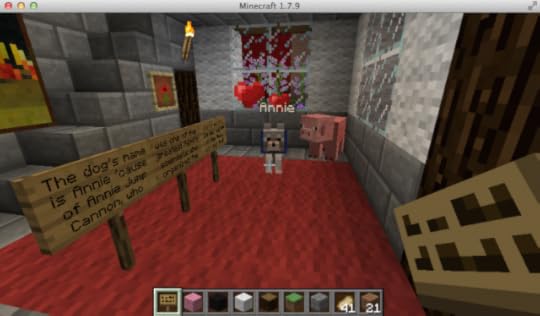
Rose, evidently aware of this gap in my education, had helpfully left some signage on the living-room carpet:
The dog’s name is Annie ’cause of Annie Jump Cannon, who
was one of the greatest female scientists; she organized the
stars. We still use her system today. Also, she was deaf.
I learned a lot more about Annie (the human, not the canine) after I logged off. She featured in a recent episode of Cosmos and my girls were quite impressed by her accomplishments. Her lifetime spanned the period between the Civil War and World War II, and as Rose explained, she was instrumental in the creation of the star classification system that is still in use today.
The girls have yet to account for the pig in my living room.



May 29, 2014
THE NATIONAL STATIONERY SHOW??
I did. not. know. this. was. a. thing.
Eye Candy from the National Stationery Show, Part I | Chronicle Books Blog.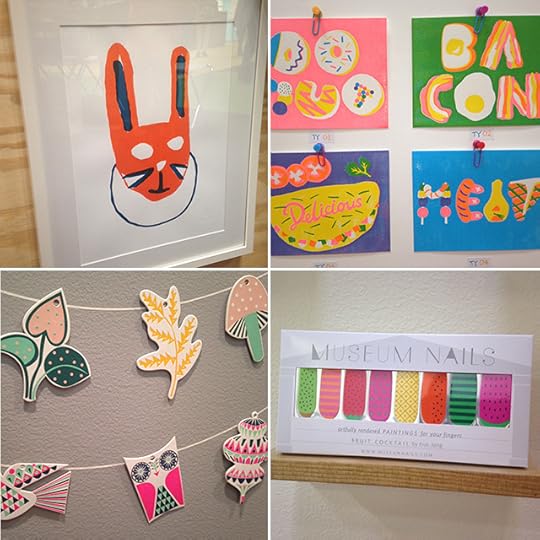
I might die of swoon.



Eowyn For the Win
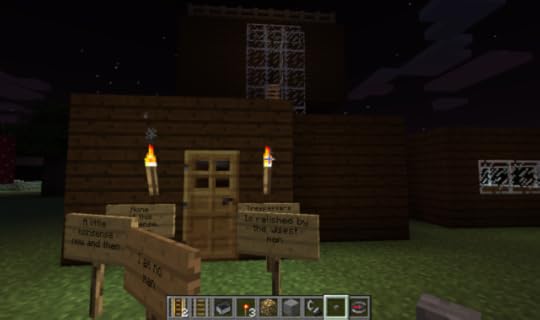
Rose put up some NO TRESPASSING signs outside her house in the Minecraft world the kids and I share. My favorite was the addendum: NONE OF THIS NONSENSE.
Well, of course I couldn’t resist a throwdown like that. A LITTLE NONSENSE NOW AND THEN, I wrote back, when she wasn’t looking, IS RELISHED BY THE WISEST MEN.
And her reply, proving the student has surpassed the teacher: I AM NO MAN.
That’s my girl.



May 27, 2014
The Writing Process Blog Tour
So, funny story. A few weeks ago my friend Sarah Tomp, whose upcoming YA novel My Best Everything I can’t wait to read, wrote to ask if she could tag me in the Writing Process Blog Tour. It sounded fun, but I was feeling pretty swamped that week, so I thanked her and declined. A day or two later, another local writer friend, Marcie Wessels, asked me the same question, and again I said I appreciated the nod but would have to pass. Well, about a week after that, my pal Edith Hope Fine issued the same invitation! And that very same day, my friend Tanita Davis did one better—she went ahead and tagged me.
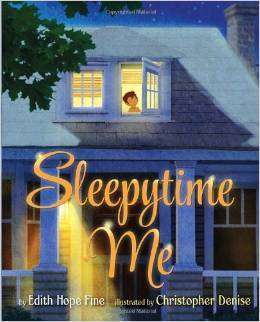 Well, okay, I can take a hint! And what do you know, a holiday weekend rolled around just in time for me to participate. So first: a big thank-you to all four of these generous friends, so eager to share the bloggity fun with me. Do click through on the links above to read their very interesting answers and find out more about their books. (Edith decided to sit out the hop herself, but you guys—I got a sneak preview of her new picture book, Sleepytime Me, illustrated by Christopher Denise, and it is a swooner. This year’s favorite bedtime reading, mark my words. It launches tomorrow! And I happen to know she’s got a companion workbook coming for her excellent Greek and Latin roots book, CryptoMania!, and it’s top-notch. Homeschoolers and teachers, you’re going to love it.)
Okay, so here are the questions, which I actually feel pretty shy about answering. I hardly ever talk about my process.
• What are you working on?
 Generally, multiple things at once. The Main Project, always, and then two or three other works-in-various-stages-of-progress, and a scrawly list of ideas. Right now, the Main Project is the book I’ve been laboring over (very much in the childbirth-metaphor sense of the word) for a very. long. time: a historical fiction YA I’m writing for Knopf. It’s a project very close to my heart (involving a good bit of my own family history) and is probably the most challenging book I’ve written yet, in terms of research and subject matter. And I’ll want to talk lots more about it before too long.
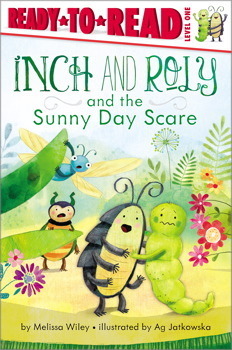
So that’s the front-burner book. Then there are the things I work on when that one is being obstreperous: I’m playing with a new Inch and Roly idea, now that Sunny Day Scare has packed its knapsack and gone off into the world to seek its fortune. (They grow up so fast!) And there’s a fantasy novel I play with when historical fiction is besting my brain.
And! And! Very very slowly, very very occasionally, I add a little to a memoir of sorts I’m writing (or thinking of writing, is probably more accurate) about our years in Astoria, New York, when Jane was going through chemotherapy. I have a lot of stories piled up from those days.
• How does your work differ from others in its genre?
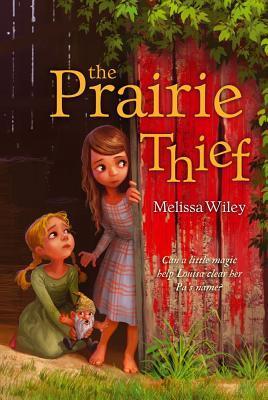
That is a really good, and really hard, question. I feel like in a way it’s a question best answered by readers, not by me about my own work. I like to work with characters who are grappling with ethical dilemmas—Louisa struggling to find a way to clear her father’s name without revealing Angus’s secret and therefore exposing him to probably dangerous public scrutiny (The Prairie Thief); Martha wrecking her dustgown and getting away with it, but fessing up after an internal struggle (Little House in the Highlands). Kids trying to sort out right and wrong when the lines seem fuzzier to them than adults give the impression they are. I think in terms of my style itself, I may work differently (but who knows?) in that I’m hearing the work read aloud as I write—probably in part because read-alouds are such an enormous part of my life. I mean, I’m reading aloud all morning long; I’ve spent nearly nineteen years this way, days full of the written word spoken. I think that gets into your fingers, as a writer: the cadence and lilt of a good read-aloud, the distinct character voices, the aural underscoring the visual images created by the text. I think, too, my having studied as a poet comes into play here. I entered my MFA program as a poet and emerged as a writer of prose fiction, but you can’t get poetry out of your blood.
• Why do you write what you do?
I put this question to Scott, adding lamely that I write the stories I’m burning to write. “I don’t know how to nail it down more accurately than that.” He chuckled. He knows me better than I know myself. “Well, first,” he said, “there’s the pioneer thing—” and he’s right; he doesn’t mean just Pioneers of the American West, though certainly that period is a lifelong fascination of mine and my original concept for Prairie Thief jumped right out of Edwardian England, where I’d envisioned it taking place, and emigrated happily to the Colorado prairie, circa 1880. Scott, who knows what ideas are crammed into my mental Possibilities drawer, was speaking also of my love of all kinds of frontier stories—the Pern books, the Darkover novels, any kind of pushing forward to unknown terrain and making terms with it.
 “But also,” he continued, “there’s your fascination with miscommunication and injustice. The injustice that arises when someone has been misunderstood. You’re always wanting to set that straight, in your work and in real life.”
As soon as he said it, I could see it: this thread woven through so much of my work. It’s the central conflict of Prairie Thief, of course: a man falsely accused, his daughter intent on clearing his name. And other misunderstandings nested inside that larger one. But also: there’s Martha’s first governess, who doesn’t like her and misreads all her errors as deliberate. I had to bring in Miss Crow, didn’t I, to understand her. Over and over in those books, there are miscommunications between family members that lead to conflict. Scott pointed out that Sunny Day Scare, too, plays with this theme: Inch and friends are interpreting a horror in the grass in different ways, and Roly simply has to figure out what the scary thing really is. Even Hanna’s Christmas, my little commercial tie-in from long ago, has Hanna’s parents incorrectly blaming her for all the acts of mischief around the house. This is kind of revelatory, actually, and you can bet I’m going to be pondering it further.
• How does your writing process work?
Ahh, a nuts-and-bolts question. Now I’m in my element. The way I work is married to time. When Jane was a baby and I was first starting out, I had to hurry and write during her naps, sometimes actually wearing her in the sling, though it was hard to type that way. After Rose was born and Scott left his job at DC Comics to stay home and write, I worked longer shifts, a couple of hours at a time. I had very tight deadlines in those deadlines, staggeringly tight as I look back, and had to work with furious efficiency in the spaces available to me. I probably work best that way.
Later still, after Beanie came along, Scott and I settled into a rhythm. My writing time was from 3-6 every day. So again, mega-focus required to stay on task. I started this blog as a way to help me do that: after a day with the kids, spending 20 minutes writing about them helped me transition from mom to writer, and then I could work on the book at hand.
We had a rough year after Wonderboy was born, but that same schedule allowed me to work. It was after Rilla came along that things changed dramatically: Scott took an editing job out here in San Diego, we moved, he was away long hours, I wrote on Saturdays. That’s why The Prairie Thief took so long: years of Saturday afternoons. In 2011, he came back home to freelance (hurrah!) and now I get the whole afternoon and evening to work—meaning both my fiction and my editorial gig at Damn Interesting.
I can’t stand writing by hand. I have complaining wrists. With the current novel, I began working in Scrivener and fell in love—it keeps all my notes, fragments, timelines, character sketches, and primary source material organized and accessible much more handily than any paper system I could contrive. I mean, I really think I’d be lost without it.
I’m a slow writer in that I self-edit ruthlessly, never having managed to do the sort of pour-it-out first drafts that the writing instruction books urge upon you. Dear Anne Lamott, I’ve tried, but I just can’t pull it off. And it’s too bad, because I always write way more than actually belongs in a book. I’ll labor over huge chunks of manuscript, polishing at the word-level, and then wind up ripping them out, a stitch at a time (agony) to hide in a file somewhere. If I were to gather up all my Martha fragments, I’d probably have enough for a whole nother book. (Sorry, it’s not in the cards.)
Every day, I dread starting. After I’ve made myself enter the cave, hours pass in a blink, like Narnia time.
I think I probably love the research stage best of all. I’m happiest with all my papers and books spread around me on the bed, and some old newspaper enlarged on my screen. An orchard robbery in 1817; the constable arrested “a man named Peter Twist and two well-dressed women.” What’s the story there? No one can tell me, so I’ll have to make it up.
Up next:
Now I’m supposed to tag some writer friends. Laurel Snyder (The Longest Night, Bigger than a Breadbox, Seven Stories Up) and Jennifer Ziegler (Sass and Serendipity, How Not to Be Popular, and the hot-off-the-presses Revenge of the Flower Girls—how’s that for a great title?? both said yes, so look for their replies in a week or so. I’m also tagging Chris Barton (Shark Vs. Train, The Day-Glo Brothers, Can I See Your ID?) and my dear friend Anne Marie Pace (Vampirina Ballerina, Vampirina Ballerina Hosts a Sleepover, A Teacher for Bear), in case they’d like to play along. But no pressure, guys! (See paragraph 1, above.)
And Sarah, Marcie, Edith, Tanita: thanks for tagging me. I had fun!



May 23, 2014
Chee chee chee chee crazy goes
It’s possible this is a you-had-to-be-there moment, and if you speak French or know anything about French songs, this won’t be as uproariously funny to you as it was to us this morning. But boy did we howl. See, every day we’ve been starting out by listening to a couple of tunes off our Lucienne Vernay Songs in French for Children CD—this started as a thing for Rilla but the truth is we all get a kick out of learning French ditties. We don’t speak French, you understand. This is important to the story.
Well, today Beanie asked for the Train song. “Le Petit Train,” you can hear a piece of it here. It’s sprightly and cheerful, with an enjoyable “ch ch fff, ch ch fff” repetition laced throughout. I decided to look up the lyrics, but my first click seemed to turn up a different Little Train song. “This can’t be it,” I murmured, scanning the lyrics. A quick comparison of the first lines confirmed the obvious. Totally different song. Laughing over the incongruity—the juxtaposition of these bleak, melancholy words with our chipper little tune—I read the song, so obviously not OUR song, out loud.
The little train of my youth
The little train is fading away
Above the roofs
Slowly through the windows I see him
Slowly and doesn’t come back
He has nothing to say
He has nothing to do
He has nothing to say
And I don’t care
About the time which goes by
About the time which hurries
The illness of my youth
I had never loved anyone else than myself
Even not you
And I was so happy with you
And I was also happy without you
I don’t care about the wind
Which comes which goes away
I don’t care about the life
Which ends or not
I don’t care ‘bout your crazy stories
I don’t care if the rain comes through the roof
I don’t care about misfortune about happiness
About joy
And all this time which is fading away
I don’t care about sad songs
The keys which open the lock
I don’t care about the life which slips away
I don’t care about the earth which closes again
I don’t care about karma of stars
About collapsing sun and the days without tomorrow
I don’t care about grief
I don’t care about grief
The little train of my youth
The little train is fading away
He bumps and continues straight ahead
I didn’t need anyone and no one needed me
And I abused the time and now it’s abusing me
The little train of my youth
The little train is fading away
And I said nothing.
“Ahh,” sighed Rose with satisfaction, “the French are my kind of people.” Nobody savors existentialist ennui like a fifteen-year-old.
Grinning, I continued my search. Our perky little train ch-ch‘d its way through what seemed to be some happy pastures, judging by the encouraging moos in the background. Clearly our tune was a celebration of the French countryside, of shiny engines gaily chugging through a bucolic landscape. True, the mental picture presented by the melody is perhaps a bit English, the conjured images perhaps a bit too reminiscent of the Island of Sodor, but—don’t you hear those happy cows, that blithe and bonny whistle?
Aha, there it was. “Le Petit Train” by André Claveau. The same lively melody, the playful lyrics, ch ch fff, ch ch fff, a tune that radiates joy!
I found the lyrics on another page and had to run them through Google Translate to get at the English. And immediately dissolved into helpless giggles.
Here, slightly mangled by the translation bots, it what our song REALLY says. I’m not going to bother to clean it up. You’ll get the drift.
A little train goes in the countryside
Train p’tit goes in the morning
can be seen spinning towards the mountain
chee chee chee chee crazy crazy
Lots of goes … In the fields, there cows always surprised to see even pass p’tit
This train that loose plumes
chee chee chee chee crazy crazy smoke …
The gatekeeper waved his red flag to say bon voyage old mechanic
But wagons zero travelers do not move because they all take the bus and the train is useless …
The train p’tit who wants to believe in miracles
The air of nothing goes whistling and calves enjoying the show
chee chee chee chee crazy mad are happy …
Unfortunately, there are people who think it’s overkill
To give so much money for a P’tit Train
So they told him this time it is well finished
Enjoy it, it’s your last outing …
A train p’tit goes in the countryside
Train p’tit goes in the morning
can be seen spinning to mountain
chee chee chee chee crazy crazy goes …
It reviews the fields and rivers and pathways that feel good summer
It reviews all humble cottages
chee chee chee chee crazy crazy …
In the near Train slows down near the firewall and the mechanic waving
She sees the red light on the rear car who slowly away and is lost in the distance …
The train p’tit lost the battle
This is the end of these beautiful strolls
He goes to the scrap heap
chee chee chee chee crazy crazy It’s over …
But later, tired of long trips
We often will think train
Who sauntered among the green groves
chee chee crazy crazy chee chee tchiiiiiiiiiii
We … regret … the … well …
So. There you have it. The cheerfulest train song you ever did see.



May 22, 2014
Day at the Beach
A dear old friend, two lively girls, a lovely gray day, beach frisbee, sand sculptures, geocaching, Dippin Dots: pretty much a perfect day.
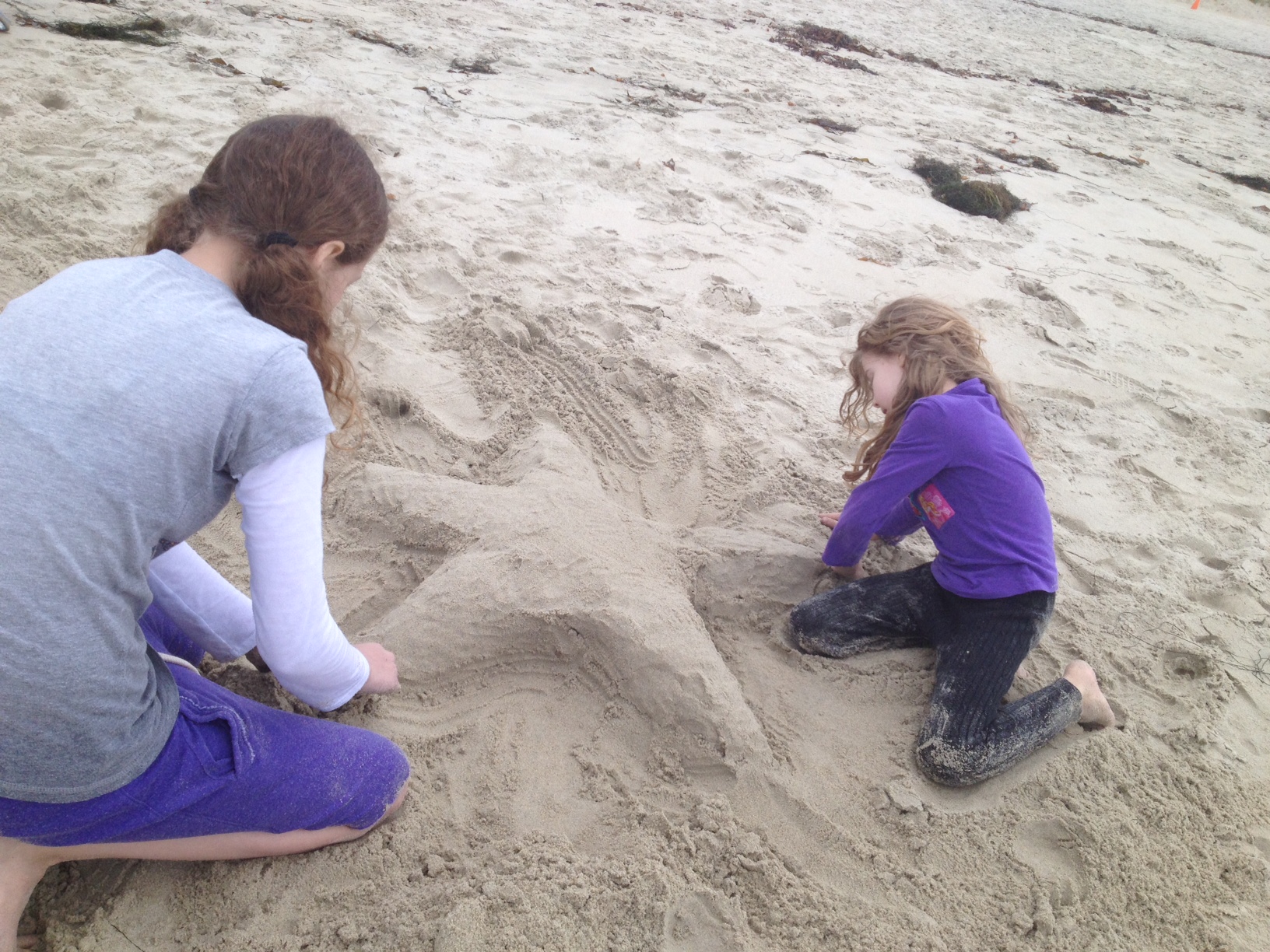


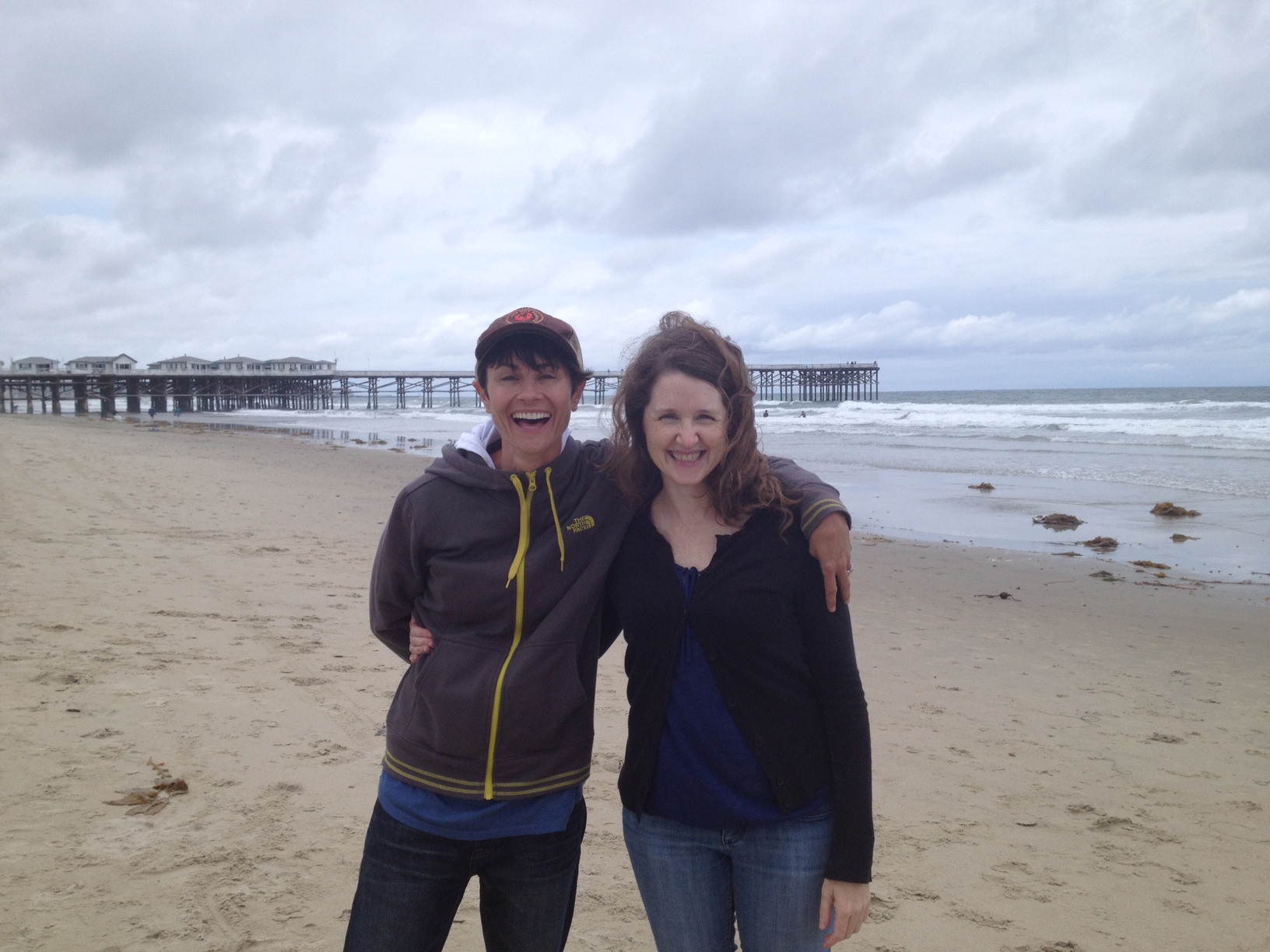
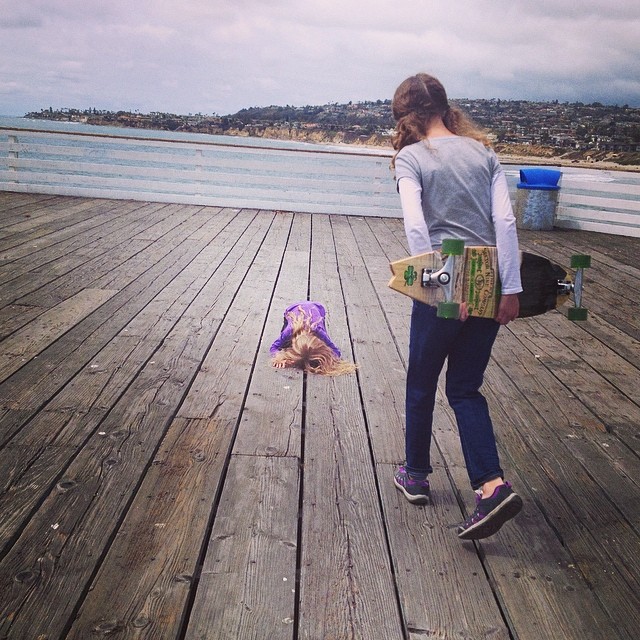
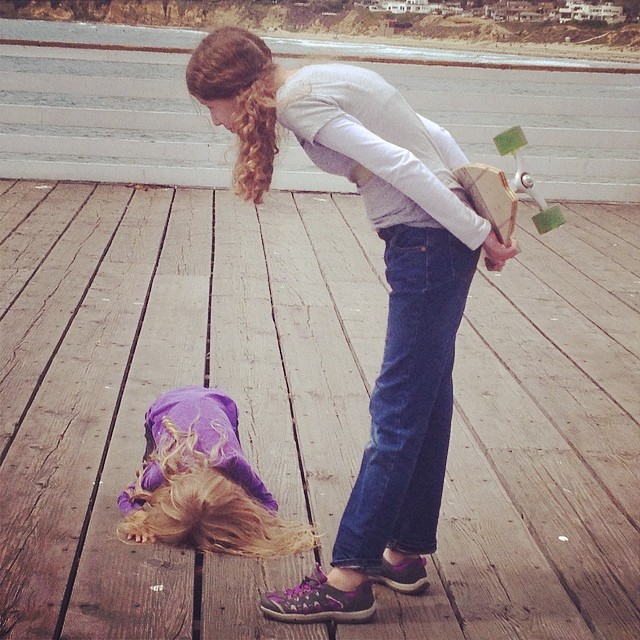
There’s a mysterious world under the pier.



May 21, 2014
Midweek reading notes
It is Wednesday, isn’t it? I’m off kilter somehow.
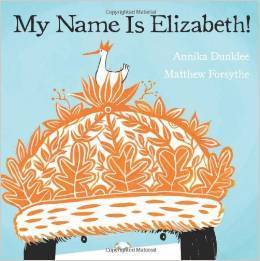 Every now and then one of my littles will shout “ELIZABETH!”—I would say ‘for no apparent reason,’ because it’s always a non sequitur, but there is a reason and it’s very apparent: what they mean is “I want to read My Name Is Elizabeth!“ Elizabeth doesn’t like being called Lizzie, Liz, Beth, or Betsy, and although my two youngest children have short names that don’t lend themselves to nicknaming, they wholly sympathize with Elizabeth’s plight, and approve of her insistence on proper nomenclature.
(They also approve—heartily—of the exception she makes for her little brother.)
Whenever this book is rediscovered, I seem to be called upon to read it several times a day for a week or so. This has been one of those weeks. I’m not complaining.
***
Just finished e. lockhart’s We Were Liars. Utterly unsettling. I mean that in a good way. More on it later.
***
And a heads-up for you.
FINALLY SOMEONE WHO UNDERSTANDS ME. Literature of the English Country House—University of Sheffield/FutureLearn http://t.co/EP0jAsBTyJ #mooc
— Melissa Wiley (@melissawiley) May 8, 2014
I got an email from FutureLearn about this upcoming course—Literature of the English Country House—and I honest-to-God squealed.
We’ll be using a wide range of texts spanning the history of literature from Thomas More’s ‘Utopia’ to Oscar Wilde’s ‘Canterville Ghost’. Along the way we will examine sections from a play by Shakespeare, poetry by Margaret Cavendish, and brief passages from novels by Jane Austen, and Charles Dickens. We will even look at fiction by a country house resident Georgiana, Duchess of Devonshire.
Starts June 2. Thought you might like to know.



May 19, 2014
Pandas don’t break
Huck, balancing stuffed panda on head: “Is she very fall-able?”
Me: “Fall-able? You mean can she fall without getting hurt? Yes.”
Huck: “No, FALLIBLE.”
Me: “Fallible?”
Huck: “Yes, you know, like when things break when they fall.”
Me: “Oh! You mean fragile!”
Huck: “That’s what I said.”