Melissa Wiley's Blog, page 156
October 3, 2010
October So Far
Belly-laughs from the Shakespeare kids at the comic twists of Twelfth Night, and an outburst of "Darn!" from the eight-year-olds when I said "That's all for today."
Early morning soccer game, mist blurring the eastern mountains.
Rilla's bare feet filthy after running across the damp sand of the parking lot, not yet baked dry after Thursday's downpour.
Hide and Seek in the Yellow House, seven times in a row.
Momentous phone calls.
Four closets tackled, two trunkloads purged.
Rilla meets Madeline for the first time and agrees she has exactly the right idea of how one ought to address the tiger in the zoo.
CYBILs reading ramping up already: two new novels devoured, fourteen more on order.
Indian food from our favorite place, thanks to a sweet friend.
Five more hours until Mad Men.
Tweet








October 2, 2010
A Reader's Guide to the Betsy-Tacy Books
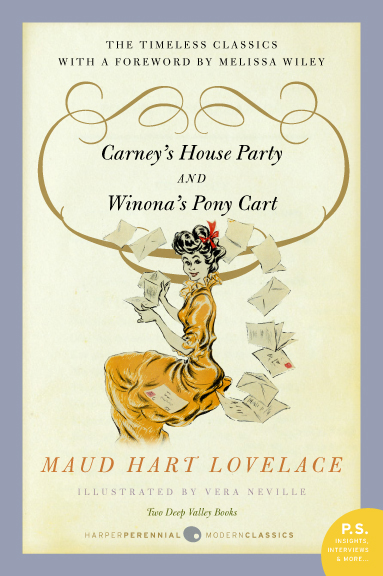 The blog A Library Is the Hospital of the Mind is hosting a Maud Hart Lovelace reading challenge during the month of October. Pick out some Betsy-Tacy or Deep Valley books and skip on over to sign up. Participants will have a chance to win copies of HarperPerennial's brand-new reissues of Emily of Deep Valley and (in a double volume, two books in one) Carney's House Party / Winona's Pony Cart. You know, the book I've been squeeing about for months, the one I had the thrill-me-to-my-very-bones honor of writing the foreword for? That one!
Not sure where to start? Here's an off-the-top-of-my-head rundown of the Betsy-Tacy books and their Deep Valley companions.
Betsy Ray's story—which is very, very similar to Maud's real life story—kicks off on her fifth birthday, the day she gets to know her lifelong best friend, Tacy Kelly. From that day forth they are inseparable, which is why the neighbors always call them Betsy-Tacy. That's the first book: very young girls having sweet and funny adventures in small-town Minnesota at the turn of the last century. It's a lovely read-aloud for small girls, though I always give other mothers a heads-up about the death of Tacy's baby sister, which happens quite early in the book and is very sensitively and quietly handled.
In book two, Betsy and Tacy roam farther from home, all the way to the grand chocolate-colored house a few blocks away—where they meet Tib, whose spritelike looks belie her blunt and practical nature. This is the year Betsy-Tacy and Tib learn to fly, explore the Mirror Palace, and concoct Everything Pudding. It's the year Tacy has diphtheria and Tib and Betsy cut off their hair in solidarity. It's a year full of exactly the right sort of mischief.
 In Betsy and Tacy Go Over the Big Hill, the girls are the extremely sophisticated age of ten. Venturing to the other side of the Big Hill is a big deal—here, I've already written a big long post about it.
The girls are twelve years old in Betsy and Tacy Go Downtown; now they're old enough to go all over town by themselves. Christmas shopping, Mr. Poppy's Opera House, a friendly rivalry with spunky Winona Root, the newspaperman's daughter. That's the year the first horseless carriage comes to town, as well as a troupe of traveling actors. Betsy, Tacy, and Tib get involved with the play and there is a delicious bit of family drama as well.
Those are the four "young" Betsy-Tacy books. Winona's Pony Cart fits in that group; the central event is Winona Root's 8th birthday. She gets herself into a bit of a scrape having to do with her party, and she's not the only member of her family who makes a misstep, and what I love about this book—probably the most overlooked of Maud's Deep Valley stories—is the earnestness with which Winona and her parents strive to recover from their individual errors of judgment. I was so happy to get to unpack this book more thoroughly in the foreword to the reissue. Winona is a girl to remember.
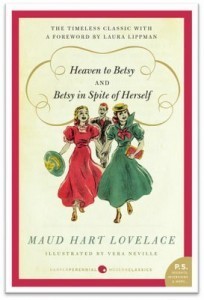
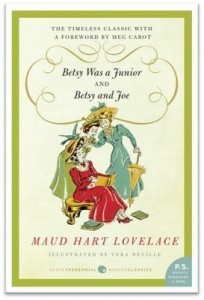
Now come Betsy's high-school-and-beyond books. Freshman year: Heaven to Betsy, which I wrote about here. New house, new school, new friends; Sunday night lunches, dances, skating parties. Joe Willard at Butternut Center. A crush on Tony; a Betsy struggling with moods and competing wishes. A Betsy who writes but doesn't quite know what to do with her writing, doesn't know how to reconcile the need to slip away and work with the desire to be in the thick of the merry-making crowd.
Sophomore year: Betsy in Spite of Herself. It's a makeover story! One of my favorite plot devices. Betsy is determined to reinvent herself into a creature more glamorous, more poised, more devastating to boys. Only trouble is, her own irrepressible self keeps bubbling up and taking over. This is the year of the fascinating Christmas visit to Tib's German relatives in Milwaukee, the year of Phil Brandish and his red auto.
Third year: Betsy Was a Junior. Sorority fever. The joys of being part of a clique—and the crash that comes when you realize you've forgotten about the feelings of people outside your in-crowd. I think Betsy does some of her best growing up in this book, especially after that incident with her little sister Margaret and the stove.
Senior year: Betsy and Joe. My favorite, because, well, Betsy and Joe.
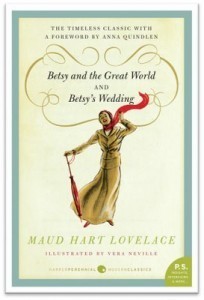
After high school, there's Betsy and the Great World—she got off to a rough start in college and her folks wisely surmise that someone who wants to be a writer might benefit from travel. So off she goes to Europe by steamer. Things are rocky with Joe, and that undercurrent of tension gives her some perspective as she explores Munich, Venice, London, and more. A beautiful book. And oh that perfect telegram!
And then, ever so satisfyingly, Betsy's Wedding. I adore this book. Rings so true. The fun of finding and fitting out your first apartment, the comic misadventures of learning to run your own home. And (especially this) there's Betsy's challenge to make room for her writing, and to give Joe room for his. As a writer married to a writer, this book hits me where I live.
Chronologically, Carney's House Party fits in between Betsy and Joe and Betsy and the Great World. Carney is one of Betsy's best high-school friends, a year ahead of Betsy, Tacy, and Tib in school. Her famous house party takes place the summer after her freshman year at Vassar. Her somewhat snobby roommate, Isobel, comes to Deep Valley for an extended visit with Carney's family. Rounding out the party are Carney's best friend, Bonnie Andrews, home from Paris, and in a surprise appearance, good old Betsy Ray. It's hard for me to contain my remarks about this book to one little paragraph—though I managed it before when I wrote "Carney's House Party is one of my favorite of Maud Hart Lovelace's books—I love how honestly Carney grapples with the complicated process of sorting out her college self from her hometown self." Yeah, that's it. I got to indulge in a meatier exploration of what makes this book tick in the foreword I wrote for the reissue.
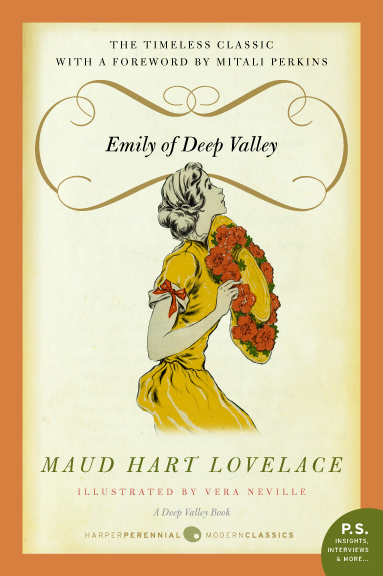 And then there's Emily of Deep Valley. I've written about her at length. Short version: Emily's a quieter sort than Betsy and Carney; she lives on the edge of the Slough with her elderly grandfather, the only family she has left. All her friends are heading off to college but Emily won't leave her grandpa alone—a difficult decision, and a right one. Loneliness and depression set in, but she (famously) musters her wits to combat them. There is much to love about this book, but if I had to pick a favorite part, it would be the relationships that develop between Emily and the Little Syrian boys, and what comes of their connection. HarperPerennial's lovely reissue of Emily of Deep Valley, with a moving foreword by author Mitali Perkins, plus historical material by Maud Hart Lovelace experts Julie Schrader and Amy Dolnick, as well as a bio of illustrator Vera Neville, will hit the shelves on October 12th. If you haven't read this rather incredible book it would be a perfect choice for the MLH reading challenge.
Of course you know I'm hoping you'll read Carney and Winona too so we can gab about them!
Tweet



September 30, 2010
Go Ahead, Make My Reading List
 Regular readers of this blog know I am afflicted with option paralysis when it comes to Choosing the Next Book. For the next three months, that won't be a problem. Nominations for the Children's & Young Adult Bloggers' Literary Awards (CYBILs) begin at midnight Eastern time on October 1st—that's 9pm tonight for us West Coast folks! I'm a first-round judge for YA Fiction, which means that between now and the end of the year, my reading list will consist of the book you nominate in that category.
We're kicking off the two-week nomination period with a Twitter party tonight, 12am Eastern time. Follow @cybils on Twitter for more on that! (You do not have to have a Twitter account to follow to the conversation.)
So what am I reading first?
Tweet



September 29, 2010
You Had Me at "Studio Ghibli Does The Borrowers"
How did I not know about this? Studio Ghibli's latest release (this summer, in Japan) was The Borrowers?
Official title: Karigurashi no Arrietty (The Borrower Arrietty)
I see (via the SDSU Children's Literature blog) that Miyazaki wrote the screenplay but did not direct the film. Still, my hopes are high.
The post links to an interesting article at the Daily Yomiuri about the slight differences between Arrietty's father in the book and the film:
…while Pod is not particularly loquacious in the novel, neither is he reserved. In a scene after Pod has discovered that Arrietty has spoken to "the boy," Pod speaks quite a bit.
When Arrietty defends herself, saying the boy has agreed to deliver a letter she has written to Borrowers living elsewhere, he appears to take some grim satisfaction in his scornfully elaborate explication of the uselessness of Arrietty's act: "…do you see your mother walking across two fields and a garden…two fields full of crows and cows and horses and what-not, to take a cup of tea with your Aunt Lupy, whom she never much liked anyway?" There is a lavishness in Pod's amplification that can only be achieved through the protracted use of language. Not for him, the effect of understated brevity. Ghibli's Pod, on the other hand, barely speaks unless strictly necessary—and even then he sometimes remains reticent in situations when a tad more back and forth might be deemed obligatory. His lack of words might seem unduly taciturn in a Western context, but, as in the original, he is portrayed as a sympathetic character. Just not a very talkative one.
Tweet



September 28, 2010
Um, Yeah, One of Those Will Be Fine
Beanie asks me the wish question. If you had one wish, what would you wish for? It's a question I always want some context for: you need to know the scope of the game before you play. What kind of wish, I ask her. A wish for the world? Or a wish just for us, for our family?
"Oh, anything," says Beanie. "You know, a new computer…a new TV…a new TV cabinet….no more war. That sort of thing."



September 27, 2010
"The Year of the Sketchbook"
The doodling, listmaking sketchbook addict in me was intrigued by Monica Edinger's post on the staggeringly talented David Macauley:
Certainly the man never stands still. He's got a new book out next month, Built to Last, and was a scholar-in-residence at New York City's Dalton School, where I teach, last year. For The Year of the Sketchbook every single person in the school was given a sketchbook and they were used in a myriad of ways. Urging us all to use sketching as a form of thinking...
September 25, 2010
"…they put their fingerprint on your imagination, in your heart."
Bruce Springsteen on songwriting:
"I said there's other guys who play guitar well, there's other guys who front really well, there's other rocking bands out there. But the writing and the imagining of a world, that's a particular thing, you know. That's a single fingerprint. All the film-makers we love, all the writers we love, all the songwriters we love, they put their fingerprint on your imagination, in your heart. And on your soul. That was something that I felt touched by, and I...
September 23, 2010
The CYBILs Are Upon Us!
October 1st is the beginning of the two-week nomination period for this year's Children's and Young Adult Bloggers' Literary Awards. Watch the CYBILs site for your chance to nominate your favorite books of the past year in every category of children's & YA publishing—fiction picture books, nonfiction picture books, early readers/chapter books, middle-grade fiction, middle-grade & YA nonfiction, science fiction and fantasy, poetry, graphic novels, and young adult fiction. Those links go to...
September 20, 2010
The Kindness of Strangers
One night en route to our family reunion in Virginia, our hotel room was near the laundry and I decided to do a quick load. I'd packed light and our wardrobe was getting pretty grubby by that point. I scrabbled for quarters, carried a sack of clothes around the corner to the washer, and discovered I'd have to go down the front desk for detergent. But when I got there, a woman with two towel-wrapped, wet-haired children had just made the same purchase. My heart sank: I was so very tired, and n...
September 18, 2010
Actually
Rilla, like many another four-year-old, has a deep and affectionate interest in words that rhyme. Today in the car she was thinking of rhymes for the word "cat"—surely one of the most satisfying words for a young English-speaker to rhyme because there are so many ready candidates. She had come up with a long list of the usual examples, and I strung them together into the ubiquitous beginning-reader sentence.
Me: "The fat cat sat on the rat…"
Rilla (laughs at my brilliant and original way with w...