Laura K. Curtis's Blog, page 6
September 2, 2015
It’s an Organizational Bunny Hop! (#getittogether)
 If you follow me on social media, you probably know how obsessed I’ve become with planners and planning. Indeed, some of you may have taken the course I offered at Savvy Authors. So naturally, when Alexandra Haughton mentioned this blog hop, I HAD to jump in. Seriously, what an excellent idea–a bunch of authors all sharing how they get organized! You can find all the different authors on the main hop page.
When I started out as a writer, I had a day job and I just wrote when the words came. I did trade shows as part of my day job, so I ran around a lot, which helped keep me from packing on too many pounds, even though the rest of my work life was pretty sedentary.
And then life changed, as it is wont to do. I gave up the trade show job for an office job. Better money, more security…less exercise. And I sold my first book, which meant I had to write more books. Under contracted deadlines. To contracted lengths. Oh, my. And I decided to self-publish some work. And volunteered to put a story in a charity anthology. And then volunteered to edit and organize another anthology.
I find it easiest to keep all my appointments on my iPhone, but I’ve always written my manuscripts mostly by hand, doing the first edit as the words go from notebooks to the computer, so it only made sense that once I started getting into using a paper planner I would become part of the #planneraddicts society. I have tried pretty much every planner system out there and the one that works for me is the Plum Paper Planner. My new one JUST started this month, so it’s looking rather barren. (Especially since it HADN’T started when I wrote this post in August, so I just stuck some stuff in so you could see how it WILL look.)
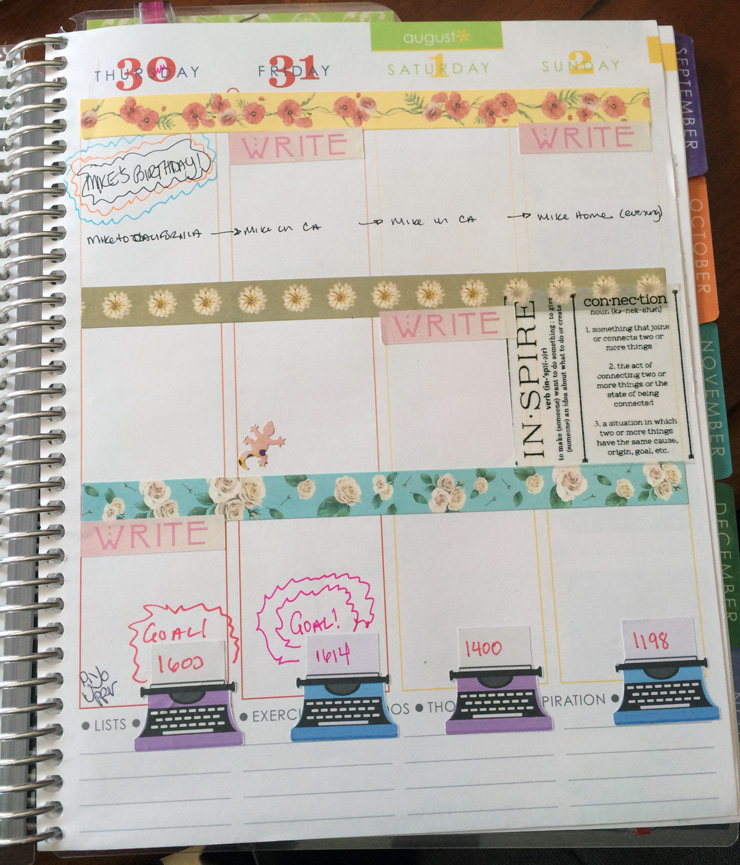
Here’s my Plum. Although it divides the day into Morning/Afternoon/Evening, I don’t split mine like that. I keep the earlier blocks for to-dos and appointments and the bottom box for long-term goals like writing and fitness. Next to each little typewriter is the number of words I’ve set as a goal for myself to write that day. The actual word count goes on the paper, and if I make my goal I get a pretty sticker or I decorate with colored markers. Likewise, I am doing PiYo to get myself moving again. So I have stickers to remind me which PiYo workout I am supposed to do each day.

This is what keeps me on track. Now, I do keep appointments in my phone’s calendar and I manage my boss’s Google calendar as part of my day job.Frankly, for appointments, I just find a gadget that will send you a reminder makes sense. But for long term tracking of what I have to do, when I have to do it, etc, I love paper. All the projects for the day job also go in the planner. Besides, all kinds of studies show that writing things down makes them stick in a way that putting things into digital media does not.
Maybe you’ve seen this GIF…I don’t know where it comes from, or I’d add attribution:
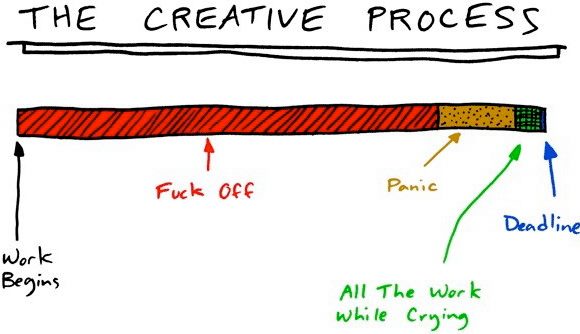
Since I really, really hate the “Panic” stage and I even more hate the “All the Work While Crying” stage, I give myself a certain number of words I need to do each day. But I have learned that I am not good at doing things “for me.” I have to do them for someone else. I will kill myself to be sure I don’t let someone else down. So what that means is that for my current project, I’ve hired an editor and have to have it to her October 16. It’s going to be single title length, so I’ve budgeted myself at 90k words. If I write a few more or a few less, that’s fine, but this is just to give me broad target to hit. My contemporaries used to come in at 65k, so it won’t be the same for every book.
I ONLY PLAN ONE WEEK AT A TIME. Seriously. I can’t stress this enough. If you have any kind of mood disorder, as so many of the writers I know do (my own are OCD and depression), it’s so, so easy to blame yourself when you don’t meet goals. So I try to keep my deadlines reasonable and pad them at the beginning. That way when I screw up, screw off, or otherwise miss a deadline, I can just add more words to the next week, or write on a couple of days I’ve given myself off. (And yes, I schedule days off.)
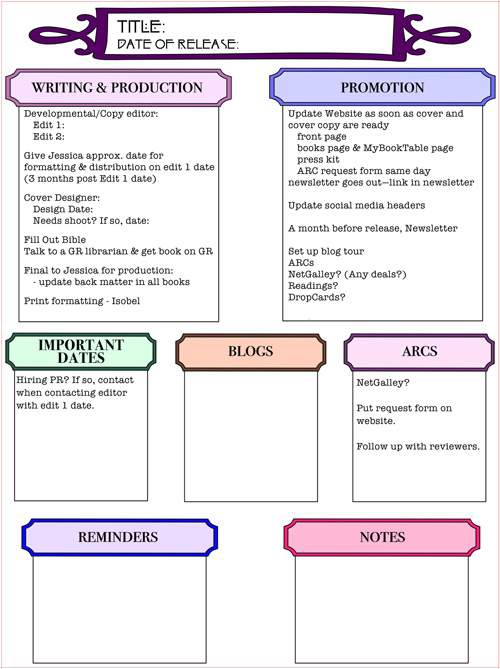
But there are also publicity and marketing deadlines to keep. So for every project, I have a “project sheet,” which was inspired by a number of my Twitter friends in response to my own desperation. It’s laid out in a way I can keep track of it (I think the wonderful Bree Bridges inspired the layout originally) and I can write notes in about what blogs I tried, whether there was reaction, what promotional stuff I did, etc. I laminate the project sheet, punch it to fit into my planner, pop it in the planner, and write on it with sharpies as I go along. I enter dates, comments, etc. (Here’s a nifty tip you may not know: If you write on a laminated sheet with a Sharpie and want to erase, go over it with a dry erase marker, then wipe off!)
I also have a couple of other recommendations for you folks who are trying to organize not just your own days, but your story’s days. Check out this post on Aeon Timeline for tracking time in an individual book or in a series. My current manuscript tracks (*shudder*) nine generations of three intertwined families. Without Aeon, I’d be completely lost.
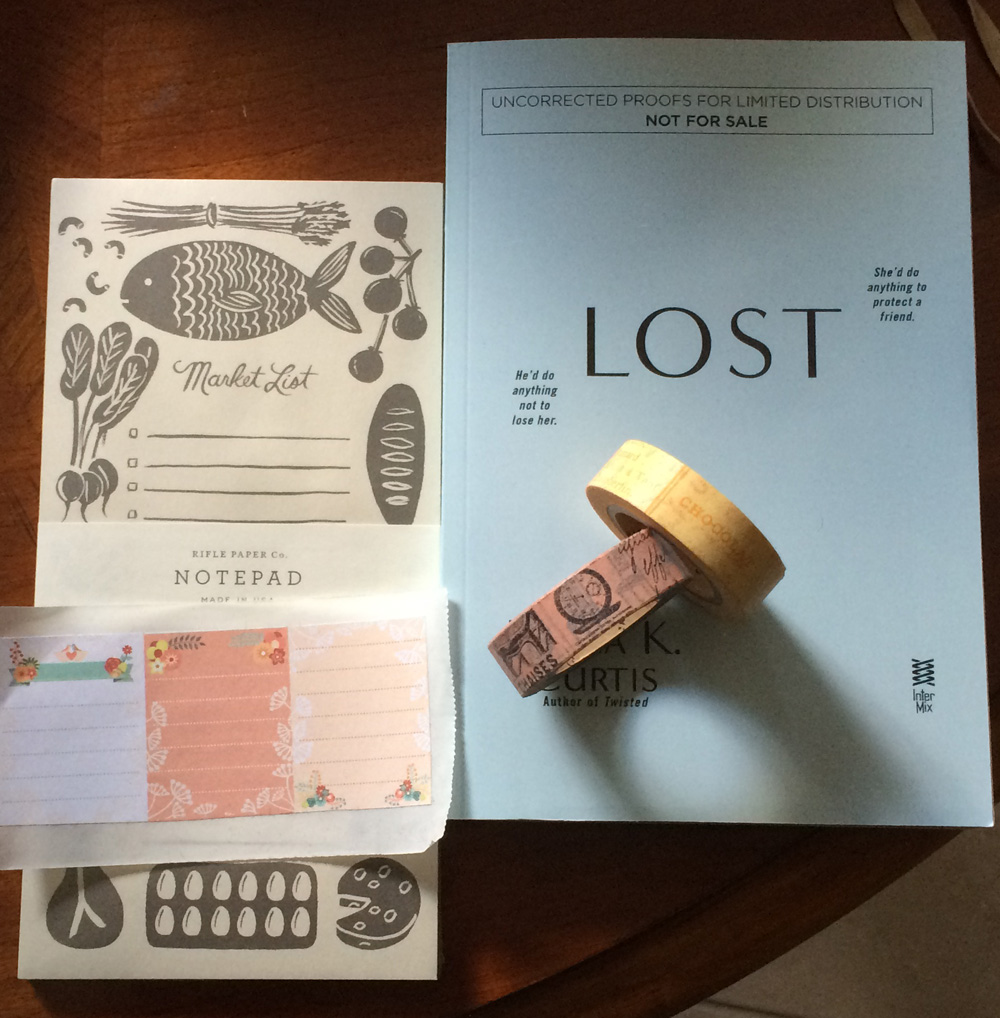
All the authors participating in the hop are giving away prize packs. There was so much great organizational stuff and so many gift cards and free books offered that the organizers had to divide them into six, that’s right, SIX, separate prizes! There’s a rafflecopter at the bottom of this post, so jump on in and enter!
Here’s my prize, which is only PART of ONE of the prizes! Washi, To-Do stickers, a pad, and an ARC of LOST. Enter at the bottom for this and a TON more stuff!
The post It’s an Organizational Bunny Hop! (#getittogether) appeared first on Laura K. Curtis.


August 10, 2015
Yes, I Read “That Book” So You Don’t Have To (Trigger Warning)
So, if you read Jezebel, Salon, MetaFilter, or even Newsweek, you’ve probably seen some of the shock, outrage, and horror at Kate Breslin’s For Such a Time, a novel in which a blonde-haired, blue-eyed Jew “falls in love” with the (fictional) Kommandant of Theresienstadt, who rescues her from Dachau. (I will not be linking to this book. If you really want to buy it, you can find it yourself. I borrowed my copy because I refused to contribute money to it.) Most of the outrage is generated by people who haven’t read the book. “This is so offensive and wrong on its face that it has no ability to be redeemed, so I can criticize it without reading it.”
Well, yes. I can see why one would feel that way, but at a certain point if you’re going to talk about what’s wrong with a book, you have to actually deal with the book itself. So, I read it. As far as I can see, this book fails in four major ways:
History
Theology
Romance
Basic story craft
Now, others far wiser than I in the knowledge of history will take up the challenge of pointing out the many, many, many egregious, offensive, outrageous historical mistakes Breslin makes. I am going to treat this as if I came to it without a personal history that includes being the child of a refugee, and try to contain and control the fury and pain that it caused me to read it. If some of that slips through, I apologize. You may also want to stop now. This is a LONG post and although I try to avoid the most explicit triggers, I can’t do so and provide an adequate picture of what is so utterly and thoroughly awful about the text.
Theology
One of the things that drove me to actually sit down and read this book is that there was a lot of debate in the community about whether or not Stella, aka Hadassah, who is supposed to represent Esther in this “retelling of the Book of Esther,” converts to Christianity.
Now that I’ve read the book, I still can’t tell you. And here’s why:
Stella isn’t a Jew. In fact, there are no Jews in this book. The Jews here are sort of incomplete Christians, proto-Christians. They don’t eat pork or read the New Testament, but other than that, they’re basically Christians. Does Stella convert? Certainly, she takes to carrying the Christian Bible around with her and getting her advice from bits of the New Testament. If she started off as an actual Jew, I’d say she converted. But since she’s never really very Jewish, I have no idea.
In the world of romance, we use the term “wallpaper historical” when a romance between two entirely modern characters is set in, say, the 17th century. These are wallpaper Jews.
Here’s a passage from one of the supposedly Jewish children in the book about one of the other Jews who was killed:
“Then she’s in heaven.” Again he spoke with the conviction of an innocent heart. “Mama told me going to heaven would be wonderful. She said she would never need a coat, ’cause it’s always summertime and there’s lots of Strudel so you never go hungry. They would never have to dig holes or shovel dirt, and they could sing and dance all day ’cause the angels would play music on accordions and trumpets.”
Yeah…no. Not Jewish. Sure, some Jews have an idea of afterlife before resurrection (Judaism allows for a lot of different views on this topic), but this is a particularly Christian “heaven,” with angels and trumpets.
Twice during the book, Stella refers to herself as a Mischling, which is so far wrong I can’t even…it’s as if I were to think fondly of myself as a Kike. (And make no mistake, she does think of herself fondly using that term.) Here’s the direct quote:
“Hadassah Benjamin, a Mischling, half Jew, bursting with a young woman’s exuberance, had ceased to exist. In her place stood Stella Muller, subdued Austrian bookkeeper and suitable stock for the Third Reich.”
Let me be perfectly clear about this: there is no such thing as a “half-Jew” and no Jew thinks of themselves that way unless they are absolutely filled with self-hatred.
And then there’s the scene where the escaping Jews, despite all the wood fires that have been described throughout the story, decide to smear themselves with the ashes of cremated Jews so that they can pretend they are … other Jews than the Jews they are. I will admit that I was so blind with fury over this that I couldn’t exactly understand why Stella thought ashing themselves was necessary.
How would they convince the guards that they were the sick bound for Auschwitz?
Her answer came when Mrs. Brenner returned from the Krematorium carrying a single box of ashes. “These must have been overlooked,” the older woman said in a quiet voice.
“I don’t think they would mind the sacrilege.”
Hadassah took the box and held it reverently. Reaching inside, she withdrew some of the ash and wiped it over her face, neck, and any other exposed skin. She thought of those who died in this place, and the many who must now stay behind to await death so that the rest of them could live. Moving from person to person, she offered each a handful of the ash, watching as they covered themselves in the only disguise that would fool the guards at the station. The souls of Jews . . .
What. The. Actual. Fuck.
Aside from that, this underscores the way Stella thinks. It’s not “the ashes of my family,” “the souls of my people;” it’s “othering” at its finest. Although she holds the box reverently, she’s pretty damn glib about the dead “not minding the sacrilege.” And we see no actual suffering in her at it.
And then there’s Aric, our “hero.” I am pretty sure he’s supposed to come to his faith at the end of this book, but there’s nothing Christian about his attitude. Ever. He’s an all-around deplorable person whose attitude throughout the book is “me first, everyone else second.” He “rescues” Stella from Dachau because he doesn’t want a black mark on his record, keeps her because he wants to have sex with her, reads banned books because they give him pleasure, and finally decides to help a couple thousand Jews escape because he can’t stand the idea of losing his girlfriend. He never, ever, does an unselfish thing. And at the end, when he’s “apologizing,” he says
“But the world will still hold me accountable for taking part in Hitler’s scheme,” he continued. “Even now, when I think of the apathy I once held toward your people, it grieves me. If I’d had your courage, I could have done so much more. . . .”
Dude. That wasn’t apathy. It was genocide. It was actively evil. It was turning your back on the God you claim to worship who commanded that you look out for those who cannot look out for themselves.
Which brings me to my last problem with the theological aspects of this book: It’s supposed to be a retelling of Esther. For those who who don’t remember Esther, it’s a relatively short book you can read it in numerous places online. But in short, Esther is a Jewish woman who becomes part of the harem of King Ahasuerus. Ahasuerus is basically an apathetic guy and his evil second, Haman, who hates the Jews, pretty much runs things. Haman orders the murder of all the Jews and Esther—because she is a Jew and has faith in her God and reveres her heritage—manages to prevent the extermination.
Yes, it’s more complicated than that. But the key to the savior of the Jews is Esther’s Judaism combined with the fact that Ahasuerus didn’t care all that much about the Jews one way or the other. Stella the proto-Christian is no Esther, and Aric—who talks to Eichmann as a matter of course—is no Ahasuerus.
Aric, indeed, is a conflation of Ahasuerus and Haman, which leaves Breslin no choice but to create “Hermann,” an even-more-evil second in command to Aric. Which makes Hermann just a cardboard villain. So evil you sort of imagine the words coming out of his mouth sounding like an adult in a Charlie Brown television show.
And Stella, who is supposed to stand in for Esther, has no faith at all. When God starts speaking to her through her “Magic Bible” (you really should read that review, because Rachel tells the story of the Magic Bible very well and I can’t think of it any other way now), she adopts both Testaments (in German, not in the sacred language of her people) as her own. She rejects her God at every turn, which makes Breslin’s statement that “It was my intent to write a book that told a more modern-day story of a courageous Jewish woman who, through strength and faith in her God, used her situation to try to save some of her beloved people—much in the way Esther saved hers” even more ridiculous.
This is less Esther retelling than lustful Esther fanfic, which brings me to…
Romance
The theological problems with the book are much more severe and complex than I had time for, so if you’re still here after my incomplete overview, I appreciate it. Let’s talk about romance.
Many people have said that romance as a genre is chock full of problematic power dynamics. This is true. It’s also true that I don’t particularly care for the excessive power imbalances (see my post on alphaholes), so if you love those kinds of dynamics, you may find this part of my post less than convincing.
I’ve seen people say “look, we don’t have problems believing the motorcycle club romances, and those guys are horrible to women.” Yep. And I don’t read those books. But even if I did, there’s a distinct difference between the average MC alphahole and a guy who literally threatens his lover with murder.
Says our hero: “as easily as I netted you from that cesspool Dachau, I can toss you back.”
Yep. He’s a winner.
Here’s the bottom line: for a romance to occur, the relationship has to be consensual. How hard is that to understand. When a woman gets involved with a spy, an assassin, a motorcycle club member, she has a choice. Where there is no choice, there can be no consent.
Aric literally holds Stella’s life in his hands. She has been abused, terrified, starved, and threatened with murder. The fact that she is attracted to the first person to offer her food, safety, and warm clothing does not mean she is in love with him, it means she is suffering from Stockholm Syndrome. The fact that he doesn’t see how wrong it is to take advantage of that does not make him any kind of hero. In fact, nowhere in the book does Aric ever look at their relationship and go “you know, this isn’t fair to her” or even “I should be a better person.” Nor does he have to. He just has to stop killing Jews. There’s no fundamental shift or growth in his personality.
Look, I’ve said many times that people should write what they want to write. But I also reserve the right to read those things critically and to call out the really horrible things I believe they say. There is nothing in this book that says “love” to me. Not “love of God” or “love of each other.”
At the end, we are supposed to believe there will be a happily ever after between Hadassah and Aric, and they’ll adopt Joseph, the young Jewish boy who believes in heaven. Where will this happy family of a war criminal, a proto-Christian, and a Jewish child live? Where will they worship?
[Aric] let out a ragged breath. “When the war is over, I must face whatever justice metes out—”
“You won’t face it alone, my son.”
Hadassah turned to see her uncle approach, along with Yaakov Kadlec. “We will be there, too. We’ll tell them of your actions and how you saved us all. I believe they will listen. After all”—her tatteh smiled—“God is on our side.”
“Yes, He is,” Hadassah said, and as she tucked the pearl into her apron pocket, she laid her palm against the miraculous Bible that held the photograph she would soon return to her beloved. The story of Elijah rose in her mind. “Whatever our future holds, Aric, God will be there to guide us,” she said, gazing up at the man she loved. “We have only to listen.”
A soft breeze arose at that moment, steady and sweet across the hills of Lvov. And Hadassah smiled, hearing His whisper.
I’m a little unclear here whose whisper Hadassah the used-to-be-a-Jew-but-carries-a-Christian-bible is supposed to be hearing. She and Aric have never once discussed anything about their relationship. The enormous obstacle of differing faiths is never even mentioned. Entire romance novels have been written with nothing but differences in religion as their conflict and everyone I know knows at least one couple who’s broken up over it (or never gotten together at all because of it). The idea that they can ignore the elephant in the room is enraging. Especially since they’re going to be raising a child together.
Plus I find this whole finale way too pat and “ooh, look, let’s slap a happy face on this horror show! It’s a romance, so there has to be a happily ever after!”
Which brings me to…
Lack of basic craft
This was probably the most disappointing area of the book for me. I expected bad theology and Stockholm Syndrome in place of romance, but reviews had said at least that it was well-written. It wasn’t.
Okay, with the exception of one unintentionally hilarious editing gaffe, there were no grammatical errors and she used some lovely metaphors. But let’s start with some basics.
We know the heroine is the heroine not only because she’s blonde and blue-eyed but because every villain, male and female alike, wants to rape her. Literally every single time we meet a new Nazi, we find out how warm s/he is for her form.
When we first meet Stella, she does not know how she has come to where she is from Dachau. She is starved. And then she sees Aric out the window:
The faint purr of a car’s engine drew her attention back to the window. A black Mercedes approached the chalet, cutting a path through the snow that concealed the road. The disjointed white cross of the Hakenkreuz emblazoned its door.
Jew Killers. Stella froze as the Nazi staff car pulled up beside the house. Fragments of memory collided with her mounting apprehension. The gritty-faced Kapo—a Jew trusted by the Nazis to guard their Block of prisoners at Dachau—had stuffed her into the blue dress. The feel of warm wool against her skin as she was wrapped in a blanket and carried. The dark trunk of a car . . .
The driver wore the black uniform of the Schutzstaffel and exited first before rushing around to open the passenger door. The man who emerged next stood tall and broad-shouldered in a heavy greatcoat. His presence evoked every aspect of authority. Dominance. Even the cane he gripped in his right hand failed to diminish his aura of power.
He looked up at her window. Stella’s heart pounded. Did some intuitive force reveal to him her hiding place, or had he already known? She pulled back from the sill, then quickly changed her mind, meeting his stare.
His face was a canvas of strength—rock-hard features fortified with asperity, amplified by the grim line at his mouth and the tautness of his squared jaw. Features much accustomed to pain. More in giving it than receiving it, she decided.
Not just no, but FUCK NO. This is like a cheesy, badly written romance meeting between a sub and her fated Dom. In fact, every poorly-characterized, trite trope that romance is branded with is evident in this novel. For example, when Aric is a caricature of the dissolute Regency rake:
Aric released a self-deprecating laugh as he tipped his glass to swirl its golden contents. He should have realized his folly then, that he’d intended more than to simply feed her, dress her in new clothes, and send her on her way. Erasing one or two black marks from his soul—that is, if he still had one.
And then there are the numerous times I felt like saying “that word, I do not think it means what you think it means.” Like the apathy comment above, or this:
His gentle tone affected her like an unwanted caress. Traitorous heat rose in her face. She felt as if she’d lost some unspoken battle between them.
If you’re female and you take public transportation, chances are you’ve experienced an unwanted caress. Is this how you felt?
My kindle insists that there are only 12 mentions of doves in the book, but it sure feels like more. In fact, in my notes I have “For fuck’s sake, can we stop with the fucking doves?” It’s the same with “salvation,” which my Kindle thinks appears only 22 times (almost exclusively with Stella being the savior of her people), but I felt as if I was being clubbed over the head with it until I was blind.
And the characterizations are brutally inconsistent. Stella’s uncle Morty first thinks:
[Stella] could be Herr Kommandant’s wife—or his mistress. Either way, she was lucky to have landed on the safe side of the fence.
But then, a couple of chapters later, we get
Morty ground his teeth. Must she sell her body to a Nazi in order to stay alive?
But really, the problem with the craft in this book is much deeper than any of that, and it’s hard to explain. Never, at any time in this book, was I ever afraid anything bad would happen to anyone I cared about. Despite the horror upon horror upon horror that reads a little like torture-porn, there is no sense of menace in the book. Maybe it was the cardboard characters or the hammering home of certain words that kept taking me out of the text, but the only time the book actually moved me was when the elders gave up their places on the “freedom train” to the children. And that’s just plain sentimentality. A scene like that doesn’t take a particular talent to move an audience with. It’s emotional manipulation that’s almost too easy.
And then there’s the whole ridiculous “let’s steal a train!” plot. And the battle on the roof of said train. Seriously.
Look, I write romantic suspense. I understand the impulse to heighten the adventure quotient. But this is not how you do it unless you’re writing a freaking Michael Bay film. I started laughing. Which, quite frankly, I appreciated by that point, though I am sure it wasn’t her intent.
So why did it garner praise? Like a starred review from Library Journal?
The short answer? I have no idea.
The sadder answer: I rather suspect that it’s because a large number of people think that “controversial” is necessarily the same as “important” and “important” gets conflated with “good.”
(If your question is “how did it final for a RITA, see Alexis Hall’s excellent post.)
But here’s the thing. This is not an important work of literature and it’s definitely not good. It’s destructive, ahistorical, crass, and poorly written. And it is damaging to both Jews and Christians alike. It is beyond me how Bethany House could not see that it hurts their evangelical cause more than it helps.
Comments for this post are on because I got a LOT more out of this book by reading it with others who could help me work my way through it so I don’t want to stop anyone else who wants to discuss, but I will be ruthless with trolls.
The post Yes, I Read “That Book” So You Don’t Have To (Trigger Warning) appeared first on Laura K. Curtis.
August 6, 2015
What Are Your Plans for the Next Two Weeks?
 Over the next couple of weeks, starting on August 10, I’ll be teaching a planning course at Savvy Authors. If you’ve been following me for a while you’ll know that planning is not something that came naturally to me, that I had to decide to do it.
But once I’d made that decision, and started making my planner look pretty and found a group of similarly-inclined folks, it really did change a lot of things. When I look back at where I was at the beginning of this year, I can see how much more I’ve gotten accomplished. Which is why I decided to teach the class.
Even if you don’t want to take a course in planning, or don’t have the time or money, I encourage you to check out my post on the MWA-NY blog where I talk about SMART goals and link to a great video about achieving word count.
If you think the course might interest you, here’s what we’ll be doing:
Day 1: Introductions, goal discussion
Day 2: Setting the big goals: Your writing and your health; build in flexibility
Day 3: Chunking — the key to small goal setting (everyone tends to have similar big goals, but their chunks look very different)
Day 4: Setting realistic time goals and avoiding burnout — multiple goals come into play here
Day 5: Micro goals: daily word count, calories, fitness steps, etc.
Day 6: Dividing your day (this will look different for everyone)
Day 7: To Do lists — turning your nemesis into your ally
Day 8: Planning to plan
Days 9-10: Putting it all together
I hope to see you in the planning class!
The post What Are Your Plans for the Next Two Weeks? appeared first on Laura K. Curtis.
July 20, 2015
Aeon Timeline: Keeping Track of Time in a Series
Recently, I realized I needed a series bible for all my books that involve Harp Security. I’m not sure how many details other authors can cram into their brains without bits and pieces getting confused, but I found that after three books, things were starting to get messy upstairs.
A series bible keeps track of a lot of information, but one thing that a lot of folks find hard to deal with is timelines and I’ve never found a satisfactory way to manage that in either a spreadsheet or in Scrivener, which is where the rest of the character and series information are stored.
Luckily, as the saying goes, there’s an app for that. Aeon Timeline. Honestly, there’s nothing like it that I’ve ever discovered. Here’s the timeline for all the Harp books so far.

Under the timeline itself, you can see various characters or organizations. When you create a new “entity,” you can either give it a start date, or you can set its age at the time of its first appearance. Harp Security, the organization, is important in the life of its founder, Nash Harper, before it actually exists. I knew when it was founded, so I set that as the start date, which is indicated on the timeline by a star. Then Aeon automatically populates its age at any other event I associate with it.
Solid dots indicate events in which the character is a participant (or, as I use it, primary character). Open dots indicate that the person was an observer (secondary character). Some of my characters, as you can see, I haven’t quite decided dates of birth for yet.
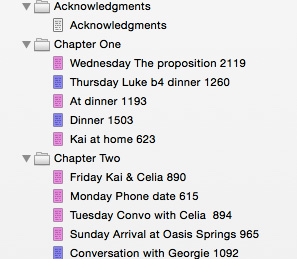 I track the days of individual books (most of which take place within the space of a few weeks) in Scrivener. After I made a character go to a government office on a Sunday, I realized I had to do something. It’s a good compromise, but once the book is done, I still have to move the big events to Aeon so they get tracked in case I need to reference them later.
I know not everyone’s a fan of Scrivener, so I thought I’d point out that you can do this same thing in Word by inserting a comment at the beginning of each scene when you are writing that tells you what day/time it is.
So there you have it. A VERY basic primer on keeping track of time when you’re writing a series.
The post Aeon Timeline: Keeping Track of Time in a Series appeared first on Laura K. Curtis.
July 7, 2015
Fantasy and Expectation: A Ramble
 Warning: TL;DR post filled with questions without answers ahead.
Romancelandia is fond of self-examination and since I come from an academic background, I often find discussions of what books are or are not capable of fascinating. When Fifty Shades came out, and to a lesser extent when it’s predecessor Twilight was released, there was a huge uproar about the glorification of stalking and abuse. “You’re giving women terrible ideas of what a good relationship should look like,” people screamed.
And I was one of those people. (Though I like to think I kept my statements to a dull roar.)
When I was in college, I dated a man who was emotionally abusive. Never physically abusive in ways that showed, he did enjoy hurting me in small ways, embarrassing me in public, and generally making me feel stupid. As a result, those are all huge, massive triggers for me. Nothing will make me abandon a book faster than a hero who does that to anyone, not just to the heroine.
So when people started talking about how “romantic” Christian Grey was, I begged to differ. To me, he was a creepy, stalking abuser who carefully separated the object of his obsession from her support system.
But this is not about Grey. It’s about two arguments I hear in the world of romance with regularity and how they are simultaneously true and not true. I believe (and this being the Internet, if I am wrong, someone will correct me instantly) it was Kierkegaard who originally discussed the human ability to believe two contradictory things at the same time. As regards romance, those two things seem to be
1) Fiction can influence your view of yourself and the world
2) Fiction cannot influence your view of yourself or the world
Instinctively, I lean toward the belief that it can, and does. And yet, whenever I hear someone (usually a man) say “romance gives women unrealistically high expectations for relationships” I think to myself, “well, that’s a crock.” Because I don’t believe that. Not for a minute.
And when people ask why I am so sure that it’s not true, I say it’s because the people reading romance know they’re reading fantasy, the same way people reading thrillers know they’re reading fantasy. You don’t really believe people live the way Jack Reacher does, do you?
But if that is true, if all those people understand that they are reading fantasy, then why should we even bother to talk about the glorification of patently unhealthy behaviors and relationships? Go read what you enjoy and be done with it. It can’t possibly have any influence over anyone.
(Of course, some people don’t know the difference between fiction and reality, a fact that the marketing firms for books like The DaVinci Code and FSOG capitalize on. But those people aren’t the ones I am talking about. Those people have other problems.)
And yet, I’ve heard any number of people say that they learned about healthy relationships from reading romance, and when I read those articles I think “yes, that’s spot on. Reading a story can show you you’re worth something.”
And I believe many, many people need reminding of their own value. People you’d look at and think “oh, she has it all. She’s filled with self-confidence.”
I am absolutely sure that most people thought my college relationship was great. In fact, several of my friends told me they were jealous. I did not have any objective reason to put up with the crap I put up with from that man. I had no weak female role models. Anyone who knows my family knows that. My grandmother divorced four husbands because they could not keep up with her. I had had a solid, strong relationship before that one with a man who respected me. I was not the person you would ever have thought would end up with an alphahole. When I got out of that relationship, it took me a long, long time to trust my own judgment enough to get into another.
I started making rules. “Thou shalt not date a man who…”. And right up at the top was “a man who denigrates you in front of his friends.” It was the first time I consciously started to defend my own worth.
 The books I write are filled with people—both men and women—learning their own value. And to me, some of the most satisfying books to read are those in which the characters discover their worth. Perhaps that story works so well for me because I know if I don’t keep reading it I might forget.
In college, I was heavily invested in epic fantasy, which is filled with relationships—good and bad, healthy and unhealthy—but I don’t think I took much away from them except for a certain wistful desire for a life away from the one I had. I was a psychology and literature double major and yet I still didn’t didn’t make any connection between reading and life.
After epic fantasy, I moved to historical romance and romantic suspense, two genres utterly removed from the reality of my life. They both provided that same sense of escape I’d gotten from fantasy. And I began to realize that all genre novels were fantasy, no matter how closely they might mimic reality. People didn’t read genre fiction to get a picture of the world.
And that, I guess, is where I land in my debate between “can it or can’t it?” Genre fiction is fantasy, and while fantasy can change a reader’s view of reality in broad strokes—”I deserve to be treated with respect”—readers who understand that they are reading fiction don’t expect to, say, find themselves courted by a vampire…or even a billionaire.
Of course, this doesn’t actually answer the question of whether books have influence, but I didn’t expect to come up with an answer. As the title suggests, this is really a ramble around in my own mind.
But in case you’re still with me, I should point out that regardless of whether people are or are not influenced by the fiction they read, I don’t believe it’s the responsibility of authors to change what they write. Nor do I think we need to consume everything critically. We can consume simply for enjoyment.
I do, however, believe that critical consumption has benefits and I don’t think we do nearly enough of it. I know I don’t. I am always reminding myself to do more, do better. And I think it’s important to listen to the people who are critically consuming the very same things we are consuming for enjoyment. And perhaps that is what makes it so hard for me to reconcile my varied feelings about books as models—I want to have my cake and eat it without thinking about sugar, but I know diabetes lurks around the too-much-cake corner.
The post Fantasy and Expectation: A Ramble appeared first on Laura K. Curtis.
July 1, 2015
Goody’s Goodies and Other Goodies!
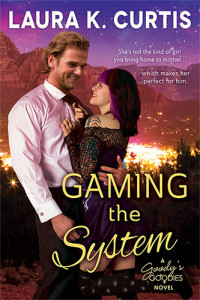 The new Goody’s Goodies book is here! Gaming the System has gotten some pretty good reviews at Goodreads already. You’ve probably heard me natter on about my punk-goth sex toy saleswoman heroine before if you follow me on social media, and I am so happy you’re finally getting to meet her!
And since I know a lot of folks like to read from the beginning of a series, I have put the first Goody’s Goodies novel, Toying With His Affections, down to free everywhere. Amazon has refused to price match thus far, only putting it down to 99¢, but I have hopes that they’ll get around to it sooner or later.
•••
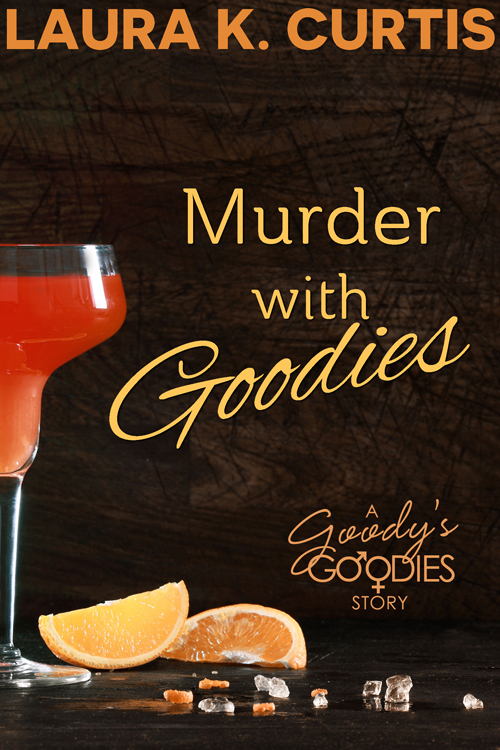 Also, if you haven’t signed up for my newsletter yet and you like free stuff, you should sign up now! Later this month I will be releasing an exclusive free short mystery in the Goody’s world for newsletter subscribers only. Here’s a little peek at the cover. It’s a cozy mystery, not a romance, but it has a romantic element.
The newsletter signup form is right over in the sidebar there ————->
As you can also see from the sidebar, I’ll be reading at Lady Jane’s Salon in New York City in July and teaching a course on using a paper planner to achieve your goals at Savvy Authors in August. If you’re going to be at RWA in NYC, please let me know…I always love to meet people and I’ll be there!
The post Goody’s Goodies and Other Goodies! appeared first on Laura K. Curtis.
June 29, 2015
Cattle. And Bananas. And Flowers.
My husband and I have a timeshare and a few years back we didn’t use our week. They notified us that we were going to lose the week if we didn’t use it before August, so we went on the timeshare site and looked for places. We decided to go to Guadeloupe because it’s a relatively easy flight, the fishing is supposed to be good, and neither of us had been (this is a challenge with my husband, who used to travel for a living).
So off we went. It was fun, though my French is extremely rusty and there’s not a lot of English spoken on the island. But it was very beautiful, so here are some pictures. (They’re mostly of bulls, because one of the things we just couldn’t get over was how there were bulls everywhere. Just chained up beside the road, eating the grass. With these little tiny chains that they could break without thinking twice.
So here are some pictures from the trip (click to see the full pix). As usual, feel free to use them if you want them! They’ll go on the pictures page, too.





























The post Cattle. And Bananas. And Flowers. appeared first on Laura K. Curtis.
June 19, 2015
Not My Thoughts, but Thoughts I Share
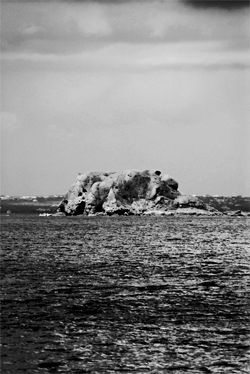 Undoubtedly, the most famous section of John Donne’s Meditation XVII is the following:
No man is an island, entire of itself; every man is a piece of the continent, a part of the main. If a clod be washed away by the sea, Europe is the less, as well as if a promontory were, as well as if a manor of thy friend’s or of thine own were: any man’s death diminishes me, because I am involved in mankind, and therefore never send to know for whom the bells tolls; it tolls for thee.
The first time I read the Meditations, I was struck by the fact that this little section, the section everyone knows, or at least the section that is vaguely familiar to most people if only from books and songs, is tucked away in the middle of the meditation, at the beginning of a much longer paragraph.
I think that it’s taken so often out of the context of the rest of the work because it has none of the religious elements of the rest of the work, but that is a shame. If you don’t have a negative reaction to spiritual texts (and believe me, I totally understand if you do), and if you’ve never read the entire Meditation, I urge you to do so. You can find here here.
If you’re confused about why this has been on my mind, you’re not paying attention.
The post Not My Thoughts, but Thoughts I Share appeared first on Laura K. Curtis.
June 3, 2015
Flowers and Rocks and Iguanas, Oh, My! More Pictures Added.
A few pictures from my vacation and the day I got back. The peonies and hydrangea are in my yard, but the other flowers and the iguanas are from St. Martin. I have no idea what they are. I love the purple and white star-shaped ones with the succulent-looking leaves. I’ve added these to the photo gallery for public use as well if anyone wants to use them for anything.
































The post Flowers and Rocks and Iguanas, Oh, My! More Pictures Added. appeared first on Laura K. Curtis.
June 1, 2015
An Open Letter to John Sandford from Leigh Neely
This is part of a series of fan letters I am hosting in the hope of introducing some of you to authors other readers are passionate about! If you have a favorite author (living or dead) you’d like to write to or about, please let me know.
 Dear John,
Though your fans are legion, I wanted you to know how much I appreciate your writing and even your comments on Facebook. It probably helps that I agree with your political views, but in my book, that just makes you a better writer.
You are at the top of my short list of writers I buy in hardback. I’ve read all your novels. In fact, I always put your release dates on my calendar when they’re announced. I even looked up some of your articles. Guess what. I enjoyed those too.
Your writing style appeals to me in so many ways. It’s clear, concise, and at times, breathtaking. You write with a journalist’s eye for the big questions: who, what, when, where, and best of all, why. Your writing had an intuitive air I envy so much. You obviously understand the psychological elements of your characters and the inner motivations for their actions. Your humor keeps me laughing. Life is nothing without humor, and as the cousin of a homicide detective, I truly appreciate that he’s one of the funniest people I know.
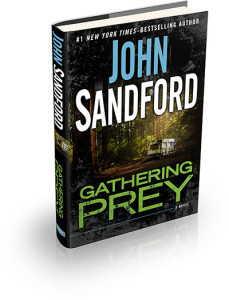
I’m sure you do extensive research for these books, but that doesn’t get in the way of a damn good story…ever. When I read the Facebook posts, yours and your son’s, I’m always baffled by those party poopers who want to point out what you did wrong. There are errors in all novels, but I seldom notice them in yours because I’m so anxious to find out what’s going to happen next. I recently read Gathering Prey in a day and a half. Thank goodness I work from home so I was able to read until the wee hours without worry.
I met Lucas Davenport through an audiobook. Unlike Lucas, I don’t listen to music much (but when I do, my list is similar to his), I listen to audiobooks in my car. Normally I’d listen to these books, and then I’d trade them for others at the used bookstore. But after I listened to my first Prey novel, I headed to the bookstore to start at the beginning, Rules of Prey, which features an appropriately named killer called Mad Dog. Is there anything more chilling than a crazed killer contemplating his latest murder by thinking, “She had never seen her sixteenth year” with absolute pleasure?
Lucas is a close friend to me now. I love his reckless way of hunting the bad guys and his impeccable taste in clothes and cars. He’s intelligent, charismatic, and damned good looking. In spite of his need to take risks, I believe he enjoys life. Like any good hero in a novel, he’s neither completely good nor completely bad. That’s the beauty of a character that stays with you. However, there’s one thing you know for certain—when Lucas gets a bad man or woman in his sights, he’s relentless until justice is served. He may serve his own kind of justice, but it’s never a disappointment for me when he does.
I love Dale, Shrake, Jenkins, and Sandy, but I have to say my favorite supporting characters are Letty and Weather. I seldom cry when I read books, but the ones that have featured these two prominently brought me to tears on more than one occasion. It has been wonderful to watch the resourceful Letty grow up with Lucas and Weather. What Lucas feels for his adopted daughter is very special, and the relationship between him and Weather is just plain great. I especially like that they have added the two babies to the household. The fact that he has never cheated on her is amazing in this age of adultery being almost in vogue.
To write these rich, compelling stories time after time is a gift, and apparently yours is boundless. Here’s one of my favorite scenes from Gathering Prey.
He made the cabin by three in the morning, stopping once at an all-night gas station in Hayward for gas, Diet Coke, a quart of milk, and a box of Honey Nut Cheerios. The cabin was dark and absolutely silent as he bounced up the driveway, until he triggered the motion-sensor floodlight on the garage. The only other visible light was on his neighbor’s porch. He was unlocking the front door when the neighbor came out in a T-shirt and underpants and yelled, “Lucas?”
“Yeah, it’s me.”
“Good, I don’t have to shoot you. How long you up for?”
“Just overnight,” Lucas yelled back.
“Have a good one.”
He went inside and had a bowl of cereal, the moon hanging low out over the lake, putting a long streak of silver on it. It was cool, almost cold. He got a spinning rod from a closet, went out on the dock and spent five minutes casting a Rapala into the moonshine, trying for bass or pike, but not trying too hard, smelling the North Woods night, looking at all the little dots of light from the cabins around the lake; then he went inside and tried not to dream about Skye, and what might have happened to her.
I was there with Lucas, smelling the clean, crisp night air, feeling my muscles relax because I was in a good place, and trying to avoid thinking of the reality for a young girl with rash judgement. I can find scenes that touch me like this one in every one of your books, John. Every time I finish one, I have a great fear there won’t be a next one.
 Alas, I’m a woman with no morals when it comes to your men for I am also deeply in love with Virgil Flowers. Again, I can see him as easily as if he were standing next to me. The long, blonde hair, the sinewy body, the wolf’s gleam in his eyes, and the smile that makes every woman wish she looked like Jennifer Anniston so she’d be worthy of sleeping with “that fucking Flowers.”
I love Virgil’s thoughtful nature and how he wishes he never had to use his gun. The characters he deals with in the little towns that fill Minnesota are priceless. The humor makes me laugh out loud.
In this scene where I first met Virgil Flowers, I felt a kinship I’ve never felt with another hero. I was raised in the South and though I’m a liberal thinker, I grew up in a nest of independent, fundamental, premillennial, Bible-believing, missionary Baptists. When I began thinking for myself, I realized I no longer wanted to blindly accept what my parents and my pastor had always told me. That’s why Virgil is quite literally my soulmate.
Every night, before he went to bed, Virgil Flowers thought about God.
The practice was good for him, he believed, and saved him from the cynicism of a cop’s life. Virgil was a believer. A believer in God and the immortal soul, though not in religions—a position that troubled his father, a Lutheran minister of the old school.
“Religion is a way of organizing the culture, your relationship to God and the people around you,” his father argued the last time Virgil went back home. “It’s not a phone booth to God. A good religion reaches wider than that. A good religion would be a value in itself, even if God didn’t exist.”
Virgil said, “My problem with that is I don’t believe God cares what we do. Everything is equally relevant and irrelevant to God. A religion is nothing more than a political party organized around some guy’s moral views, Confucius, Buddha, Jesus, Mohammed, like conventional political parties are organized around some guy’s economic views. Like Bill Clinton’s.”
His father disdained Bill Clinton, but he took the shot with appreciation.
I absolutely love this scene. If I told my mom I disagreed with her political or religious views, she’d be so upset she’d cry for days and spend the rest of her life trying to get me to admit I was wrong. So I just keep my mouth shut and enjoy my personal relationship with God and politics.
Virgil and his dad, however, do it the right way.
Virgil had been raised in a church, and the problems his father dealt with, he thought, would have driven him crazy. It’s relatively easy to solve a problem with a gun and a warrant and a prison; but what do you do about somebody who is unloved?
Better, Virgil thought, to carry a badge, and maintain your amateur status when it came to considering the wonders of the universe.
There are all kinds of writers, but you, John Sandford, are one of those rare ones—a consistently good storyteller. Just wanted you to know I appreciate it and hope you can keep writing forever.
Sincerely,
Leigh Neely
Leigh Neely writes paranormal fiction with co-writer, Jan Powell. A former newspaper and magazine editor, Leigh is also a prolific nonfiction writer. She is the author of “A Vampire in Brooklyn,” featured in Murder New York Style: Fresh Slices, and “My Brother’s Keeper,” a short story in Murder New York Style: Family Matters.
The post An Open Letter to John Sandford from Leigh Neely appeared first on Laura K. Curtis.