Laura K. Curtis's Blog, page 3
February 15, 2017
At The Water’s Edge, a TBR Challenge Read
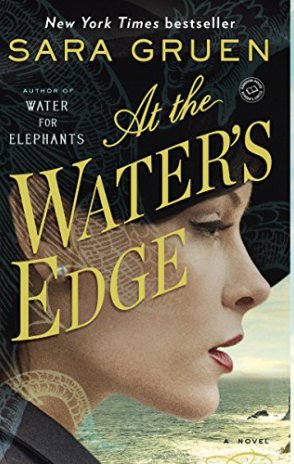 The theme this month was to read a “new to you” author. I love this cover, and I’d meant to read Water for Elephants when it came out but never got around to it, so I figured it was time.
This was a perfectly decent romance novel, but I resent the fact that it was sold as more than a genre novel.There’s nothing particularly special about it. The language is direct and simple, the tropes are familiar to any genre romance reader, and there are no real twists.
Don’t get me wrong, I do like a good romance. But I wouldn’t pay nearly this much for one. Between the cover, the price, and the “A Novel” on the cover, I expected a much more absorbing read. On the other hand, the fact that I knew at the outset that there was going to be romance was the only thing that kept me reading for the first section during which I hated, hated, hated ALL the characters.
I am a huge fan of mainstream (or even literary) fiction novels that have a romance in them. For example, almost any of the books in this post fall into such a category. That’s what I expected from At The Water’s Edge. But what I got was a straightforward historical romance (set during WW II) with a bit of a twist in the form of the Loch Ness monster. And a bunch of grim trimmings I felt were thrown in because the author wanted to give the book heft, as if she were deliberately trying to avoid having her book referred to as a romance.
My recommendation? If you’re looking for a WW II-set romance with a good period feel, take this one out of the library. But don’t pay full price for it or expect too much.


January 18, 2017
The Mammoth Book of Ghost Stories by Women, A TBR Challenge Read
25 chilling short stories by outstanding female writers.
Women have always written exceptional stories of horror and the supernatural. This anthology aims to showcase the very best of these, from Amelia B. Edwards’s ‘The Phantom Coach’, published in 1864, through past luminaries such as Edith Wharton and Mary Elizabeth Braddon, to modern talents including Muriel Gray, Sarah Pinborough and Lilith Saintcrow.
From tales of ghostly children to visitations by departed loved ones, and from heart-rending stories to the profoundly unsettling depiction of extreme malevolence, what each of these stories has in common is the effect of a slight chilling of the skin, a feeling of something not quite present, but nevertheless there.
If anything, this showcase anthology proves that sometimes the female of the species can also be the most terrifying . . .
Last year, I went to the Dublin Ghost Story Festival. It was amazing. Fabulous writers talking about tales both old and new, booksellers hawking macabre items, and a deep dive into what makes the ghost story such a special genre. And even some free books! I brought home The Mammoth Book of Ghost Stories by Women and set it aside. I was writing my own ghost story; I would get to these later.
I am only sorry I waited so long. As in any anthology, there are better and worse stories. Some of the better ones were chilling, some were action-packed, some were touching. I’d say about 80% of the stories held my attention, maybe 20% were a slog to get through, either because they were predictable or because the tone fell flat. But that’s not a surprise in a book as varied as this one.
I wouldn’t call this a horror anthology per se, because some of the stories are not horrific at all. It’s the odd thing about ghost stories—they’re hard to classify.
Ghost stories are a natural genre to anthologize as for the most part they are short, though exceptions certainly exist (like Joe Hill’s Heart-Shaped Box and Cherie Priest’s The Family Plot). The ghost story is as much about tone as it is about plot, and that’s difficult to sustain through a whole novel—both for writer and reader. The better of these stories are true little gems, packing a wallop of emotion into a tiny space.
Overall evaluation: B+, definitely worth the money!
Save
November 12, 2016
Thoughts on Fear and Hatred
 From kindergarten to senior year, I attended a school that charged a fortune in tuition to the wealthiest students specifically so that it could offer scholarships—either partial or full—to the rest. It was vital to them that we did not grow up insulated by socio-economic position, either for better or worse. I did not know that at the time, of course. All I knew in third grade was that we could play some games at one friend’s house that there was no room for at another. Because the school was in New York, we also had quite a diverse student body…though we were all female.
At eighteen, I moved to the Midwest and got my first taste of racism. It came as a shock, and it took me a long time for me to understand where it came from, but after several years (yes, I am slow) I began to understand that it was always, always rooted in fear. Many times, hate is taught, passed down generation to generation, long after the fear that originally generated it is gone.
I don’t personally think there’s anything you can do to combat hate in a 50-year-old who’s spent their whole life soaking it in, but you can alleviate the fear in a 10-year-old, a 15-year-old. You can open minds and hearts in younger people. That’s not a hopeful statement right now because we’re drowning in hate in this country and we have hateful, fearful people who will be appointing judges to the Supreme Court, who are then likely to make their decisions out of that same brew of hate and fear. The open-minded children won’t be able to make changes in any of the decisions those people make for decades.
The thing is, this whole country is afraid. The groups who are hated simply because of the way they were born fear for their lives. The people with crappy jobs (or no jobs) fear they won’t be able to put food on the table or a roof over their heads, which means that they, also, fear for their lives. The well-off fear losing their wealth; being unable to pay, for example, for a Harvard education for their children. That may seem trivial to some of us, but it’s a very real fear for people who have brought their children up for, say, sixteen years believing that they will be able to go if they get in.
 Still, the first two groups obviously have more vital fears. And the fears of the first group are, in large part, rooted in the fears of the second. That is, if the fears of the second group did not breed hatred for those who look different, who sound different, who love or worship differently, the second group wouldn’t be afraid.
Fear requires a target. Everyone wants to be able to alleviate their fears, and the easiest way to do that is by blaming someone else for the problem. People who don’t have jobs, who are afraid of losing their jobs, are afraid of losing their entire way of life, need someone to blame. And it’s easier to blame the scapegoat when it has a face, one you can easily pick from a crowd.
In fact, despite much of the rhetoric of this election period, the “other” jobless Americans face isn’t China or India or Mexico—at least it is not only those countries, and it is certainly not the Americans who have immigrated from those places. The “other” we face as we look to the future is not even human. We created it. We automated, driving workers off the assembly line. We created machines that do what humans do for a fraction of the cost and employed them, rather than people, on farms and in factories. Hell, they even work for collection agencies and campaigns, calling us 9000 times a day.
But it is not easy to blame the march of time. It is not easy to blame progress or overpopulation or technology. That’s not how we’re made.
So as I see it (I know, it took me forever to get here), while we protect PoC, LGBT+, women, and non-Christians of all stripes today, we have to simultaneously protect future generations of those same endangered people. And the only way to do that, as I see it, is to change our entire educational system so that students are prepared for actual life. Life as it is today, not as it was five, ten, twenty, fifty years ago. To prepare them to face the future without the same fears that are smothering their parents and grandparents. To teach them to desire the future. I have ideas on what would improve our system, but I see no way to get those ideas put into place.
Make no mistake, I am not calm. I am absolutely furious that so many people let their fear and hatred control them. But I am a practical person and the way I see it, those people will continue to behave in exactly the same manner unless something is done. Yes, some people get off on hatred and love violence for the sake of violence, but we can quell those if we can bring the rest to reason.
As I said, I don’t know how to implement the sweeping changes our educational system needs. Still, individual teachers are out there trying to teach their students useful things, and the children who were sixteen and seventeen for this election will be eighteen at midterms. I encourage you to find teachers with exciting, mind-opening projects, and help them. If you have money, you can donate to classrooms through DonorsChoose.org. If you don’t have money, do some research on children’s books or YA books that teach tolerance and then offer at your local library to lead discussions on them. If you’re technically or technologically minded, offer your time to teach those skills to young (and older) people.
Those of us who want to stamp out hate, or at least stamp out as much of it as we can, have a big job ahead of us. It’s easy to say that love trumps hate, easy to wear a safety pin and think that’s enough, but that’s how we got here. (I’m not telling you not to wear the pin, just to do more.) Most of us don’t like confrontation, but we have to be willing to suck up our own discomfort and do the right thing.
The progressive agenda will always require more effort because it requires complex policies and long term planning rather than “turn this off, say no to that, and don’t do the other.” But just because it’s hard doesn’t mean it’s not worth doing. So I’ll leave you with some people working toward it every day:
The ACLU
The Brennan Center for Justice
Donors Choose
The Electronic Frontier Foundation
Emily’s List
Planned Parenthood
The Southern Poverty Law Center
Anything you do for these organizations will help both present and future generations.
Now, go forth and be fabulous. Read and write and create art that celebrates the diversity of the world in all its glory.
August 17, 2016
So Cold the River, a TBR Challenge Post
 Well, I completely flunked on this month’s theme. I did read a Phyllis A Whitney from long ago, but it was a re-read, so I can’t count it as part of my TBR elimination. Instead, I went for the boook I think has been hanging around my TBR longest. I had Koryta’s book in print, which means I picked it up at a conference or award ceremony or event of some kind because I really wanted it. And yet, it remained unread.
So Cold The River is creepy, mysterious, and fun. It walks the line between horror and thriller, not quite one or the other. I guess its a paranormal thriller. I almost want to call it Gothic, but I cannot quite because the villain of the piece is too clear, too vividly pictured, and I tend to think of Gothic as hinted at without being seen. The plot is an unusual one:
It started with a beautiful woman and a challenge. As a gift for her husband, Alyssa Bradford approaches Eric Shaw to make a documentary about her father-in-law, Campbell Bradford, a 95-year-old billionaire whose past is wrapped in mystery. Eric grabs the job even though there are few clues to the man’s past–just the name of his hometown and an antique water bottle he’s kept his entire life.
In Bradford’s hometown, Eric discovers an extraordinary history–a glorious domed hotel where movie stars, presidents, athletes, and mobsters once mingled, and hot springs whose miraculous mineral water cured everything from insomnia to malaria. Neglected for years, the resort has been restored to its former grandeur just in time for Eric’s stay.
Just hours after his arrival, Eric experiences a frighteningly vivid vision. As the days pass, the frequency and intensity of his hallucinations increase and draw Eric deeper into the town’s dark history. He discovers that something besides the hotel has been restored–a long-forgotten evil that will stop at nothing to regain its lost glory.
Eric is not an entirely likeable character, and if there’s one flaw in the book it’s that I never felt particularly sympathetic toward his situation. A former Hollywood filmmaker, he lost his reputation because of what seems to me—and it may only be to me because of my own personality—to be an immature tantrum. And then his marriage imploded (also his fault), so this job, the Campbell Bradford job, is what he has left in his life.
The book ends hopefully (as most of you who know me know I require in order to fully enjoy a book), but I never feel as if Eric takes control of his life, as if he deserves to “win.” In fact, the main “good guys” are far less interesting than the main “bad guys.”
On the other hand, the writing is beautiful, the villain(s) well-developed, and the tension and mystery held masterfully. It’s definitely worth a read.
Save
Save
Save
August 9, 2016
Character Creation: Mayonnaise, Psychology, and Culture
 Approximately one hundred years ago, when I took an intro to psychology class in college, my professor said he was going to do an experiment to show us why, if we went into psychology as a profession, we needed to know about a client’s history. The client, he told us, might insist that he was only seeing us for some recent trauma, but we needed to know more because without building a full picture of who they were, we could never understand their reactions nor help them to understand what they were going through.
In a class of about 125-150 students, he asked all the Christians to stand up. Not practicing, he said, but anyone who grew up with that background. Even if you wouldn’t mention it in general, just get on your feet. Probably 2/3 of the room stood up, maybe a bit more.
“Now,” he said, “if you’ve ever tried Miracle Whip, like it or not, remain standing.” Maybe one person sat down, but if they did, I didn’t notice.
“Okay,” he said. “Everyone sit down. People with Jewish backgrounds, on your feet.” I looked around at the other thirty or so people standing in that room with me and though to myself that Miracle Whip was disgusting, something I was certain of though I had never tried it myself.
“Same question,” he said. “If you’ve eaten Miracle Whip, remain standing.”
All of us sat down.
He went on to discuss why this was, the fact that Jewish culture, even in the most reformed communities, has had food restrictions for such a long time that they have become ingrained. Even when people who would eat a pork chop, or a bacon-cheeseburger, still wouldn’t eat any mayonnaise other than Hellman’s.
There was a lot more, too, but it’s been about a hundred years since my Freshman year in college. Still, the idea has stuck with me. So next time you’re writing a character, ask what foods s/he grew up with, and more importantly why. And don’t go for the easy answer.
July 18, 2016
Square Peg, Round Hole: The Constriction of Genre
 This past week was the RWA national conference in San Diego. I’ve gone to national for mmmmppph years and I’ve always had a good time. Some years are more useful than others, but I have a lot of friends in the organization so it’s always fun.
But conferences are for more than fun, and national conferences—Bouchercon, Thrillerfest, RWA, RT—are expensive, and every year it becomes harder to justify, especially when I no longer really write romance. If I find a new agent at conference, won’t she mostly be romance? Will she have the kinds of connections I want with editors who might publish books in the direction I am going now?
But on the other hand, what conference might do a better job? If I no longer write romance, I don’t write mystery or thriller or horror, either. There are elements of all three in the two books I am in the process of editing. One has a bit of romance, one has almost none. One has a ghost, one does not. They both have relatively young heroines, but neither qualifies as YA by a long shot. I’m a member of MWA, RWA, ITW, and will probably end up joining HWA sooner or later, too. But I don’t feel my style fits solidly inside any of those genres.
As a person with a background in marketing, this kind of thing drives me batty. If I don’t know where the book fits, how do I expect an agent or editor to place it? It’s fiction that’s written for women, but I am not sure anyone would consider it women’s fiction.
And no, what I am currently writing is not suitable for self-pub. It is book club and library fodder. It needs wide print distribution, not a trickle of library sales when I can make it to a new system to donate it or sit on a panel.
When I was at RWA, people asked me what I was writing. What they wanted was “romantic suspense” or “new adult” or “contemporary” or “historical” or whatever. I couldn’t answer that. Someone said “what RITA category would you enter it in?” To that I said “none of them.” It was pretty much the most telling moment of the conference for me.
So I’ll be reevaluating my career in coming weeks and months. I’ll keep you up to date.
Save
July 8, 2016
The Brain Game
 Here we are again. Those of you who’ve known me a long time will know this is not the first — or worst — time that my epilepsy medications have stopped working. But every time it happens it’s a gigantic pain.
Someone asked me the other day how I know when they’re not working (what makes me go get an EEG after 8 years of successful treatment with a medication). For me, the symptoms look something like this:
Suddenly realizing in the middle of a conversation that I don’t know what someone is talking about
Looking at my computer screen/book page and realizing I don’t know what I’ve read
Reaching for a word and finding it just not there (not a complicated word, but a word like “dog” or “house”)
Forgetting what I am saying halfway through a sentence
Forgetting activities, to-dos, promises, responsibilities, even though I’ve written them down and looked at them several times
Feeling disconnected from life, as if there’s a cotton barrier around me that I can’t quite reach the rest of the world through
That’s what drove me to the doctor, what made her give me an EEG & MRI & do a level check on the Depakote I’ve been taking since 2008. The results:
The level of Depakote in my blood is not noticeably different than it was a year ago when the drug was working
The EEG shows multiple “absence” seizures, most of which are a second or less, but the longest of which was nine seconds
The MRI shows brain abnormalities (but if you know me, you know my brain’s never been normal) that are likely caused by seizures and should resolve if we can eliminate the seizures. These are not tumors or anything else dangerous. They’re just sort of tissue toughening caused by seizure activity.
So, what do they do when this happens? It’s different every time. In 2005, the seizure activity was much worse. I could barely finish a single sentence. But I’d been on the same drug for 21 years, so there was a whole host of drugs they could try. The very first one they switched me to worked great. Until, in 2007, I developed a toxic reaction to it. In 2008, after trying several other drugs, I was put on Depakote, which has been working until now.
So, what now? Since Depakote worked really well and the seizure activity isn’t as extreme as it was in 2005 (and for a number of other medical reasons), the first thing we’ll try is raising my dosage. After a couple of weeks, I’ll have a blood test to see whether taking more of the drug orally has significantly raised the level in my blood. A couple of weeks after that, another EEG. And a month after that, another MRI.
With a little luck, that will fix the problem. If I’m not lucky, it’s wash, rinse, repeat on the drugs, EEG, MRI until we find a cocktail that works. Luckily, in the eight years I’ve been on Depakote, a couple of new medications have been invented, so while Depakote was court of last resort when I first tried it, there are new things to try if raising the dose doesn’t work.
So if I am even more ditzy than usual in the next month or two, that’s why. And with a little luck, I’ll be back to regular-level-ditz sooner rather than later.
June 16, 2016
The Settings Thesaurus Set…The Thesauri You Didn’t Know You Needed
(A cross-post from Angela Ackerman. I have the Emotion Thesaurus and plan to get the settings books as well, so I’ve given her the floor to discuss the settings thesauri on this, the week of their release.)
It is a writer’s job to draw readers into the fictional story so completely that they forget the real world. Our goal is to render them powerless, so despite the late hour, mountain of laundry, or workday ahead, they cannot give up the journey unfolding within the paper-crisp pages before them.
Strong, compelling writing comes down to the right words, in the right order. Sounds easy, but as all writers know, it is anything BUT. So how do we create this storytelling magic? How can we weave description in such a way that the fictional landscape becomes authentic and real—a mirror of the reader’s world in all the ways that count most?
 Well, there’s some good news on that front. Two new books have released this week that may change the description game for writers. The Urban Setting Thesaurus: A Writer’s Guide to City Spaces and The Rural Setting Thesaurus: A Writer’s Guide to Personal and Natural Spaces look at the sights, smells, tastes, textures, and sounds a character might experience within 225 different contemporary settings. And this is only the start of what these books offer writers.
In fact, swing by and check out this hidden entry from the Urban Setting Thesaurus: Police Car.
And there’s one more thing you might want to know more about….
 Becca and Angela, authors of The Emotion Thesaurus, are celebrating their double release with a fun event going on from June 13-20th called ROCK THE VAULT. At the heart of Writers Helping Writers is a tremendous vault, and these two ladies have been hoarding prizes of epic writerly proportions.
A safe full of prizes, ripe for the taking…if the writing community can work together to unlock it, of course.
Ready to do your part? Stop by Writers Helping Writers to find out more!
June 15, 2016
Worth Every Penny
So I am switching it up a little this month. Instead of doing a single book review for the TBR Challenge, I am going to talk about a bunch of books, all with (at least relatively) happy endings, that cost more than you might usually spend on a book but are worth every penny. If you can’t afford them, see whether your library has them or can order them for you!
 Simone St. James: Lost Among the Living
All St. James’s books are good and they are all priced between 9.99 and 11.99 in ebook format. This one and An Inquiry into Love and Death are my favorites. Her books are all standalones, so there’s no need to worry about series.
England, 1921. Three years after her husband, Alex, disappeared, shot down over Germany, Jo Manders still mourns his loss. Working as a paid companion to Alex’s wealthy, condescending aunt, Dottie Forsyth, Jo travels to the family’s estate in the Sussex countryside. But there is much she never knew about her husband’s origins…and the revelation of a mysterious death in the Forsyths’ past is just the beginning…
All is not well at Wych Elm House. Dottie’s husband is distant, and her son was grievously injured in the war. Footsteps follow Jo down empty halls, and items in her bedroom are eerily rearranged. The locals say the family is cursed, and that a ghost in the woods has never rested. And when Jo discovers her husband’s darkest secrets, she wonders if she ever really knew him. Isolated in a place of deception and grief, she must find the truth or lose herself forever.
And then a familiar stranger arrives at Wych Elm House…
 Tim Farrington: The Monk Downstairs
I’d call this book somewhere between lit fic and women’s fiction, despite it being written by a man. It’s a gentle story of two people finding their way to an active life after hiding away. There’s a sequel, but I didn’t read that.
Rebecca Martin is a single mother with an apartment to rent and a sense that she has used up her illusions. But when the new tenant in her in-law apartment turns out to be Michael Christopher, on the lam after twenty years in a monastery and smack dab in the middle of a dark night of the soul, Rebecca begins to suspect that she is not as thoroughly disillusioned as she had thought.
Her daughter, Mary Martha, is delighted with the new arrival, as is Rebecca’s mother, Phoebe, a rollicking widow making a new life for herself among the spiritual eccentrics of the coastal town of Bolinas. Even Rebecca’s best friend, Bonnie, once a confirmed cynic in matters of the heart, urges Rebecca on. But none of them, Rebecca feels, understands how complicated and dangerous love actually is.
As her unlikely friendship with the ex-monk grows toward something deeper, and Michael wrestles with his despair while adjusting to a second career flipping hamburgers at McDonald’s, Rebecca struggles with her own temptation to hope. But it is not until she is brought up short by the realities of life and death that she begins to glimpse the real mystery of love, and the unfathomable depths of faith.
 Lyndsay Faye: Jane Steele
If you know me at all, you already knew this book would be on the list. You can read my review, or the review at Smart Bitches, Trashy Books, or just google any of the comments about it anywhere. You need to read this book. It’s better if you have at least a vague memory of Jane Eyre, but that’s not an absolute necessity.
A sensitive orphan, Jane Steele suffers first at the hands of her spiteful aunt and predatory cousin, then at a grim school where she fights for her very life until escaping to London, leaving the corpses of her tormentors behind her. After years of hiding from the law while penning macabre “last confessions” of the recently hanged, Jane thrills at discovering an advertisement. Her aunt has died and her childhood home has a new master: Mr. Charles Thornfield, who seeks a governess.
Burning to know whether she is in fact the rightful heir, Jane takes the position incognito and learns that Highgate House is full of marvelously strange new residents—the fascinating but caustic Mr. Thornfield, an army doctor returned from the Sikh Wars, and the gracious Sikh butler Mr. Sardar Singh, whose history with Mr. Thornfield appears far deeper and darker than they pretend. As Jane catches ominous glimpses of the pair’s violent history and falls in love with the gruffly tragic Mr. Thornfield, she faces a terrible dilemma: Can she possess him—body, soul, and secrets—without revealing her own murderous past?
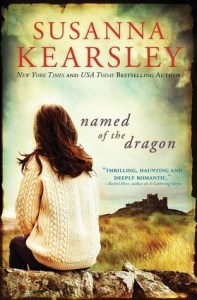 Susanna Kearsley: Named of the Dragon
Like Simone St. James, all of Kearsley’s books are expensive, and all of them are worth reading. The fact that this is my favorite is probably mostly because it is wrapped up in Arthurian legends. But if your library has any of Kearsley’s books, you can get a feel for what she writes by picking up whatever they have. Kearsley’s books combine two stories—one historical and one contemporary.
The charm of spending the Christmas holidays in South Wales, with its crumbling castles and ancient myths, seems the perfect distraction from the nightmares that have plagued literary agent Lyn Ravenshaw since the loss of her baby five years ago.
Instead, she meets an emotionally fragile young widow who’s convinced that Lyn’s recurring dreams have drawn her to Castle Farm for an important purpose–and she’s running out of time.
With the help of a reclusive, brooding playwright, Lyn begins to untangle the mystery and is pulled into a world of Celtic legends, dangerous prophecies, and a child destined for greatness.
 Carol Goodman: The Ghost Orchid
Goodman’s books are mysteries with a touch of paranormal and romance. This one is my favorite. Don’t read Goodman’s books in a glom because she repeats themes over and over, but if your library doesn’t have this one, you can probably read most of her other adult books without a problem. (I haven’t tried the YA ones.) It’s worth noting that if you really loathe first person present, you won’t want to read Goodman. It’s not usually my favorite kind of storytelling, but it suits her stories well.
For more than one hundred years, creative souls have traveled to Upstate New York to work under the captivating spell of the Bosco estate. Cradled in silence, inspired by the rough beauty of overgrown gardens and crumbling statuary, these chosen few fashion masterworks–and have cemented Bosco’s reputation as a premier artists’ colony. This season, five talented artists-in-residence find themselves drawn to the history of Bosco, from the extensive network of fountains that were once its centerpiece but have long since run dry to the story of its enigmatic founder, Aurora Latham, and the series of tragic events that occurred more than a century ago.
Ellis Brooks, a first-time novelist, has come to Bosco to write a book based on Aurora and the infamous summer of 1893, when wealthy, powerful Milo Latham brought the notorious medium Corinth Blackwell to the estate to help his wife contact three of the couple’s children, lost the winter before in a diphtheria epidemic. But when a séance turned deadly, Corinth and her alleged accomplice, Tom Quinn, disappeared, taking with them the Lathams’ only surviving child.
The more time she spends at Bosco, the more Ellis becomes convinced that there is an even darker, more sinister end to the story. And she’s not alone: biographer Bethesda Graham uncovers stunning revelations about Milo and Corinth; landscape architect David Fox discovers a series of hidden tunnels underneath the gardens; poet Zalman Bronsky hears the long-dry fountain’s waters beckoning him; and novelist Nat Loomis feels something lingering just out of reach.
After a bizarre series of accidents befalls them, the group cannot deny the connections between the long ago and now, the living and the dead . . . as Ellis realizes that the tangled truth may ensnare them all in its cool embrace.
 Joe Hill: Heart-Shaped Box
This is straight-up horror, but it does have a happy enough ending, so even though most of the people who stop by my blog are romance readers, if they don’t mind having their pants scared off, they’ll like this. Hill accomplishes something really wonderful with this book in that while the hero is truly nasty at the beginning of the book, we’re very quickly on his side and rooting for him. It’s a fantastic read.
Judas Coyne is a collector of the macabre: a cookbook for cannibals . . . a used hangman’s noose . . . a snuff film. An aging death-metal rock god, his taste for the unnatural is as widely known to his legions of fans as the notorious excesses of his youth. But nothing he possesses is as unlikely or as dreadful as his latest discovery, an item for sale on the Internet, a thing so terribly strange, Jude can’t help but reach for his wallet.
For a thousand dollars, Jude will become the proud owner of a dead man’s suit, said to be haunted by a restless spirit. He isn’t afraid. He has spent a lifetime coping with ghosts—of an abusive father, of the lovers he callously abandoned, of the bandmates he betrayed. What’s one more?
But what UPS delivers to his door in a black heart-shaped box is no imaginary or metaphorical ghost, no benign conversation piece. It’s the real thing.
And suddenly the suit’s previous owner is everywhere: behind the bedroom door . . . seated in Jude’s restored vintage Mustang . . . standing outside his window . . . staring out from his widescreen TV. Waiting—with a gleaming razor blade on a chain dangling from one bony hand. . .
 Elinor Lipman: The Inn at Lake Devine
Wonderful women’s fiction/lit fic with a slow pace, a great deal of humor, and a happy ending.
It’s the early 1960s and Natalie Marx is stunned when her mother inquires about vacation accommodations in Vermont and receives a response that says, “The Inn at Lake Devine is a family-owned resort, which has been in continuous operation since 1922. Our guests who feel most comfortable here, and return year after year, are Gentiles.”
So begins Natalie’s fixation with the Inn and the family who owns it. And when Natalie finagles an invitation to join a friend on vacation there, she sets herself upon a path that will inextricably link her adult life into this peculiar family and their once-restricted hotel.
 Graeme Simsion: The Rosie Project
Hilarious women’s fiction/romantic comedy. There’s a follow-up, but I haven’t read it.
The art of love is never a science: Meet Don Tillman, a brilliant yet socially inept professor of genetics, who’s decided it’s time he found a wife. In the orderly, evidence-based manner with which Don approaches all things, he designs the Wife Project to find his perfect partner: a sixteen-page, scientifically valid survey to filter out the drinkers, the smokers, the late arrivers.
Rosie Jarman possesses all these qualities. Don easily disqualifies her as a candidate for The Wife Project (even if she is “quite intelligent for a barmaid”). But Don is intrigued by Rosie’s own quest to identify her biological father. When an unlikely relationship develops as they collaborate on The Father Project, Don is forced to confront the spontaneous whirlwind that is Rosie―and the realization that, despite your best scientific efforts, you don’t find love, it finds you.
So there you have it. A list of some of my favorite authors and books that are worth reading despite the fact that they are not cheap. Some day, there will be a “pricewatcher” app that allows you to watch any books you’re interested in the way you watch flights to see when they drop in price. But for the moment, these are worth every penny of full price. At least in my opinion.
Save
Save
Save
June 9, 2016
On Alcohol and Crime
 I have some thoughts. They won’t be particularly fun, so feel free to move along. I won’t blame you.
Many of you know that I rarely drink, and never in large groups. I’ve been a non-drinker for more than thirty years, so I hardly think about it any more. I spend a huge amount of time at bars—it’s part of life in the writing and publishing world—but no one has ever blinked at my request for a cranberry juice and soda.
But I was not always this way. When I was a kid, the drinking age was eighteen and bartenders didn’t care if you were fifteen as long as you had some kind of vaguely passable fake ID that they could say they’d looked at. I graduated from high school an A student and a blackout drunk. And I wasn’t the only one. My friends—both male and female—had been drinking as long and as hard as I had.
Some people seem to believe that alcohol fundamentally changes your personality. It doesn’t. I was depressed before I started drinking and I was depressed while I was drinking. I was paranoid before I started drinking and while I was drinking. I was ashamed of my body before I went to parties and I continued to be ashamed of my body while I was at those parties downing tequila. I wasn’t going to be the girl who pulled off her top at a party because I wasn’t the kind of girl who repressed a desire to to do so until alcohol loosened her inhibitions.
Which is what alcohol does. It releases the constraints of the super-ego. The things that are embarrassing, the things you long to say and do but never would for fear of consequences, those are things you do when you are under the influence. In vino veritas, as they say. Your tongue runs away with you, spilling the things you’ve held in for fear of being judged. Secretly a bigot? Yeah, that will pop right out. But if you’re not a bigot, alcohol won’t suddenly force you to make racist remarks. If you’re the kind of person who wishes she could dance on a table but is afraid to do so because people might make fun of you, you’re going to dance on the table. If you hate the very idea of being the center of attention, you’re not going to dance on the table no matter how much you drink.
Alcohol doesn’t stop you from understanding the difference between right and wrong. I promise you, it doesn’t. “Why do people drink and drive, then,” you ask, because surely they know that’s wrong? They do. They just don’t realize, when drunk, that they’re drunk. If you stop them and say “is drunk driving wrong,” they’ll still say yes. But they’ll also say “I haven’t drunk enough to affect my reflexes.” That’s an error in judgment based on alcohol. Because, yes, alcohol damages your judgment, but it doesn’t change your basic desires or personality.
For two years of college, I maintained a 4.0 GPA at a competitive university while drinking myself into a stupor two, sometimes three times a week. How is such a thing possible? Because getting good grades, succeeding academically, was so ingrained as a priority in my life that I would do nothing to endanger it. And that’s despite five years of drinking heavily. In those five years I screwed up a lot, but never academically and never in a way that made me the center of attention. I would have continued drinking forever, more than likely, but I had my first seizure at twenty and the first thing the doctors told me was no more alcohol. If you have enough alcohol to cause a hangover, you have enough to cause a seizure. Since I had no control over how much I drank (I might have one drink, I might have six), I went completely dry for about ten or fifteen years before allowing myself the occasional drink and only in places where, if I did have six (like at home, or on vacation with my husband while we were somewhere we didn’t have to drive), it wouldn’t matter.
So when I hear someone say that they were drunk, and that caused them to commit a horrible crime, it infuriates me. If your hold on not being a violent criminal is so tentative that alcohol can make it slip, there’s something fundamentally wrong with you that needs to be addressed. Some fundamental disrespect for not only everyone around you, but also for yourself. People with self-respect don’t desire to take whatever they can get however they can get it. That’s arrogance, not self-respect. It’s an attitude that says “I should get whatever I want,” and that attitude is dangerous. It makes you dangerous, and not only when you drink.
I have known women who have said to me in all seriousness that their partners only hit them when they’re drunk. That’s not the alcohol causing violence. It means that those guys are violent to start with. In fact, most of the time, “only when drunk” isn’t even accurate—the abusive behavior continue even during sobriety. I have a friend who was married to a man like this for years. First he was a drunk. Then he was a dry drunk, and the physical abuse stopped but the emotional abuse continued. Only after the underlying cause was treated with years of therapy did he become a decent person. Because the abusers don’t see anything wrong with emotional abuse, but the outright violence is something that might get them caught, something that they have to admit to, that they know society disapproves of, and that the super-ego prevents until alcohol disables it.
Alcohol causes a lot of problems, it’s true. Health issues, property damage, drunk driving deaths…and with the rise of social media, the potential of ruining entire futures because of the photographs and videos taken in embarrassing situations being posted to the Internet, which is forever. And alcohol abuse on college campuses needs to be addressed. But alcohol doesn’t cause rape. It doesn’t cause violence.
And it’s time to stop pretending that it does.