
Matador Network's Blog, page 2070
August 18, 2015
3 ways to spot a fake ethical brand
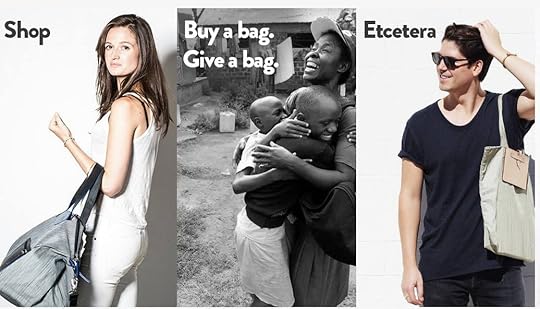
Photo: Thundress
These days it seems like everyone and their veterinarian has an ethical product company. We are bombarded with new Kickstarter campaigns for the latest organic hamster shawls or Made in the USA artisanal chamber pots. If the Internet was real life, every time we went outside we’d be surrounded by a swarm of suspendered newsies shouting “Eco-friendly! Get ya eco-friendly here!” “Fair Trade for your old maid!” “100% ethical or your money back!”
It’s at once parody á la Portlandia and a genuine sign of the times: we, the children of globalization and overinflated self-esteems, decided we would be the ones to finally stop sweatshops after hundreds of years, and then preach the gospel of conscious consumerism from the mountaintops. We might not be doing it perfectly right, but it’s definitely progress in the right direction.
But as the market for ethically produced and sustainable goods continues to grow, the number of posers, phonies and fakers will grow too.
Back when there weren’t a lot of suitors, we didn’t have the luxury of being choosy. But just like the girl that grew gigantic knockers over summer vacation, now every brand at school wants to take us to prom. And with all the newfound attention, we’d better raise our standards and get smarter about their promises of sustainably ever after. We’ll never know exactly what is happening behind a factory’s closed doors, but we can be more savvy about who we trust with our support. The goal of this article is to give you some tools to tell the fake from the real, the snake oil from the Dr. Bronner’s.
Note: I use a handful of real companies as examples in this article. I am not categorizing some some as saints and others as evil, no business is perfect. However, I do think that some brands have more work to do than others to live up to their marketing. And as consumers, we need to stop being afraid of criticizing “ethical” companies just because they mean well. Let’s all do better so that the real changemakers can rise to the top. I welcome any feedback, disagreement, questions, etc. Leave a note!
1. Photos & Language
How are the people or projects that are “benefitting” represented on the website and in other promotional material?
Whether it’s a seamstress or a poor kid who gets a free pair of shoes, these are the faces of a company’s ethical program. Pay very close attention to how they are discussed.
In photos, are the “beneficiaries” dressed in a way they would be proud of? As in, would they upload that picture to their own Facebook profile or send it to a friend?
Do the women have their hair done?
Are people fully clothed?
How do these photos compare to the photos of the models or of the company’s staff?
Are they always pictured receiving or in other passive poses?
Example #1: “Buy A Bag, Give A Bag”
I am not here to bash anyone else’s company, but this graphic makes my skin crawl and I really want you guys to understand why.
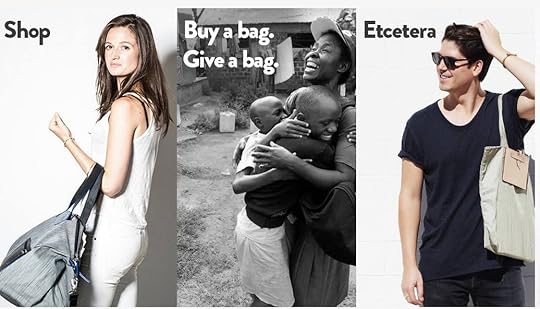
The young, slim white people are posed in color with neutral backgrounds. The black woman and her kids are not posed (are they cheering for the charity they’re receiving?), they are in black and white (either they’re so poor they can’t even afford color or it’s just really important that you don’t confuse them with the models), and we are meant to observe the “squalid” living conditions in the background. The main message here is: this single mother and her kids are so lucky that your shopping helps them.
I emailed this company and talked to a genuinely nice and well-intentioned person. I doubt he made any of these choices consciously or sees anything wrong when he looks at his website. But if you want the title of ethical/sustainable/fair trade company and the benefits that come along with it (higher price tags, warm and fuzzies), you have to actually earn it. Being nice isn’t good enough, you have to think about the impact of your work. If you don’t want the extra responsibility of thinking critically about how your “help” is paternalistic or offensive or ineffective, then don’t try to give “aid” along with your products. Some of these unexamined efforts do more harm than good.
I never did understand how giving away a bag was helpful either. Is there a purse drought somewhere that I haven’t heard about?
Example #2: Nisolo
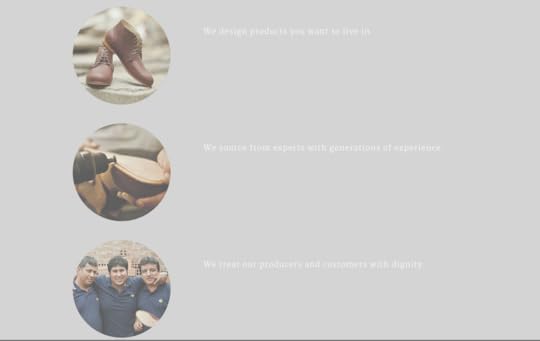
I don’t know anything about this company and have never met these people in my life. But this photo suggests that they are more likely to treat all the people who work for them — whether in the front office or in the factory — like human beings. Same color photos, same style, same format. It’s a basic message, but one that is extremely powerful in an industry characterized by routine abuse, low pay, extremely long hours, harassment, and terrible working conditions.

I am much more likely to trust a company that represents the “beneficiaries” of their work in a way that honors their humanity, instead of opening my wallet to help because I feel bad for some poor pitiful soul in some faraway country. It seems simple, but it’s pretty hard to find a factory where a workers’ dignity is truly respected — if it was that easy, sweatshops would have been eradicated long ago.
In fact, we don’t really need companies to give away free purses at all. They would be revolutionizing the world enough by paying employees fairly and treating them well, managing their environmental impact, and planning for the end-of-life of their products.
2. Details
Don’t be fooled by nice graphics or beautiful photos: pay close attention to the actual solution a company is offering. Look for details that explain how and why.
A lot of companies will say things like, “we support local artisans” but don’t say how. Or, “we use 100% natural materials” but don’t say what those are (arsenic is natural but it will still kill you). And, “we provide stable employment for [xyz vulnerable population]” but don’t talk about the pay or benefits or working hours. If we are meant to believe that simply providing jobs (even shitty, low-paying ones) is enough, we might as well just shop at the mall. That is the exact same argument Wal-Mart has always made and their products will save you a lot of money.
Other brands (and these ones can be even harder to spot) give TONS of details about their ethical program, but none of it has anything to do with what they are selling. Beware of a sneaky ethical brand!
The case of TOMS Shoes is instructive: They skyrocketed to the top of everyone’s list of feel-good brands with their buy-one-give-one model, all while providing zero information about how their products were made or about the impact of their shoe giveaways. During the height of the TOMS craze, Nike would probably have been a better ethical choice for buying shoes (at least they publish a list of all their factories!). After years of criticism about the model, they have become slightly more transparent about their work. However, it is important to note that their rise to success as a brand was due almost entirely to excellent diversionary marketing and not a strong ethical backbone.
Keep in mind:
Do they tell you exactly where items are produced? (Country, city, factory name?)
How specific are they about the “sticky” things: wages, working hours, health and safety, inspections? Do workers have a union?
Do they own the factory where they produce or is it outsourced?
Is it clear how their ethical program is really helping the world?
Are they partnering with NGOs or other folks on the ground who actually know what they’re doing to implement their ethical project?
Are they honest about what they’re doing well and what they want to improve on?
Example #1: “Buy a pair of shoes, plant a tree”

Uhhh…. *Blank stare*
What exactly is the connection between selling shoes and planting trees? Was this a deliberate choice based on deep knowledge of the industry and the impact of shoe manufacturing on the planet? Or is it just easier to plant a tree than to make your supply chain more sustainable? Or even worse, are you just trying to distract us from the fact that there are no details on your website about how your shoes are made?
This company could be run by a bunch of vegan blind nuns for all I know. But it seemed weak enough that I just closed the tab and kept it moving….
Example #2: Alta Gracia Apparel
In comparison, Alta Gracia Apparel is extremely specific about the solution they propose: they pay workers a living wage. There are no frills, no bells and whistles, no fanfare. You might think this is kind of boring or uninteresting, but I challenge you to find many brands that specify exactly how much workers in their factories are being paid (and how it compares to the local minimum wage). No greenwashing here!
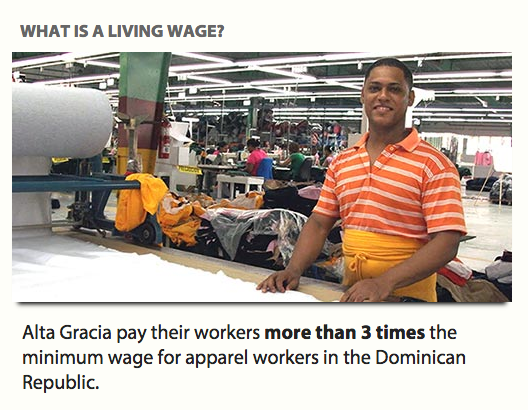
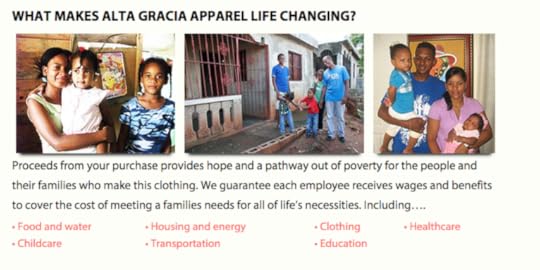
(In the spirit of full disclosure, I spent 10 months in the Dominican Republic researching this factory and several others in the area. I wasn’t compensated by them, but I did come to be truly impressed with the work they are doing. You can read the very long, dry academic paper here.)
3. Ask
Call, email or go to the store and talk to a real human being. It takes a little extra work, but it is the easiest way to gauge how much a company actually gives a shit.
If a company is truly cause-driven, or has a deep seated commitment to improving the world, you will probably know as soon as you talk to them. Usually the folks working in customer service or the cash register weren’t in the meetings with the PR firm or marketing team when the ethical “strategy” was being created. But if the ethics of a company are a crucial part of a company’s juju, even entry-level employees will talk about it openly and proudly and consistently.
I worked for a company called Holstee for years, and I spent all of my time making decisions that had a social and environmental impact but weren’t always sexy enough to make it on the website (for example, whether or not to use plastic sleeves for our greeting cards). I loved it when people were curious about our products and how they were made, because it meant all the time and energy I spent mattered to someone else. A company that cares will want to talk about it!
Example #1: Nasty Gal
Here is a real-life correspondence between myself and now fashion giant Nasty Gal (link to the article I mention is here).

By that point, I’d been shopping from Nasty Gal since before they were huge and I really wanted to give them the benefit of the doubt. Maybe she misunderstood and thought “sweatshops” was a style of crop top? It was almost as if she was telling me that they were discontinuing that particular style of sweatshop, but was I interested in another color perhaps? I pushed for clarity:
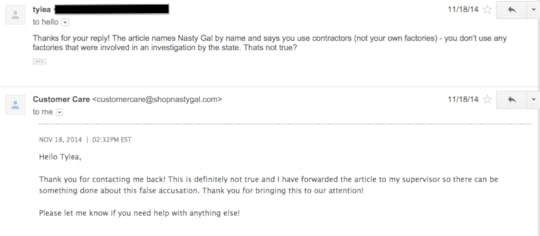
I was really disappointed with this response. It just felt so fluffy and evasive. To be fair, Nasty Gal never claimed it was an “ethical” brand, but they were pushing the Made in LA angle pretty heavily at the time. I decided, sadly, that Nasty Gal didn’t really care about how their products were made so I wouldn’t really care about shopping from them. Since then, I’ve purchased one hat and one pair of sunglasses but otherwise I’ve stopped buying from them based on this conversation.
Example #2: Warby Parker
In comparison, here is an email communication with eyewear powerhouse, Warby Parker:
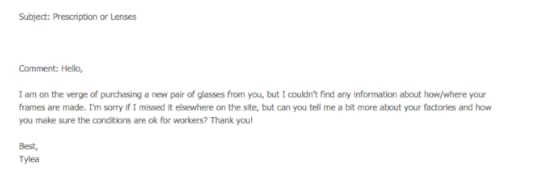
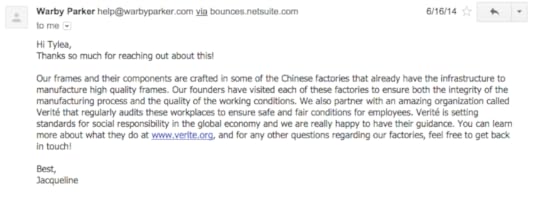
I thought this was a great response and here is why:
She welcomed my inquiry, instead of getting defensive. Warby Parker understands that many of their customers are values-driven and they want to encourage conversation as much as possible. Also, it’s just good customer service not to act like I’m an idiot. Duh.
She used the “C” word. When you work in the ethical product space, China is kind of a dirty word. This is unfair, but China has a really bad reputation with the Whole Foods demographic and it would have been easy for her to leave that detail out. I like that she didn’t. In an ideal world, companies would be transparent by publishing a complete list of factory names and locations, but this is a good start.
Founders have personally visited. This is actually not a compelling piece of information, although the reverse would be: if a company has notvisited the place where their goods are produced (like a million and one times), that is a HUGE red flag! That means they are trusting the factory’s word and then we are trusting the brand’s trust of the factory. You can pretty much guarantee that little game of telephone is not reliable.
Third party verification. This is the most important takeaway I got from this email. The Warby Parker staff are experts in design and ecommerce, they are probably not experts in factory compliance. Some folks have (valid) criticism of Verité specifically or factory inspections more generally, but to me this communicates some valuable pieces of information: (1) we acknowledge that working conditions matter (2) because of that we’ve hired a professional to help (3) we get audit reports on a regular basis so we have at least some idea of what’s going on there. Not perfect, but again a good sign.
I have a lot more tips to share, but these three are a good foundation for now. I hope you find them useful! 
This article originally appeared on Thundress and is republished here with permission.


6 ways to avoid sweatshops and still dress like a boss

Photo: bobbie vie
Let’s assume you already know about the horrible things that happen in clothing factories. You’ve watched the videos of bodies dragged from the rubble of this factory or that, heard stories of child labor, low pay, abuse, babies born in factory bathrooms, women turning to sex work when factory sewing was too terrible, etc.
Let’s also assume this makes you feel like shit.
So then what?
Buy sweatshop-free, they say. Go local! Fair trade! Artisan made! Union labor! Certified organic leprechaun kisses! Buy one baby gorilla skin bag and give one to a baby gorilla in need!
And in the time it takes you to decode what any of that means, you’ve managed to compartmentalize your guilt and buy three dresses from Zara plus some shoes from Nasty Gal and a bag from ASOS to make yourself feel better.
But there’s a better way, people! You can shop more responsibly AND have a badass, functional and affordable wardrobe free of flower crowns and moccasins. You don’t have to go off the grid or braid your armpit hair or get a PhD in economics. All you have to do is pay a little bit of attention to what, why and where you are buying your clothes.
1. Buy Less Shit
In summary, fast fashion is the devil. When the zombie apocalypse comes, they will all be wearing the same peplum tops from Forever 21. This is why their clothes are always tattered and full of holes on The Walking Dead; fast fashion is only meant to last for one wash and not for the long and active lifestyle of the undead.
So instead of rushing out and buying five new dresses from H&M for the weddings you have to go to this summer, get one or two really nice (vintage or ethically made or rented) ones. You can avoid the humiliation of repeat outfits on the Gram by wearing one with a blazer, the other with a cardigan, maybe a large statement necklace, a scarf, or decide that you don’tgiveanyfucks because who are you Cher from Clueless?! Clothes are meant to be worn more than once!
2. Stop Shopping When You’re Sad
Or lonely or upset or heartbroken. Just like how you can’t go to the grocery store when you’re hungry because you’ll spend $100 on hot cheetos and cookie dough ice cream and those Entenmann’s powdered donuts that will be your bitch the second you get in the car.
Most fashion marketing preys on our darkest fears: if you don’t buy this thing, everyone will finally see what a FAT COW/SPINSTER/UGLY WHORE you really are. And if you’re already feeling low, you’ll just gobble up whatever they’re selling in one emotionally hungry bite. You won’t feel any better and you’ll have spent your entire therapy budget on rayon.
Shop from a place of strength and the difference will be palpable. If you shop like a boss bitch, you’ll manifest that shit. If you shop like a fat ugly heifer that will die alone, I promise it doesn’t matter how trendy your clothes are, you’re not going to shine. And nobody puts Baby in a corner!
3. Buy used
When I first started learning about sweatshops, all the activists I knew told me to buy used clothes. Disgusted doesn’t even describe it. Put some stranger’s clothes ONTO my BODY? Hell naw. Grandpa Jim didn’t work every summer herding cattle to pay his way out of small town Montana for me to be sifting through the bins at Goodwill. And Grandpa Timothy would turn over in his grave if he knew that he joined the navy and fled Brownsville, Brooklyn just so his granddaughter could go around looking homeless. I will only buy brand new ostentatiously branded sweaters from Armani Exchange and bedazzled tops from Ed Hardy, thank you very much (I’m from New Jersey, give me a break).
What no one told me is that there is soooooo much amazing clothing floating around the secondhand market. You can look homeless, but only if you want to. You can also you do glam or boho or preppy or goth or pin-up or whatever else you’re into (I prefer angsty adolescent boy chic. I call it sadrogyny). The unfortunate side effect of all of this super cheap clothing is that people feel totally fine wearing something once or twice and then getting rid of it. So you can get an entirely new, great-looking wardrobe at a fraction of the retail cost if you’re willing to wear things that are gently used. PLUS you will have interesting, unique pieces and nobody will give you side eye when you’re out with your friends all dressed the same (#basic).
In addition to your local thrift, used clothing, or consignment store, there are a million ways to shop online. Ebay and Esty are the two reigning superpowers in this space.
Ebay is the Mercado Oriental of the internet: loud, crowded, smelly, huge, and full of amazing, cheap things to buy. You can find pretty much anything you want (clothes, shoes, bags, human organs). If you’re willing to sort through the internet equivalent of thousands of people screaming in your face, you can find the best selection for the best price. But to win at ebay you have to have some cojones and a lot of patience. I don’t have an Ebay addiction, I just really like to use it every day multiple times a day. I can stop anytime I want.
Etsy is like a small boutique on that cute side street in that college town where you know everyone’s name and as soon as you walk in they gush about this new piece that you’re gonna love. The selection (both vintage and hand-made) is curated and high-quality and you get all these lovely thank-you notes in your package so you feel like you’re basically best friends with the indie entrepreneur who almost definitely has the cutest bangs and an awesome collection of rings and a record collection from some hip store in downtown Austin or Portland or wherever.
The following online consignment stores are worth checking out too. Nothing is as cheap as a good score on ebay, but you’ll be sure that the items were well taken care of and authentic.
Bib and Tuck
Twice : Of this list, this is the only one I’ve personally used. I had a good experience and use it as my back-up for ebay.
Thred Up
Tradesy
Poshmark
Vinted
Dresm
Sharity
Swapdom
Threadflip (A reader suggestion. Thanks Elizabeth!)
My new favorite way to shop is on Instagram. If you search for #vintage or #thrifting (or something similar), you’ll come across tons of people selling stuff. You can find the link to their website or store or pay them directly on paypal (kind of risky but you cut out a lot of the overhead so items tend to be cheaper).
Friendly note: you should be washing everything you buy before you wear it no matter what. You think just cuz it’s “new” that it’s clean? Sorry, love. You have no idea where that blouse has been, and somebody else’s BO is the least of your concerns. It takes a few good washes for the crazy cancer-causing, hormone-disrupting chemicals they put in fabric to wash out. I would especially do this with underwear or items that go close to sensitive parts.
3. Your Tailor Is God
If the grumpy Chinese woman from Washington Heights that used to hook my clothes up came through the door right now with a tape measure bouquet and an industrial iron and asked me to marry her, I would carry her off into the sunset no questions asked. It is really hard to find a good tailor, but when you do you’ll have to resist the urge to make out with him/her every time they work a small miracle. You just turned those bell bottoms into skinny jeans? Made my mother’s wedding dress into a beret? Took this weird thrift store coat from Auntie Beatrice to Beyoncé? Get your beautiful face over here!
Not only can they take something that’s been haunting your closet for years and update it, they can also take something you bought secondhand and make it fit you perfectly. Because my thighs are two sizes larger than my waist, this is pretty much the only way I can get jeans that will fit me properly. I still look like a strong-hipped teenage boy but at least my pants fit.
Here are some handy tips on what a good tailor can and can’t do.
4. Clothing Swaps
Get a bunch of your most stylish friends, some wine, and have yourselves a good old fashion swap. You can walk out with a bunch of new-to-you clothes for free.99 (minus the cost of wine). And because you’re all friends, no one is going to bring that old raggedy white v-neck with sweat stains or the ancient acrylic sweater with massive pilling (but if they do, you’ll know who your real friends are).
There are a bunch of ways to host a swap. Here are some tips.
5. Rent
I have yet to try this because everyone knows better than to invite me to something fancy, but I definitely will for my upcoming engagement party to the hot guy from Calle 13. Just have to wait for him to call.
Rent the Runway
Gwynnie Bee (specifically for sizes 10–32; finally people are paying attention to the average size of the American woman!)
Bag Borrow or Steal
Lending Luxury
6. Ethical Brands
Buying new clothes is the last resort in my book, but sometimes it is necessary. I draw the always-buy-used line at underwear, swimwear and socks (ew). I also look extra hard for lightly used white clothing, but every once in a while I find it necessary to buy that new too.
It seems like every day a new “ethical” brand has popped up on the scene. There is no way I can list them all, but here are some of the favorites.
Patagonia: These guys are basically the holy grail of ethical manufacturing and eco-materials. It’s too bad they make fleece vests and ski pants and not crop tops or mesh jumpsuits because I would buy the hell out of everything they made. I still try to buy from them whenever possible, but the truth is it’s designed more for my flute teacher from 7th grade than for me. (Update: pretty much as soon as I wrote this, I readthis article about some of Patagonia’s suppliers using forced labor. That they’ve uncovered this issue at all is a testament to their commitment to ethical sourcing, but the fact that they can’t figure out how to fix it is depressing. Even more reason to only buy new clothes when you really have to.)
American Apparel : Now that the maniac founder is gone, I am really hoping they can pivot their controversial marketing and union-busting activities, because this is one of my go-to spots for on-trend, responsible basics. I’ve visited their factory in LA twice and I certainly can’t vouch for everything that goes on in that building, but as far as ethical production goes they’re pretty far ahead of the pack.
Everlane : These guys are relatively new to the scene and have gotten a lot of attention for their “radical transparency” approach. They make a lot of their products in China, which used to be the nail in the coffin of any ethical brand, but they release the names and locations of every facility they use. They get a little bit light on details when you ask deeper questions (audits? certifications?) but they’re certainly worth mentioning as an alternative to somewhere like J Crew.
Zady : The darlings of the ethical fashion movement, these ladies seem to be doing things right. I haven’t bought anything from them yet, but they source from a couple factories that I admire so I think that’s a great sign. Great selection and well-curated.
Some other companies with good reputations: Alabama Chanin (I have a huge fashion crush on these folks; I haven’t bought anything yet but their supply chain makes me swoon), The Reformation, Imogene + Willie,Cuyana, People Tree, Loomstate, Edun. (In my opinion, what’s really missing is ethical fashion with an “urban” edge. This is my life, not Coachella.)
Here are some other guides you might want to check out. Full disclosure, I definitely see a few companies on these lists that I don’t agree with. So as with everything, use your best judgement.
Ethical Shopping Guide
Ethical Consumer Buyer’s Guide
Sweatfree Communities Shop With a Conscience Guide
Union Made Apparel Directory
The Good Guide Apparel Rankings
Green Pages Directory
Free to Work
(FYI — I didn’t get any money or free swag from any of the companies in this article. How is that even a thing?!)
This article originally appeared on Thundress and is republished here with permission.

15 honest questions for California

Photo: David Goehring
Are you mad at us for liking almonds and pistachios better than water?
Does not compute. You keep getting browner and browner and we keep letting it happen. Sure, citizens are starting to be required to water their lawns, like, twice a week, but that’s not good enough. You produce something like 70% of our leafy greens, and almost 30% go uneaten or don’t even make it to the supermarket. We just… we don’t deserve you. How about instead of Bay to Breakers we do a giant naked rain dance along the Embarcadero?
Why does anyone live in Bakersfield?
Someone had to say it.
I’ve got my earthquake kit, my mudslide kit, and my wildfire kit. What am I forgetting?
It’s crazy beautiful here, sure, but why do I feel like you’re trying to kill me? It’s 72 and sunny out and I’d love to walk, but being prepared fits way better in my trunk than in my backpack.
How does our little NorCal v. SoCal dispute make you feel?
Does it make you a little sad that we all just can’t get along? Or do you secretly have a favorite? C’mon. Is it the 405 or 405? Pacific Beach or PB? Is it hella tight or is it sick, dude? Hippie or Hollywood, you know you want it one way or the other.
Why is your motto just “Eureka?”
Were you just not that excited when you found gold? Hell, if Oklahoma! gets an exclamation point, don’t you think you could muster up the energy?
How do you afford all your replica jerseys?
Including the NHL, AFL, and MLS, you have a bajillion sports teams. How are we supposed to get anything done? But not complaining. No. Please don’t send off a team to St. Louis. That’s not what we mean.
But one last question on this topic: how is it that San Francisco and Oakland have two professional football teams? And San Diego? Hello, can we get a little LA love? Does this make sense to anyone? Bueller?
Have you ever heard of “seasons?”
And I don’t mean “kinda warm” or “foggy” or “fire season.” Though that last one is semi-legit.
Can you please put together a pamphlet for everyone else?
It should say something like, “No, we don’t all say either ‘Sup, bra?’ or ‘hella sick.’ Some of us haven’t been to the beach in months, maybe even years, our skin tones prove it and we don’t care. Please don’t ask us about the celebrities we went to high school with or what earthquakes feel like. And as for you insisting that Shake Shack is better than In-N-Out, stop being evangelical; we’re not looking to be converted.”
Will you read my screenplay?
No? Then let me tell you about my idea for an app…
Do you know how easy you make it to introduce yourself to foreigners?
Tell someone from pretty much anywhere else in the world that you’re from America, and one of the first things out of their mouths might be, “Oh, California?” And it’s wonderful. No explanation needed. Awkward conversation avoided. “Yes, yes, I am. And for sure, it’s just as great as you think it is.”
This invite says “business casual.” Can I wear flip flops?
If you tell me no and I see a dozen other people there in sandals, I will not be a happy camper. How about yoga pants? Leggings-as-pants? They’re basically skinny jeans.
Does this smell funny to you?
Oh, whoops, it’s just Coalinga.
Does the permanent indent of my butt in my seat affect the resale value of my car?
Just curious. I have a sweet Monday Morning Commute Playlist to get me through these next two hours, but that’s not money in the bank, if you know what I mean. Do I need to lose weight to make sure I can afford my rent when I make my next switch? I’ll just up my intake of wheat grass; it’s not a problem.
$4 toast, seriously?
Seriously. I still can’t get over it.
How about a little lightning once in a while?
I know grade-school children that haven’t seen it, and don’t you think that’s a little unfair? Let’s look into trading in those Santa Ana winds for a little jolt of excitement. It’s really the only way you could possibly get better. 
The next time you order brunch, remember this article
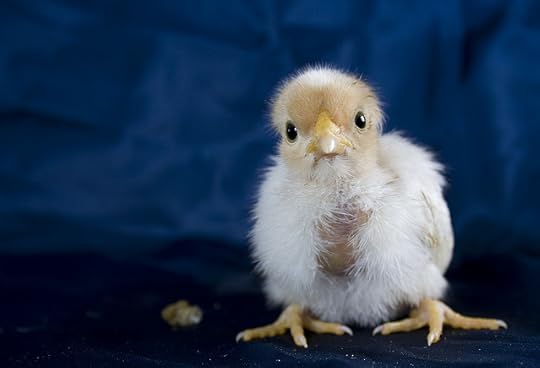
Photo: Katie Brady
BERLIN, Germany — This country loves its eggs, but there’s a horrifying fact they’d probably rather not discuss over breakfast.
German chicken hatcheries send 45 million baby chicks to the shredder each year, for the simple crime that they can’t lay eggs, because they’re male.
Agricultural Minister Christian Schmidt is calling for a stop to the carnage. He wants to bring in gender tests on eggs before they hatch.
“As soon as appropriate equipment is available on the market, there will be no justification for the hatcheries to kill hatched male chickens,” Schmidt said in a statement.
In many countries, killing male hatchlings is standard egg-industry protocol. The United States is said to kill hundreds of millions every year. Germany is the first country to make headway on banning the practice — the western state of North Rhine-Westphalia passed legislation in 2013 to turn off the shredders.
Although the law was repealed on the grounds that it violated the rights of German business enshrined in the constitution, Schmidt now wants to try again and phase out the entire practice nationally by 2017. He has allocated 1 million euros to find alternatives, including sex tests for the eggs that would let poultry farmers dispose of the male chickens before they hatch.
Two types of chickens are raised in Germany, meat chickens and egg chickens. While meat roosters survive alongside the hens till harvest time, the egg-producing birds are early on sorted by gender. The females are raised to lay eggs, and most males are either gassed or ground up to make animal feed shortly after hatching.
Some animal rights activists aren’t on board even with the egg-test standard — People for the Ethical Treatment of Animals (PETA) say there is no difference between destroying the chicken or the egg.
“This is more palatable for the public,” said PETA specialist Edmund Haferbeck. “But from an animal rights point of view, it’s just as bad.”
PETA stands against all consumption of animals and animal products, but Haferbeck noted that the egg sexing method would be more compliant with German animal cruelty laws that do not extend to fetal chickens.
German chicken farmers, on the other hand, are concerned about the new technology becoming a handicap for competing against egg industries in neighboring countries. The German poultry association ZDG argues that any regulations on disposing chicks should come from the European Union and not the German government.
“While the minister’s initiative shows German leadership, the ZDG calls for a European solution, because a unilateral move could cause production to be relocated abroad,” the ZDG said in a statement.
Schmidt’s office said it’s looking to outlaw the chicken shredding and gassing as soon as an alternative is ready. However, Haferbeck and the chicken farmers are doubtful that the egg testing will be implemented in the near future, because of the added costs.
One company thinks it may already have an answer.
Germany’s largest chicken producer, Lohmann Tierzucht, is working to create a hybrid chicken that could be used for both meat and eggs.
The “Lohmann Dual” lays fewer eggs than the standard Lohmann chicken and weighs less than broiler chickens, but the method could provide a possible solution for the poultry industry’s unsavory chick-shredding secret.
By Angela Waters, GlobalPost
This article is syndicated from GlobalPost.

20 funny Polish phrases
They’ll tell you to “stuff yourself with hay” (wypchać się sianem).
2. Poles don’t snack.
They “take something on a tooth” (wziąć coś na ząb).
3. A Pole never beats around the bush.
He prefers to “wrap the truth in cotton” (owijać prawdę w bawełnę).
4. Polish people are not nit-picky.
They are “looking for a hole in the whole” (szukać dziury w całym).
5. Polish people don’t count their chickens before they’re hatched.
They “divide the skin on the bear” (dzielić skórę na niedźwiedziu).
6. A Polish person doesn’t sulk.
He “has flies up his nose” (mieć muchy w nosie).
7. Polish people don’t mess things up.
They “make bigos” (narobić bigosu) or “brew beer” (nawarzyć piwa) instead.
8. A Pole doesn’t daydream.
They “think of blue almonds” (myśleć o niebieskich migdałach).
9. Poles will not speak bluntly.
They’ll “tell it straight from the bridge” (mówić prosto z mostu).
10. A Pole is not uninformed…
He just “fell from the Christmas tree” (urwać się z choinki).
11. Poles do not simply grin and bear it.
They “put up a good face for a bad game” (robić dobrą minę do złej gry).
12. A bad Polish writer doesn’t waffle.
He “pours water” (lać wodę).
13. A Polish person doesn’t just run away.
He “gives a leg” (dać nogę) or “takes his legs under his belt” (brać nogi za pas).
14. A Pole is never a know-it-all.
Instead, he “ate all wits” (pozjadać wszystkie rozumy).
15. Polish people won’t pull your leg.
They’ll “stick you into a bottle” (nabić kogoś w butelkę).
16. A Pole won’t take you apart.
He’ll “mix you with mud” (zmieszać kogoś z błotem) or “hang dogs on you” (powiesić na kimś psy).
17. A Pole won’t promise you the world.
But you might get “pears on a willow” (gruszki na wierzbie).
18. Polish people don’t run like hell.
They “run where the pepper grows” (uciekać gdzie pieprz rośnie) or “where the devil says goodnight” (gdzie diabeł mówi dobranoc).
19. Poles won’t pester you.
They’ll “drill a hole in your belly” (wiercić komuś dziurę w brzuchu).
20. Polish people don’t bite off more than they can chew.
They “jump at the sun with a hoe” (porywać się z motyką na słońce).
This article was originally published on March 5, 2015. Featured Photo: PolandMFA 
5 ways your vacation is killing sea turtles
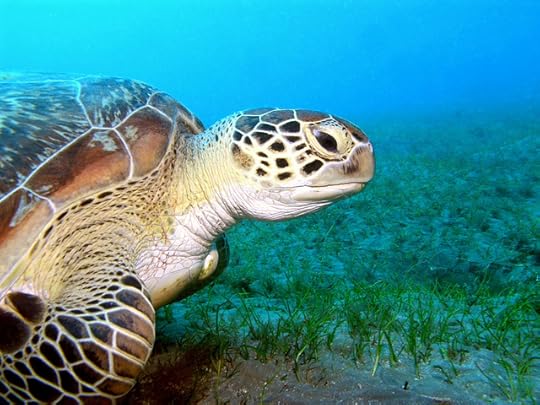
Photo: Frank_am_Main
They’re bucket-list experiences — swimming with sea turtles in the ocean, watching them nest on the beach, or if you’re really lucky, seeing an army of little hatchlings scurry from the sand into the ocean. But most species of sea turtles are endangered. One of the biggest causes is — you guessed it — human activity. And it’s not just about poaching turtles for their eggs, meat, and shells (thought those are also huge problems). Right now we’re in the thick of the nesting season for sea turtles in the western hemisphere (March through October). And in popular tourist locales like Florida, Mexico, the Caribbean, and Central America, without even knowing it, your vacation activities could be harming these amazing creatures. Here are the biggest problem behaviors and what to do about them. (Warning: This story contains images of injured and deceased turtles that may be disturbing.)
1. Using plastic at the beach
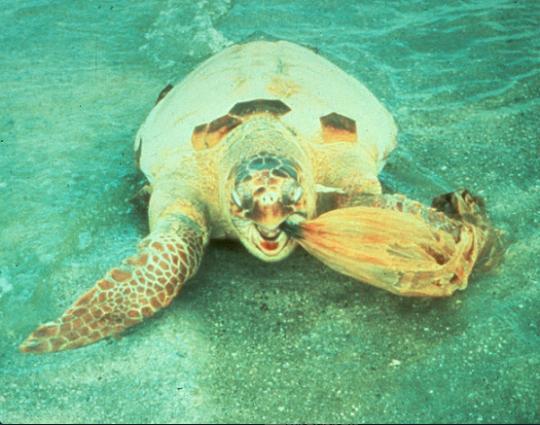
This turtle was the victim of a plastic bag. Photo: Sea Turtle Conservancy
The problem: Even if you’re careful about throwing your water bottles, straws, and sandwich baggies in trash cans, it’s still very easy for that stuff to end up in water stream, according to David Godfrey, executive director of Sea Turtle Conservancy (STC). Once in the water, “bags float and looks like a jellyfish, which a number of turtles eat,” explains Godfrey. “Turtles wash up sick or emaciated or dead and when we examine them we find plastic blocking up the gut track.” Sadly, this also happens to the babies. “There are these areas in the oceans called convergence zones, where currents come together, and you get long lines of seaweed, where hatchlings live. They float in that seaweed and find food and protection from predators,” says Godfrey. But that seaweed also collects debris, like bits of plastic. The baby turtles can eat or get caught up in it, killing them.
What to do: Take your water and drinks to the beach in reusable stainless steel bottles. And choose biodegradable or reusable containers for food.
2. Wearing chemical-based sun protection
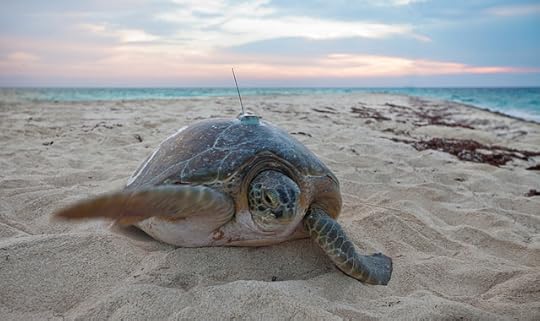
Photo: U.S. Geological Survey
The problem: “Sunscreen and sunblock give off a pretty toxic chemical when you wear them in the water,” explains Godfrey. “The film runs off your body and settles into the environment, affecting its chemical makeup. When you have hundreds of people a day swimming and snorkeling in the water, these toxins accumulate — particularly in areas where there are reefs — and it’s bad for plant life and for fish and for the turtles.”
What to do: Cover up with clothing and use turtle-friendly sunblock. “There are a number of products now with ingredients that are benign to the marine environment,” says Godfrey. Try Brands like Reef Safe and Do Naturals that are biodegradable.
3. Buying improperly fished seafood
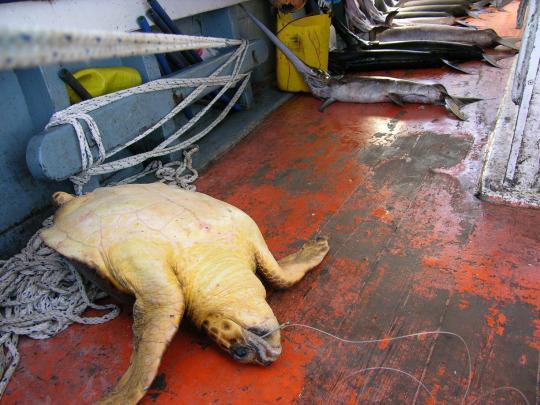
This turtle was the victim of fishing. Photo: Sea Turtle Conservancy
The problem: Turtles often migrate through popular fishing areas, and sadly, more than 250,000 are accidentally captured, injured, or killed by US fishermen each year, according to the STC. The turtles are attracted to the fishing bait and become caught on hooks and in nets. In fact, just this month, a sea turtle STC had been tracking since May was found dead on the shores of Colombia. Based on tracking data and location, experts believe she got caught in a fishing net and drowned. (Turtles can hold their breath for an extended period of time but must eventually surface to breathe air.) It’s one of the biggest threats against the sea turtle population, according to the World Wildlife Federation.
What to do: “The general rule of thumb is always get wild-caught seafood and shrimp from places where the fishermen are using turtle-friendly fishing hooks and turtle excluder devices on nets. They do this in the southeast U.S. for the most part,” says Godfrey. (Louisiana is the exception, though that may be changing soon.) You can search to find safely fished seafood at SeafoodWatch.org. And if you’re not sure, ask!
4. Staying at the wrong resort
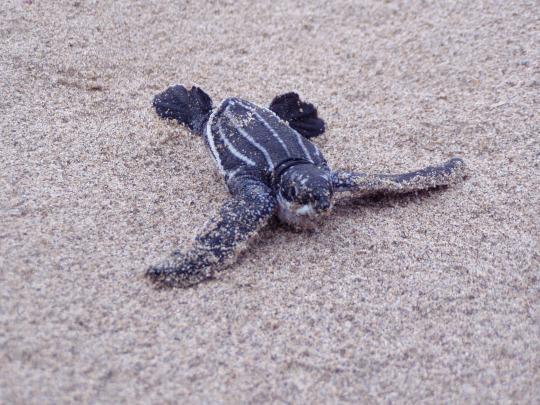
Give this little one a fighting chance. Photo: Sea Turtle Conservancy
The problem: Some hotels and resorts in places like Mexico, the Caribbean, and Central America actually exploit sea turtles. There are resorts that have staff dig up the turtles’ nests and bring the eggs back to the resorts’ private hatcheries. Then they sell the opportunity to release the hatchlings into the water. It sounds adorable, but it’s deadly for several reasons. “Hatchlings held in captivity lose the very small store of energy they are born with to swim out into the ocean,” says Godfrey. “They’ll burn that energy just sitting in a bucket, waiting to be released, so they have no energy left to swim.” Plus, these private releases almost always happen during the day, rather than at night or in the wee hours of the morning, as would happen in nature. “Baby turtles are sitting ducks during the day,” says Godfrey. “That’s when they’re most visible to fish and birds. And these resorts let guest release one or two at a time, so they no longer have the protection of the group. “Sea turtles evolved to hit the water in group of 80 to 100 at night, so as many as possible can survive predators,” explains Godfrey.
What to do: Many of these resorts claim to be protecting turtles, but they are doing great harm. Avoid any place that advertises the opportunity to release hatchlings or otherwise handle the turtles. Ask question about a resort’s turtle programs before giving them your business.
5. Using regular outdoor lights and furniture

Photo: U.S. Fish and Wildlife Service Northeast Region
The problem: One of the biggest things that disturbs sea turtle nesting is light pollution, according to Godfrey. Whether it’s outdoor lights from beachfront rentals or resorts or nighttime beach goers using flashlights, regular old white and yellow lights are incredibly disturbing to sea turtles. It can cause nesting turtles to flee the beach and return to the ocean without dropping their eggs. And what’s worse, it is actually deadly to hatchlings: They are attracted to the light, and instead of heading toward the ocean, they follow the lights and end up in backyards, pools, sand dunes, even in parking lots and on roads. Not only does this deplete the small store of energy they have to get to the ocean, but when the sun comes up they’re easy pray for birds or they can literally just cook in the sun. In addition, turtles can easily get caught up in beach chairs left outdoors and be injured or even die.
What to do: If you have a beach rental on a nesting beach, turn off all exterior lights that face the shore. You can also inquire whether a beach house or resort uses turtle friendly lights (long-wavelength — 580 nanometers or longer — LED lights which glow amber or red). The lights are available at many retail outlets and online. In some areas, there is even grant money available to help pay for turtle friendly lighting. (The money comes from restitution made by British Petroleum after the 2010 Deepwater Horizon oil spill that killed or injured an estimated 100,000 sea turtles.) As or the furniture, fold everything up and put it away overnight during nesting season.
This article originally appeared on Yahoo.com and is republished here with permission.

August 17, 2015
13 amazing shots of the perseids
ONCE A YEAR the Perseids take over our skies. Seen everywhere, but best seen in the Northern Hemisphere, the meteor shower is part of the comet Swift-Tuttle, and occurs when debris from the cloud behind the comet comes close to our atmosphere.
However some years are better than others, and this year was no exception due to the extra dark skies, with the half moon not rising until nearly dawn. Check out these incredible photographs captured by sleepy photographers around the world in the wee hours of the morning.
1. Big Sur, California

Meteoric Magic by Della Huff on 500px
2. Plesivec, Slovakia

Perseid Meteor Masacre by Martin Grančič on 500px
3. Karaman, Hungary

Destructive power of time by Muhammet Özpınar on 500px
4. Frisco, Colorado
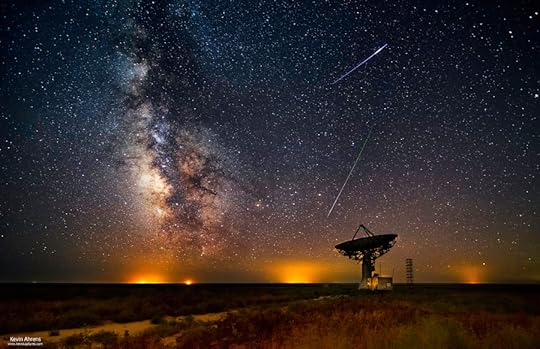
Perseids by Kevin Ahrens on 500px
5. Haväng, Sweden

Perseid Meteor Shower 3000 B.C. by Stefan Nilsson on 500px
6. Ontario, Canada

Perseid Meteor Shower Composite by Wesley Liikane on 500px
7. A castle in France

Magical Light by Herve Lambert on 500px
8. Sutton, New Hampshire

Perseids by Garrett Evans on 500px
9. Beltheim, Germany

Perseids 2015 – Compilation 1 (Clean Version) by Markus Lubjuhn on 500px
10. Magdalena, New Mexico

All Fly Away by Matt Beckmann on 500px
11. A beach in Finland

Perseids 2015 by Valentino Valkaj on 500px
12. Bavaria, Germany

Perseids 2015 by Martin on 500px
13. A rainbow night sky

Perseid Meteor Shower by Laura C. Birdie on 500px

The Animas River toxic sludge spill

Photo: M. Prinke
ON AUGUST FIFTH, WHILE AGENTS OF THE Environmental Protection Agency were trying to pump contaminated sludge out the abandoned Gold King mine in Colorado, a leak sprung, and as a result, 3 million gallons of the sludge was dumped into the Animas River. The river turned an ugly shade of brownish-yellow, and people whose lives revolve around the river were pretty much screwed — anyone who may have ingested the water would have been exposed to dangerously high levels of lead, meaning that towns would have to dip into water reserves, and farmers who are dependent on the river for crop irrigation basically just have to watch their crops die.
Much of the frustration that has been vented has been directed squarely at the EPA, who has taken responsibility for the leak, and has stopped mine cleanup at other sites in order to make sure a similar leak doesn’t happen again. Why, you might think, aren’t we pissed off at the company that polluted the mine in the first place?
Because the mine has been inactive for 95 years. Why, you might ask, would a mine with 3 million gallons of toxic sludge sit untouched for nearly a century? The answer is predictably depressing.
View image | gettyimages.com
The country is covered in abandoned mines like these.
Earthworks, a non-profit that fights pollution from extractive industries like mining, estimates that there are around 500,000 abandoned mines littered around the country that still need cleaning. This came about because of permissive mining laws that were written during the settlement of the American west in the late 1800s. The laws were permissive because the government wanted to get people to settle the west, and thus basically put no responsibility on mining companies for cleanup. This mining law — signed by President Grant in 1872 — is still in place today.
While the Animas River spill is gigantic and disturbing, it’s actually not particularly unusual: the EPA estimates that 40% of streams in the American west are already polluted by these abandoned mines, which are slowly leaking their sludge out into the surrounding environment.
The EPA is tasked with cleaning up these mines. The mining companies themselves have very few responsibilities.
View image | gettyimages.com
Mining companies make oil companies look like saints.
In Jared Diamond’s 2005 book, Collapse: How Societies Choose to Fail or Succeed, he looked in depth at the practices of the industry that is the worst toxic polluter in the United States. The culprit is not, as many environmentalists might think, the oil industry, but is actually the hardrock mining industry.
Mining causes a lot of environmental damage regardless of cleanup: ripping minerals out of the ground is generally not great for the surrounding area, especially when the mines are open pits, and when the material you’re pulling out of the ground is toxic to humans. So to be fair, the battle is already an uphill one. But mining companies practices make the problem much worse:
First, they don’t typically clean up while they’re mining. They only wait until the mine has shut down, and then they do the minimal cleanup and then leave it be. Second, as Diamond puts it, “Hardrock mining companies facing cleanup costs frequently avoid those costs by declaring bankruptcy and transferring their assets to other corporations controlled by the same individuals.” Hardrock mining also has lower profit margins than the oil industry, for example, so often the bankruptcy is legitimate. The cleanup after such a bankruptcy would fall squarely on the taxpayers.
These low profit margins and the high cost of environmental cleanup, says Diamond, all contribute to a kind of wild west, robber baron culture in the mining industry, which makes it that much worse. It doesn’t help that it’s difficult for miners to feel any sort of public backlash when they do something terrible: when BP spilled tons of oil in the Gulf of Mexico, it was at least possible for consumers to drive by gas stations marked as BP. But the products produced by hardrock mines often end up as small parts in other products, and are ridiculously hard to trace. So miners, without some sort of regulation, can act with impunity.
The EPA has an impossible job.
“The most unbelievable thing about Ghostbusters,” comedian Kurt Braunohler says, “is how much power the EPA has.” It’s a fair point: the EPA is constantly under attack because of its perceived political leanings and because its job is basically to enforce government regulations that can be really expensive for the regulated companies. It also doesn’t help that their image is that of an incompetent government bureaucracy — an image that’s been as much created by their own mistakes as it has by movies like Ghostbusters.
But the EPA has what’s basically an impossible job: to clean up the 500,000 abandoned mines littered around the country at the cost of what they estimate to be around $50 billion. In an ideal world, they would not make a single mistake during the cleanup of all these mines (actually, in an ideal world, these mines wouldn’t need cleaning, but that’s beside the point). But that’s too optimistic. Mistakes are going to be made, and some of the mistakes are going to be huge.
As a result of the Animas spill, the EPA is facing what will almost certainly be millions in lawsuits, and they’ve provided their political opponents with a little more fodder with which to chip away at their funding.
While the EPA is hardly blameless, they are dealing with a problem they inherited — a problem we have yet to actually fix.
So how does it get fixed?
While funding the EPA and supporting mine cleanup would be a good start towards fixing this problem, it still ignores a glaring reality: we’re 500,000 mines behind, and new mines like these are still being created. Unless the law is changed, we’re not going to catch up, and until we catch up, disasters like the Animas River mine spill are still going to happen.
The good news is that Arizona Representative Raul Grijalva has introduced a bill to reform the hardrock mining industry, and Earthworks is coordinating a campaign to support this bill in the House. You can take part in that campaign here.
The bad news is that the backlash of the Animas spill is likely going to fall mostly on the EPA. And while they aren’t totally undeserving of that blame, they are also not the cause or the root of the larger problem. Mining sludge is not a particularly sexy political topic for the American public to get behind, so unless people start paying attention, this spill is going to cause a flare of anger which will then die down until the next spill inevitably happens. 
Texan foods you should try
Cowboys need protein in the morning, so they add meat to…donuts. Yes, donuts. Hypnotic Donuts sells a copycat of the King’s favorite sandwich, the bacon, peanut butter and banana smothered “Evil Elvis” donut. At Gourdough’s, order the “Mother Clucker” of them all — a donut topped with fried chicken and honey.
A photo posted by Carlos Whittaker (@loswhit) on May 24, 2015 at 11:15am PDT
2. BBQ brisket
Brisket is a cut of beef as tough as snakeskin boots if it’s not carefully courted like a southern belle. It disintegrates when massaged with spices and smoked overnight. Sliced brisket is dumped into omelets, served on bread, or enjoyed solo — don’t forget barbecue sauce.
A cheap way to overnight in NYC
Follow Matador on Vimeo
Follow Matador on YouTube
IT’S another tick to add to your traveling bucket list, one you probably haven’t thought of: Sleeping in a taxi (excluding being passed out after a night on the town, that is). A New York City fun fact is that it’s perfectly legal to sleep in a vehicle on city streets. The brains behind this venture is Jonathan Powley, who owns seven taxis and vans in Queens that are kitted out to be your bed for between $20 and $70 a night. Don’t let the fact that your accommodations don’t have a toilet deter you; he’s made arrangements with nearby businesses to allow his customers to use their bathrooms. Would you do this? 
Matador Network's Blog

- Matador Network's profile
- 6 followers

