
Matador Network's Blog, page 1423
December 31, 2017
map of the most affordable US states
At the end of the holiday season, one question always looms: “how much money that I don’t have did I just spend?”
Most of us answer this sometime in January, but the truth is that Americans are big on spending year-round. However, a map from HowMuch.net shows that the amount Americans spent in 2017 varies quite a bit state-to-state. Obviously high rents in places like Los Angeles, Chicago, and the Northeast Corridor are going to inflate the costs of living for their respective states, but this map reveals that living in a state with a pricey liberal metropolis isn’t the only thing that will drain your bank account. While Americans in Washington, DC spend more than any other (56.8k per person), Alaska comes in third (49.5k) and North Dakota rests comfortably in the top ten (48.2k), above New York and Vermont.
So, if you are looking to save some cash for future holiday seasons, make sure you don’t just look for a cheaper town, but also for cheaper states. 

Photo: HowMuch.net

More like this: Infographic: 10 simple lifestyle changes that will save you money


December 30, 2017
How to stop wasting your time
If your top resolution for 2018 is to start using your time in a more useful or valuable way, the first thing you need to know is why, how, and when you’re wasting your time now. Do you have the feeling your eyes spend too many hours in front of a screen? The good news is you’re not alone — as this infographic by GoCompare shows, globally, we spend 7.5 billion hours online every day. That’s 856,164 years spent online every day.
But don’t panic — recognizing you have a problem is the first step to solving it. Once you identify your biggest time suckers (is it Twitter? Netflix? Tinder? all of them?), look at the infographic’s best section, where it tells us some offline things we could be doing instead. Climb a mountain. Visit the Seven Wonders of the World. Run a marathon. Or simply get outside and leave your phone behind.

More like this: The ultimate guide to learning a language in record time

India has a moonwalking traffic cop
When given a stage like this, how can you not perform? 38-year-old Ranjeet Singh is a traffic cop who works the beat at one of Indore’s busiest intersections, where he brings a certain kind of panache to the job. Inspired by the moves of pop legend Michael Jackson and Bollywood films, Singh guides traffic with flashy hand waves and the moonwalk. While some of his fellow officers say he is not taking the job seriously, he claims that it is a more effective way to get the attention of younger drivers. “Instead of walking back I do the moonwalk which sometimes amuses commuters. That, in a way, encourages people to follow traffic rules,” Singh told the Hindustan Times.
Singh has become his own kind of icon to the residents of Indore and has even inspired younger officers to take up his unique style. “I used to observe Ranjeet bhai during my college days and wanted to be like him,” said 22-year-old officer Sumant Singh Kachhawa. “I instantly approached him for some tips as soon as I got my job. It’s real fun to control traffic in that manner and at no point of time I feel bored.”
Follow Matador on
Vimeo
Follow Matador on
YouTube
More like this: India at street level
December 29, 2017
Trust in East Africa
In the days after I got mugged in Nairobi, I questioned whether my decision to further explore East Africa on my own was still a sensible one. My volunteer work in the Kenyan capital was wrapping up. It would be my first time traveling solo but now I was shaken, my trust in strangers ruptured. I suppose a good mugging has a way of doing that.
***
Several months earlier in Canada, many of my friends and family were puzzled when I had announced my plans for Africa.
“Are you sure you wanna go there?!” my aunt asked me when I mentioned East Africa.
Her question suggested that reasonably intelligent people still stereotyped Africa as one giant country — a poor, AIDS-stricken, war-ravaged backwater full of witch doctors, murky jungles, child soldiers, and octogenarian dictators.
Taken all together, African countries have a history of brutal conflict that gives the impression of an entire continent in peril. Indeed, some of the most dangerous countries on the planet are in Africa. No one will deny that. But the media’s hyperbolic portrayal of a wretched, hopeless place, its people in need of salvation, has gone a long way in distorting the reality of day-to-day life there.
I wasn’t scared at the thought of Africa, or Kenya in particular. I’d done a lot of traveling and knew I could hold my own.
***
In Nairobi, I worked alongside Kenyans in the impoverished communities of Mathare and Kibera, wading through mounds of garbage in search of recyclable plastic. These people were happy, hard-working, resourceful, and kind.
I explored the city, day and night, without incident. Strangers in Nairobi would, without hesitation, go well out of their way to help me when I got lost, which I did often. Trust came somewhat easily.
Then I got mugged.
The media’s portrayal of Africa as a wretched, hopeless place has gone a long way in distorting the reality of day-to-day life there.
I was walking downtown when a thin man, wearing an oversized black suit and clutching a folder stuffed with papers, asked me for spare change. I hesitated. Something did not feel right. I gave him 150 shillings anyway.
A few blocks further, two men who claimed to be city council officers apprehended me. The shorter of the two flashed his badge. Both men also wore oversized suits. When they accused me of giving money to a Zimbabwean terrorist, a bolt of fear shot through me.
Nairobi friends had warned me about city council officers. Charged with maintaining order in the Central Business District, they are infamous for their corruption and violent tactics. I was strongly advised to cooperate should they stop me.
And don’t run! I heard my friend Patrick saying. Because they are everywhere!
With the men on either side of me, I was led to an alley café and told to sit. Five more sketchy looking “officers” instantly appeared and surrounded my table.
Fuck, this is not good, I thought to myself.
Parked outside was an unmistakable fixture of Nairobi’s streets — a white Toyota truck with a canopy, its windows covered in steel mesh — a City Council paddy wagon.
Based on what I’d heard, I faced a night in jail, and a hearing before a corrupt judge in which I’d be forced to hemorrhage money, then be asked to leave the country. Or worse.
My gut turned. I began to rock back and forth in my seat hoping the motion would mask the fact that I’d started to shake.
After trying to convince the gathered officers that I was a good guy doing good work in the slums, the largest of them decided to take a crack at me. I considered him the Commander. He stood over me and stared at me for a long time, then took a seat and leaned in way too close for comfort. His teeth were in a bad way, like dirty, rotting fence posts stuck haphazardly in the ground. His pupils were dilated and dark as obsidian. His heavily blood-shot eyes brought to mind a madman. A burning fear washed over me.
Not knowing what else to do I ordered a round of Cokes for everyone from an indifferent waitress. But I quickly understood that if there was any kindness in the Commander, it was going to cost more than a soft drink.
He leaned even closer and yelled at me. His breath was dank and fetid. He accused me of lying, accused me of given the terrorist 12,000 counterfeit Shillings.
“Look, I gave a beggar 150 Shillings,” I said, trying to sound defiant. “We do this in Canada. We give the less fortunate money. Had I known it was an offense, I wouldn’t have done it. Mimi ni pole, I am sorry,” I said in Swahili. “It will not happen again.”
“Give me your bank card,” he demanded, holding out his hand.
I brought out my wallet and showed the Commander that I only had a piece of ID and 500 shillings. I explained that I only ever came to town with a maximum of 1000 Shillings.
“In case of incidents just like this,” I said.
The Commander forced a quick, disingenuous smile, and stared at me deadpan. He brought his comrades into a huddle nearby. They talked hurriedly in Swahili while I downed my Coke.
I was sure their next move would cause me further grief. Would they take me back to my apartment and demand I retrieve my bank card? Was it possible they’d beat the hell out of me? Yes, it was, I concluded. I began to shake even more.
All of the sudden the Commander and his underlings rose in unison and, without a word, split like a group of bullies catching the scent of weaker prey.
I took a deep breath and unclenched my ass. The short officer who first approached me on the street still sat opposite me. He motioned for my 500 Shillings. I gave it to him.
With that, the half-hour ordeal was over. The trauma of being mugged, however, was not.
***
In the next few days I was faced with a difficult decision: ride out the rest of my trip in Nairobi but avoid downtown, fly back to Canada early, or carry on with my original plans to explore East Africa solo?
“The best way to find out if you can trust somebody… is to trust them.”
Over a meal, I discussed my options with Patrick, my friend and colleague. With the clammy brow and slouched posture of a defeated man, I recounted the mugging, finishing with the admission that I’d have a hard time trusting people, and my own intuition, on my trip. I should probably just go back to Canada.
Patrick raised his beer to me and reminded me of something Ernest Hemingway once said, “The best way to find out if you can trust somebody… is to trust them.”
The next morning, I packed my bags and boarded a bus headed for Uganda. On this leg of the journey, my ultimate destination would be Bwindi Impenetrable Forest (to see mountain gorillas) in the remote southeast of the country. I was determined not to let fear win, and that, unless someone wafted of deviance, I would extend my trust to them.
***
On my first day in the Bwindi Impenetrable Forest, in the pure, sweeping silence of dawn, I asked myself a question: Do I trust these park rangers armed with automatic assault rifles who are about to take me and four American tourists into a soggy jungle in search of wild mountain gorillas?
The following day was no better: Do I trust similarly armed rangers to take a German and me on a hike skirting the war-ravaged Democratic Republic of Congo? Do I trust them not to rob us or sell us to ransom-hungry rebel armies?
I reasoned that park rangers were highly-trained, dedicated professionals who put their lives on the line for the cause of conservation. I understood that ranger salaries were largely covered by tourism, so harming tourists didn’t make sense. And I recalled that I hadn’t heard any news of a park ranger in Uganda (or Rwanda or the DRC) ever harming tourists. Therefore yes, I concluded, I would trust them.
In other instances, with little time or opportunity for reasoning alone, it was my gut instinct, a hunch, someone’s “vibe” I had to rely on. And because of my misstep with the beggar/Zimbabwean terrorist, I now knew that once the gut has spoken the gut must not be disobeyed.
***
On my last day in Bwindi, I decided I wanted to get to the Rwandan capital of Kigali; I wanted to do it in one day and I didn’t want to spend more than $50 USD to get to the border. A local Buhoma villager said it would be difficult but offered to find a way.
The following morning, I was presented with my offer — an older model, 100cc TVS Star motorcycle with red streamers fluttering from the handlebars, driven by a man with mini dreads, wearing white goggles, a puffy black winter jacket, green cargo pants and Birkenstock sandals.
“Hello, I am Moses,” he said, shaking my hand with a warm smile.
A warm smile can be disarming when assessing level of trust. So too can someone’s choice in attire. I concluded that nefarious activity and Birkenstocks did not go hand in hand.
“Let’s go!”, I said. My gut had spoken.
“It’s okay, really. Why don’t you trust me?”
With my loaded 70-liter backpack sprawled over the gas tank and handlebars and my laptop in my courier bag cushioned between Moses and me, we were off to the Rwandan border. Over rough, high-mountain roads, past wind-swept, terraced hillsides, through virgin rainforest, along deadly steep cliffs, and into a herd of cattle, Moses and I puttered along. The scenery was lush and stunning — it was well worth the risk. One flat tire, 5-hours, and 100km later we made it to Kisoro, 3km away from Rwanda. It was here that my sense of trust faced its biggest hurdle.
Moses found me a cab to take me the rest of the way. The back seat was full. The driver and one front-seat passenger were arguing loudly in Swahili when I settled in between them and continued to do so all the way to the border crossing.
Once we got to the border the front passenger asked me where I was going.
“Kigali,” I told him.
“Me too.” He said. “My name is Peter. Come, I have a ride for us.”
Oh man, I don’t know, I thought. “What were you arguing about with the cab driver?”, I asked.
“He charged me too much even though I am local,” he said.
My gut was unsure. Peter pointed to a parked minivan, told me to put my bags in the back.
“I’ll negotiate your price,” he said.
I watched him speak with the van driver. He motioned my way. The driver looked at me, looked back at Peter then nodded.
“The driver wanted forty dollars US but I told him you were a friend. Twenty-five dollars,” he said as he walked up to me.
“How much do you have to pay?” I asked.
“Local’s price. Twenty,” he said. “Come, put your bags in the back and I’ll take you to my family’s restaurant for lunch.”
I stood in place. The price he negotiated seems fair, I thought. I felt surer.
“Don’t worry, the driver won’t leave without us. Are you hungry?”
I was starving. “Maybe I’ll just bring my bags with me,” I said.
“It’s okay, really. Why don’t you trust me?” he asked.
I placed my backpack in the van, took my laptop with me and decided to follow him. He led me into a maze of market stalls at the border bazaar. Clothing, pirated CDs and DVDs, plastic toys and sizzling meat were all for sale. When we got to a set of stairs that led further down into the border village, Peter sped up his pace a little. I stopped to check if my wallet was in my laptop bag. Half a block away, Peter stopped and looked back at me.
“Come on, it’s okay!” He shouted through a crowd of people.
Then he turned and went down another set of stairs. I tried to catch up to him but he was nowhere to be seen. In front of me, at the bottom of the stairs, was a narrow, dark passageway that led to a courtyard. My gut pulsed an alarm.
Again, I searched for my wallet, this time with success. My gut adjusted back to neutral.
I stood for a long moment as people bumped past me. I took a deep breath and thought of the day’s journey. I was exhausted but I felt good.
For a moment, I imagined the Commander again, walking away from me… swallowed up by the bustle of Nairobi outside the cafe.
I went down the stairs and when I got into the courtyard, Peter was sitting at a table in the far corner. He motioned for me to join him and introduced his wife, father-in-law, sister and young daughter.
“See, it’s okay,” he said, pulling out a chair for me.
No sooner than I sat down did a plate of food get placed in front of me.
“Would you like a beer?” Peter asked. “It’s on me.”
***
I heard the ghost of Hemingway loud and clear. The best way to know if you can trust someone is to trust them. Bad things happen. I won’t let those bad things defeat and define me.
More like this: How to talk down thugs in Nairobi

Female travel photographers 2017
To say 2017 had highs and lows would be an understatement. But for these photographers, it was a year marked by victories and creative triumph, new boundaries pushed, and ripe with adventure. I chose to highlight specifically female photographers for two reasons. The first is that when I began researching, many lists only featured pretty girls holding on to their hats, gazing into the sunset. Don’t get me wrong, selfies are fun — there’s a selfie artist on this very list. But I wanted to find out who was getting into the nitty-gritty of travel, adventure, photojournalism, and art. Who was blazing trails this year, and making a mark on an industry famously dominated by men? So, this is about women who kicked 2017’s butt and lived to tell the tale. They are journalists, explorers, self-portrait artists, nature and landscape artists, capturers of culture and people, documenters of crisis and conflict, storytellers, and so much more. Here are the women who inspired me in the last 365 days.
1. Varina Patel
A post shared by Visual Wilderness (@visual_wilderness) on Oct 26, 2017 at 9:07am PDT
Patel is a brilliant landscape photographer based in the USA. She has an uncanny eye for colors, shapes, and balance in her images. She’s also an excellent photo-educator and runs Visual Wilderness with her husband, Jay, and together they teach anything and everything about landscape photography. This has taken them all around the world, including Fiji, Hawaii, Nicaragua, Iceland, and Morocco.
2. Danielle De Silva
A post shared by Danielle Da Silva (@thedanielledasilva) on Dec 8, 2017 at 8:03am PST
De Silva is a force to be reckoned with. She’s been listed as a Top 30 under 30, spoken for TEDx, and founded her own non-profit, Photographers Without Borders. She’s a co-founder of Sumatran Wildlife Sanctuary, speaks eight languages, and is an established storyteller. She’s an activist, conservationist, and works with non-profits while she travels.
3. Tasneem Alsultan
A post shared by Tasneem Alsultan (@tasneemalsultan) on Nov 1, 2017 at 7:38am PDT
Alsultan is an American-born Saudi who covers stories in the Middle East and has been published in the New York Times, Wall Street Journal, Washington Post, Amnesty International, and National Geographic. In the past, she has received grants and awards for her work on human rights issues, especially focusing on gender and social issues. Her work has toured the world. In 2017, she was a finalist for the Sony World Photography Awards in the genre of Contemporary Issues, won the Stern Grant, and continued to publish with incredible newspapers.
4. Robin O’Neill
A post shared by Robin O'Neill (@robinoneill) on Aug 19, 2017 at 11:31am PDT
O’Neill is the adrenaline junky of this list. She’s an outdoor lifestyle and action photographer based in Whistler, BC. She does plenty of action editorial work and explores her incredible backyard with a sense of wonder and wild curiosity which has won her both the Whistler Deep Winter and Deep Summer Photo Showdowns — photography contests held in the area. She works with tourism and hospitality boards, as well as apparel and product brands. All this action at home has led her to amazing adventures on the road, including humanitarian work in Africa.
5. Taylor Roades
A post shared by Taylor Roades (@taylorroades) on Mar 6, 2017 at 4:13pm PST
Roades is a Canadian photographer specializing in conservation, people, culture, and adventure. She does editorial, commercial, and reportage assignments for Lufthansa, Destination BC, Mastin Labs, and Canadian Wilderness Adventures. Her travels have taken her to Scotland, Indonesia, the Yukon, the rural central coast of BC, and Chile.
6. Elizabeth Gadd
A post shared by Lizzy Gadd (@elizabethgadd) on Dec 20, 2016 at 9:00pm PST
Gadd is the selfie queen of this list — but not in the way you’re thinking. Gadd is just 24 years old but has worked with some of the world’s best brands, like Sony, Fairmont, Daily Mail, Canadian Geographic and Air New Zealand. She’s Canadian and explores ethereal self-portraiture in unbelievable locations, from her backyard in BC to Ireland, Iceland, Peru, and beyond. One peek at her Instagram feed and you’ll know you’re in the right place.
7. Katie Goldie
A post shared by katie goldie (@goldiehawn_) on Feb 12, 2017 at 8:00am PST
Goldie is a travel photographer through and through, shooting in places like New Zealand, Canada, the USA, Asia, Nordic Europe, and Namibia, to name a few. She’s worked for many tourism companies in Canada, Malaysia, Namibia, Croatia, Turkey, and brands like Manfrotto, Budweiser, Eddie Bauer, and 20th Century Fox.
8. Alice Martins
A post shared by Alice Martins (@martinsalicea) on Jan 29, 2017 at 7:09am PST
Martins leans hard into photojournalism. The galleries on her website are powerful and at times difficult to view — anyone who travels knows it’s not all Icelandic waterfalls and the Eiffel Tower. Martins has an incredible gallery with double exposures from war-torn Iraq that I really recommend. She is Brazilian-born and previously worked in Southern Africa covering HIV and AIDS issues, but she is now based in Iraq where she focuses on the crisis in Syria and the war on ISIS. This year alone, she was published or featured in the Washington Post, Spiegel, TIME magazine, and Buzzfeed. When not working on stories in this region, she travels to nearby places like Cyprus and Turkey, but most of her year is spent on the front lines of places like Raqqa, Aleppo, and Mosul. This woman is badass.
9. Adriana Loureiro Fernandez
A post shared by Adriana L. Fernandez (@estascalles) on Oct 29, 2017 at 12:54pm PDT
Fernandez is a talented photographer from Venezuela, currently living in NYC. She has covered a number of issues in her home country (which she calls “decaying”) and has a series called “Paradise Lost.” The stories she weaves around Venezuela are extremely personal in nature, and she’s not afraid to approach people to include in her work. She is currently working on her MA in Journalism at Columbia.
10. Adrienne Pitts
A post shared by Adrienne Pitts (@hellopoe) on Aug 22, 2017 at 5:58am PDT
A New Zealand photographer now based in the UK, Pitts has a bright, colorful style with a lot of life in her photos. She’s worked for Google, Cathay Pacific, Paypal, Lonely Planet, Adobe, Audi, Mazda, Passion Passport, and many more. She is focused on finding the heart of a culture through people, food, light, and bold color.
11. Christina Rizk
A post shared by كرستينا رزق Christina Rizk (@christinarizk) on Jun 19, 2017 at 10:24am PDT
Rizk is a German-Egyptian who returned to Cairo after university to pursue storytelling. She has been published in the New York Times, Die Zeit, Newsweek, and more. She has an incredible breadth of work depicting Cairo in unexpected ways. In 2017, she gained a full-time position with Deutsche Presse Agentur covering the Middle East and North Africa, but in late 2017, she decided to move to Berlin, where she’s been pursuing an MA in Visual Arts and Media Anthropology. I can’t wait to see what she does next.
12. Hannah Reyes Morales
A post shared by Hannah Reyes Morales (@hannahreyesmorales) on Dec 8, 2016 at 9:24pm PST
Morales is a Filipina photographer based in Manila. She not only covers issues all over her own country but has explored Cambodia, Israel, Indonesia, New Orleans, and beyond. She leans toward humanitarian and crisis stories, from the war on drugs in the Philippines to forced marriages, sulfur mining, the lives of Filipina nannies, and child boxers. In 2017, she won the Hondros Fund — a fund in honor of photojournalist Chris Hondros who was killed on assignment in Libya — for her ability to translate the human experience into a photo.
13. Elena del Estal
A post shared by Elena del Estal (@elenadelestal) on Nov 14, 2016 at 4:12am PST
Del Estal is a Spanish freelance photographer who is currently based in India. There, she explores the culture, streets, and faces of India but goes further to tell stories about polio, child brides, forced marriages and gender inequality. This has gained her publications in the Wall Street Journal, CNN, El Mundo and more. In 2017, she was listed in a Top 30 under 30 list by Photoboite, which led to an exhibition in Rome and won her a nomination for World Press Photo’s Masterclass. Outside of India, she’s been exploring Nepal, Louisiana, Spain, NYC, and Iran.
14. Melissa Findley
A post shared by Melissa Findley (@melissafindley) on Nov 19, 2017 at 1:33am PST
Findley‘s focus is on travel, adventure, landscape, lifestyle and charity. She’s worked with Canon Australia and tourism boards to take her around the world and back. Along the way, she photographs landscapes, waterscapes, people, and moments. She’s volunteered with charities in Cambodia, Nepal, Uganda, Borneo, and Laos. Her work seeks to capture the beauty of the world, so her feed is uplifting and inspiring.
15. Lauren Decicca
A post shared by Lauren DeCicca (@deciccaphoto) on Nov 10, 2017 at 6:25am PST
One more for the photojournalism genre, Decicca is based in Bangkok but most often found documenting refugees, drug addiction, PTSD, displacement, disease, and other world issues. She’s been published in the New York Times, Wall Street Journal, Bloomberg, CNN, USA Today, Al Jazeera, and much more. She’s been working hard on stories with the Rohingya refugees, displacement inside and outside of Myanmar, and other SE Asia conflicts.
16. Alexis Coram
A post shared by Alexis Coram (@alexiscoram) on Dec 22, 2017 at 12:51pm PST
Coram left a job at a well-known tech company and hit the road in a campervan with her pet and has been barreling around the USA and Canada. This isn’t the first time Coram has gone exploring — she’s been around the block a few times, including Alaska, Peru, Scotland, and Mexico. Her landscapes and sense of light and color are astounding. She’s wrapping up this 2017 road trip and heading to Europe for a new one.
17. Lola Akinmade Akerstrom
A post shared by Lola Akinmade Åkerström (@lolaakinmade) on Apr 28, 2017 at 1:35am PDT
We’re biased because Akinmade is a Matador U Alumna. 2017 was one of her best years yet: she was published in National Geographic for a piece on Greenland and took the cover of Nat Geo’s Traveller Photography Magazine with a piece on Sweden. She also got published in Afar Magazine, BBC, Adventure.com, Fodor’s, Forbes, and Lonely Planet to name a few. She’s an award-winning writer and photographer and published two books, one on the Swedish way of life, and a book of travel reflections and images after many, many years on the road. Her Instagram game is on point. Check it out here.
More like this: The 10 women who are inspiring us to get outdoors in 2017
scuba divers witness earthquake
Scuba diving is dangerous enough on its own, but a group of divers off the coast of Mabini, Batangas in the Philipines witnessed a magnitude 5.7 earthquake while in shallow waters. The earthquake was one of a swarm that first struck Batangas in April and did not stop until August. This swarm forced the relocation of 14,000 people and caused over $300,000 USD in damage to roads, churches, and residential buildings.
The person who took this footage, Jan Paul Rodrigues, was one of a team conducting a training exercise on a course when the ground beneath them began to shake violently. The earthquake dislodged stones and sent plumes of sediment off the sea floor. Fortunately, the divers walked away without injuries, and none of these earthquakes triggered a tsunami, so you can enjoy the terrifying spectacle relatively guilt-free.
Follow Matador on
Vimeo
Follow Matador on
YouTube
More like this: Diving with sea lions
China's most exciting trek
On one of China’s five great mountains, you’ll find one of the world’s most dangerous hikes. Mount Huashan and its five peaks have a long history of religious significance. Considered holy since the second century BCE, the slopes and peaks of this entire mountain are dotted with vistas and Taoist temples. It has been a popular retreat for the hardiest of hermits and strong-willed and steel-nerved visitors.
There are four ways to summit Mount Huashan and gain access to its five peaks — two by foot, and two by cable car. Three converge just below the North Peak summit, the lowest of the five peaks at 5,295 ft, and one deposits you at the West Peak.
The first and most traditional route, Huashan Gorge, originates from the West Gate. Established in the third or fourth century, it’s the most common hiking path and will take 4-5 hours to reach the North Peak. Your second option is to take Huangpu Gorge (also known as the Soldier’s Path) from the East Gate. It’s more difficult, but faster (it’ll only take about 2 hours), and it follows the North Cable Car. The third option to the North Peak is the North Cable Car which is fee-based, and when the season is high can have a line 2+ hours long. Lastly, you can take the West Cable Car to the West Peak.
From the North Peak, there is just one route to the other summits; this is where some of the harrowing pictures are taken. You’ll climb steep stairs that cross famous features like the “Heavenly Steps,” “Sun and Moon Cliff,” and “Black Dragon Mountain”. Eventually, after 1-2 hours, you’ll reach Gold Lock Pass — where gold locks hang on a fence as symbols of safety and health.
Just past Gold Lock Pass, the route splits again and you can choose which peak to visit — East, South, Center or West. By this time, you’ve climbed your little legs out so there’s not much more elevation to gain, but you’ll probably only have time to climb one peak. Another popular route is to climb the North Peak and take the West peak cable car down.
How to get there
Some 75km outside Xi’an (where the famed terracotta warriors can be found), Mount Huashan is located just south of Huashan Village. A high-speed train from Xi’an services Huashan National Park 16 times a day and takes 30-45 minutes. These trains leave from the Xi’an North Station.
Buses take about 2 hours and leave from a bus depot across from the Xi’an station. Find a bus that’s mostly full, as these leave based on capacity. Busses will drop you in the village where you’ll need to take a taxi to the East or West Gate.
What to consider
Mount Huashan is part of the Huashan National Park. Entrance fees range from ¥100-¥180 for adults or ¥50-¥90 for students.
If you want to walk the planks attached to the sheer cliff faces, there are two options: the Plank Walk or descend the East Face to the Chess Pavilion (which is a more rewarding route). Either way, you’ll be renting a harness for ¥30 (~$5).
Night climbing is popular. The crowds are slimmer and you can ascend to the East Peak in time for the sunrise. Be sure to pack lights and clothes and nerves of steel.
If you’re climbing at night you can only purchase tickets from the West Gate.
Bring your own snacks. There is food on the mountain but it’s wildly inflated.
Tickets are required to ride the cable cars: North Peak is ¥80 one way, and West Peak is ¥140 one way plus you must take a shuttle from the East Gate to the cable car (¥20 to North cable car and ¥40 to West, one way). Students get 10% off.
If you run out of daylight, there is accommodation located near the major peaks.
More like this: Sliding down the Great Wall of China

December 28, 2017
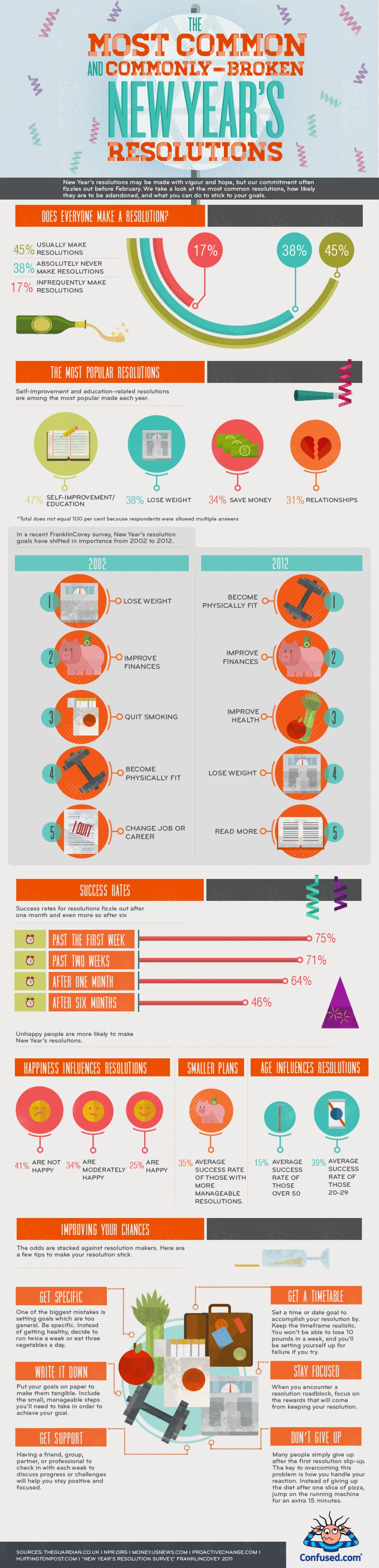
Most common New Year's resolutions
Now that 2018 is almost here, it’s time to start thinking about this year’s resolutions. That feeling of déjà vu is normal — we tend to repeat the same resolutions year after year, which says a lot about how good we are at keeping them. January is always great. In February, the struggle starts. By March, most of us have forgotten about all those things we were supposed to do (or stop doing).
Do you want to improve your own success rate? This infographic by Confused.com offers some useful advice, as well as some statistics and info about how our New Year’s resolutions have changed over the years.


Matador Network's Blog

- Matador Network's profile
- 6 followers

