
Matador Network's Blog, page 1421
January 3, 2018
Saving Kenya's Eastern Black Rhinos
Ol Jogi Ranch, a wildlife conservancy in Kenya, sits at ground zero for what conservation manager Jamie Gaymer describes literally as a war. As organized crime syndicates and poachers have decimated populations of some of the world’s most endangered animals — particularly Eastern Black Rhinos — conservationists have had to take extreme measures, such as creating their own private army to protect the animals.
As Gaymer explains, “It’s important to educate people on the importance of having wildlife, both for the country’s economy but also for future generations. It’s our obligation to ensure that other species do not go instinct.”
Ol Jogi is a 58,000-acre wildlife conservancy in Kenya. Their education mission brings in Kenyans who can witness wildlife species being cared for in their Wildlife Rescue Center. One recent star was an orphaned baby Black Rhino named Meime who was born in 2016 and found by rangers stumbling around the park, blind in both eyes.
Meimei was cared for over 5 months, fed special formula, and given special eye drops, eventually leading to a full recovery of her eyesight. She later began to forage again on her own, and Ol Jogi’s wildlife rescue and rehabilitation team will eventually release her back to the wild. To learn more about what you can do to help support wildlife conservation in Kenya, please visit Ol Jogi. 


Niagara Falls winter wonderland
You may have heard of the “bomb cyclone” that is plunging the Northeast and Midwest into terrifyingly low temperatures. It is already making headlines as the hottest winter weather term since the “polar vortex” that froze Lake Michigan back in 2014. The bomb (short for bombogenesis) cyclone has its own calling card: freezing Niagara Falls.
Yes, the cyclone that is currently drawing arctic air down from Hudson Bay has caused the continent’s mightiest waterfall to freeze in many places. And it is giving Instagrammers brave enough to go out in below 0 (Fahrenheit) weather quite the photo-op.
Here are some of the best images so far
A post shared by Martin Connell (@connellmartin1001) on Jan 3, 2018 at 12:52pm PST
A post shared by Harris Vassiliou (@life_iz_short) on Jan 3, 2018 at 11:36am PST
A post shared by Dez Alicia Photography (@dezaliciaphotography) on Jan 3, 2018 at 11:37am PST
A post shared by Tabitha & Ry (@2souls_1adventure) on Jan 3, 2018 at 11:40am PST
A post shared by The Boston Globe (@bostonglobe) on Jan 3, 2018 at 12:39pm PST
A post shared by Danette Williams (@danetteleewilliams) on Jan 3, 2018 at 11:57am PST
A post shared by Michael Vey (@mikashu12) on Dec 31, 2017 at 4:13am PST
A post shared by Niagara Falls USA (@niagarafallsusa) on Jan 3, 2018 at 1:04pm PST
A post shared by Clarice Nader (@claricenader) on Jan 3, 2018 at 11:47am PST
A post shared by Mamafih (@mamafih365) on Jan 3, 2018 at 1:07pm PST

More like this: Why traveling to cold places in the dead of winter is 100% worth it

Living in Afghanistan as woman
“Khosh amadid be Afghanistan, welcome to Afghanistan”, a smiling and polite immigration officer at Kabul airport waved me in beyond the immigration border. We had just got off the plane when I saw my first burqa-clad woman. “Do many still wear it?” I asked my husband, almost fearing his answer. “It’s a long story,” he smirked. For all the travels I had embarked on, this was my first time in a war zone. Women’s travel to Afghanistan is hardly an easy topic to write about, so I hope my experience of living there and trying to blend with a society that’s all but easy to comprehend will help other women to make the right decision, be it either to go or not.
Women’s travel to Afghanistan, is it such a bad idea?
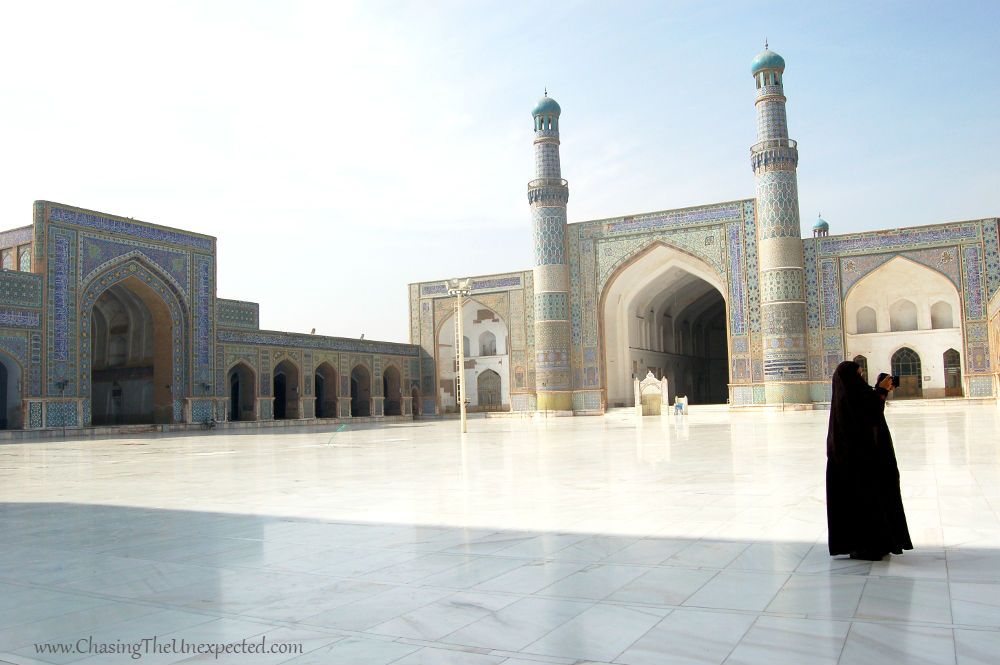
Women’s travel to Afghanistan, all covered but not forgetting to take pictures. Here at Herat Grand Mosque
Shortly after our landing, we rushed off to catch our flight connection to Herat, my husband’s hometown and my first real, palpable experience of Afghanistan. On my first taxi ride from the airport to home, I tried to observe as much as I could. I had wanted to visit Afghanistan for years, and now I was there. From the car window, Herat looked just like a normal city: screaming motorbikes darting past each other, often with three or even four passengers, strictly without a helmet, dim shop lights still on, old-fashioned cars from the ’90s roaming as if in a vintage picture, careless of any street sign (not that there were many). “Now, this feels like Asia,” I thought, recalling Iran’s and India’s traffic.
It’s when my husband asked the taxi driver to briefly stop at a fruit street vendor that I had the first clue of the stiffness in men/women relations: the driver stepped out of the car and wouldn’t get back in until my husband was back, with the sweetest and most succulent fresh figs I had ever tasted.
The first hours arriving home and enjoying tea, nuts, and sweets with the family ran so smoothly that I almost forgot where I was. My very first day in Herat quickly reminded me.
Before leaving the house for our daily shopping, I asked my mother-in-law if my Iranian manteau was an adequate outfit and, after seeing the length, she swiftly approved it. Only to regret her decision half an hour later, when all the shopkeepers at the bazaar started pointing at me, talking to me and about me (still ten minutes later, when my husband passed and heard them ranting about women’s fault on the decline of their social mores). When the next day I wore a chador, I automatically became invisible.
This is how I realized that even though Herat lies only an hour drive from the Iranian border, the dress code is quite different and if you really don’t want to wear the burqa, only a chador or full-length tunic are considered acceptable.
Becoming the perfect Afghan wife
 My mother-in-law is not quite the perfect Afghan wife, it didn’t take me long to realize. Apart from this first incident, on many occasions, she showed little to no patience for men’s narrow-mindedness. Independent, business-oriented (she launched by herself a weekly lottery for women that reached some 300 participants), and very socially active (she’s the most invited person to weddings and events), she made a point of helping people in need, switching off her constantly ringing phone only at the end of the day when she just can’t take it anymore.
Playing the perfect Afghan wife was, in fact, my strategy to reach where foreigners can’t. Foreign journalists and photographers don’t really have an easy life in Afghanistan. Due to obvious security reasons, they always need a driver and/or a security guard with them, and this is how I knew my trip was going to be different.
Women’s travel to Afghanistan is always something very tricky to consider, especially traveling solo, but my mission was to delve deep into the Afghan society, understand how the Afghan people live, how they organize their work, their leisure time, and the different aspects of daily life, including marriages.
As a matter of fact, my marriage has been truly enlightening and revealing of the local customs and tribal heritage. Even with my very poor Persian, I could understand that the first mullah we approached refused to marry us because my parents weren’t there and he wasn’t sure they would give their blessing. My soon-to-be mother-in-law began shouting at him all sorts of contempt, from accusing him of being corrupt to not perpetuating the real Islam, but nothing worked, not even telling him that I turned eighteen quite a few moons ago. While it’s a possibility that he was actually waiting for some bribe, I wouldn’t rule out the fact that he was probably worried that they actually kidnapped me and he wanted no responsibility in this.
A couple of days and mullahs later, we finally managed to exchange vows. Just when I was thinking the process was nearing the end, I was told that before going to record it in the court, we had a couple more steps. It turned out that we still needed many people to sign and approve our marriage, among which included the so-called “lord of the area.” The what? That’s right, the lord is responsible that everyone in his neighborhood behaves properly. With “properly” mainly meaning according to Islamic principles.
We were welcomed by his son, who let us into a wide garden. We entered an unadorned house where the only decoration was a colorful, ubiquitous carpet. The lord of the area, a pint-sized old man, looked pretty suspicious, especially when he was told I didn’t speak Persian. Nevertheless, he had us sit on his ceremonial carpet, offered us tea and wedding cookies and, eventually, gave us his approval.
Now, my wedding alone was something to note. Forget the long white dress, hours of makeup and hair-dresser, towering cake and the just-married limousine. Our first attempt ended up with me, my wannabe husband, and brother-in-law darting on the streets of Herat on the same shaky motorbike, while the lucky day when we actually got married, we upgraded to a not-so-brand-new Suzuki 1992.
My wedding dress, you wonder? A long, black, shapeless manteau covered with a black chador, just like every other day.
Afghanistan and its women
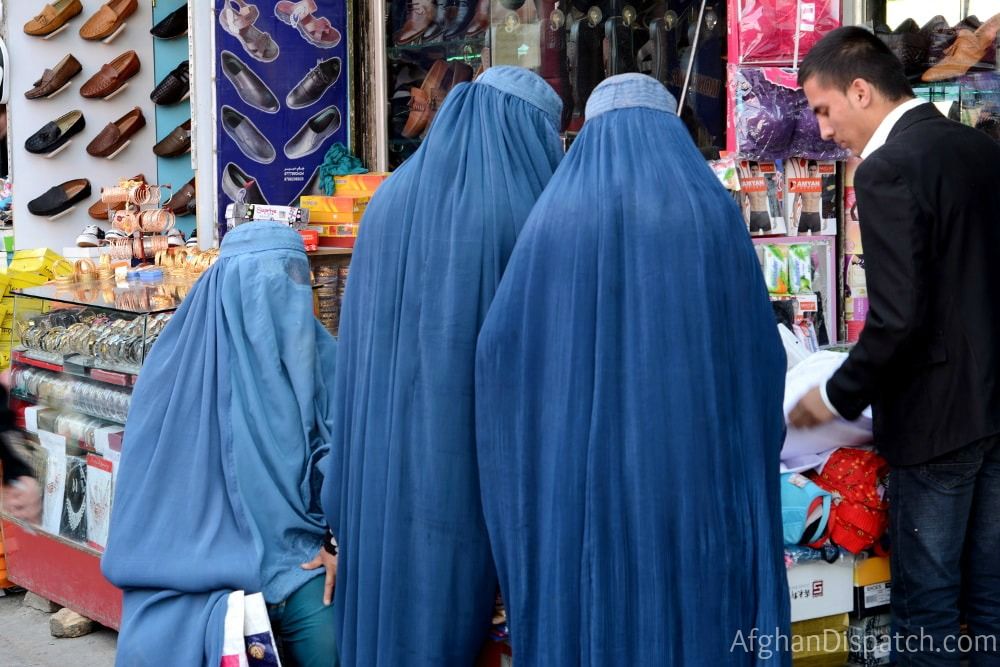
Afghanistan is notorious for being the world’s most dangerous country for women, and although many of the ladies I met lead a quiet and happy life, it’s easy to notice the different social rules men and women are subject to.
In all of this, my role was a bit of a hybrid. I was a foreigner, but I was married to an Afghan, so to some extent, I was expected to understand what my place was and to abide by the unspoken rules women grow up with, the only problem that I didn’t know those rules.
Lucky for me, however, this blended perfectly with my security strategy. When we went out, I would play the perfect Afghan wife, nodding silently and letting my husband do all the talking so no one would understand my nationality (something he probably missed once we were back in the house), and constantly being by his side. On more than one occasion, my husband did exploit my weak gender to skip some bank and office queues.
As a woman, there were many places where my presence was not welcome. Starting from car repair shops to some hookah bars and restaurants, many are men-only spaces. Likewise, there are places where only women can access, where their husband or father trust they won’t run the risk of being harassed or any stranger seeing their hair sneak out of their hijab. As a married woman, I enjoyed access to some of the men’s places as long as I was escorted by my husband, and at the same time, I could keep the women-only privileges. If you have the right husband in Afghanistan, you can enjoy a better life, frequent more restaurants where you won’t be stared at when you enter. If you have the right husband, that is something not to be taken for granted so easily in Afghanistan.
Even with a husband though, some places are still a no-no for women. We went to Armand restaurant in Herat and family or women alone were confined indoors at tables or benches surrounded by curtains. On the other hand, men alone can enjoy the benches (takht) outdoors in a lovely garden that gets covered and heated in winter. This is why our preference went to Qoqnos, a beautiful open-air restaurant where all guests had their own takht and could enjoy the surrounding park, water streams, and music.
Restaurants are only the tip of the iceberg, as men and women in Afghanistan are separated in more than one instance. Between weddings, schools, and working space, there are many occasions where it’s deemed more appropriate for the two genders not to mingle.
First attempts of a social life in Afghanistan
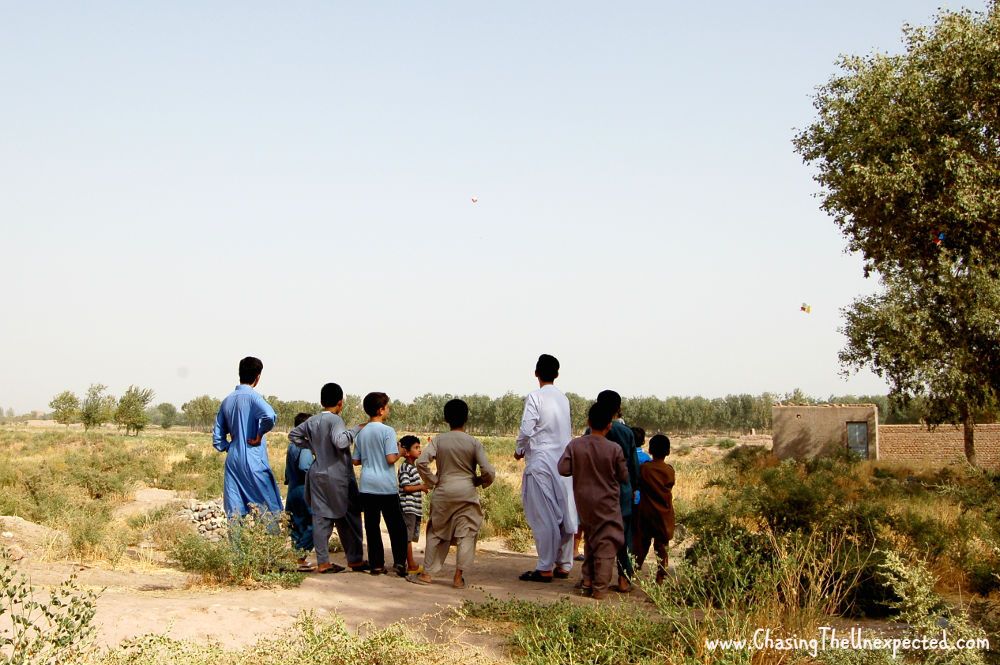
A group of Afghan children running their kite after picnicking just outside Herat
Our first family picnic took place in Qala Sherbat, some 40 minutes drive from Herat. Just like Iranians, Afghans, too, love picnicking, and just like Iranians, they arrive at the spot fully equipped with thermoses full of tea, cooking pots, plates, cutlery, tablecloths (or better, sofreh, what they use to cover the carpet with when they eat), and every possible comfort that can make them feel at home.
Being still in Herat Province, I was wearing my chador, just like all the other women. As soon as we arrived, my husband felt uncomfortable. It was an area where he was used to going picnicking until a few years ago. Then, new people had arrived and settled there and, shortly after, armed insurgents followed. Now it’s not a very safe district, mostly limited to Afghans, and yet, here I was. It didn’t take long for us to receive a reprimand that I had let my chador slip off my shoulders and my hijab wasn’t covering enough. Nevertheless, we enjoyed our lunch of kabab, abundant rice, and fresh bread and veggies, rounding it off with rivers of tea and plenty of sweets.
Surrounding us were large fields of wheat where the men, kids, and women belonging to the Pashtun tribes who had recently settled there were working. Taking photos was not allowed, as kids throwing rocks at us pointed out, leaving no room for misunderstanding. Little by little as the afternoon went by, my husband started hearing whispers that there was a foreigner among us. As he didn’t look too concerned at the beginning, I dismissed the issue, and only when I saw him hastily packing up our stuff and rushing everyone to the car, I realized the matter was more serious than I thought.
The cities in Afghanistan are heavily militarized. Soldiers, checkpoints, security services are a common sight, but it’s in the small daily occurrences that you better realize the country is a war zone and has been so for decades.
Living the war in Kabul
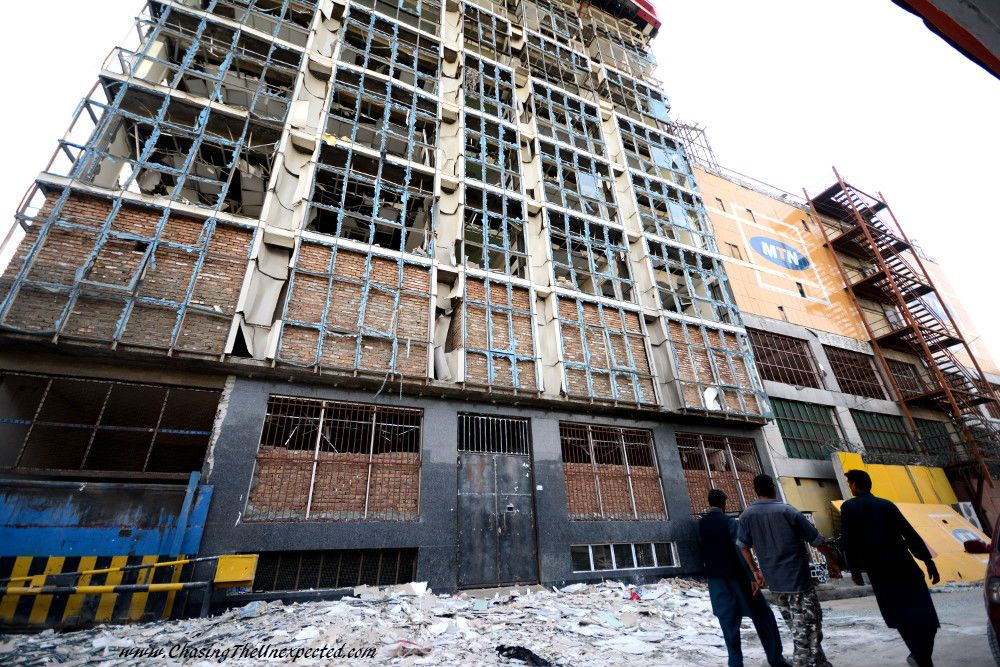
The shattered facade of the building where NGO CARE International was attacked by a Taliban commando for 11 hours until Afghan Special Forces managed to end the terrorist raid.
Even though Kabul is slightly more relaxed than Herat when it comes to women’s dress code (in the capital I could avoid wearing the chador), it’s also one of the most dangerous cities for terrorism and attacks. Walking the streets of Kabul you can hardly avoid the sight of war-torn buildings, potholed roads, and half-constructed buildings. The echo of the news of daily attacks hardly leaves you in Afghanistan, and I admit that sometimes, especially when we were in sensitive areas such as public offices, banks, or even shopping malls I would be afraid when someone would stop all of a sudden or look a little too “Taliban”.
One evening, after our daily wanderings, we were in our hotel in Kabul when my husband went down to fill our usual thermos of tea. After half an hour, he wasn’t back yet, and since our tea guy was just in front of the hotel, I started worrying. When he finally arrived, he nonchalantly gave me the news that the NDS, the Afghan Intelligence, had warned our reception that they were expecting an attack on the hotel behind ours, and that probably ours was going to be used as the springboard.
Even though we had been in Afghanistan already for a couple of months, this was not really the kind of news I could get used to easily. Apparently, my husband did, but he had been living all his life in Afghanistan, he had gone through the civil war after the Soviets pulled out, he had endured the five years of the Taliban regime, and witnessed the bombs of the Nato intervention in 2001, so I guess a “probable” attack wasn’t alarming enough to give up on his evening tea and dried figs.
In a couple of minutes, an entire movie flowed in the back of my mind and a sense of frustration pervaded my thoughts: we were finally able to go back to Italy and our plans were about to fall apart. I wanted to pack and leave, change hotels, go to any other place that was safer if there was any. Finally, my husband noticed my unease: “What are you, scared??” he asked me as if falling from the sky. “Don’t worry, these reports are common, we used to receive many every day in the base, but we were attacked no more than a couple of times a month!”
If that was supposed to calm me down, it wasn’t quite successful.

Photographing the beautiful Panjshir Valley in Afghanistan.
I traveled to Afghanistan knowing I could always leave the war zone and go back home, but for Afghans, it’s not that easy.
As hard as life in Afghanistan seemed to me, it was nothing compared to how difficult it is for an Afghan to get a Schengen visa for Europe. Even if the Afghan is married to an Italian.
Accessing a foreign embassy in Kabul is not quite like entering a consulate office in any of our cities in Europe. They are located inside a highly secure base and before being allowed to the little space devoted to the public, you are searched a couple of times, provided that you do have an appointment.
The first time we went, after introducing myself as an Italian, the security guards told me it was dangerous for me to wait outside, so I should enter the premises alone.
“What about my husband?” I asked.
“We don’t know him,” the inexperienced guard replied.
“But he’s my husband,” I said, “I’m not going anywhere if he’s staying outside.”
And then, his biggest mistake: “Maybe he’s your husband,” he replied. “Maybe not!”
This is when all my perfect-Afghan-wife pledges crumbled and I couldn’t help it but shift to a full Italian mode. I started roaring (probably a reaction the guard wasn’t expecting from a woman) until he ran back inside to come out a couple of seconds later to let us both in.
Afghanistan is one of those countries that sucks you in fully. Its tormented history, complicated society, disheveled kids, and the rugged population will give you a disconcerting range of mixed feelings. At times I wanted to leave, at times I felt like staying there for longer than planned. I was somewhat relieved when we finally boarded the plane back home, and now, after a year apart, I’m longing to go back.
This article originally appeared on Chasing the unexpected and is republished here with permission.

The books we want to read in 2018
The staff at Matador Network is not only made of great travelers, it’s also composed of serious readers who know that literature is the second-best way to escape our daily reality and to learn about culture, history, science, animals, the wonders of our world, etc. From dark fairy tales to travelogues and self-help works, here are the books that the team at Matador Network is planning on reading in 2018.
1. From Excuses to Excursions: How I Started Traveling the World by Gloria Atanmo
Une publication partagée par B (@barecca82) le 9 Avril 2017 à 11 :38 PDT
Gloria Atanmo is a super inspiring travel blogger who also happens to be a woman of color. As someone who fits into that category as well, I am intrigued with how she attained a lifestyle that is location-independent. She’s always on point with her social media presence and how she writes about her travels, so I’m sure this book is just as beautifully written as her Facebook posts. It’s important to have representation in this industry, so I’m excited to support her in her pursuits and check out her first book. –Sam O’brochta
2. Bury My Heart at Wounded Knee by Dee Brown
Une publication partagée par Off the Shelf (@offtheshelfofficial) le 26 Sept. 2017 à 8 :33 PDT
I went to grad school to study human rights, and one of the big topics in any human rights course is genocide. We talked about the Holocaust, about Rwanda, about Armenia, and about the Balkans, but I didn’t notice until recently that we never once talked about the genocide that my own country was, in many ways, founded upon: the systematic destruction of the American Indian. When we, the white Americans, talked about our Manifest Destiny and building our country so that it spanned coast-to-coast, we ignored an inconvenient truth: there were already millions of people and hundreds of nations living on that land. Now, in 2017, wherever there’s a big political fight over the environment — Standing Rock, Bears Ears, etc. — it seems to be American Indians that are leading the charge. I think I maybe owe it to them, my country, and myself to learn a bit more about their history. –Matt Hershberger
3. Lost on Planet China by J. Maarten Troost

the most remote place on Earth
Have you ever wanted to get away from everyone? It’s not as easy as it used to be. Thanks to revolutions in ground transportation over the last 200 years, it is increasingly difficult to find the same vast swaths of impassable terrain that separated civilizations for millennia. In 2009, a New Scientist report revealed that less than 10% of land is more than 48 hours of road, rail, or water travel from the nearest city of 50,000 residents.
Unsurprisingly, wealthier and more densely populated regions like Europe, India, and the eastern United States, are home to the least remote land on Earth. On the other end of the spectrum is Tibet. The Tibetan Plateau, to be exact, which is 17,000 feet above sea level and requires one day by car and 20 days on foot to reach. Considering that some of the most highly developed land on Earth (India and China) surrounds Tibet, the New Scientist‘s map of the travel times between places reveals a contrast so stark it takes the appearance of a terrestrial black hole.
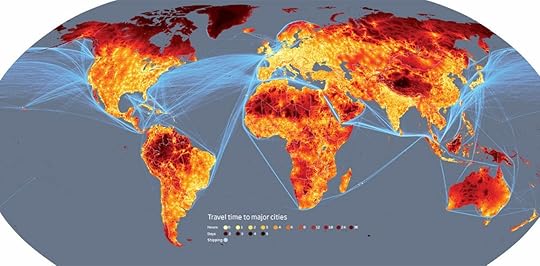
Photo: New Scientist
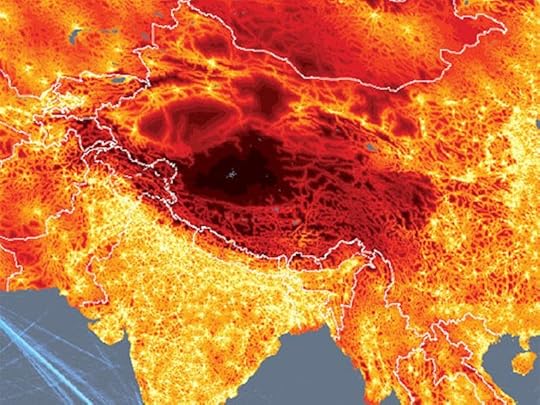
Photo: New Scientist
For a larger version of this map, click here.
More like this: 9 of the Earth’s most remote places and communities to check out in 2018

Traveling with kids
Traveling with kids is one of the most rewarding parts of parenthood. Whether a brief jaunt to a local amusement park or an overseas adventure, travel provides experiences that your children will never forget. But along with the wholesome family memories, traveling with kids can also bring challenges.
Following are 16 things that undoubtedly will happen to you when traveling with kids.
1. You’ll spend a lot of time planning.
Or trying to avoid inevitable disappointment or disaster.
2. You’ll undoubtedly overpack.
But you can manage a pack of kids, you’ve more than got it.
3. You’ll feel as though you’ve forgotten something.
Passport? Check. Money? Check. Kids?
4. Your children will get tired of traipsing through airports.
Looks like the melatonin has kicked in.
5. And they’ll forget common courtesy.
This child should be quarantined. She’s obviously rabid.
6. You’ll want to celebrate or run as soon as they doze off.
Have the doors closed?
7. At one point or another, your kids will have a complete meltdown.
I brought him here, but no one says I have to bring him home.
8. But it’s nothing a quick nap won’t solve, and thankfully, kids can sleep anywhere if they’re tired enough.
This is only the third strangest place he’s fallen asleep.
9. Naptime means mom and dad finally get a break.
We should take advantage of the peace and quiet and take a nap as well. J/K! Let’s drink!
10. Sometimes the unexpected happens.
Well, unexpected to her. Mom saw that one coming.
11. But sometimes things do go as planned.
Thanks for making the rest of us look bad. Showoffs!
13. The kids won’t always be open to trying new things.
“Am I supposed to eat that? It doesn’t even have a wrapper!”
14. But they’ll appreciate all the organization and saving that’s gone into the trip.
This is awesome…
15. You’ll find your own way of getting by.
Chardonn-yay!
16. And besides, you’re making precious family memories.
It’s not the destination, it’s the journey.
More like this: What every parent should know about traveling with their kids

Sometimes solo travel sucks
Almost five months into my latest trip, my family came out to visit. My brother, my mum, and I met in Thailand — a good gathering point since my brother was in New Zealand and I was traveling around Southeast Asia. We spent nine lovely days over Christmas sunbathing on white-sand beaches and snorkeling with bioluminescent plankton. And then, they left. We had a brief moment to say goodbye as we were separated at Phi Phi pier, where we waited on the top decks of our respective boats, and waved to each other until we were swallowed into the distance. The loneliness hit almost immediately — I wouldn’t see them, or any other friends and family members, for nine months.
Everywhere you look, solo travel is advertised as the ultimate freedom, but sometimes, it isn’t. Sometimes, being alone sucks. Although I relish being on my own and doing whatever I feel like whenever the mood takes me, traveling solo is also the source of a slew of negative sentiments: sadness, jealousy, boredom, fear, emptiness.
I’ve been traveling on and off for almost four years and the one challenge that I consistently struggle to overcome is loneliness. I stay in dorms, consider myself sociable and outgoing, and joined Tinder to successfully meet other travelers (and score the odd date or two), But solitude’s unwelcome shadow is never too far away and reminders that I’m out here alone lurk around every corner.
“Are these seats taken?” a couple inquires as I settle into a window seat on my ferry back to Ao Nang.
“No,” I say, my smile masking the fact that the first reminder has surfaced before we’ve even left the port.
Triggers abound everywhere I go and in everything I do. Waiters reiterating with thinly veiled surprise that I’d like a table for one. Activities requiring a minimum of two people. Being the only solo traveler on a day trip. Taxis and tuk-tuks wreaking havoc on your budget. Lugging all of your belongings to the bathroom at the bus station/airport because there’s no one to watch your bags. Enduring and dealing with sexual harassment on your own. Choosing a different dish because the antipasto plate you want only comes as a “sharing platter for two.” Constantly being sunburnt in that one spot on your back you can’t reach. Spending New Year’s Eve alone because you haven’t had the chance to meet anyone at your new hostel. Sitting behind the one couple on a bus/boat/train who are surgically attached to each others’ faces. Watching on social media as all your friends get married.
Being single is a big part of it. This lifestyle isn’t particularly conducive to a love life, other than a handful of Tinder dates and fleeting romances with exotic strangers. How can it be, when traveling is filled with goodbyes?
Some alone time is healthy, but too much can be toxic. It becomes normal to be alone, and so you find yourself burrowing deeper into a rabbit hole of spiraling loneliness and increasingly abstract thoughts until it engulfs and threatens to consume you entirely. Sometimes, rescue comes in the form of a like-minded roommate who invites you to join them for dinner, a group of friends who adopt you for a few days, or a sweet local who takes you as a plus one to a film festival. And sometimes, I have to seek out company, whether that’s relocating to the common room, striking up a conversation with a stranger, or, goddammit, walking into a bar alone (a terrifying thing to do, for the record) and buying myself a glass of wine.
I chose this lifestyle and I have no regrets. I’d choose working holidays and shoestring traveling over an office job in my home country any day. But just because it’s different doesn’t mean it’s easy. Just because I spend my money on flight tickets instead of mortgage payments doesn’t mean it’s easy. But I keep going because I have faith in my vision and how I want to live my life. I hope the strength of my long-held ambition to live an alternative lifestyle will continue to prop me up when it feels like I’m sinking.
More like this: Here is why I hate travelling solo
Birth control for long-term travel
Of all the things I’ve had to do to prepare before moving from Canada to Germany, I did not expect birth control to be one of the most difficult things to sort out.
Full disclosure: this post discusses birth control for women. I’m not a doctor, and options will differ per person. I’m just speaking from personal experience, and as a Canadian. Men, your options are even more limited than ours, congratulations. Condoms for everyone!
I’ve been on the pill since I was about 14 years old, which means I’ve been pumping hormones into my body since I was barely a teenager. This is because I had the kind of painful menstrual cramps that made me want to scoop out my uterus with a spoon. I used to have to leave school to come home and curl up on the bathroom floor, pressing myself into the cold tiles, because the cramps made me violently ill. I called it the “Cycle of Pain” because even if I did puke my guts up, there’d be no relief.
When I briefly came off the pill in my early 20s, the results were the same. I’d miss work, and I simply couldn’t afford to do so. There are other options out there but this one also controlled my flow.
But the pill is expensive if you’re paying for personal drug insurance — we live in a world where things like not ruining your life by getting pregnant aren’t considered much of a priority. And since I do have the immense privilege of living in Canada where birth control is even an option for me, and I can consult a doctor for free, I wanted to take care of it all before moving to Berlin. And I didn’t want to be on the pill, I wanted to try something different — what would my body be like without all those extra hormones after 15 years? Would I be a whole different person? The pill is so hard to stay regular with when you’re traveling non-stop and your schedule is totally erratic.
Long story short: I got off the pill and then got back on it. So what’s the best birth control for long-term travel?
1. The IUD
After exploring all my options (all four of them), I made an appointment with a doctor regarding getting an IUD. An IUD is a t-shaped device that’s inserted into your uterus in what apparently feels like the most painful process on the planet. This was the best option for me. Why?
They’re low hormonal — You can get a copper IUD that’s not hormonal at all, or something like Mirena that releases a small dose of progestin.
Once inserted, you can leave it in for five years. You don’t have to mess around with anything for five long years. Glorious!
It’s one of the most effective methods for preventing pregnancy.
Usually, your period slows down drastically, or sometimes even stops. This is especially helpful when it comes to traveling through countries that may not even have the kind of feminine hygiene products you need.
It’s relatively affordable, somewhere between $200-$400. Although if it falls out (happened to a friend), you’ll have to pay to reinsert it.
The only reason I did not go with this option is because I stupidly put off my appointment and didn’t have enough time to go through with it before leaving for Germany. And honestly, I’ve heard a few horror stories. Although apparently only 1 in 100 people get pregnant from the IUD, I know of at least three people who have. Another friend had to have hers surgically removed because the strings got lost, and so on.
Basically, there’s no perfect form of birth control other than abstinence. But this article is not about abstinence. Also, if you knew how fertile my huge family is, you’d know I can likely get pregnant just by looking at some dude the wrong way.
2. The pill
So we’re back at the pill. I used to be on Triphasil and Triquilar because their high hormone dosages helped with the menstrual cramps. But in this new birth control quest of mine, I ended up going back to the doctor and requesting a lower dosage. She gave me Alysena, which is apparently just as effective as the others in preventing pregnancy.
While the pill isn’t the greatest of options while traveling long-term, since schedules are erratic and not taking the pill on time every day means its effectiveness is lowered, it’s also easier to get in most countries. I know a girl who used to order her pills online, and somehow it worked. You can also usually stock up beforehand. I bought a six-month supply because that’s all I could afford at the time, and then had my friend pick up another prescription for me and mail it to Berlin. Yeah, there’s no real easy way to do this, I admit. Not having babies is expensive, but you know what’s more expensive? Having babies.
3. The ring
The NuvaRing is a vaginal ring that’s inserted for three-week periods at a time, then removed for the fourth week. You insert it yourself and remove it yourself. If you don’t like digging around in your vagina, this is not for you. But when inserted properly, you won’t feel it and neither will your partner.
In my opinion, this is the third best option. You can leave it in for three weeks and not think about it. The only thing it doesn’t really have going for it is that it’s bloody expensive in most places. In the US it can be upwards of $100/month. In Canada, it seems to be about $85/3 months, but my pill is much cheaper. The ring needs to be refrigerated, so if you’re traveling in developing countries, that can be a pain in the ass.
It also poses the risk of falling out sometimes, say, if you’re straining too hard on the toilet. Yes.
4. The implantation
Implantation is a little rod that’s inserted under your skin to release progestin for up to three years. Implanon is the most common, but for some reason, it wasn’t an option with my doctor and I’m not sure it’s available everywhere (plus it can cost up to $800 in Canada — but it lasts for two years or so).
5. The patch
This lovely little unsightly devil is slapped to your skin for a week at a time and then removed for the fourth week. It’s just as effective as the IUD, though, and costs anywhere between $0-80 a month.
Those options were the best options I found as I prepared to move abroad. The others are less appealing: Depo-Provera has to be done every 12 weeks by a doctor, the sponge isn’t as effective, and who uses female condoms?
This article originally appeared on Free Candie and is republished here with permission.
More like this: I am a female traveler and here’s why I make my reproductive health a priority

Easy ways to travel green
Traveling green takes a little extra effort at first — but can soon become second nature. Here are some easy ways to travel green which will save you money, too.
We strongly believe that travel is a force for good. However, when you consider the environmental impact of commercial aviation, the effect of mass tourism on sensitive ecosystems, and the tourist-driven strain on resources, travel doesn’t look quite so pretty.
Whether it’s an appetite for low-budget air travel, air-conditioned rooms, or fully-charged smartphones on the end of selfie sticks, the compulsion to travel takes a heavy toll on our planet.
Ecotourism is often touted as the answer but this is often just a byword for spending big on eco-lodges or sustainable tours that claim they care when their main concern is the marketing potential of ecotourism — also known as greenwashing.
There are ways you can be an environmentally-conscious traveler without forking out huge sums for ecotours and the like. Here are 10 easy ways to travel green and make that toll a little bit lighter.
1. Go renewable where possible.
If possible, choose accommodation that uses green technology like solar panels, or even a carbon-neutral hotel.
On an individual level, opt for renewable energy sources for charging mobile devices on the go. We use a lightweight solar phone charger as well as a more durable waterproof one for hiking trips.
Solar chargers are currently popular but more and more ingenious contraptions are being thought up all the time, from mini wind-powered turbines to thermoelectric wellington boots!
2. Treat local water.
A couple of years ago, we invested in a SteriPEN water purifier and have never looked back. It’s one of those products that really does make a difference. If we’re honest, we initially bought it to save money without really giving a thought to the environmental benefits.
However, the reality is that by purifying local water, we’ve avoided buying hundreds of plastic bottles of water. There are several options available on the market now such as the LifeStraw or Sawyer Mini, but we’re still carrying our trusty SteriPEN.
3. Avoid or reuse plastic bags.
In 2014, England introduced a countrywide five pence charge on plastic bags. The result was that plastic bag usage plummeted by an astounding 83% in one year. If I had it my way, they would be banned outright, but the point is that charging people to use plastic bags drastically reduces the number in circulation, thereby minimizing environmental impact.
Some countries have banned plastic bags altogether, but most still use them by the millions with or without a levy. Plastic bags do not biodegrade so just say no to them. If you’re traveling, you probably have a backpack or beach bag which can be used instead. If you must, carry one or two and reuse them for as long as possible — around 1,000 years.
4. Use power banks instead of batteries.
Batteries contain many hazardous metals such as lead, mercury, cadmium, zinc, manganese, and lithium. Most used batteries are buried in landfills and take decades to degrade — and while they do, the metals contaminate groundwater, spreading the pollutants over a wider area.
Using power banks that charge off main electricity is a far more economical, efficient, and a greener way of charging your devices on the road. This way you don’t have to carry any traditional batteries or rechargeable batteries to provide energy on the go.
We travel with a couple of different models of power banks that include a mini-phone charger for each of our smartphones and e-readers, as well as a more heavy-duty waterproof power bank.
5. Use the fan instead of the AC.
This is my guilty pleasure and something I need to work on. I get hot ridiculously quickly and sweat like a racehorse but that’s no excuse for reaching for the air con remote instead of the fan switch.
If your hotel offers a non-air con (and cheaper) option, then opt for that to avoid any temptation. Failing that, lock the remote in the safe or hand it back to reception if you think you can’t resist.
6. Camp (but leave no trace).
When camping, you leave a smaller carbon footprint in comparison to a hotel stay. But go a step further and abide by Leave No Trace, a set of outdoor ethics that promote conservation in the outdoors:
Plan ahead and prepare
Travel and camp on durable surfaces
Dispose of waste properly
Leave what you find
Minimize campfire impacts
Respect wildlife
Be considerate of other visitors
7. Respect wildlife and obey local rules.
Don’t encourage unethical animal tourism. Never ride elephants or pet sedated predators. A stoned tiger on your lap might make for a good Facebook photo but it encourages deeply unethical practices.
When on safari or visiting national parks, take extra precautions to ensure animals are being treated properly and that tour guides are not harassing or crowding the wildlife. Always try to use certified tour companies that adhere to international conventions.
Whether it’s going off-trail, feeding wild animals, or picking shells from the beach, never break local rules. These are designed to limit the impact of tourism and it is crucial for the local environment that they’re adhered to.
8. Overland where possible.
Can you take a bus — or even better: a train — instead of a hired car or flight? On shorter journeys, choose to walk, cycle, or even canoe if possible! If you must drive, try to carpool with fellow travelers. Some cities even have electric taxi services.
Travel destinations such as the Galápagos Islands and Greenland are massively impacted by rising tourism numbers and need visitors to be more conscientious when visiting.
9. Reuse hotel towels.
Hotels will argue that their motivation is to save the environment, but you can be sure they’re more concerned with profits. Regardless, reusing towels is greener so follow your hotelier’s recommendation to reuse towels and not have them washed and replaced every day. Just think: how often do you wash your towels at home?
10. Eat locally-sourced food.
A no-brainer really. Not only will locally-sourced ingredients taste much better (since they’re fresher and presumably cooked by locals who know their own cuisine), but they will leave a much smaller carbon footprint. Whatever you do, don’t eat endangered species such as turtle, shark, caribou, or over-fished salmon species.
This article originally appeared on Atlas & Boots and is republished here with permission.
More like this 6 steps you can take today to become a zero waste traveler

Matador Network's Blog

- Matador Network's profile
- 6 followers


